Introduction
Attention deficit and hyperactivity disorder (ADHD) is the most common neurodevelopmental disorder in childhood (Goldman, Genel, Bezman, & Slanetz, Reference Goldman, Genel, Bezman and Slanetz1998). This disorder, with an average prevalence of 2.4–7.1% (Dursun et al., Reference Dursun, Esin, Akinci, Karayagmurlu, Turan and Ozhan Asikhasanoglu2019; Willcutt, Reference Willcutt2012), is characterised by inattentiveness, excessive mobility, and impulsivity.
It is recognised that children and adolescents with ADHD experience losses in many areas of functionality. In addition to academic losses, these children are known to have weaker social and communication skills relative to their contemporaries (Merrell & Gimpel, Reference Merrell and Gimpel2014). As a result of these inadequate skills, family relationships and activities may deteriorate, and in some cases, they may break down completely, creating additional social and financial difficulties (Zhao et al., Reference Zhao, Page, Altszuler, Pelham, Kipp, Gnagy and Macphee2019). Studies have highlighted the financial burden for families associated with ADHD (Birnbaum et al., Reference Birnbaum, Kessler, Lowe, Secnik, Greenberg, Leong and Swensen2005; Mandell, Guevara, Rostain, & Hadley, Reference Mandell, Guevara, Rostain and Hadley2003; Matza, Paramore, & Prasad, Reference Matza, Paramore and Prasad2005; Swensen et al., Reference Swensen, Birnbaum, Secnik, Marynchenko, Greenberg and Claxton2003). In a study considering the financial burden of ADHD, the economic demands on families were shown to include not only direct costs relating to the child's behaviour (in addition to treatment expenses) but also indirect costs relating to caregiver strain. On average, over the course of their development, children with ADHD incurred a total economic burden that was more than five times greater than that of children without ADHD (ADHD = $15,036 per child; Control = $2,848 per child). This difference remained significant after controlling for intellectual functioning, oppositional defiant symptoms, and conduct problems. The parents of children with ADHD were more likely to have changed their job responsibilities or to have been fired, and they reported lower work efficiency (Zhao et al., Reference Zhao, Page, Altszuler, Pelham, Kipp, Gnagy and Macphee2019).
Families with children with ADHD encounter many challenges in the family unit. Mothers have described their caregiver role to a child with ADHD as demanding and stressful (Peters & Jackson, Reference Peters and Jackson2009). Parent–child conflict and parental stress are much higher in families whose children have ADHD than in families without ADHD (Climie & Mitchell, Reference Climie and Mitchell2017; Muñoz-Silva, Lago-Urbano, Sanchez-Garcia, & Carmona-Márquez, Reference Muñoz-Silva, Lago-Urbano, Sanchez-Garcia and Carmona-Márquez2017). One reason is that parents perceive that what is required of them frequently exceeds their coping resources (Muñoz-Silva et al., Reference Muñoz-Silva, Lago-Urbano, Sanchez-Garcia and Carmona-Márquez2017). Several studies found an association between ADHD in children and parental depression (Humphreys, Mehta, & Lee, Reference Humphreys, Mehta and Lee2012; Lee et al., Reference Lee, Lin, Robson, Yang, Chen and Niew2013). Mothers are at particular risk for developing depressive disorders (Martin, Papadopoulos, Chellew, Rinehart, & Sciberras, Reference Martin, Papadopoulos, Chellew, Rinehart and Sciberras2019).
Family functioning is important in managing everyday life and can be described as a dimension that influences the family in relation to problem-solving, communication as well as affective involvement (Miller, Ryan, Keitner, Bishop, & Epstein, Reference Miller, Ryan, Keitner, Bishop and Epstein2000). The relationship between family dysfunction and ADHD is well documented (Bauermeister et al., Reference Bauermeister, Puente, Martínez, Cumba, Scándar and Bauermeister2010; Donenberg & Baker, Reference Donenberg and Baker1993; Lange et al., Reference Lange, Sheerin, Carr, Dooley, Barton, Marshall and Doyle2005; Sollie, Mørch, & Larsson, Reference Sollie, Mørch and Larsson2016). Parents whose children have ADHD and are on treatment have reported less problematic behaviour in their child and better family functioning than parents with children having ADHD who are not treated (Moen, Hedelin, & Hall-Lord, Reference Moen, Hedelin and Hall-Lord2015). Furthermore, family functioning has been found to be the strongest association for the referral of children to mental health professionals (Reigstad, Jørgensen, Sund, & Wichstrøm, Reference Reigstad, Jørgensen, Sund and Wichstrøm2006). Severe levels of ADHD and conduct problems in a child correlate positively with high levels of disagreement between parents, low levels of family participation in social events, and a negatively affected family social life (Fleck et al., Reference Fleck, Jacob, Philipsen, Matthies, Graf, Hennighausen and Rösler2015). The demands imposed by the children with ADHD thus affect parent–child interactions and increase parental stress and general family dysfunction.
It is well established that evidence-based treatment for ADHD includes both medication with psychostimulants (Greenhill et al., Reference Greenhill, Pliszka, Dulcan, Bernet, Arnold and Beitchman2002) and behavioural interventions (Evans, Owens, & Bunford, Reference Evans, Owens and Bunford2014). These two modalities of treatment have been studied for decades, both separately and in combination. Even so, professionals still argue regarding which treatment modality is preferable and how treatment for ADHD should be initiated. Some recommend starting the medication immediately and supplementing with additional medication as necessary (McClellan, Kowatch, & Findling, Reference McClellan, Kowatch and Findling2007). Others recommend starting with psychosocial treatments and only adding medication if those treatments prove to be insufficient (American Psychological Association, 2006).
Several studies have been conducted on the effectiveness of combined interventions in treating ADHD. The most important of these studies is the Multimodal Treatment Study of ADHD (the MTA study). The MTA was a National Institute of Mental Health-sponsored multisite (was conducted eight different centres in the USA) study designed to assess the most effective treatments for ADHD, including behaviour therapy, medications, and the combination of the two. The study included 576 children, aged 7–9, who were randomly assigned to one of four treatment modes: intensive medication management alone; intensive behavioural treatment alone; a combination of both (simultaneously); or routine community care (the control group). For some types of functioning, such as academic performance and family relations, the combination of behavioural therapy and medication was superior to the other treatment groups. Moreover, it was stated that only participants in the medication-only condition may require additional approaches in the long term. However, behavioural intervention alone was not considered superior to medication or combined approaches. The key point regarding combined treatment not addressed by the MTA study is sequencing. Children in the MTA study's combined intervention group started medication and behavioural treatment simultaneously, precluding the opportunity to investigate effectively which component (medication or behavioural intervention) might be more effective when first started, which symptoms after medication could be improved with the behavioural component (Molina et al., Reference Molina, Hinshaw, Swanson, Arnold, Vitiello, Jensen and Abikoff2009; MTA Cooperative Group, 2004; Pelham & Gnagy, Reference Pelham and Gnagy1999; Swanson et al., Reference Swanson, Arnold, Kraemer, Hechtman, Molina, Hinshaw and Lerner2008). Finely tuned investigations using different doses and sequences of treatment are needed to clarify the relative effects of the two major treatment modalities (Pelham et al., Reference Pelham, Fabiano, Waxmonsky, Greiner, Gnagy, Pelham and Hart2016).
Although many studies have been conducted on combined therapies for ADHD, studies on complementary therapies that target a particular group or symptom profile are relatively few. Even though clinicians sometimes interpret a positive response to medication as indicating complete improvement, there may be situations where residual problems are disregarded. These residual problems may include both core symptoms and peripheral manifestations secondary to ADHD symptoms (family stress, dysfunction, etc.). It would seem inevitable that some core symptoms would continue at a lower level over time, and that these might include problems of intra-family communication, an increase in parental stress burden, and the reinforcing of negative habits acquired due to the disorder (Moen, Hedelin, & Hall-Lord, Reference Moen, Hedelin and Hall-Lord2016). It becomes evident that complementary treatment strategies are required for dealing with residual symptoms.
School-based interventions and parenting programmes are the most widely accepted approaches among the additional treatment strategies applied in cases of ADHD (Sonuga-Barke et al., Reference Sonuga-Barke, Brandeis, Cortese, Daley, Ferrin, Holtmann and Döpfner2013). Meta-analyses confirm that these behavioural interventions reduce behavioural problems in children with ADHD (Fabiano et al., Reference Fabiano, Pelham, Coles, Gnagy, Chronis-Tuscano and O'Connor2009). Parents Plus (PP) programmes are systemic, solution-focused, group-based interventions. They are designed for delivery in clinical and community settings as treatment programmes for families with child-focused problems, such as behavioural difficulties, disruptive behaviour disorders (including ADHD), and emotional disorders in young people with and without developmental disabilities. The current suite includes the PP Early Years Programme for families of young children aged 1–6 years (Sharry, Hampson, & Fanning, Reference Sharry, Hampson and Fanning2009); the Parents Plus Children's Programme (PPCP) for families of children aged 6–11 years (Coughlin, Sharry, Fitzpatrick, Guerin, & Drumm, Reference Coughlin, Sharry, Fitzpatrick, Guerin and Drumm2009); and the PP Adolescents Programme for families of teenagers aged 11–16 years (Nitsch, Hannon, Rickard, Houghton, & Sharry, Reference Nitsch, Hannon, Rickard, Houghton and Sharry2015). For families of adolescents with emotional disorders, the Working Things Out programme has been specifically designed for teenagers to attend while their parents concurrently attend PP Adolescents Programme (Carr, Hartnett, Brosnan, & Sharry, Reference Carr, Hartnett, Brosnan and Sharry2017). For families where separation or divorce has occurred, the PP–Parenting When Separated Programme has been developed (Keating, Sharry, Murphy, Rooney, & Carr, Reference Keating, Sharry, Murphy, Rooney and Carr2016). Among the advantages of these programmes is that they are not dependent on the presence of a clinician but can be applied by assistant staff. Furthermore, they save time and are economical because they are group-based (Carr et al., Reference Carr, Hartnett, Brosnan and Sharry2017). A review of 17 assessment studies covering more than a thousand families showed that the PP programmes had a significant impact on children's behavioural problems, on parental satisfaction, on reducing parental stress, and on achieving therapeutic goals (Carr et al., Reference Carr, Hartnett, Brosnan and Sharry2017; Nitsch et al., Reference Nitsch, Hannon, Rickard, Houghton and Sharry2015; Sharry, Guerin, Griffin, & Drumm, Reference Sharry, Guerin, Griffin and Drumm2005).
The literature shows that parenting programmes for parents of children with ADHD are common and that they are effective (Aghebati, Gharraee, Shoshtari, & Gohari, Reference Aghebati, Gharraee, Shoshtari and Gohari2014; Au et al., Reference Au, Lau, Wong, Lam, Leung, Lau and Lee2014; Coughlin et al., Reference Coughlin, Sharry, Fitzpatrick, Guerin and Drumm2009; Lessard, Normandeau, & Robaey, Reference Lessard, Normandeau and Robaey2016). However, when these studies are examined in detail, it becomes evident that they typically include children who are on a wide range of medication treatment plans. There is, therefore, a need to study children who do not respond adequately to medication only (Coates, Taylor, & Sayal, Reference Coates, Taylor and Sayal2015). It is suggested that the application of these programmes to all participants without any filtering is less than effective in terms of both costs and effort (Coates et al., Reference Coates, Taylor and Sayal2015). We suggest that limiting the application of non-medication evidence-based interventions to cases where there are only residual symptoms will make the treatment more effective and also more cost-effective.
This study aims to investigate the effect of the PPCP on families where, despite a positive response to medication, the children still have residual symptoms. In this single-blind randomised-controlled study, we compared the effect of the parental intervention versus a psychoeducation control condition on both core and peripheral symptoms in this very specific group of patients who have responded to medication. We expected that ADHD symptoms and family functioning will improve, and parental stress will decrease in the interventional group compared to the control group.
Method
The study received ethical approval from the Non-Invasive Clinical Research Ethics Committee at Atatürk University (B.30.2.ATA.0.01.00/143). The study was planned with a single-blind, randomised-controlled design as during the interviews with the participants, they were all given the same information by the first author and told they would be included in a 9-week, 2 h a week, parenting group exercise.
Participants
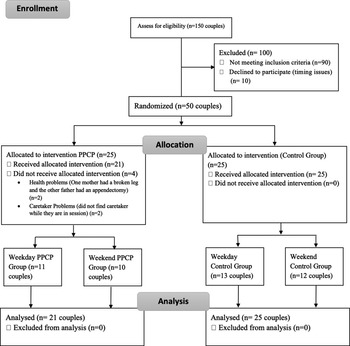
The participants in the intervention were the parents of children who met the criteria for ADHD and who were being followed up by the Child and Adolescent Psychiatry Department of the Atatürk University, Faculty of Medicine Hospital. These parents were contacted by phone and were subsequently invited to the clinic with their child for an interview. The flowchart in Figure 1 shows the number of participants entering each stage of the trial (Falci & Marques, Reference Falci and Marques2015). Of 150 couples interviewed, 50 couples met the criteria for eligibility and agreed to participate in the study following the face-to-face interviews when detailed information was given. They all gave their written consent to participate, and this constituted the PPCP group for the study. Participant couples were randomly allocated to either the PPCP (n = 25 couples) or the Control (n = 25 couples) groups.
Diagrammatic representation of study selection flow conducted according to the CONSORT (Consolidated Standards of Reporting Trials) guideline.

The eligibility criteria for the study were as follows: the parents had a child with a diagnosis of ADHD or of ADHD with comorbid Oppositional Defiant Disorder (ODD), as indicated by the Development and Well-Being Assessment (DAWBA) and DSM-5-based clinical examination. Further, the child had been on medication (Methylphenidate OROS 1–1.2 mg/kg/day) for at least 3 months. The child's profile indicated that they had achieved the maximum benefit possible with minimal side effects from the medication, but, despite the treatment, they still had residual symptoms of ADHD (see below for criteria) (Cortese et al., Reference Cortese, Adamo, Del Giovane, Mohr-Jensen, Hayes, Carucci and Coghill2018; Dittmann et al., Reference Dittmann, Cardo, Nagy, Anderson, Adeyi, Caballero and Coghill2014). Although the incidence of comorbid psychopathologies with ADHD is high and diverse, in our study, we aimed to evaluate the impact of the intervention only on the ADHD of the children involved.
When identifying children who ‘responded to treatment but still had residual symptoms’, we were looking for those who showed neither complete remission nor complete resistance to medication. We created a profile for patients with residual symptoms that was based on the literature (Chen, Huang, Hsu, & Tsai, Reference Chen, Huang, Hsu and Tsai2019; Steele, Jensen, & Quinn, Reference Steele, Jensen and Quinn2006). Since these children had been followed up in our clinic since their initial diagnosis, their baseline (i.e., before they received any medication) DuPaul Attention Deficit Hyperactivity Disorder Assessment Rating Scale (ADHD-RS) scores were already available. If their symptom severity had improved by more than 50% compared to their baseline measurement for ADHD symptoms, as based on the clinician-rated scales (DuPaul ADHD-RS), it meant that they had responded to the treatment. Despite having improved by more than 50%, if their severity scores were still at 18 or above, the children were accepted as patients who ‘responded to treatment but still had residual symptoms’ (Chen et al., Reference Chen, Huang, Hsu and Tsai2019; Cortese et al., Reference Cortese, Adamo, Del Giovane, Mohr-Jensen, Hayes, Carucci and Coghill2018; Ramsay, Reference Ramsay2017; Steele et al., Reference Steele, Jensen and Quinn2006).
Exclusion criteria were determined as the parents being divorced or living separately, the child's response to medication differing from the response described above in the criteria for eligibility, the child having a comorbid psychiatric diagnosis other than ODD or evidencing intellectual disability (Wechsler Intelligence Scale for Children-Revised [WISC-R] score of below 80). If a medication dosage change was required, participants were excluded from the analysis but continued to receive treatment. Although separated or divorced families might benefit even more from the parenting programme, because this would introduce an independent factor that could affect the results, this was set as an exclusion criterion for this study. In addition, we wanted the parents to be together in their home during the intervention, and the pre- and post-intervention scales were completed in a manner that reflected the opinions of both parents, working together.
Application
PPCP intervention group
The PPCP is a positive and practical video-based and modelling-assisted group-based course that aims to help parents build a positive relationship with their child and equips them with skills to promote prosocial behaviour and to assist with their children's learning. Furthermore, it teaches noncoercive approaches to discipline (Behan, Fitzpatrick, Sharry, Carr, & Waldron, Reference Behan, Fitzpatrick, Sharry, Carr and Waldron2001; Carr et al., Reference Carr, Hartnett, Brosnan and Sharry2017; Coughlin et al., Reference Coughlin, Sharry, Fitzpatrick, Guerin and Drumm2009).
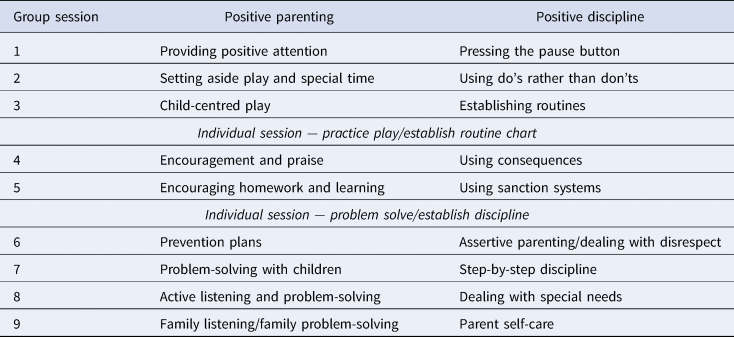
The intervention group programme involved weekly sessions of 2 h for 9 weeks. During each session, one Positive Parenting and one Positive Discipline topic were introduced through videos. This was backed up by discussion, by role-plays and practice, and by weekly planning. Table 1 shows the PPCP weekly plan (Coughlin et al., Reference Coughlin, Sharry, Fitzpatrick, Guerin and Drumm2009).
Parents Plus Children's Programme Weekly Plan

Control group (psychoeducation and attention control)
The purpose of the control group was to make it possible to compare the effects of the PPCP on children's symptoms and parents’ stress and functioning relative to the unstructured outpatient intervention typically provided by clinic-based practitioners. While the intervention group was engaged in the PPCP, the control group was involved in a psychoeducation programme with unstructured suggestions. This programme was called ‘Psychoeducation and attention control’. This control group programme also involved weekly sessions of 2 h each for 9 weeks. During these sessions, problems were discussed based on questions raised by the parents. There were conversations, role-plays, and sometimes videos. Role-plays and conversations were about family conflicts at home, and we listened to their own comments on how they were coping without any suggestions. The videos were psychoeducational videos about ADHD. It is thought that such unstructured conversations may also play a role in attention control. Unstructured suggestions were given to the parents concerning their children. These sessions did not have a specific topic, and the recommendations rarely involved general parenting suggestions. These outpatient clinic interviews were also conducted in a group.
The interventions were all delivered by the first author, co-facilitated by the last author. The interventions were conducted in Turkish, in which all families were fluent. The sessions were held in the late morning (11:00–13:00) on Tuesday or Saturday for the PPCP group, and on Monday or Sunday for the control group. All the families in the control group were offered PPCP at the end of the study period if they so wished.
Assessment Schedule
The eligible parent participants were randomly allocated to either the PPCP or the control group. After this randomisation, the subsequent assessment schedule was identical for both groups. All the measures of the children's symptoms of parental stress and family functioning were collected by our child developmental specialist at the outpatient clinic. These measures (‘Conners’ Parent Rating Scale-Revised [CPRS-R]’, ‘Parent Stress Index [PSI]’, and ‘Family Assessment Device [FAD]’) were collected before the first session, and again after the last session for both groups and from the mother and father together. Every effort was made to keep the child developmental specialist blind to the treatment status of the individual families. The child developmental specialist was not aware of the programme content being delivered to the families. The data were coded after collection and again at a later time.
Materials
Development and Well-Being Assessment
The DAWBA is a structured diagnostic package that allows the evaluation of psychiatric disorders in children and young people aged 5–17 years (Goodman, Ford, Richards, Gatward, & Meltzer, Reference Goodman, Ford, Richards, Gatward and Meltzer2000). Interviews can either be performed by an interviewer through a computer application, or by parents, children, and teachers themselves through a computer without the need for an interviewer. One of the most important features that distinguish DAWBA from classic interviewer-based interview formats is the inclusion of open-ended questions in each section. One of the most important benefits of having open-ended questions in the interview is the more accurate evaluation of symptoms and loss of functionality. The entire package was administered by the first author and the last author, who were also child and adolescent psychiatrists, in conjunction with the DSM-5-based clinical assessment to determine the ADHD diagnosis status and comorbid conditions. The Turkish form of DAWBA, which can be used in both epidemiological and clinical studies, was translated and validated into Turkish by Dursun et al. (Reference Dursun, Guvenir, Aras, Ergin, Mutlu, Baydur and Iscanli2013).
DuPaul Attention Deficit Hyperactivity Disorder Assessment Rating Scale
The DuPaul ADHD scale is an 18-item scale with one item for each of the 18 symptoms found in the DSM-IV diagnosis of ADHD. In this study, the scale was filled by a child and adolescent psychiatrist who evaluates the severity of the child's symptoms based on observation/examination (DuPaul, Power, Anastopoulos, & Reid, Reference DuPaul, Power, Anastopoulos and Reid1998).
Wechsler Intelligence Scale for Children-Revised Form
The WISC-R Children's Intelligence Test is suitable for children from 6 to 16 years old. It is routinely applied to all children with ADHD in the research hospital where the study was conducted. The whole package of WISC-R was applied, and verbal intelligence score, performance intelligence score, and total score were calculated. It is also available in a Turkish version (Savasır & Sahin, Reference Savasır and Sahin1995; Wechsler, Reference Wechsler1974).
Conners’ Parent Rating Scale-Revised
This scale has 14 sub-groups (cognitive problems/inattention, hyperactivity, anxious-shy, social problems, ADHD Index, etc.) and is answered by the parents on a four-point Likert scale. The long version with 80 items was used in this study (Conners, Sitarenios, Parker, & Epstein, Reference Conners, Sitarenios, Parker and Epstein1998). The scale has Turkish validity and reliability (Kaner, Büyüköztürk, İşeri, Ak, & Özaydın, Reference Kaner, Büyüköztürk, İşeri, Ak and Özaydın2011).
Family Assessment Device
This scale developed by Epstein et al. is a self-report scale that evaluates the needs and functioning of families according to their own perceptions. It consists of seven parts, with 60 items in total (Epstein, Baldwin, & Bishop, Reference Epstein, Baldwin and Bishop1983). The scale has Turkish validity and reliability (Bulut, Reference Bulut1990).
Parent Stress Index
The PSI was developed by Abidin et al. and consists of two areas: child and parent (Abidin & Abidin, Reference Abidin and Abidin1990). Likert-type grading of five items is used in the scale. An increase in the score obtained from the scale indicates that the stress level of parents has increased, and a decrease in the score indicates that their stress level has decreased. A Turkish validity and reliability study for the scale was conducted by Çekiç, Akbaş, & Hamamcı (Reference Çekiç, Akbaş and Hamamcı2015).
Statistical Analysis
To summarise the data obtained from the study, descriptive statistics are given as mean ± standard deviation or as median and the first and third quartiles, according to the distribution of the data. Categorical data are summarised as frequency and percentage. The Kolmogorov–Smirnov test and the Shapiro–Wilk test were used to test the normal distribution of numerical variables. To compare the ages of the children and of their fathers and mothers between the groups, the independent samples t-test was used as the numerical variables were normally distributed. To compare the categorical variables between the groups, Pearson's chi-square test was used when the expected value for cells was equal to or bigger than 5, and Fisher's exact test was used when the expected value for the cells was lower than 5.
To evaluate whether the group variables affected the total change and the subscale scores of the scales used in this study at the pre-intervention and post-intervention assessments, a nonparametric analysis of longitudinal data in factorial experiments was performed using the nparLD package in R software (Noguchi, Gel, Brunner, & Konietschke, Reference Noguchi, Gel, Brunner and Konietschke2012). Statistical analyses were performed using the Jamovi project (2020; Jamovi, Version 1.2.27 [Computer Software], retrieved from https://www.jamovi.org). The significance level was accepted as p < .05.
The R package nparLD implements a broad range of rank-based nonparametric methods for analysing longitudinal data in factorial experiments. The users can easily evaluate the treatment and time effects as well as their interactions via the robust ANOVA type statistic, which accurately controls the Type I error rate even for small sample sizes, and the classical Wald-type statistic. In treatment trials where a split-plot design with repeated measures is conducted, the main effect of interest in determining the effectiveness on an intervention is the interaction between time and treatment groups. If the one treatment is more effective, there should be a significant interaction between treatment groups (control vs. PPCP) and time. Therefore, our intervention will be significantly more effective if the analysis indicates that the PPCP group improved to a greater degree over time than the control group. Main factorial effects are not informative about the impact of treatment and are not reported here (see Supplementary Material). Primary treatment outcome measures will be the CPRS-R, the FAD, and the PSI.
The sample size was determined using data from a similar study in a randomised-controlled setting (Thompson et al., Reference Thompson, Laver-Bradbury, Ayres, Le Poidevin, Mead, Dodds and Weeks2009). These calculations determined that a sample size of 46 would result in at least 95% power when testing at a .05 level of significance. Therefore, we randomised 50 cases, considering that there might be cases that could be excluded from the analysis (e.g., probable dropouts).
Results
Sample Characteristics
A total of 50 parent couples were randomly assigned to the PPCP group (25 couples) or the control group (25 couples). Any couple who did not attend two or more sessions was excluded from the analysis. As a result, the final PPCP group included only 21 parent couples. All 25 couples in the control group completed the control intervention. The demographic and clinical characteristics of the participants are presented in Table 2. The results showed no significant difference in the gender, age, family type, and family income of participants between the two groups (p > .05). Furthermore, no statistically significant difference was found between the PPCP group (76.1% combined ADHD) and the control group (84% combined ADHD) in terms of the ADHD subtypes and psychiatric comorbidity (ODD) (p > .05).
Comparison of Clinic–Demographic Characteristics of the PPCP and Control Group

a Pearson's chi-square test was used.
b Independent samples t-test was used. Descriptive statistics are given as mean ± SD.
c Fisher's exact test was used. Descriptive statistics are given as n (%).
p-values in bold were statistically significant (p < .05).
Note: TL = Turkish Liras.
Pre-Intervention and Post-Intervention Comparisons (ADHD Symptoms, Family Functioning, and Parent Stress)
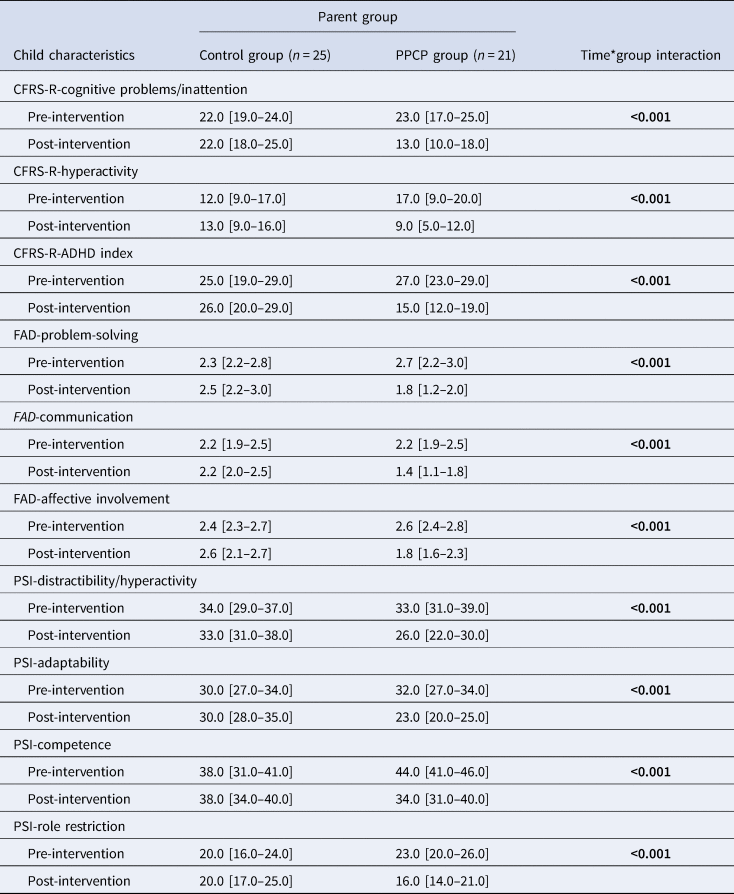
Pre- and post-intervention median, 1st–3rd quartiles, and time*group interactions for subscales of the CPRS-R, FAD, and PSI are shown in Table 3. As can be seen, there was a significant interaction between the time and the groups regarding CPRS-R (cognitive problems/inattention, hyperactivity, ADHD index), FAD (problem-solving, communication, affective involvement), and PSI (distractibility/hyperactivity, adaptability, competence, role restriction) (p < .05). Significant improvements were demonstrated on all subscales of the CPRS-R, FAD, and PSI (see Supplementary Material).
Comparison of the Change in Certain CPRS-R, FAD, and PSI Sub-Scores from the First Assessment to the Last Assessment Between the Groups

Note: CFRS-RLF = Conners’ Parent Rating Scale-Revised Long Form; FAD = Family Assessment Device; PSI = Parent Stress Index. An R software package npaRLD (nonparametric analysis of longitudinal data in factorial experiments) was used. Descriptive statistics are given as median [1st–3rd quartiles]. p-Values in bold are accepted as statistically significant (p < .05). Cronbach's alpha value of the CFRS-R, FAD, and PSI are above 0.7.
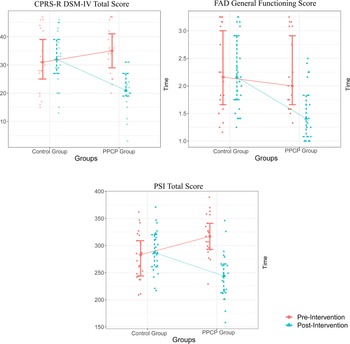
Figure 2 shows the interactions in CPRS-R total score, FAD general functioning score, and PSI total score from pre-intervention to post-intervention for the PPCP and control groups. This interaction shown in the figure was also found to be statistically significant for CPRS-R total score, FAD general functioning score, and PSI total score (p < .05). Therefore, the PPCP intervention had a significant effect on the CPRS-R total score, FAD general functioning score, and PSI total score.
Comparison of the change in CPRS-R DSM-IV Total Score, FAD General Functioning Score, and PSI Total Score between the groups from pre-intervention to post-intervention.

Discussion
In this single-blind randomised-controlled trial, an evidence-based parenting programme in children who responded to medication but still had residual symptoms was shown to improve ADHD symptoms (cognitive problems/inattention, hyperactivity, etc.), increase family functionality (problem-solving, communication, affective involvement, etc.), and reduce parenting stress (distractibility/hyperactivity, adaptability, competence, role restriction, etc.). These differences did not appear to the result of differences between participants in each group. The examination of the socio-demographic characteristics of the parents and children participating in the study indicated that the randomisation process was successful. The groups did not differ in terms of gender, age, ADHD subtypes, and comorbidity (ODD only) of the children, and the ratios are compatible with the existing scientific literature (Montiel, Peña, Montiel-Barbero, & Polanczyk, Reference Montiel, Peña, Montiel-Barbero and Polanczyk2008).
One of the most important findings of this study is that the application of PPCP to the parents of children aged 6–11, who are diagnosed with ADHD and whose residual symptoms continue despite medication, is effective in reducing the level of ADHD symptoms. This result supports the findings of previous studies showing the positive effects of a parenting intervention on ADHD symptoms in children. The majority of children in the prior MTA study (MTA Cooperative Group, 2004) medication-only management group required an additional treatment during the 14-month treatment period; however, only medication could be used. They found that maintaining the initial medication effect required a 25% increase in dosage during the period of treatment (Vitiello et al., Reference Vitiello, Severe, Greenhill, Arnold, Abikoff, Bukstein and Hinshaw2001). Our goal was to meet this additional requirement with a parenting intervention rather than with more medication, and we found this approach to be effective.
Pelham et al. (Reference Pelham, Fabiano, Waxmonsky, Greiner, Gnagy, Pelham and Hart2016) state that when response to medication is inadequate, increasing the dose of medication is superior to adding behavioural treatment. In contrast to this view, our study found that further intervention with a parenting intervention, not only maintained symptom reduction, but also produced a further reduction in symptoms. However, in our study, we found that a behavioural parenting intervention was effective in dealing with residual symptoms once the child was on the maximum dose according to their weight and side-effect profile. The dose could not be increased any further without side effects. Hence, our results suggest that for children who are prescribed the maximum dose of medication for their weight and side-effect profile. Therefore, our study supports the idea that if treatment is to be started with medication, the most effective dose should first be reached, and then behavioural methods should be added if there are still residual symptoms. On the other hand, we contend that a treatment regimen that includes only medication is not a viable long-term treatment strategy for ADHD children. Stimulants are a very effective treatment for ADHD, but there are concerns about the potential adverse effects of extended treatment on several systems, including growth (Carucci et al., Reference Carucci, Balia, Gagliano, Lampis, Buitelaar, Danckaerts and Inglis2020) and cardiovascular events (Torres-Acosta, O'Keefe, O'Keefe, & Lavie, Reference Torres-Acosta, O'Keefe, O'Keefe and Lavie2020).
When evaluating the results of studies investigating ADHD treatments, the focus is generally on improvement in the child's core symptoms and functionality, and although the effect of treatment on parental stress and family functionality is important, it is frequently overlooked (Epstein & Weiss, Reference Epstein and Weiss2012; Franke et al., Reference Franke, Michelini, Asherson, Banaschewski, Bilbow, Buitelaar and Haavik2018). The demands on the families of children with ADHD are shown to increase parental stress and impair family functioning, which can lead to conflict between the parents. This reduces the parents’ self-efficacy and increases the severity of the child's symptoms, negatively affecting treatment compliance ( Anastopoulos, Shelton, DuPaul, & Guevremont, Reference Anastopoulos, Shelton, DuPaul and Guevremont1993; Ciesielski, Loren, & Tamm, Reference Ciesielski, Loren and Tamm2020).
The results indicate that residual symptoms, present despite medication, are often related to parenting. For example, we saw relative changes in both positive parenting and positive discipline techniques that were associated with improvements in hyperactivity and impulsivity. Thus, these findings suggest that parenting programmes produced changes in ADHD symptoms. It is crucial to determine accurately when to implement such interventions because the parenting skills may already be perfectly adequate in some families, or in others, the children may benefit sufficiently from medication alone.
Many studies have shown that both medication and behavioural interventions can reduce parenting stress and parent–child conflict where children are diagnosed with ADHD (Galloway, Newman, Miller, & Yuill, Reference Galloway, Newman, Miller and Yuill2019; Theule, Wiener, Tannock, & Jenkins, Reference Theule, Wiener, Tannock and Jenkins2013). For example, in studies on parent–child relationship therapy, it is shown that the therapy positively affects parent–child relationships and contributes to the parents’ ability to control the behaviour of their children with ADHD (Zisser & Eyberg, Reference Zisser, Eyberg, Weisz and Kazdin2010). Supporting the results of our study, PP studies have shown a decrease in dysfunctional attitudes among family members, an increase in communication with each other, and a decrease in parental stress. After 9 weeks of applying PPCP to the parents of children with developmental problems, Coughlin et al. observed that the parents’ communication with their children had improved. The parents also stated that the most useful skill learned through the programme was understanding and adapting to their children. This reduced parental stress levels and these gains were preserved during the 5-month follow-up (Coughlin et al., Reference Coughlin, Sharry, Fitzpatrick, Guerin and Drumm2009). In another PP study, at the end of an 8-week PP application with the parents of children between the ages of 3–12 who were diagnosed with ADHD, ODD, and conduct disorder, the researchers found statistically significant lower anxiety and depression scores in the intervention group of parents (as measured in the Child Behaviour Checklist). On the PSI, they detected less parental stress, and on the Multidimensional Scale of Perceived Social Support, they found greater family social support in the intervention group than in the control group (Behan et al., Reference Behan, Fitzpatrick, Sharry, Carr and Waldron2001).
Limitations and Future Directions
We acknowledge that there are several limitations to the conclusions that can be drawn from our study. Although a power analysis indicated that our sample size was adequate to detect the effectiveness of the programme, future studies with larger samples will assist in establishing the generalisability of our findings. Future studies would also benefit from including a longer follow-up period. In this analysis, we included only immediately before and after the intervention assessment time-points. It will be important for studies to determine whether group differences are maintained over time.
Conclusion
In summary, a single-blind randomised-controlled study was conducted to target residual symptoms (ADHD core symptoms, family functionality, and parent stress) in children with ADHD. That means, our study addressed behavioural interventions to ADHD management in a novel manner (i.e., by targeting only those children with residual symptoms whose symptoms were not controlled via medication). This type of sequencing can be more effective as the application of the combination of medication and behavioural intervention simultaneously when ADHD is first diagnosed can be both difficult and expensive. Therefore, if positive results can be obtained by adding a secondary treatment modality for patients who have already benefitted from a certain level of medication, it offers an approach that clinicians can readily utilise in practice. In this study, the sub-chronic impaired the quality of life and lifelong stresses of these children and their parents, which are often ignored or considered to have been treated, were significantly improved by participation in a parenting programme. We think that our study indicates the potential for complementary interventions that can be applied to the parents of children who have residual ADHD symptoms.
Supplementary material
The supplementary material for this article can be found at https://doi.org/10.1017/bec.2021.13.
Acknowledgements
We are grateful to Professor John Sharry for his valuable feedback on earlier drafts of the manuscript. We would also like to thank Dr Merve Karabak and our child development specialist, Goknur Yildiz, for their assistance. This article is produced from the first author's doctoral dissertation.
Funding
This research received no specific grant from any funding agency, commercial or not-for-profit sectors.
Conflict of interest
The authors declare none.