Introduction and background
Diaspore heteromorphism is the production of two or more seeds and/or fruits (sometimes with accessory parts) on an individual plant that differ in many ways, such as morphology, mass, dispersal ability and degree of dormancy (Mandák, Reference Mandák1997; Imbert, Reference Imbert2002). There are two main categories of diaspore-heteromorphic plants: heterodiasporous and amphicarpous. In heterodiaspory, two or more diaspore morphs are produced above ground, while in amphicarpy one or more diaspore morph(s) is (are) produced above ground and one or more below ground (Mandák, Reference Mandák1997; Barker, Reference Barker2005). Imbert (Reference Imbert2002) listed 218 species that produce heteromorphic diaspores, and Wang et al. (Reference Wang, Dong and Huang2010) reported that this phenomenon occurs in 26 families, 129 genera and 292 species of angiosperms. Depending on the species, the diaspores of heteromorphic species may be dimorphic (two morphs), trimorphic (three morphs) or polymorphic (more than three morphs). However, the majority of heteromorphic species are heterodiasporous and produce two diaspore morphs (Imbert, Reference Imbert2002), and thus our survey was restricted to this group of plants.
Diaspore dimorphism results in differences in dispersal, germination and post-germination behaviour of the two morphs and is considered to be a bet-hedging strategy (Venable and Lawlor, Reference Venable and Lawlor1980; Venable, Reference Venable1985; Ellner, Reference Ellner1986). For dispersal and dormancy, the usual result in studies on dimorphic species is that one diaspore has high dispersal ability and low (or no) seed dormancy and the other one low (or no) dispersal ability and high (or relatively high) seed dormancy (e.g. Venable and Lawlor, Reference Venable and Lawlor1980; Ellner, Reference Ellner1986). Diaspore heteromorphism for germination has been called high risk–low risk (HRLR) when the same factor (e.g. temperature) is more restrictive for germination of one morph than the other, and high-risk–high-risk (HRHR) when different factors (e.g. light and temperature) are restrictive for germination of the two morphs (Venable, Reference Venable1985; Venable et al., Reference Venable, Búrquez, Corral, Morales and Espinosa1987).
However, we suggest that it is impractical to use the same factor (HRLR) versus different factors (HRHR) for restricting germination to distinguish between the dormancy behaviour of the two heteromorphisms. As Venable (Reference Venable1985) pointed out, germination of the two morphs would need to be compared in a variety of laboratory or field environments to identify the restrictive conditions for germination. Thus, it would seem that degree of dormancy, which integrates the factors and their intensities affecting germination, is a more suitable way to compare restriction of germination of the two morphs. In this paper, we consider only the dispersal and dormancy components of diaspore heteromorphism and use ‘dormancy’ to include both intensity and kind of restrictive factors for germination.
Whereas Venable (Reference Venable1985) and Venable et al. (Reference Venable, Búrquez, Corral, Morales and Espinosa1987) used a single letter (H) to designate high risk for all plant life-history traits, including dispersal and dormancy, for one morph (i.e. HR) and a single letter (H or L) to designate high or low risk for these plant life-history traits in the other morph (i.e. HR or LR), we use double-letters (or two different letters, see below) to designate the diaspore dispersal ability and degree of seed dormancy for a morph. Thus, for example, in our scheme Venable's HRLR is H/H-L/L. This double-letter (or two-letter) designation seems necessary because not all morphs of dimorphic species have either a high risk or a low risk combination of diaspore dispersal ability and degree of seed dormancy; there are ‘hybrid’ combinations (see below).
Thus, to be certain that the degree of seed dormancy is identified correctly in the two morphs, fresh seeds need to be tested for germination (‘dictum’ number 3 of Baskin et al., Reference Baskin, Thompson and Baskin2006). Lack of attention to the effect of storage on seed dormancy can cause misinterpretation of the relationship between diaspore heteromorphism and life-history strategy. Thus, the purpose of this opinion paper is to evaluate the possible consequences of using stored seeds and not having data on germination of fresh seeds in drawing conclusions about dispersal ability and degree of dormancy in diaspores of dimorphic species.
Results and discussion
For a paper to be included in our analysis, it had to contain information on: (1) dispersal ability that was measured or could be easily inferred from the description and/or illustrations of the two diaspore morphs; (2) germination; and (3) whether fresh and/or stored diaspores were tested for germination. Using these criteria, we selected 26 papers on diaspore dimorphism, which included 28 species, to analyse in our evaluation. The authors reported that diaspores were stored in 12 (46%) of the studies, which were published between 1978 and 2008, before the seeds were tested for germination. Fresh seeds were tested in 14 of the studies, which were published between 1963 and 2010 (Table 1). A perusal of papers on fruit/seed heteromorphism published more recently than those referenced in Table 1 shows that the practice of not testing fresh seeds is being continued (e.g. Atia et al., Reference Atia, Rabhi, Debez, Barhoumi, Abdelly and Smaoui2011; Souza Filho and Takaki, Reference Souza Filho and Takaki2011), as is the practice of testing fresh seeds in such studies (Cao et al., Reference Cao, Baskin, Baskin, Yang and Huang2012; Wang et al., Reference Wang, Wang, Tian and Huang2012).
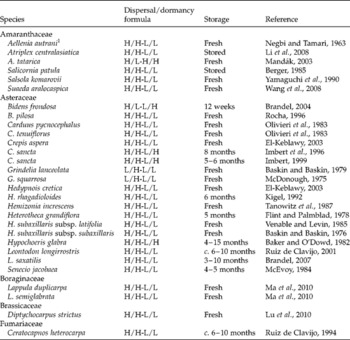
Analysis of 26 studies on diaspore dispersal ability and degree of seed dormancy in the two diaspore morphs of 28 dimorphic species. In the column entitled ‘Dispersal/dormancy formula’, the first two letters refer to one morph and the other two to the second morph. The first letter of a pair of letters for a morph refers to diaspore dispersal ability and the second letter to degree of seed dormancy. H, high risk; L, low risk. In the ‘Storage’ column, ‘stored’ means seeds were stored before being tested for germination, but the authors did not say for how long. ‘Fresh’ means fresh seeds were tested

1 Information on this species also obtained from Werker and Many (Reference Werker and Many1974).
Diaspore dispersal ability and seed germination in 22 of the 28 species conformed to the H/H-L/L strategy, whereas in six they did not (Table 1). In three of the six species in which results deviated from the H/H-L/L model, seeds were stored before they were tested for germination, and in the other three species seeds were not stored before testing. Fresh seeds were tested in 14 of the 22 cases that conformed to the H/H-L/L model and stored seeds in eight.
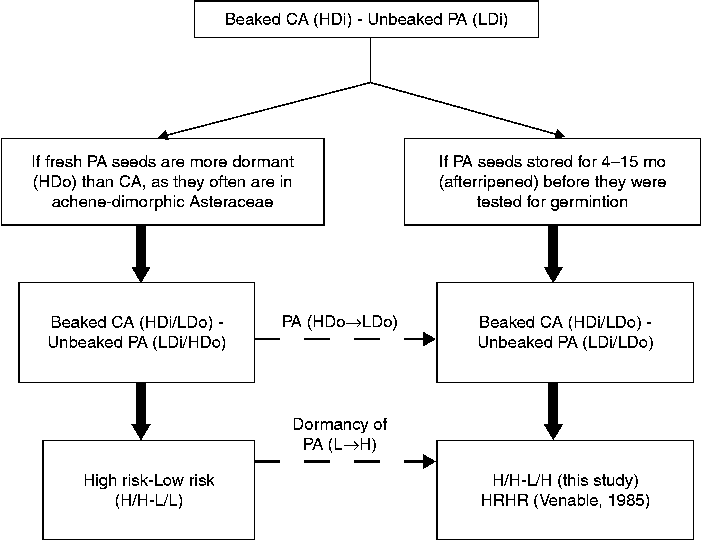
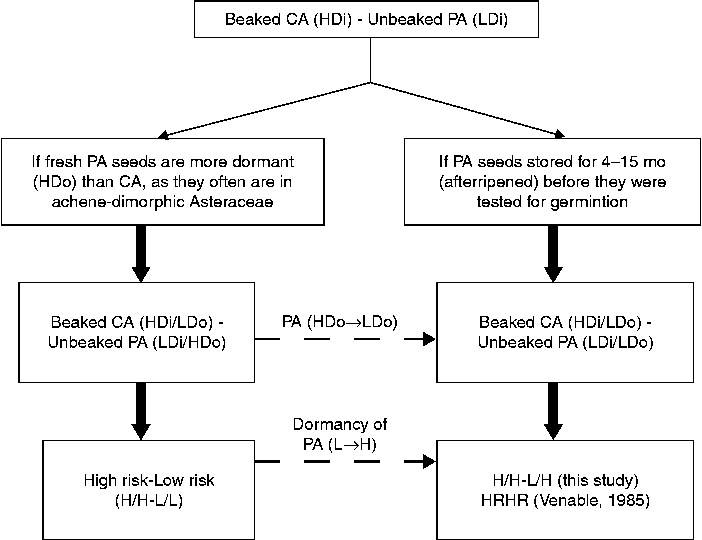
The kind of seed dormancy in the 28 species is non-deep physiological dormancy, and thus seeds might be expected to have afterripened in dry storage (Baskin and Baskin, Reference Baskin and Baskin2004). We suggest that in the three of six species (seven cases, two for Crepis sancta) in which seeds were stored and dispersal/dormancy characteristics of two diaspores did not conform to the H/H-L/L model, the dormant morph afterripened during storage, as illustrated in the much-cited study by Baker and O'Dowd (Reference Baker and O'Dowd1982) on achene-dimorphism in Hypochoeris glabra (Fig. 1) and that the eight (of 22) species in which seeds were stored but still conformed to the H/H-L/L model did not afterripen during storage. Of the three species that were not stored and still did not conform to the H/H-L/L model, two of them [Grindelia squarrosa (McDonough, Reference McDonough1975) and G. lanceolata (Baskin and Baskin, Reference Baskin and Baskin1979)] lack a pappus on both disc (central) and ray (peripheral) achenes and have little or no natural long-distance dispersal ability; thus, they do not (cannot) conform to the H/H-L/L model. Further, fresh ray achenes of both species are more dormant than fresh disc achenes, which is the usual case in Asteraceae. Thus, their dispersal/dormancy model is L/H-L/L.
An illustration of how the diaspore dispersal/dormancy relationship in Hypochoeris glabra (Baker and O'Dowd, Reference Baker and O'Dowd1982) may be misinterpreted, since fresh seeds were not tested for germination. CA, central achenes; PA, peripheral achenes; HDi, high diaspore dispersal ability; LDi, low (or no) diaspore dispersal ability; HDo, high (or relatively high) degree of seed dormancy; LDo, low (or no) degree of seed dormancy. Venable (Reference Venable1985) classified heteromorphism in H. glabra as high risk–high risk (his HRHR) since beaked achenes of this species are more light sensitive and non-beaked achenes more temperature sensitive. However, according to our scheme PA (L/H) is a mixture of low risk for diaspore dispersal (L) and high risk for seed dormancy (H).
So, if we disregard the fact that both achene morphs of the two Grindelia species have low dispersal ability, then diaspores of only one of the three species, Atriplex tatarica, in which fresh diaspores were tested deviate from the H/H-L/L model. Thus, of the diaspores of the six species that did not conform to the H/H-L/L model, three were stored and two did not have the morphology (lack pappus, wings, etc.) that makes it possible for them to fit the model; Atriplex tatarica is the only fresh-diaspore deviant.
It seems likely that storage could have caused changes in the dormancy state (via afterripening) of morphs of the deviants, Bidens frondosa, Crepis sancta and Hypochoeris glabra (Table 1). The dispersal/dormancy formula for C. sancta and H. glabra is H/H-L/H, which could have been derived from H/H-L/L via afterripening of the second morph (i.e. L → H) during storage. In B. frondosa, the formula in H/L-L/H, which could have been derived from H/H-L/L during storage via the first morph becoming more dormant (H → L) and by afterripening in the second morph (L → H). Interestingly, although achenes of C. sancta were stored for 8 months at laboratory temperatures before they were tested for germination, Imbert et al. (Reference Imbert, Escarré and Lepart1996) stated that neither central nor peripheral achenes showed any dormancy and that ‘… C. sancta is a high-risk strategy type’, apparently meaning HRHR (sensu Venable, Reference Venable1985), since neither of the two diaspore morphs were dormant. However, if the fresh peripheral achenes were dormant, as often is the case in Asteraceae, and they afterripened during the 8-month storage period, then at fresh seed maturity the species would have had the high risk–low risk (Venable's HRLR) strategy. This proposed scenario is exactly like the one for H. glabra (Fig. 1).
Regarding the eight species that conformed to the H/H-L/L model even after storage, there are three possibilities to consider. First, fresh diaspores had a high risk–low risk strategy, and there was no change in the dormancy status of either morph during storage. Second, dormancy in the H/H morph of stored seeds could have been derived from H/L (i.e. L → H) during storage; in which case, the dispersal/dormancy formula of fresh seeds would have been H/L-L/L. That is, seed dormancy in the first morph changed from low risk to high risk during storage via afterripening. A third, more remote, possibility is that the (second) L/L morph in stored seeds is a deviant of an L/H morph via stored seeds becoming more dormant than fresh seeds during storage.
Venable and Lawlor (Reference Venable and Lawlor1980) compiled information from three major review-type sources on dispersal/dormancy strategies of diaspores of 21 species of Asteraceae and six species of Brassicaceae. Eighteen species of Asteraceae and five species of Brassicaceae conformed to the H/H-L/L model, whereas three and one, respectively, did not. No information was given by Venable and Lawlor (Reference Venable and Lawlor1980) about whether or not seeds of these 27 species were stored before they were tested for germination. Ellner (Reference Ellner1986) tested germination of 13 ligulate heteromorphic species of Asteraceae from Israel that had been stored for 4–6 months at room temperature. In all 13 species, marginal (peripheral) achenes were near-dispersed and central achenes far-dispersed, and the two morphs of 10 species differed significantly in percentage and/or rate (speed) of germination. Thus, it reasonably can be concluded that the dispersal/dormancy characteristics of fresh diaspores of 10 of the 13 species conform to the H/H-L/L model. However, without data on germination of fresh seeds one cannot be sure that the diaspores are assigned to the correct dormancy category at fresh maturity, i.e. low (or no) degree of dormancy versus a higher degree of non-deep physiological dormancy.
Three of the species in Ellner's study, Crepis aspera, C. sancta and Hedypnois rhagadioloides, are present in our survey. The dispersal/dormancy formula for fresh seeds of C. aspera in our study is H/H-L/L (Table 1), whereas for stored seeds in Ellner's study it is H/H-L/H, which suggests that peripheral (L/L) seeds afterripened (i.e. L → H) during dry storage. Indirectly, then, a comparison of these two studies on the same species is ‘proof’ that the dormancy status of a morph may change during storage via afterripening. These results emphasize the need to test germination of fresh diaspores to correctly interpret the tradeoffs between dormancy and dispersal in fruit/seed dimorphic species. Our speculation on afterripening during storage in the other species for which fresh seeds were not tested for germination needs to be verified (or not).
Achenes of C. sancta were stored in the studies by Imbert et al. (Reference Imbert, Escarré and Lepart1996), Imbert (Reference Imbert1999) (see Table 1) and Ellner (Reference Ellner1986). In all three studies, both peripheral and central achenes were non-dormant. Thus, one cannot determine if peripheral achenes (or central achenes for that matter) were dormant when fresh and then afterripened during storage. That is, can diaspore storage be described as H → H (fresh seeds non-dormant, did not afterripen) or as L → H (fresh seeds dormant, afterripened). For H. rhagadioloides, the data from Ellner and those from Kigel (Reference Kigel1992) agree (see Table 1). The dispersal/dormancy formula is typical of that for fresh diaspore-dimorphic species, H/H-L/L. However, as discussed above for stored diaspores that exhibit the H/H-L/L strategy and for which fresh seeds were not tested for germination, one cannot be certain that this is the model that fits fresh diaspores.
In conclusion, we suggest that in studies on diaspore heteromorphism it is imperative that germination be tested on freshly matured seeds. Otherwise, one cannot be certain that the dispersal/dormancy formula assigned to the diaspores is correct. Testing fresh diaspores is especially important in Amaranthaceae (including Chenopodiaceae, sensu APG, 2009), Asteraceae and Brassicaceae, families that contain a high percentage of the known heteromorphic species (Imbert, Reference Imbert2002), since dormant seeds in these families have non-deep physiological dormancy and are likely to afterripen during dry storage (Baskin and Baskin, Reference Baskin and Baskin1998).
Acknowledgements
This work was supported in part by the National Science Foundation of China (NSFC 31160063, 31160093) and the Joint Funds of the National Science Foundation of China (U1130301).