Introduction
Although thyroid carcinoma is a rare disease, its incidence in Australia is increasing exponentially.Reference Currow and Thomson 1 Well-differentiated thyroid carcinoma generally has an excellent prognosis, but it is difficult to predict which patients will have a poorer outcome.Reference Busnardo and De Vido 2 The American Joint Committee on Cancer tumour–node–metastasis staging system for thyroid carcinoma is widely used to attempt to stratify a patient's prognosis and guide treatment. Such staging systems have, however, only been shown to explain less than one-third of the variation in prognosis between patients, struggling particularly to explain prognostic differences in low-risk patients.Reference Brierley, Panzarella, Tsang, Gospodarowicz and O'Sullivan 3 , Reference Hundahl, Fleming, Fremgen and Menck 4
Other features known to correlate with a poorer prognosis in well-differentiated thyroid carcinoma are advanced age, male sex, extra-thyroidal extension and certain histological subtypes.Reference Gilliland 5 There has been an increase in research on the utility of molecular markers for prognostication.
Thyroglobulin is a pro-hormone involved in the synthesis of thyroxine (T4) and tri-iodothyronine (T3). It is produced both by normal thyroid tissue and in well-differentiated thyroid carcinoma. A detectable thyroglobulin level following total thyroidectomy and ablative radioactive iodine therapy of remnant thyroid tissue indicates likely persistent or recurrent carcinoma.
Thyroglobulin measurement is used to monitor well-differentiated thyroid carcinoma; however, its role as a prognostic tool is more controversial.Reference Mazzaferri, Robbins, Spencer, Braverman, Pacini and Wartofsky 6 , Reference Pelttari, Laitinen, Schalin-Jantti and Valimaki 7 The American Thyroid Association recommends that thyroglobulin be used to monitor for disease recurrence, but there is no mention of its utility as a prognostic tool.Reference Cooper, Doherty, Haugen, Kloos and Lee 8
Thyroglobulin levels may be elevated after total thyroidectomy as a result of residual thyroid tissue or carcinoma. It had been assumed that ablation of remnant normal thyroid tissue is required before positive thyroglobulin levels can be interpreted, though there is now evidence to the contrary.Reference Ronga, Filesi, Ventroni, Vestri and Signore 9 Other studies in the literature have shown that the pre-ablative thyroglobulin level correlates with a poorer prognosis.Reference Pelttari, Laitinen, Schalin-Jantti and Valimaki 7 , Reference Giovanella, Ceriani, Suriano, Ghelfo and Maffioli 10 Additionally, the higher the cut-off point where an elevated thyroglobulin is considered significant, the more specific it is for future detection of macroscopic residual or recurrent disease.Reference Heemstra, Liu, Stokkel, Kievit, Corssmit and Pereira 11 It is important to be aware that patients with anti-thyroglobulin antibodies may have a false negative serum result for thyroglobulin levels.Reference Aras, Gultekin and Kucuk 12 , Reference Spencer 13
To date, there are still no studies to confirm the prognostic value of thyroglobulin levels among an Australian patient population with well-differentiated thyroid carcinoma. There is also a lack of consensus regarding the utility of pre-ablative serum thyroglobulin levels measured at the time of radioactive iodine therapy. This study aimed to assess the prognostic value of thyroglobulin measurement at the time of radioactive iodine therapy. The study was performed on patients presenting with well-differentiated thyroid carcinoma at a single metropolitan Australian teaching hospital.
Materials and methods
Ethics approval was obtained for this study from the Human Research Ethics Committee for the Royal Prince Alfred Hospital at the Sydney Local Health Network.
A retrospective cohort study of all patients presenting with well-differentiated thyroid carcinoma at the Royal Prince Alfred Hospital in Sydney was conducted. All patients with head and neck carcinomas presenting to surgeons in the unit have been entered prospectively into a head and neck database since 1987. Patients are added to this database at the time of their histopathological diagnosis, with relevant data updated at subsequent follow-up appointments. Patients with well-differentiated thyroid carcinoma that had been treated with total thyroidectomy and radioactive iodine therapy from 1989 to 2010 were studied. A comprehensive chart review of the patients was performed to ensure database accuracy. This involved reviewing clinician letters, operation notes, imaging findings (including details of radioactive iodine therapy), histopathology reports and results of blood tests performed at follow-up appointments.
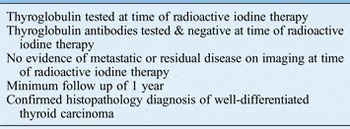
All patients with well-differentiated thyroid carcinoma who underwent total thyroidectomy and ablative radioactive iodine therapy were reviewed. After the chart review, only patients with serum thyroglobulin levels measured at the time of radioactive iodine therapy were selected for study inclusion. Patients with positive thyroglobulin antibodies, insufficient follow up, evidence of metastatic disease on radioactive iodine therapy or missing data were excluded from the analysis (Table I). Disease recurrence was defined as histopathologically confirmed recurrent carcinoma occurring at least 12 months after radioactive iodine therapy.
Inclusion criteria

Univariate analysis was used to assess whether an elevated thyroglobulin level at the time of radioactive iodine therapy was able to predict disease-free survival. Patients with a thyroglobulin level of 27.5 µg/l or higher were compared to those with a thyroglobulin level of less than 27.5 µg/l. This cut-off value was chosen as it has previously been shown to be optimal for prognostication.Reference Heemstra, Liu, Stokkel, Kievit, Corssmit and Pereira 11 The other clinical variables that were analysed separately were gender, age and lateral neck dissection performed at the time of thyroidectomy. The histological variables analysed were extra-thyroidal extension, vascular invasion, higher tumour (T) stage and multifocal carcinomas.
Results
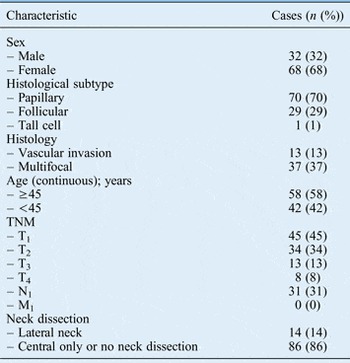
A total of 246 patients were identified in the head and neck database as having well-differentiated thyroid carcinoma treated with total thyroidectomy and radioactive iodine therapy. Of the patients excluded, 13 had positive thyroglobulin antibodies, 98 had incomplete data (including no thyroglobulin measurement at the time of radioactive iodine therapy), 8 had early recurrence (occurring within less than 12 months) and 27 had metastatic disease at the time of radioactive iodine therapy. This left 100 patients included in the study, with a mean age of 48.4 ± 15.6 years (Table II). Sixty-eight patients were female (68 per cent). The majority of patients had papillary carcinoma (70 per cent). Mean follow-up time was 3.0 years (range, 1.0–20.5 years). The median thyroglobulin level was 3.1 µg/l (ranging from undetectable to 244.0 µg/l). There were only 11 disease recurrences in the follow-up period; this meant that multivariate disease-free survival analysis was not possible.
Patients' characteristics
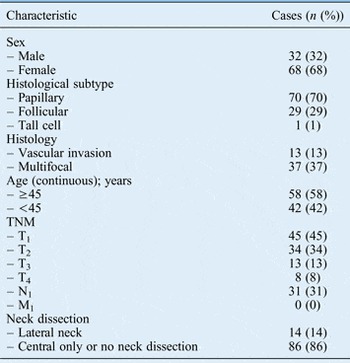
TNM = tumour–node–metastasis
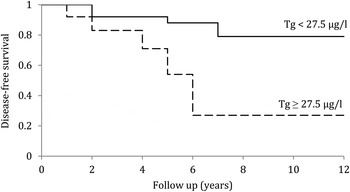
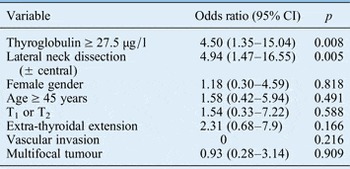
Sixteen patients had a thyroglobulin level of 27.5 µg/l or higher and 84 patients had a thyroglobulin level of less than 27.5 µg/l at the time of radioactive iodine therapy. The relative risk of developing disease recurrence with a thyroglobulin level of 27.5 µg/l or higher was 4.50 (95 per cent confidence interval (CI) = 1.35–15.04). Having a thyroglobulin level of 27.5 µg/l or higher at the time of radioactive iodine therapy had a positive predictive value of 31.3 per cent (95 per cent CI = 11.0–58.7 per cent) for macroscopic disease recurrence. This had a statistically significant effect on disease-free survival (p = 0.008) as demonstrated by Kaplan–Meier curves (Figure 1). The only other tested variable (Table III) to show a significant difference was whether lateral neck dissection was performed at the time of surgery, with a relative risk of disease recurrence of 4.94 (95 per cent CI = 1.47–16.55).
Kaplan–Meier disease-free survival curves comparing thyroglobulin positive and negative patients. Tg = thyroglobulin

Univariate analysis of prognostic variables

CI = confidence interval; T = tumour
In the 11 patients with disease recurrence, the median thyroglobulin level was 19.0 µg/l (range, 3.1–244.0 µg/l). No residual or recurrent disease was detected during follow up in the 49 patients with a thyroglobulin level that was either 3 µg/l or lower or undetectable.
Discussion
This study shows an increased relative risk of developing recurrent thyroid carcinoma if serum thyroglobulin levels are 27.5 µg/l or higher at the time of radioactive iodine therapy. These results are comparable to those reported in the literature. For instance, thyroglobulin levels of 2 µg/l or higher at the time of remnant ablation has been shown to have a positive predictive value for disease recurrence of 23.1 per cent,Reference Kim, Kim, Kim, Ryu, Yeo and Kim 14 whilst in this study it was 31.3 per cent at levels of 27.5 µg/l or higher.
The low number of recurrences during the follow-up period was a major study limitation. This was not unexpected given that well-differentiated thyroid carcinoma may recur several years after initial treatment. Research of well-differentiated thyroid carcinoma is often limited by the relatively long follow-up period required, generally excellent prognosis and low recurrence rates. There are multiple commercial thyroglobulin assays available; given the retrospective nature of this study over three decades, there was heterogeneity regarding the assays used to measure serum thyroglobulin. The lowest detection limit of the thyroglobulin assays utilised in this study varied from 0.1 to 1 µg/l.
Prescribing a cut-off value to predict when an elevated thyroglobulin level reaches clinical prognostic significance is difficult. It has been reported in the literature that an elevated thyroglobulin level at the time of radioactive iodine therapy has a positive predictive value for residual disease.Reference Ronga, Filesi, Ventroni, Vestri and Signore 9 , Reference Heemstra, Liu, Stokkel, Kievit, Corssmit and Pereira 11 Other factors that may affect the thyroglobulin level at the time of radioactive iodine therapy include residual normal thyroid tissue, positive thyroglobulin antibodies and thyroid carcinoma. Given the heterogeneity of thyroglobulin assays and individual institutions' treatment protocols, a single cut-off value is less useful than an overall assessment of a patient's risk of recurrence.
-
• Prognosis in well-differentiated thyroid carcinoma is excellent
-
• Thyroglobulin is used as a surrogate marker for disease recurrence, but its role in prognosis is not established
-
• This retrospective cohort study showed a difference in macroscopic disease recurrence in patients with thyroglobulin levels of 27.5 µg/l or higher at the time of ablative radioactive iodine therapy
-
• Elevated thyroglobulin at the time of radioactive iodine therapy should be considered when stratifying risk of disease recurrence
The results from this study support the statement that an elevated thyroglobulin level at the time of radioactive iodine therapy cannot be dismissed as non-significant. These patients may represent a group with persistent microscopic metastases. The terms ‘scan-negative, thyroglobulin positive’ or ‘thyroglobulin positive, no evidence of disease’ have been used to make the distinction between this group of patients and those with complete remission.Reference Kim, Kim, Kim, Ryu, Yeo and Kim 14 – Reference Ma, Kuang and Xie 16 Low-risk patients with persistent positive thyroglobulin should receive regular surveillance to detect any subsequent macroscopic disease. However, low-risk patients who have negative thyroglobulin at the time of remnant ablation may avoid radioactive iodine therapy and its associated risks.Reference Vaisman, Orlov, Yip, Hu, Lim and Dowar 17 , Reference Iyer, Morris, Tuttle, Shaha and Ganly 18 Indeed, in a New Caledonian population of patients with well-differentiated thyroid carcinoma, a thyroglobulin level of 20 µg/l or higher at the time of radioactive iodine therapy was present in eight patients with no detectable macroscopic disease, and all eight patients developed macroscopic metastatic disease on subsequent scans.Reference Ballivet, Chua, Bautovich and Turtle 19
Conclusion
A significant difference in prognosis was evident in patients with an elevated thyroglobulin level of 27.5 µg/l or higher at the time of ablative radioactive iodine therapy. Further investigation may clarify whether increased surveillance of low-risk patients with a detectable elevation in serum thyroglobulin has an effect on patient outcomes.