The federal system for allocating donated livers in the United States is often criticized for allowing geographic disparities in access to livers. In recent years, transplant candidates in some areas of the country have had much greater access to donated livers than others. For example, in 2016, the median Model for End-Stage Liver Disease (MELD) score for adult deceased donor liver transplant recipients in Los Angeles, California was 39, compared to 20 in Indianapolis, Indiana.Reference Kim1 Residents of Los Angeles were thus on average much sicker than residents of Indiana when they received a liver, and so at greater risk of dying on the waiting list. Critics argue that this is unfair on the grounds that where one lives is morally arbitrary and so should not influence one's access to donated livers.Reference Ubel and Caplan2 Federal regulations also stipulate that the allocation of organs “shall not be based on the candidate's place of residence or place of listing.”3 Critics argue instead that livers should be allocated in accordance with the equal opportunity principle, according to which U.S. residents who are equally sick should have the same opportunity to receive a liver, regardless of where they live.4
The Board of Directors for the United Network for Organ Sharing and the Organ Procurement and Transplantation Network has recently approved a new liver distribution policy to help address these geographic disparities.5 The new policy increases the inter-regional sharing of donated livers and so is expected to reduce geographic disparities in access to livers. However, this change may not satisfy critics since it still permits geographic-based inequalities.
In this paper, we examine a central premise of the argument for the equal opportunity principle, namely, that geographic location is a morally arbitrary basis for allocating livers. We raise some serious doubts regarding the truth of this premise, arguing that under certain conditions, factors closely associated with geographic location are relevant to the allocation of livers, and so that candidates' geographic location is sometimes a morally non-arbitrary basis for allocating livers. Geographic location is morally non-arbitrary, we suggest, since by taking it into account, the Organ Procurement and Transplantation Network may better fulfill its central goals of facilitating the effective and efficient placement of organs for transplantation and increasing organ donation.
In this paper, we examine a central premise of the argument for the equal opportunity principle, namely, that geographic location is a morally arbitrary basis for allocating livers. We raise some serious doubts regarding the truth of this premise, arguing that under certain conditions, factors closely associated with geographic location are relevant to the allocation of livers, and so that candidates' geographic location is sometimes a morally non-arbitrary basis for allocating livers. Geographic location is morally non-arbitrary, we suggest, since by taking it into account, the Organ Procurement and Transplantation Network may better fulfill its central goals of facilitating the effective and efficient placement of organs for transplantation and increasing organ donation.
In part 1, we provide a brief overview of the current system for allocating livers and the recently approved changes to this system. In part 2, we provide an account of what it means for a feature of a person's identity to count as “morally arbitrary.” In part 3, we identify five factors associated with geographic location that, when certain conditions hold, imply that geographic location is not a morally arbitrary ground for allocating livers. We conclude with a discussion of the policy implications of this finding.
While our analysis focuses on U.S. policy and considers the allocation of livers rather than other organs or tissues, our account has implications that extend beyond this context. Much of our analysis is directly applicable to the allocation of other donated organs and tissues, not merely livers; and policymakers in other countries also face the problem of geographic disparities in access to donated organs.Reference Koizumi6
1. The Current System
For over three decades, United States federal law has aimed to create an equitable and efficient system for liver allocation through a transparent, bureaucratic apparatus. Unfortunately, a seemingly inevitable shortage in organ donations has created a number of practical and ethical dilemmas. Although nearly 14,000 individuals are in need of a liver transplant nationwide, there were only 8,082 liver transplants performed in 2017.7 This persistent gap is the fundamental reason a flexible, comprehensive policy approach is necessary.
Contracted by the federal government, the United Network for Organ Sharing (UNOS) is charged with maintaining a national network for organ matching, commonly referred to as the Organ Procurement and Transplantation Network (OPTN). While the basic responsibility of this network has always stayed constant, procedures were put in place to allow continued improvements and alterations to the guidelines. In an effort to further improve the allocation process, the Department of Health and Human Services passed the OPTN Final Rule in 2000, requiring that allocation policies “shall be based on sound medical judgment” and “shall seek to achieve the best use of donated organs.”8 By using two scoring systems — the Model for End-Stage Liver Disease (MELD) and the Pediatric End-Stage Liver Disease (PELD) — the OPTN can calculate the severity of each candidate's acute illness. More specifically, the higher a MELD or PELD score, the more likely a candidate is to die within 3 months without access to a liver. Thus, candidates for a transplant are placed on a waitlist that ranks those with the highest score at the top (i.e. first in line to receive a transplant). This form of analysis helps the OPTN comply with their aforementioned core responsibilities.
However, this objective scoring system is not the only relevant consideration in the allocation decision-making process. The OPTN also established 11 geographic regions and 58 donation service areas (DSAs), with each DSA served by its own Organ Procurement Organization (OPO).9 The regions were established to provide an organizational structure intended to enhance communication efficiency and transparency.10 As of December 5, 2018, donated livers from deceased donors at least 18 years old are allocated first to those adult or pediatric candidates with a 1A status and within the geographic region where the livers were originally donated, and then to pediatric candidates within the region with a 1B status.11 Donated livers are then allocated to the candidates with the highest MELD/PELD score within the region, with scores ranging from 40 to 35,12 and then to candidates in the region with MELD/PELD scores of at least 15.13 Only then are donated livers offered to candidates outside of the region, first to adult or pediatric candidates with a 1A status, then to pediatric candidates with a 1B status, and then to candidates with a MELD/PELD score of at least 15.14 For a visual representation of this allocation system, see Table 1.
Allocation of Livers from Deceased Donors at Least 18 Years Old15

This decision to incorporate regional discretion into the allocation process has led to candidates in some areas of the United States having less access to donated livers than others, forcing the candidates residing in these zones to reach a higher MELD/PELD score to receive a liver. For example, in 2016, the median MELD score for adult deceased donor liver transplant recipients ranged from 20 in some regions of the U.S. to 39 in others.16
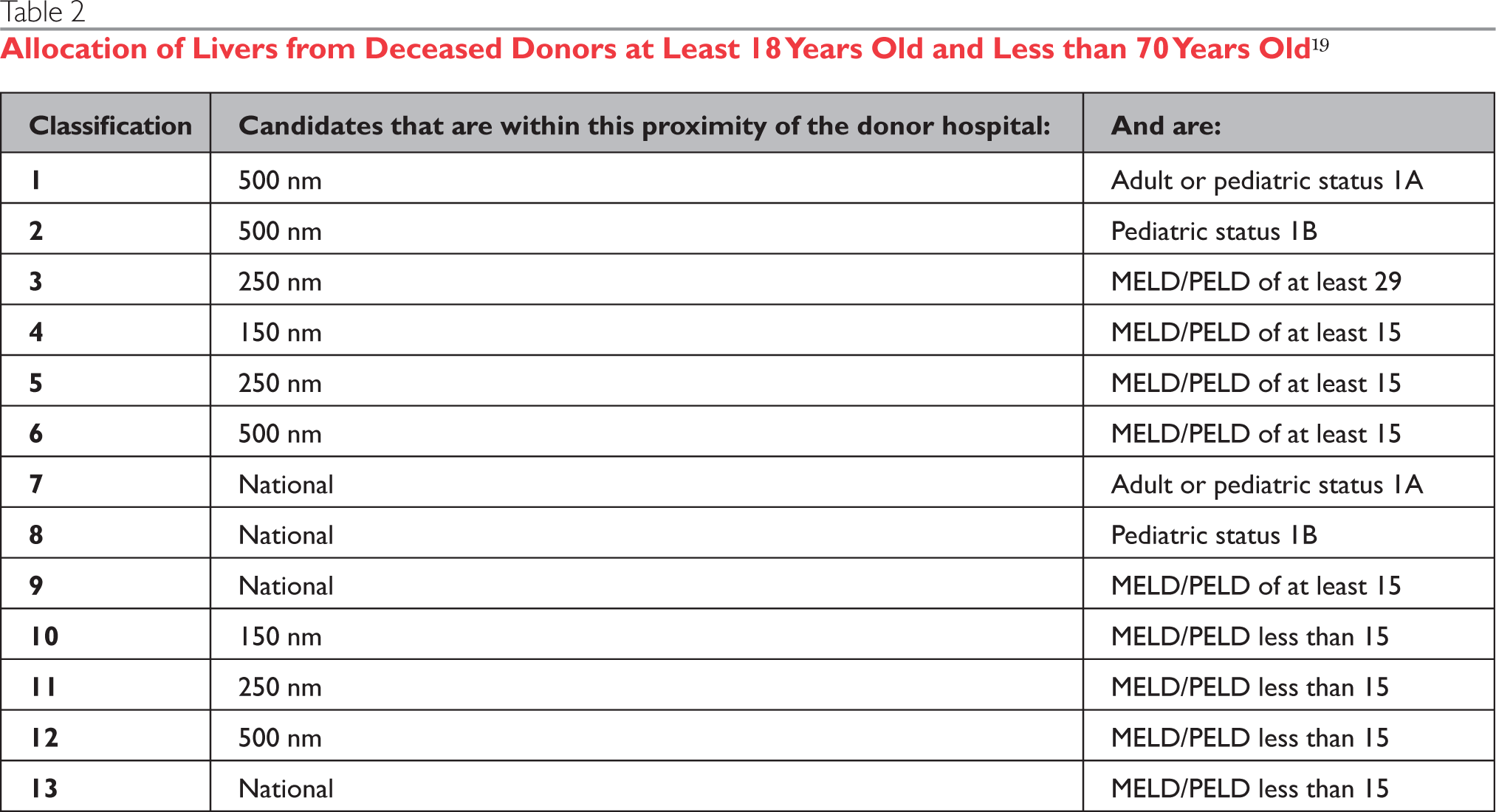
On December 3, 2018 the OPTN/UNOS Board of Directors approved a new liver allocation proposal that aims to “reduce as much as possible the role of a candidate's place of listing in liver allocation while considering the best use of organs, organ wastage, patient access, and the efficient management of organ placement.”17 The proposal — called the “broader 2-circle framework” — eliminates the use of DSA and region in the allocation of livers. Donated livers are first allocated to 1A and 1B status candidates within 500 nautical miles (nm) of the donor hospital; then to candidates having a MELD or PELD score of at least 29 within 250 nm of the donor hospital; then to candidates with a MELD or PELD score of at least 15 within 150 nm, then 250 nm, and then within 500 nm of the donor hospital; and then finally to national candidates.18 Table 2 offers a visual representation of this allocation system.
Allocation of Livers from Deceased Donors at Least 18 Years Old and Less than 70 Years Old19

The proposal was developed by the Liver and Intestine Transplantation Committee to ensure that the OPTN's liver allocation policy complies with the OPTN Final Rule's requirement that the allocation of organs “shall not be based on the candidate's place of residence or place of listing, except to the extent required” by the other requirements of the OPTN Final Rule.20 The proposal was also intended to comply with the Secretary of the U.S. Department of Health and Human Services' judgment that the use of DSAs and OPTN regions to allocate livers is inconsistent with the OPTN Final Rule.21 Although it is expected to decrease geographic inequality in access to donated livers, defenders of the equal opportunity principle are unlikely to be satisfied since it does not secure for candidates with the same MELD or PELD score an equal opportunity to access a donated liver. For proponents of this view, geographic location is a morally arbitrary ground on the basis of which to allocate donated livers. In the next sections of this paper, we investigate this charge.
2. What is a Morally Arbitrary Feature?
We endorse the claim that the OPTN should not allocate livers on the basis of features of people's identity that are morally arbitrary. More broadly, the OPTN has a duty to treat all candidates as moral equals, that is, as persons who have an equally important interest in living a good life. This duty does not necessarily imply that the OPTN must treat all candidates the same, for example, by allocating donated livers by means of a lottery regardless of MELD or PELD score. However, it does imply that if the OPTN is to treat candidates differently, it must have a legitimate reason for doing so. That is, it must not treat candidates differently on the basis of morally arbitrary features of their identity.
But, what does it mean to say that a feature of someone's identity is morally arbitrary? We aim to answer this question here.
The claim that some feature of a person's identity is morally arbitrary typically arises in cases where some agent is deciding how to treat some group of persons or allocate some scarce benefit. If some identity feature is established as morally arbitrary, this means that the treating agent in question ought not to take it as a reason to treat people who possess this feature differently from those who do not. Morally arbitrary features are therefore illegitimate grounds of differential treatment. It is thus for this reason that John Rawls, in constructing the standpoint from which principles of justice should be chosen, places certain features of people's identity behind the “veil of ignorance.”Reference Rawls22 People's race, class position, talent, and religion, Rawls claims, are morally arbitrary features of their identity, and so do not entitle them to a greater share of social primary goods than others.23 It is also the reason why governments enact anti-discrimination laws that prohibit public and private actors from treating people differently on the basis of their race, gender identity, religious beliefs, and sexual orientation. Such features of people's identity are morally arbitrary and so ought not to be a basis for differential treatment in particular contexts.
It is natural to think that certain features of people's identity — e.g. race or religion — are morally arbitrary simpliciter, that is, irrespective of context. On this view, it is always unfair to treat people differently on the basis of these factors. Proponents of the equal opportunity principle seem to be working with this conception. For example, consider Parent and Caplan's argument for this principle:
To be fair any allocation system must treat according to medical need without attention to other individual characteristics. The worth of a life is not determined by race, gender, socioeconomic status, ability, or location, and thus these demographics should neither be weighed in allocation nor unduly affected by allocation.24
We take a different view. On our view, whether a feature of people's identity is morally arbitrary or not is context-dependent, depending on the legitimate purposes of the treating agent.Reference Shiffrin25 More specifically, we suggest that a feature of someone's identity is morally arbitrary when it is irrelevant to the treating agent's pursuit of its legitimate purposes. By a legitimate purpose, we mean a purpose that the agent in question is either morally permitted or morally required to pursue. The legitimate purposes of collective agents, we suggest, depends on an understanding of the morally permissible raison d'être or defining purpose of the agent in question. A feature of someone's identity is therefore morally non-arbitrary when it is relevant to the treating agent's pursuit of its legitimate purposes.
This account, we suggest, can explain why some forms of differential treatment are impermissible, and others permissible. Consider the treatment of potential employees by private-for-profit businesses. The legitimate purpose of such businesses involves the production of a particular good or the provision of a particular service. On our account therefore, it is permissible for such businesses to favor potential employees on the basis of skill or education since these features of people's identity are directly relevant to businesses' pursuit of their legitimate purposes and so not morally arbitrary. A potential employee's race or religion, by contrast, is a morally arbitrary feature of their identity since it is irrelevant to businesses' pursuit of their legitimate purpose of producing a particular good or delivering a particular service. But this does not mean that race and religion are morally arbitrary features of people's identity in all contexts, meaning that it is always impermissible for other agents to treat people differently on the basis of these factors. For example, since religious institutions such as churches or mosques have a legitimate interest in promoting and practicing a particular religious faith, religious faith is not a morally non-arbitrary feature of a potential employee's identity when the position in question concerns the performance of clerical or teaching duties. Our account thus lends support to Title VII of the U.S. Civil Rights Act of 1964 which prohibits employers from discriminating against employees or prospective employees on the basis of race, color, religion, sex, or national origin, but exempts from this requirement any “religious corporation, association, educational institution, or society with respect to the employment of individuals of a particular religion to perform work connected with the carrying on by such corporation, association, educational institution, or society of its activities.”26
Similarly, it is arguably permissible for publicly funded colleges to favor qualified minority candidates for admission on the grounds that colleges have a legitimate interest in creating a rich educational environment for their students, and that a diverse student body is essential if such an environment is to be created.Reference Sterba27 While it would be impermissible for a private-for-profit business to favor potential employees on the basis of race, it is arguably permissible for colleges to favor potential students on this basis.
On our account therefore, whether a feature of someone's identity is morally arbitrary is context dependent, depending on the legitimate purposes of the treating agent in question. One benefit of this view, in contrast to the context-independent view, is that it provides the resources for explaining why it is sometimes permissible for certain agents to treat people differently on the basis of features that are often considered morally arbitrary. As we discuss below, there are some prima facie plausible reasons to treat transplant candidates differently on the basis of geographic location — e.g. cost and travel time — and our account can explain why such differential treatment is permissible. Indeed, the OPTN Final Rule arguably endorses this context-dependent conception of moral arbitrariness in its treatment of geographic location, holding that the allocation of organs “shall not be based on the candidate's place of residence or place of listing, except to the extent required” by the other requirements of the OPTN Final Rule — i.e. the OPTN's legitimate purpose in creating an effective allocation system. Proponents of the context-independent view may have trouble explaining why it may sometimes be permissible to treat transplant candidates differently on the basis of geographic location since if location is always morally arbitrary, then any differential treatment on the basis of it must be unfair.
Supposing our account of morally arbitrary features is correct, is geographic location always morally arbitrary, implying that the OPTN is wrong to allocate livers in a way that leads to geographic disparities? We turn to this question next.
3. Is Geographic Location Morally Arbitrary?
To determine whether candidates' geographic location is a morally arbitrary feature of their identity in the context of the allocation of livers, we must first identify the legitimate purposes of the OPTN. To complete this task, it is helpful to examine the Charter of the OPTN which governs its structure and operation. According to this document:
The primary purposes of the OPTN are to operate and monitor an equitable system for allocating organs donated for transplantation; maintain a waiting list of potential recipients; match potential recipients with organ donors according to established medical criteria for allocation of organs and, to the extent feasible, for listing and de-listing transplant patients; facilitate the efficient, effective placement of organs for transplantation; and increase organ donation.28
Most importantly for our discussion below, the OPTN's purposes include (1) allocating organs for transplantation equitably; (2) facilitating the efficient and effective placement of organs for transplantation; and (3) increasing organ donation. These three purposes are clearly legitimate ones, insofar as it is morally permissible for the federal government to establish a network to further these goals.
If geographic location is to be a morally arbitrary feature of candidates' identity with respect to the allocation of donated livers, it — or factors associated with it — must be irrelevant to the OPTN's realization of these legitimate purposes. In what follows, we identify five ways in which factors closely related to geographic location may be relevant to the OPTN's realization of its legitimate purposes. We therefore conclude that under certain conditions, geographic location is not a morally arbitrary basis for liver allocation.
3.1 Travel Time
The first reason to think that candidates' geographic location is not morally arbitrary in the context of liver allocation is travel time. There is a limit to the amount of time that livers can be transported and still be used for transplantation, known as “cold ischemic time.” The cold ischemic time for livers is currently understood to be between six and ten hours.29 Since geographic location impacts travel time, and since the travel time for any particular liver must be limited if the OPTN is to fulfill its legitimate purpose of facilitating the efficient and effective placement of organs for transplantation, geographic location is not a morally arbitrary feature of candidates' identity. Indeed, in its recent policy proposal, the Liver and Intestine Transplantation Committee adopts this line of reasoning to explain why geographic location must be taken into account in the development of a liver allocation system.30
3.2 Cost
The second reason to think that candidates' geographic location is not morally arbitrary given the OPTN's legitimate purposes is financial cost. The Liver and Intestine Transplantation Committee also explicitly mentioned the need to limit financial and logistical costs as a further reason to introduce geographical constraints in its proposed allocation system.31 Larger sharing circles require a greater dependence on air transportation which is costlier than ground transportation; and larger sharing circles also imply more inter-regional sharing, which can lead to greater administrative burdens for OPOs and transplant hospitals.32
We suggest that cost is a sound reason to think that geographic location is not a morally arbitrary feature of candidates' circumstances. To realize its legitimate purpose of facilitating the efficient and effective placement of organs for transplantation, the OPTN must consider that OPOs and transplant hospitals have limited financial and human resources. Since greater regional sharing increases financial and logistical costs, the OPTN has a legitimate reason for taking the geographic location of candidates into account and so requiring donor hospitals to allocate donated livers — in part — on the basis of their proximity to candidates. In short, because geographic location is tied to cost, and cost is directly relevant to the OPTN's realization of its legitimate purposes, geographic location is not a morally arbitrary feature of candidates' identity.
In making this point, we are not defending the Liver and Intestine Transplantation Committee's claim that the circle sizes contained in their recent proposal best balance considerations of cost and urgency.33 Whether it does so or not depends on complex normative and empirical questions that we are not in a position to answer. Our point is rather that to the extent that proximity circles of a particular size would impose undue costs on OPOs and transplant hospitals, then the geographic location of candidates is morally non-arbitrary. In addition, as the Liver and Intestine Transplantation Committee notes, there is good evidence to suggest that larger circles substantially increase transportation costs.Reference Dubay34
3.3 OPO Effectiveness
A third reason to think that geographic location may not be a morally arbitrary feature of candidates' identity is OPO effectiveness. There are currently 58 OPOs in the U.S. with each having its own designated service area. OPOs are responsible for: (1) increasing the number of registered donors, for example, through advertising campaigns and the organization of programs in schools, worksites, and religious institutions; and (2) coordinating the donation process.35 Like any organization, OPOs can be more or less effective in discharging their responsibilities, and so can have a significant impact on the supply of donated livers.Reference Goldberg36 For example, the U.S. Centers for Medicare and Medicaid Services has recently threatened to not renew its agreement with LiveOnNY, the OPO serving the New York City area, on the grounds of poor performance.Reference Bernstein and Kindy37
Since OPOs are geographically based, OPO effectiveness may constitute a third reason to think that geographic location is not a morally arbitrary feature of candidates' identity. In this case, geographic location would not be morally arbitrary since it overlaps with a transplant candidate's OPO membership, that is, the OPO within whose geographic boundaries the candidate resides. By limiting sharing of donated livers between OPOs, the OPTN gives OPOs an incentive to discharge their responsibilities as well as possible — i.e. increasing the number of registered donors and effectively coordinating the donation process. If a system limiting sharing of donated livers between OPOs can be expected to lead to a greater supply of donated livers overall through reliance on such incentives, then geographic location would again count as a morally non-arbitrary feature of candidates' circumstances. In this case, OPO membership would count as a morally non-arbitrary factor since differential treatment of candidates by OPO membership would enable the OPTN to better realize its legitimate purpose of increasing organ donation.
We suggest however that OPO membership should only be considered a morally non-arbitrary feature if such a system would not be expected to diminish some candidates' expectations of a liver, compared to a system that did not limit sharing for the purposes of incentivizing OPO effectiveness. The distribution of livers in the U.S. is a federal responsibility, and the federal government must recognize each citizen's equally important interest in living a good life. As such, the default distribution of livers in the U.S. should be as egalitarian as possible, taking into consideration of course the above-mentioned reasons regarding cost and travel time. In other words, we do not think that particular OPOs have a moral claim to the organs they are responsible for securing. OPOs are instead instruments through which the federal government fulfills its responsibilities to its citizens. For a system that limits sharing outside of OPOs to be acceptable to all citizens and so recognize each citizen's equally important interest in living a good life therefore, such a system must be as good as, or better than, an egalitarian system for all candidates, regardless of geographic location.Reference Rawls38 Whether a system that limits sharing to incentivize OPO effectiveness can meet this standard is an empirical question that we do not have the resources to address. Our aim is limited only to identifying the conditions under which it would be permissible for the OPTN to take geographic location into consideration.
3.4 State Policy Regarding Organ Donation
A fourth reason to think that geographic location is not morally arbitrary is structurally similar to the second. States, like OPOs, can also have a significant effect on the supply of donated organs since they are responsible for designing and implementing the policies by which residents are registered as organ donors, as well as the policies regarding how registration status should be interpreted by physicians. First, there are good reasons to think that how states design their organ donor registration processes — e.g. opt-out, opt-in, mandated active choice, etc. — may affect the number of registered organ donors. Since people exhibit status quo bias, a tendency to stick with the current state of affairs, the setting of default options can significantly influence the choices people make.Reference Thaler and Suntein39 In the context of organ donor registration, opt-in schemes are likely to yield lower levels of registered donors than either mandated active choice or opt-out schemes since under opt-in, the default option is to not be a donor.Reference MacKay and Robinson40 Mandated active choice, by contrast, effectively removes the presence of a default option, and under opt-out, the default option is to be a donor. While an opt-out donor registration policy is arguably not currently a realistic political possibility in the U.S., Illinois and New York have recently implemented mandated active choice policies.
Second, states can also affect whether the organs of deceased registered donors are ultimately donated by enacting laws regarding how registration status should be interpreted by physicians. For example, some countries grant families a “veto” over the use of a deceased person's organs even if the deceased is registered as a donor. By contrast, currently in the U.S., all 50 states and the District of Columbia have enacted First Person Authorization laws which make adults' documented intent to donate legally binding, irrespective of the wishes of the deceased's family. OPOs do differ however in their compliance with these laws; in a recent survey, 20% of the 56 OPOs responding to the survey indicated that they would not proceed with a donation without the consent of the family.Reference Chon41
Since states are geographically based and also partly responsible for the supply of donated livers, geographic location, here taking the form of state membership, may not be a morally arbitrary feature for an additional reason. As with OPOs, if the OPTN limits the sharing of donated livers across state lines, then states will have an incentive to implement and effectively enforce policies that facilitate the donation of livers. If such a system can be expected to lead to a greater supply of donated livers, then geographic location would again constitute a morally non-arbitrary feature of people's circumstances since the OPTN could better fulfill its legitimate purpose of increasing organ donation by allowing candidates to be treated differently on the basis of it.
As with OPO effectiveness, we suggest that a system limiting sharing of livers across state lines for the purposes of incentivizing the implementation of policies that facilitate donation is just only when such a system does not diminish candidates' expectations of transplantation compared to an egalitarian system. Although states have responsibility for a number of policies regarding donation, this does not mean they have a claim to the organs that are donated within their jurisdiction. Instead, in the U.S. at least, the allocation of organs is a federal responsibility. Whether such a system would cause states to improve their policies regarding liver donation is of course an empirical question that we cannot answer here. Again, our aim is limited to outlining the conditions under which geographic location may not be a morally arbitrary feature of candidates' identity.
As with OPO effectiveness, we suggest that a system limiting sharing of livers across state lines for the purposes of incentivizing the implementation of policies that facilitate donation is just only when such a system does not diminish candidates' expectations of transplantation compared to an egalitarian system
3.5 State Policy Affecting Organ Donation
K. Ladin, G. Zhang, and D.W. Hanto have also recently argued that geographic location is not a morally arbitrary feature since the supply of livers is also affected by other types of state policies. Ladin et al. note first that in 2015, the most common causes of death for organ donors were stroke (30.4%), blunt/vehicular injury (20.4%), cardiovascular events (18.2%), drug use (9.3%), and gunshot wounds (8.4%).Reference Ladin, Zhang and Hanto42 They note second that state policies, including vehicular safety laws, gun laws, and policies affecting access to emergency medical services, can prevent some of these deaths.43 To illustrate this point, Ladin et al. compare Massachusetts with South Carolina and Florida, noting that Massachusetts has a lower supply of donated livers than either South Carolina or Florida.44 Transplant candidates in Massachusetts would therefore expect to benefit from a policy that reduced geographic disparities in access to donated livers.
However, Massachusetts has also enacted the types of policies that would lead to less preventable deaths of the type that are a common cause of organ donation. For example, Ladin et al. note that Massachusetts requires that all motorcyclists wear helmets whereas both Florida and South Carolina only require that motorcyclists younger than 21 do so.45 Ladin et al. also note that Massachusetts has much stricter gun laws than Florida and South Carolina, including requirements that all firearm owners be licensed and bans on assault weapons and large-capacity magazines.46 Finally, Ladin et al. note that Massachusetts' health care system is superior to that of Florida and South Carolina in a number of relevant respects: the number of stroke centers per 100,000 population, access to Level 1 trauma centers, and general quality of care.47 Massachusetts, unlike Florida and South Carolina, has also expanded Medicaid under the Affordable Care Act.48 More broadly, Massachusetts has greater resources than either Florida or South Carolina, having the 6th highest median household income while Florida and South Carolina rank 39th and 42nd respectively.49 For each of these policies, Ladin et al. also document that Florida and South Carolina have higher death rates, suggesting a correlation between state policy and supply of donated livers.50
Because of the way in which state policy affects the supply of donated livers, Ladin et al. argue that geographic location is not a morally arbitrary factor. Instead, geographic location correlates with the degree of risk residents face of dying donor-eligible deaths, due in part to the state-level policies to which they are subject.51 This matters, Ladin et al. claim, from a “health equity” perspective. Such differences in risk constitute “disparities” that must be addressed, that is, “systematic differences in health outcomes that are unnecessary, avoidable, and unfair or unjust.”52 From this perspective, geographic location is morally non-arbitrary since it is directly relevant to the goal of addressing such disparities and promoting health equity. Speaking of an earlier proposed policy to increase geographic sharing, they write:
While the proposed policy may improve aggregate efficiency by preventing some waitlist deaths, it may do so at the expense of vulnerable, identifiable populations, thereby favoring too heavily efficiency over equity. Variation in liver availability may not be an “accident of geography” but rather a byproduct of disadvantage.53
We agree with Ladin et al.'s general point that geographic location is not a morally arbitrary factor when it is relevant to the OPTN's duty to address unjust health inequalities. However, we disagree with Ladin et al. about the scope of the OPTN's responsibility in this regard. In short, we think that Ladin et al.'s case for limiting inter-regional sharing of livers is weaker than they suppose.
The central problems with Ladin et al.'s analysis stems from their treatment of health inequalities that are due to differences in state policy. First, it's unclear that these differences are in fact health disparities as Ladin et al. define them, that is, “systematic differences in health outcomes that are unnecessary, avoidable, and unfair or unjust.”54
While the health inequalities due to differences in state policy regarding the wearing of motorcycle helmets, Medicaid expansion, and gun laws are certainly avoidable, Ladin et al. need to say much more to establish that they are unjust. These policies are all the result of voluntary choices by state legislative bodies and reflect a right of center political philosophy regarding the appropriate role of government that many residents in these states and their representatives find to be reasonable. To argue that health differences due to these policies are disparities, Ladin et al. must argue that these policies, and the right of center political philosophies underlying them, are unjust.
Even if Ladin et al. can show that health inequalities due to these differences in state policies are unjust and so count as disparities, to show that state residency is not a morally arbitrary factor, they must also show that addressing these disparities is a legitimate purpose of the OPTN, that is, a morally permissible or morally obligatory goal. The problem here is that it seems most likely to us that it would be unjust for the OPTN to address these disparities, for example, by limiting inter-regional sharing of donated livers. Because the disparities in question are the result of state policy choices, we suggest that it is states that have the primary responsibility to address these differences, for example, by passing stricter gun laws, requiring motorcyclists to wear helmets, and expanding Medicaid. Were the OPTN to allocate livers so as to address these disparities, the OPTN would treat the states in question (and their residents) as political incompetents who must be protected from their own choices. The OPTN would also impose undue burdens on the residents of states who have passed laws that better protect and promote their health. Consider the message that Ladin et al.'s proposal expresses to transplant candidates living in Massachusetts:
Unlike your state, Florida and South Carolina have not implemented policies that better protect and promote their residents' health — e.g. expand Medicaid, pass stricter gun laws, and require motorcyclists to wear helmets. As a result, residents of these states have worse health outcomes. So, to help address these differences in health outcomes that are due to state policy, we are going to allocate livers so as to give residents of these states a greater probability of receiving a donated liver than residents of your state.
In other words, Ladin et al.'s policy has the effect of rewarding residents of states such as Florida and South Carolina for their poor political choices.
We think that Ladin et al. are wrong therefore to think the OPTN has a legitimate purpose in addressing health inequalities that are due to differences in state policy. As such, Ladin et al. are wrong to conclude that geographic location is not a morally arbitrary factor because it is correlated with such inequalities. However, Ladin et al. also point to health differences that are due to the lesser fiscal capacities of Florida and South Carolina, rather than their policy choices.55
These differences we suggest, provide a more plausible basis for the claim geographic location may not be morally arbitrary in the context of liver allocation.
Consider first that it is plausible to think that the U.S. federal government has a duty to equalize the fiscal capacities of states in order to ensure that citizens of the U.S. have access to similar quality health, welfare, and educational services — and so similar levels of opportunity — regardless of the state in which they reside.Reference MacKay and Danis56 If this is so, then health inequalities due to inequalities in states' fiscal capacities count as health disparities that the U.S. federal government has a duty to address. Since the OPTN is an organization mandated to carry out the federal governments' responsibilities regarding the procurement and transplantation of organs, it is at least plausible to think that the OPTN ought to carry out this mandate in a way that is cognizant of the federal governments' broader responsibilities regarding citizens' health. If this is right, then the OPTN has a legitimate purpose in addressing health disparities due to the fiscal inequalities of states, which implies in turn that geographic location, understood here as state residency, is a morally non-arbitrary factor.
While we think this is a more plausible line of argument for the claim that geographic location is not morally arbitrary for the allocation of livers, it also faces a significant challenge. A crucial premise of the argument is that the OPTN has a legitimate purpose in addressing health disparities due to inequalities in state fiscal capacity. However, this purpose clearly falls outside of the purposes outlined in the OPTN's Charter. According to the Charter, the OPTN has a responsibility to allocate livers for transplantation equitably, but this does not imply that the OPTN should allocate livers in a way that promotes broader health equity in the U.S. — i.e. addresses health disparities. In addition, it strikes us as entirely reasonable not to attribute this purpose to the OPTN. Even if the federal government has a duty to address the health disparities in question, this does not mean that the federal government must charge all agencies and organizations to work to realize this goal. The most reasonable course of action is to address these fiscal inequalities directly through transfers, leaving the OPTN free to fulfill its mandate of allocating livers in an equitable fashion, for example, on the basis of candidates' PELD and MELD scores.
Finally, Ladin et al. identify an additional way in which factors associated with geographic location are not morally arbitrary. They suggest that allocating livers on the basis of MELD and PELD scores may violate the maximin principle, which gives priority to the worse off.57 While the OPTN currently gives priority to transplant candidates who are sickest — i.e. have the highest MELD or PELD scores — the OPTN does not currently give priority to transplant candidate who are worse off in a more global sense. Since the worse off are to be found in states such as South Carolina and Florida as opposed to Massachusetts, the OPTN may have reason to take state residency into account when allocating livers. As they put it:
By numerous standards, the plight of residents from states that would be net contributors is unparalleled. If social determinants result in limited access to preventative care, disproportionate ESLD burden, high levels of poverty and unemployment, inadequate subsidies for health insurance, and less access to health care services, including transplantation, there may be grounds to be concerned with redistributing these organs.58
In our view, this argument offers a more plausible way in which geographic location could be morally non-arbitrary for the allocation of livers than some of Ladin et al.'s other arguments. If the appropriate interpretation of the OPTN's legitimate purpose of allocating organs equitably involves (1) allocating in accordance with maximin, and (2) understanding the worse off in global terms and not just by reference to health status, then the OPTN would have reason to take people's state residency into account when allocating organs.Reference Brock, Rhodes, Battin and Silvers59 If the candidates in South Carolina are likely to be worse off than candidates in Massachusetts, the OPTN may have reason to limit inter-regional sharing between these states. This argument for thinking geographic location is not morally arbitrary is more plausible, we suggest, since: (a) it is reasonable to think that the OPTN should allocate livers in accordance some form of priority to the worse off (if not maximin); (b) there are good reasons to think that the worse off should be understood to be those who are lowest in global well-being;Reference Sharp and Millum60 and (c) the OPTN clearly has a duty to allocate livers equitably — i.e. the OPTN is not taking on some duty of justice that properly resides with states or the federal government.
Conclusion
We have identified five reasons to think that candidates' geographic location is not a morally arbitrary feature of their identity in the context of liver allocation when certain conditions are satisfied. The chief implication of this conclusion is that a central premise in the argument for the equal opportunity principle is false, namely that candidates' geographic location is morally arbitrary.
What are the implications of this conclusion for liver allocation policy? We would caution that it does not imply that any and all geographic disparities in access to donated livers are just. First, we have only shown that there is a problem with a prominent argument for the equality opportunity principle, not that there are no other sound arguments in support of it. Even if our argument is sound, it could still therefore be the case that any geographic disparity in access to donated livers is unjust.
Second, as we note above, candidates' geographic location is only morally non-arbitrary when certain conditions are satisfied. For example, geographic location is only morally non-arbitrary because of its connection to OPO membership if the OPTN can indeed better fulfill its legitimate purpose of increasing organ donation by using geographic disparities to incentivize OPOs to more effectively fulfill their mandates. Whether the OPTN can do so is a complex empirical question that we cannot address here.
If there are no other sound arguments for the equal opportunity principle however, our analysis does imply that when certain conditions are satisfied, geographic disparities in access to donated livers are just. If the OPTN can better fulfill its legitimate purposes by taking the geographic location of candidates into account, for example, because geographic location is correlated with factors such as cost, travel time, or disadvantage, then the resulting geographic disparities in access to donated livers are not unjust or unfair.
Despite these limitations to our argument, we hope to have contributed to discussions concerning the ethics of geographic disparities in access to donated livers and other organs and tissues. The moral arbitrariness of geographic location is often cited as a premise in support of the equal opportunity principle; we have shown here that this premise is false.