Introduction
The primary aim of this article is to introduce new perspectives, drawn from colonial archives, to a particular phase in Sarawak's well-known history of pacification under the line of Brooke Rajahs in central Borneo. This article is based on alternative written sources, which include preceding editions of the Sarawak Gazette as well as Dutch colonial documents disclosing the preceding contexts as well as the larger inter-colonial outcome and ramifications of a peacemaking event that is generally viewed as the last phase of colonial pacification by the Brookes against headhunting in central Borneo. On a second level, this article aims to promote a cross-border approach in enriching the historiography of Sarawak, Kalimantan, or, conversely, to complement unified approaches to the historiography of central Borneo as an interconnected space.
The main research from which this article is conceived is ironically not focused on headhunting, but rather on the social history of Kenyah trading expeditions and its encounters with state boundary consolidation in central Borneo. It was during a particular phase in the early twentieth century that headhunting incidents allegedly increased in conjunction with the increased competition by the indigenous populace in accessing the colonial market economy of forest produce. Archival material provide an inter-colonial perspective on the problem, as well as accounts on the peacemaking intervention that took place at Kapit, then a small trading outpost in Sarawak's forested interior. Both colonial powers had differing reasons, interpretations, and opinions regarding the importance, causes, and outcome of the peacemaking agreement. Given the lack of recorded accounts from the period that reveal the indigenous narratives on the peacemaking agreement, colonial accounts provide some valuable insights into the stakes that were involved for the indigenous Iban and Kenyah ethnic groups.
The Kapit 1924 Peacemaking Agreement is a significant event in Sarawak historiography, as it not only brought an end to widespread headhunting in central Borneo, but also marked the last phase of Brooke state formation and consolidation in Sarawak's interior after it came to power 83 years earlier. One significant outcome has been the final submission of the Iban, the largest ethnic group in Sarawak, under Brooke control, and a phase that enabled the former to participate, in various institutional permutations, in Sarawak's future political developments. Fort Sylvia in Kapit, the venue at which the 1924 ceremony was held, has been transformed into a museum by the Sarawak government in 1997. The sole available report on the peacemaking, originally written for the Sarawak Gazette in 1924, has been fully reproduced on a commemoration stone in front of the museum. The event has hitherto been written from a Sarawak perspective, highlighting the peacemaking ceremony as a final step in securing peace between Sarawak Ibans, Kayans, and Kajangs, and marking the start of a ‘modern’ phase of Iban development under Brooke rule.Footnote 1
The migratory inland expansion of Iban settlements from the lower to the upper Rajang watershed since the late 1800s started an increase in hostile encounters between Ibans and the relatively smaller ethnic groups occupying the upper Rajang river basin such as the Kayan and Kajang. This migratory inland expansion towards the border frontier, particularly into the Balleh river, one major confluence of the upper Rajang, enabled Ibans to widen forest-produce-collecting activities deep inside Dutch Borneo around the Apo Kayan plateau, which drove them into direct conflict with the Kenyah, a cluster of related ethnic groups who conversely sought trade outlets along the Rajang river system, but who had been hitherto hampered by Iban hostilities downriver.
The peacemaking process and ceremony itself were largely an oral undertaking, owing to the minimal written formalities the Brookes usually employed in handling native affairs. The report in the Sarawak Gazette, written by Charles Vyner Brooke's personal secretary, G. T. MacBryan, provides a one-sided narrative that does not reveal much about the substantial negotiations that took place at Kapit. It is within this absence of written reports in Sarawak that Dutch colonial documents become an important source to disclose what has been negotiated, as well as revealing the concerns of the Kenyah that were brought forward at the Kapit peacemaking process. This article seeks to focus on the cross-border implications of the 1924 Kapit Peacemaking Agreement, based on Dutch narratives of the event that simultaneously reveal the implications to colonial boundary consolidation and perspectives of the Kenyah as a major party to the Kapit 1924 peacemaking agreement.
Central Borneo as a heuristic space for transnational historical inquiry
While central Borneo is not an official administrative designation, I depart from Jerome Rousseau's usage of the term to characterize the ecological, socio-cultural, and political commonalities and connections that are shared among the upriver peoples in Borneo's central uplands, where rivers, rather than terrestrial village boundaries, form the important basis for social organization.Footnote 2 However, social organization between different ethnic and sub-ethnic groups was not merely limited to single rivers or basins. The flows of commodities between coastal and central Borneo also required social organization that often extended into multiple river basins (trans-basin) and has over time extended from coast to coast. State formation in central Borneo came with the partitioning of river basins that came under different jurisdictions, transforming trans-basin societies into transnational trans-basin societies.Footnote 3 In addition, central Borneo is a useful heuristic geographical device to overcome, using Willem van Schendel's problematization of what he termed ‘methodological territorialism’ or what Andreas Wimmer and Nina Glick Schiller termed as ‘methodological nationalism’.Footnote 4 The partitioned national historiographies and nationalized ethnographical knowledge production has for a long time prevented a coherent understanding of central Borneo as a locus of various interconnections. Victor T. King observed that Borneo studies are peculiarly invisible to Asian area studies debates in general. His observation corroborates the fact that much of Bornean ethnography and history are locked within national boundaries, preventing in-depth analysis of cross-regional linkages, or preventing the treatment of transnational social spaces as unified spatial units of analysis.Footnote 5 While King also welcomed the increasing contemporary localization (if not ‘indigenization’) of Borneo studies within local Borneo research institutions,Footnote 6 it appears that transnational approaches to research areas or attempts to synthesize ethnographic and historical materials from all sides of the current international boundaries by Malaysian, Indonesian, Brunei, and international researchers may still be at an incubatory stage.
The impact of Borneo studies are arguably minimal compared to historical research undertaken elsewhere in South East Asia, particularly on the Malacca Strait and the Sulu Sea, that managed to open renewed understandings of the region from the perspective of cross-border linkages and interconnections, past and present.Footnote 7 Eric Tagliacozzo's work also revealed that the key focus of boundary consolidation between British and Dutch colonial territories lay in attempts to control, if not to annihilate, recalcitrant Chinese and indigenous trade networks that were anathema to colonial state projects.Footnote 8
The emerging body of borderland research in Borneo, by both local and non-local researchers, has marked a new phase in transnationalizing Borneo studies.Footnote 9 It is within this context that this article represents another attempt to contribute to a ‘unified’ approach to one historical phase of central Borneo, utilizing both Sarawak and Dutch historical materials. Two recent pieces of work on transnationalism in Borneo should be noted. First, Ishikawa's work on the genesis of state formation in the Dutch Western Borneo–Sarawak coastal frontier focused on the material inscription of state formation within the social field of a peripheral Malay community. In his book, Ishikawa analysed the successful incorporation of Telok Melano, a marginal borderland space in south-western Sarawak, through the successful synchronization of the social, economic, and colonial state spaces by Brooke policies. He highlighted the material expansion of states in both the social and economic spheres of everyday life as an important axis to analyse state formation processes.Footnote 10 Second, Eilenberg presents a contemporary example of a complex state–society relationship in a West Kalimantan borderland that was historically never successfully subjected to state authority. His work highlights the fragile authority states exercise in borderlands and the resulting negotiating powers borderlanders were able to mobilize in order to extract concessions from the state. Sovereign authority in borderlands so desperately sought by states is obtained in exchange for a degree of autonomy granted to borderland subjects.Footnote 11
The case study presented in this article differs in many respects from the state formation process discussed by Ishikawa. While Ishikawa's case study primarily dealt with a colonial Sarawak state that was largely pre-occupied with controlling commodity flows and population sedentarization in a coastal area, the case study in this article primarily deals with a different facet of the very same colonial Sarawak state that favoured open and lax border controls. This is in itself a reflection of what Ishikawa termed as ‘the uneven expansion of the nation’.Footnote 12 The context of coastal Borneo vis-à-vis central Borneo are radically different, and the colonial Sarawak state responded to these divergent social, economic, and geographical formations in differing ways.
Borneo's vast terrain, the migratory characteristics of indigenous settlements, and the intricate river networks that facilitated shifting trade-induced mobility orientations among the central Borneo populace were certainly not an ideal setting for colonial state formation. Located between the South China Sea and the Sulawesi-Sulu Seas, two bustling maritime trade axes with oscillating influence on the central Borneo interior, Borneo could not easily be partitioned by colonial powers without confronting the pre-existing flows of commodities and peoples.Footnote 13 It is within this context that this case study is aimed to complement Tagliacozzo's rather macro analysis on colonial boundary consolidation from a microscopic perspective.Footnote 14 Boundary consolidation by colonial powers was by no means a linear process, particularly in the Borneo context. High-level agreements and conventions between the British and Dutch colonial empires were not consistently enforced. Cross-border trade and movements of peoples remained subject to the lax discretion of out-station Sarawak officials.Footnote 15 On the Kalimantan side, the enforcement of border regulations is often hampered by state inability to find alternate solutions to economic development. This also resulted in a long-lasting lax approach in which borderland communities often succeed in pressuring local authorities to keep their economic access open towards Sarawak. Eilenberg's findings on the contemporary situation in West Kalimantan is to a certain degree parallel to findings in this article regarding challenges to colonial state formation and state authority in the Borneo borderlands.Footnote 16
Headhunting and colonial state expansion
Various strands of anthropological inquiry, particularly on the Austronesian world, have engaged the subject of headhunting practices, ranging from efforts to link headhunting with social status, environmental adaptation as well as subsequent focus on the material, ritualistic, and symbological transformation of headhunting practices.Footnote 17 Others have attempted to situate headhunting within larger historical and/or political-economic processes.Footnote 18
A relevant comparison to colonial-era headhunting in Sarawak is found in Roque's focus on what he refers to as the ‘parasitic symbiosis’ between indigenous Timorese headhunting practices and Portuguese colonial authority.Footnote 19 Both colonial powers operated through what Roque refers to as the colonial ‘entanglement’ with the ritual practices of the indigenous populations. Early Brooke rule in Sarawak was made possible through both military power and the resulting symbolic projection of James Brooke himself among the indigenous Iban as an omnipotent force aligned with the spirits of the Iban cosmology. These supernatural qualities enabled the two first Brooke Rajahs to instil loyalty among certain Iban groups, and to use the latter as auxiliary forces against rebel groups, resulting in the use of Iban headhunting as part of state-sanctioned punitive expeditions until the 1860s. A parallel use of auxiliary headhunting forces was practised by the Portuguese in Timor. This colonial practice of outsourcing headhunters as auxiliary forces for manpower efficiency—or what Roque coined as ‘European praxiology’—was apparently made necessary by the poor financial state of both colonies.Footnote 20 This was in stark contrast to Dutch colonialism in central Borneo. The Dutch colonial government generally had the capabilities to subsidize a large military force and colonial bureaucracy with the frequent rotation of officials, rendering Dutch rule in the interior as rather impersonal and detached, with almost non-existent ‘entanglement’ in the ritual realm of the indigenous populations.Footnote 21 Dutch peacemaking ceremonies to end inter-ethnic headhunting by contrast were the outcome of professional military expeditions, and were usually formalized affairs in which the Dutch positioned themselves as overseeing arbiters rather than ‘entangled’ parties to the process.Footnote 22 The relevance of the discussion on colonial entanglement in headhunting practices is particularly tied to how the Dutch generally viewed Brooke governance. Brooke punitive expeditions that spilled over into Dutch Western Borneo in the 1860s raised serious concerns about Brooke's inability to keep headhunting in check.Footnote 23
The practice of headhunting among Bornean ethnic groups has been largely associated with two dimensions, namely religious and social status.Footnote 24 The religious dimension involves acts to restore balance between the spiritual and human worlds after a sequence of misfortunate events, be it warfare, harvest failures, epidemics, or personal loss. Iban headhunting has been linked to personal achievement, where heads taken serve as materialized symbols of bravery—an important currency to accumulate social status and power in a competitive but egalitarian society.Footnote 25 Vayda suggested a link between Iban headhunting raids and territorial expansion related to the perpetual accumulation of new swidden lands. This article is not aimed to provide an in-depth explanation on the ritualistic or cultural aspects of headhunting. Rather, focus is given to the political and economic contexts that triggered an increase in headhunting incidents to an extent that both colonial state powers were drawn in to intervene. This article is therefore aimed to present the central Borneo uplands as an alternative site of inquiry to understand the peculiar historical trajectories of trade and colonial state formation at the fringes of the British and Dutch colonial empires.
Rivalries of colonial state expansion in central Borneo
The arrival of James Brooke in Sarawak in 1841 raised Dutch concerns in regard to the latter's own fragile control over Borneo, which was hitherto only limited to coastal trading posts established in eastern, southern, and south-western Borneo to control trade.Footnote 26 This drove the Dutch Governor General Jan-Jacob Rochussen in February 1846 to issue a resolution outlining the extent of direct and indirect Dutch sphere of rule over its Borneo territories. In this resolution, the Dutch planned to expand its territorial control beyond coastal trade centres towards the interior.Footnote 27 Dutch–Brooke tensions reached a first peak around 1854 when the Dutch learned about James Brooke's dealings with upriver polities in western Borneo's Kapuas basin, then nominally under Dutch control. Brooke offered more favourable trade terms to sultanates around the Kapuas if they continued trading northwards, which was obviously a shorter trading route, with Sarawak. This was compounded further when Charles Brooke began regularly employing Iban forces as auxiliary Sarawak government soldiers in punitive cross-border expeditions against tax-evading Ibans on Dutch territories. These incidents drove the Dutch to press for a clear demarcation of its frontier with Sarawak. A preliminary agreement has been reached in the early 1860s over the western partition of Borneo.Footnote 28 However, subsequent Brooke annexations of the Balui, Baram, Trusan, and Limbang river basins between 1861 and 1890 stretched farther Sarawak's sphere of influence along the central Borneo frontier that was hitherto beyond the limits of de facto Dutch control.Footnote 29
The first Anglo-Dutch boundary agreement on the partitioning of Borneo was signed in London on 20 June 1891, and was principally a more detailed fixation of the 1846 Dutch-initiated division of Borneo, based on the division of river basins.Footnote 30 The resulting 1891 boundary, however, was still considered preliminary, as major portions of the interior had yet to be explored and mapped. Further negotiations and adjustments over the boundary continued until 1930. One major challenge to the Dutch was that they knew almost nothing about the vast interior and its inhabitants, particularly in the interior parts of its South and Eastern Division of Borneo. The first issued map of the 1891 agreement still showed speculative boundary lines between north-eastern Sarawak and Dutch eastern Borneo, with the Dutch portion containing speculative, if not fictionalized, toponyms of rivers, particularly in the Apo Kayan region.Footnote 31 It was within this context that the Dutch felt compelled to organize quasi-scientific expeditions to the Upper Mahakam, and later the Apo Kayan plateau, led by A. W. Nieuwenhuis between 1894 and 1900, to secure control over its central Bornean frontier.Footnote 32
In the central Borneo uplands, the ideological basis for governmentality between both colonial powers were radically different. Sarawak's colonial history under the Brookes (1841–1946) sits uncomfortably among the histories of its British and Dutch contemporaries. Sarawak was markedly anti-capitalistic compared to the British and Dutch, who were rapidly transforming their colonies since the mid-1800s as sources for raw materials to meet international market demands by encouraging private investments. Instead of supporting plantation capitalism, the Brookes felt that a land-hungry plantation economy would undermine the interests of their native subjects. Believing that trade would provide the only path to ‘civilize’ its central Bornean subjects, the Brookes focused to liberalize the supply chains of forest products. The slow development, if not failure, of commercial agriculture and cash-crop plantations was later redeemed by the discovery of large oil deposits in Sarawak's north-east during the 1920s.Footnote 33 The Brooke Administration was relatively small and underfunded in the interior, resulting in a liberal style of governance that was largely based on arbitrament, in-depth knowledge of local customs and long-term personal rapport between Brooke officers and native leaders.Footnote 34 In contrast, Dutch governmentality in central Borneo was largely focused on bringing ‘civilization’ to the interior, spearheaded by doctors, military personnel, and a highly tiered bureaucracy. This was largely achieved through a highly regimented hygienic discipline imposed on the population, rigorous taxation, control over firearms, and the imposition of territorial discipline achieved through sedentarization and control over human mobility.Footnote 35 The volatile frontier between Dutch East Borneo and Sarawak also introduced a militarized approach to the initial style of governance in the uplands, largely staffed by KNIL (Koninklijk Nederlands Indisch Leger) veterans from the Aceh war.Footnote 36 These two differing styles of governance would influence much of their differing opinions regarding the outcome of the 1924 Kapit Peacemaking Agreement.
The Kenyah and the central Bornean matrix for trade
One major hindrance facing both the Brooke and Dutch colonial governments to control the interior was the continuing inter-local warfare (or ‘inter-tribal headhunting’ in colonial narratives) among upland communities. Pacification policies by the Sarawak government under its second White Rajah, Charles Brooke (r. 1868–1917), gradually produced successful outcomes along the Rajang river basin and was immediately followed by the establishment of bazaar centres that sprung up around forts such as Kapit (1879) and Belaga (1884), where Malay and Chinese traders immediately seized opportunities to barter coastal commodities such as belacu (crude unbleached cotton), tobacco, beads, salt, and sugar in exchange for much-valued animal parts and forest products extracted by upriver communities, such as batu geliga (bezoar stones), gutta percha, getah jelutong (wild rubber), India-rubber and rhinoceros horns.Footnote 37 As most of these prized upriver commodities were extracted from the inner regions of central Borneo, the pacification of these regions became crucial, especially for the Brooke government, whose inland economy in the late 1800s to early 1900s largely rested on exports of these forest products. The Apo Kayan plateau on the Sarawak–Dutch Borneo border was one important supply region of jungle products for Sarawak markets.
The Apo Kayan or Apau Kayan (lit. ‘Upper Kayan’, often mentioned as ‘Batang Kayan’, or ‘Upper Bulungan’ in Sarawak Gazette reports) is a plateau situated in the present-day Indonesian province of North Kalimantan, adjacent to the Malaysian state of Sarawak.Footnote 38 The plateau has been primarily inhabited since the mid-nineteenth century by the Kenyah, an umbrella identity for a group of swidden agriculturalists sharing similar customs (adet) and interlocking migration histories, despite the variation of linguistic dialects, sub-ethnic endonyms, ancestral, or settlement lineages (Leppo’ or Uma’). Oral histories reveal that the numerous Kenyah groups inhabiting the Apo Kayan today originated from the Baram basin in north-east Sarawak before gradually migrating over into present-day Kalimantan around the middle of the nineteenth century.Footnote 39 Arriving in one of the most geographically isolated regions of Borneo, and noting the reluctance of coastal traders to travel all the way up to the plateau, the various Kenyah sub-groups, notably the Leppo’ Tau, Leppo’ Timai, Uma’ Jalan, Badeng, Uma’ Baka, and the Uma’ Kulit, had to institutionalize regular trading expeditions to downriver regions. These trading expeditions were principally organized to obtain salt and other prized goods such as iron, cotton cloth, and ritual items such as beads and gongs in exchange for jungle products found in abundance throughout the Apo Kayan.Footnote 40 These trading expeditions practices, known as ‘peselai’ (lit. ‘to go on a journey’), became important rituals to initiate young males into manhood.Footnote 41
Cristina Eghenter and Bernard Sellato provide two important historical inquiries into Kenyah trade networks from the Apo Kayan; however, their scope of analysis is largely confined to Bulungan.Footnote 42 The various Kenyah groups from the Apo Kayan were reluctant to trade to the eastern lowlands partly due to heavy trade levies the Sultans of Bulungan and Kutai imposed on trade items coming down the Kayan (Bulungan) and Mahakam rivers over salt trade.Footnote 43 On the lower Kayan river, trade activities were hampered by a hostile Uma’ Alim Kenyah settlement.Footnote 44 Another possibility may be that commodities brought down from the Apo Kayan were not that high in demand in coastal Bulungan, where dominant Sulu traders have long favoured bird nests and beeswax.Footnote 45 The latter two commodities may not have been available in vast quantities throughout the Apo Kayan. On the other hand, the geographical matrix in the form of shorter and navigable rivers flowing from central Borneo to the western lowlands may have been the primary reason why the Kenyah from the Apo Kayan favoured trading westwards into Sarawak. It is by no coincidence that most forest produce widely available in the Apo Kayan was highly sought after by Malay and Chinese traders on Borneo's west coast.
An early Sarawak report indicating the presence of the Kenyah from the Apo Kayan in Sarawak was recorded by Hugh Brooke-Low, the Brooke Resident of Sarawak's Third (Rajang) Division, in January 1884, when a small band of Leppo’ Tau and Leppo’ Tepu Kenyah ‘stirred trouble and took heads’ in the Tubau area, by then an important trading hub for Brunei merchants near Belaga. Low also reported that the Leppo’ Timai Kenyah were at the time contemplating migrating from the Apo Kayan to the Balleh River in order to avoid Balui Kayan hostilities that they were often faced with on their trading route to trading outposts along the Rajang.Footnote 46 Low had reported two years earlier about these troubles on the Balui River route when a total of 31 persons were killed as a result of raiding between Balui Kayans and the Kenyah from the Apo Kayan.Footnote 47
Further evidence also shows that trading expeditions from the Apo Kayan to the Rajang and Baram river basins were often impeded by Iban ambushes that deemed both trading routes unsafe.Footnote 48 Despite these widespread hostilities between the Apo Kayan and communities along Sarawak's rivers, Brooke residents took note that the various Kenyah groups in the Apo Kayan were keen to trade with Sarawak bazaars, and that this could have been key to establishing peace in Sarawak's own upriver regions. On a headtaking incident in 1889 between the Uma’ Kulit Kenyah from the Apo Kayan with upriver Sarawak Ibans, C. A. Bampfylde, Resident of the Third (Rajang) Division, reported the following on ‘Upriver Affairs’:
From Belaga fort I received news that Pingan Sorang [PeIngan Surang - author] had imposed a very heavy fine on the Uma Kulits of Batang Kayan, but whether this fine has been paid or out is unknown: several young upriver Dyaks having expressed their intention of going on the war path against these Uma Kulits were promptly stopped by the chiefs.Footnote 49
This report indicated that Brooke officials were aware that PeIngan Surang (alternatively spelled Pingan Sorang by Brooke officials), the then paramount chief of the Leppo’ Tau Kenyah of the Apo Kayan, was politically influential over other Kenyah groups who were blamed of stirring unrest in Sarawak, and key to secure peace. The Leppo’ Tau Kenyah had also appealed for peace in 1897 to the Baram Resident, Charles Hose, in order to establish friendly relations and trading opportunities with the communities along the Baram river. Hose personally went to broker the peace deal by involving the Badeng Kenyah, who were on good terms with both the communities along the Baram and the Leppo’ Tau Kenyah of the Apo Kayan, to act as peace mediators. The following passage exemplifies the Brooke approach to the Apo Kayan problem:
Whilst in the Badeng villages I met a party of Kenyahs from the Batang Kayan river, who had been sent by Tama Kuling and Tama Poyang, the Leppo’ Tau and Uma’ Kulit Chiefs, to inform me, that they were anxious to visit the people of Baram, and to meet me at Claudetown, with the intention of making friends with the people of this district and those of the Batang Kayan. They are also anxious to find an outlet for their trade. I consulted with Tama Bulan and the other chiefs present, and we decided to sent presents of gongs and white cloth to several of the Batang Kayan chiefs.Footnote 50
On another occasion, one Uma’ Kulit Kenyah envoy was reported visiting the Kapit Resident, upon which the latter reported:
Although at present they have no intention of moving from their present abodes in the Batang Kayan, these people are very anxious to establish friendly relations with. . .especially the Dayaks [Ibans—author] of the Batang Rejang. I am therefore affording them every opportunity to meet the principal Dayak chiefs. . .. The Uma’ Kulits are disirous [sic] to be able to trade with and obtain their supplies from Sarawak territory in [sic] future and say they will gladly welcome Dayak forest products seekers.Footnote 51
Charles Brooke personally invited PeIngan Surang to migrate the Apo Kayan populace over to Sarawak, which can be interpreted as a Brooke effort to bring both warring groups under its control. PeIngan Surang reached Sibu by river in March 1900 with a group of reported ‘500’ Kenyah that traded high-quality gutta percha and India rubber in exchange for salt and various goods, then valued at ‘thousands of dollars’.Footnote 52 A second party led by Bui Jalong took a detour through the Baram river before arriving at Sibu. Both parties were then invited by Charles Brooke to a conference in Kuching, where PeIngan Sorang stated that they found the Rajang markets ‘more accessible and preferable’ as long as peace with the Iban, who were considered Brooke subjects, was maintained.Footnote 53 The party, in a twist of irony, was raided by Ibans in the Upper Balleh on their journey back to the Apo Kayan.Footnote 54 PeIngan Surang arrived back in Long Nawang in October 1900 coinciding with Nieuwenhuis's arrival. To Nieuwenhuis's advantage, Kenyah leaders saw in Dutch military power the much-sought protection they needed against Iban incursions. Having yet to decide on Brooke's offer, Nieuwenhuis took the opportunity to convince PeIngan Surang, who had yet to respond to Brooke's offer, to accept Dutch military protection against Sarawak Iban raids. Nieuwenhuis in fact assisted PeIngan Surang in drawing up the response letter to the offer to which Charles Brooke later replied that he acknowledged the Apo Kayan as a Dutch protectorate.Footnote 55
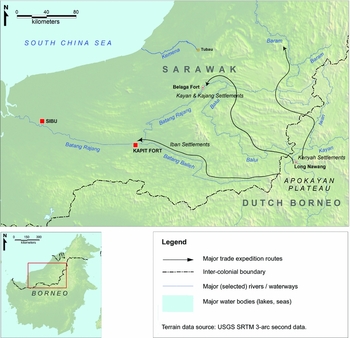
The establishment of the Kapit and Belaga bazaars provided the Apo Kayan Kenyah with alternative and shorter trade routes in comparison to routes to Borneo's east coast, which were fraught with geographical obstacles, such as impassable rapids and the vast distances that would render journeys twice as long compared to west-bound travels (see Figure 1.).
Riverine trade orientations between the Apo Kayan and Sarawak in the early twentieth century.

The 1924 Kapit Peacemaking Agreement
The real challenge that irritated both the Brooke and Dutch governments was the ongoing, though sporadic, hostilities between Ibans of the Balleh and the Apo Kayan Kenyah that reached a peak in 1921. A first attempt in 1922 by the Kapit Resident who visited Long Nawang to arrange a truce failed due to disagreements. A second party of Brooke officials, consisting of Third Division Resident Owen and his junior officer, G. T. MacBryan, took the effort to make the 350-mile roundtrip journey to Long Nawang, the largest village and political centre in the Apo Kayan, to attempt negotiating a peace settlement that would involve the Apo Kayan Kenyah, the Balleh Ibans, and the Dutch administrator (controleur), Captain Molenaar. The Brooke officers both knew that a peacemaking settlement would not be achieved if only the customs of one warring party were observed. The mission's purpose was to prepare a preliminary peacemaking agreement following Kenyah customs.Footnote 56 The Long Nawang peacemaking ceremony was concluded in May 1924, and both the Kenyah and the Balleh Ibans agreed to a further date for a subsequent peacemaking ceremony that would be undertaken following Iban customs at Kapit.Footnote 57
The Kapit peacemaking ceremony on 16 November 1924 was attended by Rajah Charles Vyner Brooke, the respective Brooke and Dutch officials, and approximately ‘4,200 natives’ in all, including the Apo Kayan Kenyah delegation that consisted of 960 men arriving in 97 canoes from across the border. As an unfortunate side incident, three men perished at the cascades during the journey, highlighting the additional human costs involved in securing peace.Footnote 58
Charles Vyner Brooke personally went down to Kapit to look after the proceedings and presented tokens of peace in the form of ancient jars to the Iban Chief, Penghulu Koh, and the Kenyah paramount chief, Taman Kila (Uyung Lencau). Central to the ceremony was the ritual spearing of pigs by each member of the warring parties while shouting, ‘May whosoever reopens [sic] this feud, die in greater agony than this animal’.Footnote 59 Afterwards, the Rajah invited Captain Molenaar and the leading Apo Kayan chiefs to join him back to Sarawak's capital Kuching. The high appreciation the Brooke government placed on the Kapit peacemaking agreement is expressed by the following letter sent by the Sarawak Chief Secretary Moulton to the Dutch government in Batavia:
Afterwards, on the invitation of His Highness the Rajah, Captain Molenaar brought some of the more important chiefs and their followers on to Kuching, the capital of Sarawak, where entertainment was provided for them. His Highness yacht was lent to them for the journey to and from Kuching. . .His Highness wishes to express his keen appreciation of the excellent behaviour of the Kayans and Kenyahs under Captain Molenaar . . . the Sarawak natives reciprocated in a remarkable way and it is thought that the peace-making in itself will remain for a very long time in the memory of all who attended it, and that as a factor in the future prosperity on the Dutch - Sarawak Border it will have a far-reaching and beneficial effect.Footnote 60
Apart from bringing permanent peace to central Borneo, the agreement was hoped, in the words of G. T. MacBryan, who organized the event, to:
encourage freer intercourse between Sarawak and Dutch Borneo to the benefit of the inhabitants of these rivers, in that they will be able to proceed unmolested about their business, and open up the vast country of the Rajang head waters for the working of forest products and to peaceful trade.Footnote 61
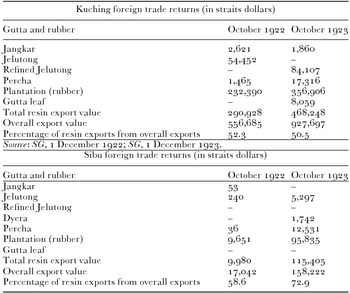
The lack of consistent availability of disaggregated data on Sarawak trade returns, particularly for the Sibu and Kapit Divisions, renders efforts to ascertain and assess the real economic impact of the peacemaking agreement difficult.
Table 1 indicates the general importance of resin exports to the Sarawak economy, represented by data from Kuching and Sibu, two major export hubs. Items collected by the Kenyah and Ibans consisted mainly of jelutong and percha resins. The latter two items may not seem overtly significant at the Sarawak state level exports, but may be of significance during the period at the level of local bazaars such as Belaga and Kapit, both serving as important supply hubs for Sibu.
Resin exports from Sarawak, 1922–23

Source: SG, 2 January 1923; SG, 2 January 1924.
Through this liberalization of human traffic, the Kenyah were able to increase their economic and social role in the Balui, Balleh, and Rajang rivers. The peacemaking successfully eliminated one major obstacle to the Brooke economic policy that placed importance on the free trade of forest products. This was intended not only to boost Sarawak's meagre export revenues, but more importantly, as the Brookes saw it, to use trade as a key to pacification and to bring Sarawak's interior to a non-capitalist, gradual, and peaceful path towards ‘civilization’.Footnote 62
The fact that the arrival of numerous peselai expeditions remain frequently reported in the Sarawak Gazette from the mid-1920s onwards until the Japanese occupation in 1941Footnote 63 suggests that the Dutch transportdiensten (commissioned logistical expeditions) and trade credit incentives,Footnote 64 partly organized to entice Kenyah trading activities away from Sarawak, were not entirely successful. The Kenyah in this regard managed to keep their trading options into Sarawak open.
Aftermath: Dutch and Kenyah responses and concerns
Since no written report has been made on the agreement, either by Brooke or Dutch officials, the following passages by the Dutch administrator A. M. Sierevelt are the only sources that disclose Dutch demands and oral agreements made at Kapit: ‘Notwithstanding the peacemaking ceremony with the Iban archenemies, held in November 1924 at Kapit in Sarawak, the current situation remains precarious. Despite the goodwill and co-operation from the Sarawak administration, the Ibans continue to breach the agreements with unacceptible practices.’Footnote 65 This passage refers to the continuing entrance of Iban parties into the Apo Kayan in search of gutta. However, this may also stem from conflicting interpretations on the agreements made at Kapit, as the following passages demonstrate:
The occasional news about covert gutta-collecting Iban parties in nearby forests still stirs anxiety throughout the Apo Kayan. The Kenyah have no objections against the coming of Iban parties to the Apo Kayan as long as the latter refrain from gutta collection and comply in following the permitted main entry routes (into Dutch Borneo), such as the Pengian, Jelarai and Marong rivers.
The Ibans in Sarawak held steadfast to claims that the peacemaking explicitly permitted them to collect gutta in the Apo Kayan, while the Kenyah made it clear that they went to the peacemaking only under conditions that the process would not be tied to the gutta question, nor would it imply any permission to allow such activities:
Yet, the Sarawak administration claims that it would be unreasonable if the Kenyah were allowed to collect gutta on the Sarawak side, while the Ibans were not allowed to do similar activities on the Dutch side. They fail, however, to acknowledge that gutta-percha reserves on the Sarawak side of the border are almost depleted—which is exactly why Ibans frequently enter the Apo Kayan.Footnote 66
Sierevelt also criticized Captain Molenaar's failure to obtain written concessions at Kapit:
Regrettably, no report of the peacemaking has been produced, which should have been co-signed by the Resident of Sibu and the former administrator of the Apo Kayan.
The current situation can be improved if only the Controller of Long Nawang is given the necessary authority to pursue and punish these Iban border violators. So far, the inspector still has to resolve (the grounds - author) for expelling (Ibans - author) from the Apo Kayan, unless they can be pursued on grounds of stealing gutta on Dutch-Indies territory. Otherwise, regulations to issue reciprocal ‘borderpasses’, as agreed upon with the Sarawak administration, will have no effect against these brutal Ibans.Footnote 67
It was apparent that the Dutch hoped to use the Kapit peacemaking Agreement as an ill-fated opportunity to regulate and formalize human traffic across the boundary by institutionalizing border passes and determining official river entry points into the Apo Kayan. The sole concern shared by both the Kenyah and the Dutch authorities was related to continuing Iban gutta-collecting activities into the Apo Kayan. While the Kenyah were primarily concerned about market access as well as Iban competition over gutta reserves, the Dutch were concerned about maintaining territorial sovereignty threatened by the cross-border theft of ‘Dutch’ natural resources and the ‘illegal’ influx of Iban gutta-collecting parties.
The Dutch, however, were continually concerned with the orientation and close rapport many Apo Kayan leaders enjoyed with Sarawak officials and traders, in addition to the continuing aspirations Kenyah leaders held to migrate to Sarawak. A number of villages in the Apo Kayan were able to exploit these Dutch concerns in order to resist taxation, as Controleur Scheffelaar reported from his 1930 visit to the Punan Busang settlement on the Iwan river: ‘I was immediately asked by these Punans not to harass them with demands insisting them to cultivate rice or pay taxes. I assured them that I did not intended to do so, driven by my own fears that they will escape into Sarawak and thereby losing an ethnographically-remarkable people from our territory.’Footnote 68
In many cases, close trading relations with Sarawak were often seen by the Dutch as pretexts for out-migrations:
These Punans are frequently visited by Ibans and Kayans from the Balui who come over to buy bezoar stones, forest products and rattan mats. The latter being in high demand in Sarawak. The previous Controleur of Long Nawang did good by visiting them with a Doctor at least two times per year. It is necessary to remind them that they are Dutch subjects, not only due to their connections with Sarawak, but also due to this Officer Abang that has attempted before to persuade them to move over to Sarawak.Footnote 69
Another case involved the Uma’ Baka Kenyah, whom the Dutch considered were living too close to the main entrance route close to the Sarawak boundary:
The ricefields of the Uma’ Baka stretches into British territory. The British Native Officer at the Belaga Fort has no reservations against that. He apparently hopes that this lax approach would encourage the Uma’ Baka to move over to Sarawak. The Marong river is the most frequently used connecting route from the Apo Kayan to the Balui in Sarawak. This route is also used by Sarawak Malay traders. It only takes two hours paddling from the Uma’ Baka village to the Sarawak border. No wonder that the Uma’ Baka frequently trade over there where they have good relationships with the Ibans, Kayans and Malays. In the end, this leaves a negative impression.Footnote 70
The Dutch imposed stricter regulations to hamper the migration of settlements away from Dutch-controlled areas. The Dutch, for example, banned Punan settlements on the Iwan river from migrating further upstreams and only allowed settlement downstreams to controllable areas closer to the main cluster of Apo Kayan settlements (Sierevelt, 1929). A number of Kenyah groups, however, managed to migrate to Sarawak against Dutch wishes. In the case of the Badeng Kenyah, the Dutch expressed fears that out migration by one group may lead to the migration of others, as Controleur Scheffelaar pointed out:
Around 400 Uma’ Badeng Kenyah under the leadership of Taman Kule Iran moved over to the Sai river across the border in Sarawak, and they have moved further down the Balui by 1930. This migration plan appears to be, as I was told, instigated when the former controleur Molenaar went to Kapit in 1925 [sic] with hundreds of Kenyah from the Apo Kayan to seek peace with the Ibans following the headhunting incident of 1921. With the Badeng now living in Sarawak, it would now be easy for Taman Kule Iran to persuade further out migrations. I had never given my permission. There are still ample lands available in the Pengian for the Badeng, even should their their numbers increase. Shortage of lands would therefore be no acceptable reason to migrate. Such out migrations also affect our prestige. Our administration is certainly not inferior to the British.Footnote 71
The peacemaking agreement allowed the Kenyah unhindered access to Sarawak markets in exchange for permissions to allow Iban parties to collect gutta in Dutch Borneo. This not only increased the circular mobility and out-migrations of the Kenyah into Sarawak, antagonizing Dutch efforts in reorienting Kenyah mobility within the confines of its own boundary, but also left the Dutch in a dilemma in having to reluctantly leave the border open in exchange for long-lasting security along the border and its own acceptance as a sovereign ruler among the Kenyah. This is further compounded by Dutch inaction towards out-migrations from the Apo Kayan to Sarawak, which continued not only until the end of de facto Dutch rule in 1950, but well into the 1990s under Indonesian rule.
This Dutch inaction, however, also discloses another side to state formation and state authority in the Apo Kayan. Their well-founded fear that over-zealous bans on trading expeditions and the demarcation of the boundary would lead to out-migrations into Sarawak was secondary to the important need to maintain local sovereign recognition over the Apo Kayan. This is partly achieved through negotiated settlements where tax collection, ironically paid for by the local populace from revenues generated from Sarawak-bound trade expeditions, was not too heavily enforced. Adding to the irony, funding of the Dutch military garrison in Long Nawang was totally dependent on locally collected tax revenues.Footnote 72 In this regard, the Dutch dilemma was that key to maintaining and exercising sovereignty over the Apo Kayan was funded by tax revenues generated from the very activities it attempted to restrict. In the end, the Dutch had to concede to the territorial anarchism of its subjects in exchange for its acceptance as a sovereign ruler. This pattern lasted long after the Dutch left, including successive Indonesian governments until recently, who have constantly failed to fully integrate the Apo Kayan, both socially and economically, into its national space.
A remaining question remains to be answered: did headhunting between the Ibans and the Kenyah in fact ceased after Kapit? One striking fact is that reports of incidents between both parties almost disappeared overnight from Sarawak Gazette reports after 1924. Even Sierevelt and Scheffelaar merely reported the still widely shared ‘headhunting’ scares among the Kenyah without any real reference to actual headhunting or raiding incidents after 1924. In fact, oral history among the Kenyah often hint at the close friendship both Kenyah and Iban chiefs (Uyung Lencau and Penghulu Koh), who reportedly became blood brothers during the peacemaking agreement.Footnote 73 Sporadic headhunting incidents, however, were briefly reported during the Japanese occupation against the occupiers and collaborators.Footnote 74 Another plausible explanation is that, starting in the late 1920s, Ibans from the Balleh and Rajang rivers started to disengage themselves from the trade of gutta due to the rising attractions of employment opportunities in the newly opened oilfields of Sarawak's north-east.Footnote 75 Simultaneously, the period between 1929 and 1965 marked a significant religious transformation in the Apo Kayan. The arrival of the United States of America-based Christian Mission Alliance made some significant influence in the Apo Kayan during the 1930s, followed by the reformation of the old Kenyah religion in the late 1947s into the Bungan cult that significantly disposed all belief systems related to headhunting and the ritual significance of head trophies.Footnote 76 The Indonesian military forced all Kenyah longhouses to destroy remaining head trophies and other non-Christian religious objects by the end of 1965.
Contemporary Kenyah perspectives
The importance of the Kapit 1924 Peacemaking Agreement, or petutung Kapit (‘Kapit deliberations’), remains a recurrent theme in Kenyah oral history. As Hoskins remarked that ‘headhunting is part of history as an ideological construct, a vision of the past now alienated from the present’,Footnote 77 the Kenyah themselves in Long Nawang today recount the story in a victor's narrative highlighting their ancestors’ heroism against Iban attacks, while simultaneously drawing moral boundaries when the gory details of Kenyah males cutting of heads and eating the livers of their Iban victims are attributed to their ancestors pre-Christian ‘paganism’. This latter story possibly referred to the 1921 slaying of the Iban gutta-collecting party that triggered the Brooke government to intervene. Most narratives, as expected, are inversions where, as George (1996) similarly encountered, the colonial and victims’ voices are excluded. In addition, there are no contemporary narratives on the preceding events related to the gutta wars or to the Kenyah's own quest to find trading routes into Sarawak. During the course of my continuing fieldwork in the Apo Kayan between 2000 and 2015, only one elderly man, Pelencau Bilong (who passed away in 2010 at the ripe old age of 101), was able to recount the story that linked the Kapit event to a larger context of events that involved the lack of salt throughout the Apo Kayan as a result of Iban raids against peselai trading expeditions, the interruption of harvest cycles due to recurring Iban headhunting raids against Kenyah families encamped in faraway swidden fields and the revenge party of Kenyahs who accordingly ‘chased the Iban away from the Iwan back into the Balleh, took their heads and ate their livers out of hunger’. If these stories were true, they were remarkably absent from Sierevelt's otherwise very detailed memoirs on the ‘gutta question’.Footnote 78
It came as a surprise when I was approached during a recent field visit (2015) by members of the Apo Kayan Customary Council (Dewan Adat Besar Apau Kayan) to talk about history. Knowing my previous inquiries about the history of the Kapit agreement, the secretary of the Council wanted to know more about what information I managed to gather. As I showed copies of the Sarawak Gazette 1924 edition and copies of Siervelt's memoirs, I was asked to translate what the ‘white men’ wrote about the petutung Kapit. I orally translated the texts on the gutta wars, the details of Dutch accounts, and a reproduced photograph of the ceremony. The men in the Council urged me to assist them in writing a history of the Apo Kayan, especially detailed stories that were in Dutch reports. One of them explained the reason why: ‘We want to show our history as borderlanders (masyarakat perbatasan), and show the government that we have our own history. Sarawak is part of our history, and I think it would be plausible for us to prepare the 100 year anniversary of the Kapit ceremony.’ It occurred to me that the reason was partly political, as the Council was preparing to advocate the formation of the Apo Kayan as a new administrative district (Kabupaten), and, as elsewhere in Indonesia, each district needs an ‘official’ history, an identity. An interesting point was that they were longing for an outsider's ‘external history’Footnote 79 —a colonial historical narrative hitherto elusive to the Kenyah, which in their eyes provided a degree of coherence and legitimacy to their own oral history.
Concluding remarks
The 1924 Kapit Peacemaking Agreement represents one of many ‘transnational’ events largely forgotten under contemporary national historical narratives. The importance of studying the events surrounding the agreement not only complements the ethnographic understanding of local mobility and inter-village or inter-riverine warfare histories in central Borneo, but also sheds a deepened understanding on colonial state formation and the problems it encountered when attempting to subjugate the indigenous populace whose territoriality did not fit the disciplining nature of the territorial-state.
As our discussion had demonstrated, the extent of ‘headhunting’ in Borneo during the 1920s was not merely an expression of inter-local warfare motivated by beliefs, individual status accumulation, personal vendettas, or simplified animosities between warring villages or riverine communities, but moreover reflected a heightened competition among local communities over certain commodities that were highly sought by regional markets around the South China Sea. This posed a peculiar problem to the Dutch who controlled the eastern part of the Borneo, which was more removed from the favoured trade networks that extended from the South China Sea through Sarawak up to the upland interior. Dutch efforts to consolidate borderland discipline and transform its subjects into legible, sedentarized, and territorial-loyal citizens was challenged by the structural power of commodity flows and market integration that long characterized the social and economic formation in central Borneo.
Brooke state expansion came with efforts to adjust modes of governance that took advantage of central Borneo's open riverine social systems by domesticating the various commodities and peoples from across the border in order to strengthen its own free-trade policies. This also highlights the peculiar anomaly of Brooke policies oriented towards open frontiers in central Borneo compared to the wider context of discussions focused on the boundary consolidation process between the British and Dutch colonial empires in Southeast Asia. The Dutch, in turn, were beset by problems of having to consolidate a borderland region that was increasingly becoming economically and socially tied to Sarawak markets as a direct result of the peacemaking agreement. The Dutch colonial Administration failed to grasp the cosmopolitan outlook of its own Kenyah subjects who were striving to use the peacemaking agreement not merely to bring an end to Iban raids, but to widen their access to markets on the Sarawak side—one outcome that perfectly fitted the designs of Sarawak's Brooke government.
The problems of state formation in central Borneo highlight a problem of conflicting geographies, namely the expansion of state spaces against the fluid geography of commodity chains and the terrestrially bound territoriality of state spaces against riverine territoriality.