INTRODUCTION
Neurocognitive dysfunction is a characteristic of schizophrenia (Heinrichs & Zakzanis, 1998). Memory impairment, along with deficits in attention and executive functions, is prevalent (Weiss & Heckers, 2001). Some forms of memory, particularly verbal memory, may be selectively impaired relative to other neuropsychological functions in patients with schizophrenia (Cirillo & Seidman, 2003; Saykin et al., 1991). Patients with schizophrenia tend not to spontaneously use semantic information to categorize related word lists for encoding and retrieval (Brebion et al., 1997; Gold et al., 1992; Nohara et al., 2000). For example, schizophrenic patients were not any better at recalling lists of words that were readily organizable into semantic categories compared to lists that were not.
Schizotypal disorder (ICD-10: World Health Organization, 1993) or schizotypal personality disorder [Diagnostic and Statistical Manual of Mental Disorders-Fourth Edition (DSM-IV): American Psychiatric Association, 1994] are genetically related to schizophrenia and share many biological features (see review by Siever & Davis, 2004). The clinical symptoms of schizotypal disorders are characterized by “eccentric behavior and anomalies of thinking and affect which resemble those seen in schizophrenia” (ICD-10) but are differentiated by a lack of overt and sustained psychosis or severe functional deterioration. We were interested in determining whether the cognitive deficits found in schizophrenia were related to any common substrate of schizotypal subjects. Our preliminary study, using a comprehensive battery of neuropsychological tests, showed that the cognitive deficits in schizotypal subjects were qualitatively similar to those in patients with schizophrenia but quantitatively milder (Matsui et al., 2004b). We found that impairment of verbal memory based on quantity of recall in schizotypal subjects was comparable to that in patients with schizophrenia. In the current study, we focus on memory organization in schizotypal subjects, compared with schizophrenic and normal subjects, to clarify characteristics of verbal memory related to this spectrum of neuropsychological impairment.
The present study examines the relationship between diagnostic group (schizophrenia, schizotypal disorder, and normal adults) and memory organization and verbal learning to clarify common characteristics between schizophrenia and schizotypal disorder. In addition, we examine whether clinical symptoms or demographic characteristics correlate with memory organization in patients with schizophrenia or schizotypal disorder. We tested the following hypotheses: (1) schizotypal subjects have greater semantic organization than schizophrenic patients but less than normal subjects; (2) the effect of learning on semantic organization would be no greater in patients with schizophrenia or schizotypal disorder than in normal subjects.
METHODS
Participants
The participants were 51 patients with schizophrenia (34 men and 17 women), 28 patients with schizotypal disorder (17 men and 11 women), and 133 healthy adults (63 men and 70 women). The participants' demographic and clinical data are presented in Table 1.
Clinical and demographic characteristics of patients with schizophrenia, patients with schizotypal disorder, and healthy subjects

Patients were recruited from the inpatient and outpatient clinics of the Department of Neuropsychiatry, Toyama University Hospital. All available clinical information and data were obtained from a structured clinical interview using the Comprehensive Assessment of Symptoms and History (CASH; Andreasen et al., 1992). Patients were diagnosed using ICD-10 diagnostic criteria through the consensus of at least two experienced psychiatrists. Every schizotypal patient also fulfilled the criteria for schizotypal personality disorder using the DSM-IV criteria (American Psychiatric Association, 1994). Whenever possible, the patient's family was interviewed by psychiatrists to provide additional information. Patients were excluded if there was a history of substance abuse or an estimated IQ less than 70. Patients with schizophrenia and schizotypal disorder had a mean age of 24.3 years (SD = 6.2; range, 15–39 years) and 24.9 years (SD = 5.6; range, 16–35 years), respectively. Almost all patients were receiving neuroleptic medication; 3 of the 51 schizophrenic patients and 5 of the 28 patients with schizotypal disorder were not on medication. The patients with schizotypal disorder took significantly smaller amounts of neuroleptics than did the patients with schizophrenia, and five had never been on medication. Current clinical symptoms were rated using the Scale for the Assessment of Positive Symptoms (SAPS; Andreasen, 1984) and the Scale for the Assessment of Negative Symptoms (SANS; Andreasen, 1983). The symptom scores indicated that all patients were rated between mildly to moderately ill and presented primarily with negative symptoms at the time of the study.
There were 133 control participants consisting of healthy volunteers recruited from the hospital staff, university students, and volunteers from the community. Control participants were excluded if they had a relative with a history of psychiatric illness, or a personal history of psychiatric illness, head trauma, neurological illness, serious medical illness diagnosed by physician, substance abuse, or an estimated IQ less than 70. None of the control participants were receiving pharmacological treatment for medical illnesses. All control participants were given the Minnesota Multiphasic Personality Inventory, and participants were excluded if they had abnormal profiles with any T score exceeding 70. There was no significant difference in age [analysis of variance (ANOVA), F = 2.67; df = 2, 209, not significant] and education (ANOVA, F = .76; df = 2, 209, not significant) among patients with schizophrenia, patients with schizotypal disorder, and healthy subjects. There was a significant difference in estimated IQ (ANOVA, F = 5.57; df = 2, 209; p = .004, healthy subjects > schizophrenia).
Approval by the Committee of Medical Ethics of the University of Toyama was obtained before approaching the participants. After a complete description of this study was presented to the participants, their written informed consent was obtained.
Procedure
Participants were tested individually by experienced examiners who were supervised by the neuropsychology faculty. First, the vocabulary and block design subtests from the Japanese version of the Wechsler Adult Intelligence Scale-Revised (Shinagawa et al., 1990) were administered for estimation of IQ (based on Silverstein, 1982). Then the Japanese Verbal Learning Test (JVLT; Matsui et al., 2004a) was administered.
Japanese Verbal Learning Test
The JVLT (Matsui et al., 2004a) is composed of a 16-word list based on Gold et al. (1992). Four exemplars from each of four categories (vehicles, countries, flowers, and flavors) are constructed so that related items never appear consecutively as blocks in the list. Thus, the unblocked list is a memory task for implicitly categorizable words that can be used to measure the degree of semantic organization in recall. The list words were selected from common Japanese words (Ogawa, 1972) so that the frequency of each word was approximately the same. Three trials involving each list were presented consecutively. The words were presented at a rate of one word per second, and the subjects were required to recall the words after each 16-word set was presented.
Data Analysis
The total number of words recalled from the list for each of the three trials was calculated. The order in which each participant recalled the words was evaluated for organizational characteristics.
Organization Index
Because the unblocked list has a latent semantic structure, participants can facilitate performance by clustering the words into categories during recall. Clustering during recall indicates the extent that participants recognize and process the semantic content of the words. Greater clustering will lead to greater word recall than by chance alone. Indices of clustering according to the serial order of word presentation (Serial Clustering) and semantic content (Semantic Clustering) were calculated using the number of clustering/number of total recall ratio. In addition, an index of Subjective Clustering, designed to quantify the degree to which an individual uses an idiosyncratic clustering strategy in recalling the target list, was calculated using the number of clustering/number of total recall ratio. To satisfy the normality assumption for parametric methods, the formula 2*arc sine of the square root of the proportion was used to transform all proportions.
Statistical Analysis
The total number of words recalled was evaluated by an analysis of covariance (ANCOVA) with diagnostic group (schizophrenia, schizotypal, control) as a between-group factor and IQ as a covariate. ANCOVA was carried out to evaluate differences for each organization index (semantic, serial, subjective clustering) between diagnostic groups. Diagnostic group was used as a between-group factor, and the organization index (semantic clustering ratio, serial clustering ratio, subjective clustering ratio) was used as a within-group factor. To examine the effect of learning, the number of words recalled and the organization index were analyzed by ANCOVA, with diagnostic group as a between-group factor, the semantic clustering ratio in each trial (trial 1, trial 2, trial 3) as a within-group factor, and IQ as a covariate. Post hoc Tukey tests were conducted on the significant main effects or interactions. Cohen's d was used to estimate effect size. Statistical significance was set at p < .05.
We looked for correlations between clinical symptoms and the organization index using Pearson product correlations. For clinical symptoms, we report correlations significant at the p < .005 level in the total patient cohort (so that they would remain significant using a Bonferroni adjustment of p < .05 for multiple correlations). Pearson product correlation coefficients were also used for patients with schizophrenia or schizotypal disorder to determine whether there were any correlations between organization indices with duration of illness, current drug dosage, duration of medication use, age at onset of symptoms, and level of education.
RESULTS
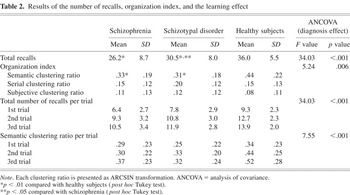
The results of the ANCOVA for the number of words recalled showed a significant main effect of diagnostic group [F(2,208) = 34.03; p < .0001]. Post hoc tests showed that the diagnostic groups were ordered in terms of the greater number of words recalled as follows: control > schizotypal > schizophrenia (see Table 2; control vs. schizophrenia: p < .001, effect size = 1.50; control vs. schizotypal: p < .001, effect size = .91; schizotypal vs. schizophrenia: p = .02, effect size = .52).
Results of the number of recalls, organization index, and the learning effect

ANCOVA revealed significant main effects of organization index [clustering score/total recall; F(2,416) = 6.81; p < .01] and diagnostic group [F(2,208) = 5.24; p < .01]. Post hoc analyses showed that the order for the greater number of words recalled related to the organization index was semantic clustering > serial clustering > subjective clustering. The control group recalled more words than the schizophrenia group (p < .01). There was a significant organization-by-diagnosis interaction [F(4,416) = 5.36; p < .001]. Post hoc tests showed that controls had a higher semantic clustering rate than schizophrenia patients (p < .0001; effect size = .51) and schizotypal patients (p < .0001; effect size = .62), but there was no difference between schizophrenia patients and schizotypal patients (p = .99; effect size = .12). There were no significant differences among diagnostic groups regarding rates of serial and subjective clustering.
ANCOVA for the effect of learning, based on the number of words recalled for learning trials 1 through 3, revealed significant main effects of diagnostic group [F(2,208) = 34.03; p < .0001] and trial [F(2,416) = 39.02; p < .0001]. There was no significant interaction between the diagnostic group and trial [F(4,416) = .654; p = .624]. ANCOVA for the effect of learning, based on the semantic clustering ratio, also showed significant main effects of diagnostic group [F(2,208) = 7.55; p < .001] and trial [F(2,416) = 4.00; p = .019]. There was a significant trial-by-diagnosis interaction [F(4,416) = 3.49; p < .01]. Semantic clustering increased with successive trials (trial 1 < trial 2 < trial 3) for controls, whereas semantic clustering in neither patient group significantly increased with successive trials.
No significant correlation was found for either patient group between any organization index (semantic, sequencing, or subjective) and the symptom subscale scores on the SAPS or SANS. No significant correlation was found for either patient group between any organization index and current drug dosage, duration of medication, age at onset of symptoms, or level of education. The only positive correlation found was between the subjective clustering rate and the duration of illness in schizophrenia (r = .39; p < .011) but not schizotypal disorder. No correlation was found between semantic or sequencing clustering rates and duration of illness in either patient group.
DISCUSSION
This study examined the way memory is organized in patients with schizophrenia, schizotypal disorder, and normal subjects. The results showed that patients with schizophrenia and schizotypal disorder exhibited a lower semantic clustering rate than the control group. There was no significant difference of clustering rates between the schizophrenia and schizotypal disorder groups. However, the schizotypal disorder group recalled more words than the schizophrenia group, but less than the normal control group. This finding suggests that impairment of semantic organization is common to both schizophrenia and schizotypal disorder, although the total quantity of verbal recall is more reduced in schizophrenia. The present results are consistent with previous findings of a significant verbal learning deficit in schizotypal patients (Voglmaier et al., 2000), while also more specifically identifying the role of semantic organization in verbal memory in schizotypal and schizophrenic patients. Brebion et al. (1997) pointed out that verbal memory deficits may be linked to difficulties with self-generated organizational strategies in which patients fail to use semantic information to facilitate verbal encoding and retrieval. Consistent with previous evidence suggesting an inability to use semantic information to aid retrieval, the present results show that patients with schizophrenia and schizotypal disorders were less likely to deeply encode items (as measured by semantic clustering rate) but were more likely to use superficial encoding strategies than normal subjects. Alternatively, the internal semantic network in these patients may be impaired, as Brebion et al. (2004) discussed as a cause of impairment of semantic organization.
A further purpose of our study was to evaluate the effect of learning on semantic organization in patients with schizophrenia, schizotypal disorder, and normal people. Patients with schizophrenia and schizotypal disorder, as well as normal subjects, showed an effect of learning on the number of words recalled in successive trials. However, patients with schizophrenia or schizotypal disorder did not show any effect of learning on the use of semantic organization, in contrast to normal subjects. Patients did not increase their use of semantic clustering with learning, and generally they did not make much use of this efficient strategy.
Clinical symptomatology was unrelated to verbal learning and memory organization in schizophrenia or schizotypal disorder. In addition, there was no significant correlation between memory organization and current drug dosage, duration of medication, age at onset of symptoms, and level of education in the patient groups. Only subjective clustering was positively correlated with duration of illness in schizophrenia. Thus, dysfunction of semantic organization appears to be intrinsic to schizophrenia spectrum disorder and presents independent of clinical symptoms.
This study has limitations, including an unmatched sample size where the normal control group was larger than both patient groups together. Therefore, one should be cautious about applying the present findings to the general population of people with schizotypal disorder. Follow-up studies are needed to determine whether the schizotypal subjects evaluated here will later develop schizophrenia.
In summary, this study showed that schizotypal patients have decrements in semantic organization that are similar to those found in schizophrenic patients. Neither patient group showed any effect of learning on increasing the use of semantic organization. These results suggest that impairment of memory organization is a common characteristic in schizophrenia spectrum disorders.
ACKNOWLEDGMENTS
This study was supported by a Grant-in-Aid for Scientific Research (C) (2), 16530445 from the Japan Society for the Promotion of Science (JSPS). The authors thank Ms. Kuniko Tanaka and Ms. Ayumi Shimoda for help in data analysis.