It is important to know what wealthy Americans seek from politics and how their policy preferences compare to those of other citizens.
There is good reason to believe that the wealthiest Americans exert more political influence than their less fortunate fellow citizens do. Historically oriented scholars like Thomas Ferguson, William Domhoff, Fred Block, and others have long argued that “major investors” or business elites dominate the making of public policy and the agendas of both the Republican and the Democratic parties.Footnote 1 Jeffrey Winters maintains that the top one-tenth of 1 percent of US wealth-holders constitute an “oligarchy” with decisive power over certain key policy areas related to what he calls “income defense.”Footnote 2 Jacob Hacker and Paul Pierson describe how Washington has “made the rich richer.”Footnote 3
Recent quantitative evidence tends to point in a similar direction. Larry Bartels and Martin Gilens, for example, have shown that senators' roll-call votes and actual federal government policy correspond much more closely with the policy preferences of “affluent” Americans (those in the top third or top fifth of the income distribution) than with the preferences of low- or middle-income citizens.Footnote 4
But the implications of unequal political influence depend heavily upon exactly what wealthy Americans actually want government to do. If—as Stuart Soroka and Christopher Wlezien have suggested—the policy preferences of the affluent were much the same as everyone else's, then their unequal influence would make little practical difference.Footnote 5 On the other hand, if the wealthy have very distinctive preferences that conflict with the interests of other citizens, their disproportionate influence would seem to create a serious problem for the working of democracy in the United States.
What Is Known
Research to date has only offered hints about the policy preferences of truly wealthy Americans. Gilens, using hundreds of general-population surveys covering scores of different policy issues, has produced excellent evidence on “affluent” Americans: those in the top 20 percent or so of income earners.Footnote 6 Relatively affluent Americans tend to be more liberal than others on religious and moral issues, including abortion, gay rights, and prayer in school, but much more conservative than the non-affluent on issues of taxes, economic regulation, and social welfare.
Moving a bit higher on the income scale, to the top 4 percent or so, Benjamin Page and Cari Hennessy—combining three unusual General Social Surveys from the 1970s—found a similar pattern, with particularly sharp differences between the affluent and other Americans concerning social issues and substantial differences on economic matters.Footnote 7
But general-population surveys seldom provide usable subsamples of people at really high levels of income or wealth. By definition, a representative sample of 1500 members of the general public aims to include only a handful—15 or so—of individuals from the top 1 percent. Differential response rates tend to reduce the number actually interviewed even further. Nor is it feasible to combine wealthy respondents across surveys; because of “top coding” of incomes it is not generally possible to identify who they are. The wealthiest respondents are usually lumped into a broad, top-income category that includes 10 percent or more of the population. Within that group it is impossible to be sure who does and who does not belong in, say, the top 1 percent.
For systematic evidence on the policy preferences of really wealthy Americans—such as the top 1 percent or the top one-tenth of 1 percent of wealth-holders—it is necessary to design special surveys that explicitly target those groups. The Survey of Consumer Finances (SCF) does so admirably, but only includes questions about economic matters.Footnote 8 A number of surveys based on “convenience samples” from wealthy neighborhoods, lists of bank clients, and the like have been conducted to study philanthropic behavior. But they tend to be very unrepresentative and have generally only investigated charitable giving.Footnote 9 There have been no scientific, representative surveys of the broader social and political attitudes and behavior of top US income earners or wealth holders.
Accordingly, we—together with an extensive set of collaborators around the country—have been working toward an original national Survey of Economically Successful Americans, or SESA.Footnote 10 Here we report some findings from a small but representative SESA pilot study, conducted in a single metropolitan area. We believe its results may be suggestive of patterns that apply more broadly.
Difficulties in Surveying the Wealthy, and the SESA Solution
It is extremely difficult to identify and interview a representative sample of wealthy Americans.Footnote 11
The first, and hardest, problem is identifying the population of wealthy households. If one had a comprehensive list of wealthy Americans it would be a simple matter to select a random sample of names from that list. But no such publicly available list exists. In the United States, income and wealth are highly private matters.
The most reliable lists of wealthy US households that we know of are produced by the Internal Revenue Service. The IRS estimates household wealth based on detailed income data from tax returns. It provides list samples of the wealthy—on a highly confidential basis—to the Federal Reserve Board in order to carry out the Survey of Consumer Finances (SCF). But this is done only because of the critical public purpose of the SCF, which is essential to making informed economic policy. These lists are not available to private researchers.Footnote 12
We were compelled to pursue a different approach. Fortunately we have been able to work with NORC at the University of Chicago (formerly the National Opinion Research Center), which has had abundant experience interviewing wealthy Americans when conducting the SCF for the Federal Reserve. At the suggestion of a NORC sampling expert we turned to an imperfect but commercially available list: the Wealthfinder “rank A” list of roughly the top 4 percent of US wealth-holding households.Footnote 13
Since the Wealthfinder “rank A” list is designed to help high-end businesses reach affluent consumers, not to conduct scientific research, it can tolerate substantial errors. (Not much money is wasted if a retailer mistakenly mails a few glossy catalogs to people who are not truly wealthy.) Still, by using two refinement strategies we were able to refine our sampling frame to zero in on the top 1 percent of wealth-holders. First, we selected only cases that met thresholds on several filter variables—the best available household-level data on the incomes, home values, and income-producing assets of households. Second, we weighted our sample toward cases that overlap with a separate list of business executives, Execureach, filtered to include only high-level executives of fairly large firms. These adjustments substantially increased the wealth levels within our sample, while minimizing the risk of excluding genuinely wealthy households. Using regression techniques, a sample drawn in this way can also be used to estimate attitudes and behavior of people in the top one-tenth of 1 percent of wealth-holders, people who have roughly $40 million or more each in net worth.
In 2011, NORC used this sampling frame to randomly draw representative samples of wealthy households from communities in the Chicago metropolitan area, including the city itself, affluent suburbs toward the west of the city, and the affluent North Shore. Chicagoland, of course, is not the whole United States. Wealthy people living in, say, Dallas, New York, or Silicon Valley may differ. But until a nation-wide SESA can be conducted, the Chicago area pilot study offers the best available window into what may be true elsewhere. The Chicago-area wealthy, if not perfectly typical, may at least tend to occupy a middle ground—not only geographically but in terms of political culture—between the extremes of the South and the two Coasts.
The pilot study as a whole yielded a total of 104 interviews. After a brief false start in the autumn of 2010, during winter and spring 2011 NORC interviewers used the refined sampling design (described above) to contact, win the cooperation of, and interview 83 Chicago-area respondents, who provided the data for most of the analyses reported here.Footnote 14
The words “contact” and “win the cooperation of” conceal a world of difficulties inherent in studying the wealthy. It is extremely difficult to make personal contact with wealthy Americans. Most of them are very busy. Most zealously protect their privacy. They often surround themselves with professional gatekeepers whose job it is to fend off people like us. (One of our interviewers remarked that “even their gatekeepers have gatekeepers.”) It can take months of intensive efforts, pestering staffers and pursuing potential respondents to multiple homes, businesses, and vacation spots, just to make contact.
Once personally contacted, a large fraction of our potential respondents agreed to cooperate with SESA. But cooperation cannot be taken for granted. Response rates among the wealthy are often abysmal. Our success resulted from special efforts. We employed highly talented and persuasive interviewers, several of whom had previously interviewed wealthy respondents for SCF. We made sure that our topics were of interest, asking questions about economic success and charitable contributions as well as public policy. We stressed the completely nonpartisan and scientific nature of the project, emphasizing the roles of Northwestern University and the University of Chicago and noting NORC's impeccable record of preserving confidentiality. And we kept our interviews fairly short; they could be completed in 45 minutes, if respondents did not volunteer extra comments
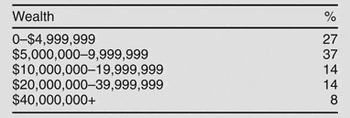
Our overall “response rate,” in the most demanding sense—that is, the proportion of eligible, sampled potential respondents that actually completed interviews—was 37 percent, a remarkably high figure for this sort of very elite population.Footnote 15 Most of our respondents fell into or near the top 1 percent of US wealth-holders.Footnote 16 Their average (mean) wealth was $14,006,338; the median was $7,500,000. (For the distribution of respondents by wealth category, refer to Table 1.) To give a further idea of their economic standing: respondents' average income was $1,040,140. About one third of them (32.4 percent) reported incomes of $1,000,000 or more.
Distribution of wealth among SESA respondents

Notes: Mean wealth = $14,006,338; median = $7,500,000.
N = 83, refined sample. The 12 cases (14%) with missing values are omitted.
We offered all respondents a choice of survey modes. The default option was a face-to-face, in-person interview at home or any other place and time of their choosing. But most respondents (89 percent) preferred to be interviewed by telephone—usually at their place of business—so that they could break off if necessary and resume later. In the general public, differences in survey modes can sometimes have serious effects upon responses, but such mode effects do not appear to be a problem with highly opinionated and very articulate respondents like ours.Footnote 17
Our questionnaire was designed to include many policy preference questions from surveys previously conducted with the general public, so that we could compare the responses of our wealthy respondents with those of other Americans. In order to explore possible mechanisms by which the wealthy may influence politics, we also asked several questions about their political activity.
Political Activity among the Wealthy
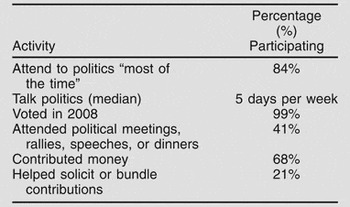
Wealthy Americans tend to be highly active in politics, far more so than the typical citizen (refer to Table 2). Nearly all our respondents (99 percent) reported having voted in 2008, and many attended a campaign speech or meeting. A large majority (84 percent) said they pay attention to politics “most of the time.” Asked how many days of the week they talk politics, the median response was five days. (More than one volunteered “all the time!”) Perhaps most importantly, fully two-thirds contributed money to politics, giving an average of $4,633 to political campaigns or organizations over the previous twelve months. (By comparison, in the American National Election Study survey conducted shortly after the 2008 presidential election, just 14 percent of the general-population respondents reported having contributed money to a candidate, party, or Political Action Committee.) A remarkable 21 percent of our wealthy respondents solicited or “bundled” other peoples' political contributions—not an activity that is common among ordinary citizens.
Political activity by wealthy Americans

N = 83.
These findings are consistent with a familiar pattern in American politics. As Sidney Verba, Kay Lehman Schlozman, and Henry Brady have shown, political activity—and especially money giving—tends to rise as individuals' income and other resources rise. Little wonder that those who have the most money give the most to politics. But this means their political “voice” is louder than others' voices.Footnote 18 Financial contributions may represent an important mechanism by which wealthy Americans exert disproportionate political influence.
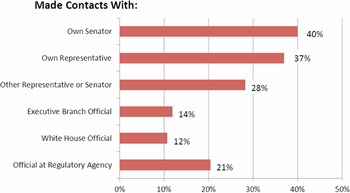
Another possible mechanism of influence involves “access” to, or contacts with, public officials. We asked our interviewees whether or not they had initiated a contact with each of six types of federal government officials or their staffs in the past six months. About half reported contacting at least one type of official (refer to Table 3), a much higher proportion than among the general public.Footnote 19 The wealthy were particularly likely to initiate contacts with members of Congress. Forty percent reported contacting their own senator, and 37 percent contacted their own representative; remarkably, about one quarter contacted a representative or senator from another district or state (refer to Figure 1). In total, 47 percent of our respondents made at least one contact with a congressional office. Contacts with executive department officials, White House officials, and officials at regulatory agencies, though less frequent, were also common.
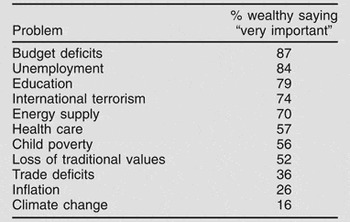
Perceived importance of problems facing the United States

Notes: Entries are the percentages of wealthy respondents rating each possible problem as “very important,” as opposed to “somewhat important” or “not very important at all.”
DKs—“Don't know” and “no opinion” responses—are excluded. N = 83.
High-level political contacts by wealthy Americans

Most of our respondents supplied the title or position of the federal government official with whom they had their most important recent contact. Several offered the officials' names, occasionally indicating that they were on a first-name basis with “Rahm” (Emmanuel, then President Obama's Chief of Staff) or “David” (Axelrod, his chief political counsel). The frequency of such close ties to the Chicago-linked Obama administration may be unique to our Chicago-area respondents, but we see no particular reason why their high frequency of contacts with congressional representatives should be atypical of wealthy Americans elsewhere in the country.
Most also replied to an open-ended question about the main purpose of their most important recent contact, often giving a fair amount of detail. We have analyzed the nature of these contacts elsewhere.Footnote 20 One key finding is that, for contacts that could be coded, just under half (44 percent) acknowledged a focus on fairly narrow economic self interest: “to try to get the Treasury to honor their commitment to extend TARP funds to a particular bank in Chicago”; “to better understand the new regulations of the Dodd-Frank Act and how it will affect my business [banking/finance]”; “Fish and Wildlife … permitting on development land”; “on behalf of clients, seeking regulatory approvals”; “I own stock in several banks. I was concerned about legislation he was drafting that I think could be harmful for the banks.” Given possible sensitivities about such contacts it is possible that their frequency was underreported, yet the number revealed to us was quite substantial.
About half (56 percent) of the codable contacts concerned broader matters touching upon the common good. We can draw some inferences about the messages our wealthy respondents may have communicated on these topics by examining their responses to closed-ended questions about various issues of public policy. As we will see, many of the policy preferences and priorities of wealthy Americans appear to differ markedly from those of ordinary citizens.
Distinctive Priorities
When we asked respondents how important they considered each of eleven possible problems facing the United States, budget deficits headed the list (refer to Table 3). Fully 87 percent of our wealthy respondents said deficits are a “very important” problem facing the country. Only 10 percent said “somewhat important,” and a bare 4 percent said “not very important at all.” The high priority put on this issue was confirmed by responses to an open-ended question about “the most [emphasis added] important problem facing this country today.” One-third (32 percent) of all open-ended responses mentioned budget deficits or excessive government spending, far more than mentioned any other issue. Furthermore, at various points in their interviews many respondents spontaneously mentioned “government over-spending.” Unmistakably, deficits were a major concern for most of our wealthy respondents.
Nearly as many of our respondents (84 percent and 79 percent, respectively) called unemployment and education “very important” problems. However, each of these problems was mentioned as the most important problem by only 11 percent, indicating that they ranked a distant second and third to budget deficits among the concerns of wealthy Americans.
Most of the remaining issues in Table 3 were also seen as very important by majorities of respondents, with two interesting exceptions. Inflation was considered very important by only 26 percent. This suggests that their widespread worry about deficits may have been based on concerns about something other than inflation—perhaps “crowding out” of private borrowing (though interest rates were then at historic lows), or perhaps aversion to government programs and the taxes needed to pay for them. Or deficit concerns may have focused on potential long-term social and economic effects.
The other exceptionally low attribution of importance is also striking. Despite world-wide alarms about climate change, only 16 percent of SESA respondents called it a very important problem facing the United States (53 percent said “somewhat important”), putting it at the very bottom of our list.
We have no directly comparable data on the general public's ratings of the importance of each specific type of problem facing the country. But the public's responses to a March 2011 CBS question (asked while SESA was in the field) about “the most important problem facing the United States today” indicate that the wealthy may differ sharply from other Americans about priorities. Amidst lingering after-effects from the financial crash and deep recession of 2008–9, including an unemployment rate hovering around 10 percent, the general public was heavily focused on jobs and the economy. About half (53 percent) of those responding to the CBS question cited the economy as the most important problem facing the country. Only 7 percent mentioned deficits or the national debt, and only 3 percent cited education.
Our wealthy respondents' focus on deficits, then, was (and is) not widely shared by the general American public. As we will see, there also appear to be major disagreements between the wealthy and other Americans about precisely how to address this and other problems. To deal with deficits the wealthy—much more than the general public—tend to favor spending cuts rather than tax increases. To deal with unemployment and economic stagnation, the wealthy—again much more than the public—tend to favor relying on private enterprise, opposing governmental income maintenance or jobs programs. To improve education, the wealthy are somewhat more favorable toward market-based reforms and less supportive of spending on public schools.
Disagreements about Spending Levels
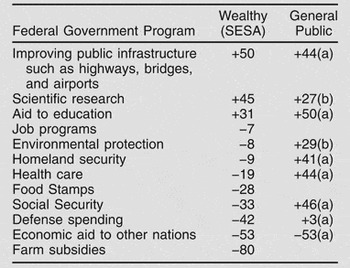
Table 4 reveals several areas of disagreement between our wealthy respondents and other citizens concerning the appropriate size of federal government programs. We asked whether each of twelve types of programs should be expanded, cut back, or kept about the same. For each program we calculated the “tilt” in opinion—that is, the net balance of support—by subtracting the percentage of “cut back” responses from the percentage of “expand” responses. The resulting percentage differences can run from +100 to −100. A plus sign indicates that the balance of opinion tilts toward expanding the program; a minus sign indicates that the balance of opinion tilts toward cutting it back.Footnote 21
Spending priorities

Notes: Each entry is the percentage of respondents (DK's excluded) that say a given program should be “expanded,” minus the percentage saying it should be “cut back.” “Kept about the same” is treated as neutral. N=83. (a) CCGA 6/10. (b) PSRA for Pew & AAAS 6/09: “increase”/“decrease”/“keep spending the same.”
The left column of Table 4 displays our wealthy respondents' balance of opinion on each of the twelve programs. Among wealthy Americans, opinion tilted strongly toward cutting rather than expanding farm subsidies, economic aid to other nations, and defense spending. More wealthy respondents also wanted to cut back than wanted to expand Social Security, Food Stamps, health care, and (by smaller margins) homeland security, environmental protection, and job programs.
Our wealthy respondents leaned toward expanding rather than cutting back only three of the twelve federal government programs we asked about: “improving public infrastructure such as highways, bridges and airports”; scientific research; and aid to education. These programs can be characterized as providing “peaceful public goods” that involve substantial positive externalities and hence underproduction by private markets. Implicitly, at least, our wealthy respondents appear to appreciate governmental production of certain public goods. At a time when the US was engaged in two costly wars and faced a relatively quiescent terror threat, however, they were much less enthusiastic about military or anti-terror spending. And they tilted toward cutting all the income-redistributive or social insurance programs we asked about.
The right column of Table 4 presents comparable data on the general public, taken from a June 2010 national survey by the Chicago Council on Global Affairs that asked several questions identical to SESA's, and from a June 2009 PSRA poll that used variant wording with quite similar meaning. (Except where otherwise noted, all of our comparisons involve identically-worded questions.) There were some marked differences in responses between the wealthy and the public. Crucially, substantial majorities of the public favored expanding (59 percent) rather than cutting back (10 percent) Social Security and expanding (59 percent) rather than cutting back (15 percent) federal health care programs. Furthermore, in contrast to the wealthy, the general public stood almost exactly at the status quo point on defense spending and tilted strongly toward increased spending on homeland security.
We speculate that the striking contrast concerning core social welfare programs between our wealthy respondents and the general public may reveal something important about the current state of American politics. If wealthy Americans wield an extra measure of influence over policy making, and if they strongly favor deficit reductions through spending cuts—including cuts in Social Security and Medicare—this may help explain why a number of public officials have advocated deep cuts in the very social welfare programs that are most popular among ordinary Americans.
Job and Income Programs
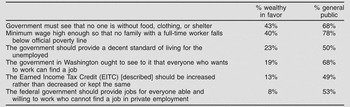
Gaps between the policy preferences of wealthy Americans and those of other citizens are especially evident with respect to job programs and income support. As Table 5 indicates, only a minority of the wealthy—in some cases a very small minority—supported any of six ideas or programs we asked about. A substantial minority (43 percent) agreed with the statement that “Government must see that no one is without food, clothing or shelter,” and nearly as many (40 percent) said the minimum wage should be set “high enough so that no family with a full-time worker falls below the official poverty line.” But only about one quarter (23 percent) favored the idea of a “decent standard of living” for the unemployed, and even fewer (13 percent) wanted to increase the Earned Income Tax Credit; most (72 percent) wanted to keep it about the same.
Job and income programs

Notes: DKs excluded. All public percentages are calculated from the 6/07 Inequality Survey conducted by CSRA, University of Connecticut, for Page and Jacobs 2009.
Most striking, given the high importance that the wealthy attribute to the problem of unemployment, is their overwhelming rejection of federal government action to help with jobs. Only 19 percent of the wealthy said that the government in Washington ought to “see to it” that everyone who wants to work can find a job [presumably a private job]. Fully 81 percent opposed this. A bare 8 percent said the federal government should provide jobs [presumably public jobs] for everyone able and willing to work who cannot find a job in private employment. An overwhelming 91 percent disagreed.
Among the general public, in contrast, about two-thirds (68 percent) said the government should “see to it” that people can find jobs. A bare majority (53 percent) even supported the idea of government provision of jobs as a last resort. The New Deal vision of back-up public employment evidently lives on in the minds of many Americans (though they seldom have a chance to tell pollsters about it), but it seems to have been rejected by the wealthy—and it has not found much resonance among Washington officials.
The American public is somewhat ambivalent about unemployment insurance—just half favor a “decent standard of living” for the unemployed—perhaps because of the argument that excessive income support for the jobless would reduce their incentives to seek work. But large majorities favor helping people find work. Opinion also tilts strongly toward expanding rather than cutting back wage subsidies through the Earned Income Tax Credit: 49 percent say the EITC should be increased and just 5 percent say decreased. A large majority (78 percent) favor an above-poverty minimum wage. Moreover, a solid majority of the public (68 percent) favor a minimum standard of food, clothing, and shelter for “everyone,” those who work and those who cannot. This represents a significant divide with the wealthy.
Health Care and Retirement Pensions
We have seen that our wealthy respondents—in sharp contrast to the general public—tilted toward cutting rather than expanding Social Security. The SESA survey did not explore precisely how such cuts would be made. But the proposals for doing so that have been put forward by various experts, politicians, and deficit-reduction commissions—raising the retirement age at which benefits can be received, slowing cost-of-living adjustments, and the like—mostly appear to be opposed by majorities of the general public. A March 2011 CBS poll that asked about various “suggestions that have been made to reduce the size of the federal budget deficit,” for example, found that only 42 percent would be “willing” to “raise the retirement age at which a person can start to collect full Social Security benefits”, while 58 percent said “not willing.” (A 55 percent majority did, however, say they were willing to “reduce Social Security benefits for retirees with higher incomes.”)Footnote 22 Over recent decades, surveys have nearly always found majorities of the American public opposed to any proposal that would reduce the Social Security benefits of low- or middle-income people.Footnote 23
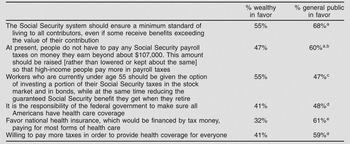
Except for this major disagreement about cutting Social Security benefits, the pension-related preferences of the wealthy appear to differ rather little from those of the general public (refer to Table 6). A majority (55 percent) of the wealthy, like two-thirds (68 percent) of the public, accepted the principle of progressivity in Social Security benefits, saying that the program should “ensure a minimum standard of living to all contributors, even if some receive benefits exceeding the value of their contributions.” This progressive aspect of Social Security has been called “crucial” in reducing poverty among the elderly.Footnote 24
Health care and retirement pensions

Notes: DKs excluded.
a Inequality Survey 6/07.
b Cap specified as “about $97,000,” its level at that time, rather than $107,000.
c AP/Ipsos 2/05.
d Gallup 11/10.
e Harvard/RWJ 3/08.
Perhaps surprisingly—but in harmony with this acceptance of progressivity—roughly half (47 percent) of the wealthy actually favored raising the “cap” on wages and salaries subject to Social Security payroll taxes, so that high-income people would pay higher payroll taxes than they now do. Raising or eliminating this cap would go a long way toward reducing projected shortfalls in Social Security revenue as the size of the retired population increases.Footnote 25 Similarly, 60 percent of the public have said they favor raising the cap.
Even on the issue of partial privatization of Social Security—in response to a question that mentions investment in stocks and bonds and makes clear that guaranteed benefits would decrease—the 55 percent support by the wealthy was not meaningfully different from the 47 percent support among the general public.Footnote 26
On health care, too, there are some matters about which the wealthy and the general public tend to agree. Only half or less of the wealthy (41 percent) and the public (48 percent) said that it is the responsibility of the federal government to make sure all Americans have health care coverage. The “individual mandate” in the Affordable Care Act was not very popular (refer to Table 6).
At the same time, the public has expressed much more support for tax-financed national health insurance (61 percent in favor)Footnote 27 than our wealthy respondents did (just 32 percent). This represents a major gap on a central issue of social welfare policy. Similarly, a solid majority of the public (59 percent), but only a minority of the wealthy (41 percent), said they would be “willing to pay more taxes in order to provide health coverage for everyone.”
Education Policy
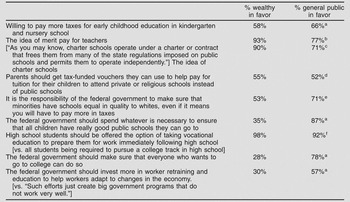
As we have seen, our wealthy respondents put a high priority on education as a “very important” problem facing the country. Federal aid to education is apparently one of the few programs the wealthy want to expand rather than cut back. As Table 7 indicates, a majority (58 percent) of our wealthy respondents also said they would be willing to pay more taxes for early childhood education in kindergarten and nursery school, which is comparable to the 66% level of willingness among the general public.
Education policy

Notes: DKs excluded.
a Inequality Survey 6/07.
b Gallup 6/09.
c Gallup 6/10.
d Greenberg 7/05.
e WP 4/01.
f Time 3/06.
The wealthy tend to favor market-oriented educational reforms to an even greater extent than the general public does. An overwhelming majority of the wealthy (93 percent), like a large majority of the general public (77 percent), favored the idea of merit pay for teachers. A similarly overwhelming majority of the wealthy (90 percent), agreeing with a large majority of the public (71 percent), favored schools that operate under a charter or contract that “frees them from many of the state regulations imposed on public schools and permits them to operate independently.” About half of the wealthy (55 percent) and of the general public (52 percent) favored vouchers—saying that “parents should get tax-funded vouchers they can use to help pay for tuition for their children to attend private or religious schools instead of public schools.” Overwhelming majorities of both the wealthy (98 percent) and the public (92 percent) favored providing vocational education as well as a college track in high school.
Despite these areas of agreement, however, there are some critical differences between the wealthy and other citizens in their views about supporting public schools and providing equal opportunity to all Americans through education and training. For example, the 53 percent of the wealthy who said that it is the responsibility of the federal government to make sure that minorities have schools equal in quality to whites “even if it means you will have to pay more taxes,” was far exceeded by the 71 percent of the public taking that position. Crucially, only about one-third (35 percent) of the wealthy said that the federal government should “spend whatever is necessary to ensure that all children have really good public schools they can go to,” while 87 percent of the public said this. Only a small minority (28 percent) of the wealthy agreed that the federal government should “make sure that everyone who wants to go to college can do so,” while more than three-quarters (78 percent) of the general public expressed that view.
Similarly, while a majority (57 percent) of the public said the federal government should “invest more in worker retraining and education to help workers adapt to changes in the economy,” a large majority (70 percent) of the wealthy took the opposite stand, that “such efforts just create big government programs that do not work very well.”
Our data suggest that the great enthusiasm of wealthy Americans for improving the US educational system mostly focuses on improving effectiveness through relatively low-budget, market-oriented reforms, not on spending the very large sums of money that might be necessary to provide high quality public schools, college scholarships, or worker retraining for all Americans.
Economic Regulation and Macroeconomic Policy
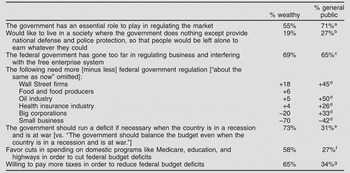
Our wealthy respondents agreed with the public about several aspects of government regulation of the economy. They accepted regulation in general terms: a majority (55 percent) agreed that “the government has an essential role to play in regulating the market,” just as a larger majority (71 percent) of the public did. A very large majority of the wealthy (81 percent), like a large majority of the public (73 percent), rejected the Libertarian view that it would be desirable “to live in a society where the government does nothing except provide national defense and police protection, so that people would be left alone to earn whatever they could.” But a large majority of the wealthy (69 percent), like a similar proportion of the public (65 percent), said that “the federal government has gone too far in regulating business and interfering with the free enterprise system” (refer to Table 8).
Economic regulation and macroeconomic policy

Notes: DKs excluded.
a GMF 6/09.
b Inequality Survey 6/07.
c WP 10/00.
d WSJ 6/10.
e CNN 11/09.
f CBS 1/11. In deficit context, “willing to … decrease spending in areas such as health care or education.”
g CBS 3/11. In deficit context, “willing to … pay more in taxes.”
When it comes to several specific areas of the economy, however, the wealthy are considerably less favorable toward government regulation than the public is. We asked a series of questions about whether various groups or industries need more federal government regulation, less regulation, or about the same amount as now. In each case we subtracted the percentage favoring less regulation from the percentage favoring more, once again measuring the net “tilt” of opinion. The figures in Table 8 make clear that our wealthy respondents tilted toward favoring less regulation of big corporations and—especially—small businesses, though they leaned toward more regulation of certain specific industries that had recently been in the news for problems of safety, quality, or cost.
The results for “small business,” are especially striking: 71 percent of the wealthy favored less regulation, while only 1 percent favored more regulation. However, in the specific cases of “food and food producers” (the subject of public health scares about E. coli and other contaminants), “the oil industry” (not long after the large BP oil spill in the Gulf of Mexico), and “the health insurance industry” (amidst discussion of escalating costs and exclusions from coverage), the wealthy tilted slightly toward more regulation. In the case of “Wall Street firms” (widely blamed for the financial crash and recession of 2008–09), the tilt was distinctly toward more regulation (refer to Table 8).
In every one of the five specific cases for which we have comparable data, the general public leaned more toward increased regulation than the wealthy did. This is especially marked in the cases of the oil industry and “big corporations.” But it is also true of Wall Street firms, the health insurance industry, and small business. In every case except small business the general public tilted substantially in the direction of more rather than less regulation.
In the realm of macroeconomic policy, particularly fiscal policy, wealthy Americans appear to have markedly more conservative preferences than their fellow citizens (refer to Table 8). To be sure, our wealthy respondents were actually much more likely than the general public (73 percent of the former, only 31 percent of the latter), to accept the Keynesian argument that “the government should run a [budget] deficit if necessary when the country is in a recession and is at war,” as opposed to the view that “the government should balance the budget even when the country is in a recession and is at war.” By the time of our survey in the winter and spring of 2011, however, most of the wealthy had apparently concluded that—despite continuing economic sluggishness—it was time to start reducing the deficit. As we have seen, their preferences tilted toward cutting rather than expanding nine of the twelve federal programs we asked about, including the highly popular Social Security, health care, and jobs programs. Likewise, a majority (58 percent) of the wealthy, unlike most of the general public, favored “cuts in spending on domestic programs like Medicare, education, and highways in order to cut the federal budget deficit.” A majority (65 percent) of the wealthy said they would be “willing to pay more taxes in order to reduce federal budget deficits,” while only 34 percent of the general public expressed such willingness.
Tax Policy
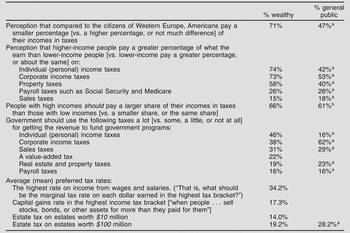
US tax policy is complex and confusing for most citizens. Many Americans are unaware of certain key aspects of tax incidence. Fewer than half (42 percent), for example, know that higher-income people pay a higher percentage of what they earn in personal income taxes than lower-income people do (refer to the second column of Table 9). Only 21 percent know that lower-income people pay a higher percentage of their earnings in sales taxes: 18 percent think that high-income people pay more, and 61 percent think they pay about the same percentage.Footnote 28 Fewer than half (40 percent) of the public perceive that payroll taxes are regressive. Only 47 percent are aware that Americans pay a smaller percentage of their incomes in taxes than the citizens of Western Europe do.Footnote 29
Tax policy

Note: DKs excluded.
a Inequality Survey 6/07.
b GSS spring '08.
Our wealthy respondents expressed considerably clearer—though not perfect—perceptions of tax burdens and tax incidence than the general public has. A large majority (71%) correctly said that tax burdens are greater in Europe than in the US. Substantial majorities perceived that corporate income taxes, personal income taxes, and property taxes are progressive (fall more heavily on high-income people than on low), but that sales taxes and payroll taxes are regressive: as a percentage of income, the burden falls more heavily on lower-income citizens (refer to the first column of Table 9).
Perhaps surprisingly, most of the wealthy accepted the general principle of progressive taxation. Two-thirds (66 percent) of the wealthy, like 61 percent of the general public, say that people with high incomes should pay a larger share of their incomes in taxes than those with low incomes. When asked to what extent the government should use several different taxes to fund government programs, the top two picks of the wealthy to use “a lot” were individual and corporate income taxes. These are taxes that the wealthy see as falling most heavily on high income people like themselvesFootnote 30 (refer to Table 9). (The general public ranks the use of various taxes in a roughly similar way, except for putting much more emphasis on corporate income taxes and much less on personal income taxes.)
Still, the acceptance of progressive taxation by wealthy Americans appears to go only so far. Despite our wealthy respondents' great concern about budget deficits, most did not favor increasing rates of the income tax or estate taxes even to the slightly higher levels that held during the Clinton administration. The tax rates they favored generally reflected the current status quo, keeping in place Bush-era tax cuts that provided larger dollar amounts of reductions to high-income earners and made the tax system less progressive.Footnote 31
When we asked respondents to say approximately what percentage rate of taxation should apply to income from wages and salaries in the highest income tax bracket (that is, the highest marginal tax rate), the average response was 34.2 percent. This came very close to the then-current top marginal rate of 35 percent, and fell well below the 39.6 percent Clinton-era figure. The average preferred capital gains rate for top-bracket taxpayers was 17.3 percent, only a shade above the then-current 15 percent. Few of our wealthy respondents wanted to entirely abolish the estate tax, and on the average they indicated an acceptance of a modest degree of progressivity in it. But the average preferred rates on a $10 million estate (14.0 percent) and on a $100 million estate (19.2 percent) were not much different from the actual rates in force in 2009, before the zero estate-tax period mandated (on a temporary basis) by the Bush-era cuts and prolonged under the Washington deal of December 2010.
Our limited comparative data on the general public indicate that most Americans preferred a significantly higher tax rate on $100 million estates: an average of 28.2 percent, rather than the 19.2 percent rate favored by our wealthy respondents (refer to Table 9). Survey data collected shortly before our SESA survey was in the field indicate that 67 percent of Americans who took a stand favored raising federal income taxes for people who made more than $200,000 per year.Footnote 32 In the context of ways to reduce the federal budget deficit, more Americans favored spending cuts than [general] tax increases, but when explicitly offered the option of “a combination of both,” 69 percent choose the combination.Footnote 33
These findings, in combination with those reported above, indicate that wealthy Americans—in contrast to the general public—tend to favor dealing with budget deficits by cutting programs, even very popular social programs, rather than raising taxes. Budget-balancing measures discussed or implemented in Washington that focus on spending cuts may be more consistent with the preferences of wealthy Americans than with the wishes of ordinary citizens.
Inequality and Redistribution
Our wealthy respondents expressed awareness of the very high levels of inequality of income and wealth in present-day America, and they favored wages and salaries for various occupations that would make the over-all distribution more equal. But—by large margins—they opposed governmental redistribution of income or wealth.
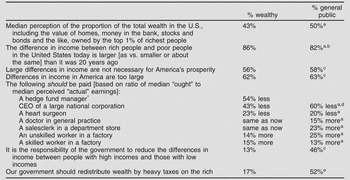
As Table 10 indicates, our typical (median) wealthy respondent estimated that 43 percent of the total wealth in the United States was owned by the top 1 percent of wealth-owners. This is not far from the actual figure of about 35 percent (or substantially more than that if net home equity is excluded).Footnote 34 A very large majority (86 percent) of the wealthy were aware that the difference in income between rich and poor people in the United States today is larger than it was twenty years ago.Footnote 35 Half (56 percent) of our wealthy respondents did not accept the argument that large differences in income are “necessary for America's prosperity.”Footnote 36 About two-thirds (62 percent) said that “differences in income in America are too large.” In all these respects, the views of the wealthy are rather close to those of the general public as a whole (refer to Table 10).
Inequality and redistribution

Notes: DKs excluded.
* CBS 1/11 found that 79% of the general public called the salaries and benefits of “most people who work on Wall Street” “too high”; only 1% said “too low,” and 20% said “about right.” DKs excluded.
a Inequality Survey 6/07.
b gap in wealth in the last 25 years.
c GSS 2008.
d “chairman” rather than CEO.
e Gallup 3/09.
More concretely, we asked each respondent to estimate how much money people in various different jobs “actually” earn each year, before taxes, and then asked what they “ought” to be paid. We then calculated the median “ought” figure for each occupation and divided it by the median “actual” figure.Footnote 37 The resulting ratio (minus 1.0, and expressed as a percentage) tells us by how much the median respondent would like to increase (positive sign) or decrease (negative sign) the pay for that occupation.
These calculations indicate that our wealthy respondents thought the pay of the highest-income occupations we asked about—hedge fund managers and the CEOs of large corporations—should be decreased substantially, by 54 percent and 43 percent, respectively, whereas two of the lowest-paid occupations—unskilled and skilled factory workers—should have their earnings increased by modest amounts (14 percent and 15 percent, respectively). This would hardly amount to a “leveling” of US incomes, but it would significantly reduce the extent of income inequality in the United States. In each case for which we have comparable data the general public largely agreed, though it would go a bit further, with slightly bigger wage increases for salesclerks, unskilled factory workers, and even doctors in general practice, but a slightly bigger wage cut for CEOs.
It is striking to see wealthy Americans saying that incomes should be more equal. This does not, however, mean that the wealthy favor redistributive action by government. Quite the contrary. A very large majority (87 percent) of the wealthy said it is not “the responsibility of the government to reduce the differences in income between people with high incomes and those with low incomes.” Likewise, 83 percent said that our government should not redistribute wealth by heavy taxes on the rich (refer to Table 10). This sentiment is consistent with the status-quo income- and estate-tax rates preferred by the wealthy. Much larger proportions of the general public said that reducing income differences is the responsibility of the federal government (46 percent) and that our government should redistribute wealth by heavy taxes on the rich (52 percent).
Opinion Differences among Wealthy Americans
Can we say anything about what sorts of wealthy Americans tend to favor or oppose various public policies? For example, do conservative views on social welfare policy, economic regulation, or tax policy tend to increase as wealth increases? Do wealthy professionals differ from wealthy business owners? Do bankers tend to disagree with manufacturers? Owners or employees of domestically-oriented firms with those oriented toward exports? Entrepreneurs who have worked their way up from the bottom (“new money”) with inheritors of great wealth (“old money”)? There are reasons to expect some differences of these sorts.
Our small pilot study is not ideally suited to answer these questions. In order to perform multivariate analyses and sort out the independent impact of various factors (some of which are correlated with each other), we would need a much larger sample. Still, we can offer some suggestive evidence, beginning with how policy preferences vary with levels of wealth.
Level of Wealth
Even though our pilot study included only a handful of respondents at the highest levels of wealth, by fitting simple bivariate regression models in which the amount of a respondent's net worth is the independent variable we can obtain estimates of how attitudes change as one moves from the bottom of our wealth distribution (under $5 million) to near the top (around $40 million). For this range of wealth, at least, we can estimate the gradients with respect to wealth of various attitudes and behaviors.
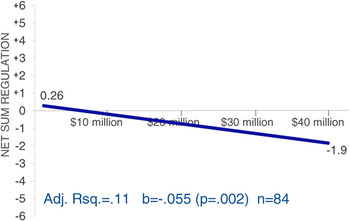
Figure 2 offers a clear example concerning economic regulation. Using our questions about whether respondents favored “more,” “less,” or “about the same amount” of regulation for each of six different industries or industrial sectors, we computed the number of cases in which each respondent favored more regulation minus the number of times he or she favored less regulation. The result was an index of net support for regulation, running from −6 (regulate all six industries less) to +6 (regulate all six of them more).
The wealthiest of the wealthy tend to favor less regulation

As Figure 2 indicates, respondents with $5 million or less in net worth tended to lean slightly toward more regulation, but those with $40 million leaned distinctly toward less regulation. There is a substantial linear relationship.Footnote 38 The slope—which implies a drop of a bit over half a point on our 12-point index for each gain of $10 million in wealth—is clearly different from zero at a high level of statistical significance (p < .002), even in our small sample.Footnote 39 At least within our wealth range, the wealthiest Americans tended to favor less regulation than the less wealthy did. This is particularly true of regulating the health insurance industry.Footnote 40
The wealthiest respondents also tilted more toward cutting back domestic social welfare programs, especially Social Security. Using responses to the “expand,” “keep about the same,” or “cut back” questions concerning five social welfare programs (aid to education, Social Security, job programs, health care, and Food Stamps), we calculated how many of those programs each respondent wanted to expand, minus the number he or she wanted to cut back. The result is an index of net support for social welfare programs that runs from −5 (cut back all five) to +5 (expand all five).
The data show a significant tendency for wealthier respondents to take positions more toward the “cut back” than toward the “expand” end of this index. Each additional $10 million in wealth corresponded to a drop of nearly half a point on the 10-point scale. There was also a tendency for the wealthiest respondents to tilt even more than the less wealthy toward cutting back Social Security specifically.Footnote 41 These relationships are weaker and less certain than those concerning economic regulation.Footnote 42 But if a similar or stronger tendency carries through to the highest levels of wealth in the United States as a whole, and if the wealthiest Americans wield especially large amounts of political power, this finding may help explain why cutting these popular programs has remained on the political agenda.
A regression of preferred top-bracket personal income tax rates on the magnitude of wealth produced similar, though less strong, findings: wealthier respondents tended to favor lower income tax rates.Footnote 43 Here, too, certain tendencies in US policy making—particularly the decades-long decline in top marginal income tax rates and the erosion of the estate tax and corporate income tax—may be more closely related to the preferences of very wealthy Americans than to those of average citizens.
Finally, bringing together their views on a number of issues, the wealthiest respondents tended to be somewhat more likely than the less wealthy to call themselves “conservative” on a liberal/conservative self-rating scale.Footnote 44
Personal Characteristics and Economic Positions
Somewhat to our surprise, when we looked beyond wealth levels, the personal characteristics and economic positions of our respondents generally seemed to make rather little difference to their preferences about government regulation or social welfare policy. To be sure, in a small sample like this one the mere failure of a relationship to attain statistical significance should not be taken as conclusive evidence that that no real relationship exists in the whole population. But real or not, we have found few relationships that are very substantial in magnitude.
Among our wealthy respondents, for example, the relatively young did not differ much from the old.Footnote 45 Men and women had very similar preferences.Footnote 46 So did the married and the unmarried.Footnote 47 Levels of formal education made no discernable difference—at least when we lumped together all advanced degrees, MDs and JDs with MBAs. (We will see, however, that professionals tended to differ from business owners and managers.) Catholics did not differ much from non-Catholics. Those who regularly attended religious services did not generally disagree with those who did not attend.Footnote 48 (Elsewhere we and our colleagues have reported that the charitable activities of our wealthy respondents, as opposed to their policy preferences, were substantially related to church attendance.)Footnote 49 One exception: Jewish respondents were substantially less inclined to cut back social welfare programs than non-Jewish respondents were.
Particularly striking to us is the fact that—contrary to our expectations—the economic backgrounds and roles of wealthy respondents generally seemed to make little or no difference to how they felt about regulatory or social welfare policies. Households with “old money” —inheritors of substantial wealth—did not differ significantly from those with “new money” (non-inheritors). Business owners did not differ from other wealthy respondents. Those who worked in banking or finance did not tend to be more or less favorable to social welfare programs or economic regulation than others were. Nor did those who work in manufacturing. There was a marginally significant tendency for respondents who did substantial business abroad to be slightly more negative about government regulation—perhaps because they viewed regulation as imposing handicaps on international competitiveness.Footnote 50
These null findings might either reflect sampling error or reveal striking patterns of political homogeneity among the wealthy. In order to find out which is true, we will need more cases to analyze so that finer social and economic distinctions can be drawn among the respondents and more powerful statistical inferences can be drawn, both about particular policies and about the general policy indices we have focused on here.
The chief exception to the pattern of null findings is an important one. The 24 percent of our respondents who classified themselves as “professionals” (mostly lawyers and doctors) differed markedly from the others—including the 41 percent of respondents who described themselves as business owners, the 19% who were business managers, and the 6 percent who were investors. Professionals were particularly distinctive in their support for environmental protection, for action against climate change, and for economic aid abroad. They were also more supportive than others of certain social welfare programs and progressive taxation. Most notably, professionals tilted distinctly in the direction of more regulation rather than less regulation of various industries.Footnote 51
This is not just an artifact of professionals' tendency to be less wealthy than our other respondents. A regression analysis predicting support for more or less regulation (similar to the regression reported in Figure 2, but including both wealth and a professional/not dummy variable as predictors), indicates that being a professional has independent effects. Controlling for wealth, professionals tended to be about 1.3 points more pro-regulation on our 12-point index.Footnote 52 To put it another way, being a professional was associated, on the average, with moving from preferring “less” regulation to favoring the “current amount” of regulation on a little more than one of the six types of regulatory targets included in the index.
At a time when—with a few conspicuous exceptions—the biggest political contributions from the wealthy have tended to go to conservative causes, it seems natural to wonder whether and where progressive policies might find a significant base of support among wealthy Americans. Those who believe that support from at least some segment of wealthy Americans was crucial to reforms in the Progressive period, the New Deal, and the Great SocietyFootnote 53—and who believe such support would be equally crucial to any major reforms in the future—might do well to look for allies mainly among professionals rather than among business owners, managers, or investors.
Party Identification
A variety of studies employing general population samples have shown that affluent Americans are more likely than those further down the income scale to think of themselves as Republicans.Footnote 54 The generally conservative policy views of our wealthy SESA respondents also make it natural to suppose that they should be predominantly Republican. And indeed, that is the case. Including independents who lean toward a party, about twice as many of our respondents considered themselves Republicans (58 percent) as considered themselves Democrats (27 percent). In this group—as in the general population—party affiliations were strongly related to liberal/conservative ideology, with Republicans generally more conservative and Democrats more liberal.Footnote 55
However, on economic issues wealthy Democratic respondents tended to be more conservative than Democrats in the general population. It may be that these Democrats' partisan attachments were grounded in social backgrounds and family histories, or in views about moral and social issues, rather than in economic policy preferences.
Among our wealthy respondents, not surprisingly, both party identification and liberal/conservative ideology were closely related to policy preferences of many different sorts. Both, for example, were strongly related to our index of preferences for expanding or cutting back social welfare policies.Footnote 56 They were even more strongly related to our index of preferences for regulation of more or fewer industries.Footnote 57 Opinions on most aspects of US public policy, from taxation,Footnote 58 to moral or social issues, to foreign policy, likewise tended to vary by ideology and party affiliation, as they do in the general public. However, the opinion differences we have described between more and less wealthy SESA respondents were not just due to wealthier respondents' greater tendency to be Republicans. Wealth and party had independent effects.Footnote 59
Beyond party affiliation and liberal-conservative ideology, a number of general views about government and politics had independent relationships of their own with various types of policy preferences. We cannot be sure what was causing what, but these relationships begin to hint at certain ways of thinking that hang together and may underlie coherent belief systems.
Among our wealthy respondents, for example, views about how much they trusted government, whether government wastes a lot of tax money, whether we should or should not get involved with the needs of other people, and whether our freedom depends on the free enterprise system were closely associated with preferences concerning both social welfare policy and economic regulation. The same was true of views concerning whether government should do nothing but defense and law enforcement; whether government should provide minimum levels of food, clothing, and shelter; whether government regulation of the economy is essential; whether the government in Washington should see to it that everyone can find a job; and whether government should redistribute income and wealth through heavy taxes on the rich.Footnote 60
Similarly, our respondents' preferences about social welfare policies and economic regulation varied with their opinions about whether domestic programs should be cut to reduce deficits; whether the federal government has gone too far in regulating business; whether differences in income in America are too large; whether it is the government's responsibility to reduce income differences; how much more or less CEOs should be paid than they are now; how important the problem of childhood poverty is; and how important luck is in affecting people's economic success.Footnote 61
These relationships offer little more than hints about belief systems. To fully work out the logic and structure of political opinions among wealthy Americans will require a national sample with more cases.
Conclusion
The political role of wealth has been a prominent concern of political theorists for centuries. Aristotle classified regimes based on the correlation between wealth and political power, while Machiavelli devoted close study to the attempts of classical and Renaissance republics to constrain the political influence of wealthy citizens.Footnote 62 In our own era, after a period of relative neglect the relationship between economic inequality and political inequality has reemerged as a subject of scrutiny—with a boost from the APSA task force led by Theda Skocpol and Lawrence Jacobs.Footnote 63 Recently political scientists have characterized contemporary America as an Unequal Democracy, where an Unheavenly Chorus sings with unequal political voices; as an arena of Winner-Take-All Politics; even as an outright (albeit circumscribed) Oligarchy. Footnote 64
Given the centrality of moneyed interests to any understanding of democratic politics, it is striking how little political scientists actually know about the political attitudes and behavior of wealthy citizens. Our SESA pilot study represents an effort to begin to fill that gap. The sample is small and confined to the Chicago metropolitan area. Thus it is possible that our findings are distorted by the sampling error inevitable in a small pilot survey (potentially compounded by the special difficulties of interviewing economic elites), or that wealthy people in other parts of the country are quite different from those in the Chicago area. Nevertheless, our data provide a first systematic glimpse of the policy preferences of wealthy Americans—and shed suggestive light on the potential implications of unequal responsiveness to those policy preferences.
When we compare wealthy Americans' responses to our survey with the responses that the general public has given in various other polls and surveys, we find a variety of substantial differences in policy preferences.
Our evidence indicates that the wealthy are much more concerned than other Americans about budget deficits. The wealthy are much more favorable toward cutting social welfare programs, especially Social Security and health care. They are considerably less supportive of several jobs and income programs, including an above-poverty-level minimum wage, a “decent” standard of living for the unemployed, increasing the Earned Income Tax Credit, and having the federal government “see to” —or actually provide—jobs for those who cannot find them in the private sector.
Judging by our evidence, wealthy Americans are much less willing than others to provide broad educational opportunities, by “spend[ing] whatever is necessary to ensure that all children have really good public schools they can go to” or “mak[ing] sure that everyone who wants to go to college can do so.” They are less willing to pay more taxes in order to provide health coverage for everyone, and they are much less supportive of tax-financed national health insurance. The wealthy tend to favor lower estate tax rates and to be less eager to increase income taxes on high-income people. They express concern about economic inequality and favor somewhat more egalitarian wages than they perceive as presently existing, but—to a much greater extent than the general public—the wealthy oppose government action to redistribute income or wealth.
The wealthy are significantly less favorable to increasing government regulation of Wall Street firms, the health care industry, small business, and especially big corporations.
Many of these differences seem susceptible to straightforward interpretation as reflections of the distinctive economic interests of wealthy citizens. Economic regulation, for example—even if it provides net benefits for consumers and society as a whole—may impose net costs on some wealthy investors. Although social programs aim to help millions of lower-income, ill, and retired citizens, they may barely touch the wealthy, who do not generally have to rely upon Food Stamps, Social Security payments, or (in many cases) even public schools. Under our tax system—in which effective rates remain mildly progressive or at least proportional to income—a wealthy American can be forced to pay millions of dollars in taxes to fund programs that he or she views as yielding only meager personal benefits. By the same token, when it comes to dealing with budget deficits, the wealthy may (in material terms) have less to lose from spending cuts than from tax increases, and wealthy bond owners may be particularly wary of deficit-induced inflation that would undercut bond values.
Of course we should also consider a very different interpretation: that the distinctive policy preferences of wealthy Americans may reflect better information, deeper thinking about the problems facing the country, and a clearer-headed understanding of economic and social reality than most citizens have—including the possibility that government may often be incapable of achieving what we would like it to achieve. Perhaps our wealthy respondents (most of them highly educated and quite attentive to politics) are right to think that government jobs programs don't work, that education is more likely to be improved by market-oriented reforms than by major increases in spending on public schools or college scholarships, that citizens can provide for their own health care, that economic markets can mostly regulate themselves efficiently, and that budget deficits currently present a greater danger to the United States than joblessness does.
Yet any superior knowledge among the wealthy may tend to be one-sided. Wealthy Americans appear to be acutely aware of marginal tax rates and of the costs and inconveniences of economic regulation, but they may know no more—perhaps less—than ordinary citizens do about the benefits of regulations or of spending programs that require tax revenue. This may be particularly true when it comes to social welfare programs. Few wealthy Americans—and few of their friends or family members—are likely to need unemployment insurance or Medicaid. Few have to face unemployment, home foreclosures, or bankruptcy.Footnote 65 Even if the wealthy tend to have unusually high cognitive skills and abundant information about politics, they may lack certain kinds of information that can be highly relevant to a balanced assessment of public policies. Their experiential base tends to differ from that of other citizens.
We cannot hope here to choose definitively between such contrasting interpretations of wealthy Americans' policy preferences. Nor, for that matter, can we resolve disputes about how much attention policy makers ought to pay to the preferences of ordinary citizens. On the latter question the present authors are not in total agreement among ourselves. One of us has argued at length that the American public is “rational” (in the aggregate) and that its policy preferences deserve respect. But another has emphasized the errors, inconsistencies, and delusions of ordinary citizens.Footnote 66
If our wealthy respondents are better informed and more realistic in their political thinking, the substantial differences we observe between their policy preferences and those of ordinary citizens reflect poorly on the civic competence of the latter, even in the aggregate. Yet if those divergences at least partly reflect peculiar interests and biased perspectives of the wealthy, then the prospect of unequal political clout must be troubling to (small-d) democrats. It raises a serious challenge to a core democratic value, i.e., the idea that government policymaking should be attentive to the interests of all citizens.
We can offer little new evidence about the extent to which the wealthy actually influence policy making, although our evidence supports the long-standing finding that the affluent participate disproportionately in politics. But if one accepts, at least for the sake of argument, the notion that the wealthy exert substantial political power, our findings may shed some light on the current state of American politics. For example, the contemporary emphasis in Washington on reducing the federal budget deficit addresses what is, by far, the most important public problem in the minds of wealthy Americans—though not of the American public as a whole. The willingness of many policy makers to cut popular social welfare programs, and their reluctance to increase taxes on people with high incomes, may be explained in part by the fact that social welfare programs and increased taxes on the rich are much less popular among wealthy people than among ordinary citizens. And the turn away from economic regulation in recent decades—a turn that left exotic financial derivatives unregulated before the 2008–09 financial crash in which they played such a prominent part, and that left Washington surprisingly inhospitable to more rigorous banking regulation even after that crashFootnote 67—may be attributable, in part, to the distinctive antipathy of wealthy citizens to government regulation of the economy.
Obviously, our findings regarding the policy preferences of wealthy Americans cannot, in and of themselves, provide any direct evidence that those preferences actually shape public policy. Much better data and much more work will be necessary to begin to pin down how, and to what extent, the distinctive preferences of the wealthy actually matter. In the meantime, however, the apparent consistency between the preferences of the wealthy and the contours of actual policy in certain important areas—especially social welfare policies, and to a lesser extent economic regulation and taxation—is, at least, suggestive of significant influence.
How might our findings fit into the broader story of rising economic inequality in the United StatesFootnote 68? The American political system has done less than other rich democracies to redress growing inequality in “market” incomes,Footnote 69 and may also have done more to exacerbate that inequality in the first place.Footnote 70 Is this distinctive political response a reflection of the disproportionate political power of wealthy Americans? Have the preferences of the wealthy moved rightward,Footnote 71 so that they now exert their power in more anti-egalitarian directions? Has increasing economic inequality itself increased the power of the wealthy, producing even stronger obstacles to egalitarian policies? Unfortunately, our snapshot of the preferences of the wealthy at a single point in time cannot answer these questions—but it may provide a starting point for future work on the complex relationship between economic and political change.
Even without being able to gauge the actual political power of wealthy citizens, we can confidently reject the view that extensive political power by the wealthy would be of little practical importance anyway because their policy preferences are much the same as everyone else's. On many important issues the preferences of the wealthy appear to differ markedly from those of the general public. Thus, if policy makers do weigh citizens' policy preferences differentially based on their income or wealth, the result will not only significantly violate democratic ideals of political equality, but will also affect the substantive contours of American public policy.