INTRODUCTION
Small-scale dairy farms have been considered an important source of employment generation and daily earnings in both developing and developed countries (Somda et al., Reference Somda, Kamuanga and Tollens2005). In Mexico, they represent 79% of the total dairy farms in the whole country, and milk production is considered the main source of family income (Martinez-Garcia et al., Reference Martínez-García, Dorward and Rehman2012). Small-scale dairy farms have also been considered a rural development option (Espinoza-Ortega et al., Reference Espinoza-Ortega, Espinosa-Ayala, Bastida-López, Castañeda-Martínez and Arriaga-Jordán2007). The Mexican government, through its programme Alianza para el Campo (Alliance for the Countryside), has been promoting the use of a great variety of crop- or forage-related technologies among small-scale dairy farmers including improved seed, fertilisers, herbicides, tractors and irrigation systems; however, there has been low adoption amongst famers (Martínez-García, Reference Martinez-Garcia2011). This has been attributed to different factors such as capital constraints, farmer characteristics (age, education and experience), farm characteristics (family members, family labour, herd size, milking cows, total number of hectares and level of infrastructure) and institutional characteristics (access to credit and extension services) (Martínez-García et al., Reference Martínez-García, Dorward and Rehman2012).
Alliance for the Countryside has also promoted the use of improved grassland. Martinez-Garcia et al. (Reference Martínez-García, Dorward and Rehman2015) pointed out that the adoption of this innovation among non-users was associated significantly with the farmer's experience, total number of hectares and the number of technological level. This implies that the higher the framer's experience, number of hectares and technological level on farm, the higher the probability to adopt improved grassland. However, the cognitive and social psychological factors associated with farmers’ intention to adopt improved grassland were not addressed. For the purposes of this research, improved grassland is defined as a combination of a perennial variety of westerwolds ryegrass (Lolium multiforum) and white clover (Trifolium repens), which small-scale dairy farmers normally cut and carry to stall to feed their herds. In contrast to several other crop-related technologies promoted by the government, this innovation has been widely used and adopted by farmers, who can be characterised as established users (farmers with an experience of 10 or more years using the innovation) and recent users (farmers with less than 5 years of experience) based on how long they have been using the innovation (Martinez-Garcia, Reference Martinez-Garcia2011). Thus, one question emerges: What are the factors driving the use and adoption of improved grassland among established and recent users? Previous studies have used econometric techniques to analyse the motivation for collective action and adoption of organic farming (Gyau et al., Reference Gyau, Takoutsing, Degrande and Franzel2012; Läpple and Van Rensburg, Reference Läpple and Van Rensburg2011); however, there is a lack of information and understanding of attitudes, beliefs and social pressure underpinning farmers’ intentions to adopt agricultural innovations in Mexico and other developing countries (Martinez-Garcia et al., Reference Martínez-García, Dorward and Rehman2013).
Social-psychological models like theory of reasoned action (TRA) and theory of planned behaviour (TPB) have been used to explore the rationality that underlies the individual's decisions to engage in a given behaviour and the contribution of factors influencing it (Zubair and Garforth, Reference Zubair and Garforth2006). The TRA has been used as an analytical framework, which explicitly recognises the importance of the influence of actions and behaviour, as well as the attitudes and perceptions of the decision maker (Garforth et al., Reference Garforth, Rehman, McKemey, Tranter, Cooke, Yates, Park and Dorward2004). The TRA can be used to suggest (i) interventions to target specific factors that have a strong influence on decisions, and (ii) sources of information or influence to work effectively and reach particular categories of decision maker (Garforth et al., Reference Garforth, Rehman, McKemey, Tranter, Cooke, Yates, Park and Dorward2004). Accordingly, the TRA has been used successfully in agriculture as a social-psychological model to identify farmers’ beliefs and social psychological factors associated with the adoption of innovations (e.g. see the studies done by Borges et al., Reference Borges, Lansink, Marques and Lutke2014, Bruijnis et al., Reference Bruijnis, Hogeveen, Garforth and Stassen2013, Martinez-Garcia et al., Reference Martínez-García, Dorward and Rehman2013 and Rehman et al., Reference Rehman, McKemey, Yates, Cooke, Garforth, Tranter, Park and Dorward2007).
In contrast to many adoption studies, this work focuses on an innovation that has been successfully adopted by farmers. Most of the studies based on TRA and TPB have been mainly focussed on understanding the intentions and attitudes of people who have not adopted an innovation, sometimes comparing them to those who have (de Lauwere et al., Reference de Lauwere, van Asseldonk, van't Riet, de Hoop and ten Pierick2012; Zubair and Garforth, Reference Zubair and Garforth2006). Therefore, this paper seeks to identify factors influencing the adoption of a successful innovation in order to provide insights that may improve design and implementation of future research and extension activities toward smallholders. To accomplish this, we carried out an exploratory investigation regarding farmers who have been using an innovation for a relatively long period (established users) and also farmers who have only recently started to use or experiment an innovation.
MATERIALS AND METHODS
Theoretical framework
The TRA (Ajzen and Fishbein, Reference Ajzen and Fishbein1980) was used to explore farmer and farm characteristics, beliefs and social referents influencing established and recent users’ intention to use improved grassland on their farms over the next 12 months. The TRA is composed of intention, attitude (beliefs) and subjective norm (social referents). Intention (to adopt or not adopt) is often treated as the dependent variable under the influence of two independent determinants, the attitude and the subjective norm. An attitude toward any concept is simply a person's general feeling of either ‘favourableness’ or ‘unfavourableness’ toward anything and it represents a positive or negative evaluation of performing the behaviour (Ajzen and Fishbein, Reference Ajzen and Fishbein1980). Ajzen (Reference Ajzen2005) mentions that attitude is the product of the outcome beliefs (how strongly one believes the behaviour will lead to a set of outcomes) and outcome evaluations (how important each of these outcomes is to the individual). On the other hand, the subjective norm is a respondent's perception of others regarding him, the subject (Ajzen and Fishbein, Reference Ajzen and Fishbein1980). The subjective norm is the product of subjective beliefs (how strongly one feels that a set of other people and organizations – salient referents – would approve or disapprove a given behaviour) and motivation to comply with the views of each of those referents (Ajzen, Reference Ajzen2005; Ajzen and Fishbein, Reference Ajzen and Fishbein1980), i.e. in this study, a person's intention to use improved grassland is determined by his attitude (beliefs) and the influence of the other people's views (subjective norm). The TRA has been shown to be valid in circumstances wherein an individual has volitional control over the behaviour in question (Armitage and Conner, Reference Armitage and Conner2001). We used the TRA because we assumed the use of improved grassland (behaviour) is under volitional control as farmers have used and adopted the innovation for several years.
Study area
The research was carried out in the State of Mexico. It is 22,357 km2 area, representing 1.1% of the national area but with a population of more than 15 million – the most populated zone in the country. Particularly, the study was developed in the municipality of Aculco (See supplementary Figure S1 available online at http://dx.doi.org/10.1017/S0014479716000703), in one of the main milk production zones of the State of Mexico. It supplies 49,000 litres of milk per day, representing 8.7% of the milk production of the State of Mexico (SIAP, 2012). Aculco dairy farmers and cheese manufacturers have developed a strong value–chain relationship, with about 82% of the milk production being used to produce traditional cheese varieties sold in Mexico City. Thus, dairying is the main source of employment and economic activity of the zone (Espinoza-Ortega et al., Reference Espinoza-Ortega, Espinosa-Ayala, Bastida-López, Castañeda-Martínez and Arriaga-Jordán2007).
Farmer selection and data collection
Farmer selection was based on two characteristics: (i) farmers must be engaged in the use of improved grassland in their farms and (ii) farmers must have a herd size between 3 and 20 animals. According to Espinoza-Ortega et al. (Reference Espinoza-Ortega, Espinosa-Ayala, Bastida-López, Castañeda-Martínez and Arriaga-Jordán2007), this range of herd size describes small-scale dairy farmers in central Mexico. Data were collected from 80 dairy farmers, representing 5.3% of the total farmers in the study area. A non-probabilistic snowball sampling method was used to identify participants (Vogt and Burke, Reference Vogt and Burke2011). The data were gathered from August 2009 to January 2010. Data collection for the TRA was carried out in two distinct phases, as suggested by Ajzen and Fishbein (Reference Ajzen and Fishbein1980). In the first phase, semi-structured individual interviews with 15 farmers (farmers included in the original sample size, n=80) elicited farmer's beliefs and identified people (social referents) whose opinion influence farmers’ behaviour to use improved grassland. The beliefs and social referents that were recorded from multiple interviews were incorporated into a structured questionnaire for the second phase. The questionnaire included 11 outcome beliefs and 10 social referents (Supplementary Table S1). The questionnaire also gathered information regarding farmer's characteristics (farmer's age, farmer's education, farmer's experience and years using improved grassland), and farm characteristics (family members, family labour, herd size, milking cows, milk yield per cow per day, total number of hectares, area (ha) used for grassland and milk yield as main source of income).
Data analysis
In order to compare farmer and farm characteristics, and beliefs and social referents influencing farmer's intentions to use improved grassland on their farms, the sample (n=80) was divided into two groups of farmers, based on the length of time the farmers had used the innovation, i.e. established users (Group 1, n=64) were the farmers who indicated an experience of 10 or more years using the innovation, and recent users (Group 2, n=16) were the farmers who manifested an experience of five or fewer years. A set of 12 variables that described farmer and farm characteristics was considered to compare the groups.
The normal distribution test of Kolmorgorov–Smirnov (Field, Reference Field2013) was conducted with a set of 11 quantitative variables such as farmer's age, farmer's education, farmer's experience, years using improved grassland, family members, family labour, herd size, milking cows, milk yield per herd per year, total number of hectares and area (ha) used for grassland. To identify differences between established and recent users, these 11 quantitative variables were analysed through a dependent t-test (Field, Reference Field2013). The components of the TRA were asked, measured and analysed as recommended by Carr and Tait (Reference Carr and Tait1991) and Martinez-Garcia et al. (Reference Martínez-García, Dorward and Rehman2013) with the following model:
 $$\begin{equation*}
A = \sum\limits_{i = 1}^n {{b_i}{e_i}\quad{\rm{and}}\quad{\rm{SN}} = } \sum\limits_{j = 1}^n {s{b_j}{m_j}}\quad{\rm{so}}\;{\rm{that}}\;{\rm{B}} \cong {\rm{BI = A}}{w_1} + {\rm{SN}}{w_2},
\end{equation*}$$
where A is the attitude toward the behaviour, bi is a belief about the likelihood of outcome i, ei is the evaluation of outcome i, n is the number of salient beliefs, SN is the subjective norm, sbj is a normative belief (that the reference group or individual, j, thinks the person should or should not perform the behaviour), mj is the motivation to comply with referent j, B is the behaviour, BI is the intention to behave and w1 and w 2 are the empirically determined weights.
Intention
Intention to behave (IB) of the farmers was measured by asking, how strong is your intention to use improved grassland on your farm over the next 12 months? The responses were recorded on the bi-polar five-point Likert-type scale (Bryman and Cramer, Reference Bryman and Cramer2011) ranging from very strong (+2) to very weak (−2). To identify variables correlated with established and recent users’ intention to use improved grassland, the Spearman rank-order correlations were calculated with four variables that describe farmers’ characteristics (farmer's age, farmer's education, farmer's experience and time using improved grassland) and with eight variables that describe farm characteristics (family members, family labour, herd size, milking cows, milk yield per herd per year, total number of hectares, area used for improved grassland and milk yield as main source of income). Another two extra measures of the farmers’ perception of the use of improved grassland were developed using the questions: How useful would it be to use improved grassland on your farm during the next 12 months? And how difficult would it be to use improved grassland on your farm during the next 12 months? The responses were also recorded on a bi-polar five points scale, ranging from very useful (+2) to very opposed (−2) and from very easy (+2) to very difficult (−2), respectively.
Attitude
A general measure of attitude (direct attitude) was determined by recording the response to whether the farmer feels the behaviour is important or unimportant, e.g. how important would it be to use improved grassland on your farm over the next 12 months? The responses were recorded on a bi-polar five points scale, ranging from very important (+2) to unimportant (−2). The attitude (A, indirect attitude) was also read by calculating the sum of the products of both outcome belief (bi ) and outcome evaluation (ei ) attributed to each salient belief. Rehman et al. (Reference Rehman, McKemey, Yates, Cooke, Garforth, Tranter, Park and Dorward2007) pointed out that a salient belief is what the subjects commonly expect to happen due to a particular action taken. For this research, the salient beliefs were the list of the advantages and disadvantages associated with the use of improved grassland on the farm. The salient beliefs were presented in two stages to capture both the strength of the belief and the values attributed to each. The two components of attitude bi and ei were measured using a bi-polar five points scale, ranging from strongly agree (+2) to strongly disagree (−2) for outcome belief and very important (+2) to unimportant (−2) for outcome evaluation. The overall attitude (∑ bi ei ) was obtained by summing products of all salient beliefs (bi *ei ), which was correlated with IB to get the weight one (w1 ). The drivers and barriers were obtained by correlating the sum of each outcome belief (bi ), outcome evaluation (ei ) and salient belief (bi*ei ) with IB (Ajzen and Fishbein, Reference Ajzen and Fishbein1980). A cognitive barrier and driver to uptake of a particular behaviour is an outcome attitude, which is found to correlate significantly with intention (Garforth et al., Reference Garforth, McKemey, Rehman, Tranter, Cooke, Park, Dorward and Yates2006).
Subjective norm
A general measure of subjective norm (direct subjective norm) was done by recording the response to the question: how likely the people you respect most would think you should use improved grassland on your farm over the next 12 months? The responses were recorded on a bi-polar five-point scale, ranging from very likely (+2) to very unlikely (−2). The sum of the values was taken as representing the general subjective norm. The subjective norm (SN, indirect subjective norm) was generated by calculating the sum of the products of both normative components: Subjective belief (sbj ) and motivation to comply (mj ) attributed to each salient referent. Rehman et al. (Reference Rehman, McKemey, Yates, Cooke, Garforth, Tranter, Park and Dorward2007) mentioned that a salient referent is a person or social entity, in the subjects’ social environment, or in their perception, that is influential regarding the behaviour in question. In this case, the salient referents were persons and organisations that may influence farmer's intention to use improved grassland on the farm. The components sbj and mj were measured using a bi-polar five-point scale, ranging from strongly encourage (+2) to strongly discourage (−2) and very motivated (+2) to not at all motivated (−2), for subjective norm and motivation to comply respectively. The overall SN (∑ sbj mj ) was obtained by summing products of all salient referents (sbj*mj ), which was then correlated with IB to get the weight two (w 2) as recommended by Ajzen and Fishbein (Reference Ajzen and Fishbein1980).
We compared the strength of correlation of overall attitude and IB (w 1) with the overall subjective norm correlation and IB (w2 ) to identify whether either the attitude or normative components had higher influence on the farmers’ intention toward behaviour, i.e. use of improved grassland (Ajzen and Fishbein, Reference Ajzen and Fishbein1980). The TRA components were analysed in disaggregated form as recommended by Carr and Tait (Reference Carr and Tait1991) and Mckemey and Rehman (Reference McKemey and Rehman2002). According to the nature of TRA data, non-parametric tests were adopted; thus, the Spearman rank-order correlation was conducted to analyse the data. To identify differences between groups regarding farmers’ perceptions of the TRA components, the Mann–Whitney U test was used (Field, Reference Field2013). The SPSS v22 software (Field, Reference Field2013) was used in data analyses. Supplementary Figure S2 shows the TRA's components analysed and the all farmer's and farm's characteristics (extra variables) correlated with intention.
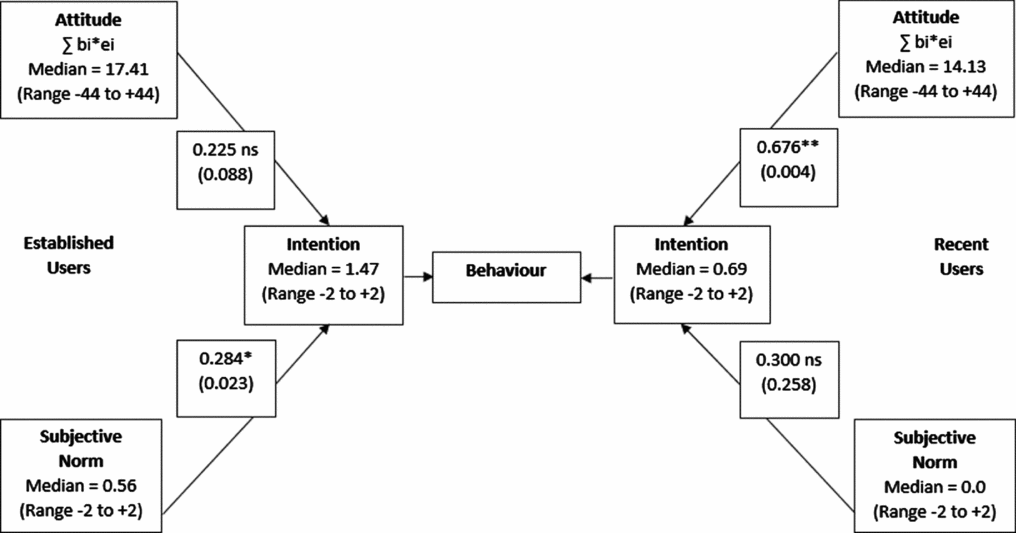
Based on the theoretical relationship between intention and the other psychological constructs and the extra variables (farmer's and farm's characteristics) presented in Figure 1, the following hypotheses were derived:
-
H1: The intention of the established users to use improved grassland is positively correlated with the direct measure of their attitude.
-
H2: The intention of the recent users to use improved grassland is positively correlated with the direct measure of their attitude.
-
H3: The intention of the established users to use improved grassland is positively correlated with the direct measure of their subjective norm.
-
H4: The intention of the recent users to use improved grassland is positively correlated with the direct measure of their subjective norm.
-
H5: The intention of the established users to use improved grassland is positively correlated with the indirect measure of their attitude.
-
H6: The intention of the recent users to use improved grassland is positively correlated with the indirect measure of their attitude.
-
H7: The intention of the established users to use improved grassland is positively correlated with the indirect measure of their subjective norm.
-
H8: The intention of the recent users to use improved grassland is positively correlated with the indirect measure of their subjective norm.
-
H9: The intention of established and recent users to use improved grassland is positively correlated with the all farmer´s and farm´s characteristics (extra variables).
Established and recent users intention toward using improved grassland.

RESULTS
Comparison between established and recent users
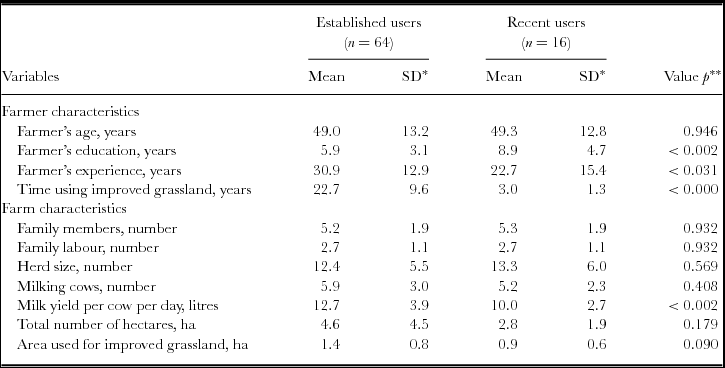
The variables that describe farmer characteristics, such as farmer's education, farmer's experience and years using improved grassland were statistically different between the two groups (Table 1); however, out of the seven variables that describe the farm characteristics, just the variable milk yield per cow per day was different (p < 0.05) between groups.
General characteristics and differences between groups of farmers.

* SD=Standard deviation.
** p value of the dependent t test (p < 0.05).
Intention of established and recent users to use improved grassland
Among both established and recent users, a majority of farmers expressed very strong (47% established users and 31% recent users) and strong intention (53% established users and 31% recent users) to use improved grassland on their farm over the next 12 months. The Mann–Whitney test revealed that the intention of established users (median=1.47) was higher (p<0.05) than recent users (median=0.69). Moreover 12% of recent users were undecided and 25% had weak intention.
Variables correlated with intention of established and recent users to use improved grassland
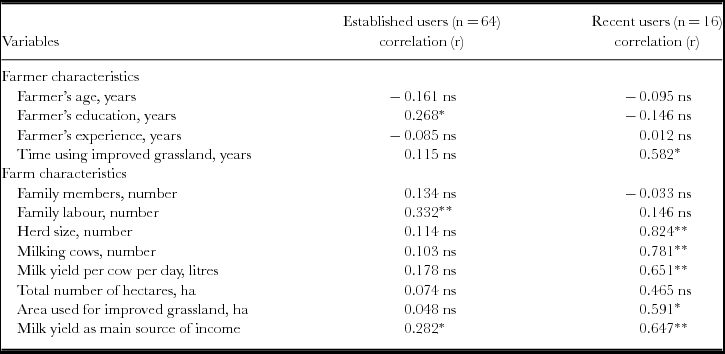
Out of the 12 variables analysed, three showed a significant correlation with the established users’ intention: farmer's education, family labour and milk yield as the main source of income (Table 2). For the case of the recent users, out of the eight farm variables analysed, five showed significant correlation with intention: herd size, milking cows, milk yield per cow per day, area used for improved grassland and milk yield as main source of income (Table 2). Therefore, we partial rejected the H9, i.e. the intention of established and recent users to use improved grassland is positively correlated with the all farmer´s and farm´s characteristics (extra variables).
Variables correlated with farmer's intention to use improved grassland.

ns: Showing non-significance and *correlation is significant at the 0.05 level (two-tailed).
**Correlation is significant at the 0.01 level (two-tailed).
Perception about usefulness and difficulty of use of improved grassland
The median responses of the usefulness of improved grassland for established and recent users were similar (1.53 and 1.38, respectively); suggesting that farmers would consider the use of improved grassland to be useful. About 53% of established users said it would be very useful and the other 47% said it would be useful; in contrast, 37.5% of recent users said that it would be very useful and 62.5% said it would be useful. Perception of both established and recent users about the usefulness of the grassland also showed significant correlation with intention (r = 0.443, p (two-tailed) < 0.001 and r = 0.670, p (two-tailed) < 0.001, respectively).
Difficulty
The median responses of the established users (−0.09) suggested that farmers would find it slightly difficult to use improved grassland during the winter season as they reported that forage production decreases on grassland with lower temperatures. The proportion of established users who felt that it would be difficult was 51.6%. The median responses of the recent users were slightly positive (0.31); however, 37.5% of farmers also felt that it would be difficult to use improved grassland during winter and dry season due to lack of water as irrigation systems were more widely present on established users farms than recent users’ farms; i.e. the formers have access to gravity-fed irrigation systems from a dam, allowing them to irrigate the grassland once a month (for 48 hours) during the dry season (November to April).
Beliefs underpinning attitude of established and recent users toward using improved grassland
In the evaluation of the direct attitude, most of the established users (69%) said that improved grassland would be very important, and the remaining 31% said it would be important. More than 30% of recent users considered that it would be very important, almost half (44%) said it would be important and the remaining 25% considered that it would not be important. The overall median of the direct attitude for established users was positive (1.69). This further indicated a significant correlation with intention (r = 0.363, p (two-tailed) < 0.01), revealing that the importance of the innovation would influence the established users’ intention to use improved grassland on their farms over the next 12 months. The overall median of direct attitude of recent users was also positive (0.81); moreover, significant correlation was found with intention (r = 0.918, p (two-tailed) < 0.01); this implies that the importance of the innovation would also have influence on recent users to use improved grassland. Therefore, we did not reject the H1: The intention of the established users to use improved grassland was positively correlated with the direct measure of their attitude, and H2: The intention of the recent users to use improved grassland was positively correlated with the direct measure of their attitude.
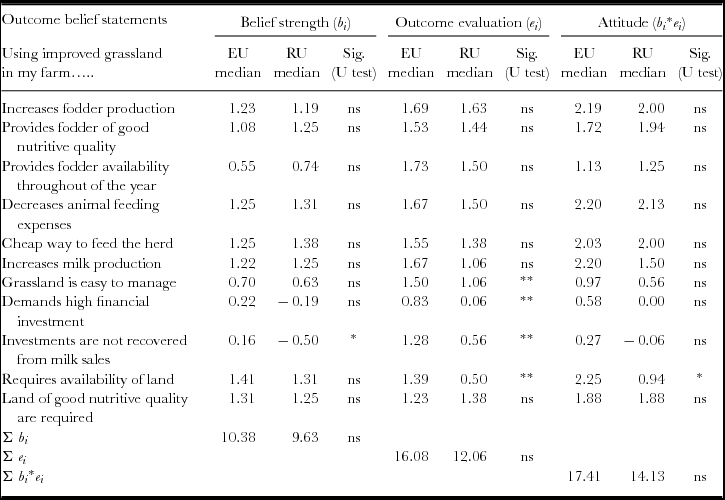
When looking at median scores (Table 3), few significant differences were noticed between established and recent users regarding belief strength, outcome evaluation and their summated product (attitude). The two groups only differed in one out of 11 salient beliefs regarding the strength of beliefs that they hold. Established users slightly believed that investments for using improved grassland are not recovered with the milk sales (median = 0.16) and this was significantly stronger than the beliefs of recent users (median= −0.50), (U = 356.00 p < 0.05). Indeed, more than half (55%) of established users agreed with this belief, whereas more than half of recent users (69%) disagreed.
Comparison of the belief strength (bi ), outcome evaluation (ei ) and attitude (bi *ei ) of the established and recent users of improved grassland.

EU = Established users and RU = recent users.
ns: Showing non-significance, Sig. (U test) = significance of difference of scores of recent users and established users on the bases of Mann–Whitney U test and * and ** denotes significance at 0.05 and 0.01 levels, respectively.
In the evaluation of outcomes, there were significant differences in 4 out of 11 evaluative beliefs between the two groups. Established users showed a higher score (median = 1.50) than recent users (median = 1.06) in the evaluation of the importance of the knowledge to manage the grassland (U = 279.50 p < 0.001). In contrast, three negative beliefs about using improved grassland on farm: it requires high financial investment (established user median = 0.83, recent user median = 0.06, U = 332.50, p < 0.001), investments are not recovered with the milk sales (established user median = 1.28, recent user median = 0.56, U = 318.00, p < 0.001) and availability of land (established user median = 1.39, recent user median = 0.50, U = 303.00, p < 0.001) were significantly more negatively evaluated by recent users. As for the summated product of belief strength and outcome evaluation representing overall attitude toward using improved grassland on farm, insignificant differences were found between established and recent users. Requires availability of land was the only significantly different (p < 0.05) outcome belief statement between the groups (Table 3).
Cognitive barriers and drivers for the established and recent users
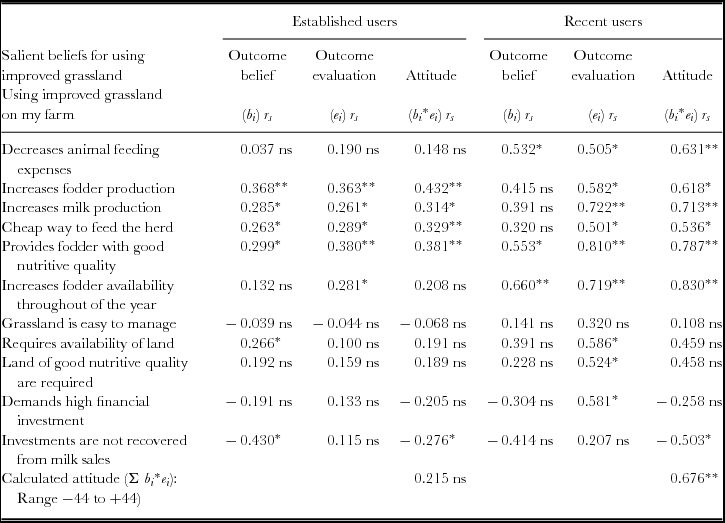
One cognitive barrier for using improved grassland on farm – for both groups of users – was evident: Investments are not recovered from milk sales (Table 4). On the other hand, four cognitive drivers for using improved grassland were evident for the established users: increases fodder, increases milk production, offers a cheap way to feed the herd and provides fodder of good nutritive quality. In each case, these were supported by significant correlation between intention and both outcome belief and evaluation. For the case of the recent users, six drivers for using improved grassland were evident: decreases animal feeding expenses, increases fodder production, increases milk production, offers a cheap way to feed the herd, provides fodder of good nutritive quality and provides fodder availability throughout of the year. They were also supported mainly by significant correlation between intention and outcome evaluation.
Correlation of intention with outcome belief, evaluation and attitude of the established and recent users toward using improved grassland.

ns: Showing non-significance and *correlation is significant at the 0.05 level (two-tailed).
**Correlation is significant at the 0.01 level (two-tailed).
Subjective norm toward using improved grassland by established and recent users
The perceived social pressure to use improved grassland on farm by established and recent users was captured through the direct subjective norm. Over half (59%) and 10% of the established users indicated that it is likely and very likely that the people whom they respect most would think they should use improved grassland on the farm over the next 12 months, respectively; nevertheless 9% gave neutral response, indicating that they do not know if any relative would influence them to use improved grassland, and 22% indicated that it is unlikely. However, half of the recent users (50%) indicated that it is likely, 6% gave neutral responses and 37 and 7% indicated that it is unlikely and very unlikely, respectively.
The overall median of the direct subjective norm for established users was slightly positive (0.56) and a significant correlation with intention (r = 0.284, p (two-tailed) < 0.05) was found, indicating that social pressure would influence the established users’ intention to use improved grassland on their farms over the next 12 months. Therefore, we did not reject the H3 regarding the established users as their intention to use improved grassland was positively correlated with the direct measure of their subjective norm. However, for recent users, the overall median of direct subjective norm was neutral (0.00), and no significant correlation was found with intention; this implies that social pressure would have no influence on recent users to use improved grassland. Thus, we rejected the H4 for recent users as their intention to use improved grassland was positively correlated with the direct measure of their subjective norm.
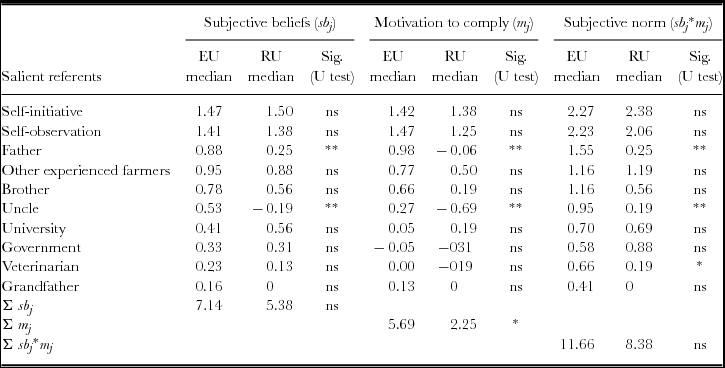
Significant differences in the subjective norms were observed between the two groups in 3 out of the 10 salient referents (Table 5); these differences can be further elaborated by examining the subjective beliefs and motivation to comply for the two groups with respect to the three significant salient referents (father, uncle and veterinarian). There were no statistical differences between the two groups in terms of the overall median scores of the subjective beliefs; however, established users were more strongly encouraged, than recent users, to use improved grassland on farm by their fathers (established user median = 0.88, recent user median = 0.25, U = 218.00, p < 0.001) and their uncles (established user median = 0.53, recent user median = −0.19, U = 262.50, p < 0.001).
Comparison of the subjective belief (sbj ), motivation to comply (mj ) and subjective norm (sbj *mj ) of established and recent users of improved grassland.

EU = Established users, RU = recent users, ns: showing non-significance, and Sig. (U test) = significance of difference of scores of recent users and established users on the bases of Mann–Whitney U test * and ** denotes significance at 0.05 and 0.01 levels, repectively.
The comparison of the overall median scores showed that established users were more motivated to comply than recent users by the salient referents (established user median = 5.69, recent user median = 2.25, U = 325.50, p < 0.05), mainly by their fathers (established user median = 0.98, recent user median = −0.06, U = 302.00, p < 0.01) and their uncles (established user median = 0.27, recent user median = −0.69, U = 253.50, p < 0.01). Note that both established and recent users exhibited negative median scores when asked if the government influences motivation to comply in both established and recent users. Non-significant differences were observed between the two groups in terms of the overall median scores of subjective norms, since both groups had similar scores.
Factors behind established and recent users' intention to use improved grassland
The indirect subjective norm was associated significantly (p < 0.05) with established users’ intention (Figure 1). Therefore, we did not reject the H7: The intention of established users to use improved grassland was positively correlated with the indirect measure of their subjective norm; however, we rejected the H8: The intention of the recent users to use improved grassland was positively correlated with the indirect measure of their subjective norm. This implies that established users’ intention to use improved grassland over the next 12 months was strongly associated with social pressure, mainly from their fathers, whereas the intention of recent users to use improved grassland was associated with their beliefs, since attitude was associated significantly (p < 0.01) with intention (Figure 1). Thus, we did not reject the H6: The intention of the recent users to use improved grassland was positively correlated with the indirect measure of their attitude; however, we rejected the H5: The intention of the established users to use improved grassland was positively correlated with the indirect measure of their attitude, i.e. the recent users’ intention to use improved grassland in the next 12 months was associated with the advantages and disadvantages that farmers perceive of the use of improved grassland on their farms. Therefore, social pressure was playing an important role in established users’ decisions to use improved grassland on their farms, whereas recent users’ decisions were based on their beliefs.
DISCUSSION
The results of the established and recent users showed that the formers had stronger intention to use improved grassland in the next 12 months. This could be attributed to the finding that established users relying more on milk production as a main source of family income. A considerable proportion of recent users were undecided and displayed weak intention; possible reasons for this behaviour included little experience with using the innovation for 1 or 2 years, continued experimentation with the innovation, increased investment and effort as grassland requires replanting and therefore more investment and effort in the system and significant family income from non-farm activities. Daskalopoulou and Pretrou (Reference Daskalopoulou and Pretrou2002) pointed out that farmers who gave more importance to off-farm activities in terms of employment and income generation do not constitute potential adopters of agricultural innovations.
The results of the correlation between farm characteristics and recent users’ intention suggested that factors underlying the recent users’ decision to use improved grassland rely on their farm characteristics. Keil et al. (Reference Keil, Zeller and Franzel2005) found that farm size was associated with farmers’ decisions to adopt improved fallows in Zambia. Also, the positive correlation between the variable time using improved grassland and recent users’ intention indicated that the longer the time a farmer adopts improved grassland, the stronger is the farmer's intention to use improved grassland on the farm.
On the other hand, the significant association of education with established users’ intention suggested that the better is the farmers’ education, the stronger is the farmers’ intention to use improved grassland. Staal et al. (Reference Staal, Baltenweck, Waithaka, Wolff and Njoroge2002) mentioned that farmers’ education has positive association with adoption of innovation, since this is related to the probability of improving the ability to manage technologies and to use the information. Established and recent users’ intention was associated with the variable milk yield as the main source of income; this implies that the more the farmers depend on milk production as the main source of family incomes, the stronger is the farmers’ intention to use improved grassland on farms over the 12 months.
Both established and recent users perceived the use of improved grassland to be very useful; furthermore, for both groups, farmers’ perception about the usefulness of improved grassland was associated with intention. This implies that the more the farmers perceive the grassland to be useful on farm, the stronger is the farmers’ intention to use grassland on farms over the next 12 months. Both groups perceived the use of improved grassland during winter and dry season would be slightly difficult; however, it would not be a constraint as the difficulty was not associated with farmers’ intention.
The positive score of the direct attitude in both established and recent users showed that the importance of improved grassland to farmers was a relevant factor to use it over the next 12 months. However, the use of the innovation was considered of more importance by established users than recent users, since 25% of the latters considered improved grassland not very important; one possible reason for this finding was that the main incomes of these farmers were from non-farm activities. The score of each attitude and calculated attitude did not show significant differences between the two groups; this could be attributed to established and recent users having similar perceptions of the advantages and disadvantages of the use of improved grassland on farm.
Six out of the eleven beliefs were identified as cognitive drivers for recent users, whereas four beliefs were identified among established users. Garforth et al. (Reference Garforth, McKemey, Rehman, Tranter, Cooke, Park, Dorward and Yates2006) affirmed that if the drivers can be strengthened in a particular population, more people will adopt the behaviour. On the other hand, one belief was considered as cognitive barrier (investments for using improved grassland on farm are not recovered from milk sales); this implies that farmers in both groups who share this salient belief were less likely to express an intention to use the innovation in their farms.
Despite the fact that both established and recent users considered the availability of land an important factor to use improved grassland on their farms, farmers’ intention was not significantly associated with the total number of hectares in the farm or farmers’ belief that the use of improved grassland requires availability of land. This implies that farmers who possess small areas, but who consider milk production as the main source of family income, still intend to use improved grassland on their farms.
The results of the direct subjective norm showed that social pressure was an important factor encouraging use of improved grassland over the next 12 months, mainly among the group of established users. Regarding motivation to comply, established users felt more motivated by their self-initiative, self-observation, fathers, other experienced farmers and brothers, whereas recent users by their self-initiative, self-observation and other experienced farmers. Garforth et al. (Reference Garforth, Rehman, McKemey, Tranter, Cooke, Yates, Park and Dorward2004) pointed out that the differences in the degree to which farmers are motivated to comply with the various referents could be used to suggest the appropriate channels and sources for a great impact on adoption; these more influential referents could be targeted in the development of appropriated communication strategies.
In general terms, established users’ intention to use improved grassland was mainly influenced by the social pressure and the opinion of salient referents, in which the fathers played an important role. Garforth et al. (Reference Garforth, Rehman, McKemey, Tranter, Cooke, Yates, Park and Dorward2004) mentioned that when a normative element is clearly dominant, the salient referents become the more important elements within the proposed audience. The recent users were more influenced by their attitude, which was determined by their responses to the positive and negative belief questions regarding the use of improved grassland on farm. Garforth et al. (Reference Garforth, Rehman, McKemey, Tranter, Cooke, Yates, Park and Dorward2004) also reported that farmers’ attitudes toward an innovation have a strong influence on whether or not farmers intend to use it. Therefore, recent users’ beliefs were an important factor that underlied farmers’ decision to use the innovation in their farms.
CONCLUSION
Established and recent users’ intention to use improved grassland on their farms was associated with the usefulness and importance (direct attitude) of the innovation to farmers. Established and recent users’ intention to use improved grassland over the next 12 months was also influenced in different ways, as established users’ intention was strongly influenced by normative beliefs (i.e. social pressure from salient referents, where the father, uncle and veterinarian play the most important role), whereas recent users’ intention to adopt was mainly influenced by behavioural beliefs (positive and negative beliefs regarding the innovation) and by farm characteristics. However, the variable milk yield as the main source of family income played an important role across groups in farmers’ intention to adopt the innovation. The more the farmers depend on milk yield as the main source of family income, the stronger the farmers’ intention was to use improved grassland on the farm. Therefore, our findings could be used by research and extension in central Mexico to improve the services offered to small-scale farmers. In addition, extension services may consider the drivers and social referents identified herein as source of knowledge and communication in order to promote the innovation, especially among farmers who have not already engaged in the use of improved grasslands.
Acknowledgements
The authors wish to express their sincere thanks to Consejo Nacional de Ciencia y Tecnología (CONACYT) for providing financial support and to all the farmers involved in the study for their cooperation and assistance.
SUPPLEMENTARY MATERIAL
To view supplementary material for this article, please visit https://doi.org/10.1017/S0014479716000703