Introduction
A popular approach to estimating premorbid IQ is by combining demographic information with scores on oral reading tasks such as the National Adult Reading Test (NART; Crawford, Parker, Stewart, Besson, & DeLacey, Reference Crawford, Parker, Stewart, Besson and De Lacey1989; Willshire, Kinsella, & Prior, Reference Willshire, Kinsella and Prior1991). Along these lines, Gladsjio, Heaton, Palmer, Taylor, and Jeste (1999) estimated the percentage of cases for whom the American NART-based IQ predicted score fell closer to the demographically corrected, measured score than expected by chance. There are, however, indications for interactive effects of age and educational attainment on cognitive measures (Ardila, Ostrosky-Solis, Rosselli, & Gomez, Reference Ardila, Ostrosky-Solis, Rosselli and Gomez2000; Craik, Byrd, & Swanson, Reference Craik, Byrd and Swanson1987) including recent data from Greek adults (Simos, Kasselimis, & Mouzaki, 2011), where age effects on WASI Vocabulary performance (which is strongly correlated with overall IQ) were restricted to lower educational level subgroups. Such findings are directly relevant, both theoretically and clinically, to the notion of increased vulnerability to cognitive decline with reduced education (e.g., Deary, MacLennan, & Starr, Reference Deary, MacLennan and Starr1999). Accordingly, the main objective of the present study was to identify population subgroups where reading measures may be particularly valuable in predicting current IQ.
Additional goals emerged when considering the peculiarities of the Greek orthographic system, which is highly transparent and phonetic. In view of the extant literature suggesting that naming accuracy is not a very sensitive measure of word recognition ability in shallow orthographies (such as Spanish, Italian, Finnish, Serbo-croatian, and Greek among others; Müller & Brady, Reference Müller and Brady2001; Porpodas, Reference Porpodas1999), we developed and used reading measures that assess naming speed in addition to accuracy. We also sought to render word reading performance less dependent upon the participant's educational attainment by using higher frequency words (than those in established reading tests such as NART). It was assumed that ability to read relatively familiar words (both orthographically and semantically) would require less “fluid” cognitive resources, providing a more accurate index of crystallized intelligence (availability and accessibility of stored graphemic, phonological, and possibly also semantic representations of words). Despite these efforts, word reading efficiency still reflects general processing speed and, to some extent, rapid, automatized decoding ability. The second objective of the present study was to account for stimulus/task familiarity in the prediction of IQ by word reading efficiency performance through the use of a pseudoword reading efficiency task. By contrasting word and (phonotactically matched) pseudoword reading efficiency measures, we sought to determine the relative contribution of semantic memory versus decoding ability to reading-based estimates of IQ.
We predicted that reading efficiency is a viable predictor of premorbid IQ, only when combined with demographic variables. We further anticipated that the predictive value of reading efficiency measures is significant for the subgroups of participants with lower educational attainment. Finally, we predicted that word reading efficiency would be a better predictor of crystallized intelligence (vocabulary) than pseudoword reading efficiency, with the opposite trend for fluid intelligence.
Methods
Participants and Procedures
The sample included 386 adults (163 men) aged 48–87 years (Mean = 63.77; SD = 9.11) with an average of 11.15 years of formal education (SD = 4.50; range = 3–20 years) recruited from eight broad geographic areas of Greece (220 from urban and 166 from rural areas or small-towns). They all reportedly normal or corrected to normal vision and hearing, were native Greek speakers, and had a negative history for closed head injury accompanied by loss of consciousness, other known neurological or psychiatric condition, and learning disability. Recruitment and data collection were obtained in compliance with the principles outlined in the Helsinki Declaration. Data collection was performed between 9/2007 and 2/2009.
Measures
Word reading efficiency (WRE) was assessed with a list of 112 high-frequency words (see Appendix 1), printed on a single sheet in four columns in order of increasing length (one to six syllables). All words were among the 1000 most frequent word forms in the “Hellenic National Corpus” (Hatzigeorgiu et al., 2000; hnc.ilsp.gr). A list of 70 one- to six-syllable pseudowords (see Appendix 2) printed in three columns in order of increasing length was used to assess pseudoword reading efficiency (PsWRE). Pseudowords were constructed by altering one or two letters in 70 words matched on mean frequency of appearance with those included in the word list. Average N values (Coltheart, Davelaar, Jonasson, & Besner, Reference Coltheart, Davelaar, Jonasson and Besner1977) were 2.94 (SD = 3.71) for words and 1.20 (SD = 2.67; p = .001) for pseudowords, based on the Institute for Language & Speech Processing PsychoLinguistic Resource corpus; Protopapas, Tzakosta, Chalamandaris, & Tsiakoulis, in press). Corresponding Levenshtein 20 values (orthographic distance; Yarkoni, Balota, & Yap, Reference Yarkoni, Balota and Yap2008) were 2.03 (SD = 0.54) and 3.11 (SD = 1.32; p = .001).
Participants were asked to read items on each list aloud with a time limit of 45 s, as fast as possible and without errors. Other than detailed instructions and the warm up achieved by reading the word list (always administered before the pseudoword task), there were no practice stimuli for the pseudoword task. Still, participants who failed to start reading within the first 5 s were excluded from the study (only six participants, all with <6 years of formal education) encountered this problem. The number of words or pseudowords read correctly in the time allotted served as the WRE and PsWRE indices, respectively. Scores were normally distributed and test–retest coefficients (n = 20) were r = .95 for WRE and r = .91 for PsWRE.
IQ estimates. Non-verbal IQ was estimated using the WASI Block Design subtest using standard administration procedures. Verbal IQ was estimated through the Greek adaptation of PPVT-R Form L (Dunn & Dunn, Reference Dunn and Dunn1981; Simos et al., Reference Simos, Kasselimis and Mouzaki2011), and WASI Vocabulary (Simos et al., Reference Simos, Kasselimis and Mouzaki2011; Wechsler, Reference Wechsler1999Footnote 1). Cronbach's alphas were .98, .91, and .94 for PPVT-R, WASI Vocabulary, and Blocks, respectively. Corresponding test–retest reliability estimates were: .88, .72, and .93.
Data Analyses
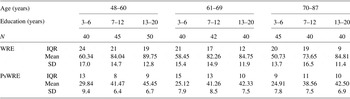
The sample was divided into nine subgroups by discretizing age and education, each, into three levels (age: 48–60, 61–69, and 70–87 years, education: 3–6 years, 7–12 years, and 13–20 years of formal education, respectively). Quality of education was not recorded in view of the highly integrated nature of the Greek educational system both geographically and culturally (at least through high school). Importantly, the public education system in Greece is fairly uniform, with no major disparities in quality of education. Effort was made to ensure sample geographic and SES representativeness. Performance descriptives for each subgroup are shown in Table 1. Following the approach introduced by Gladsjio et al. (1999) we first estimated the amount of variance accounted for by raw reading efficiency scores on each of three, demographically corrected, IQ estimates: PIQ (indexed by Block design performance), VIQ (average of WASI Vocabulary and PPVT-R scores), and FSIQ (average of the three subtests). T scores for each IQ subtest score were computed separately for the nine subgroups. Residual effects of age and education on subtest scores within each subgroup were minimal: ∣β∣ < .1. The clinical utility of reading efficiency measures in predicting current IQ was assessed by determining the extent to which predicted IQ T scores based on raw WRE or PsWRE scores (Tpred) were closer to the actual, demographically corrected IQ index (T scores) than the latter were to the respective IQ index predicted by chance alone (50 points). The prediction of a particular IQ index by each of the two reading efficiency measures was deemed as successful (i.e., better than demographic factors alone) if the difference between T and Tpred was smaller than 0.5 SEreg points than the difference between T and 50 points. Linear regressions of IQ T scores on WRE or PsWRE were performed on the entire sample and on age and education-restricted subgroups of participants formed on the basis of exploratory correlational data.
Performance on the reading efficiency tasks for nine participant subgroups (raw scores)

Note. 1. Scores correspond to the number of stimuli read correctly in 45 s. In the entire sample, error rates were very low, averaging 1.5% for words, and higher, as expected, for pseudowords (14.5%). Importantly, error rate did not vary with education level or age (p > .1 for all main effects and interactions). Correlations between number of stimuli read correctly in 45 s and number of errors did not exceed r = .2 in any of the subgroups. 2. There was little evidence of ceiling effects in performance: Fewer than 7% of participants in the entire sample read more than 90% of the words correctly (only 3.1% read more than 95% of the words correctly). For pseudowords, the corresponding figure was 0%. Perfect score (112 for words and 70 for pseudowords) was not achieved by any participant.
IQR = interquartile range.
Results
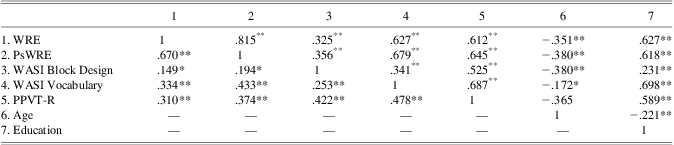
As shown in Table 2, performance on each of the measures used in the study correlated highly with education and, to a lesser degree (with the exception of Block Design), with age. Correlations between gender and each of the cognitive measures were <.1. Importantly WRE and PwRE raw scores correlated significantly with each of the IQ measures even after controlling for age and education level.
Correlations between reading efficiency, PPVT-R, WASI Vocabulary and Block Design in the entire sample (raw scores)
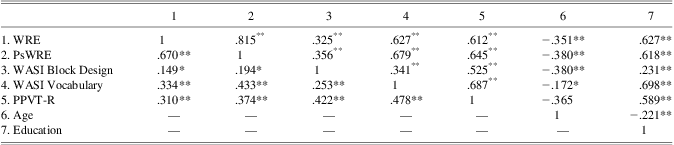
Note. Zero order coefficients are shown above the diagonal and partial correlations controlling for age and education level below the diagonal.
*p = .003.
**p = .0001.
WRE = Word Reading Efficiency task; PsWRE = Pseudoword Reading Efficiency task.
Association of Reading Efficiency Measures With Intelligence Estimates
For the entire sample, simple linear regressions of demographically adjusted IQ T scores on reading efficiency raw scores were significant for the FSIQ and VIQ indices but failed to reach significance for PIQ (WASI Blocks T score). The four significant regression equations were as follows:
 $${ &{\rm{Estimated}} \ \,{\rm{FSIQ}} \ \,{\rm{T}} \ \,{\rm{score}} \cr\qquad \ \,\qquad = \, 46.33\, + \, 0.053 \, \ast \, ({\rm{WRE}} \ \, {\rm{raw}} \ \,{\rm{score}}) \cr {\rm{Adj}}{\rm{.}} \ {{R}^2} \, = \, .019,\;S{{E}_{reg}}\, = \, 7.54, F(1,386)\, = \, 8.58,\;p\, = \, .004. $$
 $${ &\hskip -2.6pc {\rm{Estimated}} \ \,{\rm{FVIQ}} \ \, {\rm{T}} \ \,{\rm{score}} \qquad \cr = \, 45.66\, + \, 0.064 \ \ast \ ({\rm{WRE}} \ \,{\rm{raw}} \ \,{\rm{score}})\, \cr {\rm{Adj}}{\rm{.}} \ {{R}^2} \, & = \, .024,\;S{{E}_{reg}}\, = \, 8.21,\;F(1,386)\, = \, 10.57,\;p\, = \, .001. $$
 $${ &\hskip -2.6pc {\rm{Estimated}} \ \,{\rm{FSIQ}} \ \,{\rm{T}} \ \,{\rm{score}} \cr = \, 44.13\, + \, 0.171 \ \ast \ ({\rm{PsWRE}} \ \,{\rm{raw}} \ \,{\rm{score}}) \cr {\rm{Adj}}{\rm{.}} \ {{R}^2} \, & = \, .062,\;S{{E}_{reg}}\, = \, 7.26,\;F(1,386)\, = \, 26.65,\;p\, = \, .0001. \cr $$
 $${ &{\rm{Estimated}} \ \ {\rm{FVIQ}} \ \ {\rm{T}} \ \ {\rm{score}} \cr\quad \qquad \qquad \ \ = \, 42.87\, + \, 0.209 \ \ast \ ({\rm{PsWRE}} \ \ {\rm{raw}} \ \ {\rm{score}}) \cr {\rm{Adj}}{\rm{.}} \ {{R}^2} \, = \, .083,\;S{{E}_{reg}}\, = \, 7.85,\;F(1,386)\, = \, 34.76,\;p\, = \, .0001. \cr $$
As indicated by R2 values, the percentage of variance in estimated FSIQ and VIQ T scores accounted for by reading performance, beyond that accounted for by demographic variables, ranged between 1.9 and 8.3%. Only PsWRE resulted in better prediction of estimated IQ values than demographic factors alone: this occurred for 7% and 10% of cases with respect to FSIQ and VIQ, respectively. However, inspection of correlations between raw reading efficiency scores and estimated IQ T values computed separately for each of the nine age and education subgroups, revealed that significant coefficients (at alpha = .01) were restricted to four subgroups of participants (48–87 years with 3–6 years of education, and 70–87 years with 7–12 years of education). Inspection of the bivariate scatter plots indicated adequate distribution of scores on both variables of each pair (word or pseudoword fluency and TVIQ or TFSIQ scores—despite the use of truncated distributions). All six regression equations predicting estimated IQ T scores from WRE or PsWRE raw score in the subsample (N = 165, 67 men) were significant as follows:
 $${ &\hskip -0.4pc{\rm{Estimated}} \ \,{\rm{PIQ}} \ \,{\rm{T}} \ \,{\rm{score}}\cr\quad \qquad \qquad = \, 43.72\, + \, 0.122 \ \ast \ ({\rm{WRE}} \ {\rm{raw}} \ {\rm{score}}) \cr {\rm{Adj}}{\rm{.}} \ {{R}^2} \, = \, .047,\;S{{E}_{reg}}\, = \, 9.62,\;F(1,164)\, = \, 8.72,\;p\, = \, .004. \cr $$
 $${ &\hskip -0.2pc{\rm{Estimated}} \ \,{\rm{FSIQ}} \ \,{\rm{T}} \ \,{\rm{score}}\, \cr\qquad \qquad \qquad = \, 40.273\, + \, 0.184 \ \ast \ ({\rm{WRE}} \ {\rm{raw}} \ {\rm{score}}) \cr {\rm{Adj}}{\rm{.}} \ {{R}^2} \, = \, .198,{}S{{E}_{reg}}\, = \, 6.78,F(1,164)\, = \, 41.223,\;p\, = \, .0001. \cr $$
 $${ &\hskip -0.2pc{\rm{Estimated}} \ \,{\rm{VIQ}} \ \,{\rm{T}} \ \,{\rm{score}} \cr\qquad \qquad \qquad \ = \,38.815\, + \,0.211 \ \ast \ ({\rm{WRE}}\,{\rm{raw}} \ {\rm{score}}) \cr {\rm{Adj}}{\rm{.}} \ {{R}^2} \, = \,.230,\;S{{E}_{reg}}\, = \,7.09,\;F(1,164)\, = \,49.668,\;p\, = \,.0001. \cr $$
 $${ &{\rm{Estimated}} \ \,{\rm{PIQ}} \ \,{\rm{T}} \ \,{\rm{score}} \cr\qquad \qquad \ \qquad = \,42.917\, + \,0.277 \ \ast \ ({\rm{PsWRE}} \ {\rm{raw}} \ {\rm{score}}) \cr {\rm{Adj}}{\rm{.}} \ {{R}^2} \, = \,.073,\;S{{E}_{reg}}\, = \,9.44,\;F(1,164)\, = \,13.216,\;p\, = \,.0001. \cr $$
 $${ &\hskip -0.9pc{\rm{Estimated}} \ \,{\rm{FSIQ}} \ \,{\rm{T}} \ \,{\rm{score}} \cr\qquad \qquad \qquad \ \ = \,39.999\, + \,0.388\ \ast \ ({\rm{PsWRE}} \ \,{\rm{raw}} \ \,{\rm{score}}) \cr \hskip -0.9pc{\rm{Adj}}{\rm{.}} \ {{R}^2} \, = \,.254,\;S{{E}_{reg}}\, = \,6.54,\;F(1,164)\, = \,56.105,\;p\, = \,.0001. \cr $$
 $${ &\hskip -2pt{\rm{Estimated}} \ \ {\rm{VIQ}} \ \ {\rm{T}} \ \ {\rm{score}} \cr\qquad \qquad \ \ \quad \qquad = \,38.740\, + \,0.437 \ \ast \ ({\rm{PsWRE}} \ \,{\rm{raw}} \ \,{\rm{score}}) \cr \!\!\!{\rm{Adj}}{\rm{.}} \ {{R}^2} \, = \,.283,\;S{{E}_{reg}}\, = \,6.851,\;F(1,164)\, = \,64.930,\;p\, = \,.0001. \cr $$
The amount of variance explained by reading efficiency scores in demographically adjusted IQ estimates ranged between 4.7% and 28.3%, with PsWRE scores contributing slightly more variance to each IQ estimate than WRE scores. This impression was confirmed after reviewing the rates of “successful” predictions of IQ T scores in Table 3, suggesting that only PsWRE was associated with a positive net prediction of PIQ (in ∼4% of the cases). Moreover, the net benefit of using PsWRE versus WRE was 22.8 versus 17.1% for VIQ and 20.2 versus 10% for FSIQ prediction, respectively.
Relative prediction accuracy of reading efficiency (raw scores) for demographically corrected IQ estimates (subgroup of persons 48–87 years old with 3–6 years of education, and persons 70–87 years with 7–12 years of education; n = 165)

Note. PIQ = WASI Block Design T score; VIQ = Average of WASI Vocabulary and PPVT-R T scores; FSIQ = Average of PIQ and VIQ T scores; WRE = Word Reading Efficiency task; PsWRE = Pseudoword Reading Efficiency task.
The possibility remains, however, that these IQ estimates may be contaminated by the effect of brain pathology on processing speed (consistent with the small to medium size correlation between age and reading efficiency: r = −.297 for words and r = −.292 for pseudowords, controlling for education). However, exploratory analyses on data from a small group of participants reporting history of mild to moderate TBI (as indicated by loss of consciousness >1 hr; N = 38; MAge = 65.4; SD = 8.1 years; MEdu = 9.5; SD = 5.2 years) indicated that the association between reading efficiency and IQ measures remained strong even for measures less likely to be affected by brain damage such as PPVT-R (r = .670 for words and r = .608 for pseudowords).
Discussion
Results presented here confirmed our first prediction that reading efficiency scores obtained from a large, representative sample of Greek adults improved the prediction accuracy of demographic variables, primarily for Verbal IQ. Results were comparable to those reported by Gladsjo et al. (Reference Gladsjo, Heaton, Palmer, Taylor and Jeste1999) using similar statistical procedures.
With respect to our second prediction, results highlighted important demographic restrictions in the clinical utility of the reading tests (to individuals with no more than high-school education). These restrictions may reflect the transparency of the Greek orthography (reducing demands on semantic memory for word forms) and the fact that word reading efficiency was assessed with relatively high frequency words. Despite the fact that by requiring speeded naming responses we avoided ceiling effects on both tasks (see additional information presented in Table 1), total variance of individual scores varied (inversely) as a function of education (as indicated by Levene's F tests; p < .01). It should be noted that occupation (an index commonly used in demographic-based approaches to estimating premorbid intelligence) was not factored in the analyses presented here. Exploratory regression analyses using raw WRE and PsWRE scores did not indicate significant effects of occupation (current or past—for retired participants) independent of age and education. Further analyses are needed to determine optimal cutoff scores on the reading measures for categorical IQ estimates evaluating the sensitivity and selectivity of such scores.
With respect to our third prediction, WRE did not outperform PsWRE as a concurrent predictor of IQ estimates (this was true even for VIQ). This may at first appear surprising given that word reading and oral vocabulary scales are both believed to tap into crystallized knowledge (semantic memory for oral and written word forms). Although this issue has not been studied systematically for Greek, one potential explanation of this finding is that performance on word reading efficiency tasks depends very little upon semantic knowledge (or at least to the same extent as similar tasks involving pseudowords). At the same time, word reading is certainly easier than speeded pseudoword reading especially if the former involves relatively high frequency words. Inspection of Table 1, reveals a slight trend for increased inter-individual variability for PsWre than WRE (as indicated by the ratio of standard deviations over respective means), although this pattern was not consistent across study subgroups.
Increased contribution of a performance element (assuming that pseudoword reading is much less automatized than word reading) may also account for the slightly stronger association between pseudoword reading efficiency and Block Design scores, than between word reading efficiency and Block Design. The fact that pseudowords were constructed in such a way as to reduce the likelihood of lexical activation (by keeping orthographic neighborhood low and string distance values high) may have contributed to this effect.
The present study has several limitations. First, IQ was not calculated based on performance on comprehensive IQ batteries, but rather estimated with three different tests/subscales (WASI Block Design for estimating PIQ and PPVT-R and WASI Vocabulary for estimating VIQ). Although these tests can be used to determine IQ, they have a less than perfect correlation with standard IQ scores, and thus, are imperfect estimates of this latent construct. Unfortunately however, there are no officially standardized IQ batteries in Greek. Thus, we used the best available evidence to estimate IQ, a relatively common practice in previous studies (e.g., Stevenson, Reference Stevenson1986). Furthermore, the order of words and pseudowords was not counterbalanced. This could be an issue since a participant could be slower on pseudowords simply because they are administered in the second half of the experimental session. Although the brevity of the word reading task is not likely to have introduced significant fatigue effects, any such would have probably been cancelled out by opposing practice effects.
Finally, results attesting to the predictive value of reading tests for IQ in healthy volunteers or patients with extra-cerebral disease should be viewed with caution in view of the ongoing debate on whether reading ability is affected by brain trauma or disease (for reviews, see Franzen, Burgess, & Smith-Seemiller, Reference Franzen, Burgess and Smith-Seemiller1997; O'Carroll, Reference O'Carroll1995). Furthermore, the measures used in the present study should be used with great caution in disorders that are particularly likely to seriously affect speed of processing, such as progressive degenerative (such as Alzheimer's dementia), demyelinating diseases (such as multiple sclerosis), and traumatic brain injury. In some cases, it has even been shown that reductions in processing speed may actually mediate the effect of brain damage on other cognitive functions (e.g., learning and memory; Timmerman & Brouwer, Reference Timmerman and Brouwer1999). This cautionary note is supported by the current data demonstrating a small to medium size correlation between age and reading efficiency (controlling for education). Exploratory analyses on data from a small group of participants reporting history of mild to moderate TBI indicated that the association between reading efficiency and IQ measures remained strong even for measures less likely to be affected by brain damage such as PPVT-R. It remains imperative, however, that future studies examine the predictive value of reading efficiency measures, longitudinally, at different stages of various disorders known to affect processing speed.
To conclude, in agreement with numerous previous studies in various cultures and orthographies (O'Carroll, Moffoot, Ebmeier, & Goodwin, Reference O'Carroll, Moffoot, Ebmeier and Goodwin1992; Taylor, Reference Taylor1999), our results do not support the use of reading measures as sole indicators of premorbid intelligence. It is, however, noteworthy that reading efficiency measures obtained in less than one minute may significantly improve demographically based premorbid intelligence estimates, especially for lower educational level subgroups, by tapping into both crystallized knowledge (semantic memory) as well as an implicitly acquired linguistic skill (phonological decoding).
Acknowledgments
This work was supported by a doctoral fellowship to DK through “IRAKLITOS II—University of Crete” of the Operational Programme for Education and Lifelong Learning 2007–2013 (E.P.E.D.V.M.) of the NSRF (2007–2013), which is co-funded by the European Union (European Social Fund) and National Resources.
Word Stimuli (in Greek)

Pseudoword Stimuli (in Greek)