Childhood maltreatment is associated with chronic, severe, and treatment-resistant depression (Klein et al., Reference Klein, Arnow, Barkin, Dowling, Kocsis, Leon and Wisniewski2009; McCauley et al., Reference McCauley, Kern, Kolodner, Dill, Schroeder, DeChant and Bass1997), and a history of maltreatment is associated with a threefold greater risk for depression (Brown, Cohen, Johnson, & Smailes, Reference Brown, Cohen, Johnson and Smailes1999) that is carried throughout the lifetime (Gillespie & Nemeroff, Reference Gillespie and Nemeroff2007). Research based on cognitive models of depression suggest that early history of child abuse is linked to later adolescent and adult depression via rigid adjudications of negative stimuli, traits, and events to the self as well as disregard of positive stimuli, traits, and events (Liu, Choi, Boland, Mastin, & Alloy, Reference Liu, Choi, Boland, Mastin and Alloy2013; Pillay, Bundhoo, & Bhowon, Reference Pillay, Bundhoo and Bhowon2010). This process is thought to contribute to the emergence of biased cognitive self-schemas, which exclude positive self-information and preferentially assimilate negative self-information (Beck, Reference Beck1961). For example, prior work has shown that self-criticism fully mediates the relationship between childhood verbal abuse and internalizing symptoms in adulthood (Sachs-Ericsson, Verona, Joiner, & Preacher, Reference Sachs-Ericsson, Verona, Joiner and Preacher2006). Therefore, child maltreatment is likely to “shape” the neurophysiology of self-processing in negative and long-lasting ways and that altered neurophysiology of self-processing may be the material substrate that supports lifetime risks for depression among maltreated individuals.
Maltreatment has been defined as acts of commission (i.e., sexual and physical abuse) or omission (e.g., neglect or absent parenting) by the Centers for Disease Control and Prevention and other authors (Saul et al., Reference Saul, Valle, Mercy, Turner, Kaufmann and Popovic2014; Valentino, Cicchetti, Rogosch, & Toth, Reference Valentino, Cicchetti, Rogosch and Toth2008). Others have defined these as two types of deviation from expectable environmental input as (a) presence of harmful input and (b) lack of necessary input (Humphreys & Zeanah, Reference Humphreys and Zeanah2015). Evidence suggests that these modalities of maltreatment may have different impact upon cognitive and regulatory skills (e.g., executive function and emotion regulation), which are supported by the midline and orbital prefrontal cortex, substrates that also enable self-referential processing. For example, maltreatment is associated with structural abnormalities such as reduced volume of the medial and orbital prefrontal cortex (De Brito et al., Reference De Brito, Viding, Sebastian, Kelly, Mechelli, Maris and McCrory2013; van Harmelen, van Tol, et al., Reference van Harmelen, de Jong, Glashouwer, Spinhoven, Penninx and Elzinga2010). In addition, severity of maltreatment has been associated with increased dorsal medial prefrontal cortex activity during social exclusion (van Harmelen, Hauber, et al., Reference van Harmelen, Hauber, Gunther Moor, Spinhoven, Boon, Crone and Elzinga2014). Those structural and functional abnormalities in midline prefrontal structures suggest that aspects of self- and social cognition will be impacted by maltreatment. Given that the dorsal medial prefrontal cortex plays a crucial role in self-referential processing, this suggest that more severe maltreatment may impact the neural basis of self-processing during social challenges, thus enhancing cognitive vulnerability for psychiatric disorders (van Harmelen, Hauber, et al., Reference van Harmelen, van Tol, Dalgleish, van der Wee, Veltman, Aleman and Elzinga2014), lending credence to the possibility that altered neurobiology of self-processes will distinguish depressed versus maltreated depressed individuals.
It is important to note that self-processing, executive function, and emotion regulation are all enabled by overlapping orbital prefrontal cortex substrates, including the dorsolateral and medial prefrontal and the anterior cingulate cortices. The dorsolateral, medial prefrontal, and anterior cingulate cortices are known to support executive function and self-processing (Christoff, Cosmelli, Legrand, & Thompson, Reference Christoff, Cosmelli, Legrand and Thompson2011; Fossati et al., Reference Fossati, Hevenor, Graham, Grady, Keightley, Craik and Mayberg2003; Gusnard, Akbudak, Shulman, & Raichle, Reference Gusnard, Akbudak, Shulman and Raichle2001; Jankowski, Moore, Merchant, Kahn, & Pfeifer, Reference Jankowski, Moore, Merchant, Kahn and Pfeifer2014; Kircher et al., Reference Kircher, Senior, Phillips, Rabe-Hesketh, Benson, Bullmore and David2001; Pfeifer et al., Reference Pfeifer, Masten, Borofsky, Dapretto, Fuligni and Lieberman2009; Philippi, Tranel, Duff, & Rudrauf, Reference Philippi, Tranel, Duff and Rudrauf2014; Sheline et al., Reference Sheline, Barch, Price, Rundle, Vaishnavi, Snyder and Raichle2009) whereas the medial orbital prefrontal cortex and the anterior cingulate cortex (ACC) overlap in their support of emotion regulation, self-processing, and aspects of executive functioning (Koenigsberg et al., Reference Koenigsberg, Fan, Ochsner, Liu, Guise, Pizzarello and Goodman2010; McRae et al., Reference McRae, Gross, Weber, Robertson, Sokol-Hessner, Ray and Ochsner2012). It is critical that executive functions are conspicuously altered among adult and child survivors of child maltreatment (Cecil, Viding, McCrory, & Gregory, Reference Cecil, Viding, McCrory and Gregory2015; Kirke-Smith, Henry, & Messer, Reference Kirke-Smith, Henry and Messer2014; Miller et al., Reference Miller, McTeague, Gyurak, Patenaude, Williams, Grieve and Etkin2015), as is emotion regulation (Dvir, Ford, Hill, & Frazier, Reference Dvir, Ford, Hill and Frazier2014; Shackman & Pollak, Reference Shackman and Pollak2014) and its circuitry (Jedd et al., Reference Jedd, Hunt, Cicchetti, Hunt, Cowell, Rogosch and Thomas2015). While self-processing shares neural substrates with these functions, it is unknown what neural areas of self-processing are impacted by maltreatment and its modalities.
There are empirical reasons to conjecture that different modalities of maltreatment may be associated with different consequences. Maltreatment by omission has been linked to reductions in gray and white matter volumes, and both disrupted connectivity between, and reduced metabolism in, the prefrontal cortex and the amygdala. Maltreatment by commission has been associated with smaller hippocampus volume and larger ventral prefrontal cortex (for a review, see Humphreys & Zeanah, Reference Humphreys and Zeanah2015). In addition, distinct neuropsychological profiles have emerged from investigations with adolescent in-patients with maltreatment experiences by commission versus omission (Kavanaugh, Holler, & Selke, Reference Kavanaugh, Holler and Selke2015). Specifically, maltreatment by commission resulted in lower adolescent executive functions, as well as intense psychological symptoms, yet maltreatment by omission was unrelated to any cognitive or psychological symptoms (Kavanaugh et al., Reference Kavanaugh, Holler and Selke2015). Furthermore, longitudinal research has also found more internalizing symptomatology over time among victims of child sexual abuse than among maltreated youth without a history of child sexual abuse (Lewis, McElroy, Harlaar, & Runyan, Reference Lewis, McElroy, Harlaar and Runyan2015). Up to this point, the limited neurobiological literature on maltreated youth strongly suggests that the development of midline frontal cortical areas supporting self-processing and executive function, as well as limbic structures enabling emotional experiences, are profoundly impacted by all forms of maltreatment (Humphreys & Zeanah, Reference Humphreys and Zeanah2015).
Overall, previous research suggests that maltreatment by commission (i.e., sexual and physical abuse), which involves direct threat of bodily harm, may cause more dysregulated neurophysiology and more severe neurocognitive dysregulation in addition to psychopathology. Maltreatment by omission, which inflicts emotional but not direct, acute bodily harm (such as neglect or witnessing domestic violence), results in more emotional symptoms and uncertain patterns of neurocognitive function. Thus, it is reasonable to hypothesize that adolescents who suffered maltreatment by commission would evidence greater neurophysiological abnormalities underlying self-processing versus adolescents who suffered maltreatment by omission, followed by nonmaltreated depressed youth and finally healthy controls (HCs). However, while past research suggests the possible existence of distinct sequelae pursuant to commission versus omission, children who are physically or sexually abused frequently witness violence and experience neglect; thus, there is considerably overlap in the experiences of these groups (Trickett, Kim, & Prindle, Reference Trickett, Kim and Prindle2011). In addition, different forms of child maltreatment have been found to have equivalent psychiatric and behavioral effects in studies with large samples (Vachon, Krueger, Rogosch, & Cicchetti, Reference Vachon, Krueger, Rogosch and Cicchetti2015), ranging from anxiety and depression to rule breaking and aggression. Therefore, there are also empirical reasons to examine the effect of early maltreatment, regardless of modality, on the neurobiology of self-processing. In summary, the neurobiology of self-processing is likely impacted by both the occurrence versus nonoccurrence of maltreatment as well as by the modality of maltreatment.
Negative Self-Cognitions: Bridging Child Maltreatment and Depression
Research based on cognitive models of depression shows that holding negative versus positive self-cognitions is linked to both onset and recurrence of depression, particularly during sustained stressors (Just & Alloy, Reference Just and Alloy1997; Nolen-Hoeksema, Reference Nolen-Hoeksema2000). For example, during a self-processing encoding task, depressed adolescents endorsed more negative and fewer positive words, showed less free recall, and recognized fewer positive words than healthy youth (Auerbach, Stanton, Proudfit, & Pizzagalli, Reference Auerbach, Stanton, Proudfit and Pizzagalli2015; Neshat-Doost, Taghavi, Moradi, Yule, & Dalgleish, Reference Neshat-Doost, Taghavi, Moradi, Yule and Dalgleish1998). Similarly, depressed adolescents showed greater amplitude in P1 and late positive potential components (i.e., event-related potential components indexing selective visual attention and effortful encoding respectively) following negative versus positive words compared to HCs (Auerbach et al., Reference Auerbach, Stanton, Proudfit and Pizzagalli2015). These mood congruent cognitive biases for negative versus positive self-descriptors has been noted in depressed adults (Direnfeld & Roberts, Reference Direnfeld and Roberts2006). Consequently, across investigations over the past decade, findings have shown that individuals with depression exhibit cognitive and affective processes that are biased toward negative- over positive-valenced information. These processes and abnormalities, that is, are likely more severe in depressed victims of early child maltreatment because depressed survivors of child abuse evidence treatment resistant depression as well as self-blame attributions and negative self-cognitions (both implicit and explicit) that distinguish them from depressed peers without a history of child maltreatment (Johnson, Benas, & Gibb, Reference Johnson, Benas and Gibb2011; van Harmelen, de Jong, et al., Reference van Harmelen, van Tol, van der Wee, Veltman, Aleman, Spinhoven and Elzinga2010), and, as discussed, high negative self-cognitions are known to be prospectively linked to internalizing symptoms (Feiring & Cleland, Reference Feiring and Cleland2007; Feiring, Taska, & Chen, Reference Feiring, Taska and Chen2002; Liu et al., Reference Liu, Choi, Boland, Mastin and Alloy2013; McAlpine & Shanks, Reference McAlpine and Shanks2010).
A depressogenic view of the self (i.e., worthlessness and helplessness) is a core sign of depression that mediates the link between maltreatment and later depression (Alloy, Abramson, Smith, Gibb, & Neeren, Reference Alloy, Abramson, Smith, Gibb and Neeren2006); thus, the neural basis of negatively biased versus positive self-cognitions are a prime candidate as a neural marker for treatment resistant and recurrent depression. Accordingly, identifying the neurophysiology of negative versus positive self- processing in depressed adolescents with and without a history of abuse (vs. HCs) is critical to understand the mechanisms that confer higher risk of severe depression and to inform the development of personalized interventions for these vulnerable youth.
Neurobiology of Self-Processing and Reward Processing in Adolescence
The incidence of depression increases sixfold during adolescence, in part due to neurodevelopmental transformations occurring during this developmental period that involve neural structures enabling executive function, emotion regulation, and self-processing (Merikangas et al., Reference Merikangas, He, Burstein, Swanson, Avenevoli, Cui and Swendsen2010; Paus, Keshavan, & Giedd, Reference Paus, Keshavan and Giedd2008). In addition, self-processing and its neuropsychology undergo critical changes during adolescence. Specifically, self-processing during adolescence begins to be organized as generalized self-abstractions, which tend to be stable and are believed to play a role in remembrance and saliency of future self-relevant stimuli (Claudio, Garcez Aurelio, & Machado, Reference Claudio, Garcez Aurelio and Machado2012; Hammen, Marks, deMayo, & Mayol, Reference Hammen, Marks, deMayo and Mayol1985). Of note, the neural systems subserving higher order cognitive functions necessary for self-processing and social cognition (specifically cortical midline structures) undergo pronounced structural and functional changes during adolescence (Blakemore, Reference Blakemore2008; Mills, Lalonde, Clasen, Giedd, & Blakemore, Reference Mills, Lalonde, Clasen, Giedd and Blakemore2014). Under typical development executive functioning and cognitive skills, supported by the prefrontal cortical region, robustly improve from childhood to adolescence (Blakemore & Choudhury, Reference Blakemore and Choudhury2006; Crone, Reference Crone2009; Paus, Reference Paus2005; Zelazo & Carlson, Reference Zelazo and Carlson2012). Other substrates involved in self-processing and emotion processing such as the ACC and caudate similarly peak in gray matter development in later childhood and sharply decrease by the onset of adolescence, while white matter continues to increase asynchronously through this period (Eshel, Nelson, Blair, Pine, & Ernst, Reference Eshel, Nelson, Blair, Pine and Ernst2007; Lenroot & Giedd, Reference Lenroot and Giedd2006). These transformations herald both opportunities and risks. The novel capacity for self-directed abstractions is a sophisticated cognitive skill largely absent during earlier periods, and it is also a risk factor linked to higher risks for depression as the ability to conceive the self through abstractions enables self-generalizations and schemas that are more difficult to change with age (Harter, Reference Harter and Baumeister1993; Hoffman, Cole, Martin, Tram, & Seroczynski, Reference Hoffman, Cole, Martin, Tram and Seroczynski2000; Tram & Cole, Reference Tram and Cole2000). Cortical midline structures including the ventral and anterior rostral medial prefrontal cortex as well as the precuneus, posterior cingulate cortex, and posterior parietal cortex are widely implicated in self-processing and abstract thinking (Northoff & Bermpohl, Reference Northoff and Bermpohl2004; Northoff et al., Reference Northoff, Heinzel, De Greck, Bermpohl, Dobrowolny and Panksepp2006). However, other subcortical structures such as the striatum have been strongly linked with both self-processing and the experience of positive emotions due to the receipt of rewards (Northoff & Hayes, Reference Northoff and Hayes2011). These cortical midline structures as well as limbic areas continue to develop well into adulthood (Mills et al., Reference Mills, Lalonde, Clasen, Giedd and Blakemore2014; Ostby et al., Reference Ostby, Tamnes, Fjell, Westlye, Due-Tonnessen and Walhovd2009; Shaw et al., Reference Shaw, Kabani, Lerch, Eckstrand, Lenroot, Gogtay and Wise2008). The limited number of studies exploring the functioning of these regions across development suggests that the activity of the medial prefrontal cortex during self-evaluation may increase from late childhood to early adolescence but then decrease by adulthood (Ray et al., Reference Ray, Shelton, Hollon, Michel, Frankel, Gross and Gabrieli2009). Hyperactivity of the dorsal ACC (dACC) has also been observed in adolescents versus adults during self-referential processing (Pfeifer et al., Reference Pfeifer, Masten, Borofsky, Dapretto, Fuligni and Lieberman2009). The dACC supports modulation of emotional responses, resolution of emotional conflicts, performance monitoring, and error detection (Drevets, Savitz, & Trimble, Reference Drevets, Savitz and Trimble2008; Haupt, Axmacher, Cohen, Elger, & Fell, Reference Haupt, Axmacher, Cohen, Elger and Fell2009; Kerns et al., Reference Kerns, Cohen, MacDonald, Cho, Stenger and Carter2004; Song & Hakoda, Reference Song and Hakoda2015). Together, hyperactivation of the medial prefrontal cortex and the ACC during self-processing in neurotypical youth suggests that self-processing may demand more cognitive effort and/or elicit more conflict during adolescence (Sebastian, Burnett, & Blakemore, Reference Sebastian, Burnett and Blakemore2008), but it may also be more motivationally salient and rewarding as suggested by reports of heightened activity in the striatum to rewards in typical adolescents (Chein, Albert, O'Brien, Uckert, & Steinberg, Reference Chein, Albert, O'Brien, Uckert and Steinberg2011; Fareri, Martin, & Delgado, Reference Fareri, Martin and Delgado2008; Op de Macks et al., Reference Op de Macks, Gunther Moor, Overgaauw, Guroglu, Dahl and Crone2011; Van Leijenhorst et al., Reference Van Leijenhorst, Zanolie, van Meel, Westenberg, Rombouts and Crone2010). It is likely that these circuits (midline cortical structures and striatum) underlie negatively biased self-cognitions in depressed individuals with a history of maltreatment, whom as noted are likely to endorse more severe depressive symptomatology compared to depressed nonmaltreated patients
Neurobiology of Self-Processing and Reward Processing in Depression and Maltreatment
Hyperactive cortical midline structures function during self-processing is generally reported among depressed patients (Grimm et al., Reference Grimm, Ernst, Boesiger, Schuepbach, Hell, Boeker and Northoff2008; Lemogne et al., Reference Lemogne, le Bastard, Mayberg, Volle, Bergouignan, Lehericy and Fossati2009; Nejad, Fossati, & Lemogne, Reference Nejad, Fossati and Lemogne2013), and higher activity in these structures has been shown to subserve negative self-cognitions and rumination during depression (Johnson, Nolen-Hoeksema, Mitchell, & Levin, Reference Johnson, Nolen-Hoeksema, Mitchell and Levin2009). Abnormal function and connectivity in cortical midline structures predicts onset of depression in at-risk individuals (see review by Stansfeld, Reference Stansfeld1992). In addition, depressed patients demonstrate lower striatal activation to positive stimuli, which has been linked to decreased interest/pleasure in and performance of activities (Pizzagalli et al., Reference Pizzagalli, Holmes, Dillon, Goetz, Birk, Bogdan and Fava2009). Adolescents at risk for depression exhibit striatum hypoactivity during passive viewing of happy faces (Monk et al., Reference Monk, Klein, Telzer, Schroth, Mannuzza, Moulton III and Fromm2008) and during processing of monetary rewards (Forbes et al., Reference Forbes, Christopher May, Siegle, Ladouceur, Ryan, Carter and Dahl2006, Reference Forbes, Hariri, Martin, Silk, Moyles, Fisher and Axelson2009). Thus it is reasonable to expect that functioning of both cortical midline structures and the striatum during the processing of positive versus negative self-descriptors will distinguish previously maltreated and currently depressed adolescents from both DCs and HCs without a history of maltreatment.
The organization of the self is promoted in early transactions with caregivers as self-competency and emotion regulatory strategies are internalized (Cicchetti, Reference Cicchetti1991). Abusive and punitive parenting practices such as frequent dismissing, criticizing, and punishing of emotional experiences (Shipman et al., Reference Shipman, Schneider, Fitzgerald, Sims, Swisher and Edwards2007) results in negative self-schemas, pervasive shame, and self-representations of being incompetent, worthless, or unlovable (Bennett, Sullivan, & Lewis, Reference Bennett, Sullivan and Lewis2010; Cicchetti & Toth, Reference Cicchetti and Toth1998), which can spur later adolescent depression (Feiring et al., Reference Feiring, Taska and Chen2002; Stuewig & McCloskey, Reference Stuewig and McCloskey2005). Maltreatment significantly alters the developmental course of self-esteem. Kim and Cicchetti (Reference Kim and Cicchetti2006) found that physical maltreatment was associated with low initial self-esteem, and emotional maltreatment was linked to slower growth in self-esteem over time. Responsiveness of caregivers to their children (e.g., validation vs. invalidating responses to their children emotions) and poor parent–child relationship quality impacts the children's ability to effectively regulate their emotions, which in turn increases risk for internalizing symptoms (Alink, Cicchetti, Kim, & Rogosch, Reference Alink, Cicchetti, Kim and Rogosch2009; Chang, Schwartz, Dodge, & McBride-Chang, Reference Chang, Schwartz, Dodge and McBride-Chang2003; Robinson et al., Reference Robinson, Morris, Heller, Scheeringa, Boris and Smyke2009; Shipman & Zeman, Reference Shipman and Zeman2001). Although the development of emotion regulation is partially attributed to individual differences such as temperament, early social influences such as quality of interactions with caregivers, in particular the failure or ability to provide coregulation of children's emotions, have a defining role in these maturational processes (Thompson & Meyer, Reference Thompson, Meyer and Gross2007). Overall, research suggests that internalization of negative self-cognitions due to maltreatment (due to punitive and unsupportive parenting) leaves children vulnerable to emotion dysregulation and depressogenic cognitions, namely, persistent negative thoughts and emotions regarding the self and others. Examining how neurobiological processes underlying negative self-processing are associated with parenting practices among adolescents with different early experiences would be key in establishing whether punitive and unsupportive parenting is linked to developing substrates that undergird risks for severe depression.
Neuroimaging research shows perturbed functional development of cortical midline structures and emotion-processing substrates in maltreatment victims. Adults maltreated as children exhibit medial prefrontal cortex hypoactivity while encoding and recognizing emotional stimuli (van Harmelen, van Tol, et al., Reference van Harmelen, van Tol, Dalgleish, van der Wee, Veltman, Aleman and Elzinga2014), and amygdala hyperactivity during exposure to negatively valenced faces (Dannlowski et al., Reference Dannlowski, Stuhrmann, Beutelmann, Zwanzger, Lenzen, Grotegerd and Kugel2012, Reference Dannlowski, Kugel, Huber, Stuhrmann, Redlich, Grotegerd and Suslow2013; van Harmelen et al., Reference van Harmelen, van Tol, Demenescu, van der Wee, Veltman, Aleman and Elzinga2013). Structural integrity and connectivity of cortical midline structures and limbic regions are also compromised by child maltreatment. Adults and children with early trauma show reduced medial prefrontal cortex, ACC, and hippocampal volume relative to typically developing peers (Cohen et al., Reference Cohen, Grieve, Hoth, Paul, Sweet, Tate and Williams2006; Dannlowski et al., Reference Dannlowski, Stuhrmann, Beutelmann, Zwanzger, Lenzen, Grotegerd and Kugel2012; Grant, Cannistraci, Hollon, Gore, & Shelton, Reference Grant, Cannistraci, Hollon, Gore and Shelton2011; Kelly et al., Reference Kelly, Viding, Wallace, Schaer, De Brito, Robustelli and McCrory2013; Stein, Koverola, Hanna, Torchia, & McClarty, Reference Stein, Koverola, Hanna, Torchia and McClarty1997; van Harmelen, van Tol, et al., Reference van Harmelen, van Tol, van der Wee, Veltman, Aleman, Spinhoven and Elzinga2010). Furthermore, adolescents with early maltreatment experience show lower connectivity between prefrontal cortex and limbic regions, which mediates the association between child maltreatment and internalizing symptoms (Herringa et al., Reference Herringa, Birn, Ruttle, Burghy, Stodola, Davidson and Essex2013). With regard to reward neurobiology, abnormalities in the reward neural system, including striatum morphology and functioning, are linked to a history of abuse and emotional neglect, implicating reward-processing alterations among maltreated victims (Edmiston et al., Reference Edmiston, Wang, Mazure, Guiney, Sinha, Mayes and Blumberg2011; Frodl, Reinhold, Koutsouleris, Reiser, & Meisenzahl, Reference Frodl, Reinhold, Koutsouleris, Reiser and Meisenzahl2010; Pruessner, Champagne, Meaney, & Dagher, Reference Pruessner, Champagne, Meaney and Dagher2004). Blunted subjective responses to reward cues as well as basal ganglia dysfunction (all regions supporting reward-related learning) have been observed in adults with a history of early maltreatment (Dillon et al., Reference Dillon, Holmes, Birk, Brooks, Lyons-Ruth and Pizzagalli2009), suggesting that motivation and goal-directed action enabled by reward circuitry is negatively affected by childhood maltreatment. Finally, it has been proposed that corticostriatal abnormalities linked to early adversity (Cohen et al., Reference Cohen, Grieve, Hoth, Paul, Sweet, Tate and Williams2006), may predispose survivors to a number of reward-related maladaptive behaviors, including smoking, drug use, and consumption of high-fat diets (Nusslock & Miller, Reference Nusslock and Miller2015).
Collectively, the neurobiological research on child maltreatment indicates abnormal functional and structural development of the neural substrates for self-processing, emotion regulation, and reward processing, which may explain why maltreated, depressed youth evidence depression that is resistant to pharmacotherapy and psychotherapy (Birmaher, Arbelaez, & Brent, Reference Birmaher, Arbelaez and Brent2002; Klein et al., Reference Klein, Arnow, Barkin, Dowling, Kocsis, Leon and Wisniewski2009), yet the precise neural mechanisms via which early maltreatment experiences affect self-processing and increase subsequent risk for chronic depression remain an enigma. By uncovering specific neural markers of self-processing linked to a history of maltreatment, we seek to understand the neurophysiology underlying chronic depression and negative self-attributions known to predict recurrent psychopathology pursuant to child maltreatment (Abramson & Alloy, Reference Abramson, Alloy, Joiner, Brown and Kistner2006; Hankin, Reference Hankin2008; Takano & Tanno, Reference Takano and Tanno2009).
In summary, the reviewed literature indicates that individuals with a history of child maltreatment are at greater risk for chronic depression and that altered self-processing may be the mediating process that links child maltreatment to treatment resistant depression (Alloy et al., Reference Alloy, Abramson, Smith, Gibb and Neeren2006). These altered self-processes (e.g., negative self-schemas, low self-efficacy, and negative self-attributions) emerge because of inadequate caregiving and/or lack of protection in environments where child maltreatment takes place (Bennett et al., Reference Bennett, Sullivan and Lewis2010; Cicchetti & Toth, Reference Cicchetti and Toth1998). Absent coregulation of children's emotional experiences by parents and/or presence of damaging dysregulating experiences with caregivers results in internalization of noxious schemas regarding the self and others (Egeland, Sroufe, & Erickson, Reference Egeland, Sroufe and Erickson1983; Kim & Cicchetti, Reference Kim and Cicchetti2010). In particular, children internalize the self as broken, helpless, and incapable, which in turn raises the risk of treatment-resistant depression. Thus, we predicted that youth with depression and past history of child maltreatment would show abnormal functioning of neural substrates during negative over positive self-processing compared to depressed youth without such a history. Moreover, given the significant changes in self-development during adolescence, this period may be more susceptible to effects of maltreatment. As such, this study aimed to bridge multiple gaps in literature by examining neural correlates of self-processing in maltreated and nonmaltreated depressed adolescents and healthy peers. The negative effects of maltreatment on brain functioning of depressed adolescents is warranted, as the adverse experiences in childhood may result in neurobiological alterations that supports the persistent negative self-concept seen in youth with depression with or without maltreatment history.
Building upon the reviewed literature, we hypothesized the following:
-
1. Depressed youth with a history of maltreatment by commission and omission as a group would exhibit reduced activation in both cortical midline structures and the striatum during the processing of positive versus negative self-descriptors, compared to depressed with no history of maltreatment, who in turn would show reduced neural activity compared to HC adolescents.
-
2. In a similar vein, depressed youth with maltreatment by commission would exhibit reduced cortical midline structures and striatal activity during positive versus negative self-descriptors relative to those with maltreatment by omission and depressed youth with no maltreatment, who in turn would show reduced neural activity compared to HC adolescents.
-
3. Individual differences in striatal and cortical midline structures activity will be associated to negative biases in self-report measures of self-esteem, negative attributional style, self-compassion, and clinical indices of depression, including chronicity and severity (specifically lower neural activity during positive versus negative self-descriptors would be associated with lower self-esteem, attributional style, and self-compassion and higher severity and chronicity of depression).
-
4. Punitive and inadequate parental emotional regulatory strategies (e.g., neglect, amplification, or punishment) used in response to negative emotions experienced by their adolescent offspring will be linked to lower cortical midline structures and striatal function during positive versus negative self-processing. For example, higher neglect and punishment strategies used by parents will be linked to lower striatum activity during positive versus negative descriptors among adolescents.
Methods
Participants and procedures
Participants were residents in Minneapolis or Pittsburgh recruited in brief inpatient psychiatric units, through therapists’ referrals, and via fliers and radio advertisement. The study was approved by the institutional review boards at both the University of Pittsburgh and the University of Minnesota. Exclusionary criteria included a history of neurological trauma, substance dependency, autism, and mental retardation. All participants had normal or corrected visual acuity, which was checked by a brief vision test, and no auditory problems.
Right-handed adolescents (N = 121) were included in this study (67 females; M age = 14.75 years, SD = 1.64) and underwent a psychological assessment (which was videotaped) conducted by Dr. Quevedo or a research associate using the Kiddie Schedule for Affective Disorders and Schizophrenia for School-Aged Children—Present Version (Kaufman et al., Reference Kaufman, Birmaher, Brent, Rao, Flynn, Moreci and Ryan1997) and the Children's Depression Rating Scale—Revised (Poznanski et al., Reference Poznanski, Grossman, Buchsbaum, Banegas, Freeman and Gibbons1984). These structured interview instruments were employed to ascertain number and severity of current and past depressive episodes. Of these, 37 were HCs and 86 were adolescents diagnosed with depression (see Table 1). The posttraumatic stress disorder section of the Kiddie Schedule for Affective Disorders and Schizophrenia for School-Aged Children interview was used to determine occurrence and modality (omission vs. commission) of maltreatment. Diagnostic agreement between two coders was established by double coding all videotapes. The results showed 98% agreement in primary diagnostic category (depressive disorder) and 100% agreement in presence or absence maltreatment as well as in the classification of omission or commission maltreatment.
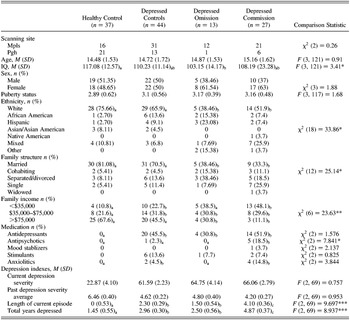
Demographic and clinical indexes of healthy and depressed youth with different maltreatment histories

Note: Statistics pertain to depressed only. Cells with different subscripts were also significantly different.
*p < .05. **p < .01. ***p < .001.
Depressed control (DC) youth (N = 45) had no history of abuse or trauma. A small group reported history of neglect or witnessing domestic violence but were neither physically nor sexually abused (N = 13, depression with acts of omission [DO]), and 28 depressed youth reported physical or sexual abuse (depression with acts of commission [DCM]). Participants who had experienced sexual and physical abuse were classified as DCM even if they had also experienced neglect and/or had been exposed to domestic violence as per definitions of child maltreatment used by the Centers for Disease Control and Prevention and other authors (Valentino, Cicchetti, Rogosch, & Toth, Reference Valentino, Cicchetti, Rogosch and Toth2008). Adolescents completed self-report inventories indexing their pubertal development (Petersen, Crockett, Tobin-Richards, & Boxer, Reference Petersen, Crockett, Tobin-Richards and Boxer1985). They also completed a measure of attributional style (Conley, Haines, Hilt, & Metalsky, Reference Conley, Haines, Hilt and Metalsky2001), which yields an overall score for individual differences in attributing positive or negative hypothetical events to the self versus external causes, to be situation specific or global, or to be stable or unstable. Adolescents completed a measure of self-compassion (Leary, Terry, Allen, & Guadagno, Reference Leary, Terry, Allen and Guadagno2010), which tests individual reactions of kindness, thoughtfulness, and acceptance of one's frailty and humanity. They also completed a questionnaire of self-esteem (Harter, Reference Harter1982), which assesses an adolescent's feelings of self-worth and perceived competence in cognitive, social, and physical domains. Adolescents also reported their levels of conflict and hostile interactions with their parents (Schubiner & Robin, Reference Schubiner and Robin1990). The caregivers (generally the mother) reported on parenting strategies primarily used to regulate and manage their children's negative emotions (Malatesta-Magai, Reference Malatesta-Magai, Cicchetti and Toth1991). These strategies are summarized in five main parental regulatory strategies: neglect, amplify, punish, override, or support.
Participants from Minneapolis and Pittsburgh, F movement (1, 113) = 0.04, p < .947, and study groups, F movement (3, 113) = 0.44, p < .722, were similar in movement parameters in both current and past depression severity as reported in Table 1. The groups also did not differ in scanning site assignation (Table 1). No group differences were observed in age, pubertal status, or gender distribution. However, depressed subgroups differed in length of current episode and number of past years depressed, with DCM youth having longer episodes and greater number of years depressed than DC and DO youth (see Table 1).
Self-appraisal task
The task was adapted from a previous functional magnetic resonance imaging (fMRI) study of self-appraisals in adolescents (Pfeifer et al., Reference Pfeifer, Masten, Borofsky, Dapretto, Fuligni and Lieberman2009). The task required participants to make direct self-evaluations as well as to evaluate the self from the perspective of their mother, best friend, or peer with regard to positive and negative descriptors. This manuscript focuses exclusively on direct self-evaluations due to the complexity of analyzing multiple self-appraisal conditions, across valence and four groups of participants. In the direct self-evaluation condition, participants heard and saw the following statement: “What do I think about myself? I think …” and then heard positive or negative descriptors drawn from social (e.g., “I make friends easily”) and academic (e.g., “It's hard for me to write papers”) domains. An equal number of phrases from each domain were positive and negative. Each descriptive phrase lasted approximately 1 s, after which participants were instructed to indicate whether the phrase was self-descriptive or not via a button box. In total, 20 self-descriptors were used (10 academic: 5 positive and 5 negative; 10 social: 5 positive and 5 negative). The task was administered in a mixed-block and event-related design that permitted separate analyses of positive and negative self-descriptors. The presentation of individual events within blocks was optimized using a generic algorithm (Wager & Nichols, Reference Wager and Nichols2003) for detection of the difference between positive and negative items. The inter stimulus interval, which included time to respond and time between delivery of descriptors, was varied (M = 6600 ms, SD = 1248.2 ms).
Neuroimaging data acquisition
Neuroimaging data were collected using 3.0 Tesla Siemens Trio MRI scanners. Structural three-dimensional axial MPRAGE images were acquired in the same session (repetition time/echo time = 2100/3.31 ms, interval time = 1050, 8° flip angle, 256 × 200 mm field of view, slice thickness = 1 mm, 256 × 200 matrix, 176 continuous slices). Mean blood oxygen level dependent images were then acquired with a gradient echo EPI sequence over 17:02 min covering 60 oblique axial slices (2.0 mm thickness, repetition time/echo time = 3340/30 ms, 200 × 200 mm field of view, 80 × 80 matrix, 90° flip angle). Temporal signal to noise ratios were calculated using 3dTstats in AFNI by dividing the mean baseline estimates (signal) by the standard deviations of the residual time series (noise), which were then extracted and found statistically similar between sites (Minneapolis vs. Pittsburgh), t (476) = 2.03, p = .97.
Analyses
Variables, which differed between depressed subgroups (see Table 1), specifically family structure, length of current episode, and total number of years depressed (which were higher for DCM youth), and use of antipsychotic medication, were used as covariates in SPSS analyses with extracted brain function values from coordinates that significantly differed between groups. Family income, which differed between depressed and controls (though not among depressed subgroups) was also used as a covariate. Finally, if significant differences in behavioral variables (frequency of endorsement and reaction time) were present, these variables were also included as covariates in analyses with extracted brain function.
Medication effects, specifically presence and dosage, were evaluated within depressed participants. Analyses were conducted with DCM and DO separately and as a group compared to DCs and HCs. Significant results are reported for both approaches, but primacy is given to pooled results in the images and the discussion given small sample size of the DO group.
Behavioral data analysis
To assess frequency of endorsement of self-descriptors based on task performance, responses to the phrases were coded 1 for endorsing a positive descriptor or denying a negative descriptor, and 0 for endorsing a negative descriptor or denying positive descriptor. Subsequently, repeated measures analyses of variance (ANOVAs) with a within-subjects factor of self-descriptor valence (positive or negative), a between-subjects variable of group (DCM + DO, DC, and HC), and dependent variables (endorsement and reaction time) were computed.
Neuroimaging data analysis
The sample analyzed here had movement parameters of maximum absolute shifts in the xyz axes of <2 mm or maximum absolute rotations of <0.987 radians. Participants with large movement were excluded prior to analysis (N = 9) and movement parameters. As previously reported, movement did not differ between the groups. Data was previewed before it was preprocessed with ART software. Data were then preprocessed and analyzed with Statistical Parametric Mapping 8 (SPM8; http://www.fil.ion.ucl.ac.uk/spm). Functional images for each participant were realigned to the first volume in the time series to correct for head motion. Realigned images were then coregistered with the subject's high-resolution anatomical image, segmented, spatially normalized to standard Montreal Neurological Institute template, resliced to voxels of 2 mm3 and spatially smoothed with a Gaussian kernel of 7 mm full-width at half-maximum. A canonical hemodynamic response function was applied to model epochs.
A first-level fixed-effect model for each participant, scan, and condition effects at each voxel were calculated using a t statistic, producing a statistical image for two contrasts: positive self-descriptors versus baseline and negative self-descriptors versus baseline. ART was also used to correct for unusual scans in the time series, slices, and volumes, as recommended by (Mazaika, Whitfield, & Cooper, Reference Mazaika, Whitfield and Cooper2005). Specifically, ART was used to detect volumes that were outliers (movement > 2 mm) or that had global signal intensities greater than 9. These volumes were then regressed out of analyses in the Level 1 GLM analyses. The groups were compared in mean numbers of volumes with movement > 2 mm and found not be statistically different F (3, 118) = 2.05, p = .11. In addition, frequency of participants with any number of volumes with movement >2 were compared between the groups and found not to be statistically different, χ2 (3, 118) = 3.8 p = .28. It is important to note that the Level 1 fMRI analysis simply used the valence of the descriptors, and did not code whether the participant made a positive or negative self-evaluation, as was described above for the behavioral data analysis. Therefore, we use the term self-descriptors with respect to the fMRI data, and not self-evaluations. A Level 2 flexible factorial model was employed by entering these t contrast images as repeated measures within-subjects factors, a recommended procedure to test group by condition effects (Glascher & Gitelman, Reference Glascher and Gitelman2008). This repeated-measures ANOVA included two factors (one between subjects, one within subjects) as follows: Group (four levels: HC, DC, DO, DCM) × Self-Descriptor Valence (two levels: positive, negative), as well as subject level effects (Glascher & Gitelman, Reference Glascher and Gitelman2008). Two a priori targeted contrasts (whole brain level) were directly tested using this repeated-measures ANOVA given our first two hypotheses. These contrasts were (a) DCM + DO < DC < HC and (b) DCM < DO < DC < HC for positive > negative self-descriptors.
Follow-up post hoc analyses examined brain activity differences between the groups for the same contrasts for just positive or just negative self-descriptors to clarify if group differences found during the a priori principal analyses were due to differences to both valences of self-descriptors or to group differences for either positive or negative ones. Post hoc results are reported in online-only supplementary Table S.1.
Contrasts (a) and (b) were also used to examine a priori regions of interest (ROIs) based on prior findings with the task (Pfeifer et al., Reference Pfeifer, Masten, Borofsky, Dapretto, Fuligni and Lieberman2009), which were known also to subserve reward processing during typical self-referential tasks. These ROIs were defined and extracted using preexisting masks defined by the WFU Pick Atlas GUI in SPM8. Labeling of regions was confirmed by both the xjview GUI in SPM8 and Talairach Daemon software. These ROIs were the right and left caudate, which were areas of significant differences between healthy adolescents and adults using the presented task.
To correct for multiple comparisons, we calculated whole-brain, voxelwise, and cluster extent thresholds via Monte Carlo simulations using the program 3dClusterSim in AFNI. A voxelwise threshold of p < .005 and a cluster-extent threshold of k = 93.4 (2 mm3) voxels corresponded with p < .05 FWE corrected. This joint magnitude-extent threshold was used in all tables and figures. Summary statistics for 8-mm spheres centered on coordinates of significant differences between the groups were extracted using the eigenvariate function in SPM8. These extractions were used in graphs, correlations with clinical and self-processing variables, and more importantly to verify the results obtained with SPM 8 using SPSS software when covariates that differed between the depressed subgroups were included in the analyses. These covariates were IQ, family structure, length of current episode, past number of years depressed, use of antipsychotics, and family income (which differed between controls and depressed).
Results
Behavioral results
Frequency of endorsement
A repeated-measure ANOVA 3 Group (depressed, depressed maltreated, HC) × 2 Valence of Self-Descriptors (positive, negative) yielded a main effect of group, F (2, 79) = 8.29, p < .01, wherein HC youth endorsed more positive self-evaluations and less negative self-evaluations than all depressed participants regardless of their history of maltreatment: M HCs = 0.73, M depressed maltreated = 0.55, M depressed = 0.486. There was no Group × Valence of Self-Descriptor interaction, but there was an effect of valence of self-descriptor, with negative self-descriptors having been denied more often than positive self-descriptors were endorsed, F (1, 79) = 13.3, p < .01.
Reaction time (RT)
A similar repeated-measures ANOVA yielded an effect of valence for RT, with shorter latencies for positive self-descriptors than negative self-descriptors across all groups (M positive = 2089 ms, M negative = 2187 ms), F (1, 79) = 4.65, p < .05. There were no Group or Group × Valence effects for RT. Of note, covariates (i.e., full IQ, use of antipsychotics, chronicity, scanning site, family structure, and income) did not yield significant effects for endorsement or RT.
Neuroimaging results
There were no main effects of group in the omnibus F test; however, significant results were observed for the two hypothesized in our a priori contrasts, which specified Group × Condition interactions reported below. The hypothesized a priori contrasts were (a) DCM + DO < DC < HC and (b) DCM < DO < DC < HC for positive > negative self-descriptors. These were followed up by post hoc simple analyses of only positive or only negative self-descriptors to ascertain whether the results were due to primarily brain function differences for either negative or positive descriptors or to differences between the groups during both conditions (see supplementary Table S.1). The results did not differ with the addition or removal of covariates (family structure, length of episode, total number of year depressed, use of antipsychotics, and family income) during analyses with brain function extractions in SPSS.
Positive > negative self-descriptors
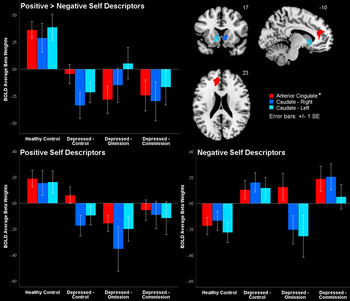
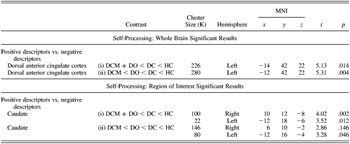
Whole-brain analyses of contrast (a) revealed that when pooled as a group, DCM and DO youth showed the least activity in the dACC during the processing of positive relative to negative self-descriptors, followed by DCs and then HC adolescents (Table 2, Figure 1). Of note, contrast (b) shows that DO adolescents show decreased right and left caudate activity during both negative and positive descriptors (Figure 1), whereas DCM youth showed more left and right caudate activity for negative self-descriptors, but less for positive self-descriptors. However, the latter contrast, while significant and suggestive of different patterns of brain function for maltreatment due to omission versus commission, ought to be considered with caution given the small sample size of DO participants.
(Color online) Depressed maltreated adolescents show significantly lower dorsal anterior cingulate cortex processing of positive versus negative self-descriptors compared to depressed and healthy youth without a history of maltreatment. Depressed maltreated also show lower ventral striatum activity to positive versus negative self descriptors compared to healthy and depressed youth without this history, primarily due to right caudate deactivation during positive self-descriptors.

Brain regions that distinguish healthy controls and depressed youth with different early adversity histories during self-processing
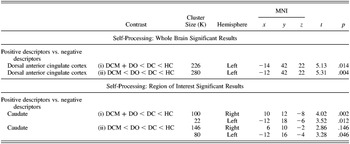
Note: MNI, Montreal Neurological Institute; DCM, depressed commission: physical or sexual abuse; DO, depressed omission: neglect or witness of domestic violence; DC, depressed control: depressed with no early adversity; HC, healthy control; DCM + DO: all maltreated pooled as a group.
ROI analyses of this contrast, using caudate ROI's, which previously differentiated adolescents and adults for this task (Pfeifer et al., Reference Pfeifer, Masten, Borofsky, Dapretto, Fuligni and Lieberman2009), suggested that DCM youth had the least activity particularly for the right caudate, specifically its more ventral aspect, during the processing of positive versus negative self descriptors (Table 2 and Figure 1 top left bar graph). Supplemental Table S.1 shows cluster sizes and direction of results for positive or negative self-descriptors separately. These analyses were conducted for ROIs (caudate clusters) derived from previous fMRI studies in adolescents (Pfeifer et al., Reference Pfeifer, Masten, Borofsky, Dapretto, Fuligni and Lieberman2009) and from our own whole-brain analyses results (ACC clusters). The results suggest that analyses with positive > negative contrasts emerge from both less activity in ACC to positive self-descriptors and more activity in ACC to negative self-descriptors in maltreated youth versus depressed versus HCs.
Analyses with brain activity extractions for both ACC and caudate areas (using 8-mm spheres centered in the significant coordinates reported in Table 2) included covariates that differed between depressed groups. These analyses examined the effects of group for both contrast (a), three groups with pooled DCM and DO youth, and contrast (b), four groups with DCM and DO as separate groups. The results showed that length of current episode, number of years depressed, family structure, income, and/or use of antipsychotics were not significant covariates, yet group sill significantly predicted brain activity for contrast (a), F (3, 110) = 4.664–5.655, p < .01, and (b), F (2, 111) = 7.05–8.54, p < .01, in the same direction as results with SPM 8 analyses. Similarly, frequency of endorsement of positive or negative self-descriptors, which differed between HC and depressed groups, were not significant covariates, and again the significant effects of group remained.
Effects of medication
There were no significant effects of medication presence or dosage or Medication × Group interactions in brain function for either ACC or striatum activity within depressed participants, F (2, 115) = 0.04–8.54, p = .964.
Neural function associations with self-processing, parent regulation strategies of adolescent's negative emotions, and clinical variables
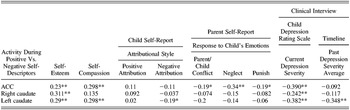
As predicted, higher self-esteem and self-compassion were associated with greater ACC and striatum activation to positive versus negative self-descriptors. Consistent with this finding, a negative attributional style was associated with reduced activation in the left caudate, although no such relationships were observed for positive attributions. Overall, the self-report measures most consistently linked to ACC and striatum activity to positive versus negative descriptors was the self-esteem and self- compassion measures.
Negative regulatory strategies (i.e., neglect and punishment) reported by parents regarding their response to their children's emotions of anger, fear, and sadness were associated with less ACC activation to positive versus negative self-descriptors, but striatum activity was not associated with parental responses to children's emotions. Furthermore, youth reporting greater conflict with a parent also showed attenuated activity in the ACC and caudate (see Table 3). Finally, greater current depression severity was associated with attenuated ACC and bilateral caudate activation to positive versus negative self-descriptors, and greater past depression severity was associated with reduced left caudate recruitment. It is important to note that current and past severity did not differ between depressed youth with different histories of maltreatment (Table 1). Regardless of depression or history of maltreatment, those with lower ACC and striatum activity during positive versus negative self-descriptors endorsed more severe depression symptoms.
Correlations between brain activity during positive versus negative descriptors and measures of self-processing, parent responses to child emotions, and clinical variables

Note: ACC, Anterior cingulate cortex.
*p < .05. **p < .01.
Discussion
Our results confirm cognitive models of depression and suggest neurobiological mechanisms for how negative versus positive self-information is more salient for depressed maltreated individuals. As hypothesized, we found in whole-brain analyses that depressed youth with a history of abuse, by omission or commission, exhibited hypoactivation in the ACC when processing positive self-descriptors and hyperactivation of this region when processing negative self-descriptors, followed by DC and HC adolescents. Furthermore, a priori ROI analyses also indicated attenuated caudate responses, particularly in the ventral striatum, during positive versus negative self-processing in DCM adolescents relative to DO, DCs, and HC youth. By contrast, positive self-descriptors activated neural substrates of self-referential processing (ACC) and reward (ventral striatum) most potently in HCs, likely reflecting positive biases during self-appraisals among typically developing individuals (Seidel et al., Reference Seidel, Eickhoff, Kellermann, Schneider, Gur, Habel and Derntl2010), as well as positive affect during self-reflection in neurotypical development. It must be noted that DO youth (N = 13) showed a unique pattern of striatal deactivation to both positive and negative self-descriptors despite a similar pattern of heightened ACC activity to negative (and diminished ACC activity to positive) self-descriptors just like DCM adolescents. Low motivational saliency of any valenced information and negative attentional biases might distinguish depressed neglected youth from both nonabused and severely maltreated depressed youth. However, these results may be an artifact of the small sample size, and it would be critical to replicate these findings with a larger sample size of adolescents who suffered maltreatment by omission versus commission.
Finally, it is remarkable that although all depressed participants endorsed more negative and less positive self-descriptors than HC youth, brain function differences still distinguished those with a history of abuse, even after covarying differences in the relative positivity of self-evaluations. This suggests that youth with a history of abuse might offer similar responses in measures of self-processing to other depressed adolescents, yet they may actually experience higher discordant affect and cognitive dissonance regarding how positive versus negative traits apply to them. This underscores the value of neurobiological markers of functioning. However, whether higher affective and cognitive dissonance is present for depressed abused youth during self-processing, and more important, whether this is a contributing factor for a more chronic and difficult course of depression, would need to be tested in future longitudinal research. It is nevertheless notable that higher current severity of depressive symptoms was associated with lower ACC and striatum activity during processing of positive versus negative self-descriptors.
ACC
The ACC is involved in error monitoring (Wang, Ulbert, Schomer, Marinkovic, & Halgren, Reference Wang, Ulbert, Schomer, Marinkovic and Halgren2005), modulation of attention (Crottaz-Herbette & Menon, Reference Crottaz-Herbette and Menon2006), attribution of emotional salience (Davis et al., Reference Davis, Taylor, Hutchison, Dostrovsky, McAndrews, Richter and Lozano2005), and self-referential processing in adolescents (Pfeifer et al., Reference Pfeifer, Masten, Borofsky, Dapretto, Fuligni and Lieberman2009). It is also implicated in processing of viscerosomatic symptoms such as autonomic and neuroendocrine functioning related to fear and anxiety. Furthermore, impaired ACC functioning is associated with emotion dysregulation in mood disorders (Drevets, Price, & Furey, Reference Drevets, Price and Furey2008). Consistent with longstanding literature implicating negative self-attributional biases in depressed (Hoffman et al., Reference Hoffman, Cole, Martin, Tram and Seroczynski2000) and maltreated youth (Feiring et al., Reference Feiring, Taska and Chen2002; Stuewig & McCloskey, Reference Stuewig and McCloskey2005), our finding suggests that maltreated adolescents may allocate less attention to, attribute less emotional salience, and identify less with positive descriptors during self-reflection compared to both healthy and DC youth. This is congruent with past results showing that maltreated youth demonstrate hypervigilance to negative affective stimuli resulting in negative self-schemas (Bennett et al., Reference Bennett, Sullivan and Lewis2010; Cicchetti & Toth, Reference Cicchetti and Toth1998; Kim & Cicchetti, Reference Kim and Cicchetti2006). Specifically, electrophysiological and behavioral investigations with maltreated youth have implicated atypical processing of negative emotional stimuli (i.e., anger in faces), suggestive of increased attentional and cognitive allocation toward such information (Pollak, Cicchetti, Klorman, & Brumaghim, Reference Pollak, Cicchetti, Klorman and Brumaghim1997; Pollak, Holt, & Wismer Fries, Reference Pollak, Holt and Wismer Fries2004; Pollak & Kistler, Reference Pollak and Kistler2002; Pollak, Klorman, Thatcher, & Cicchetti, Reference Pollak, Klorman, Thatcher and Cicchetti2001; Pollak & Tolley-Schell, Reference Pollak and Tolley-Schell2003, Reference Pollak, Tolley-Schell and Posner2004). However, it is also possible that positive stimuli are perceived as less rewarding or even aversive among depressed maltreated youth. For example, relative to healthy adults, positive stimuli hyperactivates the ACC and insula in those with unipolar depression and severe anhedonia (Mitterschiffthaler et al., Reference Mitterschiffthaler, Kumari, Malhi, Brown, Giampietro, Brammer and Andrew2003). Given the role of the ACC on the modulation of emotional responses (Drevets, Savitz, et al., Reference Sheline, Barch, Price, Rundle, Vaishnavi, Snyder and Raichle2008; Haupt et al., Reference Haupt, Axmacher, Cohen, Elger and Fell2009; Kerns et al., Reference Kerns, Cohen, MacDonald, Cho, Stenger and Carter2004; Song & Hakoda, Reference Song and Hakoda2015) and the role of the insula for suppression of emotional responses and experience of negative emotions, particularly disgust (Goldin, McRae, Ramel, & Gross, Reference Goldin, McRae, Ramel and Gross2008; Wicker et al., Reference Wicker, Keysers, Plailly, Royet, Gallese and Rizzolatti2003), it is also possible that positive self-information is experienced as unpleasant and/or highly conflictive, resulting in the use of maladaptive emotion regulation strategies that undergird disengaging behaviors and reduced positive-oriented action associated with depression. Given the paucity of neuroimaging research with maltreated youth, it is unclear whether the increased risk associated with maltreatment is due to an atypical emotional experience of positive information (i.e., experiencing such rewarding stimuli as aversive), or higher salience of negative information (i.e., greater cognitive elaboration and affective reactivity for these stimuli), or an interaction of both experiences. More research specifically pertaining to depression and maltreatment history in youth will be necessary to provide a more cogent illustration of the developmental mechanisms that bridges early maltreatment with onset and recurrence of depressive disorders.
This study observed hypoactivation in the dACC in response to positive stimuli specifically in maltreated depressed adolescents more than DC and HC peers. This is consistent with research as the dACC has been found to be more involved in cognitive control and resolution of cognitive conflict (e.g., response inhibition and monitoring errors) whereas the ventral region is more engaged in emotional and social evaluation (Somerville, Wig, Whalen, & Kelley, Reference Somerville, Wig, Whalen and Kelley2006). Investigators have posited that the role of the dACC includes the self-monitoring of ongoing behaviors during problem solving and production of an emotional signal (e.g., experience of frustration) that motivates changes in subsequent behaviors (Spunt, Lieberman, Cohen, & Eisenberger, Reference Spunt, Lieberman, Cohen and Eisenberger2012). The use of reappraisal strategies (i.e., reevaluating meaning to modify emotional responses) to regulate negative emotion has been linked to dACC and prefrontal cortical regions (Ochsner & Gross, Reference Ochsner and Gross2005). Given the poor recruitment of dACC among depressed maltreated adolescents for positive self-relevant information, it is possible that depression among these maltreated youth is associated with poor behavior monitoring (e.g., social disengagement), deficient generation of affective signals to modify emotional responses and behaviors, and/or difficulties selecting an appropriate emotion regulation style for positive self cues. In effect, these findings may reflect singular deficiencies in the recruitment of top-down cognitive control and awareness of positive versus negative affect in depressed youth with a maltreatment history, which in turn contributes to their protracted course of depression (Koster, De Lissnyder, Derakshan, & De Raedt, Reference Koster, De Lissnyder, Derakshan and De Raedt2011).
In a similar vein, negative correlations between ACC activation to positive versus negative self-descriptors, and both child reports of parent–child conflict and parents’ use of punitive emotion regulation strategies, suggest that youth who receive less emotional support from parents show limited capacity to flexibly attend to self-relevant information that varies in valence. This is an ACC-mediated psychological bias in depression (Wagner, Schachtzabel, Peikert, & Bär, Reference Wagner, Schachtzabel, Peikert and Bär2015) that may be particularly acute for those with a history of abuse. As such, youth with history of maltreatment may be more susceptible to develop severe and chronic forms of depression (Klein et al., Reference Klein, Arnow, Barkin, Dowling, Kocsis, Leon and Wisniewski2009; McCauley et al., Reference McCauley, Kern, Kolodner, Dill, Schroeder, DeChant and Bass1997). Furthermore, adolescents exposed to neglecting and punishing regulatory parenting strategies may be more likely to disproportionately allocate attentional resources to negative emotional stimuli (whether internally or externally generated), underscoring the transactional origin of the self in the parent–child relationship. In addition, negative regulatory strategies used by parents (i.e., methods that focuses on punishing youth's negative emotions rather than promoting positive behaviors or assuaging negative emotions) may be adopted by their children, who in turn emphasize their negative over positive self-attributes. We must note that the maltreatment history was self-reported by the adolescents and that we had no evidence that the attending parent had maltreated or neglected the participants. However, research shows that maltreated youth are frequently reared in negative and chaotic emotional climates (i.e., stressful home environments), and by parents who struggle to provide protection from abusive experiences (Shipman et al., Reference Shipman, Schneider, Fitzgerald, Sims, Swisher and Edwards2007).
Striatum
The striatum is essential for reward prediction and goal-directed behavior as it links outcome assessments with action initiation (Grahn, Parkinson, & Owen, Reference Grahn, Parkinson and Owen2008; Haruno & Kawato, Reference Haruno and Kawato2006; Liang, Zebrowitz, & Zhang, Reference Liang, Zebrowitz and Zhang2010; McCabe, Cowen, & Harmer, Reference McCabe, Cowen and Harmer2009). Healthy youth might experience pleasure when evaluating the self in a positive light, and they may be prepared to behaviorally respond with behaviors congruent with a high self-concept. This is supported by our finding that higher self-esteem and self-compassion are linked to greater activity in the striatum (and ACC) to positive versus negative self-descriptors. In contrast, depressed youth, particularly those with a history of maltreatment, showed reduced striatal and dACC responses during positive self-descriptors, which was also associated with negative self-attributional style in the left caudate. The associations between increased depression severity and attenuated activity across both the striatum and the ACC underscores that atypical recruitment of these neural substrates during emotionally charged self-processing may have a role in chronic and more severe mental illness. In effect, it may facilitate downregulation of positive affect, lower saliency of positive information, less pleasurable experience of positive stimuli, and subsequent impairment of cognitive appraisal (i.e., rumination focused on negative self traits) combined with disengagement from positive self-representations (Etkin, Egner, & Kalisch, Reference Etkin, Egner and Kalisch2011). The downregulation may increase the vulnerability to depressogenic schemas.
Implications for treatment and illness course
It should be noted that functioning of the ACC and striatum may be biomarkers of treatment response. For example, treatment with selective serotonin reuptake inhibitors diminished activity in both the anterior and the posterior cingulate cortex, as well as the precuneus, during negative self-referential processing in neurotic and depressed individuals (Delaveau et al., Reference Delaveau, Jabourian, Lemogne, Guionnet, Bergouignan and Fossati2011; Posner et al., Reference Posner, Hellerstein, Gat, Mechling, Klahr, Wang and Peterson2013). In addition, striatal functioning elicited by rewards predicted treatment response in depressed adolescents (Forbes et al., Reference Forbes, Ryan, Phillips, Manuck, Worthman, Moyles and Dahl2010). Furthermore, the connectivity between the ACC and the amygdala during self-referential processing is a marker of depression's course and response to medication (Nejad et al., Reference Nejad, Fossati and Lemogne2013; Pizzagalli, Reference Pizzagalli2011). Therefore, depleted ACC and striatum activity in maltreated depressed adolescents, even compared with DC youth, suggest that early adversities have a protracted effect on social–emotional development, leaving these individuals vulnerable to chronic or more severe depression than those without a history of trauma (Klein et al., Reference Klein, Arnow, Barkin, Dowling, Kocsis, Leon and Wisniewski2009). This is also suggested by significantly higher indexes of chronicity (Table 1) among commission versus omission and not maltreated DC youth. However, the associations in the whole sample between striatum and ACC activity (during positive vs. negative descriptors) and current severity also suggest that youth with the least activity in these areas during positive (vs. negative) self-processing may experience more severe depression regardless of their history of maltreatment. Differences between the groups suggest that early adversity combined with depression during a sensitive period for identity formation might promote intractable negative self-schemas that are more rigid than negatively biased self-cognitions in nonmaltreated depressed youth. These hypotheses need to be investigated to better characterize the mechanisms undergirding chronicity and severity of depression in those with a history of child maltreatment. Nevertheless, our results highlight the importance of early intervention and treatment, such as cognitive behavioral therapy, to modify and restructure negative self-cognitions in youth who have previously experienced trauma. Variations in striatal and ACC recruitment across maltreated depressed adolescents may reflect the unique modifications in reward processing and self-development as a function of the type of adverse experience. A larger sample size would be needed to better characterize the distinctive pattern of activation for subpopulations of depressed youth, particularly for those maltreated due to omission of appropriate caregiving experiences.
Conclusions
This study provides evidence that may explain why depressed adolescents with past experiences of trauma are at heightened risk for developing and perpetuating negative self-concept, namely, hypoactivity in the ACC and caudate while processing positive, relative to negative, self-relevant information. Depressed youth with a history of maltreatment evidenced both disrupted top-down cognitive control of negative affect (possibly hypervigilance and rumination regarding negative self-information) and disengagement with positive self-referential cognitions. In addition, positive self-thoughts may be associated with more adverse or less rewarding emotional experiences that result in reduced motivation to view oneself in a positive light. The accompanying atypical neural pattern in anterior cortical midline structures and the striatum in depressed adolescents who experienced trauma, relative to peers with and without depression, suggests that early adversity significantly disrupts positive self-development and contributes to self-defeating cognition patterns associated with severe and chronic depression (Beck, Dowd, & Leahy, Reference Beck, Dowd, Leahy, Leahy and Dowd2002).
Limitations and future directions
Given that adolescence is a developmental period linked to increased susceptibility to external influences (Nelson, Leibenluft, McClure, & Pine, Reference Nelson, Leibenluft, McClure and Pine2005; Pfeifer et al., Reference Pfeifer, Masten, Borofsky, Dapretto, Fuligni and Lieberman2009), more systematic research is needed to fully explore both neurobiological and environmental factors that augment risk for depression. Our investigation represents the first effort to examine differences in brain functioning elicited by self-processing across subtypes of trauma (e.g., neglect or witnessing violence, and physical or sexual abuse) that may contribute to depressogenic symptomatology. Larger sample sizes may offer greater opportunities to further delineate how modalities of maltreatment may exert different cognitive and neurobiological risk for psychopathology. For example, it should be noted that our neglected and exposed to domestic violence sample was small, which reduced the statistical power with our multiple analyses. In the future, researchers should recruit a larger participant pool as it should be anticipated that among maltreated children those who experience solely neglect or acts of omission is relatively low compared to other subtypes. In addition, the use of multiple informants to better establish both the length and the severity of abuse history should be considered in prospective studies. For example, better characterization of the maltreatment experience such as the number of abuse types experienced, length of the maltreatment period, and self-reported trauma symptoms from the exposure are important information to gather in future research to better elucidate links between early traumatic experiences and the development of depression in youth. Longitudinal investigations will be necessary to determine whether chronicity and severity of depression cause or result from hyporesponsivity of striatum and anterior cortical midline structures to positive versus negative self-descriptors, as well as whether both illness course and abnormal neurobiology are due to a history of child maltreatment. While our findings offer a novel contribution to the current literature on adolescent depression, a fully developmental approach to psychiatric research is essential to better elucidate the underlying cognitive, social, and biological factors.
Supplementary Material
To view the supplementary material for this article, please visit https://doi.org/10.1017/S0954579416001024.