Child maltreatment is an extreme and severe form of maladaptive parenting (Cicchetti & Lynch, Reference Cicchetti, Lynch, Cicchetti and Cohen1995; Cicchetti & Toth, Reference Cicchetti, Toth and Cicchetti2016) that initiates negative developmental trajectories with consequences spanning myriad domains of functioning throughout the life course (Masten & Cicchetti, Reference Masten and Cicchetti2010). In particular, it is well established that individuals who experience child maltreatment are at risk for disrupted interpersonal relationships (Doyle & Cicchetti, Reference Doyle and Cicchetti2017). As early as infancy, maltreated children are more likely to demonstrate an insecure disorganized attachment style (Carlson, Cicchetti, Barnett, & Braunwald, Reference Carlson, Cicchetti, Barnett and Braunwald1989; Cyr, Euser, Bakersman-Kranenburg, & van IJzendoorn, Reference Cyr, Euser, Bakermans-Kranenburg and van IJzendoorn2010). The lack of a secure attachment with a caregiver during this period sets the stage for future interpersonal challenges and psychopathology (Sroufe, Reference Sroufe2005; Weinfield, Sroufe, & Egeland, Reference Weinfield, Sroufe and Egeland2000). During childhood, maltreated individuals exhibit more difficulty with peers than their nonmaltreated counterparts. This can take various forms, including peer victimization, bullying, withdrawal, and aggression (see Cicchetti & Toth, Reference Cicchetti, Toth and Cicchetti2016, for review). Throughout adolescence, maltreated youth continue to be at risk for social difficulties. Conflictual friendships may continue and disturbances in romantic relationships also begin to emerge, including involvement in dating violence (Trickett, Negriff, Ji, & Peckins, Reference Trickett, Negriff, Ji and Peckins2011). In adulthood, romantic relationship dysfunction may persist (Labella et al., Reference Labella, Johnson, Martin, Ruiz, Shankman, Englund and Simpson2018) including higher rates of domestic violence, marital dissatisfaction, and divorce (Colman & Widom, Reference Colman and Widom2004; DiLillo et al., Reference DiLillo, Peugh, Walsh, Panuzio, Trask and Evans2009; Vezina & Herbert, Reference Vezina and Herbert2007).
Attachment theory provides an important theoretical framework for understanding why maltreated individuals may experience perpetual interpersonal challenges. According to attachment theory (Bowlby, Reference Bowlby1969), early experiences with caregivers shape children's internal working models of the social world. These mental representations influence children's future perceptions, expectations, and attitudes of others and the self and are relatively stable over time (Hazan & Shaver, Reference Hazan and Shaver1994). Children exposed to insensitive, unresponsive, or abusive caregiving may develop negative expectations for relationships, as well as negative beliefs about their own self-worth.
Because maltreated children are more often exposed to insensitive and pathological caregiving, they are at considerable risk to develop insecure attachments (Cyr et al., Reference Cyr, Euser, Bakermans-Kranenburg and van IJzendoorn2010). Specifically, maltreated children are at heightened risk for the development of disorganized attachment (Cyr et al., Reference Cyr, Euser, Bakermans-Kranenburg and van IJzendoorn2010), a style marked by inconsistent and disorganized strategies for coping with separations and reunions with caregivers. Importantly, children with insecure attachments carry these difficulties in coping with interpersonal stress forward and have challenges with peer relationships (Jacobvitz & Hazen, Reference Jacobvitz, Hazen, Solomon and George1999) and romantic relationships (Sroufe, Egeland, Carlson, & Collins, Reference Sroufe, Egeland, Carlson, Collins, Grossmann, Grossmann and Waters2005) later in development.
Dishion's (Reference Dishion, Dishion and Snyder2016) implicit interpersonal grammar hypothesis further clarifies the way in which coercive and/or aggressive relationship dynamics may develop among individuals exposed to abusive and neglectful early caregiving environments. According to Dishion, “what is learned in … familial experiences creates an implicit interpersonal grammar, which is often activated in interpersonal contexts similar to those in which the behavior was experienced” (Dishion, Reference Dishion, Dishion and Snyder2016, p. 56). Coercive interactions and aggression are the result of direct training as well as implicit learning. In families marked by maltreatment, children may develop implicit beliefs that close relationships are untrustworthy, aggressive, and/or antagonistic. This “grammar of coercion” (Dishion, Reference Dishion, Dishion and Snyder2016, p. 56), is then elicited in future interpersonal interactions. Thus, maltreated children may develop an implicit grammar of coercion in which they have automatic beliefs that interpersonal dynamics are marked by victimization, coercion, and aggression, thus perpetuating interpersonal dysfunction.
Together these theories provide a solid framework for understanding why maltreated children may experience relationship challenges throughout the life course. As maltreated children age and engage in diverse interpersonal exchanges, they may draw on maladaptive implicit beliefs regarding the self, others, and social interactions that were formed in early development, and these maladaptive beliefs may continue to negatively impact their relational functioning (Cicchetti & Toth, Reference Cicchetti, Toth and Lamb2015).
Child Maltreatment, Antisocial Behavior, and Relational Aggression
In addition to dysfunctional implicit beliefs about the self, others, and interpersonal interactions, maltreated children are also vulnerable to the development of antisocial behaviors (Cicchetti & Toth, Reference Cicchetti, Toth and Cicchetti2016). Maladaptive parenting is central to theories of the development of antisocial behavior (Dishion & Patterson, Reference Dishion, Patterson and Cicchetti2016). Children may respond to abusive, neglectful, or coercive parenting by exhibiting disruptive, aggressive, and coercive behaviors themselves, thus perpetuating a cycle of negative and coercive interaction. Moreover, as antisocial children grow and spend more time in peer contexts such as school, they are more likely to affiliate with antisocial peers, further amplifying antisocial behavior and solidifying antisocial developmental trajectories.
Dishion and Patterson (Reference Dishion, Patterson and Cicchetti2016) described both microsocial and macrosocial mechanisms underlying the development and escalation of antisocial behavior. Microsocial influences include moment-to-moment action and reaction patterns among parent–child and peer–child dyads that function to foster, elicit, and exacerbate antisocial behavior. Macrosocial influences evolve more gradually and involve larger shifts in social networks. For instance, adolescence is marked by a normative shift away from family and toward peers. This may function to amplify antisocial behavior if, during this period of developmentally appropriate reductions in parental monitoring, adolescents are situated within a deviant peer network (Dishion & Patterson, Reference Dishion, Patterson and Cicchetti2016). Thus, antisocial behavior may develop in part because of maladaptive parenting and may be evoked, maintained, and amplified throughout development by the affiliation with antisocial peers as friends.
Not only are maltreated children at risk for antisocial behavior, but they are also more likely to be relationally aggressive (Cullerton-Sen et al., Reference Cullerton-Sen, Cassidy, Murray-Close, Cicchetti, Crick and Rogosch2008; Rogosch & Cicchetti, Reference Rogosch and Cicchetti2005). Relational aggression refers to social behaviors designed to manipulate or harm others and often includes behaviors such as spreading rumors, gossiping, socially excluding others, the silent treatment, and withdrawing friendship (Crick, Reference Crick1995; Murray-Close, Nelson, Ostrov, Casas, & Crick, Reference Murray-Close, Nelson, Ostrov, Casas, Crick and Cicchetti2016). Via implicit beliefs shaped by an early maladaptive caregiving environment, maltreated children may regard close relationships as involving manipulation, criticism, inconsistent support and love, and also rejection. These scripts can be activated when maltreated children are in peer contexts and result in relationally aggressive behavior. In a meta-analytic review of parenting styles associated with relational aggression in children and adolescents, Kawabata, Alink, Tseng, van IJzendoorn, and Crick (Reference Kawabata, Alink, Tseng, van Ijzendoorn and Crick2011) found that harsh parenting, psychologically controlling parenting, and uninvolved parenting were all related to increased relational aggression among offspring.
Gender differences have been widely investigated within the area of relational aggression, although evidence supporting moderation has been inconsistent (see Murray-Close et al., Reference Murray-Close, Nelson, Ostrov, Casas, Crick and Cicchetti2016, for review). Specifically, meta-analytic results showed that fathers’ psychologically controlling behavior was more predictive of girls’ relational aggression than of boys’. However, they did not find this same effect for mothers’ controlling behavior, or other aspects of parenting (Kawabata et al., Reference Kawabata, Alink, Tseng, van Ijzendoorn and Crick2011). Regarding maltreatment specifically, Cullerton-Sen et al. (Reference Cullerton-Sen, Cassidy, Murray-Close, Cicchetti, Crick and Rogosch2008) found that among girls only, sexual abuse predicted relational aggression. Thus, there is some evidence that gender may play a moderating role in the relation between maladaptive parenting and relational aggression.
Childhood Antisocial Behavior and the Development of Emerging Adult Relationships
Both childhood antisocial behavior and relational aggression have implications for the development of maladaptive interpersonal functioning later in life. For example, adolescent antisocial behavior has been linked with lower levels of mutuality with friends, lower quality friendships, and more conflictual friendships (e.g., Dishion, Andrews, & Crosby, Reference Dishion, Andrews and Crosby1995; Piehler & Dishion, Reference Piehler and Dishion2007). Prospective studies also support associations between childhood antisocial behavior and young adult romantic relationship dysfunction, including intimate partner violence perpetration and victimization, interpartner conflict, and ambivalence toward the relationship (e.g., Capaldi, Knoble, Shortt, & Kim, Reference Capaldi, Knoble, Shortt and Kim2012, for review). For instance, Capaldi, Dishion, Stoolmiller, and Yoerger (Reference Capaldi, Dishion, Stoolmiller and Yoerger2001) found evidence for a developmental cascade model such that boys’ antisocial behavior in childhood predicted deviant peer associations in early adolescence, which contributed to late adolescent hostile talk about women, and antisocial behavior, both of which predicted aggression toward romantic partners in early adulthood. Antisocial behavior beginning in childhood, as opposed to adolescent-limited antisocial behavior, appears to be more strongly related to later romantic relationship difficulties (Woodward, Fergusson, & Horwood, Reference Woodward, Fergusson and Horwood2002). Thus, assessing antisocial tendencies in childhood may be more informative for identifying precursors to negative romantic relationship interactions.
Given maltreated youths’ heightened risk for antisocial behavior, childhood antisocial behavior represents an important potential mechanism by which maltreated youth may develop difficulties with adult relationships. Consistent with this conceptualization, Ha, Otten, McGill, and Dishion (Reference Ha, Otten, McGill and Dishion2019) showed that disruptive parenting during childhood predicted antisocial behavior in early adolescence, which in turn predicted deviancy training with peers later in adolescence, which in turn predicted coercive romantic relationship dynamics in adulthood. Moreover, Ha et al. (Reference Ha, Kim, Christopher, Caruthers and Dishion2016) also found that child maltreatment enhanced risk for early adolescent gang involvement, which predicted coercive relationship talk during later adolescence, which was associated with sexual coercion in early adulthood. Therefore, there is emerging empirical support for antisocial behavior as a mechanism explaining why children exposed to maladaptive parenting are at risk for negative romantic relationship dynamics. However, the assessment of child maltreatment has been somewhat limited thus far, with measurement relying on young adult retrospective self-reporting of childhood maltreatment. Prospective designs with documented child maltreatment record data are necessary to clarify whether maltreatment is a precursor to an antisocial developmental cascade resulting in disrupted romantic interactions.
Childhood Relational Aggression and the Development of Emerging Adult Relationships
Numerous studies have documented that children who are relationally aggressive experience significant peer problems (see Murray-Close et al., Reference Murray-Close, Nelson, Ostrov, Casas, Crick and Cicchetti2016, for review). For instance, Crick et al. (Reference Crick, Ostrov, Burr, Cullerton-Sen, Jansen-Yeh and Ralston2006) found that observer reports of relational aggression prospectively predicted future peer rejection. Moreover, there is evidence that relational aggression may be more strongly associated with social problems for girls, whereas overt aggression may be more socially problematic for boys (Preddy & Fite, Reference Preddy and Fite2012). It is also evident that difficulties with peers and friends in childhood and adolescence are associated with subsequent romantic relationship difficulty. Oudekerk, Allen, Hessel, and Molloy (Reference Oudekerk, Allen, Hessel and Molloy2015) found support for the notion that negative interaction styles with friends can crossover to negative interaction styles with romantic partners later in development. Specifically, they showed that lower levels of autonomy and relatedness within friendships during early adolescence predicted these same qualities within romantic relationships during late adolescence. Moreover, poor friendship quality and feeling alienated from peers has been shown to predict young adult romantic relationships marked by hostility, negative affect, difficulty with conflict resolution, and dating violence perpetration and victimization (Linder & Collins, Reference Linder and Collins2005; Linder, Crick, & Collins, Reference Linder, Crick and Collins2002). Although not as widely studied, peer relational aggression is also associated with the development of dysfunctional romantic relationships. For example, Leadbeater, Sukhawathanakul, Holfeld, and Temple (Reference Leadbeater, Sukhawathanakul, Holfeld and Temple2017) found peer relational aggression and victimization predicted intimate partner violence 10 years later (during early adulthood). Together, prior research documents that negative peer interactions have implications for the development of hostile and aggressive romantic relationships. However, whether relational aggression functions as a mechanism explaining why maltreated children may develop difficulties in friend and romantic relationships in early adulthood has yet to be investigated.
Current Study
The aim of the current study was to investigate differential pathways from child maltreatment to emerging adult relationship difficulties. Specifically, we sought to prospectively test whether child maltreatment initiates a developmental cascade resulting in coercive negative interactions in emerging adulthood via childhood antisocial tendencies and via childhood relational aggression. To examine the uniqueness of both a relational aggression pathway and an antisocial pathway, we included childhood indicators of both antisocial characteristics and multi-informant ratings of childhood relational aggression in our prospective model. We hypothesized that children who experienced a greater number of subtypes of maltreatment would evidence both increased relational aggression with peers during childhood and increased antisocial behavior, which would prospectively predict greater negative friend and romantic interactions in early adulthood. Given mixed findings regarding the role of gender in moderating the effect of maladaptive parenting on relational aggression (Kawabata et al., Reference Kawabata, Alink, Tseng, van Ijzendoorn and Crick2011), as well as preliminary findings showing differential associations between relational aggression and social difficulties (Preddy & Fite, Reference Preddy and Fite2012), we also conducted exploratory analyses of gender moderation within these pathways.
Finally, given robust associations between a history of child maltreatment and involvement in domestic violence in adulthood (see Capaldi et al., Reference Capaldi, Knoble, Shortt and Kim2012, for review), and because negative romantic interactions have been identified as proximal precursors of domestic violence (Booth, Crouter, & Clements, Reference Booth, Crouter and Clements2001), we conducted additional exploratory analyses. Specifically, we investigated the relation between childhood maltreatment and involvement in domestic violence in emerging adulthood, and we examined whether higher levels of romantic conflict, criticism, and antagonism were associated with a greater likelihood of domestic violence involvement.
Method
Participants
Participants (N = 392) were from a longitudinal follow-up study of emerging adults who previously participated in a research summer camp program as children. The first wave of the study (Wave 1) included 680 low-income maltreated (n = 360) and nonmaltreated (n = 320) children aged 10 to 12 (M = 11.28, SD = 0.97). The sample was racially and ethnically diverse (71.6% African American, 11.8% Caucasian, 12.6% Hispanic, 4.0% biracial/other race) and evenly distributed by gender (50.1% male). The majority of the children's families had a history of receiving public assistance (96.1%).
A total of 420 of the original study participants completed the Wave 2 assessment in emerging adulthood. The current study, however, only included 393 of the original study participants. As described in subsequent sections (see Measures section), we were interested in gradations of maltreatment parameters beyond describing a child as maltreated or nonmaltreated. Thus, we examined the number of child maltreatment subtypes experienced in childhood as a predictor of future outcomes. Participants who did not have a variegated description of child maltreatment experiences beyond a maltreated/nonmaltreated distinction were excluded (n = 27).
Analyses (χ2 and t tests) comparing the 393 included to the 680 original participants on demographic variables indicated that participants in the original sample did not differ from included participants on child maltreatment status, age, gender, childhood antisocial behaviors, childhood relational aggression, interpersonal conflict in emerging adulthood, family income, history of receipt of public assistance, or parent marital status. At Wave 2, young adults were on average 20.17 years old (SD = 1.35), 51.9% female, 78% African American, 14% Hispanic, and 51.4% had a history of childhood maltreatment.
Parents of child participants completed informed consent approving their child's participation in Wave 1 of the study and for review of any Department of Human Services (DHS) records pertaining to the family. A DHS liaison then reviewed Child Protective Services (CPS) records to identify children who had experienced maltreatment and/or were part of a family with a history of maltreatment (i.e., children meeting criteria for the maltreated group). Because children living in foster care experience varied out-of-home placements, they were not recruited for the current investigation to reduce heterogeneity among the maltreated sample. The DHS liaison directly contacted eligible families and described the study to parents. Interested parents provided signed consent for their contact information to be shared with research staff for contact regarding participation. The eligible families were representative of those receiving services through DHS. A comprehensive review of all CPS records was conducted to code maltreatment information. Trained research staff and a clinical psychologist coded maltreatment records using the Barnett, Manly, and Cicchetti (Reference Barnett, Manly, Cicchetti, Cicchetti and Toth1993) nosological system for classifying child maltreatment. This classification system draws on all available record information for coding and does not rely on CPS determinations.
Maltreated children are predominantly from low-income families (Fourth National Incidence Study of Child Abuse and Neglect; Sedlak et al., Reference Sedlak, Mettenburg, Basena, Peta, McPherson and Greene2010). Therefore, the DHS liaison identified demographically comparable families (i.e., families receiving Temporary Assistance for Needy Families) that were eligible for recruitment for the nonmaltreated comparison group. As with the maltreated group, the DHS liaison contacted a random sample of eligible nonmaltreated participants to discuss study details. If participants expressed interest, then their information was passed to project staff, who were provided consent to search family DHS records and verify the absence of maltreatment information using the Maltreatment Classification System (MCS; Barnett et al., Reference Barnett, Manly, Cicchetti, Cicchetti and Toth1993). Further, trained research staff completed the Maternal Child Maltreatment Interview (Cicchetti, Toth, & Manly, Reference Cicchetti, Toth and Manly2003) with mothers to confirm the lack of maltreatment. If any conflicting information was provided that suggested the nonmaltreated participants may have experienced maltreatment, they were excluded from the nonmaltreated comparison group.
A range of strategies were used to relocate and recruit participants at Wave 2. Records of last known addresses, extensive public Internet searches (e.g., LexisNexis), contact information from medical records, and neighborhood canvasing were part of a comprehensive recruitment design. In addition, the DHS liaison was again utilized to locate participants through access to DHS records. The living situation of participants was varied and the developmental timing (i.e., 18–20 years of age) created unique challenges within this sample. Many participants were in a transitory period, either living with their families of origin or just beginning to live independently, which resulted in fewer participants being available in public databases.
Procedures
At Wave 1, children attended a weeklong day camp from 9:00 a.m. to 4:00 p.m. consisting of both traditional camp activities and research assessments (for detailed descriptions of camp procedures, see Cicchetti & Manly, Reference Cicchetti and Manly1990). During camp, children were assigned to groups of eight (four maltreated and four nonmaltreated children) same-age and same-sex peers. Each group was led by three trained camp counselors who were blind to the maltreatment status of the children and the study hypotheses. The staff-to-child ratio allowed counselors to intensively engage with children throughout the week and become familiar with each child's behaviors and actions throughout the day. Counselors relied on their 35 hr of interaction to complete a range of behavioral observations. In addition, children provided assent to complete individual research assessments (e.g., questionnaires and performance tasks) with trained research staff during a portion of each day.
At Wave 2 of the study, emerging adult participants were individually interviewed in private interview rooms by trained research assistants. Participants completed a range of assessments, such as self-report measures and structured clinical interviews.
Measures
Child maltreatment
Child maltreatment was operationalized with the MCS (Barnett et al., Reference Barnett, Manly, Cicchetti, Cicchetti and Toth1993) during Wave 1. The MCS is a multidimensional classification system that can be applied to official, documented CPS records. This objective measure of child maltreatment was developed to address and compensate for issues with self-report disclosures of maltreatment (Manly, Reference Manly2005). The MCS is a reliable and validated measure of maltreatment (Bolger & Patterson, Reference Bolger and Patterson2001; Manly, Reference Manly2005; Manly, Kim, Rogosch, & Chcchetti, Reference Manly, Kim, Rogosch and Cicchetti2001). Specifically, the MCS goes beyond the CPS narratives and labels to systematically code dimensions of maltreatment that may uniquely impact a child's development (Manly, Reference Manly2005). That is, the MCS categorizes a child as maltreated or nonmaltreated, but also addresses nuanced differences in regard to aspects such as the type and number of subtypes experienced (i.e., emotional abuse, neglect, sexual abuse, and physical abuse; Manly, Reference Manly2005). Due to the high frequency of multiple subtype co-occurrence (Manly, Reference Manly2005), we elected to operationalize child maltreatment as a continuous variable that indicates the number of maltreatment subtypes experienced by the participant. The MCS codes four subtypes of maltreatment (i.e., neglect, physical abuse, emotional abuse, and sexual abuse), and participants could receive a score of 0 (no maltreatment) to 4 (experienced all four subtypes), indicating cumulative exposure.
Childhood antisocial behavior
Childhood antisocial behavior was measured using the Pittsburgh Youth Survey (Loeber, Farrington, Stouthamer-Loeber, & Van Kammen, Reference Loeber, Farrington, Stouthamer-Loeber, Van Kammen and Jessor1998). The Pittsburgh Youth Survey is a self-report measure that assesses a range of delinquent behaviors in childhood. The survey is designed to be developmentally appropriate for child respondents. Reporters indicate the lifetime prevalence of behaviors, as well as the occurrence in the past 6 months. A total count of the 25 conduct disorder symptoms (e.g., physical aggression, stealing, and damaging property) endorsed in the child's lifetime was used to determine childhood antisocial problems. The reliability for the 25 items was adequate (α = .83).
Childhood relational aggression
Children's relational aggression was evaluated with a multi-informant approach that included both peer and camp counselor reports. By relying on multiple reporters who interacted relationally with the child, we were better able to triangulate diverse perspectives and reinforce the validity of the measurement. After the camp counselors and children had interacted with one another for a full week at summer camp, they reported on and rated each child's relationally aggressive behaviors. As detailed in subsequent sections, the peer and counselor ratings of the child's relational aggression were modeled as indicators of a relational aggression latent factor.
Peer rating of relational aggression
Camp counselors conducted a sociometric peer rating measure with each child on the final day of camp (cf. Bukowski, Sippola, Hoza, & Newcomb, Reference Bukowski, Sippola, Hoza and Newcomb2000). Children were given a behavioral descriptor of relationally aggressive behavior (“when s/he is mad at someone, refuses to play or talk to the person, will try to get others not to like the person, will spread rumors or talk behind the person's back”) and asked to rate how true the descriptor was for each peer in their group on a 3-point scale (0 = not true to 2 = very true). All ratings from peers were averaged to yield a total peer rating of relational aggression score.
Counselor report of relational aggression
Counselor observations of children's relational aggression were measured with an instrument originally developed for teachers (Crick, Reference Crick1996) and adapted for use with counselors in a research summer camp (Shields & Cicchetti, Reference Shields and Cicchetti2001). Using a scale of 1 (never true) to 5 (almost always true), counselors rated each child on items pertaining to physically aggressive behaviors (four items; e.g., “the child hits or kicks peer”), relationally aggressive behaviors (five items; e.g., “when mad at a peer, this child ignores the peer or stops talking to the peer”), and prosocial behaviors (four items; positively toned filler items). The current study was interested in a subscale of the summed relational aggression items. Each child was rated by two of his or her three counselors, respectively, and then the relational aggression subscales were averaged across counselors to yield a total relational aggression score. Previous studies have demonstrated the validity of this measure (Crick, Reference Crick1996; Shields & Cicchetti, Reference Shields and Cicchetti2001) and the relational aggression measure had a Cronbach's α = .89 in the current sample.
Negative interactions in emerging adulthood
At Wave 2, emerging adult participants self-reported on aspects of their most important same-sex friend relationship and romantic relationship in the past year using the Network of Relationships Inventory: Behavioral Systems Version (NRI-BSV; Furman & Buhrmester, Reference Furman and Buhrmester2009). The NRI-BSV is a 24-item questionnaire that asks participants to rate items pertaining to each relationship, such as “How much do you and this person criticize each other?” on a 5-point Likert scale (1 = little or none to 5 = the most). The measure produces eight 3-item scales across two major factors: negative interactions and relationship support. The NRI-BSV has been widely used and has evidence of good reliability and validity (Furman & Buhrmester, Reference Furman and Buhrmester1985, Reference Furman and Buhrmester2009). The current study used the three negative interactions scales to assess negative interactions with friends and romantic relationships: conflict (“How much do you and this person get upset with or mad at each other”); criticism (“How much do you and this person say mean or harsh things to each other”); and antagonism (“How much do you and this person hassle or nag each other”). The three scales were modeled as indicators of two latent factors representing the degree of negative interactions in friend and romantic relationships.
To assess domestic violence during emerging adulthood, beyond coercive tactics and negative interactions, we asked participants if they had experienced or perpetrated domestic violence in the past 12 months. A dichotomous variable was created to group participants based on the presence or absence of domestic violence. In the current sample, 22.7% of emerging adults reported involvement in domestic violence in the past year.
Data analytic plan
Descriptive data analyses were conducted using SPSS 25 and structural equation models (SEMs) were performed using Mplus Version 8.2 (Muthén & Muthen, Reference Muthén and Muthén2017). Measurement modeling was conducted to confirm the factor structure of the latent constructs. Childhood relational aggression was indicated by peer-rated relational aggression and counselor-rated relational aggression. Emerging adult (EA) negative romantic interaction was indicated by conflict, criticism, and antagonism, and EA negative friend interaction was indicated by same-sex friend conflict, criticism, and antagonism. The maximum likelihood robust estimator was used to handle the nonnormality of one of the indicators (i.e., EA romantic conflict) in the confirmatory factor analysis (CFA). Results of measurement modeling informed model specification in the SEMs.
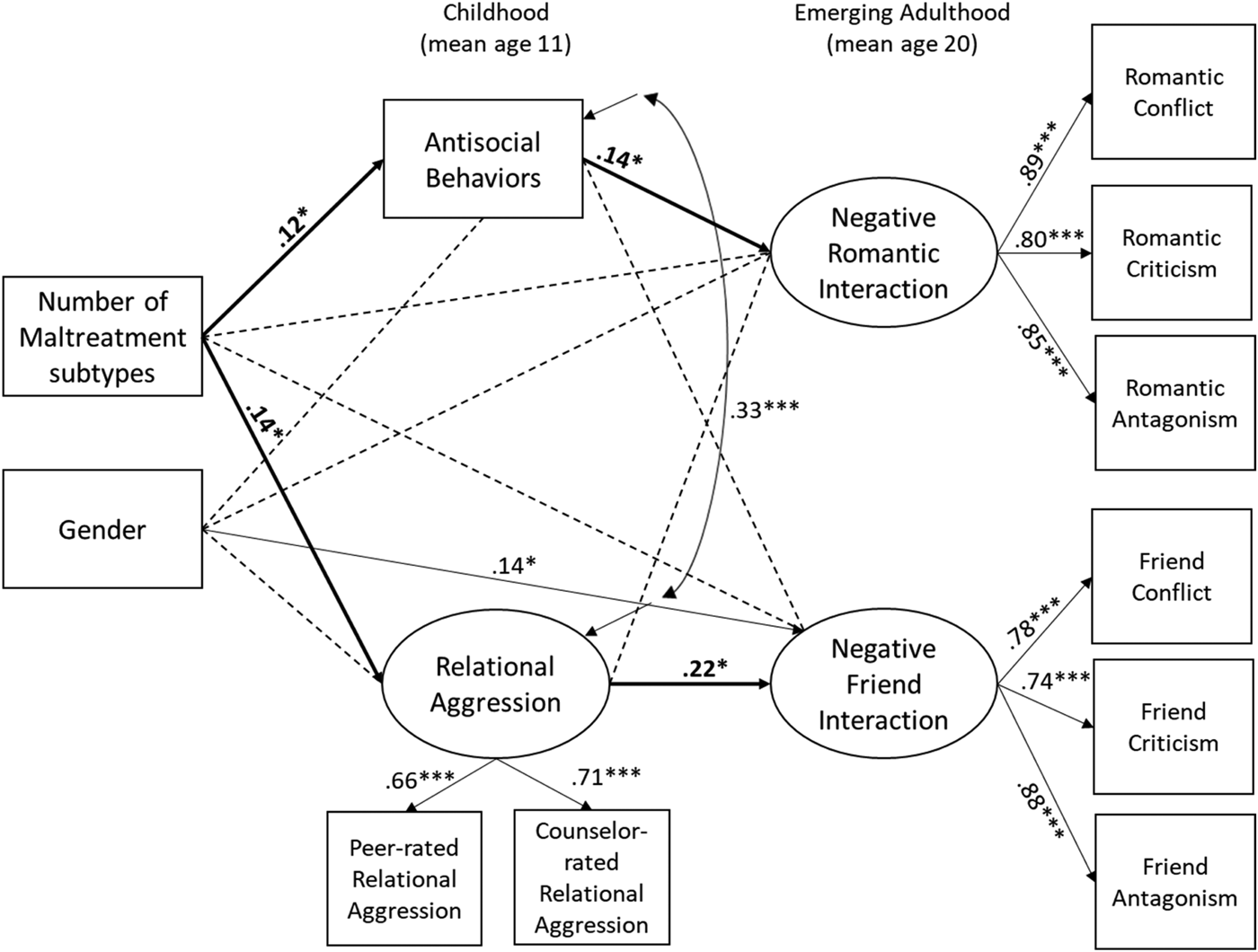
The first SEM was specified as illustrated in Figure 1. The number of maltreatment subtypes experienced in childhood and gender (modeled as a covariate) were both included as exogenous variables. Wave 1 childhood antisocial behavior and the latent childhood relational aggression factor (indicators: peer- and counselor-rated relational aggression) were specified as mediators with correlated residuals. Latent factors for negative interaction within romantic and friend relationships (indicators: conflict, criticism, and antagonism, respectively) were modeled as endogenous variables predicted by the number of maltreatment subtypes experienced, childhood antisocial behaviors, and childhood relational aggression.
Structural equation model results. Standardized factor loadings and path coefficients are presented. Gender is coded 1 = female, 0 = male. The residual correlation between emerging adult latent variables was significant (b = .35, p < .001) but not depicted to facilitate legibility of the figure.*p < .05. ***p < .001.

Missing data for endogenous variables were estimated as a function of exogenous variables based on the missing at random assumption (Schafer & Graham, Reference Schafer and Graham2002). Structural relationships were tested using maximum likelihood estimation. Model fit for the CFA and SEMs were evaluated using comparative fit index (CFI), root mean square error of approximation (RMSEA), and the standardized root mean square residual (SRMR). CFI values greater than .95, RMSEA values less than .06, and SRMR values greater than .06, and a nonsignificant χ2 statistic were considered evidence of good model fit (Hu & Bentler, Reference Hu and Bentler1999; Yu & Muthen, Reference Yu and Muthén2002). Mediation was tested using 95% bias-corrected bootstrapped confidence intervals (CIs; MacKinnon, Fairchild, & Fritz, Reference MacKinnon, Fairchild and Fritz2007). CIs not including the value of zero are considered statistically significant.
Finally, gender moderation was tested using the multiple-group SEM method. Moderation of the childhood antisocial pathway by gender was assessed at the following three paths: (a) child maltreatment→childhood antisocial behavior; (b) childhood antisocial behavior→EA romantic negative interaction; and (c) childhood antisocial behavior→EA friend negative interactions. Similarly, moderation of the childhood relational aggression pathway by gender was tested at the following three paths: (a) child maltreatment→childhood relational aggression latent factor; (b) childhood relational aggression latent factor→ EA romantic negative interaction; and (c) childhood relational aggression latent factor→EA friend negative interaction.
Results
Preliminary analyses
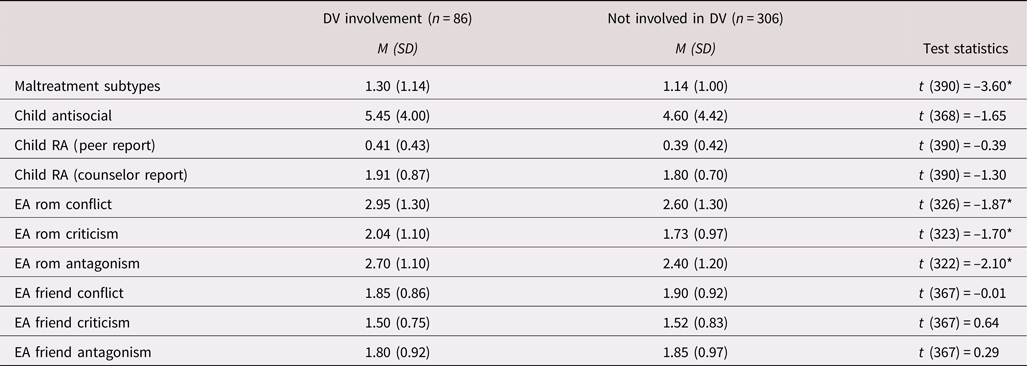
Table 1 provides the zero-order correlations among study variables. Results indicated that a greater number of child maltreatment subtypes was significantly associated with higher levels of childhood antisocial behavior (r = .12, p < .05) and marginally associated with higher levels of peer-rated relational aggression (r = .10, p = .06) and counselor-rated relational aggression (r = .09, p = .09). In addition, peer-rated relational aggression was associated with higher levels of counselor-rated relational aggression (r = .47, p < .001). A greater number of childhood antisocial problems was related to higher levels of EA romantic conflict (r = .12, p < .05), criticism (r = .16, p < .01), and antagonism (r = .14, p < .05), as well as higher friend criticism (r = .11, p < .05). Neither of the childhood relational aggression variables were related to romantic relationship variables; however, higher levels of peer-rated relational aggression was significantly associated with higher levels of friend conflict (r = .15, p < .01) and friend criticism (r = .12, p < .05). Higher levels of counselor-rated relational aggression was related to more EA friend conflict (r = .20, p < .001) and friend antagonism (r = .11, p < .05). Finally, the three indicators for EA negative romantic interactions were intercorrelated (r = .65–.75, p < .001), as were the three indicators for EA negative friend interactions (r = .60–.68, p < .001).
Zero-order correlations among study variables (N = 392)
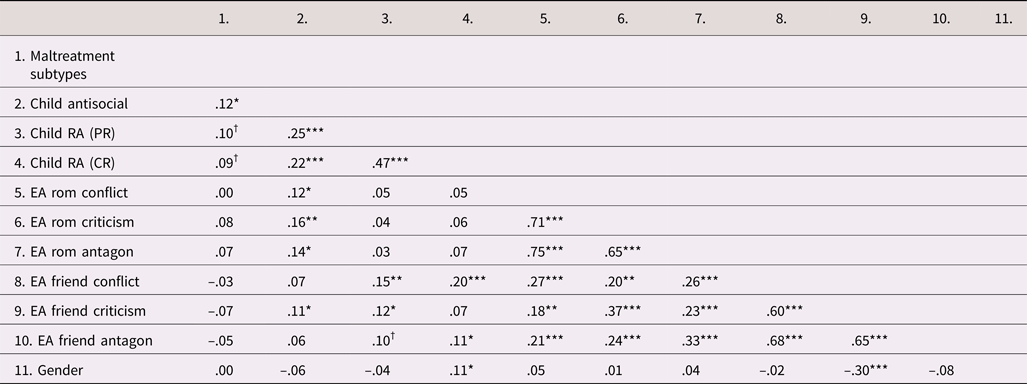
Note: RA, relational aggression. PR, peer report. CR, counselor report. EA, emerging adult. rom, romantic. antagon, antagonism. Gender is coded 0 = males, 1 = females. All variables are coded such that higher values indicate higher levels of the construct. †p < .10. *p < .05. **p < .01. ***p < .001.
Measurement modeling
CFA was conducted to determine the factor structure of the childhood relational aggression measured variables (peer- and counselor-rated relational aggression), the negative romantic interaction measured variables (conflict, criticism, and antagonism), and the negative friend interaction measured variables (conflict, criticism, and antagonism). Results confirmed a three-factor model, χ2 (15) = 26.04, p = .04, RMSEA = .04, 90% CI [.01, .07], CFI = .99, SRMR = .03, with statistically significant factor loadings (λ = .66–.89) and correlated residuals between indicators of EA negative romantic interaction and EA negative friend interaction (b = .28, p < .01) and between indicators of romantic-criticism and friend-criticism (b = .44, p < .01).
SEM
An SEM was estimated as specified in Figure 1. The model evidenced good fit to the data χ2 (30) = 68.76, p < .05, RMSEA = .05, 90% CI [.04, .08], CFI = .97, SRMR = .03. Children who experienced more child maltreatment subtypes self-reported higher levels of antisocial behavior (b = .12, p < .05) and were rated as being more relationally aggressive by other informants (i.e., relational aggression latent factor; b = .14, p < .05) during childhood. Moreover, higher levels of EA negative romantic interaction were predicted by higher levels of childhood antisocial behavior (b = .14, p < .05), but not by childhood relational aggression (b = .04, ns). Alternatively, higher levels of EA negative friend interaction were predicted by more relational aggression in childhood (b = .22, p < .05), but not by childhood antisocial behavior (b = .02, ns). The number of child maltreatment subtypes was not a unique predictor of EA negative romantic interaction (b = .01, ns) or friend interaction (b = –.10, ns). Finally, females reported significantly higher levels of EA negative friend interaction (b = .14, p < .05). The residual correlations between antisocial behavior and relational aggression in childhood (b = .33, p < .01) and between negative romantic interaction and negative friend interaction (b = .35, p < .01) were both significant.Footnote 1
The 95% bias-corrected bootstrap method was conducted to determine the significance of the mediating pathways from: (a) the number of child maltreatment subtypes→childhood antisocial behavior→EA negative romantic interaction; and (b) the number of child maltreatment subtypes→childhood relational aggression→EA negative friend interaction. Results indicated that childhood antisocial behaviors significantly mediated the effect of child maltreatment on EA negative romantic interaction [0.002, 0.053]. Similarly, the relation between child maltreatment and EA negative friend interaction was significantly mediated by childhood relational aggression [0.003, 0.080].
Gender moderation
To examine moderation by gender, two sets of multiple-group SEMs were tested: moderation of the childhood antisocial behavior pathway and moderation of the childhood relational aggression pathway. We anticipated that the antisocial pathway (child maltreatment→childhood antisocial behavior→EA negative romantic interaction) may be stronger for males and the relational aggression pathway (child maltreatment→child relational aggression→EA negative friend interaction) may be more robust for females. Models were specified as depicted in Figure 1 (without sex as a covariate) with factor loadings and all structural paths constrained to equality across gender (i.e., male/female) groups. The fully constrained model evidenced adequate fit to the data, χ2 (68) = 134.98 p < .001, RMSEA = .07, CFI = .95, SRMR = .06.
Following the constrained model, we estimated a partially unconstrained model to test for moderation of the childhood antisocial pathway by relaxing the constraints between gender groups for the following three paths (while maintaining all other model constraints): (a) child maltreatment→EA negative romantic interaction; (b) child maltreatment→childhood antisocial behaviors; and (c) childhood antisocial behaviors→EA negative romantic interaction. This partially unconstrained model also evidenced adequate fit to the data, χ2 (65) = 131.31 p < .001, RMSEA = .07, CFI = .95, SRMR = .05. The chi-square difference test was nonsignificant, Δχ2 (3) = 3.71, ns, indicating the lack of significant gender moderation of the antisocial pathway.
Next, a second partially unconstrained model was estimated to examine whether gender moderated the relational aggression pathway. This model relaxed constraints between the binary gender groups for the following three paths: (a) child maltreatment→EA negative friend interaction; (b) child maltreatment→childhood relational aggression latent factor; and (c) childhood relational aggression latent factor→EA negative friend interaction. This partially unconstrained model also evidenced adequate fit to the data, χ2 (65) = 130.84 p < .001, RMSEA = .07, CFI = .95, SRMR = .05. The chi-square difference test was nonsignificant, Δχ2 (3) = 4.14, ns, indicating the lack of significant gender moderation of the relational aggression pathway.
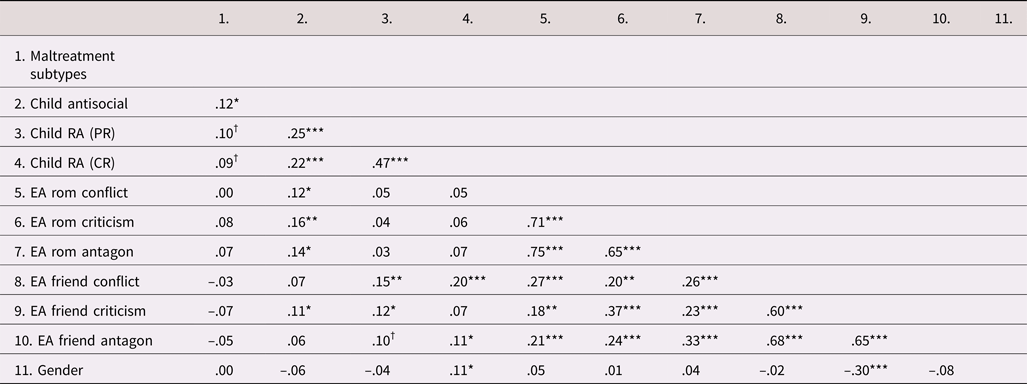
Domestic violence involvement
Exploratory analyses were also conducted to examine EA involvement in domestic violence (see Table 2). Results indicated that emerging adults who reported that they had perpetrated and/or experienced domestic violence in the past 12 months experienced a significantly greater number of maltreatment subtypes as children, t (390) = –3.60, p < .05, compared to emerging adults not involved in domestic violence. We also investigated whether those involved in domestic violence reported higher levels of negative romantic interactions. Findings indicated that emerging adults involved in domestic violence in the past 12 months reported significantly higher levels of conflict, t (326) = –1.87, p < .05, criticism, t (323) = –1.70, p < .05, and antagonism, t (322) = –2.10, p < .05, in their romantic relationships compared to emerging adults not involved in domestic violence. The two groups did not significantly differ in their self-reported levels of friend conflict, t (367) = –0.01, ns, criticism, t (367) = 0.64, ns, and antagonism, t (367) = 0.29, ns. Means and standard deviations are listed in Table 2.
Domestic violence involvement

Note: DV, domestic violence. RA, relational aggression. EA, emerging adult. rom, romantic. *p < .05.
Discussion
The aim of the present study was to determine whether child maltreatment initiates a developmental cascade resulting in negative friend and romantic relationships in emerging adulthood. Specifically, we investigated whether childhood antisocial behavior and childhood relational aggression represent two pathways within this developmental cascade. Consistent with prior research (e.g., Cicchetti & Toth, Reference Cicchetti, Toth and Lamb2015; Rogosch & Cicchetti, Reference Rogosch and Cicchetti2005), we found that as the number of maltreatment subtypes children experienced increased, so too did their displays of antisocial behavior and relational aggression. Results also supported both childhood antisocial behavior and childhood relational aggression as mechanisms partially explaining why maltreated children develop difficulties in interpersonal interactions in emerging adulthood. We found specificity within these pathways such that childhood antisocial behavior was a mediator of child maltreatment effects on EA negative romantic interactions, whereas childhood relational aggression was a mediator of child maltreatment effects on EA negative friend interactions.
That child maltreatment indirectly contributed to the development of difficult, conflictual, and/or coercive relationships in early adulthood is consistent with a substantial body of research on the negative interpersonal sequelae associated with maltreatment (e.g., Doyle & Cicchetti, Reference Doyle and Cicchetti2017; Trickett et al., Reference Trickett, Negriff, Ji and Peckins2011). Dishion (Reference Dishion, Dishion and Snyder2016) posited the implicit grammar hypothesis to explain the development of negative coercive interactions, which provides a useful framework for understanding our findings. According to his theory, individuals exposed to maltreating family environments may develop implicit beliefs regarding relationships and interpersonal exchanges, which may then be elicited in future interactions. Dishion (Reference Dishion, Dishion and Snyder2016) highlighted that maladaptive parenting not only overtly teaches coercion and negative interaction styles via social learning but also shapes implicit scripts regarding how relationships function and how loved ones interact, which may then contribute to future coercive negative exchanges in relationships.
Regarding romantic relationships, we found evidence for a developmental antisocial pathway from child maltreatment to conflictual coercive romantic interactions. These findings are consistent with the work of Ha and colleagues (Ha, Kim, Christopher, Caruthers, & Dishion, Reference Ha, Kim, Christopher, Caruthers and Dishion2016; Ha et al., Reference Ha, Otten, McGill and Dishion2019) that has shown various forms of antisocial behavior and deviant peer affiliation to underlie the risk associated with maladaptive caregiving environments on the development of dysfunction in adult romantic relationships. Ha and colleagues (Reference Ha, Kim, Christopher, Caruthers and Dishion2016, Reference Ha, Otten, McGill and Dishion2019) focused on disruptive parenting (i.e., high family conflict, low parental monitoring, and low supportiveness) and retrospectively reported child maltreatment as predictors of these cascade models. We extend these findings by (a) employing a sample of low-income, racially and ethnically diverse children with documented maltreatment histories from CPS record data, and demographically matched nonmaltreated children, and (b) assessing their interpersonal functioning 10 years later.
Moreover, prior research indicates that negative romantic interactions may be precursors to domestic violence (e.g., Booth et al., Reference Booth, Crouter and Clements2001). Our results indicated that emerging adults who reported involvement in domestic violence (as either a perpetrator or a victim) endorsed significantly higher levels of romantic conflict, criticism, and antagonism. Given that emerging adults in our study who were involved with domestic violence also experienced significantly more maltreatment subtypes as children, our findings provide preliminary evidence that this antisocial developmental cascade from child maltreatment may result in not only negative romantic interactions but also more severe outcomes such as intimate partner violence. Furthermore, IPV has been implicated as a mechanism underlying the intergenerational transmission of maltreatment (Adams, Handley, Manly, Cicchetti, & Toth, Reference Adams, Handley, Manly, Cicchetti and Toth2019). Taken together, it is plausible that the cascading of negative interpersonal interaction initiated by child maltreatment, maintained by childhood antisocial behavior, further snowballed by negative romantic interactions and domestic violence, may come full circle and result in maltreatment within the next generation.
Regarding the development of coercive friendships in emerging adulthood, we found evidence for a relational aggressive pathway initiated by child maltreatment. Consistent with Dishion's (Reference Dishion, Patterson and Cicchetti2016) theory of the development of coercive interaction, these findings suggest that maltreatment may shape individuals’ expectations that relationships are marked by manipulation, inconsistency, and withdrawal of love. When children with these expectations are in the peer context, they may be more likely to engage in relational aggression, which may further reinforce these expectations, and result in the selection of, and further socialization by, relationally aggressive friends in adulthood. Loeb, Tan, Hessel, and Allen (Reference Loeb, Tan, Hessel and Allen2018) found that early adolescents with stronger negative social expectations for their peers’ behavior were more likely to have friends with strong beliefs about the acceptability of aggression both in emerging adulthood and continuing on into young adulthood.
Although we anticipated that both childhood antisocial behavior and relational aggression would predict negative interactions with both friend and romantic domains in emerging adulthood, we found evidence for specificity in these pathways. Childhood antisocial behavior predicted negative romantic dynamics and childhood relational aggression predicted negative friend dynamics. Limited prior research has examined antecedents to different types of EA relationships. However, among a sample of adolescents, Furman and Shomaker (Reference Furman and Shomaker2008) found no associations between dimensions of romantic interactions and dimensions of friend interactions. Specifically, the authors observed adolescent–friend and adolescent–romantic partner interactions and coded these exchanges. Affective responsiveness, off-task behavior, communication skills, and conflict, observed among adolescent–friend dyads were unrelated to these dimensions observed among the same adolescent and his/her romantic partner. This suggests that although commonalities exist across relationships, there is specificity in the way in which young people respond to friends versus romantic partners. Our results point to differential antecedents as well.
Although not a central aim of the paper, we also conducted exploratory gender moderation of these pathways. Results did not support gender moderation of either the antisocial pathway or the relational aggression pathway. Our findings differ from those of Preddy and Fite (Reference Preddy and Fite2012), who showed that relational aggression was associated with social problems for girls and overt aggression was associated with social problems for boys. Although there is evidence that sexual abuse may be more strongly associated with relational aggression among girls than among boys (Cullerton-Sen et al., Reference Cullerton-Sen, Cassidy, Murray-Close, Cicchetti, Crick and Rogosch2008), it is also the case that the majority of research on gender differences in relational aggression is mixed (Murray-Close et al., Reference Murray-Close, Han, Cicchetti, Crick and Rogosch2015). For instance, Murray-Close, Han, Cicchetti, Crick, and Rogosch (Reference Murray-Close, Han, Cicchetti, Crick and Rogosch2008) found the lack of gender moderation such that cortisol dysregulation was related to relational aggression for both girls and boys. Regarding the antisocial pathway, our results suggest that child maltreatment initiates an antisocial developmental cascade to romantic relationship dysfunction in emerging adulthood that is relevant for both men and women. This is consistent with the finding that men and women are relatively equally likely to be perpetrators of intimate partner violence (see Capaldi et al., Reference Capaldi, Knoble, Shortt and Kim2012, for review).
Given the long-term prospective design of this study, and our focus on identifying underlying developmental pathways, our results are poised to offer important insights into prevention and intervention designs for maltreating families. With regard to the development of coercive romantic relationships and involvement in domestic violence, our findings underscore the necessity of early intervention. It is apparent from our results, and others (e.g., Ha et al., Reference Ha, Kim, Christopher, Caruthers and Dishion2016, Reference Ha, Otten, McGill and Dishion2019), that a dysfunctional early caregiving environment sets the course for an antisocial developmental cascade marked by childhood antisocial tendencies, affiliation with deviant peers, and coercive romantic exchanges. Moreover, because of links between intimate partner violence and perpetration of maltreatment (Adams et al., Reference Adams, Handley, Manly, Cicchetti and Toth2019), early intervention may not only prevent the development of antisocial behavior and dysfunctional romantic relationships, but it may also ultimately function to disrupt the intergenerational transmission of maltreatment. Thus, family-based prevention programs targeting early conduct problems, especially among high-risk families, are essential. Shaw, Dishion, Supplee, Gardner, and Arnds's (Reference Shaw, Dishion, Supplee, Gardner and Arnds2006) downward extension of the Family Check-Up intervention to the toddler years offers an excellent example. Results of this study supported the effectiveness of this family-based program at reducing child conduct problems, and was especially helpful for children at elevated risk for continued conduct problems later in development. Interventions such as this offer important opportunities for interrupting the negative developmental cascade initiated by child maltreatment.
If the opportunity to preventively shape prosocial behaviors in the early caregiving environment is missed, these findings also inform secondary or tertiary prevention efforts with adolescents and young adults who demonstrate antisocial tendencies or relationally aggressive patterns. As previously discussed, Dishion (Reference Dishion, Dishion and Snyder2016) posited that early coercive and conflictual behaviors may become overlearned and automatic as they occur in several close relationships, resulting in adolescents and young adults engaging in coercive relationship behaviors. Therefore, interventions that bring these implicit beliefs about relationships into active awareness may help individuals reorganize their expectations for close relationships and increase prosocial interactions.
The present study advances our understanding of the pathways underlying child maltreatment risk for negative interpersonal interactions during emerging adulthood. Strengths include the 10-year longitudinal design, the coding of CPS record data to classify child maltreatment, multi-informant reports of childhood relational aggression (peers and camp counselors), and the high-risk nature of the sample. In spite of these strengths and contributions, there are limitations worth considering. We relied on self-report measures of EA relationship functioning. Future research utilizing observational paradigms involving actual interactions among dyads will provide important insights. Next, although we grounded this study within attachment theory and discussed the relevance of implicit beliefs and expectations regarding relationships, we did not directly assess these constructs. Future research assessing internal representations and implicit social cognitions, using paradigms such as the 5-min speech sample (Gottschalk & Gleser, Reference Gottschalk and Gleser1969) and Go/No-Go Association Task, will continue to advance this line of research. Finally, although we incorporated multiple informants, our model focused exclusively on behavior and interpersonal interactions. A central tenet of developmental psychopathology is the investigation of multiple levels of analysis (Cicchetti & Dawson, Reference Cicchetti and Dawson2002; Rutter & Sroufe, Reference Rutter and Sroufe2000). Consideration of neurocognitive and neuroendocrine pathways may also be particularly relevant to understanding why maltreated children experience interpersonal challenges later in development.
In conclusion, results of the current study support both a childhood antisocial pathway and a childhood relational aggression pathway from child maltreatment to EA negative interpersonal interactions. We found specificity within these pathways such that childhood antisocial behavior was a mediator of child maltreatment effects on EA negative romantic interactions, whereas childhood relational aggression was a mediator of child maltreatment effects on EA negative friend interactions. Together, results indicate that children exposed to maltreatment face significant interpersonal challenges in emerging adulthood, within both the friend and the romantic domains, and point to distinct childhood pathways to these negative interactions. Our findings are consistent with Dishion's (Reference Dishion, Patterson and Cicchetti2016) framework for understanding the development of antisocial behavior and coercion within relationships and underscore the need for early preventive intervention to disrupt the negative developmental cascading of effects from child maltreatment to EA relationship dysfunction.
Financial Support
We are grateful to the Jacobs Foundation (to Dante Cicchetti) and the National Institute on Drug Abuse (R01-DA01774 to Fred A. Rogosch and Dante Cicchetti) for their support of this work.