Introduction
End-of-life experience can include a variety of physical, psychosocial, and spiritual sources of distress, which can contribute to poor quality of life, affecting patients’ ability to have inner peace and meaningful conversations, including goodbyes to loved ones.
Desire for death (DfD) has been central in end-of-life debates in the context of advanced disease and palliative care (PC). Unfortunately, although there is a growing body of research on DfD, there is still a lack of guidelines for clinical care to address the desire to die among terminally ill (Breitbart et al., Reference Breitbart, Rosenfeld and Pessin2000; Mystakidou et al., Reference Mystakidou, Rosenfeld and Parpa2005; Hudson et al., Reference Hudson, Kristjanson and Ashby2006). The DfD has been described as a complex and multifactorial dimension of end-of-life suffering. Several studies have shown DfD to be associated with demographic, clinical, and psychosocial variables, such as gender; unrelieved physical symptoms (e.g., pain, nausea, fatigue); declining physical functioning and loss of autonomy; feeling like a burden; social isolation; depression; hopelessness; as well as other variables, such as deterioration in quality of life and loss of dignity (Breitbart et al., Reference Breitbart, Rosenfeld and Pessin2000; Monforte-Royo et al., Reference Monforte-Royo, Villavicencio-Chávez and Tomás-Sábado2011; Julião et al., Reference Julião, Barbosa and Oliveira2013; Wilson et al., Reference Wilson, Dalgleish and Chochinov2016). Hudson et al. (Reference Hudson, Kristjanson and Ashby2006) found that psychological, existential, and social reasons seem to be more prominent than those directly related to physical symptoms. The DfD is fluctuant and not sustained throughout the illness trajectories. It is known that DfD variations across time can depend on effective physical and psychological care, as well as brief psychotherapeutic approaches (Monforte-Royo et al., Reference Monforte-Royo, Villavicencio-Chávez and Tomás-Sábado2007; Price et al., Reference Price, Lee and Goodwin2011; Julião et al., Reference Julião, Barbosa and Oliveira2013, Reference Julião, Oliveira and Nunes2017). Patients may use DfD as a cry for help when confronting seemingly insurmountable distress, and as an extreme coping strategy to maintain control against anticipated agony, perceived as an unbearable experience (Pestinger et al., Reference Pestinger, Stiel and Elsner2015).
Unfortunately, the literature on this issue has many methodological limitations, and it is difficult to compare studies results due to the variability in sample characteristics, settings, participation rates, and scales used (Hudson et al., Reference Hudson, Kristjanson and Ashby2006). Nevertheless, research efforts should continue to garner insights into DfD and how it unfolds for patients nearing death.
To date, there is only one Portuguese study (Julião et al., Reference Julião, Barbosa and Oliveira2013) on DfD in a PC inpatient population. To the best of our knowledge, there are no Portuguese studies on the prevalence of DfD and its associated factors in the home-based PC field.
Methods
Design and measures
We conducted a retrospective analysis of all first DfD entries registered in our anonymized database (October 2018–April 2020), intending to evaluate the prevalence and associated demographic, clinical, physical, and psychosocial factors of DfD in palliative patients followed by our tertiary home-based PC Unit (HPCU). Since October 2018, our HPCU developed a four-domain patient/family-centred documentation sheet (#4D2S) (Julião et al., Reference Julião, Sobral and Calçada2020b), designed for application at each clinical encounter, from admission to follow-up and until discharge, allowing a holistic approach to patient and family evaluations. The #4D2S is composed of four main patient/family-centred domains: #1 Physical Well-being, including the Edmonton Symptom Assessment Scale (ESAS) (rated from 0 — absence of symptom to 10 — extreme exacerbation of the symptom) (Bernardo, Reference Bernardo2005; Hui and Bruera, Reference Hui and Bruera2017); #2 Social and Occupational Well-being, composed of social support, advanced directives, and living will items); #3 Psychological Well-being, and the #4 Spiritual Well-being, comprised of a general hope question, religious believes, personal spiritual practices; the Portuguese dignity question (Chochinov et al., Reference Chochinov, McClement and Hack2015; Julião et al., Reference Julião, Courelas and João Costa2018) and will to live (WtL) (0 — total WtL; 10 — worst possible WtL).
Domain #3 is comprised of several psychological measures, including the single question for depression (SQD) “Are you depressed?” (Chochinov et al., Reference Chochinov, Wilson, Enns and Lander1997; Julião et al., Reference Julião, Nunes and Sobral2016), the single question for anxiety (SQA) “Do you feel anxious?” (Palliative Care Needs Assessment Guidance, 2014), knowing the diagnosis, adaptation to the disease, feeling a burden, and the Desire-for-Death Rating Scale (DDRS) (Chochinov et al., Reference Chochinov, Wilson and Enns1995). The DDRS allows clinicians to rate DfD on a scale of 1 to 6. A score below 3 means that a patient has no significant DfD, while patients with a severe or persistent have a DfD score ≥4 (used to calculate the DfD prevalence).
All patients anonymously registered in the database gave written informed consent after reading an information sheet complying with the European Union General Data Protection Privacy Regulation Privacy Laws. Anonymization consists of the removal of any personal data to irreversibly prevent the identification of the individual to whom it relates. According to the Portuguese National Ethics Committee for Clinical Research, “Personal data that has been rendered anonymous in such a way that the person is no longer identifiable, is no longer considered personal data and is therefore not covered by the General Data Protection Regulation”. For this reason, the study was not submitted to an Ethics Committee.
Statistical analysis
Descriptive statistics were performed to characterize the sample studied. The association between independent factors and DfD was examined using χ2 test or Fisher exact test. Crude Odds Ratios (OR) and the respective confidence intervals (95% CI) were calculated through binary logistic regression and by exact logistic regression for sparse tables. The Mann–Whitney test was used to assess median differences in the continuous variables according to the DfD categories. Then a multivariate analysis was performed to evaluate the independent associations between the significant univariate factors and DfD. For this step, we included only the variables with a significant association with DfD (P < 0.05) and with a minimum number of cases to allow analysis (Palliative Performance Status (PPS), feeling a burden, ESAS well-being, drowsiness, and shortness of breath items). A logistic regression model was then built using backward selection and the respective adjusted odds ratios (aOR) and 95% CI are presented. The analyses were performed using the SPSS26.0, and the Stata 13.0.
Results
Patients’ sample
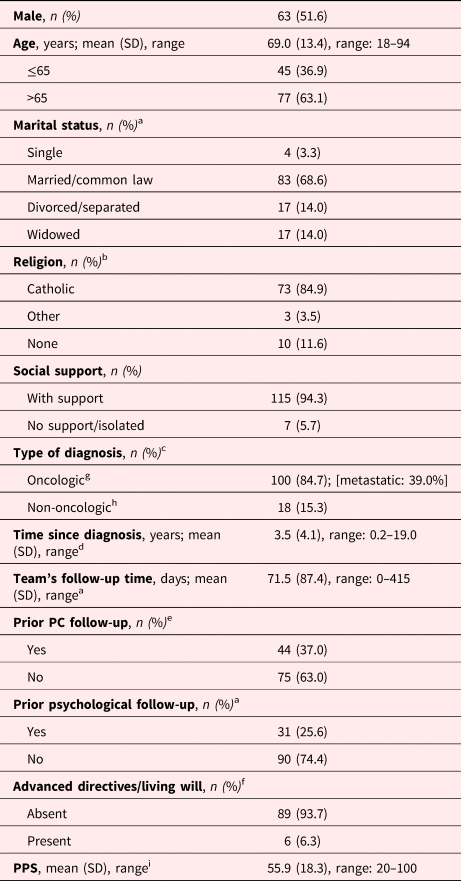
We analyzed our retrospective database between October 2018 and April 2020 and retrieved 163 entries (i.e., patients anonymously registered in database). Forty-one patients were not included in the analysis, because no DfD score was registered, leaving a final sample of 122 patients. Sixty-three per cent of the patients were male. The average age was 69 years (range: 18–94). Sociodemographic and clinical data are shown in Table 1.
Sociodemographic and clinical characteristics of the 122 palliative patients analyzed

Some proportions do not add to 100% due to rounding.
PC, palliative care; PPS, Palliative Performance Scale.
a 1 entry missing.
b 36 entries missing.
c 4 entries missing.
d 8 entries missing.
e 3 entries missing.
f 27 entries missing.
g Colon, n = 20; breast, n = 13; liver, n = 7; larynx, n = 7; lung, n = 6; pancreas, n = 6; nose, n = 5; ovarian, n = 5; prostate, n = 5; esophagus, n = 4; lymphoma, n = 4; stomach, n = 4; bladder, n = 3; uterus, n = 3; brain, n = 2; multiple myeloma, n = 2; kidney, n = 2; osteosarcoma, n = 2; heart, n = 1; meninges, n = 1; rectal, n = 1; small bowel, n = 1; thymus, n = 1. The total does not add up to 100 because some patients had more than one diagnosis.
h Lateral amyotrophic sclerosis, n = 9; chronic obstructive pulmonary disease, n = 3; congestive cardiac failure, n = 3; congenital neurologic syndrome, n = 1; Parkinson's disease, n = 1; renal insufficiency, n = 1.
i 100% – healthy; 0% – death; 6 entries missing.
Prevalence of desire for death
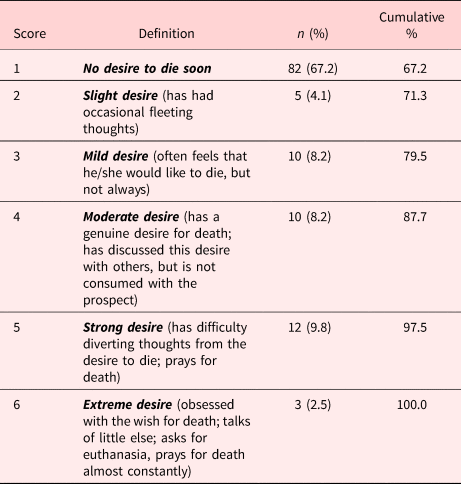
As shown in Table 2, the prevalence of DfD (DDRS score ≥4) was 20.5% (n = 25; 95% CI [13.33–27.66]). Eighty per cent of the patients (n = 97) did not show a persistent or severe DfD.
Desire-for-Death Rating Scale scores of the 122 palliative patients analyzed

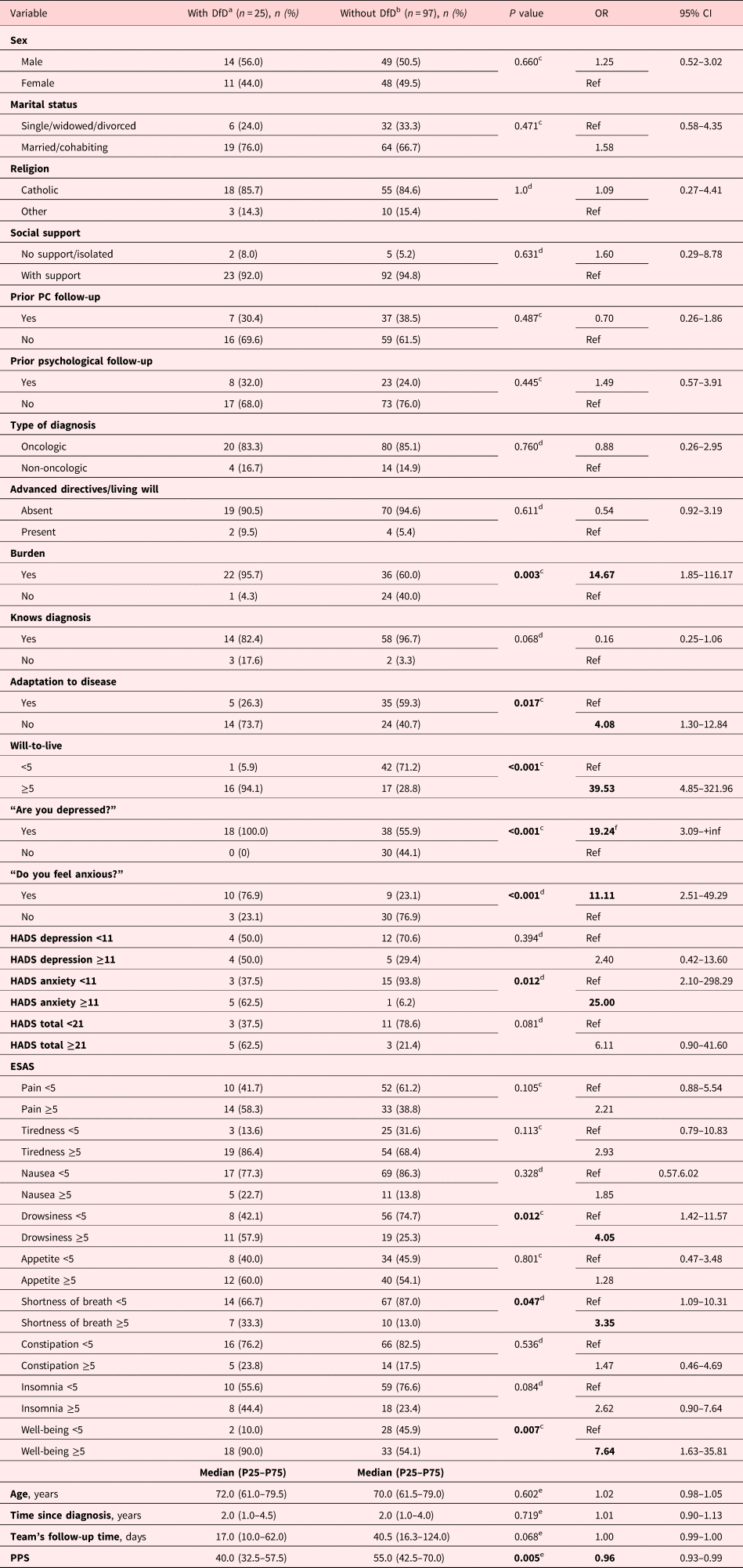
Patients with DfD were mostly men (56.0%), married/cohabiting (76.0%), and Catholic (85.7%) (Table 3). The majority presented high scores in the WtL scale (indicating a paucity of will to live) (94.1%); all reported being depressed (100%) and most reported feeling anxious [both on the SQA question (76.9%) and the HADS anxiety scale (62.5%)]; and felt themselves to be a burden to others (95.7%).
Sociodemographic, clinical, physical, and psychosocial characteristics of the 122 palliative patients with or without desire for death

CI, confidence interval; DDRS, Desire for Death Rating Scale; DfD, desire for death; ESAS, Edmonton Symptom Assessment Scale; HADS, Hospital Anxiety and Depression Scale; inf, infinite; OR, odds ratio; PC, palliative care; PPS, Palliative Performance Scale; Ref, reference category. Bold mentioned in statistically significant.
a DDRS score ≥4.
b DDRS score <4.
c Pearson Chi-Square.
d Fisher Exact Test.
e Mann–Whitney Test.
f Exact logistic regression.
Of those with a DfD, three patients reported to have an extreme desire for death (2.5%). They were oncologic patients with high scores in the WtL numerical scale, hence expressing a lack of will to continue their lives. All these patients answered positively to the question “Are you depressed?” and two of them felt like they were a burden.
Desire for death and associated factors
Sociodemographic and clinical factors
Regarding sociodemographic and clinical factors, an association between DfD and the PPS was found. The data showed that patients with higher PPS scores were less likely to desire death than those with lower scores (OR = 0.96; 95% CI [0.93–0.99]). No statistically significant associations were observed between patients with and without DfD regarding sex, age, marital status, religion, social support, prior PC follow-up, prior psychological follow-up, type of diagnosis, presence of advanced directives/living will, time since diagnosis, and team's follow-up time (P > 0.05).
Physical factors
The average ESAS scores (mean; SD) on each physical items were as follows: pain (3.6; 3.4); tiredness (6.1; 3.1); nausea (1.4; 2.8); drowsiness (2.7; 3.4); appetite (4.7; 3.7); shortness of breath (1.5; 2.9); constipation (1.8; 3.0); insomnia (2.4; 3.6); and well-being (5.3; 3.4). Based on the latter ESAS scores, physical suffering was low to moderate.
Statistically significant positive associations were found between ESAS scores and DfD for drowsiness (OR = 4.05; 95% CI [1.42–11.57]), shortness of breath (OR = 3.35; 95% CI [1.09–10.31]), and well-being (OR = 7.64; 95% CI [1.63–35.81]), i.e., a paucity of well-being was associated with heightened DfD.
Psychosocial factors
Depression and anxiety
Based on their response to the SQD, 56 patients (45.9%) reported being depressed; 30 (24.6%) were not depressed; and 36 (29.5%) had missing data for this item. Regarding the SQA, 19 (15.6%) patients answered “yes, I feel anxious”; 33 (27.0%) responded No; and 70 entries (57.4%) were missing from database. The average sample score on the HADS depression subscale was 9.3 (SD = 4.8), on the HADS anxiety subscale was 8.5 (SD = 4.6), and on the HADS total was 18.1 (SD = 6.8).
Positive associations were found between DfD and reported depression (OR = 19.24; 95% CI [3.09–+inf]), as well as feeling anxious (OR = 11.11; 95% CI [2.51–49.29]). Moreover, a positive association was found between DfD and scores ≥11 on HADS anxiety subscale (OR = 25.0; 95% CI [2.10–298.29]). No associations were found between patients with or without DfD for the HADS depression subscale and the HADS total scale.
Will-to-live
The mean sample score on the WtL scale was 3.6 (SD = 4.1), indicating a strong average WtL. Patients with higher values of WtL (meaning a lack of will-to-live) were more likely to desire death (OR = 39.53; 95% CI [4.85–321.96]).
Additional factors contributing to desire for death
Other factors evaluated were feeling a burden, knowing the diagnosis, and adaptation to the disease. Patients feeling a higher sense of being a burden were more likely to desire death (OR = 14.67; 95% CI [1.85–116.17]), as well as those who did not reveal adaptation to the disease (OR = 4.08; 95% CI [1.30–12.84]), compared to those who showed adaptation. Knowing the diagnosis did not present a statistically significant association with DfD.
Independent factors
After adjustment, controlling for drowsiness, and shortness of breath, three factors maintained a statistically significant association with DfD: the PPS, feeling a burden, and the ESAS well-being item. Patients with higher PPS scores were less likely to desire death (aOR = 0.95; 95% CI [0.91–0.99]), while those who felt they were a burden to others (aOR = 12.82; 95% CI [1.31–125.16]) and reported lack of well-being (aOR = 7.72; 95% CI [1.26–47.38]) were more likely to desire death.
Discussion
To the best of our knowledge, this study is the first to describe the prevalence and associated factors of the DfD of palliative patients cared for in a HPCU. Our results indicate that 20% of patients endorse a significant and persistent desire for hastened death are aligned with earlier studies (Chochinov et al., Reference Chochinov, Wilson and Enns1995; Rodríguez-Mayoral et al., Reference Rodríguez-Mayoral, Ascencio-Huertas and Verástegui2019), along with the Portuguese research by Julião et al. (Reference Julião, Barbosa and Oliveira2013) in terminally ill persons in a PC Unit.
Although many of our findings might have been underpowered due to a high percentage of missing data in our database, a common limitation for retrospective analysis based on clinical staff evaluations and registries, there are some noteworthy observations.
For most patients (DDRS score <4 = 80%), DfD seems to be of mild to moderate intensity and not consistently held over time. It would seem that most patients maintain a strong wish to live, in spite of the challenges and burdens they confront in the course of approaching death, and highly influenced by multiple physical and psychological aspects of the patient's context and good care (Chochinov et al., Reference Chochinov, Wilson and Enns1995; Julião et al., Reference Julião, Antunes and Nunes2020a).
Only three patients (2.5%) declared constantly obsessing about the wish for death. All three of these patients had high scores in the WtL numerical scale, indicating a paucity and fragility of the will to continue with their lives. The WtL and DfD scales provide a simple and reliable means for researchers and clinicians to identify terminally ill patients’ attitudes towards continuing their lives. All three patients answered affirmatively to the SQD (the Portuguese version of this scale has been published and appears to be a promising tool for screening for depression in the Portuguese PC setting (Julião et al., Reference Julião, Nunes and Sobral2016). Although we cannot draw any conclusions from the comparison between the DfD with the HADS depression subscale — as we have no HADS entries for each of the three patients — based on the SQD tool, we can affirm that depression seems to be one of the most important underpinning factors influencing DfD. Finally, two patients with extreme DfD felt like they have become a burden, which previous studies have also reported (Breitbart et al., Reference Breitbart, Rosenfeld and Pessin2000; Hudson et al., Reference Hudson, Kristjanson and Ashby2006; Julião et al., Reference Julião, Barbosa and Oliveira2013). Self-perceived burden has been identified as a relevant factor in death-hastening acts among patients with life-threatening illnesses, as a means to alleviate a perceived heavy burden of care when facing progressive disability and dependency in the hands of patients’ loved ones.
Regarding the independent factors associated with the desire to hasten death, our results are aligned with the existing evidence showing significant associations between DfD and the overall performance status (evaluated using the PPS), perhaps also linked to the feeling of being a burden. Physical symptoms, its intensity and control, play an important and well-documented role in the DfD and WtL as shown by the ESAS well-being, an item integrated into the physical ESAS subscale (Julião et al., Reference Julião, Antunes and Nunes2020a). The present study — in addition to our previous one in a sample of PC inpatients (Julião et al., Reference Julião, Barbosa and Oliveira2013) — show that self-perceived burden has been identified as a relevant factor in death-hastening acts and this fact might be linked with high and progressive dependency and uncontrolled physical symptoms. Therefore, we think that future qualitative research in the Portuguese population should be designed to determine terminally ill patients’ specific reasons for DfD when depending on loved ones or when facing unrelieved physical suffering.
Our study has certain limitations. We performed the retrospective analysis on an anonymous database that reflects daily health professionals’ assessments in each clinical contact, without following any a priori and obligatory protocol of evaluation per patient. Therefore, we could not control the number of entries nor which data points were entered for each patient. For that reason, the high percentage of missing data might have interfered with our statistical analysis. Our sample size was relatively small and composed primarily of older, end-stage cancer patients. Desire for death is an important issue, warranting larger sample sizes in cancer and non-cancer diagnosis with dire prognoses.
Our study reinforces the findings about DfD as reported in previous studies. Nevertheless, building a strong, evidence-based understanding of DfD will help clinicians and researchers develop clinical approaches that best meet the needs of dying patients and their families. A deep and nuanced understanding of DfD can also help inform the end-of-life debate on the issue of physician-assisted suicide. Policies regarding physician-assisted suicide should, at least in part, be informed by data, which delineates the nature of suffering that can undermine a dying patient's wish to go on living. Studies that provide such data serve to guide best practices and thoughtful social policies, best serving the needs of dying patients, families, healthcare providers, and society at large.
Author contributions
MJ, MAS, BA, and HMC were responsible for the conception, design, and writing the initial draft. MJ, MAS, PC, and CS were responsible for the database managing and initial data analysis. CS was responsible for the statistical analysis. All co-authors made the revision of the final report and had full access to all the data.
Funding
Bárbara Antunes is funded by the National Institute for Health Research (NIHR) Applied Research Collaboration East of England (ARC EoE) programme. The views expressed are those of the author and not necessarily those of the NHS, the NIHR, or the Department of Health and Social Care.
Conflict of interest
There are no conflicts of interest.