Egypt had a long history of artisanal textile spinning, weaving, and dyeing, and the sector remained strong into the early 20th century by furnishing part of the ever-growing population's local market demand. Nevertheless, the dynamics of the cotton economy contributed to the country's political and economic subordination to Britain.Footnote 1 Often called the “cotton paradox,” Egypt's status as a cotton grower dependent on imports of coarse raw cotton and cotton textiles resulted from the high value of its own long-staple raw cotton on the export market.Footnote 2 At the time Egypt achieved formal independence in the early 1920s, Britain bought nearly 45 percent of Egypt's exports of raw cotton and supplied almost 90 percent of the 201 million square meters of cotton textiles imported annually into the country.Footnote 3 Much of this imported fabric was cheap cloth, mass produced with coarse cotton yarns and destined for peasant consumption, although Great Britain also exported a range of sturdier and more elegant fabrics for sale to the smaller middle and upper classes. Most Egyptian textile artisans and local factories worked short- and medium-staple raw cotton and thread, mainly imported from India and the United States, until an Egyptian law in 1916 prohibited the importation of raw cotton to prevent the spread of cotton pests.Footnote 4
Calls to develop a new mechanized textile industry supplied by locally grown cotton became increasingly urgent in Egypt after World War I as the nationalist movement expanded.Footnote 5 National self-sufficiency in textiles, some bourgeois nationalists and landowners argued, would allow cotton growers a measure of control over their market, develop the nation in a “modern” way through the promotion of industrial manufacturing, and create a unified national economy.Footnote 6 As Talʿat Harb, a leading economic nationalist, put it: “By using our cotton in our clothes, and especially the clothes of the poor, for which there is great demand, we would be able . . . to actively encourage agriculture and industry at a single time.”Footnote 7 A variety of industrial concerns emerged to support the goal of textile self-sufficiency; the Bank Misr textile factories at al-Mahalla al-Kubra (the Misr Spinning and Weaving Company) and Kafr al-Dawwar (the Misr Fine Spinning and Weaving Company) established in the late 1920s and the 1930s were the most prominent, although a range of smaller specialized factories also appeared and several older concerns were reorganized and expanded.Footnote 8 Even after Egypt achieved tariff independence in 1930, however, an inability to profit from these new mills plagued cotton growers-cum-industrialists. Although the lack of local technology and skilled labor to power the new factories worried elites, creating a local market for their new mass-produced textiles proved equally challenging.
The Egyptian press followed the emergence in India of locally produced cotton textiles as a national symbol in the anticolonial struggle, and Egyptian activists modeled some of their tactics, such as bonfires and boycotts, on Indian experiences.Footnote 9 The material nature of Egyptian cotton restricted it, however, as an equivalent political vehicle in Egypt. Unlike India's short-staple cotton, Egypt's trademarked raw cotton was of a very long staple and could be used to produce exceptionally fine fabrics. It was not particularly well suited to the production of cheap textiles for a mass market. Such misallocation of resources to support the nationalist goal of cotton self-sufficiency would be akin to “countries using silver or even gold to make saucepans under the pretext of employing the primary materials that are at their disposal,” one textile expert complained.Footnote 10 In the decades following the 1916 law, Egypt gradually increased the domestic cultivation of shorter-staple cottons, and local industrialists turned as best they could to the use of Egyptian cotton in their new factories, producing (at least initially) often rather rough textiles due to their “simple” weaving and spinning technologies that “specialized in coarse, low counts” of thread.Footnote 11 At the same time, marketers worked to cast the consumption of cloth made with Egyptian cotton as a nationalist duty. This complex campaign drew partly on Egyptian long-staple cotton's reputation for creating fine, high-quality, almost silky cloth. The awkward translation of long-staple cotton's reputation into marketing campaigns to encourage mass consumption of cheap, coarse cloth forms the focus of this article. These campaigns would structure the reception of new textiles and shape the nation's gradual shift toward mass consumption in the 1940s and 1950s.
The first part of this article investigates the larger movement to develop local industries in Egypt, in order to contextualize the promotion of “national” textiles. It then examines two marketing strategies from the 1930s that helped to broaden the local market in cotton textiles and set new discursive parameters: a reconfiguration of cotton's silkiness as durability and a depiction of cloth consumption as a way to knit together various constituents of the newly independent nation. Both tactics were particularly visible from 1932 to 1935, during a campaign to market new, locally knitted cotton socks for men, a commodity that had been relatively unimportant in Egypt before 1920. The article then turns to the 1940s, when the growing popularity of artificial thread, especially in women's nylon hosiery, forced a change in the local mechanized textile industry premised on the economic unity of agricultural and industry. This shift corresponded to a rise in social criticism that used images of the proliferation of goods and new “populuxe” sartorial practices, including nylon, to symbolize increasing moral, social, and political decadence.Footnote 12 In 1948, the local magazine Ruz al-Yusuf even published a short story criticizing the fat cats of old-regime society under the title “The Nylon Woman.”Footnote 13
By reading nylon advertising through a broader history of “national” textiles, this article argues that the experience of cotton marketing in the 1920s and 1930s shaped the role nylon hosiery played in the creation of a postcolonial Egyptian discourse about luxury. In a larger sense, this textile history demonstrates that the material specificity of consumer goods structured how objects could help define the boundaries of national community and the behaviors deemed suitable in it. I draw on a variety of primary sources, including state archives, commercial records, trade reports, memoirs, and literary writings, to situate several marketing campaigns that appeared in the Egyptian press in the 1930s, 1940s, and 1950s.Footnote 14 The Egyptian press expanded dramatically after World War I, fueled in part by illustrated magazines such as Ruz al-Yusuf, al-Ithnayn, and al-Musawwar, whose circulation went beyond the small, literate part of the urban and provincial strata.Footnote 15 Although precise numbers are rare and probably lower than actual readership, Arabic press circulation in Egypt grew from an estimated 180,000 daily in 1928 and 1929 to over 500,000 in the second half of the 1940s.Footnote 16 The new illustrated, popular magazines, according to Relli Shechter, “introduced the concept of reading for leisure, and promoted a new style of journalism that highlighted fashion, sports, tourism, and local and international cinema. They featured attractive layouts and high-quality illustrations, caricatures, and photographs . . . ”Footnote 17 Although the reception of the magazines and their advertisements remains largely unknown, the marketing and satirical writings they published reveal the parameters of Egyptian commodity politics and the importance of materiality in shaping them.
NARRATIVES OF COMMERCE
The vast inequalities of wealth in old-regime Egypt often led contemporaries to attribute consumption patterns to two primary but separate dynamics: a concern about price among the lower classes and a desire to emulate European cultural practices among the much smaller upper and middle strata.Footnote 18 Consumption of local textiles has been explained primarily in terms of state control of the market rather than cultural meaning: in the 1930s, tariffs restricted the variety of fabrics available to price-conscious consumers, who were forced to choose “national” fabrics or nothing.Footnote 19 Scholarly acceptance of the theory of emulation, also considered a straightforward and negative process, has impeded a search for complexity in the cultural meaning of consumption among the higher classes. Post-1956 Egyptian nationalist accounts generally derided upper-class consumption as diverting critical start-up capital from substantive development projects in industry.Footnote 20
Several studies have examined Egyptian consumption in this period, usually as an indicator of the overall state of the economy or of popular standards of living. These works generally provide useful statistical assessments of the consumption of basic and luxury goods by various classes, although they frequently analyze the variety of cloths and clothing items in the market in single undifferentiated categories like “textiles” or “cotton fabrics.”Footnote 21 Others have examined in detail the multivalent histories of important local commodities such as cotton, textiles, tobacco, and wheat, demonstrating how goods can act as windows onto and catalysts of larger social and political processes.Footnote 22 Since the “cultural turn,” however, transnational consumption studies have focused more on the search for meaning, employing commodities as a prism through which to write cultural history. Several very rich studies of local consumer cultures in the early modern and modern Middle East have emerged as a result. Elaborating the social and cultural contours of consumption has complicated our view of the role of foreign capital in regional underdevelopment and of the wide-ranging local networks of consumption and distribution that interacted with growing international trade in the 19th and 20th centuries.Footnote 23 Religious politics inflected colonial consumption in the region in often unexpected ways.Footnote 24 Although Elizabeth Thompson and others have shown that Islamist populists often sought to restrict women from urban forms of sociability, including the cinema and retail stores, religious scholars carefully balanced “ritual and economic concerns” about the need for commerce with non-Muslims and the risks of such commerce to bodily and spatial purity, as Leor Halevi has recently demonstrated.Footnote 25 Women's history particularly comes into view through analyses of the history of consumer goods and ideals of consumer behavior for middle-class women that were promulgated in new forms of print advertising and school textbooks.Footnote 26 Some of the more culturally focused studies have not engaged the larger political and economic contexts of the circulation and consumption of goods, however,Footnote 27 and few studies of Egyptian consumption have linked the materiality of different commodities to the production of their meanings.Footnote 28
The exact ways that objects shaped the practices and habits of the self have been difficult for historians to recover. In his seminal study of “the social life of things,” anthropologist Arjun Appadurai insists “we have to follow the things themselves, for their meanings are inscribed in their forms, their uses, their trajectories.”Footnote 29 Semiliterate societies like Egypt have left relatively few written documents for historians interested in following the meaning of common objects. In the general absence of a rich archival record, more prescriptive but public debates in print media about the meanings of goods and their relationships to different members of society can help us identify significant changes that affected the contours of ordinary perception. Such debates suggest, as the rest of this article will demonstrate, that although industrialists and state officials marketed new cotton goods for their durability and as a political vehicle to strengthen nationalism, demand among the lower classes for cheaper clothing that could be frequently purchased to follow changes in fashion contributed to the growth of the synthetic goods that ultimately challenged cotton's dominance.
“SILKINESS,” COTTON TEXTILES, AND THE NEW NATIONAL ECONOMY
In the early 1930s, the nationalist Wafd Party renewed a call for a boycott of British products.Footnote 30 The Wafd had gained power a decade earlier with a successful boycott of British goods that also led to the founding of a new national bank, Bank Misr, directed by Talʿat Harb with the mission to fund local businesses, including a new textile plant at Mahalla.Footnote 31 The language of economic nationalism had sharpened in 1931 amidst popular enthusiasm over the Agricultural and Industrial Fair, which for the first time almost exclusively displayed locally produced items. “Egyptian industry” was of three types at the fair: “long-established industries” for commodities such as sugar, cement, cigarettes, alcohol, soap, oil, and mineral water (several of which were owned by local minorities or had utilized foreign capital, as was congruent with nationalism in this period); “artisanal industries” producing furniture, shoes, clothes, rugs, cookies, and pastries; and the “Bank Misr industries”—the press, the cinema and theater group, the fishery, linen, silk, and cotton-weaving plants, and the mother-of-pearl button plant.Footnote 32 The 1931 exposition helped to launch a new phase in the development of local import-substitution industries to manufacture popular consumer goods.Footnote 33 These included Muhammad Yassin's “National Glassworks,” established in 1934 to produce common items such as tea glasses, lamp chimneys, and eventually sheet glass,Footnote 34 and the tarbush (pl. ṭarābīsh) factory, founded in 1932 by a popular subscription campaign known as the Piaster Plan (mashrūʿ al-qirsh).Footnote 35 The marketing of the Piaster Plan's ṭarābīsh united the nation regionally and historically: different models of ṭarābīsh sported names of momentous figures in national tarbush production history or of major Egyptian textile centers, such as the “Muhammad ʿAli,” after the ruler who had introduced the headgear to Egypt; the “Fouah” or the “Qaha” for towns with ṭarābīsh factories; and “Mahalla.”Footnote 36
Bank Misr founded the Egyptian Products Sales Company (Sharikat Baiʿ al-Masnuʿat al-Misriyya) on 9 October 1932 to retail the products of the bank's industries, especially its textiles.Footnote 37 In the early 1930s, the store carried “silk and cotton clothing and varieties of calico, plain white calico, cotton flannel, and other [products] from the Cotton Spinning and Weaving Company at Mahalla” as well as suitcases, shoes, perfumes, brass bedsteads, neckties, sterile medicinal cotton, underwear, and socks.Footnote 38 Its products, the company advertised, befitted modern Egyptian consumers—its cloth was “appropriate for the climate”; its silk could be used “for dresses, shirts, and neckties”; and its cotton fabrics were of “renowned durability and good taste.”Footnote 39 An advertisement for the store's opening in February 1933 explicitly positioned it as a hub uniting a variety of Egyptian people and objects in the project of national development. “Only buy what you need from an Egyptian—in that way the wealth of your country will grow. Visit the stores of the Egyptian Products Sales Company: its employees are Egyptian, its wares are Egyptian, its raw materials are Egyptian, and [its products were] made by the hands of Egyptian workers.”Footnote 40 At the opening of the store's Tanta branch in 1937, Minister of Commerce and Industry ʿAbd al-Salam Fahmi Pasha gave a long speech linking the company's mission to the “start [of] a political renaissance . . . and an economic renaissance” in the country. Fahmi proclaimed that he was dressed “in a cotton and wool suit and a tarbush [both] of Egyptian manufacture and Egyptian raw materials and [made] by Egyptian hands.” This outfit, he declared, was “the most chic,” although he asserted that “[b]y God, if I wore canvas [khaysh] made by my country and by the hand of my brother the Egyptian, it would be good that I was wearing it.”Footnote 41
Fahmi's oblique association of his chic cotton clothing with rough, hand-woven canvas echoed a more populist strand of economic nationalism. This discourse had identified silk textiles with the foreign imports of colonialism, especially during the Wafdist boycotts and bonfires of European cloth in 1931 and 1932. The Committee of the Young Volunteers for Encouraging Egyptian Goods, for example, ran a public notice in several Arabic-language Egyptian newspapers on 3 March 1931, declaring “it is better for a native to wear coarse clothes made in Egypt than to wear silks of foreign manufacture.”Footnote 42 Similarly, Ruz al-Yusuf featured a poem titled “Egypt Addresses the Egyptian,” which called on Egyptians to reject “foreign silks” and consume coarser local cotton cloth.
The silk garment [thawb al-ḥarīr] is from your enemy, take it off and trample on it.
Light the fire and burn his old clothes in it.
By your blood he amassed his capital and money. . . .
If the son of the nation [ibn al-waṭan] weaves canvas [khaysh],
wear it and embrace it.Footnote 43
The boycotters also produced a buttonhole badge depicting an Egyptian spindle to “encourage national industry” by indicating that a person's clothes were “spun and woven in Egypt.”Footnote 44
In Egypt, the call to reject “foreign silks” resonated with a strand of Islamic discourse that had singled out silk cloth, and especially its use by men, to represent degenerative luxury and the need for moral and religious reform. Abstention from silk consumption was used in the 19th century as a marker of piety among local ʿulamaʾ and other exemplary men.Footnote 45 By the mid-20th century, Islamist leaders viewed luxury textiles as a cause of the decadence of the entire community. Although it is not clear that Islamist leaders, or the industries they established, entirely avoided silk, Hasan al-Banna, the founder of the Society of Muslim Brothers, invoked hadiths about the moral corruption caused by luxury fabrics and railed in his sermons against “luxury” in dress and consumption.Footnote 46 In the 1940s, Sayyid Qutb wrote explicitly against silk in Social Justice in Islam. Citing a hadith forbidding the use of silk by men, Qutb explains that although generally the injunctions of the Prophet should be understood in their own context, the one against silk should be followed literally: “In fact, the wearing of silk, or saffron-dyed or embroidered cloth, often detracts from the worth of men [qīmat al-rijāl]. It moves them to softness [ṭarāwa], especially in the era of jihad.”Footnote 47 Silk—like “huge automobiles” and imported bottled water—exemplified excessive consumption, which Qutb asserts is an individual crime capable of ultimately corrupting the broader community that tolerates it.Footnote 48
Class conflict was often expressed through reference to the quality of cloth, and silk was a primary cultural marker of class differentiation. The French commercial attaché in 1911 described the widespread effects of the boom preceding the spectacular crash of 1907 in such terms. Even the small farmer, “up til now so thrifty,” he asserted, had begun to spend part of his earnings on ameliorating his situation with “a relative luxury,” such as a silk robe or silk scarf for himself, his wife, or his children.Footnote 49 Fikri al-Khuli, a peasant turned weaver at the Misr Spinning and Weaving Factory in the late 1920s and early 1930s, frequently used silkiness in his memoirs to illustrate the disparity between prosperous craftsmen and unskilled workers. One of the primary sources of conflict in Mahalla at the time was between the more urban, experienced, and affluent hand weavers from the town (the maḥallawiyya) and the untrained peasants recruited to work in the factories alongside them (the shirkawiyya, or company men).Footnote 50 Al-Khuli remarked that although the cloth manufactured in the factory was as fine as “flowered calico that brides wear in the village,” the factory workers dressed in “canvas.”Footnote 51 The maḥallawī weavers, however, wore “foreign silk [ḥarīr ifranjī].”Footnote 52 Expensive “silken clothes” (whether real silk or fine cotton) thus connoted a complicated interweaving of immorality, class difference, “foreignness” as an import, complicity with authority or colonialism, and un-Islamic practices.
KNITTING THE NATION: THE SHURBAJI COMPANY AND SOCK PROMOTION IN THE INTERWAR MARKET
The early 1930s marketing campaigns for cloth made from local, long-staple cotton responded to the cluster of meanings attached to silkiness with a variety of strategies. Even though Egyptian cotton was one of the longest staple varietals in the world and was prized for the fine, smooth, and luxurious cloth it could produce—cloth that could even be finished to resemble the sheen of silkFootnote 53—marketing the silkiness of new nationalist textiles was complicated by the technical limitations of Egyptian mechanization.
The cotton piece goods produced in Egypt [in the 1920s and early 1930s], at first of a poor quality, had a thick weave and were plain whites and yellows. With the passage of time, Egyptian weaving and dyeing became more expert, but the quality of the finished Egyptian product was not as fine as that of European and Asian imports.Footnote 54
Local factories turned both to the state and to the public for help in increasing sales. The state assisted them through regular textile tariff increases throughout the 1930s. To reach the public, the factories implemented new marketing campaigns that promoted the quality of their goods.
The local press had long advertised imported goods and the wares of larger commercial establishments such as department stores. This merchandise was promoted for its quality and beauty, appropriateness for “modern” life, elegance, ability to signal bourgeois status, and even production in large, “modern” factories.Footnote 55 Advertising generally “demonstrated a concern for modernity and modern products,” Mona Russell asserts, which could construct “the fashionable male . . . clad in a European suit, wing-tip shoes, fancy tie, tarbush, and sometimes carrying a walking stick and/or cigarette.”Footnote 56 Women were increasingly depicted in interwar advertising adorned in narrowly cut frocks, high-heeled pumps, and stylish hats, although modest styles like draping shawls and sheer veils continued to mark women as “local,” much as the tarbush did for men.Footnote 57 In the 1930s, most advertisements “remained product oriented, with uncomplicated text, few slogans, and simple illustrations,”Footnote 58 although some began to provide a more definite context for commodities’ consumption by using more elaborate captions and illustrations. “Captions were also used to associate commodities with desirable lifestyles. Most important, advertisements moved their focus from the commodity to the consumer and employed status (stratification) and identity evoking elements of consumption to increase sales.”Footnote 59 Uniformity in advertising—both running the same ads over a number of issues of the same periodical and promoting different products with similar ads—resulted from what Relli Shechter describes as the monopoly character of the press in which the advertising business was integrated.Footnote 60 Most advertising was produced by individual presses, and some journal publishers formed advertising agencies.
Although “buy local” and other nationalist campaigns surfaced in the press around the nationalist upsurge of 1919 to 1924, most local producers did not have the resources to allocate funds to large advertising campaigns before the 1930s.Footnote 61 The majority of advertisements even in the 1930s continued to be for imported products or those of foreign-owned firms, because “under normal conditions, established local businesses did not feel they needed to advertise in order to increase sales, and they would usually do so only under pressure of competition.”Footnote 62 New nationalist goods like the textiles produced by Bank Misr's firms and affiliated companies were prominently publicized, however, as they tried to gain a foothold in the market.
Cloth advertisements in the 1930s emphasized the variety of “elegant” merchandise produced by the Bank Misr industries.Footnote 63 Some explicitly asserted that the consumption of locally produced textiles would lead to overall national progress; along with nationalist symbols such as flags, drums, and uniforms, many used the imagery of steps and hills to mark the upward trajectory of national development.Footnote 64 The Misr Cotton Spinning and Weaving Company depicted the power of its locally produced fabrics to unite Egyptians. One illustration portrays the inside of a shop, where a smiling saleswoman displays a long swath of fabric to four customers standing side by side at the counter. The caption identifies them as “the Egyptians”: an upper-class woman wearing a thin veil; a balding, bareheaded man dressed in a light-colored ifrangī suit; another man wearing a dark suit and tarbush; and finally a man wearing a kaftan, turban, and spectacles. Framed by long, draping displays of fabric, the advertisement's text declares that the “Egyptians” are “surprised” that “Egypt weaves . . . these beautiful items!”Footnote 65 Arrayed equally in front of the cloth counter, consumers would be bound together, this advertisement suggests, by national textiles.
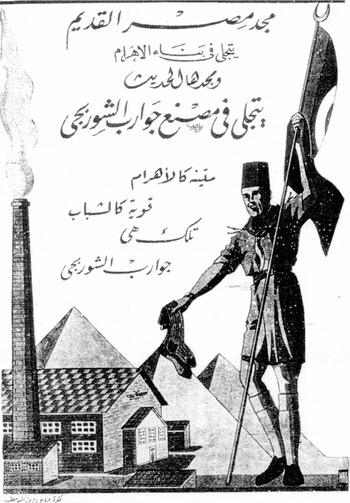
Another solution to the dilemma of how to market the rather coarse locally produced textiles made of long-staple Egyptian cotton was to transform the cotton's reputation for fineness and silkiness into a discourse about durability. Talʿat Harb positioned Egyptian cotton textiles as “authentic” and “pure,” unlike cheaply made imported textiles that used finishing processes, such as adding cornstarch or glue, to achieve a temporary silky or smooth look to their products. He repeatedly stressed that one Egyptian garment was equal to three or four cloths of foreign manufacture because the former lasted longer.Footnote 66 The promotion of Egyptian cotton as more durable and “authentic” than imported yarns and fabrics carried over into the use of Pharaonic imagery in textile trademarks.Footnote 67 Narratives about Pharaonicism and durability coincided with a masculinist nationalist rhetoric associated with “strength” that became increasingly popular in the 1930s. A 1934 advertisement, for example, features a drawing of the Shurbaji cotton hosiery factory in front of the Giza pyramids, flanked by a young man in a scouting uniform and a tarbush, holding an Egyptian flag in one hand and a pair of socks in the other (see Figure 1). The 1930s Shurbaji Pharaonic logo (a falcon with outstretched wings, the Pharaonic symbol of royal protection) is prominently displayed over the factory door. The text declares: “Egypt's ancient glory is expressed in building the pyramids. Her modern glory is expressed in al-Shurbaji's hosiery factory. Durable like the pyramids; strong like boys [al-shabāb]—Shurbaji's socks.”
“Glory of Egypt,” advertisement for Shurbaji socks. Ruz al-Yusuf, no. 349, 29 October 1934 (special issue), 27.

Linking cotton textiles, especially hosiery, to the durability and duration of the Egyptian national community was part of an explicit effort to create and expand markets for local goods. Socks and stockings were not widely consumed in 19th-century Egypt, as they were expensive and not necessary in the mild climate or under the long, modest clothing worn by both men and women.Footnote 68 Hosiery became increasingly prevalent with new styles of footwear and fashion emerging especially in Egypt's cities in the first decades of the 20th century.Footnote 69 As opposed to older baladī styles of dress, such as the long galabiya or slip-on leather shoes like the markūb or bulgha, ifrangī dress styles, such as trousers, suits, or laced-up shoes, required socks as an accessory to finish the look of elegance and ease they were meant to convey. Offering both men's socks and women's stockings in silk, lace, and silk blends, Holeproof Hosiery, for example, was promoted in the mid-1920s as “incomparably” “sturdy,” “elegant,” and “economical.” Imported from Great Britain, its products were handled in Egypt by an Alexandrian agent, Baruda Brothers, and retailed at “all department stores.”Footnote 70 Ads for Holeproof men's socks were varied, often depicting a sock-clad foot next to an elegant shoe or a man in a dressing gown pointing out the reinforced toe and heel of his sockFootnote 71; at other times ads featured the enormous Holeproof factory in England.Footnote 72
Responding to the growing local market in imported socks and increasing support for new factories, the local hosiery sector exploded in the 1930s and 1940s. The Department of Commerce and Industry established a training school for knitting hosiery, underwear, and dress fabrics in 1935.Footnote 73 Bank Misr specifically promoted small-scale development of this niche (hosiery, underwear, upholstery) in the textile industry to compete against foreign merchandise, in part by urging the immigration of several Muslim families to Egypt from Syria in the late 1920s and the 1930s.Footnote 74 By 1943, a local textile expert estimated that “the bonneterie industry has attained sufficient development to satisfy and at times surpass the needs of local consumption.”Footnote 75 Much of this growth came from the establishment of small local hosiery factories, most of which employed hand knitting, although several large mechanized factories were also founded. Among the most important was the Egyptian Hosiery Company/La Bonneterie, which was established in 1924 and registered as a joint-stock company in 1935. Half-owned by the Filature Nationale, by 1937 it had an “up-to-date factory” in Alexandria with 560 workers operating 420 machines to make underwear and another 80 knitting machines to manufacture socks and stockings. These machines worked “coarse cotton yarn” from the local spinning mills, “fine cotton yarn (spun from Egyptian cotton),” wool yarn imported from the United Kingdom, and rayon yarn procured from the United Kingdom and Germany. Annual output was estimated to be 96,000 dozen pairs of socks and stockings and 72,000 sets of underclothes.Footnote 76 Although few hosiery companies consistently showed a profit,Footnote 77 the sock market continued to grow faster than the output of local industries. A Ministry of Commerce and Industry report in 1948 “estimated that tricotage factories and workshops employed 6,000 workmen and produced 70 percent of local consumption.”Footnote 78 In 1954, local production was estimated at 600,000 dozen socks per year, although strong imports continued at least through the 1940s, reaching almost 458,000 dozen socks in 1950.Footnote 79
Among the numerous hosiery enterprises founded in this period, the Shurbaji Hosiery Factory was perhaps the most aggressively marketed as being essentially “Egyptian,” probably because of the company's ties to Bank Misr and the fact that the Shurbajis were Muslim, though the family had emigrated from Syria only in 1932. Muhammad Shurbaji owned one of the largest weaving factories in Damascus, manufacturing natural and artificial silk textiles, which were exported to Iraq, Anatolia, the Balkans, and Egypt. The family expanded into a variety of industrial concerns throughout the Middle East in the 1920s and 1930s. In Egypt, the Shurbajis founded a number of textile factories: a knitting factory for hosiery in Cairo in 1932; a silk weaving and upholstery factory in Cairo in 1937; and two spinning and weaving factories in 1940 (one in Alexandria and another in Cairo).Footnote 80 The company was privately owned until it was registered as an Egyptian joint-stock company in April 1947, capitalized at LE 50,000.Footnote 81 Although the family retained significant commercial interests in Syria through at least the 1940s, they were always referred to in the local press as “Egyptians.”Footnote 82
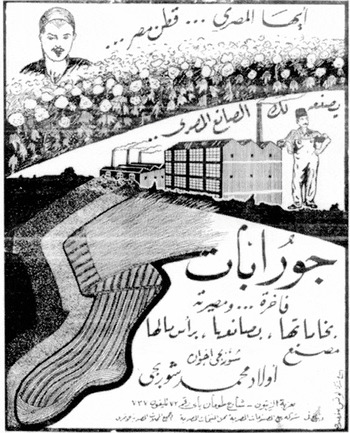
Reflecting the new marketing discourse of local textiles, promotional material in the early 1930s from the Shurbaji Brothers Company heralded its new cotton socks for men and boys for their “durability and tasteful colors” and their superiority to foreign imports.Footnote 83 Moreover, the manufacture of cotton hosiery was presented as knitting together various social groups into a national community. In January 1933, for example, a Ruz al-Yusuf advertisement connected three social groups (see Figure 2). A peasant man on top of the frame looks out over a field of cotton, below him a worker leans against a miniaturized factory, and spreading out from the factory are cotton threads that metamorphose into socks—a commodity awaiting a consumer. “Oh, Egyptian!” the text exhorts. “The cotton of Egypt. From it, the Egyptian worker manufactures fine socks for you—socks that are Egyptian by their raw materials, manufacture, and capital.” Other Shurbaji advertisements in the early 1930s focused on knitting together diverse groups of male Egyptians via expanding consumption. A 1934 advertisement, for example, portrayed different generations of customers—a middle-aged effendi, a young upper-class man, and a boy—all dressed elegantly in ifrangī clothes and clustered around a pair of al-Shurbaji socks, which “the old and the young prefer.”Footnote 84 Al-Shurbaji marketed different types of socks for “people of various classes.”Footnote 85 In 1935, the company planned to launch several “durable, good-quality, and cheaply priced” lines for the general middle-class public—“student socks [jawārib tilmīdh]” and “government-employee socks [jawārib muwaẓẓaf]”—as well as a more expensive, deluxe (fākhir) model for the “special class of people [ṭabaqa khāṣṣa min al-shaʿb]” who prefer and can afford a more sumptuous model.Footnote 86
Advertisement for Shurbaji hosiery, showing peasant, factory worker, and socks. Ruz al-Yusuf, no. 258, 23 January 1933, 37.

Although differentiated, these male identities were linked through a universal consumption: socks were positioned, like the tarbush, as part of a “modern” national dress required of men from all groups and classes of Egyptians. One promotional article asserts that “socks are almost the only type of clothing that all people share in wearing—from a suckling infant to an old adult, from a worker to a government minister.”Footnote 87 Another asks, “How many Egyptians, in their differences of class and contrasts of income, finances, and creed, don't plunge their feet and legs into socks?”Footnote 88 Such publicity generally depicted men's whole bodies or faces rather than just their sock-clad legs and feet. Advertisements and promotional materials for Shurbaji in the 1930s, then, pitched their goods to a wide audience of Egyptians, linking together different male identities—based on class and occupation (peasants, workers, government employees, students), consumption culture (elite, practical, elegant), and age—into a single, stratified but conflict-free national community, thereby equating the purchase of men's cotton socks with participation in the polity.
Shurbaji's sock campaign of 1933 to 1935 made the most deliberate use of the imagery of interlinked male identities, although several other firms promoted men's socks in similar ways during this time. The Ahmad Halawa Stores advertised the “largest storehouse of hosiery” for men, women, and boys, depicting elegantly dressed upper-class adults and a young schoolboy.Footnote 89 Bata also marketed a line of variously priced imported men's socks, including more luxurious models from silk and “refined cotton” and less expensive ones such as the “cotton screen” and the “practical.”Footnote 90 Nunu Brothers, another Cairo knitting and weaving factory that manufactured men's and children's socks in the late 1940s, used national symbols such as flags and scouting images, as well as tropes of modern retail, such as elegant packaging and dapper salesmen, to market their “scientific socks” for men.Footnote 91 New nationalist hosiery advertising campaigns stood out in the local press, since prior advertising for imported men's socks merely listed hosiery among other goods for sale and promoted them by price.Footnote 92
Evidence suggests that consumers did not always respond to the sober messages of fabric durability or the visions of a neatly ordered class-stratified nation that were promoted in the 1930s. Rather, they demanded cheaper fabrics, more frequent purchases, and the blurring of social classification that mass consumption could offer—the possibility of upward mobility. Short-staple cotton textiles, many of which were imported from Japan, Italy, or even England and found markets despite the continually rising tariff barriers, offered other rubrics that competed with silkiness or “durability” in conveying status to consumers. Inferior grades of cotton, with shorter staple lengths, could produce, for example, a fabric with a “thicker feel” than those made with longer, silky fibers.Footnote 93 The longevity of fabrics was not a meaningful attribute to consumers who wanted multiple outfits or frequent changes of style. Cheaper fabric allowed for more variety in wearing apparel, a factor some local textile experts considered of primary importance to the textile market. To explain a general lack of domestic interest in textiles woven with long-staple cottons, Eman noted during World War II that although “Egyptian cotton produced more durable and resistant fabrics. . . . This advantage . . . is not even appreciated by the consumer who always prefers to buy two outfits instead of one and thereby follow the progress of fashion.”Footnote 94 Cheaper fabrics thus appealed for different reasons to both the very poor and those slightly better off who wanted more variety in their clothing fashions.
THE ADVENT OF ARTIFICIAL SILKS
Despite improvements in local textile technologies in the 1940s, manufacturers like the Shurbaji brothers began to protest that yarns made from Egyptian cotton were too expensive and often too physically defective for the production of hosiery for the rapidly expanding middle-class and lower-class markets.Footnote 95 By the end of the 1940s, therefore, Shurbaji had turned to producing nylon hosiery; in fact, it claimed to be the first local factory to knit nylon hosiery in Egypt, a production previously “monopolized” by the United States.Footnote 96 By 1950, the Shurbaji hosiery factory in Imbaba alone produced nearly 800 pairs of nylon hosiery (jawārib) per day.Footnote 97 By 1954, the French commercial counselor in Egypt noted that “[i]t appears that in the hosiery industry, nylon has practically replaced all other fibers.”Footnote 98
Egyptians had already begun to consume substantial amounts of other artificial silk fabrics, such as rayon, in the early 1930s.Footnote 99 British trade officials noted in 1931 that “[f]ine white shirtings are being to some extent replaced by new articles altogether, such as . . . artificial silks.”Footnote 100 Local plants began weaving rayon textiles from imported thread in the mid-1930s, and by 1937 approximately 2,000 looms were in operation.Footnote 101 Bank Misr enterprises capitalized on this new consumer interest. By 1936, the Misr Silk Weaving Company was weaving several fabrics of imported threads of artificial silk, especially rayon, and the cloths were sold at Bank Misr's Egyptian Products Sales Company as well as through local textile chains such as `Adès.Footnote 102 An Egyptian consumer, in an interview with Harb, praised the high quality of the fabric's weaving, dyeing, and strength, despite its plain appearance.Footnote 103 In 1946, Bank Misr founded a rayon plant at Kafr al-Dawwar near its Fine Cotton Weaving and Spinning Company, and it became the third most capitalized textile firm within a decade.Footnote 104 Production at the plant began in 1948, and the “company made rapid progress thereafter, manufacturing rayon and nylon filaments, viscose staple fiber, nylon staple fiber, and transparent fiber.”Footnote 105 In 1954, the company branded its artificial silk thread “Misrilon,”Footnote 106 suggesting its hope to capitalize on the nationalist markets built up around “Egyptian cotton” in the preceding two decades—or at least pointing to its fear about losing control of them.
Artificial silk possessed many of the qualities of long-staple cotton fibers that local elites had been promoting in Egypt during the 1930s and 1940s. Artificial fibers could be used to create silky, relatively durable fabrics, and thus a direct competition gradually emerged between artificial silks and some cloth woven from long-staple cotton.Footnote 107 A special 1950 issue of the local newspaper al-Misri devoted to cotton included a long article detailing the specific technologies used in manufacturing artificial silk. The article explicitly compared artificial silk fibers to the properties of Egyptian long-staple cotton and reported the permanent conversion of many Lancashire factories from weaving only long-staple Egyptian cotton to using artificial silk.Footnote 108 In such ways, artificial silk threads emerged as a threat to Egyptian cotton growers by the late 1940s and early 1950s.
SELLING STOCKINGS, SATIRIZING NYLON
As local production of nylon threads and textiles increased, so did their distribution. The postwar mass marketing of women's nylon hosiery differed, however, in significant ways from the promotion of men's socks in the 1930s. In part, the sheer nylon hosiery market of the late 1940s was molded by tensions in selling women's natural-fiber hosiery in the preceding decades. Women's sheer hosiery had remained an expensive luxury through World War II because it was primarily produced with natural silk.Footnote 109 (Although nylon stockings were first sold in the United States in 1940, wartime constraints held up distribution until 1946.)Footnote 110 In mid-1920s Egypt, silk stockings cost from three to eight times the price of cotton stockings, twice as much as wool, and much more than men's socks. The demand in women's fashion for sheer stockings escalated with the popularization of shorter dress cuts in the interwar years.Footnote 111 Using the language of light and reflection, al-Musawwar advertised imported Kayser stockings for their beauty under short hemlines: “Cover your legs with Kayser Miroclear stockings so that the world's spotlight will shine on them, especially under the short dress styles in fashion this year.”Footnote 112 The sheerness of these stockings implied a new mobility and visibility of women's bodies in society (shorter, leg-revealing skirts) and a new adornment of such bodies to express “luxury” as a reflection of class aspirations. Such fashions represented a substantial change from older status markers in women's public sumptuary practices, which tended to link covering, rather than revealing, with upper-class status. Advertisements for women's silk stockings through the 1930s played on similar associations of luxury, rarely mentioning prices but rather emphasizing the fine quality and elegance of the products and the potential for these attributes to pass on to consumers.Footnote 113 Popular stories in the press parodied the upward mobility women believed silk stockings could confer. One such story in 1942 depicted the social snubbing of a lawyer's wife for bragging about the cheaply priced (and as it turned out, cheaply made) silk stockings she found in a local department store.Footnote 114
After the late 1940s, the advent and dominance of nylon radically altered the women's hosiery market and the communities of consumers associated with it. Priced about 50 percent lower than pure natural silk hosiery, artificial silk hosiery was more affordable to a larger market of Egyptian women, and production and consumption accordingly expanded.Footnote 115 In 1952, imports of stockings made from pure artificial silk and artificial silk blends reached 144,560 dozen pairs. Large quantities were also produced by the domestic industry.Footnote 116 Because of a lack of market surveys and the general grouping of nylon hosiery with other artificial silk fabrics in statistical reports, it is difficult to give absolute numbers as to the size of the market expansion. It is likely that nylon stockings came within reach of the budgets of lower-middle-class and middle-class women and that they were worn to work and social events more often than their silk counterparts, even if they were still not casually purchased. The vast majority of rural women were not consumers of nylon stockings.Footnote 117
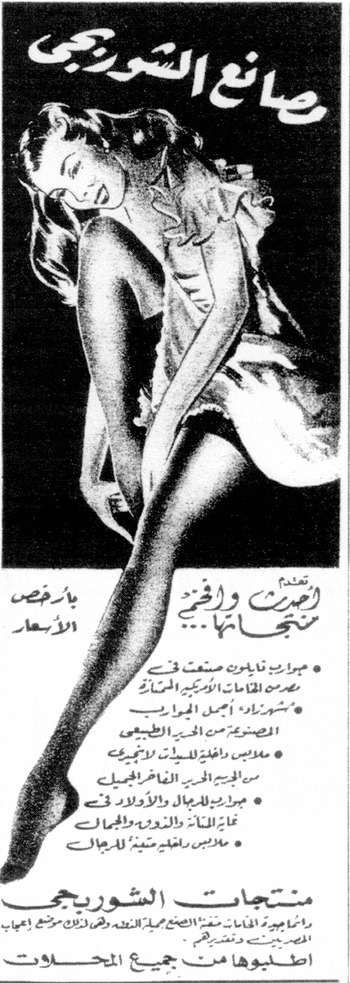
Despite the profusion of stockings in the market and the proliferation of the kinds of consumers able to afford them, women's nylon stockings in the 1940s and 1950s were often advertised through unitary, sexualized images of women. When Chemla and other local department stores listed the variety of brands of nylon stockings available and their prices, the different stockings were not illustrated in the ad copy nor linked to particular groups of consumers.Footnote 118 Shurbaji's marketing of its luxurious “Shehrezade” stockings to women in the 1940s and 1950s focused primarily on women's legs (see Figure 3). Graphically, these advertisements often represent a single woman, adorned in a very short or raised skirt, seated with pointed toes or reclining, or they show disembodied legs in much the same pose.Footnote 119 Other manufacturers promoted their stockings in similar ways. The ʿId company advertised its selection of nylon stockings (“the strongest in our market”) with a photograph of two sets of women's legs, positioned next to each other and nearly identically attired in short skirts, stockings, and high-heeled pumps; the picture was cropped from the women's skirt hems (at the knee) to their shoes.Footnote 120 In 1956, Shurbaji even presented a float in the parade celebrating the final evacuation of British troops that featured an enormous model of a female leg, cut from the thigh down, toes pointed, and adorned in a nylon stocking.Footnote 121
Shurbaji advertisement for women's nylon stockings. Al-Musawwar, no. 1260, 3 December 1948, 39.

Paralleling and reinforcing this objectification of women in advertising was a discourse of sexual pleasure associated with nylon stockings. At the opening of the Shurbaji store in Zamalek in 1958, one woman reportedly was “unable to control her emotions due to her excessive pleasure” and let out a trill of approval.Footnote 122 The feminist writer Amina al-Saʿid proclaimed her “delight” at “the women's stockings in terms of taste and durability. . . . ‘Allow me,’ she told the Shurbajis, ‘to become a customer [tonight] rather than a journalist. What I see is clear proof of the range of progress in our national production—a noble progress.’” Even the governor of Giza, General ʿUthman Khalil, was photographed intently running his hands over women's nylon stockings on a store mannequin at the opening.Footnote 123 Such publicity emphasized femininity and sexual attractiveness over women's different occupational, generational, or reproductive identities. It also contrasted sharply with the plurality of men's identities (and the graphic focus on their faces and personalities) marshaled in new nationalist sock advertisements targeted to men a decade earlier. The sale of nylon stockings coincided with a global postwar climate of the 1950s that emphasized a “new look” and a new “femininity” for women. Marketing of nylon in Western Europe and North America in this period also tended to objectify women and represent them in this singular mode.Footnote 124 What made the case of Egypt different from other nylon markets was the congruence of the cotton and artificial silk markets—their direct competition for the same market niche for silky fabrics, which charged this representation with powerful social conflict.
Silkiness and durability, the two hallmarks of Egyptian textile marketing, thus reappeared as essential traits in the selling of nylon. The threat of new fabrics to the established base of the Egyptian old-regime cotton economy, however, was reflected in a discourse of sexual danger and threat in nylon marketing. Popular political commentary and social satire inflected nylon silkiness with an overt sexuality capable of sapping the nation's energy. Inverting the linkage in early 1930s nationalist sock advertising between cotton fabric and national cohesion, nylon came to symbolize the fracturing and declension of the nation's unity by the late 1940s.Footnote 125 In his 1948 short story “The Nylon Woman,” ʿAshur ʿUlaysh decries the inequalities of postwar Egyptian society through a contest over an objectified woman. He describes the plight of a young lawyer, Ahmad, unemployed because he lacks the social contacts and registration fees needed to apprentice and advance in the profession.Footnote 126 Lamenting that his hard-won education has resulted only in “hunger, vagrancy, and privation,” Ahmad watches a chic, beautiful woman say goodbye to her lover departing on the night train. She gazes at herself in a mirror on the wall, “looking attentively at herself in infatuation . . . She expends every effort to display her beauty.” “Like a dog appearing for a bit of meat,” he follows her to her sleek car, “regarding her closely, precisely examining her features, almost devouring her [yalatihamuhā]. . . . She began to adjust her dress part by part from top to bottom . . . She wore thin, transparent clothes [thiyāb hafāfa shafāfa] that revealed her charms and beauty like a full moon.” Ahmad suddenly “began to boil like a cauldron,” as he realizes: “‘She wasn't for us . . . She's for him who can pay the price! Everything for him who owns everything and nothing for him who owns nothing. She was ‘nylon,’ she herself.’”Footnote 127 The story's illustration depicts Ahmad in a poorly fitting overcoat and trousers and the “nylon woman” in a short, tight skirt with sheer stockings and very high heels. Mistress of the corrupted upper classes who dominated society, politics, and the economy in this period, the nylon woman signals the wide, corrosive effects of current social inequalities. The images of reflection (mirror, moon, shiny car, transparent clothing) linking the woman-mistress to nylon underline the way nylon refracted broader social and political struggles.
Another 1948 cartoon, in Akhir Saʿa magazine, depicts a baladī woman named Zulaykha asking for nylon flip-flops at an elegant urban shoe store.Footnote 128 An important character from Qurʾanic sacred history (Joseph's mistress and the wife of his Egyptian master), Zulaykha usually symbolizes female desire and upper-class decadence. By the 1940s, Barbara Stowasser asserts, exegeses of “Joseph and the women” began to cast the story as
a parable with communal rather than just gender-related meaning. For Qutb, the main theme of the story is the struggle between religious righteousness and a corrupt society. . . . [whose] representatives were the highborn, spoiled and headstrong Aziz's wife [Zulaykha] and . . . society's aristocracy who spent their days in idleness and materialistic pleasures.Footnote 129
This Zulaykha, like the “Nylon Woman,” captured a wider condemnation of monarchical society. Coded by the language of textiles, the sociopolitical critique reflected a new moment in Egypt's political economy and nationalist imaginary.
A NEW REGIME?
In the popular unrest of 1951 and 1952, “luxury” and “silks” circulated as symbols of the political and social decadence of the state and sociopolitical elites. Cotton prices jumped dramatically in 1950 and 1951 due to international shortages caused by the Korean War, and the entire Egyptian cotton crop was sold at high prices. The resulting profits and foreign currency financed record imports, especially of “luxury items,” into the Egyptian economy, leading to a massive trade deficit in 1951.Footnote 130 In June 1951, Ahmad Husayn (founder of the opposition party Young Egypt, later charged with instigating the Cairo fire of January 1952) denounced Wafdist leader Fuʾad Sirag al-Din—and the “pasha class” he represented—as “immersed in silk.”Footnote 131 The king's excessive consumption and gambling, including his lavish wedding in May 1951 to Queen Nariman, whom he had met in a gold store,Footnote 132 incensed a broad front of opposition groups as well. This protest culminated in the burning of the central Cairo commercial district on 26 January 1952. Most downtown streets were impassable for days because of the acrid-smelling piles of burned rubbish, including “carcasses of automobiles still smoking” and “cardboard boxes from which were sticking out a pair of socks, a necktie or a scarf, [and] half-burned shirts.”Footnote 133 The local correspondent for the London Times reported that “luxury shops were favourite targets. . . . Goods were removed and in some cases used as fuel for bonfires in the streets.”Footnote 134
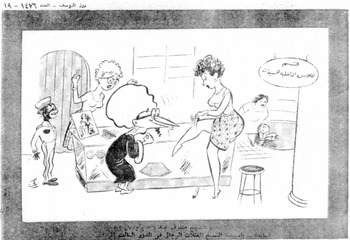
Artificial silks and “nylon women” also furnished the metaphorical punch for political critiques under the new regime of the Free Officers, which took power in 1952. In many ways, the new regime marked a significant change in Egyptian society, politics, and economy. Over the 1950s, Gamal Abdel Nasser would gradually place large sectors of the economy under government control, including many of the textile factories and large stores, as part of a new “socialist” vision of national self-sufficiency. In the period from 1952 to 1956, however, the new regime struggled to reform Egyptian politics, gradually concentrating policymaking into its own hands and neutralizing other centers of power. Another cartoon on nylon hosiery appeared in Ruz al-Yusuf in September 1956. Set in the women's lingerie department at the local department store Cicurel, it depicts an ifrangī woman customer, scantily dressed in a short skirt, high heels, and a low-cut, sleeveless shirt, trying on a pair of sheer stockings (see Figure 4). In front of the counter stands a turbaned shaykh literally drooling over the customer's legs. The caption reads: “Shaykh Matluf at Cicurel. The saleswoman [says]: ‘Sir [ya sayyidnā al-shaykh], the men's underwear department is on the third floor!’”Footnote 135
Shaykh Matluf at Cicurel. Ruz al-Yusuf, no. 1476, 24 September 1956, 19.

The cartoon is a dense cultural text that can be read on many different levels, especially given the support of the magazine's editor, Ihsan ʿAbd al-Quddus, for the regime by this time.Footnote 136 At the center of the conflict is the shaykh's lascivious behavior. Based on Molière's character Tartuff, Shaykh Matluf was a popular caricature of the provincial religious cleric. Corrupt, hypocritical, and lewd, with a beaklike nose and enormous turban, he was a lustful, sexual predator hiding behind his religious garb.Footnote 137 The ʿulamaʾ were a constituency whose autonomy was under attack by the state in this period. Having successfully crushed the more radical Muslim Brothers over the past several years, Nasser moved to neutralize the mainstream ʿulamaʾ after 1955, when he abolished the shariʿa courts and began the reorganization of al-Azhar. Depicting religious leaders, physically burdened by the garb of tradition, as insincere or predatory—and specifically intoxicated by silk—would help the state relegate them to the forces of “reaction.” The state-sponsored press's appropriation of the Islamic discourse on degeneracy caused by silky fabrics and the nylon women who consumed them is striking in this cartoon.
Such critiques made sense in the broader context of linking the consumption of hosiery and other textiles to the unification of a larger body politic. Unlike the way cotton was positioned to unite Egyptian men in the 1930s, however, nylon reduced women to a singular identity and cast them as reflective mirrors for the collective or communal tribulations of postwar Egypt. Nylon—its transparency, shine, and “artificiality”—came to symbolize behaviors and consumption practices thought to cause moral decay or intensify differences within the national community itself. Although artificial fibers lowered the cost of hosiery and other goods considerably, thereby expanding consumption, the use of synthetics like nylon rather than cotton subverted the model of national economic unity between agriculture and industry.
The specific ways that cloth—“foreign silks,” “durable Egyptian cottons,” and “artificial silks”—emerged as a potent and visible symbol through which to contest the relations of colonialism and establish national community in Egypt varied, then, with the changing realities of Egypt's political economy. The country's early importation of textiles despite its cultivation of raw cotton, the growth of its state-protected local mechanized industry working long-staple cotton for a largely lower-class market, and that industry's diversification into artificial silk technologies all helped to structure a shift from “foreign silks” to “the nylon woman” as tropes in popular and political discourse defining the limits of the national community and the behaviors suitable for it. Ultimately, the postcolonial Egyptian state would appropriate the condemnation of silkiness to legitimate its own assumption of power. Teasing out the subtleties and dynamics of old-regime textile marketing illuminates how postwar references to “luxury” helped to establish the authority of the regime that emerged after 1952. As radical as were many of the changes wrought by Nasser in the 1950s, they were also facilitated by a persistent ambivalence toward silkiness that challenged old-regime efforts to fabricate a seamless national community.