Introduction
Smoking is an important factor in the development of coronary artery disease (CAD). The prevalence of deaths related to smoking in patients with CAD is around 30% (Ockene et al., Reference Ockene1992). Smoking cessation is one of the main interventions in the treatment of CAD. Cessation alone results in a reduction of approximately 36% of relative risk of death and 32% of non-fatal myocardial infarction (Critchley & Capewell, Reference Critchley and Capewell2003). However, the rates of successful quitting are around 10 to 25%, which show the challenges involved to manage smoking cessation in clinical practice (Barth, Critchley & Bengel, Reference Barth, Critchley and Bengel2006).
In patients who undergo Coronary Artery Bypass Grafting (CABG), smoking cessation is an independent predictor of reduction in mortality and requirement of new revascularization (van Domburg et al., Reference van Domburg, Meeter, van Berkel, Veldkamp, van Herwerden and Bogers2000). Continuing smoking in this setting is associated with an impaired long-term prognosis even in patients who undergo Percutaneous Coronary Interventions (PCI; Cohen et al., Reference Cohen, Doucet, Cutlip, Ho, Popma and Kuntz2001).
Interestingly, almost all cardiac patients abstain from smoking for at least the first few days after a cardiac event, or after bypass surgery, and this may provide a unique opportunity for an intervention aimed at preventing a return to smoking after discharge (Hajek, Taylor & Mills, Reference Hajek, Taylor and Mills2002; Munafo, Rigotti, Lancaster, Stead & Murphy, Reference Munafo, Rigotti, Lancaster, Stead and Murphy2001; Simon, Solkowitz, Carmody & Browner, Reference Simon, Solkowitz, Carmody and Browner1997). However, the comparison of long-term smoking cessation after revascularization procedures is unknown. Therefore, extrapolation from previous studies is increasingly uncertain, and direct measurement of the contemporary hazards of smoking in this setting is needed.
We aimed to evaluate the rate of smoking cessation in patients who underwent revascularization procedures immediately and after 12 months of follow-up. Moreover, we aimed to assess the preventive factors in smoking cessation as a secondary end point.
Methods
We examined consecutive smoking patients from the database of the “Dante Pazzanese” Heart Institute located in São Paulo, Brazil, between January 2010 and December 2011. These patients, according to the revascularization procedure performed, were allocated to two groups: CABG and PCI. During hospitalisation, no standard approach, such as formal brief advice, existed. Data related to quitting or maintenance of smoking were obtained at subsequent clinical appointments or from telephone calls. Patients who underwent urgent procedures were excluded so that we avoided the interference of the acute disease factor. In addition, patients who underwent combined revascularization procedures were also excluded because it would not be possible to determine which of the procedures were associated with smoking cessation.
The primary endpoint was the absence of smoking for 12 months or more after the revascularization procedures. The secondary endpoints were the rate of smoking cessation, in the first week after hospital discharge, the average time of return to smoking, and the correlation of the return to smoking with sex, the degree of smoking, smoking cessation orientation, and the time to hospital discharge.
Parametric distributed data are reported as mean values with standard deviation. The Student's t-test was used to compare mean values for the continuous variables. The chi-squared or Fisher's exact test was used to find significant associations between categorical variables. All tests were two-tailed, and p < 0.05 was considered statistically significant. The Ethics Committee in Research of Dante Pazzanese Institute of Cardiology approved the study.
Results
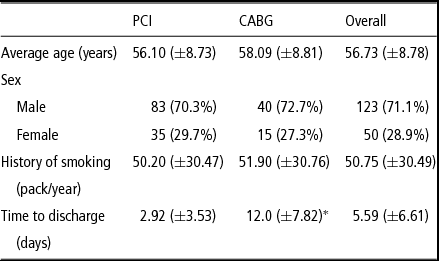
Among 173 patients selected, 118 (68.2%) underwent PCI and 55 (31.8%) underwent CABG, the average age was 56.7 years (±8.78), and 71.1% were males. The baseline characteristics are presented in Table 1.
Baseline characteristics

*p < 0.001.
There was no difference in the baseline characteristics of age, sex, and history of smoking between the two groups. The time of discharge was significantly higher in the CABG group.
After revascularization procedures, the total rate of smoking cessation was 79.3%. Furthermore, there was no significant difference between the two groups (83.6% – CI 95%: 71.2–92.2% for CABG, and 79.3% – CI 95%: 70.8–86.3% for PCI).
The rate of patients who returned to smoking after quitting was 40%, without a significant difference between the two groups (41.3% for CABG and 39.4% for PCI). Conversely, the maintenance of smoking cessation after one year was 53.2%, which was also similar between the two groups (52.7% for CABG and 53.4% for PCI). Nevertheless, the average time of absence of smoking was significantly higher in the CABG group (6.9 months versus 4.5 months for PCI).
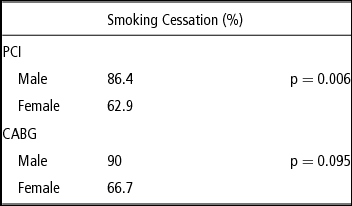
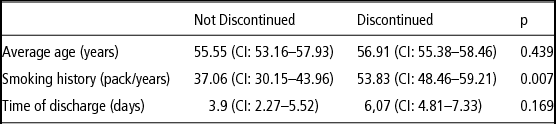
For the secondary endpoints, male patients reached higher rates of smoking cessation in the PCI group (Table 2). In addition, the average smoking history was significantly higher in the patients who quitted smoking. The average age and time to discharge were statistically similar between the groups (Table 3).
Correlation performed according to sex and smoking cessation immediately after the procedure

Mean values of age, smoking history, and length of time of hospitalisation in patients who discontinued or did not smoke after the procedure

CI: 95% Confidence Interval.
Discussion
The main hypothesis of this trial was to determine whether myocardial revascularization procedures would affect the rate of smoking cessation. In our study, the majority of the participants quit after the interventions immediately after hospital discharge. Pietrobon and Barbisan (Reference Pietrobon and Barbisan2010) found similar high rates of smoking cessation after CABG (93.15% after 60 days and 93.84% after 90 days).
Furthermore, the proportion of patients who maintained smoking cessation after 12 months was 53.4% for PCI and 52.7% for CABG. Hajek et al. (Reference Hajek, Taylor and Mills2002) reported an abstinence rate of around 40% 12 months after myocardial infarction and elective CABG. In another study, Zhang et al. (Reference Zhang2011) evaluated smoking patients who underwent PCI, and the rate of abstinence after 12 months was 55.4%. Although the literature reports different dropout rates after surgical and percutaneous procedures, studies were conducted in populations with different cultural and social characteristics.
We examined several variables that could confound or mediate the effect of smoking cessation. Data from previous literature showed conflicting results regarding smoking history and smoking cessation after revascularization procedures. Rigotti, McKool and Shiffman (Reference Rigotti, McKool and Shiffman1994) did not identify smoking history as a predictor of smoking cessation. On the other hand, Hasdai et al. (Reference Hasdai1998) identified that in patients undergoing PCI, smoking history was a predictor of habit maintenance. Interestingly, our study showed a higher smoking history among participants who quit smoking. Abdullah et al. (Reference Abdullah, Ho, Kwan, Cheung, McGhee and Chan2006) also found that the higher number of cigarettes per day was a predictor of smoking interruption in elderly patients.
Moreover, gender was an independent predictor of smoking cessation. We found that females had lower rates of success in quitting smoking than males, which was already documented in previous trials (Bohadana, Nilsson, Rasmussen & Martinet, Reference Bohadana, Nilsson, Rasmussen and Martinet2003). Existing evidence evaluating possible gender differences related to physiological and behavioral factors include differential sensitivity and tolerance to nicotine, greater withdrawal symptoms, and the importance of timing of cessation attempts in relation to menstrual cycle.
Behavioural and psychological factors include the following: fear of weight gain, need for social support, depression and negative affect of smoking, self-efficacy (confidence in ability to quit), and stage of change (readiness to quit smoking) (Gritz, Nielsen & Brooks, Reference Gritz, Nielsen and Brooks1996).
The minimal smoking-cessation intervention characterised as a brief explanation of smoking risks and the existing ways to achieve smoking cessation was not standardised in our study. But patients undergoing both interventions (CABG and PCI) received an orientation done by physicians and nurses during the hospitalisation period. In a study performed by Smith and Burgess (Reference Smith and Burgess2009), participants received an intensive or minimal smoking-cessation intervention. The 12-month self-reported rate of abstinence was 62% among patients in the intensive group and 46% among those in the minimal group (odds ratio [OR] 2.0, 95% Confidence Interval [CI] 1.2–3.1). Conversely, a recent systematic review done by Rigotti, Clair, Munafo and Stead (Reference Rigotti, Clair, Munafo and Stead2012) showed that high-intensity behavioural interventions that begin during a hospital stay and include at least one month of supportive contact after discharge promote more effective smoking cessation among hospitalised patients, and there was no evidence of the effect of lower intensity or shorter duration interventions. These data suggest that CAD patients with major adverse cardiac events or revascularization procedures may benefit from approaches that include guidelines and more regular accompaniments to optimise success regarding abstinence rates. In spite of lack of this standard approach, we achieved a good percentage of smoking cessation rates at one week of discharge showing the importance of the window of opportunity.
We should also mention that the average length of abstinence was slightly higher in the CABG group (6.9 months) than in the PCI group (4.5 months). This fact could be explained by the higher psychological stress that the surgical patients experience compared with patients undergoing PCI.
The self-declaration to characterise smoking cessation utilised in our trial is less accurate than the gold-standard biochemical methods for absence of smoking, such as carbon monoxide monitoring or urinary cotinine. The evaluation by patient's self-declaration has been studied and has high sensitivity and specificity. However, there can be wide variations in these values in different countries and studies (Patrick et al., Reference Patrick, Cheadle, Thompson, Diehr, Koepsell and Kinne1994; Wong, Shields, Leatherdale, Malaison & Hammond, Reference Wong, Shields, Leatherdale, Malaison and Hammond2012). Moreover, it is not possible to determine the influence of previous nicotine dependence levels, as these data were not tested in our trial. Furthermore, the convenience sampling method promotes the potential bias of self-selection and reduction of external validity.
Conclusions
Our study is the first to compare smoking cessation rates after myocardial revascularization procedures performed at the same center. We noted that the interventions were of important value for smoking cessation, and the smoking absence rates are similarly independent of the procedure executed. Furthermore, the smoking interruption after 12 months was maintained in only 50% of patients. This fact exhibits and strengthens the lack of efficient strategies to address smoking addiction.
Financial Support
This research received no specific grant from any funding agency, commercial or not-for-profit sectors
Conflict of Interest
None
Ethical Standards
The authors assert that all procedures contributing to this work comply with the ethical standards of the relevant national and institutional committees on human experimentation and with the Helsinki Declaration of 1975, as revised in 2008. The Ethics Committee in Research of Dante Pazzanese Institute of Cardiology approved the study.