Introduction
Over the last 30 years a number of initiatives have developed to support family poultry production systems. This paper identifies the main groups involved and details their work. Questions have been raised about the future of these networks, in particular their focus and outputs and their sustainability in terms of funding. Many professionals involved felt the need to discuss these issues. Therefore, during the World Poultry Congress held in Brisbane 2008 a participatory workshop examined the future role of networks to support family poultry production. This paper provides a short report of this self-reflection process.
History of the existing networks
Pioneering work on Newcastle disease (ND) during the 1980s and 1990s was one of the starting points of much activity on family poultry systems (Copland, Reference COPLAND1987; Spradbrow, Reference SPRADBROW1992; Reference SPRADBROW1993; Alders, Reference ALDERS1996a; Reference ALDERS1996b; Alders and Spradbrow, Reference ALDERS and SPRADBROW2001). Another was the Africa Network for Rural Poultry Development (ANRPD), which was established in 1989 with members from 33 different African countries. Its main objective was for rural poultry development in Africa, publishing a twice-yearly newsletter, which contained information on recent meetings held by the network, research reports and research proposals (Rushton, Reference RUSHTON1993).
In 1995 an FAO consultancy on the use of ND-V4HR vaccine in backyard poultry systems reviewed the possibility of expanding the activities and role of the Africa Network for Poultry Research (Rushton, Reference RUSHTON1995). In 1997, the ANRPD evolved into the International Network for Family Poultry Development (INFPD). The INFPD is an independent voluntary association administered by a seven-member Executive Committee. It has received valuable support from the FAO and other international organizations such as the Technical Centre for Agricultural and Rural Co-operation, Wageningen, The Netherlands (CTA) and the International Development Research Centre, Ottawa, Canada (IDRC). Members include researchers, policy makers, educators, staff of development agencies (NGO's), aid donors and smallholder farmers. At the 11th European Poultry Conference held in Bremen in September 2002, the World's Poultry Science Association (WPSA) Executive Council approved the establishment of INFPD as a Working Group within WPSA.
WPSA has played an increasingly important role in the promotion and support for family poultry farming in the developing countries of the world. Through the organisation of workshops, symposia, regional conferences and World's Poultry Congresses, WPSA has facilitated information exchange in all aspects of poultry science, technology and production for many years, with an increasingly greater emphasis on family poultry development at these forums over the past 15 years. In 2002 a working group on Small-scale Family Poultry Farming (SSFPF) was established within the Asian Pacific Federation of WPSA. The working group organised a major international symposium on Avian Influenza and small-scale family poultry farming in Bangkok in March 2007 and the World's Poultry Congress in Brisbane in 2008 included a major 4-day stream on Poultry production in developing countries.
The International Rural Poultry Centre (IRPC) is a subsidiary entity within the KYEEMA Foundation and was established in 2003 to promote cost-efficient, sustainable improvements to village poultry production and to assist with the implementation of ND control projects in rural areas (Alders and Harun, Reference ALDERS and HARUN2004). The IRPC implements projects in collaboration with Ministries of Agriculture and local NGOs in Africa and Asia.
The Danish Network for Smallholder Poultry is supported by the Royal Veterinary and Agricultural University in Copenhagen. It works with partners in Africa, Asia and Latin America.
Recently the FAO has directed some of its highly pathogenic avian influenza control funds to examining how best to support smallholder poultry producers where this disease is present or in countries at risk. The Animal Health, Production and Livelihoods (AHBL) project was initiated 2006 with the support of the German Government.
After many years of investment in research and coordination made by the Australian Centre for International Agricultural Research (ACIAR), the Food and Agriculture Organization of the United Nations (FAO), the Danish International Development Agency (DANIDA) and others providing support for family poultry production in developing countries, there is a need to review and reflect on what has been achieved and identify the future role of the networks to achieve optimal impact on small-scale family poultry farming. This paper reports on a workshop held at the 23rd World's Poultry Congress in Brisbane in July 2008, organized with the express intent of facilitating coordination and collaboration between the networks and the agencies to achieve this aim.
WPC Workshop
Sixty-three Family Poultry practitioners and researchers from 24 countries met during the afternoon of 4 July 2008 in a workshop run concurrently with the XXIII World's Poultry Congress in Brisbane. Participants were an eclectic group of farmers, university lecturers, NGO workers, national government departments of agriculture and representatives of international organizations and donor agencies. The theme of the workshop was ‘Through cooperation and coordination between agencies supporting small-scale family poultry production in developing countries, to develop programs which have maximal impact on the rapidly developing world food crisis, or ‘Silent Tsunami’’.
The workshop was co-moderated by Dr Robyn Alders and Dr Jonathan Rushton. The workshop was opened by Dr Bob Pym on behalf of the WPSA, Professor Funso Sonaiya, the Coordinator of the International Network for Family Poultry Development and Dr Irene Hoffmann of the Food and Agriculture Organization of the United Nations. All speakers reaffirmed the important role of family poultry in livestock development and wider human development programs. Participants were divided into three working groups:
• The first subgroup worked on the socio-economic, technical and institutional issues that should be considered when developing a family poultry project;
• The second subgroup discussed who the clients of the family poultry network(s) are; and
• The third subgroup looked at potential donors to family poultry projects, general constraints encountered and how approaches to donors might be re-framed to encourage support.
Socio-economic, technical and institutional issues associated with family poultry projects
Working Group 1 discussed the priorities that need to be addressed in a small-scale poultry farming development project and who the main beneficiaries are. The sub-group was facilitated by Dr Fallou Gueye and Dr Emmanuelle Guerne Bleich, and the group identified and discussed four major constraints that small-scale poultry producers (as final beneficiaries supported in collaboration with institutional and private partners) are facing. These included:
1. Difficulties encountered by farmer organisations or associations in accessing services and other inputs;
2. Deficiencies in general poultry management related to good practices, skills and knowledge and a reluctance to opt for new initiatives and undertake new ventures involving risk;
3. Poor access to markets and to sustainable commercialisation mechanisms (e.g. issues of restriction to local village markets; remote locations; potential for greater profitability; and impact of intermediaries); and
4. Poor access to the different public and/or private sector services providers for animal production and health support.
The group concluded that any poultry development project should ensure that these constraints are properly addressed and that all of the key actors associated with small-scale poultry production need to be involved and, where appropriate, provided with assistance to facilitate better collaboration and networking. Such assistance would involve technical as well as socio-economic and institutional aspects. An interactive, NOT ‘top down’, approach should be selected to build a stronger trust from the small-scale producers.
Who are the clients of the family poultry networks?
Working Group 2 worked on defining the clients of the family poultry networks. There were 16 people in the working group from as many countries. Professor Sonaiya compiled the outcomes of the working group, which were as follows:
1. Definitions – The first business was to understand the word ‘client’. Two other words were thought to better define the objective of the group. These were ‘customers’ and ‘stakeholders;’
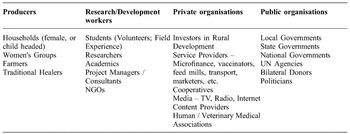
2. Clients / Customers / Stakeholders List – As a result of a brainstorming session, the following list was produced (a summary is found in Table 1); and
3. Categorisation – The working group was sure that this list should be categorised but did not have the time to do so. The authors have attempted a categorisation shown in Table 1.
Potential customers and stakeholders of a family poultry network.

Potential donors and supporters
Working group 3 tackled financial issues, looking at the different categories of donors, key messages that emphasise the importance of family poultry and general financial issues that surround implementation. The working group notes were prepared by Dr Rushton. The following areas were addressed:
• Identification, issues and constraints of existing and potential donors
– Inter development agency donors (e.g. World Bank, DFID, Bill and Melinda Gates Foundation)
– Livestock development initiatives (e.g. EU with ELIDEV)
– Regional networks (e.g. ALIVE for Africa)
– Regional focus (e.g. AusAID with Asia)
– Many bilateral donors are now working through other organisations (e.g. AusAID and CARE in Cambodia)
– Collaboration between agencies and donors (e.g. World Bank and DFID with global livestock fund)
• Potential input from private sector companies
– Six large global players and a number of large regional companies
– Traditionally a perceived requirement for a monetary return on investment
– Argument, however, for focusing on corporate responsibility with respect to the role of SSFPF in alleviating poverty in the present world food crisis
– In similar vein, the current HPAI crisis may help justify investments in research on family poultry production
• National funding issues
– Large poultry companies in a number of developing countries
– Importance of linking ongoing projects with national funding: A significant proportion of funding from donors is provided direct to government rather than through external projects.
– The importance of understanding how local public administration works and how national governments can contribute
• The importance of giving the right message to donors
– Current messaging to potential funders is for the most part unappealing
– Importance of focussing on people rather than poultry per se with two important messages: viz. poverty alleviation and emergency issues and health impacts
– The two most important and topical areas here are:
♦ HIV/AIDS and
♦ HPAI
– Public-private partnerships (an important potential area for funding to be further investigated)
• General problems and issues with present networks
– Core funding for network activities is difficult to obtain
– Need for a clearly defined role for the network
– Need to optimize efficiency and minimize cost of information sharing
– Need for an effective conduit for contact between people with proposals and ideas with potential funding agencies
– Need for scientists (young and established) to receive support for attending meetings, training and post-graduate courses (scholarships). In this vein it was recommended that support be sought from appropriate sources for funding the attendance of family poultry farming researchers at the 24th World's Poultry Congress in Brazil in 2012
– A need to link local projects that could be research, development and/or extension focused in order to rapidly disseminate information
– Project funding is still difficult but possible to obtain. However these projects suffer from the typical start and stop syndrome
• A lack of skills
– at international and particularly at developed country level in terms of experience in rural systems and more specifically in agriculture
– at the national level in having enough people and equipment to carry out certain tasks.
The need for and role of an overarching network in support globally of small-scale family poultry production
is a new network necessary?
Given the quantity of work currently being conducted on poultry development, Newcastle disease control and more recently highly pathogenic avian influenza control it may be questioned whether a new network is necessary. The answer was an unequivocal yes. An overarching network would provide a forum for scientist information exchange, development of standard protocols and subsequent comparison of results. It would also speed the dissemination of results and technologies identified to improve poultry production, which can then be passed to poultry keepers.
what focus should such a network have?
The network should not be solely poultry disease focused; it should cover rural poultry systems in general, including all aspects of poultry production as well as trade and development support processes.
what would be the network activities?
The network activities would include:
• production and updating of manuals on vaccine testing protocols, poultry production data collection and statistical analysis of results;
• development and maintenance of an Internet page to answer queries on research and trial design;
• co-ordination of biannual meetings for poultry scientists, farmers and commercial companies;
• provide back-up support for research projects;
• advise on availability of funds for research ideas.
which countries should be involved in the network?
Membership of the network should be open to all who are interested in family poultry production irrespective of where they are located. The keeping of backyard poultry is increasing again in a number of developed countries and so there is an opportunity to share experiences and information between family poultry producers worldwide.
what manpower and equipment would a network require?
The network would probably require a full time co-ordinator with constant access to computer terminal and good access to fax and telephone links. Any participating unit would also require access to the Internet or good fax links.
who should organise the network?
The proposal for an overarching network with the principal aim of coordinating and facilitating collaboration between the many organisations, agencies, governments and networks supporting small-scale family poultry production in developing countries, was mooted by Pym et al. (Reference PYM, EVANS, HUQUE and GIBBINS2005) in Tanzania. At that meeting ‘Poulet sans Frontieres’ was mooted as the title of the new network. It would thus seem appropriate that WPSA in concert with a number of the networks and agencies closely involved (INFPD, IRPC, DNSP and FAO), should take the lead on this and progress the development of protocols for the establishment of the network. It is envisaged that these proposals would be available for discussion by the SSFPF community by mid 2009.
Conclusions
Participants would have liked more time for their deliberations and the hope is that this report will contribute to ongoing discussions. There was general agreement that family poultry contribute significantly to the lives of millions of poor households throughout the world and a commitment to advance ‘Poulet sans Frontieres!’
Acknowledgements
Workshop participants are thanked for their contributions. WPSA, IRPC/KYEEMA Foundation and FAO are recognised for their facilitation and support of this ongoing discussion.