Introduction
Acquired laryngotracheal stenosis can have numerous aetiologies, including trauma, inflammatory diseases, neoplasms and collagen vascular diseases. Prolonged intubation, however, accounts for more than 90 per cent of cases of acquired laryngotracheal stenoses.Reference Koshkareva, Gaughan and Soliman1 The duration of intubation, endotracheal tube size, trauma during intubation, re-intubation and infection during intubation have been cited as contributing factors.
Iatrogenic laryngotracheal damage typically presents days to weeks after extubation, as a variable degree of dyspnoea ranging from wheezing to severe asphyxia. Once present, laryngotracheal stenosis presents a significant management challenge; thus, its prevention should be made a priority by ensuring appropriate airway management. Some studies have indicated that the laryngotracheal damage progresses in severity with the duration of intubation; thus, the 1989 American consensus conference on artificial airways stated that tracheostomy is preferred if an artificial airway is anticipated to be needed for more than 21 days.Reference Plummer and Gracey2
An endotracheal tube can produce mucosal ulcerations at the tube–tissue interface within hours as a result of pressure necrosis, followed by an inflammatory response with local invasion of bacteria resulting in a subglottic chondritis, and subsequent formation of granulation and fibrous scar tissue. Ultimately, these alterations may lead to the development of granulomas, adhesions, and glottic or subglottic stenosis. Infectious agents have been suggested as a significant aetiology in the development of acquired laryngotracheal stenoses. Numerous studies have identified various bacterial species on both the external and luminal surfaces of endotracheal tubes, citing pseudomonas, staphylococcal species and enteric Gram-negative bacteria as isolates of high pathogenic potential to cause ventilator-associated pneumonia.Reference Adair, Gorman, Feron, Byers, Jones and Goldsmith3
In many cases, the bacteria are protected within biofilms, an adherent matrix of micro-organisms and extracellular polysaccharides on the surface of implanted materials. Microcolonies of bacterial cells are separated by interstitial voids that enable diffusion of nutrients and oxygen.Reference Tolker-Nielsen and Molin4 Mature biofilms allow bacteria to enter a quiescent state with decreased rates of division, making antibiotics less effective. A bulky extracellular matrix protects against phagocyte ingestion, while the negatively charged biofilm surface repels positively charged antibiotic molecules.Reference Solomon, Wobb, Buttaro, Truant and Soliman5 Bacteria may be intermittently shed by shear forces, resulting in recurring infections despite multiple courses of treatment.Reference Saye6 Although biofilms have been found on tracheostomy tubes in vitro after 6 days,Reference Jarrett, Ribes and Manaligod7 earlier conversion from endotracheal intubation to tracheostomy has been demonstrated to result in a lower incidence of ventilator-associated pneumonia.Reference Schauer, Engle, Maugher and Cherry8
In the current study, we sought to study endotracheal tubes at the site of contact with tracheal mucosa to determine if they were coated with bacterial biofilms that may contribute to laryngotracheal mucosal injury.
Materials and methods
Under an institutional review board approved protocol, endotracheal tubes were removed at the time of extubation, immediately fixed in formalin for 24 hours, and stored at 4°C. All intubated patients were eligible for the study, except for patients with a history of previous airway surgery or those in whom the endotracheal tube could not undergo immediate processing after removal. As previous studies have shown an increase in ventilator-associated pneumonia when tracheostomy was performed after 4 to 7 days, we defined the prolonged intubation group as patients who had been intubated for 6 days or longer, whereas patients intubated for less than 6 days served as the control group.Reference Schauer, Engle, Maugher and Cherry8
Two 5 × 5 mm sections from the external surfaces of the distal endotracheal tube and the cuff, representing the site of the tube–tissue interface, were excised for further study. These sections were then dehydrated using graded ethanol steps from 30 to 100 per cent, followed by critical-point drying with liquid CO2. Each specimen was mounted and coated with gold-palladium particles using an Argon sputter coater (Cressington Scientific Instruments Ltd, Watford, UK). The samples were then examined with a AMR-1400 scanning electron microscope (Phillips, Amsterdam, The Netherlands) and representative images were recorded and saved for further analysis. When possible, tracheal secretions were collected via aspiration from the endotracheal tube into a sputum trap within 72 hours prior to extubation. These aspirates were sent for standard Gram staining, and aerobic and anaerobic bacterial culture.
The resultant images were analysed by two of the senior authors (NAC and JNP), each with over seven years of biofilm research experience. They were blinded to the study group from which the image was obtained. They scored each image for the presence of bacterial biofilm based on morphological criteria, including three-dimensional structure, presence of water channels, and presence of extracellular matrix embedded with spherical or elliptical bodies sized 0.05–5.0 µm. If at least one of these two authors determined any of the images to contain evidence of biofilm, that sample was scored as positive for the presence of biofilm.
Data analysis was performed using Student's t-test to compare the percentage of samples positive for biofilm in both the prolonged intubation and control groups.
Results
A total of 32 endotracheal tube samples were processed between September 2007 and September 2008 and analysed for evidence of bacterial biofilm. The duration of intubation ranged from 3 hours to 24 days (mean 8.0 days, median 6.0 days). All specimens were polyvinyl chloride Sheridan/HVT endotracheal tubes (Hudson RCI, Durham, NC, USA) with inner diameters ranging from 7.0 to 8.0 mm.
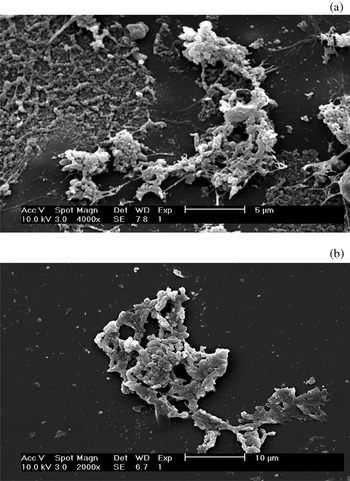
Multiple characteristics were used by the expert panel to determine if samples demonstrated evidence of bacterial biofilms. Morphological criteria indicative of bacterial biofilm included: three-dimensional structure; presence of water channels or interstitial voids; well developed extracellular matrix; and evidence of cocci or rod bacteria as spherical or elliptical bodies within the size range 0.05–5.0 µm (Figure 1).
Electron micrographs showing morphological characteristics of bacterial biofilms, including the presence of cocci and rod bacteria, well developed extracellular matrix, and abundant interstitial voids and water channels.

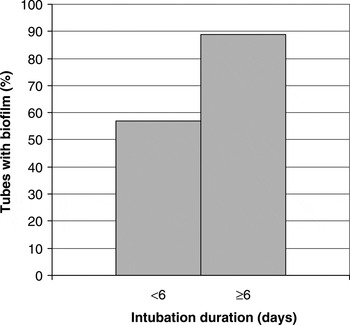
In patients who had been intubated for less than 6 days, eight out of 14 samples (57.1 per cent) demonstrated evidence of bacterial biofilms. In patients intubated for 6 days or longer, 16 out of 18 samples had biofilms (88.9 per cent) (Figure 2). The group with longer duration of intubation had a significantly higher percentage of endotracheal tubes exhibiting bacterial biofilms (p = 0.0439). Of note, biofilms were identified in tubes obtained as early as the first day after intubation.
Endotracheal tube biofilm accumulation by length of intubation. Compared with patients intubated for less than 6 days, patients intubated for 6 days or longer had an increased likelihood of demonstrating evidence of bacterial biofilms (88.9 vs 57.1 %, p = 0.0439).

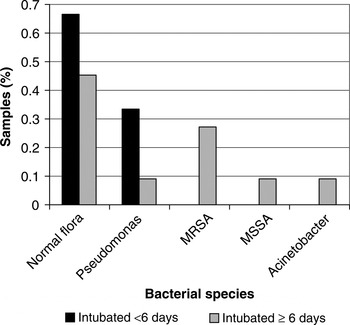
Culture data from aspirated tracheal secretions were available for 20 patients. Figure 3 summarises the microbiological profile of tracheal cultures taken from these patients around the time of extubation. Although pseudomonas and normal flora were more common in the early group, and Staphylococcus aureus was more prevalent in the later group; the difference was not statistically significant. Overall, normal flora were most common (55 per cent), followed by pseudomonas (20 per cent), methicillin-resistant S aureus (15 per cent), methicillin-sensitive S aureus (5 per cent) and acinetobacter (5 per cent).
Respiratory culture results. MRSA = methicillin-resistant Staphylococcus aureus; MSSA = methicillin-sensitive S aureus

Discussion
This study demonstrated a correlation between duration of intubation and the presence of bacterial biofilm on endotracheal tubes. The tubes of patients who had been intubated for 6 days or longer demonstrated a statistically significant increased likelihood of exhibiting bacterial biofilm. In keeping with previous studies, the culture data identified pseudomonas and S aureus species on many of the endotracheal tubes. Although there was a tendency for more pseudomonas in the group intubated for less than 6 days and more S aureus in the group intubated for 6 days or more, the sample size was too small to establish statistical significance.
The persistence of bacteria protected within the extracellular matrix of biofilms may play a role in ventilator-associated pneumonia and iatrogenic laryngotracheal damage secondary to prolonged intubation. Our study findings are similar to those from other studies that found biofilms on indwelling devices such as pneumatic equalisation tubes, tracheoesophageal speaking valves, orthopaedic prostheses, intravascular and urinary catheters, and dental implants, all of which have been described as a source of chronic bacterial colonisation.Reference Donlan and Costerton9–Reference Ell, Mitchell and Parker11
Since this evaluation protocol utilised a binary system of presence or absence of biofilms, it did not allow for the quantification of the amount of biofilm present on a given sample. It also relied on morphological evaluation of scanning electron microscopy images by an expert panel, which was subject to individual interpretation.
• Endotracheal intubation causes many infectious and inflammatory changes at the tube–tissue interface
• Prolonged intubation accounts for more than 90 per cent of acquired laryngotracheal stenosis
• Bacteria protected within biofilms may be more resistant to treatment
• In this study, longer intubation was associated with significantly more bacterial biofilm
Future research directions include using immunohistochemistry to confirm the location of bacteria within suspected biofilm structures. This technique may be more reliable in distinguishing biofilms from other morphologically similar structures such as blood clots and cellular debris mixed with mucus. This method could also be used for quantification, such as counting the number of biofilms visible per high-powered field. Further study is also needed to elucidate the relationship between the presence of bacterial biofilm, ventilator-associated pneumonia and subsequent laryngotracheal damage, and to determine the effect of antibiotic-impregnated or silver-coated endotracheal tubes on the formation of bacterial biofilm.Reference Kollef, Afessa, Anzueto, Veremakis, Kerr and Margolis12
Conclusions
This study demonstrates a statistically significant correlation between duration of intubation and the presence of endotracheal tube bacterial biofilm. Further study is needed to determine if the persistence of bacteria protected within biofilms contributes to the development of iatrogenic laryngotracheal damage.