Introduction
While examining some material of Omphalodes luciliae Boiss. (Boraginaceae, tribe Cynoglosseae), it became clear that three specimens previously assigned to Omphalodes luciliae subsp. luciliae differed from that subspecies, and indeed all others recognised in the species by Edmondson (Reference Edmondson and Davis1977), in having short setules on the calyx instead of the more or less well-developed dish-like tubercles (which do not bear trichomes) that are characteristic of all the other taxa within the species. Further examination revealed other distinguishing characters, and hence these specimens are described below as the new subspecies Omphalodes luciliae subsp. pisidica R.R.Mill. In specimen citations, Turkish vilayet (province) names are preceded by the relevant grid square reference used in Davis (Reference Davis1962–1988) to facilitate cross-reference to that work and the associated papers by Edmondson (Reference Edmondson and Davis1977).
Description
Omphalodes luciliae Boiss. subsp. pisidica R.R.Mill, subsp. nov.
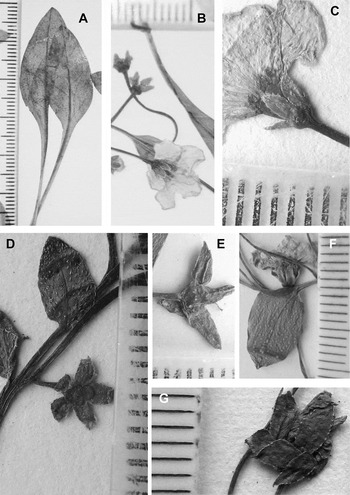
Ab aliis subspeciebus Omphalidis luciliae Boiss. marginibus loborum calycis parce et breviter setulosis, eorum laminis parce strigosis (non tuberculis patelliformibus munitis) differt. – Type: Turkey, C3 Isparta, distr. Sütçüler, Dedegöl Dağ at Dedegöl Tarn, shady rocks, 2300 m, 3 viii 1949 (in flower and fruit), P.H. Davis 16027 (holo E). Fig. 1A–D.
Omphalodes luciliae Boiss. subsp. luciliae sensu J.R.Edm. in P.H.Davis, Fl. Turkey 6: 281–282 (Reference Edmondson and Davis1979 [‘1978’]) p.p. excl. typ.
Omphalodes luciliae subsp. pisidica R.R.Mill. A, basal leaves; B, flower; C, flowering calyx showing setules; D, young fruiting calyces. A–C from the holotype, Davis 16027 (E); D from Davis 15609 (E). Omphalodes luciliae subsp. cilicica (Brand) Bornm. E, young fruiting calyx from Findlay 118 (E), collected from Turkey, C5 Niğde, Ala Dağ at Demirkasyk; F, leaf and flower from Parry 1 (E), collected from Turkey, C5 Niğde, Narpiz gorge. Omphalodes luciliae subsp. scopulorum J.R.Edm. G, young fruiting calyx from Davis 13429 (E), collected from Turkey, C2 Denizli, Boz Dağ.

Perennial. Stems several, ascending from decumbent base, 6–10 cm at early anthesis, lengthening to 25 cm in late anthesis and fruit, slender, narrowly winged, angled, glabrous. Leaves radical and cauline; radical leaves long-petiolate (petiole 20–70 mm, usually much longer than lamina); cauline alternate, remote, very shortly petiolate (petiole 1–5 mm, much shorter than lamina); lamina of all leaves chartaceous, elliptic to orbicular-elliptic, the radical 12–30 × 6–12 mm, the cauline 5–15 × 5–11 mm; apex obtuse, base cuneate (cauline more obtuse), margin entire; midrib distinct, lateral veins 2–3 pairs, indistinct; upper surface subglabrous, lower surface with scattered very short white setules from tuberculate bases. Flowers (1–)3–8 per stem, axillary in upper leaf axils; pedicels 8–12 mm and ascending-erect at anthesis, becoming decurved and lengthening slightly in fruit. Calyx lobes ovate-elliptic, 2.5 × 1.2 mm, shortly setulose on margin, and lacking dish-like trichomes; surfaces strigose. Corolla rotate, powder blue; tube white, very short, c.2 mm and subequalling calyx; limb 8–10.5 mm in diameter, the lobes spreading, suborbicular, 3.5–4.5 × 3–4.5 mm, broadly rounded. Faucal scales c.0.8 × 0.8 mm, yellow. Nutlets broadly elliptic-ovate, c.3.5 × 3 mm, chestnut brown; disc with narrow central ridge, glabrous; wing very narrow, c.0.3 mm wide, subentire.
Distribution. Turkey: Isparta, Antalya.
Habitat and ecology. Shady conglomerate rocks; 1900–2300 m. Flowering July onwards; fruiting early August onwards.
Proposed IUCN conservation assessment. Endangered (EN B1ab(iii)). The population of the taxon is known from two subpopulations on two mountains separated by about 50 km. Both subpopulations must undoubtedly be small although no data on actual subpopulation sizes are available. Actual and potential threats include grazing by goats, trampling by cavers and climbers, and seed collecting; Omphalodes is an attractive genus horticulturally and seeds of a diverse range of plant species collected in the wild on these mountains are known to be offered for sale via internet seed lists such as Euroseeds (www.planteliste.net/euroseeds.doc, accessed 3 August 2010). Even though the part including Bozburun Dağ is a National Park that is being proposed as a biosphere reserve, the goat population in that part of the location alone is at least 22,000 (Çetinkaya, Reference Çetinkaya2002) and over-grazing is a problem.
Additional specimens examined (paratypes). Turkey. C3 Isparta: distr. Sütçüler, Dedegöl Dağ in the cirque Anici, N. cliffs, fl. powder blue, 2200 m, 2 viii 1949, P.H. Davis 15990 (E, flowers and immature fruits). C3 Antalya: Bozburun Dağ above Tozlu Çukur Yayla, in shady conglomerate rocks, fl. powder blue, 1900–2200 m, 25 vii 1949, P.H. Davis 15609 (E, flowers and immature fruits).
This new subspecies of Omphalodes luciliae is more or less confined to the ancient Roman province of Pisidia, now the Turkish vilayets of Isparta and adjacent Antalya, hence the specific epithet. It has a more easterly distribution than Omphalodes luciliae subsp. luciliae and the collection localities of the three specimens seen, on two different mountains, are very close together. The holotype and Davis 15990 had both previously been determined as Omphalodes luciliae subsp. luciliae, by myself (6 June 1985) and J. R. Edmondson (6 June 1975), respectively; the paratype from Antalya had not previously been determined to subspecies level. However, all three specimens can be easily separated from all the other four subspecies of Omphalodes luciliae [O. luciliae subsp. luciliae, O. luciliae subsp. cilicica (Brand) Bornm., O. luciliae subsp. kurdica Rech.f. & Riedl and O. luciliae subsp. scopulorum J.R.Edm.] by the presence of short setules, not dish-like trichomes, on the calyx lobe margins [compare Figs 1C and 1D, which show O. luciliae subsp. pisidica, with Figs 1E–F (O. luciliae subsp. cilicica) and 1G (O. luciliae subsp. scopulorum), as representative of the state found in the other four subspecies]. This character had previously been overlooked by workers on the group. Edmondson (Reference Edmondson and Davis1977, 1979) understood that the four subspecies then recognised had more or less vicariant, allopatric distributions, which he mapped (Edmondson, Reference Edmondson and Davis1977: 301). The recognition of this new fifth subspecies further clarifies the distribution of the other four subspecies, particularly Omphalodes luciliae subsp. luciliae which becomes restricted to the ancient region of Caria (now the vilayets of Aydin and Denizli together with SW Antalya, in western Turkey). The plants from the eastern part of the range of Omphalodes luciliae subsp. luciliae sensu Edmondson (Reference Edmondson and Davis1977, Reference Edmondson and Davis1979), i.e. those from Isparta and Pisidian Antalya, belong to Omphalodes luciliae subsp. pisidica. Omphalodes luciliae subsp. scopulorum occurs chiefly in Greece (Olympos, Parnassos and Kiona) with two records from the Manisa Dağ massif in westernmost Anatolia, while O. luciliae subsp. kurdica is distributed in extreme SE Turkey, NW Iran and N Iraq (Edmondson, Reference Edmondson and Davis1977).
The area in which the new subspecies occurs is one of fairly high endemism. Bozburun Dağ, where Davis 15609 was collected, is also the type locality of the related species Omphalodes ripleyana P.H.Davis (Davis, Reference Davis1956). This was collected at a different area of alpine grazing pasture (Kuruca Ova Yayla, not Tozlu Çukur Yayla), in deeply shaded limestone rocks. It differs from all the taxa within Omphalodes luciliae by its milk-white (not typically blue) corollas, its very strongly accrescent fruiting calyx and its nutlets which have an incurved and fimbriate, not entire, margin; these characters are maintained in cultivation (P. H. Davis, pers. comm. in Edmondson, 1979: 282). Southwest Anatolia is clearly one of the major centres of diversity for the Omphalodes luciliae species complex.
The following specimens examined belong to Omphalodes luciliae subsp. luciliae in the restricted sense adopted here: Turkey. C2 Denizli: Cadmi orientalis supra Colossam [Honaz Dağ above Honaz], 1842, Boissier (lecto of Omphalodes luciliae, G–BOIS, photo; isolecto E, K; designated by Edmondson, Reference Edmondson and Davis1977: 300); Cadmus orientalis ad rupes, vi 1842, Boissier (GOET, photo seen, probably another isolectotype; NY, det. L.C. Higgins, photo seen, probably another isolectotype although someone [not Higgins] has annotated the sheet that this ‘Cadmus orientalis’ is Baba Dağ); Cadmi occidentalis supra Gheyra [Ak Dağ above Geyre], 1842, Boissier (syntype of Omphalodes luciliae, G–BOIS, photo); ‘Caria’, otherwise unloc., Pinard (syntype of Omphalodes luciliae, G–BOIS, photo; isosyntype GOET, photo); Baba Dağ, 2130 m, Davis 254 (E). C3 Antalya: Tahtali Dağ, 2200–2300 m, Davis 14138 (E).
Acknowledgements
The Royal Botanic Garden Edinburgh is supported by the Scottish Government Rural and Environment Research and Analysis Directorate (RERAD).