Anarchy is regularly presented as the heart and soul (and most of the body) of the structure of international systems. The discipline of international relations (IR) focuses so centrally on the pernicious effects of anarchy—its dangers or perilsFootnote 1—that Barnett and Sikkink plausibly contend that “the study of international relations has largely concerned the study of states and the effects of anarchy on their foreign policies.”Footnote 2 Roth argues, with only slight exaggeration, that “the core debate between the various paradigms of international relations theory concerns the extent to which anarchy … can be either managed, mitigated, or overcome.”Footnote 3
The extensive literature on the effects of anarchy certainly has been contested, often and vigorously. Nonetheless, claims that anarchy has determinate effects remain commonFootnote 4 and anarchy continues to be widely viewed as the (sole) “ordering principle” of international systems. My challenge to these persistent (mis)understandings is distinctive in six ways. I examine an empirical case, “forager societies,” that perfectly fits the Waltzian model of anarchic orders but does not experience security dilemmas or warfare, practice self-help balancing, or pursue relative gains. I criticize IR's dominant conception of structure (rather than particular substantive theories). I address the elements of international structures (rather than particular types or questions of ontology). I advance an alternative account of those elements. That account dispenses with anarchy. And I emphasize the systemic nature of structural theories.
Forager Societies
Hunter-gatherers, the simplest type of human society, vary in form from “the Calusa of southern Florida, who had substantial material wealth and a fully developed class system … [to peoples with] almost nothing in the way of material possessions and minimal social stratification.”Footnote 5 Hunter-gatherers usually are divided into relatively simple and complex subtypes. Binford distinguishes “foragers” (who “have high residential mobility, low-bulk inputs, and regular daily food-procurement strategies”) from “collectors” (who, facing “incongruent distributions of critical resources” “move goods to consumers with generally fewer residential moves”).Footnote 6 Woodburn calls these immediate-return and delayed-return societies.Footnote 7
I focus exclusively on simple immediate-return or forager societies, interchangeably using the labels “bands” and “foragers” (which draw attention to their principal social unit and the material basis of their way of life). More precisely, by forager societies I mean a type defined ostensively by nomadic bands of three African peoples that live in desert or dry savannah environments (the !Kung [San, Ju'hoansi, Basarwa] of Botswana and Namibia, the G/wi of Botswana, and the Hadza of Tanzania) and three non-African forest dwellers (the Aché of Paraguay, the Eastern Penan of Borneo, and the Nayaka of southwestern India).Footnote 8 This provides an empirical test while avoiding the possibility of working with an idiosyncratic individual case.
Although some readers will be skeptical of what follows, my account relies on standard models in anthropology and archaeologyFootnote 9 and is supported by extensive detailed citations. Furthermore, after laying out the case I address alternative appropriations of anthropology in IR.
Ecology, Demography, and Economy
Today, most foragers have been forced to the edge of extinction or into sedentary life. (Nomadic/foraging Penan and Aché bands probably no longer exist and most !Kung, G/wi, Hadza, and Nayaka have adopted partially or fully sedentary lives.) Until recently, though, they were common across much of the globe.
Foragers thrive in, and today are confined to, environments that are hostile to agriculturalists and pastoralists. Extremely low population density and regular movement are required to avoid overtaxing the land. For example, an Aché band of twenty requires about a hundred square miles of forest.Footnote 10
Bands typically number from about fifteen to several dozen individuals, living in households of nuclear (or slightly more extended) families.Footnote 11 Bands, however, are not kinship units.Footnote 12 Related and unrelated households and individuals regularly change bands,Footnote 13 following “lines of dissent rather than those of descent.”Footnote 14 Bands are “open, flexible, and highly variable in composition.”Footnote 15
The simplicity of forager life makes subsistence “at least routine and reliable and at best surprisingly abundant.”Footnote 16 Sahlins famously called foragers “the original affluent society.”Footnote 17 They “are poor only in the sense that they do not accumulate property.”Footnote 18 “All the people's wants (such as they are) are generally easily satisfied.”Footnote 19
Individuals and families privately possess simple tools and small personal items. “Property,” however, is minimal—more by social choice than technological or ecological necessity. Sanctions against accumulation “apply even to the lightest objects such as beads, arrowheads or supplies of arrow poison.”Footnote 20
Bands do collectively practice limited territoriality.Footnote 21 For example, among the !Kung bands have rights to use and control n!ores, parcels of land around waterholes.Footnote 22 But the same norms that require asking permission to camp in another band's n!ore ordinarily require permission to be granted.
Sharing resources is central to forager life. “All individuals have an automatic right of access to ungarnered resources, [but] they are elaborately constrained about how they can use them. Garnered resources have to be shared and used immediately.”Footnote 23 Plant products and small animals may be consumed individually, often while foraging. Large game, though, the most prized resource in band societies, is shared by everyone.Footnote 24
Although hunting takes place individually or in small groups, the meat and its distribution belong to the community. Bands typically possess “elaborate formal rules dissociating the hunter from his kill.”Footnote 25 Among the Aché, everyone in the band except the hunter and his parents gets a share.Footnote 26 Food “is, above all, a good that circulates.”Footnote 27
Politics
In forager societies, authority, like resources, is dispersed rather than concentrated. “The essence of this way of life is … communal sharing of food resources and of power.”Footnote 28
“Foragers are characterized by minimal social differentiation and a strong ethos of equality and sharing”Footnote 29 and by the “virtual absence of laws and social hierarchy.”Footnote 30 Equality, which “does not have to be earned … but is intrinsically present as an entitlement of all,”Footnote 31 “is actively promoted and inequality is actively resisted through a set of coherent interlocked and mutually reinforcing institutional procedures.”Footnote 32
“Relative age is one of the few status distinctions that can be made.”Footnote 33 Even gender inequality is extremely limited.Footnote 34 Men monopolize huntingFootnote 35 but they have neither political nor domestic control over their wives or daughters, even in matters of marriage and divorce.
Foragers highly value autonomy, but they seek it cooperatively rather than competitively.Footnote 36 Generalized interdependence prevents dependence on any particular individual, family, or band.
Leaders, who vary with time and topic, “aid in group decision-making, but … do not hold power.”Footnote 37 Bands have neither political nor ritual/religious offices. All adults may participate in discussions leading to a decision, which typically is taken by consensus.Footnote 38 And those decisions are neither formally binding nor centrally enforcedFootnote 39 (although informal social pressuresFootnote 40 do produce high levels of compliance).
Flexible band composition, minimal property, and consensual decision making mitigate conflict. Bands also emphasize “early detection of conflict and its treatment by means of a number of tension-relieving processes which reinforce cooperation and harmony.”Footnote 41 Exit is a last resort, restoring harmony in the band and providing dissatisfied individuals a fresh start at little cost.
Foragers, like all societies, experience violent crime.Footnote 42 But they suffer no internal security dilemma, despite the absence of formal sanctions.Footnote 43 If informal sanctions and reintegrative conflict resolution fail, exit is the standard solution, even for murder.
Amity and sharing, not fear and balancing, characterize relations within the band. Self-help is not the norm. Feuding is unknown. Revenge killing is rare. Even enmity is atypical and usually short lived.
Inter-Band Relations
Foragers are “warless societies.”Footnote 44 In relations between and across bands, foragers neither experience security dilemmas nor engage in “warfare,” broadly understood as organized violent intergroup conflict (including not only “war” with “armies” but also raiding and violent feuding).
Warfare simply does not exist among the !Kung, Hadza, G/wi, Penan, and Nayaka. One cannot say much more about such a negative existential fact—except to challenge others to present contrary evidence. But in examining nearly two hundred sources, some sixty of which are cited here, I found not a single documented instance of warfare among these five peoples.Footnote 45
Aché bands do fight—but only in accidental encounters, and even then only when flight is impossible.Footnote 46 They do not go to war, set out on raids, or in any other way intentionally attack one another. Such violence, unplanned on both sides, is not warfare in any serious sense of the term.
Special relationships do develop between bands. These are socially important and enhance security in times of climatic stress. They do not, however, involve balancing. And, except among the Aché, enmity between bands is unknown.
Relations with sedentary peoples follow different rules. Fear and uncertainty, however, provoke hiding rather than balancing. The Hadza, for example, practice defense by “avoidance. They protect themselves by scattering … [They] can and do avoid most serious inter-group conflict with enviable ease.”Footnote 47
Forager Warlessness
Students of IR usually turn to anthropology for evidence of the cross-cultural pervasiveness of warfare.Footnote 48 Foragers present a striking exception that reflects the structured, characteristic behavior of a distinct type of society, not accident or statistical noise. Warless societies, although atypical, “are not scarce in the world ethnographic sample.”Footnote 49 Ross finds that “wars with other societies take place rarely or never” in eighteen of eighty-five nonstate societies in his database.Footnote 50 Ember and Ember find a similar pattern in a dataset of nearly 200 societies.Footnote 51
IR, however, has largely ignored forager warlessness—or even denied it. For example, Gat claims that “fighting is recorded across the whole range of hunter-gatherer societies”; that both internal and interband violence is the norm “across the range of hunter-gatherer peoples.”Footnote 52 In fact, though, foragers are a distinct type of hunter-gatherer society and warlessness is essential to their way of life.
Gat does question “the apparent absence of warfare” among the !Kung and the Hadza.Footnote 53 But he merely mentions the Hadza in passing and among the !Kung documents murder not warfare.Footnote 54 Nowhere in his 800-page book does Gat document a single instance of warfare among foragers.
Gat does claim that the fieldwork on these societies “involves a curious selective blindness to whole aspects of the evidence we possess about hunter-gatherers.”Footnote 55 The supporting note, however, reveals that “evidence” to be small parts of three books on Paleolithic peoples that, as Gat puts it of the third, “[take] no account of the anthropological studies of recent hunter-gatherers.”Footnote 56
Gat also references “Keeley's excellent War Before Civilization.”Footnote 57 But Keeley offers no evidence of warfare among the !Kung or the Mbuti, the foraging peoples he addresses. In fact, Keeley acknowledges “real exceptions” to the general prevalence of warfare, amounting to about 5 percent of cases, primarily among nomadic bands in isolated or hostile environmentsFootnote 58—that is, immediate-return foragers.
Forager warlessness not only is undeniable but its significance cannot be explained away. Keeley suggests that the “seeming peacefulness” of foragers may be “more a consequence of the tiny size of their social units and the large scale implied by our normal definition of warfare than of any real pacifism.”Footnote 59 But warlessness should not be confused with pacifism. And warring is common among nonforager societies of the same size. Keeley also suggests that “armed conflict between social units … often is just terminologically disguised as feuding or homicide.”Footnote 60 But feuding is not documented in any of the forager societies I examine. And homicide is not armed conflict between social units.
Bands, despite their limited functions and flexible membership, really are “units.” They regularly persist over multiple generations, take collective decisions on the major matters of social importance, and interact with one another as corporate actors. Inter-band relations are truly analogous to interstate relations. There is no “political organization above the level of the band, which is completely autonomous in its decisions.”Footnote 61 Finally, foragers are not formerly warring peoples that have been “pacified” by colonial or state authorities. Forager life depends on separation from, rather than subordination to, more complex societies.Footnote 62
Binding through Sharing: A Logic of Anarchy
Foragers perfectly fit the Waltzian model of anarchic orders. Seeking survival and autonomy, they interact without government or hierarchy. Functional differentiation is minimal among both individuals and groups. All men are equal—and equally armed. But bands and their members seek security and autonomy, and usually achieve it, by circulating rather than accumulating goods and authority—by binding themselves to, rather than balancing against, other individuals, families, and bands. What I suggest we call “binding through sharing” is, like self-help balancing, a reasonable strategy for pursuing security and autonomy in some (but not all) kinds of anarchic systems.
Sharing should not be romanticized. It “come[s] no more naturally to hunter-gatherers than to members of industrial society.”Footnote 63 Efforts to evade the norm are common.Footnote 64 It is “imposed on the donor by the community,” much like taxation.Footnote 65
Nonetheless, sharing is an ordering principle. Interests, rationality, and even needsFootnote 66 have a particular character in sharing societies. Foragers pursue neither relative gains nor absolute gains but seek sufficiency and guaranteed access to whatever is socially available. Sharing even helps to explain the absence of coercive enforcement of collective decisions. “Coercion, the attempt to extract by force, represents a betrayal of the trust that underwrites the willingness to give.”Footnote 67
Starting Over
Foragers demonstrate, empirically, that “the effects of anarchy,” where they exist, are not effects of anarchy. Standard arguments that “self-help is necessarily the principle of action in an anarchic order”Footnote 68 and that “no amount of cooperation can eliminate the dominating logic of security competition”Footnote 69 are not even close to true.
This conclusion is hardly novel. Scholars have known at least since Wendt's classic article “Anarchy Is What States Make of It,”Footnote 70 published twenty years ago in this journal, that anarchy has pernicious effects only in conjunction with additional forces. This knowledge, however, has not penetrated very deeply into IR's practice. For example, a Google Scholar search in May 2012 for “logic of anarchy” and “international relations” produced more than 900 results since 2000.
Much of the explanation, I suspect, lies in the tendency of discredited theories to persist until replaced by something “better.” Abandoning plainly inaccurate talk of the effects of anarchy is likely to require a new conception of the elements of structure—which I try to provide.
IR has no widely employed alternative to what I call the tripartite (ordering principle, functional differentiation, and distribution of capabilities) conception of the elements of structure that Waltz introduced. It grounds structural realism and is adopted by both neoclassical realists and neoliberals (as a starting point for analyses that examine nonstructural forces that alter “the effects of anarchy”). Constructivists often supplement this list—but typically in an ad hoc fashion. Features such as norms and identity have not been integrated into a widely employed general structural framework.Footnote 71
Furthermore, standard applications of the tripartite conception privilege anarchy over functional differentiation and distribution of capabilities. Waltz claims that “two, and only two, types of structures are needed to cover societies of all sorts.”Footnote 72 And scholars talk not only of the anarchic structure of international relations but also, surprisingly frequently, of the “structure of anarchy.”Footnote 73 This reduces “structural” analysis to identifying the effects of anarchy—which I have just shown are nonexistent.
The solution, I suggest, is to go back to the beginning and construct from scratch a new conception of the elements of social and political structures. Understanding structure as “the mutual relation of the constituent parts or elements of a whole as determining its peculiar nature or character”Footnote 74—a structure is “defined by the arrangement of the system's parts”Footnote 75—I ask what in fact arranges social and political systems. The answer turns out to bear little relation to the tripartite conception that has dominated IR for three decades.
Foragers, States of Nature, and Great Power States Systems
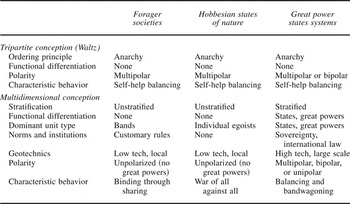
Consider three simple anarchic societies: foragers, Hobbesian states of nature, and great power states systems. This set combines the “exception” of foragers with the models most frequently employed in discussing “the effects of anarchy.” My working assumption is that the features needed to differentiate these systems will provide the rudiments of an adequate account of the elements of social and political structures.
In Hobbes's ideal-type state of nature, men live without government or any other “common Power to keep them all in awe.”Footnote 76 There is no functional differentiation. And capabilities are distributed evenly.Footnote 77 But in forager societies as well, materially equal and largely undifferentiated actors interact in the absence of hierarchy. The tripartite conception thus does not—cannot—explain Hobbes's “warre of every man against every man.”Footnote 78
Hobbes himself, though, draws attention to three additional factors. Actors are driven by competition, diffidence, and glory (which generate violent conflict for gain, safety, and reputation).Footnote 79 Conflict is intensified by an “equality of hope in the attaining of our Ends”Footnote 80 that is frustrated by scarcity, greed, and vanity. And “notions of Right and Wrong, Justice and Injustice have there no place”;Footnote 81 that is, there are no normative constraints on or justifications for behavior.
The Hobbesian war of all against all arises where equal, competitive, fearful, and vain egoists with equal hopes of attaining their ends interact in a world in which goods and respect are scarce and where rules do not exist (and could not be enforced if they did). Binding through sharing, by contrast, arises where equal actors seek sharing social relations in a world of material sufficiency governed by deeply egalitarian customary practices.
Great power states systems have still another structure. They are composed of unequal and functionally differentiated actors. States are differentiated from, and formally superior to, nonstate actors and the leading states are (at least informally) superior to lesser states. States and nonstate actors perform different functions. And great powers “take on special responsibilities” as “specialists in managing system-wide affairs.”Footnote 82
Great power systems, like forager societies but unlike states of nature, are rule-governed. For example, structural realists assume that the “units” are sovereign statesFootnote 83—which, by definition, have different rights and responsibilities than other actors. Sovereignty is also essential to the stratification of great power systems. And capabilities, in contrast to “rule-less” states of nature, cannot be measured by material resources alone; the normative and institutional resources of sovereign states are important elements of their power.
Great power systems, like both forager societies and states of nature, are closely associated with a particular kind of dominant actor. Great powers, however, are very different from Hobbesian egoists and forager bands.
Finally, great power systems have no single behavioral logic. Great powers balance among themselves. In relations with nonstate actors, however, they exercise sovereign rights and prerogatives. In dealings with lesser powers they often establish hierarchical domination. Weak states typically bandwagon (or hide). And nonstate actors are largely precluded from self-help action.Footnote 84
At least six elements are necessary to capture the differences in the arrangement and characteristic behaviors of these three simple anarchic societies.
1. Stratification: the layered and ranked arrangement of social positions.
2. Functional differentiation, which defines and allocates social functions.
3. Unit differentiation, which generates social actors and distributes them across positions.
4. Norms and institutions: rules, roles, and practices that regulate relations and help to constitute actors of a particular type.
5. “Geotechnics”: the material dimension of social positions and relations, conceptualized in terms of geography and technology.
6. Polarity: the number of great powers in a system.
Table 1 compares tripartite and multidimensional representations of the structures of these three simple anarchic societies. Before addressing each element, though, I want to return briefly to anarchy.
Two representations of the structures of three simple anarchical systems

Anarchy and Structure
Anarchy, I have shown, is not an “ordering principle” in any plausible sense of that term. “Anarchic orders” run the gamut from binding through sharing to the war of all against all.
Neither is anarchy the logical opposite of (or in practice incompatible with) hierarchy. The stratification of great power systems is central to their structure.
What then is the structural significance of anarchy? Not much.
Anarchy indicates the absence of “archy,” from the Greek arkhē (rule) or arkhos (ruler). Contemporary IR commonly defines anarchy as absence of government or central authority.Footnote 85 The tripartite conception, however, presents anarchy as the absence of hierarchy (which has many sources other than government). Anarchy also is regularly defined as the absence of any higher authority,Footnote 86 legitimate authority,Footnote 87 or authority simpliciter;Footnote 88 enforcement;Footnote 89 and lawFootnote 90 or rules.Footnote 91
Our three simple anarchic societies, however, show that absence of government is not necessarily associated with any of these additional features. Therefore, treating anarchy as a central or even defining feature of international systems—which seems to be the intent of most scholars who make central reference to it—requires restricting its definition to absence of government.
But these three simple anarchic societies also show that absence of government implies nothing of interest about behavior. This explains the desire for thicker definitions.
Thicker definitions, however, make “anarchy” no longer a feature of all international systems. They deprive “anarchy” of a single clear and determinate meaning. And they obscure the fact that “the effects of anarchy” are caused by something—probably several things—in addition to lack of government.
The solution, I suggest, is to retain the thin “absence of government” definition; drop anarchy from our account of the elements of structure; and include the features of thicker definitions that do important analytical work.
Abandoning anarchy may sound radical to those raised on the tripartite conception or the belief that anarchy is the “fundamental” feature of international relations.Footnote 92 But none of the seven editions of Morgenthau's Politics Among Nations contains an index entry for anarchy.Footnote 93 Similarly, “anarchy” occurs only twice in Carr's The Twenty Years' Crisis, Kennan's American Diplomacy, and Kissinger's A World Restored.Footnote 94 Anarchy simply was not important to these leading pre-Waltzian realists.Footnote 95 Interwar idealists also typically used anarchy rarely and to indicate disorder or lawlessnessFootnote 96—as did leading postwar nonrealists.Footnote 97
Earlier authors did, of course, address features that contemporary IR associates with anarchy—but not as instances of anarchy or its effects. Returning to that practice, I set aside anarchy and focus instead on stratification, functional differentiation, rules, and other forces that actually arrange the parts of international systems. “The effects of anarchy” will thus be properly attributed. Because anarchy has failed in its principal contemporary uses—it is not the defining feature of international systems (domestic forager societies are anarchic); it is not an ordering principle; and “the effects of anarchy” are not effects of anarchy—this analytical advance comes at almost no cost.
The Elements of Social and Political Structures
Structures are relatively deep and constant features of systems that, as I will emphasize in the next section, produce their effects in distinctive ways. Properly identifying which features of systems are structural thus is vital to determining what produces which effects, how.
I have suggested that at least six elements are needed for an adequate account of the principal dimensions of structural variation. Elsewhere, I have outlined and illustrated this framework and presented an extended discussion of stratification.Footnote 98 Here I show how each element is required to depict the structures of our three simple anarchic systems. I also draw comparisons with the tripartite conception, note parallel work undertaken from nonstructural perspectives, and suggest a few (usually typological) ideas for further elaborating each element.
Most of my arguments build on well-established lines of criticism or research. My contribution largely involves connecting disparate discontents and bodies of work to the definition of the elements of social and political structures and integrating them into a framework for structural analysis.
Stratification
Our three simple anarchic societies are stratified—arranged in layers or levels. Forager societies and states of nature are single layered: unranked, flat, egalitarian, without formal or informal super- and subordination. Great power systems, however, have three hierarchical layers, and the particular placement of states above nonstate actors and great powers above lesser powers is essential to their character.
Although the tripartite conception devotes two of its three elements (“ordering principle” and “distribution of capabilities”) to stratification, standard deployments do not depict patterns of stratification with anything close to tolerable accuracy. “Anarchy,” (re-)defined as absence of hierarchy, is wrongly ascribed to all international systems (and only international systems). “Hierarchy” is inappropriately excluded from international relations and unhelpfully treated as undifferentiated (or a residual; whatever is not “anarchic”). And ordering principle and distribution of capabilities are misleadingly presented as unrelated features rather than complementary, and usually interacting, sources and dimensions of inequality and super- and subordination.
“Stratification,” by dropping any reference to anarchy and linking authority (“ordering principle”) with force (“distribution of capabilities”), clarifies the centrality of “hierarchy” in most international systems. Although this point has been made repeatedly over the past two decades,Footnote 99 attention has been focused principally on the fact of hierarchy and on analyzing particular forms (especially empire). The next step is to catalogue and compare forms of stratification.
Elsewhere I have developed a typology that distinguishes unranked systems (such as states of nature), singly ranked systems (where one principle or dimension of stratification predominates, as in caste systems), and multiply ranked or “heterarchic” systems (such as medieval Europe).Footnote 100 Whatever the details, though, stratification comes in many forms, the particulars of which are central to a system's structure.
Functional Differentiation
The tripartite conception recognizes functional differentiation as inherently structural but holds that “the units of an anarchic system are functionally undifferentiated.”Footnote 101 In fact, though, functional differentiation is central to great power systems. More generally, standard talk of international political systems rests on their differentiation from other functional subsystems.Footnote 102
Even where all actors perform the same functions, as in states of nature, the system has a particular form (rather than the absence) of functional differentiation. Functional differentiation is a feature not of the actors but of the system. Functional differentiation refers to how—however—functions are distributed. This varies widely across anarchic and international systems.
In IR, functional differentiation is central to a line of theory and research running from functionalism and neofunctionalism through the extensive literature on international regimes (principles, norms, rules, and decision-making procedures governing a particular [typically functional] issue area). This work, however, usually has been presented as, and taken to be, nonstructural. It acquires new meanings when understood as addressing system structure rather than nonstructural modifications of the effects of anarchy.
Functional differentiation also presents the replacement of territorial by functional organization, which many see as central to globalization, not as a modest modification of a fundamentally constant structure but as a major structural change. Buzan and Albert even suggest that functional differentiation may be emerging as the ordering principle of a globalized world.Footnote 103
I have no typology of functional differentiation to offer. The essential point here, though, is the centrality of functional differentiation to social and political structures, not the details of the forms it characteristically takes.
Unit Differentiation (Segmentation)
It may be true that “the logic of anarchy obtains whether the system is composed of tribes, nations, oligopolistic firms or street gangs.”Footnote 104 Not, though, when the units are forager bands. Neither is it true that “the absence of central authority, not any characteristic of states … causes them to compete for power.”Footnote 105 Forager bands do not compete for power.
Even leading realists acknowledge the structural centrality of unit type. For example, Gilpin argues that “the character of the international system is largely determined by the type of state-actor.”Footnote 106 Waltz claims that “international political structures are defined in terms of the primary political units of an era.”Footnote 107
The tripartite conception's restriction of structure to “third image” features “at the international level” is as misguided as imagining that the structure of an organism can be specified without reference to its organs. It is no more true that “a systems theory of international politics deals with forces that are in play at the international, and not the national, level”Footnote 108 than that a theory of the circulatory system should not deal with the heart and blood vessels.
Systems are not composed of undifferentiated pieces. Quite the contrary, a system arises from integrating in a particular way parts of a particular character. Entities without specific properties—let alone property-less “units”—cannot be parts of a system. Sound systemic/structural analysis thus requires attending to the ways that structure is partly constituted by (certain features of) the units. For example, the interests of states, because they are states, differ from those of other types of “units,” giving states systems a particular character.
Unit differentiation creates links to the vast constructivist and poststructural literatures on identity, which are usually understood as unrelated, if not antagonistic, to structural analysis. It also allows structural theory to incorporate the classical realist distinction between status quo and revisionist powers and presents offensive and defensive realism as theories of different types of systems (rather than competing versions of “the best” realist theory).
The type of unit that predominates in a system—or whether there is a predominant type—is an empirical question. Therefore, IR probably should focus on comparing similarities and differences between historically important types (for example, states, empires, tribes) and how these features relate to other elements of the system's structure.
Norms and Institutions
Forager societies show that it is not true that “in a system without central governance … there are no effective laws and institutions to direct and constrain” actors.Footnote 109 Great power systems also have essential legal/normative and institutional dimensions (for example, sovereignty and alliances). Even the Hobbesian state of nature has a very particular normative order—as Hobbes puts it, “every man has a Right to every thing”Footnote 110—that is vital to the system's structure.
Structures produce patterned behavior by encouraging, enabling, constraining, and ignoring actions. Social and political systems do this largely through norms and institutions. States, as Waltz argues, are “differently placed by their power and differences in placement help to explain both their behavior and their fates.”Footnote 111 They are also, however, differently placed and shaped by their authority, status, and roles, by the rules that govern them, and by the institutions and practices in which they participate.
One cannot accurately depict the structure of a social or political system without reference to norms and institutions. Thus even those who deny their structural status sneak them back in. For example, Mearsheimer describes anarchy as “an ordering principle, which says that the system comprises independent states that have no central authority above them. Sovereignty, in other words, inheres in states.”Footnote 112 In fact, though, sovereignty arises not from the absence of central authority—states of nature and forager societies lack sovereignty—but from constitutive practices of mutual recognition.
The grip of the tripartite conception is strikingly illustrated by the fact that even neoliberals, who focus substantively on institutions and norms, treat them as nonstructural. For example, Axelrod and Keohane write that “world politics includes a rich variety of contexts” that actors “seek to alter … through building institutions.” “Establishing hierarchies, setting up international regimes, and attempting to gain acceptance for new norms are all attempts to change the context.” They even write of “deliberate efforts to change the very structure of the situation by changing the context.”Footnote 113 Structures, however, are not (mere) “contexts” and the “structure of the situation” is not the same as the structure of a system. Although neoliberals “find the neorealist conception of structure too narrow and confining,”Footnote 114 they provide no alternative—and thus fail to do justice to the real (structural) significance of institutions. They typically adopt “the neorealist sense” of structureFootnote 115 or use “structure” in an ordinary-language sense in which situations are “structured” by many things other than “structure” in the sense I use it here.Footnote 116
Constructivists frequently do see norms and institutions as structural. Their focus, however, has often been on the ontology of structuresFootnote 117 and substantive discussions typically have been ad hoc, historical, or focused on particular issues.Footnote 118 Explicitly incorporating norms and institutions into a general structural framework not only permits but encourages studying them systematically and comparatively.
Norms and institutions that establish super- and subordination, differentiate functions, and constitute units probably are best treated as matters of stratification, functional differentiation, and unit differentiation. This suggests conceptualizing “norms and institutions,” understood as a distinct element of structure, as system-wide rules, roles, and practices that regulate relationships between (occupants of) social positions (and thus help to constitute social actors).
Elsewhere I have sketched the idea of a “constitutional structure of international society” composed of four elements: (1) principles and practices of international legitimacy, which establish the members of international society; (2) principles and practices of internal legitimacy, by which dominant actors justify their rule; (3) hegemonic cultural values; and (4) fundamental regulative practices,Footnote 119 including prominently what Bull calls “life” (the regulation of the legitimate use of force) and “truth” (practices for establishing rules and obligations).Footnote 120 Although space again requires dispensing with further details, the structural centrality of norms and institutions is clear.
Geotechnics
The tripartite conception is usually described, by realists and nonrealists alike, as materialist.Footnote 121 In fact, though, material elements play a minor role. Anarchy is normative (absence of formal hierarchy) or institutional (absence of government, a particular institution of governance). Functional differentiation is normative and institutional. And polarity, although material, does little analytical work.
The tripartite conception presents anarchic orders as differing structurally in terms of their (material) distribution of capabilities only. Such differences between international systems, however, are largely peripheral. As Waltz puts it, “the logic of anarchy does not vary with its content.”Footnote 122 Anarchy—which, to repeat, is not material—generates the security dilemma, balancing, and the pursuit of relative gains. Except when discussing differences between bipolar and multipolar systems, distribution of capabilities usually is ignored in mainstream structural analysis.
Structures, however, do have an important material dimension. I suggest conceptualizing it in terms of geography and technology; “geotechnics” in Deudney's useful formulation.Footnote 123 This (again) is the practice of those who adopt the tripartite conception. For example, Mearsheimer emphasizes “the primacy of land power” and “the stopping power of water.”Footnote 124 Waltz argues that “among states armed with nuclear weapons peace prevails whatever the structure of the system may be” and that military and industrial technology “may change the character of systems.”Footnote 125
Geotechnics links structural international analysis with the discipline of geography, which has undergone a renaissance in recent decades,Footnote 126 and with geopolitics, which is undergoing a more modest revival.Footnote 127 It also provides a proper structural place for bodies of work that emphasize military technology, such as the offense-defense balanceFootnote 128 and the literatures on weapons of mass destruction. It also opens structural theory to large parts of the globalization literature.
I suspect that there is promise in focusing on how particular technologies, both military and nonmilitary, shape a system's character. Consider, for example, gunpowder and steam power. Systems also vary greatly in their scaleFootnote 129 and interaction capacity.Footnote 130 Once again, though, the key point is the general importance of this element of structure, not its details.
Polarity
Finally, our three simple anarchic societies vary in polarity, the number of great powers. Great power systems have a few major poles of power. States of nature and forager societies have none; they are “unpolarized.”
Among polarized systems, IR has focused on the distinction between bipolar and multipolar systems. Adding unipolar systems (which are historically almost as common as bipolar systems are rare) and tripolar systems (which although historically rare have a distinctive logic)Footnote 131 yields a topology of systems with none, one, two, three, or a handful of great powers.Footnote 132
Systems and Structures
“Structures,” in the sense that I have been using the term, are features of systems.Footnote 133 “The most general and fundamental property of a system is the interdependence of parts or variables.”Footnote 134 The parts of a stable system “fit” one another; they have evolved or been designed to depend on one another as parts of a whole.Footnote 135
The “fit” between parts of a whole explains the lack of sharp boundaries between the elements of social and political systems.Footnote 136 For example, unit type is often inextricably entwined with stratification and functional differentiation. (Consider the great powers.) Norms and institutions typically “suit” the actors, their functions, and stratification. Material features likewise tend to cohere with other elements of the system. Conversely, persistent “contradictions” between elements often generate system change or collapse.
Structural analysis must therefore attend to the interdependence of the elements of social and political structures. Stratification and functional differentiation, for example, are closely correlated: strong and weak, rich and poor, and privileged and despised actors tend to do different things. And causation runs in both directions.
Systems, being composed of interdependent elements, rarely have master variables. For example, lack of property is central to forager life. The emergence of property signals the passing of that way of life. But the absence of property is as much effect as cause, the result of the mutually shaping influences of particular forms of stratification, functional differentiation, and customs.
The elements of structures are not just very important or especially deep independent variables. They are not independent variables at all. “System effects”Footnote 137 result from (typically nonlinear) interactions of interdependent variables; of parts of a whole. Because independent-variable models consider neither parts nor wholes, but rather pieces broken out of their systemic context, they cannot actually explain structural regularities.Footnote 138
Structural and independent-variable depictions of “the same” subject have different characters and provide different insights. For example, international institutions, understood systemically/structurally, do not mitigate, moderate, or modify “the effects of [the master variable of] anarchy.”Footnote 139 Rather, they help to give a system, and “anarchy” itself, a particular quality. Institutions interact with stratification, unit type, and other structural elements to produce a system with a distinctive character. For example, dynastic, national, and territorial sovereignty help to create different kinds of privileged actors, different patterns of stratification and functional differentiation, different relations between polity, people, and territory, and different sources of conflict and cooperation.
The Substance and Subject of Structural Theory
My approach to structure also differs from Wendt's “structural idealism”—although more in emphasis than orientation.Footnote 140 Where Wendt stresses metatheory, especially ontology and the agent-structure problem, I approach structures more substantively. Where Wendt examines particular types of structures, I address the elements out of which types might be constructed. And where Wendt focuses on the impact of structures on agents, I focus on the systems that actors are parts of.
The Substance of Structural Analysis
Wendt aims “to rethink the dominant ontology of international structure.”Footnote 141 I take for granted the ontological “stuff” of structures (understood in terms similar to Wendt's) in order to focus on their substantive “stuff,” the elements of social and political structures. And rather than “defin[e] the structure of the international system as a distribution of ideas”Footnote 142—a definition that, whatever its ontological merits, is for substantive analytical purposes about as useful as defining the structure of an organism as a distribution of organs—I define international structures in terms of stratification, functional differentiation, unit differentiation, norms and institutions, geotechnics, and polarity, thus specifying how and through what forces actors and opportunities are distributed.
Wendt's famous argument that “anarchy can have at least three kinds of structure based on what kind of roles—enemy, rival, or friend—dominate the system,”Footnote 143 although a tour de force for the metatheoretical purpose of “explicat[ing] the deep structure of anarchy as a cultural or ideational rather than material phenomenon,”Footnote 144 is deeply problematic as structural analysis. As Wendt notes, “the task of structural theorizing ultimately must be to show how the elements of a system fit together into some kind of whole.”Footnote 145 But in addressing international structures Wendt considers “the nature and effects of shared ideas only.”Footnote 146 He further narrows his focus to “role structure, the configuration of subject positions that shared ideas make available.”Footnote 147 And among roles he considers only those involving “shared understandings governing organized violence.”Footnote 148 These ideas (alone), Wendt claims, form “the deep structure of an international system.”Footnote 149
“Structure” is thus reduced to a single feature that does all the explanatory work. This is reductionist (analytical) not systemic (holistic) analysis—explanation in terms of the independent effects of separate pieces rather than the interaction of parts of a whole. But the behavioral patterns that Wendt identifies are no more effects of roles (alone) than “the effects of anarchy” are effects of anarchy.
For example, Wendt argues that “friendship generate[s] the macro-level logics and tendencies associated with ‘pluralistic security communities’ and ‘collective security.’”Footnote 150 These security systems, however, as Wendt himself notes, “have different structures, with different logics and tendencies.”Footnote 151 Neither arises from or is explained by friendship (alone). And it is just as plausible that renouncing war generates the subject positions of friends—or that these are interdependent, co-constituting elements of a system.
Wendt also notes that “underlying [the Lockean anarchy of] rivalry is a right to sovereignty”Footnote 152—making role structure an effect as well as a cause. “Modern inter-state rivalry … is constrained by the structure of sovereign rights recognized by international law.”Footnote 153 Thus international law, although not a logical consequence of rivalry,Footnote 154 is “a key part of the deep structure of contemporary international politics.”Footnote 155
“Role structure,” much like “anarchy,” presents an underspecified and one-sided account of system structure. My multidimensional framework allows cashing out, explicitly and in some detail, the forces that shape “roles” (and “anarchy”). It also addresses elements of structure that, because they are not prominently connected to regulating violence, Wendt ignores.
Getting the ontology of structures right may be necessary for effective substantive theory. But one also needs to get the substance (elements) of structures right and properly identify how they produce their effects. My framework is a step in that direction.
The Subject of Structural Analysis
Wendt, like Waltz (and most of mainstream IR), sees “the challenge of ‘systemic’ theory” to show “how agents are differently structured by the system so as to produce different effects.”Footnote 156 This formulation prioritizes and adopts the perspective of agents. But systemic theory ought to adopt a system-centric perspective. And structural theory ought to be undertaken from the standpoint of structures (rather than things that they influence).
Actors considered as parts of systems are not agentsFootnote 157 but occupants of structural positions; “officeholders.” And structures are not external things that “shape and shove”Footnote 158 actors. Neither are structures mere environments or contexts in which actors happen to be located. (Organisms are not the environments of organs.) Even Wendt's depiction of agents as “embedded” in structuresFootnote 159 represents actors as (semi-)independent entities, to whom structures are essentially external, rather than parts of systems. (The parts of a watch are not embedded in the watch—which is the whole composed of its parts and their relations.)
Although Wendt notes that roles “are attributes of structures, not agents,”Footnote 160 he “focuse[s] on the role attributed to the Other.”Footnote 161 Self and Other, however, are not structural positions but system-independent generic identities. And talk of attribution draws attention to agents rather than structural positioning and participation in shared practices.
Or consider Wendt's agent-centric talk of “role taking” and “alter casting”Footnote 162 and his insistence that role taking “at some level [i]s a choice.”Footnote 163 That may, at some level, be true. But it is not a structural truth.
That structures ultimately depend on agencyFootnote 164 may be crucial to general social theory. For structural theory, though, it is largely beside the point. Structural theories are usually—and I would argue most productively—understood to address the nature and effects, not the causes, of structures. Powerful structural theories are possible without directly considering how structures arise or change. My framework aims to provide a foundation for such theories.
One need not go as far as Luhmann's “modern systems theory,” which dispenses with agents altogether.Footnote 165 Nonetheless, for the purposes of structural analysis there is much to be said for treating actors as occupants of structural positions rather than subjects or the targets of system effects—and treating structures as structures of systems (of which actors are parts) rather than as external influences on agents.
Structural analysis thus understood is not privileged, metatheoretically, theoretically, or methodologically. It does, however, deserve a place in IR—especially because substantive international theories that link agency and structure have proved well beyond our capabilities (as illustrated by the fact that Wendt treats them separately). Structural theories thus understood certainly have limits. One will undoubtedly miss many important things by not considering the causes of structures and how structure interacts with agency and process. Nonetheless, they have much to contribute. And my framework, I hope, may facilitate their development.
Applications and Implications
Finally, I offer an empirical application. My framework highlights the variability of international systems. Therefore, I look at system change. Two transitions provide four cases. Space requires that the cases be relatively well known. Selecting different time frames seems sensible. Based on these criteria, I consider the shift from medieval to modern international relations and the transformation of post–World War II international society.
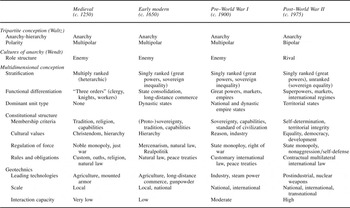
Space permits only highly stylized accounts. I have chosen the most highly stylized presentation possible. Table 2 compares, in allusive summary fashion, my framework with those of Waltz and Wendt. This frees space to address a few implications of these comparisons.
Three representations of the structures of four historical international systems

Waltz and Wendt represent international systems as simple and relatively constant. I present them as complex and variable. Nothing in my framework remains unchanged across these four cases (or the three anarchic societies in Table 1)—suggesting that one can say little of interest structurally about “the international system.”Footnote 166
Where I see regular and repeated structural change, Wendt and Waltz see many centuries of structural constancy, with change only after World War II. They present early-twentieth-century international relations as structurally the same as thirteenth-century international relations—but fundamentally unlike its late-twentieth-century successor. Although accurate for the single element that each treats as variable, these readings, as general accounts of international structure, require neglecting a wide range of striking structural changes.
For example, medieval international relations took place among many different types of major actors, both secular (emperor, kings, various lesser princes, cities, and lineages) and ecclesiastical (the princes and polities of the church being almost as diverse as their secular counterparts and no less enmeshed in lineage politics). By the middle of the seventeenth century, however, states and dynasties were largely predominant. In the medieval system, authority was divided on the basis of function, polity type, local and regional customary rights and obligations, type of lordship, and contractual feudal obligations. By Westphalia, sovereignty, in the sense of a single supreme authority, was beginning to assert its predominance. A noble monopoly on the use of force had been replaced by a system of warfare based on massive armies of state-employed mercenaries. Religion had been largely eliminated as a ground for international conflict, at least among Christian princes in Europe. Christendom as an ordering principle was giving way to the idea of a European society of states. The leading powers were beginning to operate globally rather than regionally.
Medieval and early modern international systems were composed of different parts arranged in different ways—that is, they had almost entirely different structures. And the remaining columns in Table 2 show further fundamental changes across the modern era.
Consider now late-twentieth-century international society. “Bipolar anarchy” is not an extremely economical representation of something like my multidimensional account. Bipolarity does not even hint at most of the changes my framework identifies. And those changes are at least as important as polarity in structuring postwar international relations. Even Waltz grants equal weight to weapons technology in explaining peace between the superpowers.Footnote 167 And principles and practices of self-determination, territorial integrity, and nonaggression, the rise of public and private nonstate actors, the creation of a new kind of international economy, and Cold War ideology (which my framework captures in competing visions of democracy and development) are on their face no less important. Although “bipolar anarchy” may explain some important features of postwar international politics, it simply is not a plausible representation of the structure (arrangement) of the postwar international system.
Rivalry does arguably identify “the heart” of the changes that distinguish postwar from prewar international relations. But this is a very different matter from identifying the structures of those systems. (Mammals are distinguished from other vertebrates by being warm blooded, producing milk, and having hair and three bones in their middle ear. This is not, however, an account of the structure of mammals. That A differs structurally from B by c does not make c the structure of A.)
My framework fully captures the changes that Wendt encompasses in rivalry. It also, however, allows one to unpack rivalry (as well as enmity and friendship), specify the forms role structures take historically, and link principles and practices governing the legitimate use of force to the rest of the structure of international societies.
Postwar rivalry was rooted in a contingent normative-institutional complex centered on self-determination, nonaggression, territorial integrity, and sovereign equality. This complex helped to alter patterns of alignment (for example, the rise of nonalignment, which involves neither balancing nor bandwagoning) and forms of hierarchy (for example, “neo-colonialism” and “informal empire”). It also both contributed to and was strengthened by the increasingly contractual and multilateral character of international law. And the associated abolition of empires and proliferation of “quasi-states,”Footnote 168 whose principal power resource is international recognition, helped to change patterns of unit differentiation and the system-wide distribution of capabilities.
With the survival of most states depending more on rights (sovereignty; mutual recognition) than might, space opened for the pursuit of absolute gains.Footnote 169 This facilitated new forms of functional and unit differentiation (as evidenced in the proliferation and increasing importance of transnational actors and international organizations and regimes). The declining importance of the state as a protector from external attack was also associated with the rise of welfare and development as principles of internal legitimacy.
Postwar changes had an important geotechnical dimension as well. For example, nuclear weapons supported practices of territorial integrity and nonaggression. New communication and transportation technologies facilitated self-determination (by enabling new forms of indirect influence). They also were crucial to the development of an increasingly international economy, which not only altered patterns of functional differentiation but helped to produce sustained increases in welfare (which in turn became increasingly central to the legitimacy of postwar states).
Waltz and Wendt skip over depicting the actual structure (arrangement) of international systems.Footnote 170 They jump immediately to models focused on one or two dimensions of structure, “reading off” substantive theory from a limited range of values that one or two elements of structure characteristically take. And it seems to me no coincidence that each highlights a single difference between postwar and earlier international systems, suggesting that their focus is on substantive theory with a contemporary application rather than comparative structural analysis.
Wendt's and Waltz's models certainly provide considerable insight. But they neither accurately depict the structure of international systems nor present truly structural accounts of international action. For that one needs something like my multidimensional framework.
Conclusion
The tripartite conception remains IR's sole widely employed account of the elements of structure. Only structural realists, though, seem happy with it. And even they regularly, and of necessity, ignore its limitations. Discontent, however, has typically led to criticisms of particular formulations, ad hoc amendments, or abandoning structural analysis. I have instead presented a new framework of the elements of social and political structures as a foundation for a very different type of structural international theory.
That framework probably is incomplete.Footnote 171 Its elements certainly have not been adequately elaborated. Nonetheless, it permits identifying, with considerable accuracy, how international systems are arranged and how that arrangement shapes their operation. This is a significant advance in IR's understanding of the structures of international systems and an essential first step toward more accurate and more powerful substantive structural theories.