During a disaster, it is usual for a major breakdown to occur in peoples’ communication-supporting technologies and environment. Natural disasters are events like earthquakes, floods, cyclones, landslides, etc., which kill thousands of people. The frequent outbreak of natural disasters is a serious problem in the world. Many natural disasters have occurred recently, such as the tsunami in Indonesia in 2004, the earthquake in Pakistan in 2008, Van Chuan in China in 2008, the Haiti earthquake in France in 2010, the Great East Japan Earthquake in 2011, Hurricane Katrina in the United States in 2012, the Gorkha earthquake in Nepal in 2015, and the Chapala flood in Socotra Island and Almokala in 2015 in Yemen. Consequently, these have focused our attention toward the safety of people who are still alive during the disaster. Rescue teams are required to communicate with each other and with evacuees during a disaster in order to look for injured and missing people, to contact central services for supporting them based on information about the geographic area, and to connect them with the hospital to receive necessary medical aid for saving people lives. Therefore, immediate availability, rapid deployment, and reliability are the key factors for communication network infrastructure during disaster and emergency situations.
In fact, wireless solutions for emergency situations in the disaster area have been known for a long time. Wireless communication linkage is imperative for assessing damage, collecting information on supplies and other sources, coordinating rescue and relief activities, mentoring the disaster area, and for recovery assessment. To establish efficient voice and data communication during a major disaster, a high-bandwidth wireless solution is the most highly recommended.Reference Komnakos, Vouyioukas, Maglogiannis and Constantinou 1 However, the weakness of traditional wireless communication network technologies—for example, 2G, 3G, and 4G—is that they are easily disabled by natural disasters and terrorist attacks. When the disaster occurs in a large area, wireless network technology providers require a week or month to recover their network.
The existing wireless communication solutions are not capable of delivering services to cover complex disasters that occur in a wide area.Reference Lee, Ku and Ahn 2 However, space communications technology can be used only for mitigating the impact of the disaster and for helping rescue and research teams to efficiently and successfully carry out their duty. Therefore, the recommended new system of coordination and communication using space assets to support public health during disaster relief efforts is feasible.Reference Dinas, Mueller and Clark 3 Space technologies are essential tools for collecting information required for protecting people and for mitigating economic losses due to disasters. One of the reliable solutions for communications is satellite-based communication.Reference Yoo 4 However, the weaknesses associated with using satellites for disaster management are the cost of the image, launching cost, and delay. So, space technologies are of growing importance in all four parts of the disaster cycle: preparation, response, recovery, and mitigation.
New aerospace technology including nanosatellites and unmanned aerial vehicles can provide a highly flexible mechanism for on-demand communication, situation awareness, and direct intervention as first responders, which can help to save thousands.Reference Kobilarov 5 , Reference Ma, Ortega, Ruble and Lu 6 Because of large high altitude platform (HAP) coverage, it offers an alternative for providing broadband communication services after a catastrophic incidentReference Deaton 7 and for managing traffic.Reference Alsamhi and Rajput 8 Many research studies have been carried out using HAP to demonstrate the performance of broadband services and the enhancement of quality of service (QoS),Reference Alsamhi and Rajput 9 , Reference Alsamhi and Rajput 10 as well as to demonstrate the performance of rescue operation teams and headquarters of the disaster.Reference Likitthanasate, Grace and Mitchell 11 - Reference Deaton 16
Recently, an emergent space technology called the Tethered Balloon has been developed, which operates in the troposphere layer at an altitude of 200-400 m above the ground.Reference Khaleefa, Alsamhi and Rajput 17 , Reference Alsamhi and Rajput 18 The attractive feature of the Tethered Balloon is its rapid deployment, which allows users to operate their existing mobile handsets and supports emergency relief and secure teams to perform their duties easily in a disaster zone. Hence, it represents the best solution for disaster mitigation and recovery. Therefore, we proposed the use of the Tethered Balloon, which is a flying balloon incorporating lifting of any communication technology equipment to cover the disaster area. The aim of this paper is suggesting a completely wireless communications solution that can be deployed immediately, reliably, and easily before or during and continuing after the disaster.
The rest of this paper focuses on disaster management and coverage and reliability of the Tethered Balloon, as discussed in second and third sections, respectively. Fourth section describes the proposed technology. Results and discussion are presented in fifth section. In the final section, the conclusion is discussed.
COMMUNICATION AND DISASTER MANAGEMENT
Since early days, telecommunication has played a significant role in disaster management, prevention, and mitigation by providing information to the population in the disaster area, particularly during emergency rescue and relief operations for the disaster-affected people. A disaster is a severe disruption in the functioning of the community or society causing widespread material, economic, social, or environmental losses.Reference Lee, Ku and Ahn 19 Catastrophic events like the Asian tsunami of 2004, the Haiti earthquake of 2010, and the Gorkha earthquake of 2015 in Nepal have killed nearly 300,000, 200,000, and 8000 people, respectively.
Disaster management is a discipline that involves preparing for a disaster before it occurs, disaster response, and supporting and rebuilding the society after natural or terrorist disasters have occurred. Gallardo et alReference Gallardo, Djalali and Foletti 20 identified existing competency sets for disaster management and humanitarian assistance that would serve as guidance for the development of a common disaster curriculum. Therefore, disaster management must be taken into consideration because of its goal to save lives, protect people from further harm, and to respond to activities including attempts to reverse adverse health effects. Pre-disaster activities and post-disaster activities are required to manage the disaster.
Pre-disaster Activities
Pre-disaster activities include prevention, detection, mitigation, and preparedness. These are paramount to limit the impact of a natural disaster. Hence, the preparation for a specific disaster focuses on minimizing hazards. In this case, the disaster management team develops a plan of actions to manage the particular disaster. Also, telecommunication equipment can be used as a conduit for disseminating information about the impending danger. Thus, people take necessary precautions to mitigate the impact of these hazards. On the other hand, remote sensing and the Global Positioning System (GPS), play critical roles in tracking approaching hazards, coordinating rescue and relief operations, assessing damages, and in mobilizing support for reconstruction.
Post‐disaster Activities
Post‐disaster activities mainly include relief and recovery operations, as well as the processes of damage estimation, relocation, and repair of damaged infrastructure.
During the disaster, the first responders need to find others who can assist in rescue operations, and the rescue teams need to find survivors and victims and move them to safe zones. The response includes the mobilization of necessary emergency services and first responders in the disaster area. The rescue team operations are totally dependent on reliable, efficient, and fast emergency communication systems.Reference Tauqeer, Shahid and Rasool 21 Besides, the highest priority is given to rescue and relief teams for carrying out useful, valuable, and adaptive duties during and after the disaster. Therefore, they are required to coordinate disaster management efforts in the disaster area to bridge the disaster zone and the safe zone. Thus, survivors of disaster can easily reach those who can help restore normalcy to their lives. Further, especially in disaster situations, wireless communication represents the only viable delivery mechanism.Reference Pace and Aloi 22 Therefore, suitable communication technology should be used to provide a critical path for the rescue team. This includes providing and maintaining operable and interoperable wireless communication services and the Internet before, during, and after presidentially declared emergencies or disasters. 23
Finally, the recovery operations must be addressed, which start after the immediate threat to human life has subsided. Recovery from disaster requires the restoration of the usual way of life and decreasing uncertainty. Relief teams should provide fast aid for alleviating the suffering of domestic disaster victims. The summary of the requirements during or after the disaster are listed inReference Deaton 7 , Reference Qiantori, Sutiono, Hariyanto, Suwa and Ohta 24 as follows:
1. Provide an imaging and acoustic triangulation device to locate survivors of disasters.
2. Guide rescue and research operations.
3. Deliver rescue tools, sensors, and medical supplies.
4. Provide mobile telephone connectivity to coordinate search, rescue, and logistics.
Therefore, telecommunications play a pivotal role in disaster prevention, mitigation, management, and recovery assessment. Space technologies are relevant to all nations for disaster management and mitigation regardless of their level of economic or technological development.
COVERAGE AND STABILITY OF THE TETHERED BALLOON
The Tethered Balloon is one of the space technologies that potentially attracted the researchers’ attention for being easy to deploy, being of low cost, and because of its Line of Sight. This technology could replace destroyed telecommunication infrastructure over a wide affected area. Further, it delivers broadband services to different users and at a high QoS to a large coverage area.
A study on the coverage of the Tethered Balloon can be performed in a similar manner to the general approach used for HAP.Reference García-Crespillo, Nossek, Winterstein, Belabbas and Meurer 25 The geometry between the Tethered Balloon and the user on the ground is shown in Figure 1. Two sides of this triangle are usually known, which indicate the distance from the user at the edge of the Tethered Balloon coverage area to the earth’s center, R=6378×103 m, and the distance from the Tethered Balloon to the earth’s center. There are four variables in this triangle: ε is the elevation angle, α the nadir angle, β the central angle, and d the slant range. If two variables are known, the others can be found as follows:
 $${\varepsilon}{\plus}\beta {\plus}\alpha \, {\equals}\, 90$$
 $$d\,{\rm cos}\,{\varepsilon}\, {\equals}\, r\,\sin \,\beta $$
 $$d\,{\rm sin}\, \alpha \, {\equals}\, R\,{\rm sin}\,\beta $$
h is the height of the Tethered Balloon above the earth’s surface; thus, h+R=r. Therefore, r can be calculated by applying the cosines law for triangles as shown in Figure 1.
 $$r^{2} \, {\equals}\, R^{2} {\plus}d^{2} {\plus}2Rd\,{\rm cos} \ (90{\plus}{\varepsilon})$$
 $${{{\rm sin}\ \alpha } \over R}\, {\equals}\, {{{\rm sin}\,(90{\plus}{\varepsilon})} \over {R{\plus}h}}$$
 $${\rm sin}\ \alpha \, {\equals}\, {{R\,{\rm cos}\,{\varepsilon}} \over {R{\plus}h}}$$
Geometry of the coverage of the Tethered Balloon.

The biggest triangle represents the case of the largest coverage area for the Tethered Balloon at an elevation ɛ=0°. On the basis of the condition of maximum coverage area and equation (6), β can be calculated using equation (1). Also, the maximum nadir angle can be given as follows:
 $$ \alpha _{{{\rm max}}} \, {\equals}\, {\rm sin}^{{{\minus}1}} \left( {{{R{\plus}hr} \over {R{\plus}h}}} \right)$$
Hence, the surface of the coverage area depends on the β angle and it isReference Mohammed, Arnon, Grace, Mondin and Miura 15 as follows:
 $${\rm SC}\, {\equals}\, 2\pi R^{2} (1{\minus}{\rm cos}\,\beta )$$
The maximum signal path length in this case occurs at the Earth’s surface and is given by the following:
 $$d_{{{\rm max}}} \, {\equals}\, \sqrt {2Rh{\plus}h^{2} } $$
Signal Propagation Predication Models
The Tethered Balloon has the potential to deliver a wide variety of telecommunication services and to cover a large disaster area. Signal propagation is used for wireless communication and depends on the terrain, the frequency of operation, the height of the subscriber, the height of the base station, and other dynamic factors. The coverage area depends on the propagation models, which are useful for predicting the path loss and received signal strength (RSS) between the transmitter and receiver. Among the most commonly used methods are Okumura Model and Hata Model.
Hata Model
Hata Model is applicable for transmit antenna effective height 30-200 m and mobile antenna height 1-10 m. It is also applicable for the frequency of 150-1500 MHz. The value of allowable path loss is also substituted in Hata ModelReference Khaleefa, Alsamhi and Rajput 17 , Reference Alsamhi and Rajput 26 with the “correction factor” for a small city taken as:
 $$\left( {1.1\ {\rm log}_{{10}} \left( {f_{c} } \right)-{\rm }0.7} \right){\rm }h_{{re}} -{\rm }\left( {1.56\ {\rm log}_{{10}} \left( {f_{c} } \right)-{\rm }0.8} \right.$$
The variable D in the Hata Model equation determines the radius of the coverage area.
 $$\eqalignno{ & P_{l} \, {\equals}\, 69.55 {\plus} 26.16\, {\rm log}_{{10}} \left( {f_{c} } \right) -a\left( {h_{{re}} } \right){\minus}13.82 \cr & {\rm log}_{{10}} \left( {h_{{te}} } \right){\plus}\left( {44.9{\minus}6.55\,{\rm log}_{{10}} (h_{{te}} h)} \right)\,{\rm log}_{{10}} D $$
where f c is the frequency, h re represents height of the mobile antenna, h te the base station antenna height, a(h re ) the correction factor, P l the path loss, and D the cell range in kilometer.
Okumura Model
Okumura Model is widely used for signal prediction in case a disaster occurs in urban or suburban areas, but not for signal prediction in urban areas. It is also applicable for frequencies of 150-1920 MHz and distances of 1-100 km, as well as for base station height of 30-1000 m.
 $$P_{l} \, {\equals}\, L_{F} {\plus}A_{{mn}} \left( {f,d} \right){\minus}G\left( {h_{{te}} } \right){\minus}G\left( {h_{{re}} } \right){\plus}G_{{{\rm AREA}}} $$
where P l is the path loss in dB, L F the free space loss in dB, A mn (f, d) the median attenuation relation to free space in dB, G(h te ) the base station height gain factor, G(h te ) the mobile station antenna height gain factor, and G AREA the gain due to the type of environment.
 $$G\left( {h_{{te}} } \right)\, {\equals}\, 20\ {\rm log}_{{10}} (h_{{te}} \,/\,3)$$
 $$G\left( {h_{{re}} } \right)\, {\equals}\, \left\{ {\matrix{ {10 \,{\rm log}_{{10}} (h_{{re}} \,/\,200),\ \ \quad \qquad {\rm }h_{{re}} \,\lt\,3{\rm m}} \cr {20\,{\rm log}_{{10}} (h_{{re}} \,/\,200),\quad 3{\rm m}\,\lt\,h_{{re}} \,\lt\,10{\rm m}} \cr } } \right.$$
where h te is the balloon base station effective antenna height and h re the mobile antenna height.
 $$L_{F} \, {\equals}\, 32.45{\plus}20{\rm }\,{\rm log}\left( d \right){\plus}20\,{\rm log}\left( f \right){\minus}10\,{\rm log}\left( {G_{t} } \right){\minus}10\,{\rm log}\left( {G_{r} } \right)$$
where d is the distance between the balloon and the user, f the operation frequency in MHz, G t the balloon antenna gain, and G r the user antenna gain.
 $$A_{{mn}} \left( {f,d} \right)\, {\equals}\, 16.5{\plus}15\,\log \left( {f\,/\,100} \right){\minus}0.12 d$$
where; f is the frequency of operation and d the distance traveled.
RSS
Coverage can be estimated by the radiation power transmitted from the balloon, the RSS, or from the elevation angle and distance. Coverage can be extended using Multi-Tethered Balloons and depends on many parameters such as radiation power, RSS, environment, elevation angle, and propagation path as shown in Figure 1. The radius calculation depends on the chosen value of allowable path loss and RSS.
RSS depends on path loss and parameters of the transmitter and receiver, and varies based on environment. The RSS for a cellular network is expressed in dBm as:
 $$P_{{rss}} \, {\equals}\, P_{t} {\plus}P_{l} {\plus}G_{t} {\plus}A$$
where P rss is the RSS in dBm, P t the transmitted power in dBm, G t the transmitted antenna gain in dB, P l the total path loss, and A the connector and cable loss in dB.
Disaster Network Using the Tethered Balloon
Tethered Balloon network architecture represents a local multipoint distribution system, which is a radio technology that provides broadband service to many customers from a single balloon or from multiple balloons in space. Network architecture provides service in the disaster area and mitigates risk. It includes sky segments, tethered, ground, and user segments (including users of another system and relief and rescue teams). The function and role of each segment have been described below.
The space segment connects the mobile terminal with the central unit. It consists of a balloon and a payload. The payload comprises a Radio Remote Unit and antennas for mobile wireless communications, GPS, and remote sensors. The payload can be implemented using various wireless technologies such as 3G, Wi-Fi, WiMAX, LTE, and LTE-A, or through the combination of more than one technology. The connection link between the balloon and other networks on the ground is tethered. There are several advantages of using the tethered link, such as minimizing the need for propulsion to keep the balloon stable in high winds, sending communication signals and video feed, and supplying power to payload materials in the absence of solar energy.
The ground segment consists of the Main Unit) of broadband service and power system as well as the center of disaster management. The disaster management center is the place for guiding rescue and relief teams and for the analysis of the image reaching the center from the remote sensor in the balloon payload.
The user segment includes the user terminal, called hand-held mobile terminal (mobile handset and others system users), and rescue and research teams. It has to be constantly borne in mind that relief and rescue teams should be given high priority during or after disasters.
The Multi-Tethered Balloon could be the solution for large disaster mitigation and recovery. The Tethered Balloon will move the tower into the air, which will be connected with the help of ad hoc networks. Therefore, during disasters, the balloons connect with each other in the sky using ad hoc networks technology, which is used for emergency communications.
Why the Tethered Balloon is Suitable for Disasters
Earlier, many lives were lost as people could not be rescued on time during disasters. Tethered Balloon technology can provide crucial information under such circumstances for the first responders and could save many lives. Recently, it is being used as a platform for lifting up a variety of payload (camera, radio antennas, electro-optical sensors, radio-relay equipment, and advertisements) for various research and applications. Thus, tethered balloons enable supporting telecommunication over a large disaster area and also support healthy recovery.Reference Hariyanto, Santoso and Widiawan 27
Weather Impact
The performance characteristics of the Tethered Balloon depend on the properties of the atmosphere through which it flies. The Tethered Balloon is operated in the troposphere layer of the atmosphere. This layer extends from the earth’s surface to an altitude of approximately 10-20 km. The air in the troposphere is in constant motion, and the region is characterized by unsteady or gusting winds. Many issues related to flight stability and automatic control are discussed.Reference Nelson 28
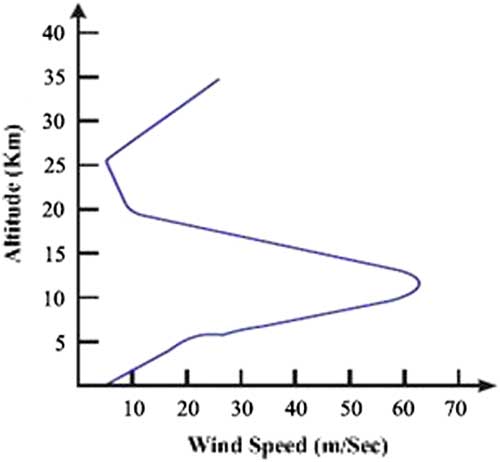
Wind is the most critical factor for balloon safety. The best condition for balloon flight is light and stable wind at a speed of 12 mph. In case the weather conditions deteriorate with increasing wind, or if there is any risk for storms, operations are suspended until the weather improves and stabilizes. As the wind speed increases, the payload capacity should be decreased. Wind velocity at different altitudes in the troposphere layer is shown in Figure 2. It is shown that wind speed is low, and hardly increases, at an altitude of ~3 km and then a decrease is seen at an altitude between 17 and 25 km. Therefore, it is the preferable altitude for the balloon to fly at.
Wind Velocity With Respect to Altitude.Reference El-Disi 29

Air humidity has little influence on balloon performance. Humid air is better for the fabric than dry air. On the other hand, high temperature slightly improves balloon flying performance as it causes expansion of the helium within the balloon because of solar radiation. The balloon can fly as long as the wind speed is low and as long as there is no danger from storm fronts.
Rainfall is one of the most important constraints in the signal performance of LoS. Rain attenuation causes the absorption and scattering of radiation from the transmitted signal, which results in severe degradation of RSS. Therefore, it has a direct impact on the quality of the system. Rain attenuation is significant and must be taken into consideration for the calculation of carrier to noise ratio. Presence of raindrops can severely degrade the reliability and performance of communication between the balloon and the user on the ground. The attenuation due to rain can be expressed as:
 $$Y_{R} \, {\equals}\, KR^{a} \quad \quad \quad {\rm dB}\,/\,{\rm Km}$$
where K and a are frequency-dependent coefficients and R the rain rate (mm/hour). Values of the coefficients K and a are determined as a function of frequency (GHz) in the range between 1 and 1000 GHz.
Tethered Balloon Stability and Reliability
The Tethered Balloon is restrained by a tether to maintain the balloon in a stable position. These tethers can also provide power for the payload from the ground.Reference Komerath 30 The tether used varies with altitude because it is assumed to be supported by the balloon as well as the by the tethered winch that is fixed to the ground. It is assumed to be of a circular section, sufficiently rough to ensure turbulent wakes at a limited wind speed of 30 m/second, giving a drag coefficient of 0.3.Reference Komerath 30 For safety, and to prevent the escape of the balloon, the tether between the confluence point and the balloon attachment point is a double cable composed of two parallel wire ropes, each independently capable of controlling the balloon.
Mathieson tried to add aerodynamic lift from the motion of the aerodynamically shaped balloon, to improve the lifting capabilities.Reference Graeter 31 Although the tethered balloon operates in a truly lighter-than-air mode, the release of the payload creates an upward force equal to that of the payload, and, therefore, the balloon and the cables and yarders must be capable of controlling this lift force.
This technology may be practically developed for normal weather conditions, but it might not maintain the necessary degree of control in violent atmospheric conditions of storms (with winds stronger than 10-12 mph). Thus, it could be desirable to have alternative landing and mooring sites or systems to allow its survival in the storm conditions that will inevitably be encountered.
THE PROPOSED TECHNOLOGY
The prime purpose of our proposed Tethered Balloon technology is to provide reliable communication services for guiding rescue and relief teams and for saving the victims located in the disaster coverage areas in which there is a damage of all infrastructure. Emergency operations carried out via the proposed technology could also be invaluable to determine where to focus rescue efforts and manage evacuees. Therefore, the Tethered Balloon enables effective and efficient administration and provides a suitable emergency communication system over a disaster area as shown in Figure 3.
The Tethered Balloon will be launched before the disaster. Subsequently, the payload telecommunications component can be used for dispersing information about the imminent danger. Thus, people can take necessary precautions to mitigate the impact of these hazards. When the balloon reaches the desired altitude, the telecommunication applications, including remote sensing, the video camera, and GPS, have pivotal roles to play in tracking approaching hazards and in mapping the area. Remote sensing can be used for preparing seismic hazard maps to assess the nature of the risks. The video camera will capture the affected area (disaster area). These captured images can coordinate search and rescue teams with the arrival of first responders as shown in Figure 3.
During the disaster, the video camera will capture images of the affected area (disaster area). These images will be sent via tethered or wireless means to the disaster analysis center for study and analysis of the area. According to the analysis, rescue teams will be sent to perform their duty of providing aid and emergency services for saving people lives. The first duty of a rescue team is to provide aid to injured people, and, further, to arrange for medical help. GPS, remote sensing, cameras, and rescue teams cooperate and work efficiently. Further, visual information on the disaster area is transmitted to first responders and other rescue teams. The device at the server side of the disaster center, the handsets at the client side and for the rescue teams, and the Tethered Balloon with WiMAX in the payload for information conveyance are taken into consideration together. Therefore, communications via the Tethered Balloon plays a pivotal role in disaster prevention and mitigation.
After a disaster, it not easy to repair the destruction caused. Therefore, the Tethered Balloon may continue launching in the desired location to provide communication to users of different technologies. The applications of payload communication are coordinating relief operations, estimating damages, and mobilizing support for reconstruction and recovery after the disaster. As a consequence, with the help of the emergency device—that is, the handsets they carry—the residents can communicate with each other, with the relief workers, or with relatives.
The importance of this proposed technology is that rescue teams are given high priority in their location, which, therefore, makes it easy for them to employ the emergency device to perform their duty efficiently. Our proposed technology could be used for any type of disaster in any place, except in the condition of a violent storm (winds stronger than 10 mph).
Our scenario focuses on the evaluation the performance of rescue teams in a disaster area. Rescue teams are given higher priority for QoS to perform their duty successfully. During the disaster, three groups of rescue teams are created. The first group works in the disaster area to rescue trapped survivors of the disaster. They also work on the bridge to transfer people during a catastrophe to the safe zone. The second group moves the evacuees from the edge of the disaster to a hospital for saving their lives. The third group (disaster center) works on monitoring the disaster area and communicates with the rescue team to direct and guide them to perform their duty well. Therefore, the Tethered Balloon is used to provide critical communication essential for search and rescue as well as to capture images and to organize and control the disaster.
RESULTS AND DISCUSSIONS
The result is the demonstration of the importance of using the Tethered Balloon as a new technology for disaster area coverage as well as of its use for preparedness, detection, mitigation, and recovery. It used to support the broadband communication network because of its ability to carry WiMAX. Communication via the Tethered Balloon provided higher QoS to rescue teams. Therefore, the results show that the facilities (calls and Internet) from the proposed technology improved excellently before or during and after a disaster (Figure 3).
Proposed Technology.

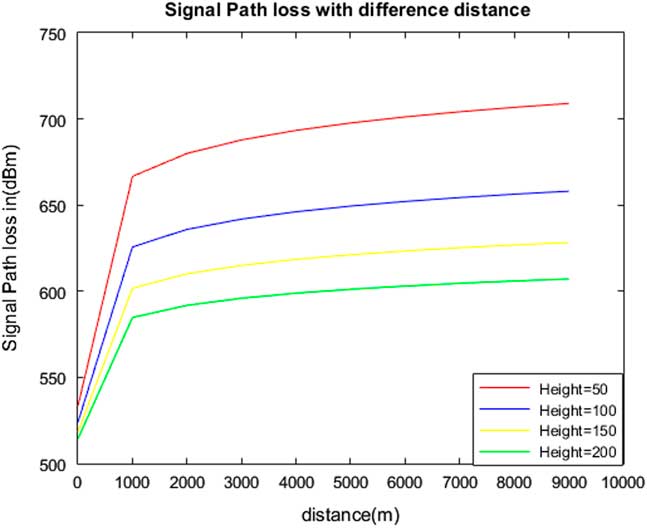
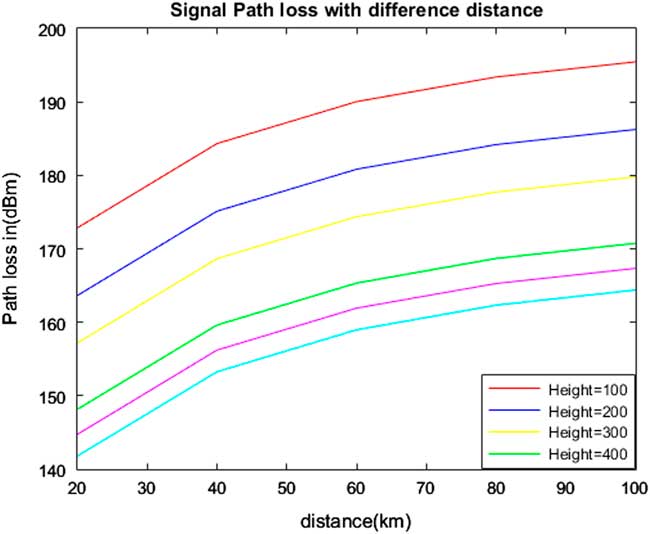
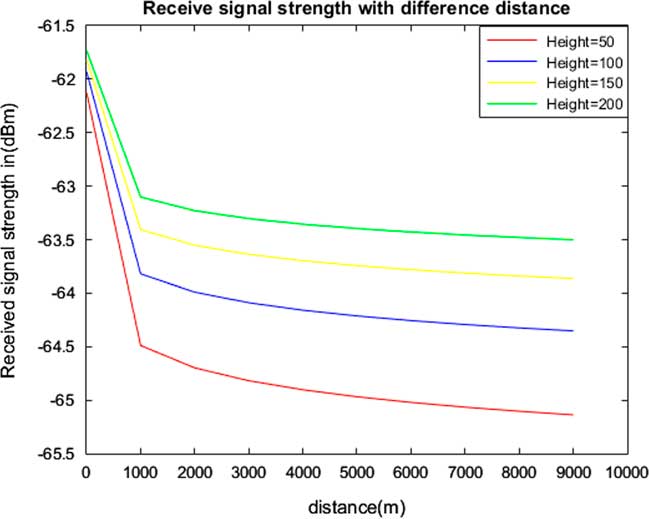
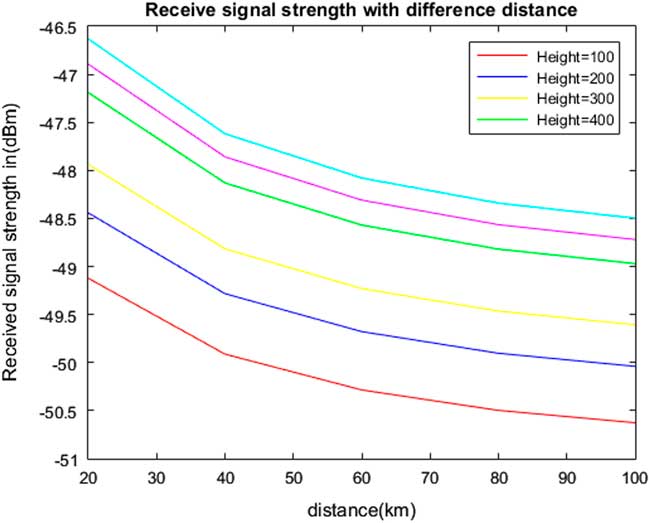
We have considered the transmitted output power is constant at 49 dBm; however, the altitude of the Tethered Balloon varied from 100, 150, and 200 m, to 450 m, respectively. Signal path loss is shown in Figures 4 and 5. The signal path loss of Okumura and Hata Models shows a decreasing trend for the height of the Tethered Balloon and an increasing trend for the distance between the Tethered Balloon and the user on the ground. RSS is shown in Figures 6 and 7. The trend for the strength of the signal from the Tethered Balloon is opposite to that of loss in signal strength based on the height of the balloon, and there is a decreasing trend for the distance between the balloon and user on ground. The results found that the signal strength for Okumura Model is stronger and largest compared with Hata Model.
Signal Path Loss Using Hata Model.

Signal Path Loss Using Okumura Model.

Received Signal Strength Using Hata Model.

Received Signal Strength Using Okumura Model.

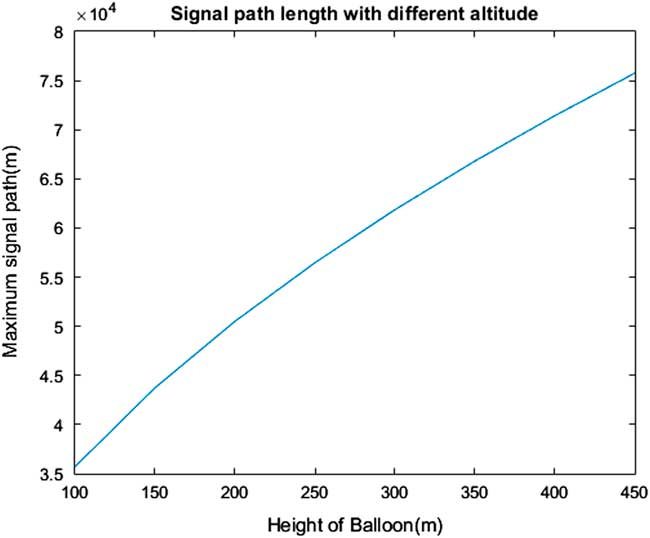
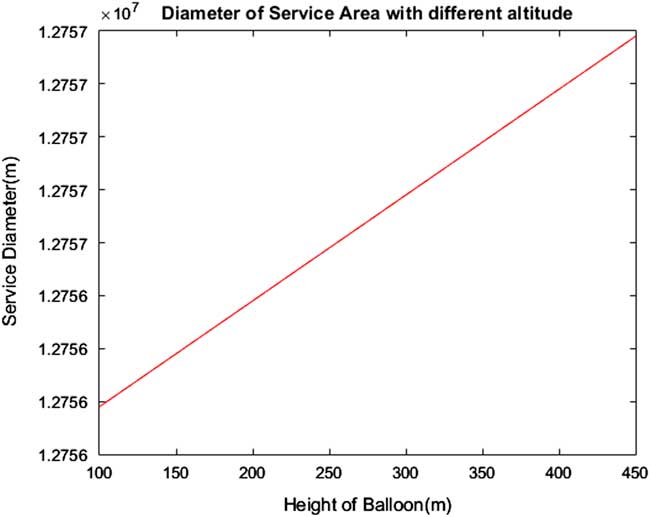
The maximum signal path length is shown in Figure 8. The signal path length is represented at elevation angle zero for difference in altitude. Therefore, the signal path increases as the altitude of the balloon increases. Also, the service diameter increases when the altitude of the balloon increases. Service diameter is shown in Figure 9.
Maximum Signal Path for Difference in Altitude.

Service Diameter With Difference in Altitude.

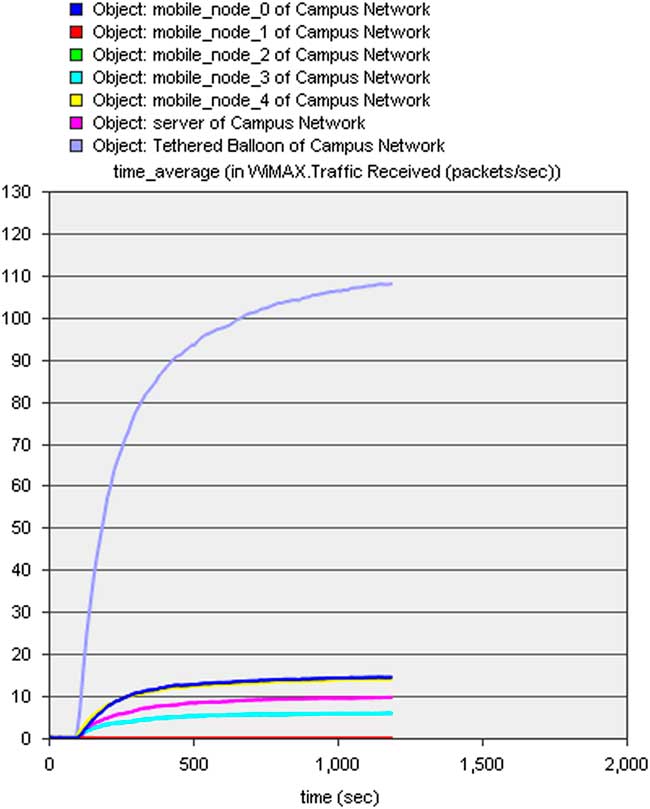
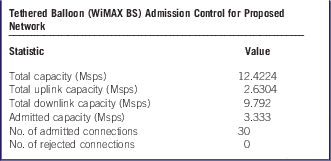
The rescue and relief teams receive the signal according to their location from the center of the balloon coverage area. The traffic signal is significantly enhanced as shown in Figure 10. These enhancements are because of giving them higher priority than others. The performance of the Tethered Balloon technology with the cooperation of WiMAX broadband service over the disaster area is shown in Table 1.
Rescue Traffic Received.

Call Admission Control for the Tethered Balloon (WiMAX BS)

Abbreviations: Msps, mega-samples per second; BS, broadband service.
CONCLUSION
Wireless communication networks created using space technology, such as the Tethered Balloon, are the foundation of and key to disaster management as well for the development of emergency communication. OPNET model is used for simulation and analysis of the preference of the proposed communication network. In brief, this paper describes the concept of the Tethered Balloon for disaster mitigation and recovery. The large coverage and LoS as well as the tethered features make the Tethered Balloon a suitable technology for disaster mitigation, response, and recovery. RSS and path loss are calculated and discussed in brief, and, therefore, the coverage significantly varied according to variation in the altitude of the Tethered Balloon. Rescue and relief teams have performed their duty efficiently because they had been given the highest priority during the disaster. As a result, the proposed technology was effectively and efficiently employed for disaster mitigation and response as well as for continued coordination of the relief teams until disaster recovery.