1. INTRODUCTION
Pulse compression is a simple but efficient way to improve the peak power of laser pulses. Stimulated Brillouin scattering (SBS) in various media is commonly used to compress nanosecond laser pulses down to sub-nanosecond with remarkable conversion efficiency (David, Reference David1980; Damzen & Hutchinson, Reference Damzen and Hutchinson1983; Dane et al., Reference Dane, Neuman and Hackel1994; Kmetik et al., Reference Kmetik, Fiedorowicz, Andreev, Witte, Daido, Fujita, Nakatsuka and Yamanaka1998; Marcus et al., Reference Marcus, Pearl and Pasmanik2008). Its structure is simple and easy to operate (Feng et al., Reference Feng, Xu and Diels2014; Xu et al., Reference Xu, Feng and Diels2014). Referring to a previous work, Stokes pulse width shorter than 500 ps with energy efficiency >70% has been achieved. The results show that the SBS medium plays an important role in SBS pulses compression (Hasi et al., Reference Hasi, Zhong, Qiao, Guo, Li, Lin, He, Fan and Lü2012; Omatsu et al., Reference Omatsu, Kong, Park, Cha, Yoshida, Tsubakimoto, Fujita, Miyanaga, Nakatsuka, Wang, Lu, Zheng, Zhang, Kalal, Slezak, Ashihara, Yoshino, Hayashi, Tokizane, Okida, Miyamoto, Toyoda, Grabar, Kabir, Oishi, Suzuki, Kannari, Schaefer, Pandiri, Katsuragawa, Wang, Lu, Wang, Zheng, He, Lin, Hasi, Guo, Lu, Fu, Gong, Geng, Sharma, Sharma, Rajput, Bhardwaj, Zhu and Gao2012).
Among SBS media, fluorocarbon stands out from the others and is widely used as a new series of SBS media (Guo et al., Reference Guo, Hasi, Zhong, Jin, Lin, He and Lu2012; Hasi et al., Reference Hasi, Wang, Cheng, Zhong, Qiao, Zheng, Lin, He and Lu2013). Since the molecular structure of fluorocarbon does not contain C–H bond, its absorption coefficient is low in the near-infrared and visible region. It also has advantages such as high-gain coefficient, high damage threshold, and short photon lifetime, which contributes to obtaining higher-energy reflectivity and shorter Stokes pulses in SBS pulses compression.
Anirban compressed a 10 ns laser pulse to 600 ps with FC-75 in single cell when input energy was higher than 570 mJ and the energy reflectivity 87% (Mitra et al., Reference Mitra, Yoshida, Fujita and Nakatsuka2006); In 2009, Yoshida et al. got 160 ps-compressed pulses in FC-40 (Yoshida et al., Reference Yoshida, Hatae, Fujita, Nakatsuka and Kitamura2009); Zheng achieved 235 ps pulses in FC-43 and 175 ps pulses in FC-70 (Zheng et al., Reference Zheng, Hasi, Zhao, Cheng, Wang, Lin, He and Lü2014). Due to high chemical stability and easy to achieve high-pulse compression ratio, fluorocarbon becomes the most popular media series in SBS oscillator.
In order to obtain close to SBS compressed pulse width limit, we designed “twice SBS pulse compression” structure. Stokes pulse returns from the first compressed cell is used as pump pulse in the second compressed cell. However, in a “twice SBS pulse compression” experiment of the laser pulses at 532 nm with the FC-40 as the SBS medium, a 750 cm−1 SRS frequency shift was observed. Accordingly, we conjecture that SRS process occurs during the SBS pulse compression under strong-focusing condition. Owing to SRS effects, the energy reflectance of the second SBS compression process is limited.
In general, SRS and SBS are in competition in liquid in an optical cell. For most liquids, the steady-state region for SBS and SRS can all be considered to be reached pumped by ~10 ns laser pulse, as the acoustic phonons and the lifetime of the vibrational modes are all shorter than this. Since SBS always has higher steady-state gain than SRS, SBS is always in dominant. Other than the competition between SBS and SRS, Jian-Zhi et al. (Reference Jian-Zhi, Gang and Richard1990) and Liu et al. (Reference Liu, Shi, Ouyang, Chen, Liu and He2009) have reported the pumping effect of SBS on SRS. This pumping effect proves that SRS can be enhanced by SBS; and this effect will result in energy conversion decreasing in the SBS process.
In this paper, SRS characters in FC-40 such as frequency shift and energy conversion efficiency are measured and then the competition between SBS and SRS is studied. To this end, we design SRS research experiments on a mode-locking laser system and competition research experiments on a narrow linewidth Q-switched laser system. To our knowledge, this is the first study of SRS characters of this kind of fluorocarbon. Results show that, SRS does exist in SBS pulse compression that cannot be ignored. The experimental results together with the analysis are reported as follows.
2. EXPERIMENT ON THE MEASUREMENT OF SRS CHARACTERISTICS OF FC-40
Generally, competition between SBS and SRS is dependent on whether the laser pulse duration is shorter than their own phonon lifetime (Boyd, Reference Boyd2003). The usual methods for suppressing these processes are to control their steady-state gain coefficients by using particular pumping pulse durations that one process is realized in steady state and others in transient conditions (Sen and Sen, Reference Sen and Sen1986; Sentrayan & Kushawaha, Reference Sentrayan and Kushawaha1993; Ben Yehud et al., Reference Ben Yehud, Belker, Ravnitzki and Ishaaya2014). Since the relaxation time of SBS is longer than that of SRS and the frequency shift and the gain linewidth of SBS is narrow, the SRS process can be studied with a mode-locking laser of picoseconds pulse width (Trutna et al., Reference Trutna, Young and Byer1979; Shi et al., Reference Shi, Chen, Mo, Liu, He and Yang2012).
The results of former experiments draw a conclusion that the medium has a direct impact on the SBS process. FC-40 is a kind of perfluorinated amines, it is composed of (C4F9)3N and (C4F9)2NCF3 (shown in Fig. 1). FC series of medium belongs to fluorocarbons in which hydrogen atoms are replaced by fluorine atoms. These new SBS media have similar frequency shift, low absorption, and small phonon lifetime. Such liquid medium is purified easily with additional advantages of high damage threshold and stable chemical properties. So it is conducive to high-power, high-energy SBS compression experiments. But few people care its SRS properties.
Molecular structure of FC-40.

The experimental optical path used to study SRS in FC-40 is presented in Figure 2. A mode-locked Nd:YAG laser system (Continuum Leopard) at 532 nm with a pulse duration of 100 ps and linewidth 35 cm−1 is used as the pump light. The repetition frequency of the pump laser is 10 Hz and the maximal output energy is 15 mJ.
Experimental layout for measuring SRS parameters of FC-40. M1, M2, 532 nm reflection mirrors; H1, half-wave plate; P1, polarizer; L1, focal length 500 mm; L2, focal length −200 mm; BS1, beam splitter; G1, grating.

The pump laser is horizontally polarized after passing through a half (1/2)-wave plate and a polarizer subsequently. In order to increase the power density of the injected laser, a 2.5:1 convex and concave lens system is used to narrow the diameter of the beam to 1.5 cm. The length of the cell is 60 cm. The output laser is separated into two parts by a beam splitter. One of the divided beams is detected by a spectrometer (Andor Shamrock SR-750) to measure the spectrum of SRS. Another beam is injected onto the grating to separate the Stokes of which the energy can be evaluated.
The SRS-transmitted spectrum in FC-40 is shown in Figure 3. Pumped by the laser with 1 GW/cm2 intensity, the SRS spectrum of FC-40 with the central wavelength of 532 nm sees the generation of the first-order and higher-order Stokes wavelength. Even the third-order Stokes line can be observed. Anti-Stokes lines can also be observed due to four-wave mixing effect. Each wavelength is separated from its neighbor by a frequency shift of 750 cm−1.
Stokes and anti-Stokes lines intensities in FC-40, injection laser 1 GW/cm2.

In order to further the understanding of the SRS process in FC-40, the energy conversion efficiency of the first- and second-order Stokes are measured. The measurement results are shown in Figure 4. Energy meters used in this experiment are Ophir PE50BF-DIF-C and PE9.
SRS conversion efficiency at different intensity of the pump lasers in FC-40.

Figure 4 shows the conversion efficiency of SRS in FC-40 with a variation of pump intensity. Derived from the spectrometer and SRS energy conversion curve, it can be observed that 400 MW/cm2 is the threshold of first-order Stokes line in the SRS process. When pump intensity increases to 1.2 GW/cm2 above, the conversion efficiency enters the saturation region, where the maximum value reaches 21.2%. With respect to the second-order Stokes laser beam, the threshold intensity comes a little higher than the first-order, which is 480 MW/cm2.
The second-order Stokes can be pumped by first-order Stokes seed as well as four wave mixing (FWM). Under the condition of FWM, the threshold of the second-order Stokes is not very high. Limited by the pumping power, the saturation region of the second-order Stokes is not observed. As pumped by broad linewidth lasers, the gain of backward stimulated Raman scattering (BSRS) decreases a lot (Trutna et al., Reference Trutna, Young and Byer1979), BSRS is significantly suppressed and is not observed.
3. EXPERIMENTS ON THE COMPETITION BETWEEN SBS AND SRS PROCESSES
In case of pumped by narrow linewidth laser, things become complicated. In media such as SF6 and CS2, SBS is very strong due to high gain. Under this circumstance, SRS is suppressed as most of the pump energy is converted to SBS stokes seeds although it builds up slowly.
However, in some other media, if there is not considerable disparity between SBS and SRS in gain, SBS, forward stimulated Raman scattering (FSRS), and BSRS can be all excited. It has been reported in the past in the media such as CH4, H2, CF4, and water (Sentrayan & Kushawaha, Reference Sentrayan and Kushawaha1993; Shi et al., Reference Shi, Chen, Mo, Liu, He and Yang2012; Ben Yehud et al., Reference Ben Yehud, Belker, Ravnitzki and Ishaaya2014).
In order to study the competition between SRS and SBS processes in FC-40, a Q-switched laser system with narrow linewidth is employed. In this case, Raman/Brillouin gain depends on the intensity of the pump power in the medium.
As shown in Figure 5, a Q-switched Nd:YAG laser outputs a single longitudinal mode Gaussian baseband laser. The laser pulse width is 8 ns with repetition frequency of 10 Hz. The initial spot diameter is approximately 8 mm with the energy of 40 mJ at 532 nm.
Experimental setup. M1, M2, 532 nm reflection mirrors; H1, H2, half-wave plate; Q1, Q2, quarter wave plate; P1, P2, polarizer; L1–L4, lenses; L1, focal length 1500 mm; L2 focal length 300 mm; L3, focal length 250 mm; L4, focal length 400 mm; BS1, BS2, beam splitter; G1, G2, gratings.

The laser passes through a half-wave plate H1 and a polarizer P1, then it is circularly polarized by a quarter (1/4) wave plate Q1. The laser is injected into the generating cell after passing through the focusing lens. Cell2 is the generation cell, while Cell1 is the amplification one, both with FC-40 media filled. The reflected Stokes beam is S-polarized after going through Q1.
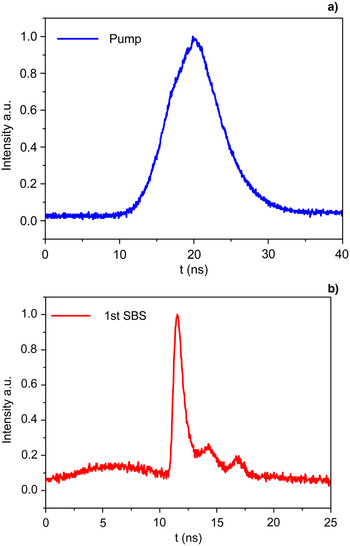
The output Stokes light is used as the pump light and focused into another cell. It is also circularly polarized by the quarter wave plate Q2 and focused into Cell 3 by L3. The injected energy is controlled by H2 (half-wave plate). The backward SBS and SRS are received in one measurement system by the refection of M2. The forward laser is also received by another measurement system after L4. The input and the output laser waveform of the first pulse compression are shown in Figure 6. The oscilloscope used in this experiment is Tektronix DPO71254C and photodetector is Ultrafast UPD-35-UVIR-P.
The input (a) and the output (b) pulses achieved by the first SBS pulse compression process.

At first SBS pulse compression cell, the compressed SBS pulse width is 1 ns. In this process, SRS is not observed at the first compression, because of the intensity of the pump laser under the threshold. In this pulse compression structure, the intensity of the output laser can be increased without the occurrence of SRS.
Stokes pulse of the first SBS compression cell is used as pump in the second SBS cell. In the second SBS pulse compression experiment, the pump energy is controlled by the half-wave plate H2 and polarizer P2. The conversation efficiency of this SBS pulse compression process is shown in Figure 7.
Conversation efficiency of SBS, experimental result in FC-40.

SBS conversation efficiency is shown in Figure 7. At low pumping energy, the SBS conversation efficiency increases linearly with raising of pump energy. When pump energy exceeds 15 mJ, the SBS energy reflectivity enters the gain saturation region. Conversation efficiency increased slowly and eventually stabilized about 40%. Compared with the traditional compression experiment in FC-40, this experimental result of efficiency appears to be too low (Yoshida et al., Reference Yoshida, Hatae, Fujita, Nakatsuka and Kitamura2009). For further analysis, we recognize the forward and backward SRS conversation efficiency in this experiment.
The SRS conversation efficiency is shown in Figure 8. The threshold energy of SRS is higher than that of SBS in all situations. Since the steady gain of SBS in the liquid medium is one order higher than that of the SRS (Weber, Reference Weber1994), the SBS process has definite superiority and draws most of the energy. It can be observed that SBS gain saturation can be reached more easily.
Conversation efficiency of SRS; (a) FSRS and (B) BSRS.

Since the SBS should always dominate for its higher gain. However, with higher pump intensity, the SRS could compete with SBS and gets increased, and the SBS gets decreased. For the relaxation time of SRS process is shorter than that of SBS, the SRS builds up earlier and it is easier for the SRS process to reach a steady state. Thus, SRS has be not been fully inhibited although SBS usually has a much higher steady-state gain coefficient than that of the SRS process.
In order to understand the physical mechanism between SRS and SBS more clearly, the waveforms of these processes in this medium cell are measured.
The waveform of first-order and the second-order backward SRS are shown in Figure 9. The second compressed SBS Stokes pulse width is 272 ps, while recording the first-order BSRS pulse width 256 ps, the second-order BSRS pulse width 247 ps. It can be observed that backward SRS has almost the same waveform with SBS (Jian-Zhi et al., Reference Jian-Zhi, Gang and Richard1990; Liu et al., Reference Liu, Shi, Ouyang, Chen, Liu and He2009). It can be observed that the SRS pulse raises when the power of SBS pulse begins to fall. This phenomenon shows that SRS pulse always established after the SBS pulse, which can prove the pump effect. Pulse compression in the SBS process results in intensity increasing, then SRS occurs and get amplified in backward transmission.
Measurement of output pulse shapes in BSRS process.

This phenomenon of temporal correlation between SBS and SRS supports that SBS is pumping SRS. As pulse compression occurs in the SBS process, the SBS light has higher intensity. In case it surpasses the threshold of SRS, the SBS acts as an exciting source to excite SRS. In this process, it generates “Stokes seed” of the SRS which will get amplified by the remained pump light. As observed in narrow linewidth experiment, the threshold of SRS in this experiment is about 300 MW/cm2 (at focal point of L3), which is lower than that in wide linewidth laser.
From above, the growth of the SRS pulse results from the pump laser radiation as well as the SBS pulse. Meanwhile, two phenomena can be expected, one is that SBS refection efficiency will reach saturation region earlier and may not reach very high. This is because of the competition between SRS and SBS. The other is that the threshold of SRS will decrease. This is because SRS pulse not only gets gained from the pump light, but also from the SBS pulse. While in SBS pulse compression, the intensity of the SBS pulse can be higher than the pump.
Considering the above analysis, when FC-40 is used as the SBS compression medium, both SBS and SRS can occur at strong focusing circumstance. Pump effect does exist in the SBS pulse compression process. It means that SRS should be taken into consideration before other nonlinear competitions in SBS pulse compression. In order to scale SBS compression to high-energy and high-power scalable two-cell structure without strong focusing is appreciated. In the generation cell, the energy should be controlled below the SRS threshold. If the pump effect occurs, it could affect the energy efficiency of the SBS process.
4. CONCLUSION
In summary, SRS characteristics in FC-40 have been investigated. The spectrum and SRS threshold are studied in a mode-locking laser system. Each wavelength is separated from its neighbor by a frequency shift of 750 cm−1.
Meanwhile, the relationship between SBS and SRS excited by a narrow linewidth laser is studied. Experimental results demonstrate that, in strong focusing condition, SBS has a pumping effect on the SRS synchronously while transmitting. Referring to the studies in alcohol droplet and water reported by other authors, this effect generally exists in liquid.
In addition, while designing SBS pulse compression experiment, the pumping effect on the generation of SRS should be taken into account. A scalable two-cell structure to separate generation and amplification is appreciated in SBS pulse compression.
As the experiment results show that SRS does exist in SBS pulse compression, SBS has an obvious pumping effect on BSRS transmitted. In the future, we want to fulfill some experiments to study SRS characteristics of more kinds of Brillouin media, and measure the SRS gain coefficient of fluorocarbons.
ACKNOWLEDGEMENT
This work is supported by the National Natural Science Foundation of China (Grant Nos. 61378007 and 61138005).