Introduction
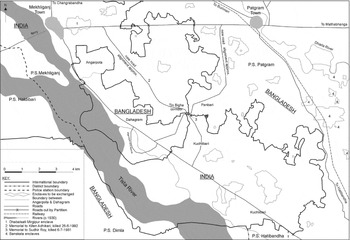
The 26th of June 2007 marked the 15th anniversary of the opening of the Tin Bigha Corridor, a narrow strip of land running through Indian territory that connects the Bangladeshi chhitmahal of DahagramFootnote 1 with mainland Bangladesh. Dahagram is the largest of a series of chhitmahals, or enclaves—literally, pieces of India inside of Bangladesh and vice versa—scattered along the northern part of the India-Bangladesh border.Footnote 2 These enclaves have emerged as persistent problems in the relationship between India and East Pakistan and later Bangladesh.Footnote 3 Situated at the margins of both state and nation, they are at once symbols of an incomplete and ongoing PartitionFootnote 4 and are spaces that complicate easy equations of nation, identity, and territory.Footnote 5 Within the broad complexity of the chhitmahals, Dahagram is particularly marked (see Figure 1). Its peculiar history, especially the long and acrimonious debate over the Corridor, has marked it as an exceptionally unstable and sensitive spaceFootnote 6—one where people continually struggle both for forms of belonging and to maintain their belongings. The instabilities of life within Dahagram are contingent on a range of shifting relations—the political climate between two countries, the vagaries of policing and securing the border, and local communal politics and struggles over territory. The history of the enclave, seen from the ‘ground’ level shapes, articulates with, and differs from, national histories of struggle over space and territory in postcolonial Bengal. It is this complexity and the local histories of claiming various forms of belongings that will be examined here.
Dahagram, Patgram, and Tin Bigha Corridor, Map by Brendan Whyte

The celebration by Dahagram's 16,000 residents on 26th June commemorates the long political struggle over the opening of the Corridor. Friends had been telling me for months about the festivities that would accompany the ‘Corridor Open Day’. You must come. There will be music, sweets. Indians will parade in the Corridor to protest and we will also protest back, demanding a full opening of the Corridor. Footnote 7 Travelling to the enclave from Patgram—a busy market town in Northern Lalmonirhat district in Bangladesh—in a light summer rain, I was looking forward to this spectacle of territorial belonging. As I arrived, there was a crowd of Indian protesters in the Corridor itself, yet there was no corresponding crowd from Dahagram. Curious, I proceeded directly to my friend Tariq'sFootnote 8 tailoring shop to find out what had happened. As it turned out, the celebrations had fallen victim to the ban on political gatherings put in place by the Emergency Administration, which had come to power after the collapse of Bangladesh's Interim Government in January 2007.Footnote 9 ‘We spoke to the UNO [Upazila Nirbahi Officer]’,Footnote 10 Tariq sourly told me after whisking me away for a cup of tea, ‘and decided that because of the Emergency, this year we wouldn't have any celebrations’. And so, while activist groups from the surrounding Indian village of Mekhliganj protested the existence of the Corridor, and indeed, the enclave itself—shouting slogans of ‘United we stand, united we fight’, and ‘Leave Bharat [India]!’—Dahagram residents gathered in tea stalls and grumbled.
This discontent marked more than a lost holiday, or inability to counter the taunts and jeers of Indian protesters. The 26th June Anniversary, even with the paltry media coverage it usually draws, is an annual opportunity to reassert the enclave's claim of belonging to Bangladesh. This is so critical to enclave residents because, despite 60 years of struggle, such claims remain highly partial and, at moments, debated. The Corridor was only open during daylight hours and enclave residents were effectively ‘locked in’ at night.Footnote 11 The Corridor itself runs through sovereign Indian territory and is controlled by the Indian Border Security Forces (BSF), who many believe might close the Tin Bigha for good at any moment. What is more, Dahagram residents know that the enclave itself plays a largely symbolic role in concepts of state, nation, and territory within Bangladesh. The enclave is more important as an idea of territory ‘saved’ from the clutches of a ‘spatially greedy’ Indian state, than as a material geographic reality that is complicated, problematic, and economically and socially marginal from the perspective of the central government. Belonging is a question, as such, that is rarely taken for granted within the enclave.
The problem of understanding life in areas such as Dahagram is one that has recently re-emerged as a central issue in social science and historical research. The outpouring of literature on borders and frontiers has highlighted the importance and the possibilities of engaging borders as ‘privileged site[s] for assessing the power and limitations of the nation state’.Footnote 12 As many of these studies show, life for borderland residents is often one of tenuous negotiation.Footnote 13 At the same time, debates over rights and sovereignty set against the backdrop of the global war on terror have fore-grounded the contingency of membership within nations and states, thus reviving ArendtianFootnote 14 concerns about the tenuous link between rights and statelessness.Footnote 15
Despite these critical interventions, the methodological and linguistic approaches to understanding and describing life in unstable and sensitive border areas like those of Dahagram are often over-determined by broad and abstract concepts such as citizenship, statelessness and, in the wake of Agamben's influential Homo Sacer,Footnote 16 exception and ‘bare life’. Though such concepts have been productive in thinking through the processes and practices of securing border areas,Footnote 17 they do not necessarily clarify the ways residents of such spaces frame their own struggles, histories, and concerns. In a recent critique of the paucity of language for exploring such conditions, Butler argues: ‘I think we must describe destitution. . .but if the language by which we describe [it] presumes, time and again, that the key terms are sovereignty and bare life, we deprive ourselves of the lexicon we need to understand the other networks of power to which it belongs, or how power is recast in that place or even saturated in that place’.Footnote 18 As Butler suggests, the reliance on such tropes limits our ability to describe complex conditions of statelessness and the ways that people who live in such conditions forge their own claims to rights and resources and also in the way they frame their own conditions, histories, and political possibilities.
What, then, is the grammar through which we should begin to reconstruct such histories and claims for those who live in places like Dahagram? My modest response to this question is that a critical starting point is to explore the ways that such issues are framed by those who live in such conditions themselves. In exploring histories of belonging(s) within Dahagram, this paper sheds light on how people frame particular claims to membership—in communities, in nations, in states—and how they seek to actualize their rights. The landscape of Dahagram is historically sedimented with histories of belonging.Footnote 19 Citizenship, displacement, security (both national and personal), and rights, are all subsumed within a range of notions of belonging and indeed belongings (material goods). Movement and the ability to hold and dispose of possessions—land, clothing, houses, crops, livestock—are central to my exploration. Yet belonging is more than purely a question of possession. It is also one of community and identity. Who has the right to belong and why? I explore history from within the enclave, examining the intertwined political economies and cultural politics of belonging(s) in Dahagram largely as its residents related them to me. Rather than establishing the ‘facts’ of Dahagram's history, I argue that these narrations are both the memories of possessions and dispossessions and the bases for ongoing claims to belonging. These claims, in turn, structure particular notions of nation and community that govern who is a legitimate member and what such membership means.
My opportunistic adoption of the homonym ‘belonging’ is intended to draw attention to the ways that the politics of membership within the enclave are inseparable from debates over, and claims of, ownership. Enclave residents would occasionally use Bengali words and phrases such as ami oi barir lok, gramer lok, or more often chhiter lok [I belong to that household, village, or enclave] to denote belonging (membership) and jinishta amar [that is mine], dokhol kora niechi [I (forcefully) took] to denote belonging (possession). The limited usage of these terms per se is not what interests me here. Rather, I am suggesting that broadly exploring ways that membership and property are linked in narrations of Dahagram's history is a more productive way to understand the dilemmas of life in unstable and sensitive spaces than more narrowly defined problematics such as ‘statelessness’ or ‘citizenship’.
Tensions of belonging
Prior to Partition in 1947, the chhitmahals were discontinuous land-holdings dating back to the Mughal incursion north from Dacca (Dhaka in contemporary spelling) into the kingdom of Koch (Cooch) Behar in the late seventeenth century. According to Whyte,Footnote 20 Mughals were unable to dislodge a number of powerful chieftains from the lands around Boda, Patgram and Purvabhag—areas on the frontier between Koch and Mughal rule—that were granted to them by treaty in 1713. These lands remained officially part of the kingdom of Koch Behar while becoming enclaves within the Mughal empire. Similarly, Mughal soldiers had occupied lands inside Koch Behar, lands that became a discontinuous part of Mughal territory. During the colonial period, many of these enclaves were spread along the border between Rangpur district, under direct colonial administration, and Koch Behar, an indirectly ruled ‘Princely State’. Though the existence of such territorial ambiguities caused confusion for colonial administrators,Footnote 21 projects and proposals to ‘solve’ the chhitmahal issue either ran into administrative complications or simply came to no fruitful end. Roughly 200 chhitmahals Footnote 22 became state enclaves—in the sense of being completely bounded by another sovereign state—at and shortly after Partition in 1947 with the accession of Cooch Behar to India in 1949.Footnote 23 Of these, Dahagram was the largest, both in terms of land and population. Situated on the banks of the Tista river, it is, at its closest point, roughly 170 meters from what became the official border.
While the Partition boundary in West Bengal, known as the Radcliffe Line, was nominally drawn by separating majority Hindu districts from majority Muslim districts, this process was much more complicated on the ground. As Van Schendel argues,Footnote 24 very little of the border actually separated majority Muslim and Hindu districts and, in practice, the border more frequently ran through areas where there was a majority of the same religious group on both sides. Furthermore, ‘the clear lines that appeared on the maps used by colonial officials, including the Bengal Boundary (or Radcliffe) Committee, did not correspond with anything visible ‘out there’. There was no way unequivocally to recognize the new border on the ground’.Footnote 25 In practice, the border was worked out through lengthy and often contentious legal and political negotiations between India and Pakistan. Many of the ambiguities resulting from this process, including the enclaves themselves, continue to plague border residents and are the source of ongoing conflicts.
Though punctuated by moments of violence and open conflict, the history of Dahagram during the East Pakistan period (1947–1970)Footnote 26 is perhaps best described as a story of uncomfortable belonging to both India and Pakistan. From Partition, or more specifically from the accession of the Princely State of Cooch Behar to India in 1948,Footnote 27 the complicated border configurations in the Patgram/Mekhliganj region meant that residents of Dahagram had to illegally cross one, and often two, borders simply to take their goods to market. In the years following Partition, and even after the introduction of the official passport system in 1952,Footnote 28 movement across the border was not heavily regulated.Footnote 29 There was regular back and forth travel along the length of the Bengal border, as many border residents had lands and even families bifurcated by the haphazardly-drawn Partition boundary. Yet, as tension between the two countries grew, the number of border incidents skyrocketed.Footnote 30 Regulation and control along the border became more intense and the border itself more formalized through the establishment of boundary commissions to settle territorial controversies and the creation of paramilitary organizations to patrol and secure the border such as the Ansars in East Pakistan and the Bangiya Jatiya Rakshi Bahini [West Bengal National Volunteer Force] in West Bengal.Footnote 31
This gradual formalization ossified an asymmetrical relationship of rights and power inside the enclave drawn along communal lines. Van Schendel argues that notions of citizenship in the post-Partition period had a general character of transterritoriality. ‘Both states saw themselves as being in charge of the populations living in their own territory, but also of a [religious] category of people living in the territory of the other state’.Footnote 32 Dahagram's population was roughly divided between Hindus and Muslims. As movement across the border became more and more legally precarious, the ability of Muslims living within Dahagram to freely and safely travel to market in surrounding areas decreased. Such informal or unstated policies meant that Hindus in Dahagram were residents of India in all but address. At the same time, Mulsims were doubly alienated from membership within Pakistan, legally residing within sovereign East Pakistani territory, yet hemmed in by another state and residing side-by-side with others who effectively held more rights than they. While Hindus in Dahagram were able to live largely as though they were actually residing in India, Muslims had to negotiate the vagaries of paramilitary forces, police, and often-hostile neighbours simply to buy and sell goods.
As with Indian enclaves in East Pakistan, daily navigation of such issues posed intermittent problems. When disputes arose over ownership of livestock or crops, Muslim residents had little recourse, as those who could legally represent and protect their rights were situated across an international border. With the 1958 Nehru-Noon Accords that made provisions to exchange the enclaves—provisions that were fiercely challenged and, ultimately, never implemented—these situations became more precarious. As tensions rose, Dahagram became a zone of contention, and monitoring of and hostility towards its residents grew. An Indian border security camp was established near what is now the Tin Bigha Corridor,Footnote 33 and both residents of the surrounding Indian Thana of Mekhliganj and border security jawans [soldiers] began to patrol its perimeter.
Dahagram residents characterize this period as one of suffering, where the act of going to market was fraught with risk and life within the enclave was one of extreme instability. As residents recall, it was common practice for the border patrols to require a payment or bribes for passage to move into or out of the enclave. As Akkas Ali, a small-holder farmer living in the north of Dahagram, described it, ‘Whenever we crossed into Indian territory, we had to go through BSF scrutiny.Footnote 34 The BSF would note our name, put some mark on our shoulder, such as branding cows. They even compelled us to do work for them, doing such chores as cleaning their lavatories, cutting their lawns, sawing wood for them, etc’.Footnote 35 Whilst residents in the south of the enclave, closest to Bangladesh, frequently dodged security forces to reach the East Pakistani mainland, others residing in the north would more frequently make the trip into India. This trip was more risky as it made travellers vulnerable for longer. Many were arrested in the haat [market] in Mekhliganj.Footnote 36 Enclave residents frequently reminded me, there is not a single family in the enclave who has not suffered [koshto] while a household member was detained in an Indian jail. Beyond the problem of moving into and out of the enclave, Muslim residents faced vulnerability from looting by both Indians in Mekhliganj and Hindus living within the enclave.
The Dahagram War
Such tensions of belonging characterized life for (Muslim) Dahagram residents both before and after the Liberation War in 1971. Indeed, this situation only substantively changed with the opening of the Tin Bigha Corridor in 1992. However, this is neither to say that the difficulties of life within and movement out of the enclave were unchanging nor that they were purely reflections of local struggles over the status of the enclave and its residents. Certain moments in agricultural cycles—during rice harvests, for example—were more violent than others. Conflicts regularly arose over the exact location of the border and raids were carried out on both sides of the border to carry off freshly harvested paddy. Moreover, the politics of belonging within the enclave were indexed to broader debates and struggles over territory, sovereignty, and space between India and Pakistan. In moments of tension, for example during the debate over the Nehru-Noon Accords, daily practices of regulating movement periodically resolved themselves into moments of crisis and open violence. In such moments, residents of the enclaves, and indeed, residents of the border region more broadly, were more likely to experience expropriation, thefts, and various forms of organized communal attacks.
Perhaps the most vividly remembered of these incidents within Dahagram occurred in the spring of 1965 and resulted in the destruction of much of the enclave. This incident, which came to be known as the Dahagram War continues to resonate in enclave politics today. The war was set against the backdrop of increasing tension between India and Pakistan over Kashmir. As the dispute intensified, there was a marked build-up of Indian and Pakistani troops along border regions in both the east and west.Footnote 37 Beginning in January, the Indian Border Security Forces began to amass troops and dig trenches in the area along the Tin Bigha, by far the closest point of the enclave to the mainland. This effectively cut off Dahagram residents from Patgram Thana in East Pakistan and forced them to make a more riskyFootnote 38 crossing into Mekhliganj in India to buy and sell goods.Footnote 39 Tension in Dahagram reached a dangerous height following India's build-up along the Rann of Kachchh—another space that had been contentious and sensitive in the relationship between India and Pakistan situated on India's West Coast—in early March,Footnote 40 and a series of incursions along the East Pakistan border.Footnote 41 Violence seemed inevitable to residents of Dahagram.
On the morning of 13th March, a small herd of goats was rustled by a group of Indians from Mekhliganj. Such back and forth rustling was a common occurrence, particularly along Dahagram's northern border.Footnote 42 Yet in periods of tension, disputes could quickly escalate to overt violence. Bachao Miah, the goats’ owner, crossed the border to demand their return and was shot in the leg by a man who was repeatedly described to me as a ‘BSF officer’. Miah, assisted by his sons, retreated back into Dahagram. That night, Indians surrounded Dahagram on three sides. With the support of the Border Security Forces, they began moving from the border in towards the enclave's centre, burning Muslim homes as they went.Footnote 43
For most, the memory of the outbreak of the war is one of confusion and chaos. Kolim Hyder, who was a boy of eight in 1965, tried to explain the confusion and rupture of that night to me.
It was around eight in the evening. We saw people North of the village crossing the road. Everybody was carrying bundles, gripping their children, and walking fast. . .. People were carrying pillows, quilts. . .. I remember we hadn't taken our evening meal, though usually we ate earlier. My father took the rice pot [bhater hari]. A few days earlier, we had harvested mashkalai dal.Footnote 44 Our yard was filled with kalais. Do you know how to collect kalais from [the] field? The roots come out, not just the plant. Kalai bunches were lying scattered in the yard where during the day ten or twelve people laboured to husk them.
My father rushed to the cow-shed and untied all of the cows, so that they could save their lives and also eat the dal. In those days, we used to grow plenty of kalai. We had vast plots of land [anek jomi] near the char, which have now gone under the river. My father took hold of the rice pot. We kids were walking alongside my mother. We reached Tin Bigha.
When we arrived at the Tin Bigha, the BSF weren't allowing us to pass. . .. BSF was firing to prevent people from crossing Indian territory, but we were desperate and by 10 PM, we passed Tin Bigha and reached the mainland. Not everyone could pass. Others had to wait until the next night. . .. We went to Patgram. We took shelter in a school and we had no food that night. My father threw away the rice pot he carried in the rush across the Tin Bigha, as he had to grip us children. There was a huge crowd. My father threw the rice pot when the BSF fired in Tin Bigha. I walked all the way to Patgram [11 kilometres]. My mother took hold of my young sisters, while my father looked after the elder pair. During the crossing, my father held tight so that I would not be lost in the crowd [Par howar shamoi, abba amar hat dhore rhakse, jano ami harai najai].Footnote 45
The themes of chaos shared in Kolim's vivid remembrances were echoed by almost all who recall the war. Only a few were able to escape through the Tin Bigha on that first night. Most were held there for another 24 hours in terror of an attack from the front by the Border Security Forces or from behind by the same villagers who had burned their homes.
Perhaps what are most vivid in Kolim's narrative are the loss of means to eat and the trauma of separation from places and belongings. His description highlights the stark contrast between the bounty of the dal harvest and the sudden loss of even a pot to cook rice in. Indeed, the story of rescuing a rice pot from a burning house only to lose it in the panic of flight was repeated, in various ways, by many people. Some simply could not carry their cooking pots in their mad dash south. Some report saving their pots only to have lost the rice that was in them. Some remember a fortunate and generous few, mostly those with homes situated close to Tin Bigha, who were able to salvage some rice and share it with those huddled together in hunger and fear, waiting for more than a day for clearance to cross into safety. These collective memories symbolize and encapsulate the loss of homes and the physical flight from the enclave. For Kolim, the forced discarding of the pot seems to mark a stripping away of belongings, reducing the residents of Dahagram to refugees dependent on the hospitality of others. The loss of the pot presaged the difficulties to come.
The large influx of refugees into Patgram dangerously stretched the town's resources. Refugees from Dahagram were billeted in impromptu camps set-up in Patgram's schools and railway stations. The day after residents fled, fighting began between the East Pakistan Rifles post in Panbari and the Indian Border Security Forces post near the Tin Bigha in Mekhliganj. Heavy fire was almost continually exchanged for the following two weeks.Footnote 46 As demands for a withdrawal of aggression were swapped between India and East Pakistan,Footnote 47 troop build-ups continued in the border regions around Patgram, along the length of the Rangpur border, and around other border districts such as Kushtia and Sylhet.Footnote 48 Meanwhile, waves of Muslim refugees living in the Indian district of Cooch Behar began moving across the border amidst reports that they were being forcibly expelled by the Indian Border Security Forces.Footnote 49
On 1st April, a ceasefire agreement was reached and Dahagram residents began to return to their homes from Patgram.Footnote 50 As part of the agreement, the Indian government would provide basic compensation for victims of the attack. These included essentials such as a small amount of rice and cooking oil and a cow for every family who had lost their home so that they could re-till their fields. These meagre supplies were inadequate to carry most residents through the next harvest cycle. Many had lost not only their homes and possessions, but also their stores of rice and dal necessary for both income and household self-sufficiency. What is more, many of the fields planted with rice for the boro harvest in mid-summer had been burned or damaged.
Tensions along the border remained high. The declaration of war between India and Pakistan in June caused a further military buildup along all of East Pakistan's boundaries. Though there was no further direct military action against Dahagram, residents of the surrounding Mekhliganj Thana blockaded the enclave, preventing Muslim residents from travelling to either Mekhliganj or Patgram markets. As one resident bitterly recalled, ‘We used to wait for rain or darkness so that we could rush through [the Tin Bigha] to Patgram to buy essentials. Life was very hard in those days. There was nothing human in that vast India’.Footnote 51 Others remember sifting through the dirt and remains of their burned homes to recover even tiny amounts of rice. Many families were forced to slaughter the cows provided as compensation for food. Most supplemented insufficient diets by fishing the Tista river.
The loss proved to be one that many families were unable to recover from. Jasmine Begum, now an elderly woman living in a run-down home built on the site of her family's original property, bitterly recalls the war as the beginning of her family's long descent into poverty. They had been moderately wealthy, with livestock, enough rice to run a self-sufficient home, and jute to sell in the Mekhliganj and Patgram markets. ‘During the fire, we were unable to take anything away with us. We survived on whatever relief we got. We have never recovered from the fire. We learned fear then. Fear has been part of our life since’.Footnote 52
The Dahagram War marked a moment of trauma that lays bare the vagaries of life for enclave residents in the years before the Liberation War. In memories of this moment, the stakes in imagining forms of belonging within nation and state as linked to possession are clarified. The inability of the East Pakistani state to protect residents in their own homes; the loss of the very means to cook food; and the meagre recompense for loss of homes, crops, and livestock all speak to memories and experiences of instability, uncertainty, and anxiety that were part of daily life within the enclave. Yet, it also marked the way that questions of territorial belonging resonated both within and in relation to Dahagram. Not only were the stakes of national belonging high for enclave residents, but the space of the enclave itself was imbricated in broader questions of territory. While it may be an exaggeration to claim, as many enclave residents do, that the 1965 India-Pakistan War broke out first in Dahagram, it is certainly true that the fate of enclave residents and their ability to live within and move into and out of the space of Dahagram were intimately linked to broader conceptions of national space. Such conceptions were to form the basis of future claims for inclusion and membership.
Belonging to Bangladesh
If the ‘East Pakistan Period’ was characterized by periodic violence and territorial uncertainty, the period after Bangladesh's independence in 1971 leading up to the opening of the Corridor in 1992 was the most unstable and contentious period in Dahagram's postcolonial history. During this time, the lines of belonging and exclusion were starkly drawn and the complications that shaped lives of residents during the East Pakistan period more frequently became open conflicts. Though not far from areas that saw intense fighting during the Liberation War, Dahagram escaped direct involvement. In any case, the Liberation War, at least initially, led to significantly relaxed conditions for Dahagram residents. Following India's military and humanitarian interventions in the Liberation War, a climate of cooperation emerged between India and Bangladesh. During this period, residents moved more freely, both across the border to trade in Indian markets in Mekhliganj, and to the Bangladeshi mainland to trade in Patgram.
This relaxing of tensions, effectively, began to end with the controversies surrounding the Indira-Mujib Pact in 1974. The Pact, also known as the ‘Land Boundary Agreement’, conceived of a range of longstanding territorial disagreements between the two countries as fundamentally linked to animosity between India and Pakistan, as opposed to between India and newly independent Bangladesh. In the wake of the Liberation War—when the border had been effectively, if temporarily, erased—the Pact sought to address these issues. Among the range of agreements reached in the Pact were provisions to resolve outstanding disputes over demarcating the border and the exchange of all the enclaves with the exception of Dahagram and Berubari Union, a disputed area along the border with Jalpaiguri. To address these two contentious spaces, the Pact proposed to cede the disputed area of Berubari to India in exchange for the leasing of the Tin Bigha Corridor to Bangladesh into perpetuity.
The Pact transformed Dahagram into a focal point and symbol of territorial tension and political dispute between Bangladesh and India. In Bangladesh, the Mujib Administration fell under immediate criticism for failing to address the question of the Farakka Barage and water sharing on the Ganges—a longstanding dispute and issue of pressing concern for Bangladesh residents living downstream of India.Footnote 53 Moreover, opposition parties cited the decision to hand over Berubari as a ‘serious attack on the national interest of the country [that] chopped Bangladesh's interest with an axe’.Footnote 54 A writ to block the Berubari handover was turned down by the Supreme Court and the disputed territory was handed over to India shortly thereafter.Footnote 55 In India, a similar dispute emerged over the legality of leasing land to Bangladesh. As the representative of Cooch Behar argued in the Lok Sabha, ‘This type of gift of Tin bigha to Bangladesh must be stopped at all costs. Certainly, we want friendship with Bangladesh, but not at the cost of our motherland. No more appeasement. No more surrenders. No more cessation of our motherland’.Footnote 56 While the Berubari issue was resolved by constitutional amendment within Bangladesh that allowed for the acceptance of the conditions of the Pact,Footnote 57 the leasing of the Corridor remained both politically and legally problematic and unresolved in India.Footnote 58
As legal disputes over the Corridor began to grow, movement again became complicated for Dahagram's Muslim residents. The Border Security Forces imposed a five-kilogram ceiling on goods moving into and out of the enclave. This effectively meant that residents could not sell enough crops to purchase household essentials. Residents, moreover, describe being forced into positions of compromise as it became harder to access markets without negotiating with border security forces. Yet, for many residents, memories from this period are also framed as claims of stoic resistance to territorial aggression. As Bashar, who grew up during this period as a member of a politically influential, though comparatively less wealthy family in the enclave, put it:
BSF would come, demand mangos, wood, or timber, and take anything away they wanted. Anything. A goat, a hen. We had no way to say no. They would bring in their labourers with them. If we said no, the next day they would punish [shasti] us on our way to Mekhliganj. Believe me, we were just like prisoners [ashami]. Worse than prisoners. A prisoner is not in want of food or medicine. We had want of everything. Moreover, we had no freedom to move. The period from 1982–1992, we were in a condition that is not describable in any language [bhashai bola jai na]. For example, if you take Ethiopia, though they are in want of food or medicine, they at least have the freedom to roam around. We had nothing. No freedom, no essentials. Children died of diarrhoea. They were buried without clothes [kafoner kapor chara]. . .. But brother, still Dahagram people did not give their allegiance to India [India ke kono chhar die ni]. They didn't surrender. Even after such severe torture and blockades.Footnote 59
The equation of life inside Dahagram to that of being in a prison was a frequent analogy I heard during my research. Here, this metaphor is extended to suggest that Dahagram was worse off than a country beset by war and famine. Though hyperbolic—male residents did regularly leave Dahagram to access both Mekhliganj and Patgram—the narrative's ultimate claim to belonging is clear: despite deprivation and suffering, Muslim residents persevered and refused to surrender their land and allegiance to India. Their communal claim to belonging repeatedly positioned residents as stoic sufferers holding their land in the name of a Muslim Bengali state.
The challenges posed by these regulations of movement led to increased ‘illegal’ border crossings by often-desperate residents. Many tell stories of men waiting for dark, rain, or fog to cross the Tin Bigha to reach Bangladesh. Others tried their luck in the Mekhliganj markets. Both these activities had a risk of arrest, for which the standard penalty was a fine and one month in jail, though many claim they were detained for longer. During this period, detainees had no way to communicate with their families to inform them of the arrest, leaving their households in states of anxiety until their release. If the position for men was complicated, women were in an even more vulnerable and compromised position. Movement into and out of the enclave was markedly gendered. While men would periodically risk crossing to India or Bangladesh—frequently returning with boastful tales about near misses and bold evasive ploys—women rarely left Dahagram. Their movements were confined not only by religious prohibitions on their leaving the home, but by the added belief, much repeated by men, in their inability to flee from pursuers. During this period, many women died of complications related to childbirth, as access to medical facilities was impractical if not impossible. The threat of violence from hostile neighbours and security forces created further arguments for the cloistering of women within the enclave.
Yet there were more complications and dangers of living in the enclave than just the restriction of movement. Kidnapping and rape were common features of life in Dahagram during this period. Women from within the enclave were periodically taken by villagers from surrounding areas and ‘tortured’ for days before being allowed to return. Men within the enclave also engaged in the kidnapping of women from Mekhliganj. Indeed, these kidnappings were occasionally remembered as celebrations of resistance by Muslim men who had been regularly humiliated by Indian Border Security Forces tolls on movement, insults in Mekhliganj haats, and Hindu neighbours who accentuated such insults through the very freedom of their own movement. The gendered violence involved in territory-making in the post-Independence and pre-Corridor years marked the bodies of women both as belongings (objects within the political and spatial economy of territory) and belonging (symbols of nation and community in need of protection, preservation, and purity).Footnote 60 Women in Dahagram were thus regularly caught-up within multiple and violent politics of possession and inclusion.
The Dahagram Movement Committee
If the Bangladesh period saw an increase in projects seeking to forcibly exclude Muslim residents within Dahagram, it also saw a renewed interest in claiming Dahagram as part of Bangladesh. This movement was intimately linked to the political shift away from secularism in the wake of the assassination of Mujib in 1975 and the assumption of the presidency by Ziaur Rahman in 1977.Footnote 61 This period saw an extension of the communal politicization of territory signalled in the debate over the Indira-Mujib Pact in 1974. In 1977, the Zia Administration issued 16 ‘Civil Guns’ to Dahagram. These guns, nominally for use in ‘defence’, were given to the enclave's unofficial Union Parishad governing body and, in effect, seem to have been distributed to wealthy and politically influential Muslim families within the enclave. This endorsement of violent defence marked, for many, the first concrete step in Bangladesh securing the enclave as a part of its national territory. If, from the perspective of the administration, the distribution of these guns marked territorial sovereignty over Dahagram, for residents, they signified a political acknowledgement that Dahagram belonged to Bangladesh and could be defended as such. While it is not clear how, or if, the weapons were used (many residents told me stories where the guns played significant roles in intimidating Indians, though none shared stories of their being fired), the guns are spoken of almost reverentially as critical symbols of belonging. While representatives of the state could not directly ‘administer’ the enclave, they could encourage residents to claim and defend their own territory.
Zia's awarding of the ‘civil guns’ presaged a series of events in the early 1980s that would bring the questions of belonging and the issues around the Corridor to a head. In July of 1981, the Bangladesh Bureau of Statistics attempted to conduct a census in the enclave as a first step in negotiating the terms of the Tin Bigha Corridor's lease. For Bashar Hassan, this census was a catalyst for galvanizing the political elite in the enclave into broader advocacy and protest for realization of the Indira-Mujib Pact. At the time, he was one of the privileged few within the enclave whose families could afford to send them to school in Patgram. Bashar's memories position the census as a focal moment, both of suffering and of resistance.
Dahagram's first census happened in 1981. If you hear the stories, you will simply tremble. Bangladesh decided to conduct a census to show the world that ‘Dahagram is ours and we are controlling it [Dahagram amader neontrone]’. We who were studying here [in Patgram], were trained as enumerators. . .. However, we were blocked on the way in. Indians came with bows and arrows. . .. Indians were saying that though the enclave belongs to Bangladesh on paper, they would not allow the possession of it. Then the two DCs [District Commissioners] of the neighbouring districts sat again. Indian politicians suggested that ‘If you have to do a census, then go through Changrabhanda [far to the North of the Tin Bigha]’.
Three census officials entered Dahagram by that round-about way. We, however, were instructed by the Bangladesh authorities to do our fieldwork earlier, going through the Tin Bigha in the night as we used to when going to and coming from Patgram. However, after the census, Indians [who were maintaining the blockade] only allowed the officials to return. We fieldworkers had no way to come back. They were on guard on all corners of Dahagram with bows and arrows. They imposed a total blockade which lasted for a long 22 days. These days were the most sad and helpless days of my life. None was able to get out of Dahagram. During these 22 days, 26 of our people died from a scarcity of medicines and other essentials. We had to bury them without any cloth or with old clothes.Footnote 62
As Foucault has argued,Footnote 63 modernity is characterized by a political paradigm primarily concerned with the management of populations through technologies of governance. The census is one strategy through which governments make populations ‘legible’ and ‘manageable’.Footnote 64 As such, it is both a technology of governance and a tool of inclusion and incorporation.Footnote 65 In Dahagram, the very process of conducting the census became a battleground of belonging. To mark residents of Dahagram as members of Bangladesh through enumeration would be to solidify their claims of national inclusion. Bashar's narrative emphasizes this. The purpose of the census was to officially claim that, ‘Dahagram is ours, and we are controlling it’. In this same sense, the protests and attempts to block the census offered a counter-narrative. As the Bangladesh Observer reported at the time, ‘What happened on July 6 when Bangladesh officials in their third bid went to conduct census inside these enclaves was a naked attempt by India to foil the census and show the world that people of these enclaves no more want to remain with Bangladesh’.Footnote 66
Following the census, the group of students who were trained as enumerators decided that direct political action was needed if the enclaves were to be claimed for Bangladesh. To this end, they formed what came to be known as the Dahagram Shangram Shomiti (Dahagram Movement Committee). All these students were from elite and powerful families within Dahagram—families that had been involved in the enclave's politics for a long time. The link between the census and the Movement Committee is striking. Cohn points out that the census in British India was perhaps most significant for politicizing its enumerators.Footnote 67 Though the politics were different in Dahagram than they were in nineteenth-century colonial India, the stakes in classification and inclusion and the political significance of the census were no less apparent to the enumerators who formed the Dahagram Shangram Shomiti. Indeed, for this group of students, the census and the blockade following it offered a clear message that spurred them on to find other ways to forcefully assert their inclusion in Bangladesh. As Bashar recalls: ‘We proceeded with the demand that we should be given back our territory, the territory which belonged to us according to the ‘74 treaty. After the formation of the committee, Bangladeshi administration began to evaluate us. Prior to that, we were just like dogs and foxes.’Footnote 68 In other words, through the actions of the Committee, residents of Dahagram would not only reclaim their territory, but also achieve the status of belonging within Bangladesh and its residents would be recognized as rights-bearing citizens as opposed to marginal people beyond the bounds of the state.
The Dahagram Shangram Shomiti began to raise public awareness of the situation in Dahagram. Mohammad Yusuf, another member of the committee, described their activities to me as claims not just for membership in Bangladesh, but also for the dignity of the residents of Dahagram. It did not simply argue for implementing the Indira-Mujib Pact, but also that residents were deserving members of the nation. In Yusuf's words:
We didn't take any subscription or monetary help from anybody outside the committee. We did it on our own [ja korsi, nijera korci]. One day, three of us were on our way to Ishwardi Junction to stick handbills over a train there that was headed to Chittagong. We only had three taka with us and no tickets. It was our decision that we wouldn't extend our hand, as no movement can be run with money earned by begging. What a movement needs is self-confidence. While returning, the ticket collector found me. I began showing our handbills and saying, ‘You see, we are from Dahagram, we are running our movement’. He was convinced. He fed us pao rutti [toast]. I realized that whoever fights for his country gets respect. Those were good days. A kid like me, who was just in his 10th grade, would go before the DC [District Commissioner] and say, ‘Sir, I am from Dahagram Shangram Shomitti. We are fighting to realize the ‘74 Treaty’. And the DC would pay attention to me, extend his hand to shake with me, and say, ‘Sit down my son’.Footnote 69
Yusuf's description tells a story of both inclusion through struggle and the recognition by other Bangladeshis of the righteousness of their cause. Moreover, it narrates a decidedly local negotiation with institutions of government's interactions with the enclave. As this local history illustrates, renderings of populations and territory engendered dynamics within Dahagram that would prove integral to the shaping of belonging and life both within it and, more broadly, within the nation-state. As Chatterjee argues, a central strategy in the negotiation between populations who are, at best, contextually members of the nation state and the institutions that seek to govern them is to give to the empirical form of a population group the moral attributes of a community.Footnote 70 Yusuf's emphasis on the dignity of the movement's activities, made through earnest appeal as opposed to through begging, stakes out this territory, both for movement members and for the residents they represented. He emphasizes Dahagram residents not as downtrodden burdens on the state, but rather as active political citizens, ready to struggle for their territory and their belonging. In other words, he asserts their belonging in the nation as a means of making a claim for administrative inclusion in the state.
The Dahagram Shangram Shomiti began to draw the notice of authorities in both Bangladesh and India. In Mekhliganj, the police mounted an active effort to locate and arrest its members, whilst the existing Kuchlibari Shangram Shamiti in India, which opposed the opening of the Corridor, and its companion organization, the Tin Bigha Shangram Shamiti, began to increase their own protests and activities.Footnote 71 Tensions rose and blockades and arrests became more frequent. As the activities of the Dahagram Shangram Shomiti became more and more visible, their Indian counterparts in the Kuchlibari Shangram Shamiti expanded their campaign by reaching out to the Hindu nationalist Bharatiya Jananta Party (BJP) to help re-nationalize the question of the Corridor. In response, the Dahagram Shangram Shomiti contacted the Jatiya Ganotantri Party [JAGPA] in Bangladesh, an ardently nationalist party led by Shaiful Alam Prodhan.Footnote 72
In 1984, with JAGPA's support, the committee organized its most dramatic and visible protest, which it called ‘The Long March’. Riaz, another member, described the march to me.
Twenty-two youths from Dahagram joined JAGPA members in a procession wearing funeral robes [kafoner kapor]. First, we performed a Janozah [funeral rights] prayer in Dhaka. Then we began the Long March. We said that by any means necessary we would march through the Tin Bigha, as it should have been Bangladeshi land according to the treaty. Our march got huge attention because of JAGPA's participation. At Lalmonirhat, more than 100,000 peopleFootnote 73 got out of their homes to join us. It was a huge procession, looking like it was just waiting to explode.Footnote 74
Riaz's description highlights the symbolic import of the march. Cut off from the Bangladeshi mainland, Dahagram residents were slowly dying. By formally conducting funeral rights and marching with the intent to pass through the Tin Bigha, Dahagram Shangram Shomiti members were intent to force both an international event that would highlight the debate over the Corridor and emphasize their willingness to confront death in defence of territory, rather than a slow starvation at the hands of the Indian Border Security Forces and residents of Mekhliganj. In other words, the Long March drew attention to Dahagram not simply as a moral community in Chatterjee's sense of the term, but also as a moral obligation to the Bangladeshi state and nation.
Opening the corridor
The activities of the Dahagram Shangram Shomiti coincided with the rise to power in Bangladesh of General Hossain Mohammad Ershad following the assassination of Zia in 1981. Ershad, whose controversial tenure as head of the Bangladesh government lasted from 1982–1991, radically curbed democratic liberties and persistently blocked efforts to overturn military rule and restore Parliamentary Democracy within Bangladesh. Furthermore, his regime continued the move initiated by Zia away from secular Bengali nationalism and moved towards a more overtly Islamist Bangladeshi state. Against this backdrop, the political relationship between India and Bangladesh remained strained. This relationship was further stressed by the increasingly virulent rhetoric of the BJP in India against the threat of illegal immigration from Muslim Bangladesh and pressuring of the Congress Party to take action against it. This pressure led, among other things, to the 1986 Indo-Bangladesh Border Roads & Fences Project.Footnote 75
In 1982, in a conference to resolve border issues, technical experts and security forces from both India and Bangladesh reached an agreement on lease terms for the Tin Bigha. Contrary to the agreement reached in the Indira-Mujib Pact, this new agreement stated that sovereignty over the Corridor would remain in the hands of Indian officials. Despite this clarification, no direct action to open the Corridor was taken, though an active debate re-emerged in India over the legality of the creation of Tin Bigha.Footnote 76 This debate was deployed in different ways by different parties. The Left Front in West Bengal, and notably Amar Roy Prodhan, pressed for the full exchange of all the enclaves, as opposed to the partial solution of just addressing Dahagram.Footnote 77 The BJP enthusiastically adopted the cause of opposing the opening of the Corridor on nationalist grounds. Claiming to defend a country marred by Partition and betrayed by its political leaders, the BJP began to use the Tin Bigha issue as a whip to beat both Congress and West Bengal's Left Front government.Footnote 78 As a pamphlet published in 1992, mirroring much of the rhetoric deployed in public and in the Lok Sabha, claimed, ‘BJP. . . [was] not there in 1947 [at Partition] to resist that evil design, but today, in 1992, things have changed. Today we, the general people, refuse to be a mute party to the sinister design of transferring Tinbigha Corridor to Bangladesh by Roa Govt.—Jyoti Basu combined’.Footnote 79
Nationalist claims to territory and territorial defense were no less prevalent in the Ershad government. Ershad, originally from Rangpur himself and a notorious supporter of Uttor Bongo [North Bengal] championed the cause of Dahagram and the Tin Bigha Corridor as a nationalist issue around the securing of territory, using the 1982 lease as a basis to pressure the Indian administration over Dahagram. As the Dahagram Shangram Shomiti's activities gained increased attention, Ershad began to bring the debate over the Corridor to a head. In 1986, and again in 1988, Ershad made personal visits to the enclave. These visits remain amongst the most celebrated and fondly remembered moments in Dahagram's history. Sharif Udin Talukdar, who was a member of the Dahagram Shangram Shomiti, a prominent political player in the enclave, and future Union Parishad Chairman, remembers the visit as a moment of extreme emotions. ‘He was the first high-profile leader to step into Dahagram. He came here by helicopter. After Ershad's arrival, we were quite speechless. It was as though we helpless folks got our father. We began weeping before him’.Footnote 80
Ershad's visit did indeed mark a turning point in enclave politics. During his visit, he distributed over Tk. 25,000 worth of goods to needy households. He also made Angorpota and Dahagram into an official Union Parishad within Patgram Upazilla, giving it formal political standing within the Bangladesh administrative system, despite its territorial dislocation from the Bangladeshi mainland. He further allocated funds for the development of both schools and medical facilities in Dahagram. Moreover, Ershad began actively advocating for a solution to the Corridor problem, proposing, among other things, the construction of a fly-over bridge for the Tin Bigha, so that residents could effectively pass from Dahagram to Panbari without ever having to touch Indian soil. Yet his visits also increased the tensions over belonging within the enclave. As Riaz explained it to me,
Seeing the emotional outburst on our part at Ershad's visit, Indians understood our true desires and where our commitments lay. After realizing that we were truly Bangladeshi, Indians escalated their tortures. Earlier, they believed that some day we may be India-minded. They hoped that there would be a new generation in Dahagram that was pro-India. After Ershad came, those hopes were gone.Footnote 81
As such, while Ershad's visit brought renewed hope to residents, it also marked an increase in tensions with Mekhliganj. Residents spoke of numerous blockades from the mid 1980s onwards. Indeed, many echoed Bashar's comment on the impossibility of even acquiring kafan cloth to shroud dead bodies in accordance with Islamic funerary rights. We had nothing to bury our dead in and were forced to cover them in banana leaves. Along with an increase in violence between Muslim residents and surrounding areas, Hindus living within the enclave began an active campaign to demonstrate that Dahagram residents ‘desired’ to be part of India. Muslim residents recall that they were often forced or extorted to sign petitions and documents claiming allegiance to India by Hindus living within the enclave, themselves formulating their own claims of belonging to India.
Tensions between the Dahagram Shangram Shomiti and the Kuchlibari Shangram Shamiti, as well as the regular blockades and increases in arrests, continued throughout Ershad's presidency. Yet in 1991, the relationship between India and Bangladesh again briefly thawed with the collapse of the Ershad regime under joint pressure and activism from a coalition of parties and public protests within Bangladesh.Footnote 82 As the Bangladesh National Party (BNP) assumed power and a series of court cases blocking the Corridor in India were resolved, the possibility of opening the Corridor became real. On 26th June 1992, amidst protest by both the Kuchlibari Shangram Shamiti and the BJP, the Corridor finally opened.Footnote 83 Whilst seen, almost uniformly within the enclave, as a major and important victory, the Corridor has also created new and complicated configurations of sovereignty, sensitivity, and belonging within the enclave. Furthermore, the opening of the Corridor has served to ossify the borders of Dahagram. Travelling to Mekhliganj in India is now unambiguously illegal and to get there one must negotiate frequent border patrols and the panoptic watchtowers of the Indian Border Security Forces that now surround the enclave. Access to Bangladesh is now similarly restricted except through the Tin Bigha Corridor, which until 19 October 2011, remained open only during daylight hours.Footnote 84
Many members of the Dahagram Shangram Shomiti feel that the partial and contingent fulfilment of the Indira-Mujib Pact is a betrayal to those who fought and struggled for the Corridor. As Riaz told me,
The [BNP] government, did it wrong to receive the Indian suggestion [that the BSF would control the Corridor]. What could we people of Dahagram do? We had no options. We were helpless. We have no political representation at the national level. We have no strong lobby. We have no strong voice to raise the issue at some international level. In 1982, President Ershad said to India, ‘Give me my territory’. What Khalida Zia did in 1992 was cheap politics [shasta rajniti].Footnote 85
Riaz's claim marks both a frustration at the partial fulfilment of the Indira-Mujib Pact but also another statement of inclusion within Bangladesh. Riaz speaks of heads of state claiming ‘their’ territory. A failure to defend the rights of enclave residents is a lack of commitment to ‘national’ interest. At the same time, the ‘cheap politics’ of the BNP administration highlight that despite the long struggle, belonging in Dahagram remains partial, contingent, and contested.
Understanding the politics of belonging
The opening of the Corridor transformed the landscape of politics in Dahagram in many ways. Yet, the enclave remains an unstable place where the stakes of various forms of uncertain belonging remain high. The Corridor, when opened in 1992, remained open for only one hour a day. Since 1992, the amount of time has increased and until recently the Corridor remained open during daylight hours, a reality that posed a range of uncertainties and anxieties for residents—among them, complications with accessing urgent medical care at night. Inside the enclave, the political fault lines have shifted. Following the opening of the Corridor, the majority of the Hindu families within Dahagram left, leaving a glut of land that residents had little money to purchase. Much of this land was snapped-up by bhatiyas [outsiders] moving from elsewhere in Bangladesh. If the pre-Corridor history is remembered largely along communal lines, many of the contemporary political struggles in the enclave are between long-term residents and these newer migrants, many of whom were able to purchase large amounts of land and have become prosperous small-holder farmers. The opening of the Corridor has allowed for the Bangladesh Rifles (Bangladesh's border security force) to establish several camps within the enclave. It has also led to the establishment of a range of Border Security Forces’ camps around Dahagram's perimeter and the construction of ten panoptic watchtowers staffed by armed Indian Border Security Forces jawans. Despite, and in part because, of such changes, the question of belonging remains acute for residents.
It is no surprise, then, that the enclaves’ history itself is remembered and narrated as a claim to both membership and to the right and ability to hold and possess belongings. The ways that Dahagram's pre-Corridor past is remembered and talked about constitute both stories of possession and dispossession and ongoing claims that the partial belonging afforded by the Corridor is inadequate and insufficient for those who have struggled, persevered, and suffered for Bangladeshi territory. This is not to claim that such narratives are uniform, or that they constitute and encompass all of Dahagram's fragmentary narratives and pasts. Rather, it is to say that the history of Dahagram, as it is told by its residents, is thus an ongoing and unfinished project of transforming and redefining Dahagram's ambiguous and liminal position within the Bengali state and nation—of asserting Dahagram as a moral community worthy and deserving of inclusion within Bangladesh. Chhitmahal residents are frequently referred to as ‘stateless’.Footnote 86 Yet their history has also been an ongoing negotiation with what such a term might mean. If residents are ‘stateless’, their lives are also over-determined by the Indian and East Pakistani/Bangladeshi state and the tension between symbolic and more grounded forms of belonging within and to them. The histories recounted in this paper are both narrations of Dahagram's past as well as projects to claim a national belonging as a means to actualize political membership within the Bangladeshi state. These claims and negotiations go beyond, as they partially encompass, liberal normative notions of ‘rights’ and ‘citizenship’. At the same time, they cannot be understood solely from the perspective of statelessness or bare life.
In sensitive, unstable, and contentious zones such as border regions, upland areas, and enclaves, such histories of belonging(s) are more than simple narrations of the past. They also form the basis of ongoing struggles over how such spaces, and their residents, fit or do not fit into constructions of nation and state. Attending to such histories, and taking seriously the ways that residents of these zones frame them, can provide critical insights into the terrain of negotiation between states and groups and spaces who only imperfectly fit into categories of ‘citizen’ and ‘national territory’. These emic understandings of the past are thus critical in rethinking the politics of inclusion and exclusion and broad networks of power within which they are inscribed.
Seen in this light, discontent over the inability to celebrate such anniversaries as ‘Corridor Open Day’ in Dahagram acquires a different meaning. Residents rarely have the opportunity to publically articulate their histories of suffering for territory or their ongoing demands for full inclusion in Bangladesh.Footnote 87 Belonging for residents of Dahagram determines their ability to move into and out of the enclave, the ability to go to market to sell and purchase essentials, and the constant spectre of violence and fear that haunts those who lived through the long struggle to gain substantive, as well as formal, membership in the territory of Bangladesh. The stakes of articulating claims to belonging are thus more than symbolic—they are about the ongoing negotiation of life in a sensitive, contingent, and unstable space.