Childhood and adolescence are recognised as critical periods for mental health and wellbeing (Cosgrave, et al., Reference Cosgrave, Killackey, Yung, Buckby, Godfrey, Stanford and McGorry2004). Research regarding the onset of mental disorders in children and adolescents has identified many risk and protective factors. One of the strongest risk factors for mental disorders is the experience of trauma through childhood maltreatment (Bailey, Reference Bailey2005). A major protective factor consistently reported in the research is social support (Gilligan, Reference Gilligan2000; Hall-Lande, Eisenberg, Christenson, & Neumark-Sztainer Reference Hall-Lande, Eisenberg, Christenson and Neumark-Sztainer2007; Ravens-Sieberer, Reference Ravens-Sieberer2008; Steinhausen & Metzke, Reference Steinhausen and Metzke2001), with perceived social support more highly correlated with wellbeing than actual received support (Robinson & Garber, Reference Robinson, Garber, Cicchetti and Cohen1995).
Child Maltreatment
Child protection statistics from the Australian Institute of Health and Welfare (AIHW) provide the best available indicator of the extent of the problem of child abuse and neglect in Australia (Bromfield & Horsfall, Reference Bromfield and Horsfall2010). These show that during 2011–12, the total number of substantiations of child abuse and neglect was 48420 (AIHW, 2013). Child protection in Australia categorises child abuse substantiations into four main categories: physical abuse, sexual abuse, emotional abuse, and neglect (Bromfield & Horsfall, Reference Bromfield and Horsfall2010). Physically abusive behaviour refers to any non-accidental physically aggressive acts towards a child. It may be intentional or the inadvertent result of physical punishment (Higgins, Reference Higgins2004). In Australia, physical abuse in 2011–12 accounted for 21% of all substantiated cases of child abuse and neglect (AIHW, 2013).
Emotional maltreatment can consist of acts of commission (e.g., verbal abuse) or omission (withholding of affection or attention). It refers to inappropriate verbal or symbolic acts and a failure to provide adequate non-physical nurture or emotional availability (Bromfield & Horsfall, Reference Bromfield and Horsfall2010). Children who witness domestic violence are also typically categorised as having experienced emotional abuse. In Australia, substantiated cases of emotional abuse in 2011–12 accounted for 37% of all cases of child abuse and neglect (AIHW, 2013).
Neglectful behaviour refers to the failure (usually by a parent) to provide for a child's basic needs. Neglect accounted for 29% of all substantiated cases of child abuse and neglect in 2011–12 in Australia (AIHW, 2013).
Sexual abuse refers to any sexual activity between an adult and a child below the age of consent (16 years); non-consensual sexual activity between minors (e.g., a 14 year old and a 10 year old); or any sexual activity between a child under 18 years and a person in a position of power or authority (e.g., parent, teacher) (Bromfield & Horsfall, Reference Bromfield and Horsfall2010). Sexual abuse accounted for 12% of substantiated cases in 2011–12 in Australia (AIHW, 2013).
Attachment and Trauma
Attachment and trauma theory provide explanations regarding why young people who are abused and neglected are more at risk of developing mental disorders. The basis of attachment theory is a focus on the child's relationship with caregivers who protect, nurture, and care for them. Children must learn to recognise, distinguish, and express their emotions in ways that are compatible with the relationships around them and are also socially acceptable (Fonagy, Target, & Gergely, Reference Fonagy, Target and Gergely2002). Attuned caregivers assist children to develop this skill. Perry explains that “experiences during the early vulnerable period of life are critical to shaping the capacity to form intimate and emotionally healthy relationships” (Perry, Reference Perry, Schetky and Benedek2001, p. 1). When children have suffered from child maltreatment, their capacity to form relationships is severely inhibited (Perry, Runyan, & Sturges, Reference Perry, Runyan and Sturges1998). These children do not gain the core attachment capabilities that should be formed in infancy and early childhood (Perry, Reference Perry1999).
Trauma theory is relevant in understanding the impact of child maltreatment. Van der Kolk (Reference Van der Kolk1989) explained, “Traumatisation occurs when both internal and external resources are inadequate to cope with the threat” (p. 390). Children are considered more vulnerable to the impact of trauma than adults as their brains are still developing and growing rapidly. Repeated experiences of trauma can “organise” a child's brain so they become “primed” for basic survival responses (Perry, Reference Perry2002). The basic internal protective mechanism in humans is the flight or fight response. With each experience of fight or flight, our mind forms a network of connections that get triggered with every new threatening experience. Another internal response to threat is the freeze response, which occurs in situations where fighting or fleeing is not possible. This happens in cases of extreme, repetitive, and almost unendurable trauma. It can be particularly damaging to relationships as emotions need to be available in order to create and sustain healthy relationships (Bloom, Reference Bloom1999).
Children who are exposed to repeated experiences of overwhelming arousal do not have the kind of safety and protection they need for normal brain development. They may never develop normal modulation of arousal (Perry, Reference Perry2002). As a result, they are chronically irritable, angry, unable to manage aggression, impulsive, and anxious (Bloom, Reference Bloom1999). Traumatic events in childhood, therefore, increase risk for a host of social concerns, such as adolescent drug abuse (Perry, Reference Perry1999). As they get older, these children have an increased susceptibility to relationship breakdown, aggression, violence, and controlling behaviours (Goldberg, Reference Goldberg2000). The distinct effects of specific types of abuse have also been investigated. Physical and sexual abuse, when compared with other forms of abuse, are found to have particularly harmful effects, including an increase in susceptibility for developing other mental disorders (Ballon, Courbasson, & Smith, Reference Ballon, Courbasson and Smith2001; Chaffin, Kellenher, & Hollenberg, Reference Chaffin, Kellenher and Hollenberg1996).
Child Maltreatment and Social Support
When children have suffered from child maltreatment, their capacity to form social relationships is severely inhibited (Perry et al., Reference Perry, Runyan and Sturges1998). This is particularly concerning as the capacity/likelihood of social support is a significant protective factor in mental illness (Gilligan, Reference Gilligan2000; Hall-Lande et al., Reference Hall-Lande, Eisenberg, Christenson and Neumark-Sztainer2007; Ravens-Sieberer, Reference Ravens-Sieberer2008; Steinhausen & Metzke, Reference Steinhausen and Metzke2001). Studies undertaken from a range of perspectives have noted the importance of social networks, yet it remains a relatively under-developed area of research and practice in relation to children and adolescents who experience child maltreatment (Frederico, Jackson, & Black, Reference Frederico, Jackson and Black2006). The small body of relevant research notes the importance of children's informal social networks in strengthening mental health for children who have experienced child abuse and neglect (Gilligan, Reference Gilligan1999). Studies relating to trauma, within a developmental psychopathology perspective, have found an absence of social support to be harmful (Jackson & Warren, Reference Jackson and Warren2000; van der Kolk, Reference Van der Kolk, Van der Kolk, McFarlane and Weisaeth1996). Importantly, research on social support has also found that perceived support is the protective factor for mental illness, “Perceiving the availability of a supportive network, whether or not the individual actually uses it, appears to be related to lower levels of distress” (Robinson & Garber, Reference Robinson, Garber, Cicchetti and Cohen1995, p. 163).
Informal vs. Formal Support
Children who have experienced abuse and neglect often have been unable to develop the skills required to initiate, form, and preserve relationships and are at risk because of their paucity of protective informal social networks. A child's social network is largely directed by their caregiver (Robinson & Garber, Reference Robinson, Garber, Cicchetti and Cohen1995), and in cases where children have experienced child abuse and neglect, social support networks are often damaged. This manifests in different ways in their existing social support systems including composition of the network, the amount of conflict within the network, and the amount of reciprocity within the network, which all impact on the network effectiveness (Tracy, Reference Tracy1990).
Another factor involved in social networks for children who have been abused and neglected, is that they have numerous professionals from the service system involved in their lives. Research by Frederico et al. (Reference Frederico, Jackson and Black2006) found 74% of children who had experienced child abuse and neglect listed one or more professionals in their social network map. These comprised mental health clinicians, child protection workers, and foster care workers, who are all professionals involved in the child's life because of their abuse and neglect experience.
The Current Study
The current study aimed to investigate the relationship between abuse experienced by children and adolescents who have involvement by Child Protection Agencies and outcomes in terms of their subsequent social support networks. It was hypothesised that higher levels of abuse would be associated with weaker informal social networks. In contrast, higher levels of abuse were expected to be associated with stronger subsequent formal networks because of the intervention of professionals. The impact of different types of abuse – neglect (abandonment and developmental abuse), emotional abuse, physical abuse, and sexual abuse – were investigated. It was hypothesised that sexual and physical abuse would have the greatest impact resulting in the weakest informal networks and the strongest formal networks. Demographic variables including age, gender, metropolitan/rural residence, and indigenous status and their relationships to abuse experience were also examined.
Method
Participants
Participants were 85 clients from Berry Street Take Two, a service specifically for children reported to authorities and requiring care and protection due to child abuse and neglect. The data was obtained for clients of the service between 2004 and 2010. Clients aged 8–15 years at the time of referral were selected for study. The average age was 10.68 years (SD = 2.13). There were 56.5% who were male and 42.5% who were female; 15.3% who were of Aboriginal or Torres Strait Islander identity; 22.4% who resided in metropolitan areas and 77.6% who resided in rural areas.
Procedure
Ethics approval was obtained from the University of Canberra Committee for Ethics in Human Research, the service, and the Research Coordinating Committee of the Department of Human Services Victoria.
All measures were obtained from existing client files. Clinicians entered information into the files over the course of service provision to the client, and this information was sourced and coded by the researchers.
Consent to use the client data was obtained through the service agreement that clients (and their guardians) accept through the Agency Guideline for client confidentially. This informs clients of the following: “Information may be used for research, monitoring, and evaluating the quality of our services. Your name would be removed if your information were used in this way”.
Measures
Demographics
Demographic information taken from the client files was gender, age in years at referral, Aboriginal and Torres Strait Islander status, and metropolitan or rural area of residence.
Abuse
Abuse was measured using the HCA. This is an instrument that was developed jointly by La Trobe University, Take Two and the Victorian Department of Human Services. It is based on many of the principles outlined in the literature and informed by the Children and Young Persons Act 1989 (CYPA) and remains consistent with the more recent Children, Youth and Families Act 2005 (CYFA) (Frederico et al., Reference Frederico, Jackson and Black2006). The HCA requires the child protection worker to investigate and record the level of abuse in five domains: Abandonment/No Appropriate Carer, Developmental and Medical Harm, Emotional and Psychological Harm, Physical Harm and Injury, and Sexual Harm. For each domain, experiences are listed that are categorised as either concerning, serious, or extreme. Scores were obtained for each domain from 0 (no abuse), 1 (concerning), 2 (serious) to 3 (extreme). A total abuse score was derived by averaging over all five domains, yielding a score that ranged from 0 to 3 with a higher score revealing greater total abuse.
Social network
The social network was measured using the Social Network Map (Tracy & Whittaker, Reference Tracy and Whittaker1990). Children had been asked by their clinician to name different people involved in their life who help them and care for them across seven areas of life. The seven areas of life were: current household, other family, work or school, clubs or organisations, friends, neighbours, and formal agencies.
A more detailed set of questions was then asked about the people listed in the children's maps and responses were placed in a social network grid. These questions relate to whether each person provides concrete support (e.g., tangible support such as money), emotional support (e.g., empathy, caring, love, trust), and information or advice (e.g., guidance, suggestions). The children were also asked if this person was ever critical of them and how close they were to the person. For each area of life, two dimensions of the social network were derived – quantity and quality.
Quantity was determined by the number of people (both children and adults) and the number of people who were adults in each area of life. These scores could range from zero upward, but generally the network was not pursued beyond 15 people.
Quality was measured by averaging the children's answers to questions related to different aspects of support: concrete, emotional, information or advice; closeness; and whether or not the person was critical of them. Scores on each of these scales ranged from 1 (hardly ever) to 3 (almost always). This yielded a total quality of support scale for each area of life that could range from 1 to 3 with higher scores indicating greater perceived support. Note, however, that the scale was able to be accurately computed for only some areas of life due to the absence of support in some areas of life and large amounts of missing data in others (see results section). Adequate reliability was evident for the area of life support scales that were able to be computed according to Cronbach's alpha coefficient: quality of household (α = .66); quality of adult household (α = .68); quality of other family (α = .73); quality of adult other family (α = .72); quality of work/school (α = .67); quality of friends (α = .70); and quality of adult formal (α = .67).
A limitation of social network mapping is that it is designed to be used as a clinical tool and is not set up to be used for research purposes; consequently, it is not a standardised measure and no psychometric data are available from other studies. As a clinical tool, reliability and validity are achieved through the training of all staff in the agency on how to use the measure and the use of detailed scripts prepared by the developers of the tool to guide the clinician's approach (Tracy & Whittaker, Reference Tracy and Whittaker1990).
Results
Data were analysed using PASW version 18.0.
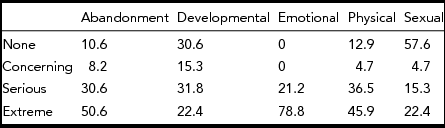
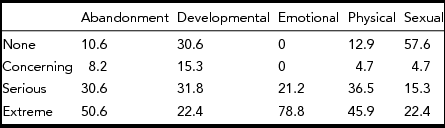
Table 1 presents the percentage of clients who were abused for each type of abuse. Emotional abuse was the most common, overall, with over three quarters experiencing extreme abuse and the remainder experiencing serious abuse. Abandonment was the next most common form, with just over half the clients being extremely abused and only 11% not abused at all. Following this was physical abuse, with a similar pattern of just under half being extremely abused and 13% not abused at all. Developmental abuse was not experienced at all by 31%, but almost one-quarter were extremely abused. Sexual abuse was most likely not to be experienced, with over half not having been sexually abused, but almost a quarter had been extremely abused.
Percent of clients who had experienced each type of abuse by level of abuse.
Note. N = 85.
There were no children who suffered from no form of abuse or only one form. A small number (n = 5, 5.9%) experienced two forms of abuse. Over a quarter suffered three forms of abuse (n = 24, 28.2%); more than one-third suffered from four forms (n = 32, 37.6%); and over a quarter suffered from all five forms of abuse (n = 24, 28.2%). Notably, there were only 6 (7.1%) who did not experience either physical or sexual abuse, and 36.5% (n = 31) experienced both of these forms of abuse. In terms of total abuse, the mean level of abuse for clients was 1.93 (SD = 0.57), which was just under the serious level of abuse cut-off (score of 2.0).
Demographic Factors
The sex difference in the total abuse score was determined by a t-test, which showed that overall there was not a significant sex difference in the amount of total abuse experienced by the clients, t(83) = −0.35, p = .731. Possible sex differences in each type of abuse were determined by Chi-Square tests of independence. The tests revealed no sex difference for: abandonment, χ2 (2) = 1.47, p = .731; developmental abuse, χ2 (3) = 0.79, p = .852; or physical abuse χ2 (2) = 0.18, p = .912. However, a significant sex difference was evident for sexual abuse, χ2 (2) = 9.41, p = .009, Cramer's V = .334. Follow-up analyses revealed that boys were more likely not to be abused than girls (66.7% vs. 45.9%); boys were less likely to experience concerning or serious abuse than girls (8.3% vs. 35.1%); but that at the highest level of abuse, the per cent of boys and girls experiencing extreme abuse was not significantly different (25.0% vs. 18.9%).
The effect of indigenous status on abuse was examined only for the total abuse score because of small sample sizes within the different abuse types. Overall, there was no significant difference between the amount of abuse reported for indigenous and non-indigenous clients, t(83) = −0.13, p = .895. Similarly, there was not a significant effect of rural or metropolitan area of residence on total abuse score, t(83) = –1.77, p = .680.
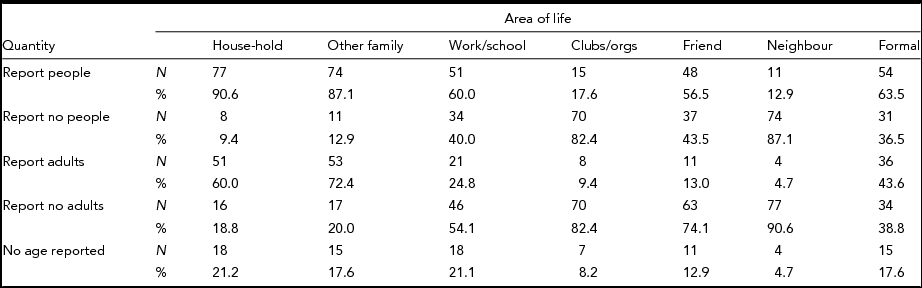
Table 2 presents the number of clients who reported people in their network, by each area of life, for all people (both children and adults), and for adults only. People were most likely to be reported in the other family area of life, followed in order by household, formal, work/school, friends, clubs/organisations, and lastly neighbours. For adults in the network, the same pattern was evident. Table 2 also reveals that in the household area of life almost 10% reported no people at all and almost one-fifth reported no adults. A similar pattern was evident for the “other family” area of life. For the work/school area of life, 40% reported no-one at all and over a half reported no adults. There was almost a complete absence of people in the clubs and organisations area of life. No friends were reported in the network by almost half of the clients and no adult friends by three-quarters of the clients. Neighbours were almost completely absent from the social networks. Finally, for the formal area of life, no people were reported by over a third of clients and a similar percentage reported no adults.
Number of clients reporting people in their network by area of life, for all people and adults only.

Note. No age reported = No age recorded for the person on the Social Network Map.
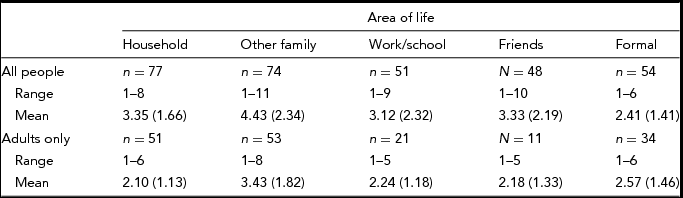
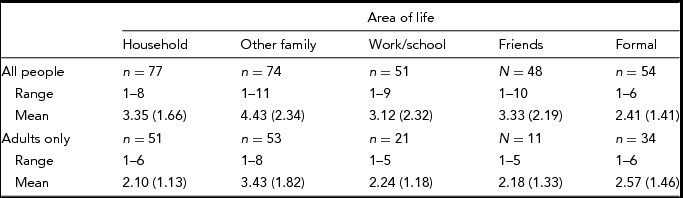
Table 3 presents information on the quantity of the social network, only for clients who reported people in the particular area of life. It gives the range of the number of people reported and the average number of people reported. It is evident that the highest mean number of people was reported in the other family area of life, and that otherwise the mean number of people varied between two and four people in each area of life. Very few clients reported adults in work/school and friends’ areas of life, and all those reported in the formal area of life for whom age was available were adults.
Network quantity by area of life for all people and adults only, for clients with people in each area of life.
Note. (SD), N = number of valid responses analysed.
Of interest to the aims of the current study was how network quantity varied by experience of abuse. Note that this could not be examined for emotional abuse because there was no variance on this measure, as all clients were either seriously or extremely abused emotionally. For the other areas of abuse, concerning and serious abuse were combined, as there were generally too few clients in the concerning abuse category to analyse separately. One-way repeated ANOVAs were undertaken for each type of abuse with the independent variables being the level of abuse and the dependent variables being the number of people in each area of life (note that data for all clients were analysed, including those who reported no people in the area of life). ANOVAs revealed that there was no effect on network quantity in any area of life of the experience of any type of abuse.
Network Quality
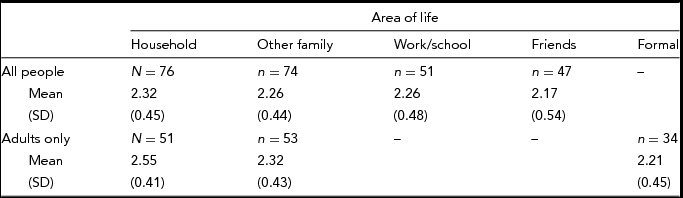
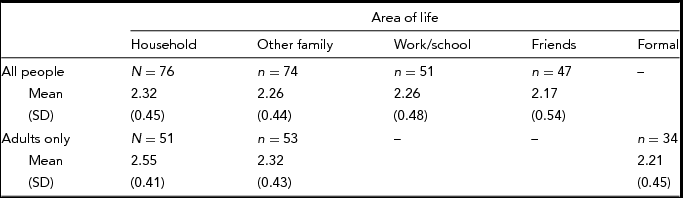
Mean quality of the network by area of life is presented in Table 4. This reveals that, on average, clients received a relatively high level of support from all their available networks, with all the means being above the scale midpoint of 2.0. One-way repeated ANOVAs were undertaken for each type of abuse with the independent variables being the level of abuse and the dependent variables being the mean perceived quality of support in each area of life. These revealed that there was no effect on network quality in any area of life of the experience of any type of abuse, with the exception of the effect of developmental abuse on the quality of perceived support from people at work/school. Follow-up pairwise comparisons showed that the only significant difference (p = .001) was that clients with no developmental abuse reported significantly better network quality in the work/school area of life (M = 2.58, SD = 0.32) than those with concerning or serious abuse (M = 2.05, SD = 0.47). The difference between those with no developmental abuse and those with extreme abuse (M = 2.27, SD = 0.46) was not significant, however (p = .065), nor was the difference between those with serious and concerning abuse and those with extreme abuse (p = .142).
Network quality by area of life for all people and adults only.
Note. N = number of valid responses analysed.
Discussion
The current study investigated whether higher levels of abuse would be associated with weaker informal social networks and stronger formal networks. Results revealed that all children had experienced a high level of abuse and very few had not experienced physical or sexual abuse. The only sex difference was for sexual abuse at no abuse and lower levels, and this difference was not significant at the extreme sexual abuse level. No effect was found of indigenous status, rural/metropolitan area of residence or age. Neither quantity nor quality of the social network maps was found to be related to levels of abuse. Overall, for those clients who reported support, clients received a relatively high level of support from all their available networks. However, many clients had some major deficits in their social networks, particularly in the neighbours’ area and clubs/organisations.
The hypotheses that higher levels of abuse would be associated with weaker informal social networks and that higher levels of abuse were expected to be associated with stronger formal networks were not supported.
The study also hypothesised that those who experienced either physical or sexual abuse would have the weakest informal support networks and the strongest formal support networks. Only 7.1% did not experience either physical or sexual abuse and over a third experienced both physical and sexual abuse, meaning this hypothesis could not be tested. Such high levels of physical and sexual abuse are particularly concerning given their relationship to the development of mental disorders (Chaffin et al., Reference Chaffin, Kellenher and Hollenberg1996).
High levels of emotional abuse experienced by the children meant that comparison between higher/lower levels of emotional abuse on social networks was not possible. The high incidence of emotional abuse in the current study parallels reports by the AIHW (2013), which found that emotional abuse was the highest percentage (37%) of substantiated abuse in Australia in 2011–12.
Examination of demographic information found that boys were more likely not to be sexually abused than girls. While not the topic of this study, such findings need to be viewed with caution given the underreporting of sexual abuse amongst males (O'Leary & Barber, Reference O'Leary and Barber2008).
The finding that clients with support received a relatively high level of support from all available supports in their social network (both formal and informal) is promising, as research on perceived social support has been found to be a protective factor in mental illness (Robinson & Garber, Reference Robinson, Garber, Cicchetti and Cohen1995). Supports were most likely to be reported in “other family” area of life, followed in order by “household”, “formal”, “work/school”, “friends”, “clubs/organisations”, and lastly “neighbours”. This is interesting as the first three networks are provided for children by adults in their lives. While work/school is an informal source of support, as all children should attend, it is formal in the sense that it provides clear structure, rules, and regulations. A contributor to children's sense of social support in this domain may include that when children who have been maltreated are required to pursue social networks, they do so better in a structured environment.
While it was found that clients with support received a relatively high level of support, it should be noted that almost half of the group reported no friends and almost three quarters reported no adult friends. These findings may be reflective of previous knowledge indicating that children who have experienced abuse and neglect have limited relational capacity (Perry et al., Reference Perry, Runyan and Sturges1998). They may also be indicative of a paucity of social network, which is largely directed by the caregiver (Robinson & Garber, Reference Robinson, Garber, Cicchetti and Cohen1995).
It is interesting that a third of children and adolescents reported no adults in the formal area. This could suggest that these children and adolescents do not see the professionals involved as part of their social network. It is also possible, however, that as it was a professional administering the social network map, these children/adolescents may not think to identify this professional as part of their network.
The only significant effect found in the current study was that those who had not experienced developmental abuse reported a significantly better network quality in the work/school area of life than those who had experienced concerning or serious developmental abuse. Children who have not experienced developmental abuse are more likely to have met their age appropriate developmental milestones thus allowing them to be on par with their peers emotionally, physically, and socially.
There was almost a complete absence of supports reported in clubs/organisations. This may be reflective of over three quarters of the population coming from rural areas, where there are lower numbers of clubs/organisations in which children can be a part.
Limitations
The sample investigated a group of children who are not often researched and as such, the sample size was limited. Given the sample was from clients of a child protective service they had all experienced high abuse rates. This did not allow for variance in severity or types of abuse experienced and left one domain of abuse (emotional) completely unable to be examined because this type of abuse was ubiquitous for these young people. Maltreatment subtypes seldom occur in isolation (Higgins & McCabe, Reference Higgins and McCabe2001) and, as such, this child protection sample had high rates of co-occurrence amongst abuse types, which made differentiating according to type of abuse experienced difficult.
Furthermore, the research relied on information already collected from young people in the course of service delivery. While this is ethically preferable, so as not to further distress the young people through possibly distressing research questions, it meant that many questions remain unanswered and data were limited to those recorded in case files.
Directions for Future Research
Little research has investigated the social networks of young people in care for abuse, yet this is a well-established protective factor. This study begins to explore this important area of research. To further research the relationships of type of abuse with impact on social networks, young people with more diverse abuse experience need to be included, to be able to examine a wider range of abuse conditions. It will clearly be difficult, however, to investigate the unique impact of specific types of abuse, because co-occurrence of abuse is so common. A further direction for research would be to investigate developmental impacts by including more young people from different age groups. Although the current study included young people aged 8–15, the sample size precluded powerful analysis of developmental changes.
Conclusion
The current study investigated a group of children and young people who are not often researched. While limited variance on some of the measures restricted the ability to address the hypotheses, description of these young people's social networks using information derived from their clinical management provides a worthwhile avenue to pursue for future research. The impact of child abuse and neglect can be lifelong and relationships are essential to healing. Given this, is imperative that research regarding relationships of these children and young people continues to be pursued.