


How much does self-interest truly matter to political attitudes? This question is fundamental not only to our understanding of political behavior but also to our understanding of democracy and government more broadly. While scholars in political behavior and other fields have made important progress on questions of self-interest and attitudes, we still lack a precise understanding of the magnitude of self-interest effects. I argue that this is due to the absence of empirical tests that distinguish between true, narrow self-interest and other-regarding considerations born from experience and identification with those who are similar to oneself. In other words, it is difficult to disentangle the extent to which my attitudes reflect a desire to benefit myself as opposed to the social or economic groups to which I belong. For example, are senior citizens wary of austerity proposals for old-age programs because they are worried about their own bottom line, or because they feel solidarity and sympathy for other retirees and future retirees?
In this manuscript, I use a novel approach to distinguish between these two factors, exploiting an important and under-studied aspect of many major policy proposals: the presence of a “cutoff” or “carve-out” point that exempts some citizens (e.g., those born before or after a certain date) from austerity or excludes them from benefits. I present results from two survey experiments that focus on issues for which popular discourse suggests self-interest should loom large (privatization of Medicare and student debt relief), and for which age-based carve-outs are a common feature of real policy proposals. Such provisions establish an essentially arbitrary dividing line between those who will be personally affected by a policy and those who will not. In these experiments, I exploit as-if-random distribution of the birth dates of individuals in narrowly drawn, age-appropriate samples around selected cutoff points in tandem with truly random assignment of survey prompts to obtain a “clean” estimate of self-interest effects on support for policy changes. In terms of isolating the true causal effect of self-interest, this is superior to the traditional observational approach of comparing broad demographic categories with each other and to the traditional experimental approach of primes meant to trigger self-interested considerations among all subjects.
Using this new approach, I find that narrow self-interest effects on policy attitudes are real and sometimes substantial, but failing to account for group-oriented sociotropism can lead to exaggerated estimates of their size. The magnitude of self-interest effects varies widely between the two studies, with very large effects in the student debt study and medium–small effects in the Medicare study. Among individuals, those with the largest material stake in the policy (i.e., those most in need of aid) exhibit the largest self-interest effects, as extant theory predicts. A pair of follow-up studies incorporating additional measures suggests that these narrow self-interest effects spill over into beliefs about how policies affect others, complicating our understanding of the distinction between self-interest and other-regarding consideration.
Self-Interest and Attitudes
Scholars of public opinion have long grappled with the role of self-interest in policy attitudes—that is, the extent to which attitudes reflect considerations that “bear directly on the material well-being of individuals’ private lives” (Sears et al. Reference Sears, Lau, Tyler and Allen1980, 671). While some major theories of political behavior (e.g., Hobbes Reference Hobbes1973) assume a dominant role of self-interest in politics, many studies have found that the actual influence of self-interest on attitudes is limited, and secondary to “symbolic” factors like ideology and other-regarding or “sociotropic” concerns (Franko, Tolbert, and Witko Reference Franko, Tolbert and Witko2013; Funk Reference Funk2000; Huddy, Jones, and Chard Reference Huddy, Jones and Chard2001; Lau and Heldman Reference Lau and Heldman2009; Legerski and Berg Reference Legerski and Berg2016; Sears Reference Sears1997; Sears and Funk Reference Sears, Funk and Mansbridge1990; Sears, Hensler, and Speer Reference Sears, Hensler and Speer1979; Sears et al. Reference Sears, Lau, Tyler and Allen1980). A less optimistic strain of scholarship (e.g., Bartels Reference Bartels2008; Hicks, Jacobs, and Matthews Reference Hicks, Jacobs and Matthews2016) questions self-interest from the perspective of macropolitical outcomes, given that nonwealthy voters do not seem motivated to protect their own economic interests. Miller and Ratner (Reference Miller and Ratner1998), in a series of experiments, find that people overestimate the importance of self-interest to others’ attitudes. Similarly, Kim (Reference Kim2014), in a critical essay, argues that self-interest does not live up to our perceptions of it as a motivating force.
Other recent studies have found a more clearly defined role of narrow self-interest in policy attitudes, particularly when self-interest is seen in terms of labor market risk and instability (Alt and Iversen Reference Alt and Iversen2017; Cavaillé and Trump Reference Cavaillé and Trump2015; Chong, Citrin, and Conley Reference Chong, Citrin and Conley2001; Cusack, Iversen, and Rehm Reference Cusack, Iversen and Rehm2006; Darke and Chaiken Reference Darke and Chaiken2005; Doherty, Gerber, and Green Reference Doherty, Gerber and Green2006; Franko Reference Franko2016; Gingrich and Ansell Reference Gingrich and Ansell2012; Häusermann, Kurer, and Schwander Reference Häusermann, Kurer and Schwander2016; Margalit Reference Margalit2013; Owens and Pedulla Reference Owens and Pedulla2014). Even in these cases, however, the influence of self-interest is far from overwhelming, and it seems only to emerge under specific circumstances: when the stakes of a policy for the individual are large, clear, and salient (Chong, Citrin, and Conley Reference Chong, Citrin and Conley2001; Doherty, Gerber, and Green Reference Doherty, Gerber and Green2006).
To be sure, the importance of self-interest to political behavior, such as voting and mobilization, is fairly well-established (e.g., Campbell Reference Campbell2002). This may be due to the fact that self-interest can serve to increase the importance of attitudes (Boninger, Krosnick, and Berent Reference Boninger, Krosnick and Berent1995; McCombs Reference McCombs1999), if not necessarily the content of those attitudes (see also Miller and Ratner Reference Miller and Ratner1998). Self-interest also seems to affect issue attention, another necessary component in political mobilization (Bolsen and Leeper Reference Bolsen and Leeper2013).
At the macro level, much of the scholarly and political attention to self-interest is concerned not so much with individuals as with groups. While idiosyncratic self-interest concerns might affect individual behavior and attitudes in any number of ways, such concerns only matter politically insofar as they affect the attitudes and behavior of groups. This is reflected in much of the aforementioned literature comparing self-interest with other-regarding motives, from studies that sought self-interest effects among white Americans on the issue of school busing (Sears, Hensler, and Speer Reference Sears, Hensler and Speer1979) to comparative welfare state research analyzing the response of different economic classes to growing inequality (Alt and Iversen Reference Alt and Iversen2017). This focus on groups introduces a complication, however—affinity for in-groups is a powerful force in public opinion in its own right—empirically similar to but conceptually distinct from self-interest (Conover Reference Conover1984, 764). Disentangling narrow self-interest, or concern with one’s own material circumstances per Sears et al. (Reference Sears, Lau, Tyler and Allen1980), from sympathy or concern for those similar to the individual is difficult to do in typical observational and experimental research designs.
The questions of self-interest and in-group affinity loom large in the case of senior citizens and “entitlement reform” in the United States. It has become a well-worn cliché to refer to Social Security as the “third rail of American politics” (a phrase often attributed to former House Speaker Tip O’Neill, or one of his aides [Safire Reference Safire2007]), and threatening Medicare, the national health insurance program for seniors, is considered just as politically dangerous. These programs are politically strong, the story goes, because senior citizens in the modern era are politically strong (meaning well-organized and politically active) and motivated to defend them based on self-interest (though again, much academic literature questions this point—see Campbell (Reference Campbell2009), Jacobs and Shapiro (Reference Jacobs and Shapiro1999), Lynch and Myrskylä (Reference Lynch and Myrskylä2009), and Rhodebeck (Reference Rhodebeck1993); see Campbell (Reference Campbell2002) for compelling evidence that self-interest motivates seniors’ mobilization, if not their attitudes). In recent years, this has put Republican politicians in an awkward position—while their policy preferences point toward fundamental reform of old-age “entitlement” programs (both to contain costs and to reduce the role of government in Americans’ lives), they must grapple with the fact that the Republican Party is increasingly reliant on older Americans for support.
One way of squaring this circle is to offer to exempt or “carve out” current or soon-to-be seniors from the pain of reforms. Former President George W. Bush included such an age-based carve-out in his 2005 proposal to privatize Social Security, and former Speaker Paul Ryan included one in his proposal to convert Medicare into a “premium support” program.Footnote 1 In cases like these, the rubber meets the road on the question of self-interest as opposed to symbolic or sociotropic concerns. Do such carve-outs work in building support among older Americans for major policy change?Footnote 2 The failure of Bush’s Social Security plan to garner support among seniors suggests some reason for doubt—Gallup polls conducted before and after the State of the Union address in which the plan was announced suggest that older Americans had a much stronger negative reaction than others (Jones Reference Jones2005). Perhaps seniors did not know or understand that the plan would not have affected them and reacted out of their own perceived self-interest. Alternatively, it could be that in-group affinity for other older Americans who will soon come to rely on the same old-age programs as current retirees contributes to those retirees’ hostility to such policy changes, even if the retirees themselves would be held harmless.
While seniors’ self-interest has long been a subject of attention and debate in American politics, recent developments have raised the salience of self-interest for a much younger group of citizens. The rapid growth of college tuition and student loan debt (Ciluffo Reference Ciluffo2017) has led to growing demand among young Americans for some form of relief. Recognizing this demand, virtually every major Democratic politician has endorsed a higher education affordability initiative (from debt relief to free college), and discussions of what to do about the issue have loomed large in the 2020 Democratic presidential primary (Kreighbaum Reference Kreighbaum2019; Nova Reference Nova2019).
There has been a clear assumption on the part of these politicians that championing this issue would draw greater support from young voters. Indeed, the Democratic candidates who have staked out the most aggressive positions on college affordability and debt (Bernie Sanders and Elizabeth Warren) have drawn the greatest support from younger voters. Attributing causation is difficult, however, as the left-leaning ideology of these candidates is in sync with younger Americans in general, who are much more likely to support radical change than older Americans, even within the Democratic Party (Levitz Reference Levitz2020). High support among the young for free college proposals could be evidence of ideology rather than self-interest or of sociotropic concern born out of recent experience: perhaps those struggling with student debt want to help those younger than themselves to avoid falling into the same circumstances.
Austerity in social insurance for the elderly and student debt relief have something in common—major changes along these lines may not apply to all Americans, even within the relevant subpopulations. Just as social insurance austerity proposals have typically involved a “carve-out” for current or soon-to-be retirees for political reasons, attempts to grapple with the student debt problem may have to focus on a subset of debtors (or potential future debtors) for fiscal reasons. This means that both policy areas are ideal for isolating the true effect of self-interest, since in both cases it is reasonable to assume some sort of arbitrary age threshold above which one is either exempted from austerity measures or excluded from debt relief. The two cases also offer variation in terms of the age of the relevant subgroups and of the nature of the potential impact on those affected (costs versus benefits), which increases the confidence with which consistent results can be generalized.
Hypotheses
Based on the existing literature and my own theoretical expectations, I generate a set of hypotheses on the effects of narrow self-interest considerations on policy attitudes.Footnote 3 Note that since austerity reforms visit costs, while student debt relief delivers benefits, the expected effects are in opposite directions across the two cases for each hypothesis.
The first and most basic expectation is that proposals that either minimize the population subject to austerity or maximize the population receiving benefits will be more popular than those that visit austerity broadly or bestow benefits narrowly. Both self-interested and sociotropic concerns point in this direction.
H1: Policy proposals that exclude some populations from burdens (benefits) will be more (less) popular than proposals containing no such exceptions.
Of course, for self-interest to be a meaningful factor in policy attitudes, concern about how a policy would affect oneself must have an effect beyond the general preference for less austere or more generous policies.
H2: Individuals will exhibit higher (lower) levels of support for proposals that exclude them from burdens (benefits), as compared with similar proposals that do not exclude them personally.
The second hypothesis is necessarily focused on true self-interest: the exclusion or inclusion of the individual him or herself. One goal of this study is to distinguish between such “true” self-interest and sociotropic concern for others similar to oneself in situations where oneself is not directly affected. This latter dynamic is labeled “social identification” by Fowler and Kam (Reference Fowler and Kam2007). This leads to the third hypothesis.
H3: Individuals will exhibit higher (lower) levels of support for policy proposals that exclude people slightly different from themselves from burdens (benefits) than for proposals that contain no such exceptions, even if the exceptions do not affect the individuals themselves.
Which of these two forces—true self-interest or social identification—is more important to policy attitudes? Here, the existing literature is somewhat ambiguous—some work emphasizes the importance of other-regarding considerations over self-interest (Funk Reference Funk2000; Huddy, Jones, and Chard Reference Huddy, Jones and Chard2001), particularly when individuals are considering others like themselves (Conover Reference Conover1984, 764), while some studies suggest that self-interest could override other concerns in situations like this where the stakes are large and clear (Chong, Citrin, and Conley Reference Chong, Citrin and Conley2001). The next set of hypotheses expresses these competing expectations.
H4a: Self-interest will have a larger effect than sociotropic concerns on policy attitudes (the effects predicted in H2 will be larger than those hypothesized in H3).
H4b: Sociotropic concerns will have a larger effect than self-interest on policy attitudes (the effects predicted in H3 will be larger than those hypothesized in H2).
In addition to sociotropism, “symbolic” considerations like left-right ideology are often found to be more important to policy attitudes than self-interest. On the other hand, ideology may not be a strong predictor of policy attitudes in every situation. In the present cases, both status quo Medicare (Norton, DiJulio, and Brodie Reference Norton, DiJulio and Brodie2015) and alleviating student debt (Demos 2018) are broadly popular ideas that are not especially polarized. This leads to a second set of competing hypotheses.
H5a: Self-interest will have a larger effect than ideology on policy attitudes.
H5b: Ideology will have a larger effect than self-interest on policy attitudes.
True self-interest effects, if they exist, should vary predictably across individuals. Specifically, the literature suggests that self-interest effects are largest when the stakes are high (Chong, Citrin, and Conley Reference Chong, Citrin and Conley2001). This certainly seems to be the case when it comes to mobilization among seniors surrounding Social Security, as Campbell (Reference Campbell2002; Reference Campbell2003) finds that poor seniors, who rely on the program the most, are the most active. Similarly, Ozymy (Reference Ozymy2012) finds that poorer college students are more active on student loan issues than their higher-income peers. If this is also true at the level of attitudes, we should observe larger self-interest effects among those who would be placed at greatest risk by cuts or who would stand to benefit the most from new benefits. In the present study, I focus on specific forms of insecurity that would make a respondent more reliant on the policy in question (concerns about economic security and affording medical expenses in retirement and concerns about being able to pay back student loans).
H6: Individuals that will be more reliant on policy will exhibit larger self-interest effects in their policy attitudes than those that will be less reliant. Footnote 4
Research Design
Many existing studies seek to quantify self-interest by making observational comparisons of policy opinions across demographic and economic groups (e.g., Alt and Iversen Reference Alt and Iversen2017; Lau and Heldman Reference Lau and Heldman2009; Rhodebeck Reference Rhodebeck1993; Sears et al. Reference Sears, Lau, Tyler and Allen1980; Tedin, Matland, and Weiher Reference Tedin, Matland and Weiher2001). While these studies contribute valuable evidence, the pitfalls of this strategy are clear: since many other factors differ between demographic groups aside from self-interest, the resulting estimate could be an artifact of these other factors. Control variables offer only a partial solution, since they can only account for factors that are measured and measured accurately. The appeal of a randomized experiment, of course, is that it can potentially offer an estimate of self-interest that is uncontaminated by measurable and unmeasurable differences between economic and demographic groups.
When one considers the reality of group-based affinity, however, designing an effective experiment becomes difficult. If I feel a special affinity for my social group, a randomized experimental prompt that tells me a given program will help (or harm) my group may activate my affinity for my group as well as my narrow self-interest. In this sense, the experimental treatment would “bundle” unintended considerations with the self-interest considerations the researcher intends. One possible solution would be to tell the respondent that she, personally, would be helped (harmed), while others like her would not. While this approach could produce interesting results, it suffers from a lack of realism (public policy does not exempt specific individuals) and makes the intent of the experiment obvious to the respondent (the researcher wants to know how selfish you are) in a way that could trigger social desirability bias.
In this study I exploit the real-world use of age-based carve-outs in policy proposals and use carefully recruited samples in narrow age ranges to avoid the pitfalls of these other strategies. The basic approach is to present respondents within a narrow age range with a description of a policy proposal that would confer benefits or burdens on people in their demographic and economic group, which randomly includes a birthdate-based carve-out that falls roughly in the middle of the age range of the group, excluding all people born before that date from change. This results in four groups: (1) born before the cutoff, carve-out; (2) born before the cutoff, no carve-out; (3) born after the cutoff, carve-out; and (4) born after the cutoff, no carve-out.
Groups (1) and (2) are the only groups that have a self-interested stake in the presence or absence of the carve-out, but the possibility of group-based affinity means that self-interest is not necessarily the only relevant difference between groups (1) and (2): the carve-out may also activate considerations about others similar to the respondent. This is why groups (3) and (4) are crucial to the design: they offer a test of the effect of the carve-out when self-interest considerations are not present, allowing me to estimate the effect of group-based affinity and subtract it from the difference between group (1) and (2).
Subject to some modest and realistic assumptions, then, the difference in treatment effects between older (groups (1) and [2]) and younger (groups (3) and [4]) respondents represent a “clean” estimate of self-interest. The key assumption is that group-based affinity considerations are the same across the birthdate-based cutoff, meaning that people born on one side of the cutoff identify with people born on the other as much as they do with someone born on the same side. My approach of recruiting very narrow age ranges (two to three years) and using arbitrary cutoffs makes this assumption much more plausible: my baseline feeling of social connection to people born before December 31, 1959 should not be meaningfully different if I myself was born in 1959 or 1960.
This study consists of two experimentsFootnote 5 embedded in online surveys of American respondents in narrow demographic categories appropriate to the selected policy proposals: 58- to 60-year-olds for the Medicare reform study and 23- and 24-year-olds who reported having student loan debt for the student debt relief study (see below for more information on these samples). In addition to ensuring that group-based affinity is similar across respondents, sampling from these narrowly defined and directly relevant populations is more appropriate for the study of self-interest than sampling from the national population.
In each experiment, respondents read a description of the policy proposal and were asked to rate their approval or disapproval on a 7-point scale.Footnote 6 In the randomly selected control groups, the description stipulated that the proposed change would apply to all eligible Americans regardless of age. For the treatment groups, the description included a cutoff date; individuals born before this date would not be affected by the change. The cutoff dates fall roughly in the middle of the age range of each sample, meaning that about half of respondents in the “carve-out” condition in each experiment would be personally affected by the described change while about half would not.
The wording of the two experimental questions is as follows, with the experimental manipulations in bold. The Medicare reform proposal is based on former Speaker Ryan’s proposal, while the student debt relief proposal is based on one of Senator Sanders’s 2016 campaign proposals.
We want to ask your opinion on a hypothetical proposal to reform the Medicare program to make it more fiscally sustainable over the long term. Under this proposal, Medicare beneficiaries would be moved out of traditional Medicare into a “premium support” system where they can choose their own private health insurance plan. Medicare would pay a portion of the premiums, and seniors themselves would pay the rest. Under this plan, most seniors would pay higher premiums than they currently pay, and may also pay higher out-of-pocket costs.Footnote 7 This change would apply to all current and future Medicare beneficiaries/would only apply to people who were born after December 31, 1955. People born on or before December 31, 1955 would still be eligible for the current Medicare program. Would you approve or disapprove of this proposal? [7-point scale]
We would like to ask your opinion about a hypothetical proposal to help people with federal student loans pay them off more easily. Under this proposal, the student loan interest rate would be cut almost in half, from its current rate of 4.32% to 2.32%. With this change, the typical borrower could expect to pay several thousand dollars less to repay their loans, depending on the size of their debt and other factors.Footnote 8 This lower rate would be available to all current and future borrowers/only be available to people born after June 30, 1992. Would you approve or disapprove of this proposal? [7 point scale]
Some further discussion of question-wording choices is in order. In designing both prompts, I took steps to avoid potential confounding via “background assumptions.” As Dafoe, Zhang, and Caughey (Reference Dafoe, Zhang and Caughey2018) argue, observed effects in a survey experiment may be due not to the direct or intended effect of the treatment on the dependent variable but to the treatment’s effect on important assumptions that also affect the dependent variable. They demonstrate a number of such scenarios, including that respondents assume a country described as a “democracy” in an experimental prompt is also majority white and Christian. Thus, in order to ensure that experimental prompts are truly affecting the dependent variable in the hypothesized manner, it is important to fix information for respondents. I have done so in two ways.
First, the control prompt explicitly informs respondents that all eligible Americans would be affected rather than offering a “true” control that excludes all information about eligibility. I chose this approach to ensure that respondents in control did not simply assume some sort of carve-out provision would be included, as this is a common feature of policy proposals (particularly entitlement reform proposals). In experimental terms, such respondents would fail to “comply” with the treatment (or control, as the case may be) and bias estimates of the true causal effect downwards. Second, I have also made the stakes explicit for beneficiaries or potential beneficiaries in both experiments—Medicare reform would visit costs on those affected, while student debt relief would extend benefits. This guards against the possibility that respondents in treatment and control groups would make different assumptions about the consequences for those affected.Footnote 9
Both samples were recruited with the aid of a survey research firm (SSI, now Dynata). For the Medicare study (conducted April 19–28, 2016) the sample consisted of 2,020 US-located respondents born between the dates of January 1, 1955, and December 31, 1957. Of these respondents, 1,206 were born after the cutoff date of December 31, 1955.Footnote 10 For the student debt relief study (conducted July 12–22, 2016), the sample consisted of 1,215 US-located respondents born between January 2, 1991, and December 18, 1993, all of whom reported owing at least some student debt.Footnote 11 Of these respondents, 635 were born after the cutoff date of June 30, 1992. By targeting these relatively precise ranges of people with a potential stake in the described policies, I ensure that self-interest considerations, where operative, are clear and salient. Respondents were randomized into treatment and control conditions as described above, without regard to age. I also worked with Dynata to recruit two similar but smaller samples (roughly 500 respondents each) for a pair of follow-up studies in March of 2020, which I discuss briefly in the text and in more detail in Appendix E.
The dependent variables in the analyses that follow are respondents’ approval of the described policy measured on a 7-point scale from “strongly disapprove” to “strongly approve.” The key independent variables are indicators of treatment group and respondent age and interactions between the two.
Testing the ideological hypotheses (H5a and H5b) requires a measure of ideology, which I capture with a 7-point scale (“conservatism”) ranging from “very liberal” to “very conservative.”
Testing H6 on policy reliance requires measures of respondents’ financial circumstances and the extent to which the described proposal would either put them at greater risk or alleviate that risk. For the Medicare study, I asked respondents about their self-reported health, their confidence in their ability to afford their medical costs in retirement, and their confidence in affording a comfortable retirement in general.Footnote 12 These ordinal items scaled well (alpha = 0.78), so I rescaled each to range from 0 to 1 and added them together to create a single measure of health and retirement insecurity, a continuous variable ranging from 0 to 3 (the mean and median of this measure are both 1.5, with a standard deviation of 0.74). For the student loan study, respondents answered a question on whether they agree or disagree (on a 5-point scale) with the statement “I will be able to pay off my student loans.”Footnote 13
Both surveys also included a battery of demographic and political questions to use as control variables where necessary. These including party identification, gender, income, education,Footnote 14 and race/ethnicity. The full text of both surveys can be viewed in Appendices A and B, and descriptive data for both samples can be viewed in Appendix C.Footnote 15
Results
I begin by testing H1, the simple expectation that among all respondents in the Medicare study, the proposal that would exempt those born before the end of 1955 will be more popular than the proposal that affects all recipients. The overall mean approval is 2.53 on the 7-point scale (reflecting the general unpopularity of such austerity proposals), with a standard deviation of 1.79. A t-test for the difference of means in approval scores across the two groups supports the hypothesis: the mean approval in the group with the carve-out is 2.76 out of 7, compared with 2.31 in the group with no carve-out—a statistically significant difference (p < 0.001). The largest effect appears to be in the “strongly disapprove” category, which nearly half (47.2%) of the respondents in the no-carve-out treatment selected as their response, compared with 35.5% of those in the carve-out treatment (again, a statistically significant difference). Still, despite the statistical significance, it should be noted that the effect is substantively modest (about one quarter of a standard deviation) and that overall approval for the proposal is quite low, even in the treatment condition (the mean still falls below 3, which corresponds to “disapprove somewhat” on the scale).
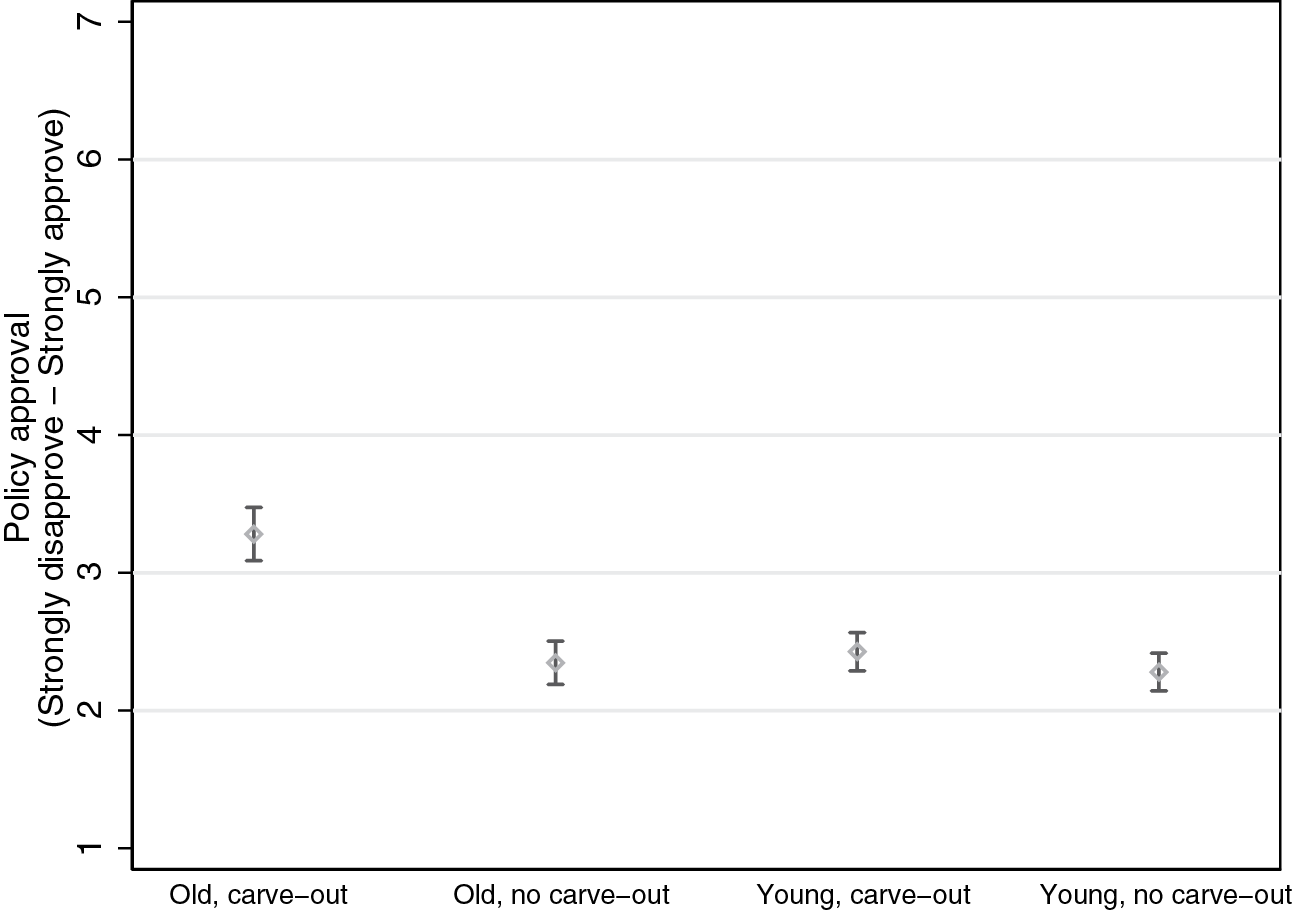
Moving on to narrow self-interest (H2) and group-oriented sociotropism (H3), Figure 1 displays mean approval by experimental condition and age (expressed as whether or not the respondent was born before [“old”] or after [“young”] the cutoff), with 95% confidence intervals. There is clear support for H2 (self-interest), as the gap between “carve-out” and “no-carve-out” conditions is considerably larger among older respondents, who would be spared by the carve-out (0.93, or about 0.52 standard deviations [p < 0.001]) than among younger respondents (0.15, or about 0.08 standard deviations [p = 0.14]). This difference in effects is statistically significant (p < 0.001) in a simple regression of approval on dichotomous variables representing the carve-out treatment and whether or not the respondent was born before the cutoff as well as an interaction between the two. Notably, among those born before the cutoff date, 45.3% “strongly disapprove” in the control condition, compared with just 24.9% in the carve-out condition. The support for H3 (sociotropic effects) is clearly less compelling, as the treatment effect does not attain statistical significance among the younger respondents. Exploring the results in finer detail reveals that the carve-out treatment does significantly dampen the strongest opposition, even among those it does not affect: about 43.5% of younger respondents in the carve-out condition answered “strongly disapprove,” compared with 49.3% in the control (p = 0.04). Still, these results militate in favor of H4a over H4b: the self-interest effect is clearly larger than the sociotropic effect.Footnote 16 Note the implications for estimating the effects of self-interest, however—given that support for the policy was higher in the carve-out condition even for younger respondents, the estimated effect of 0.93 is upwardly biased—the unbiased estimate is 0.78, or 0.44 standard deviations. This estimate distinguishes “true” self-interest from empathy toward others who are retiring soon.Footnote 17
Mean Medicare Proposal Approval Ratings across Experimental Conditions and Age Groups, with 95% Confidence Intervals.

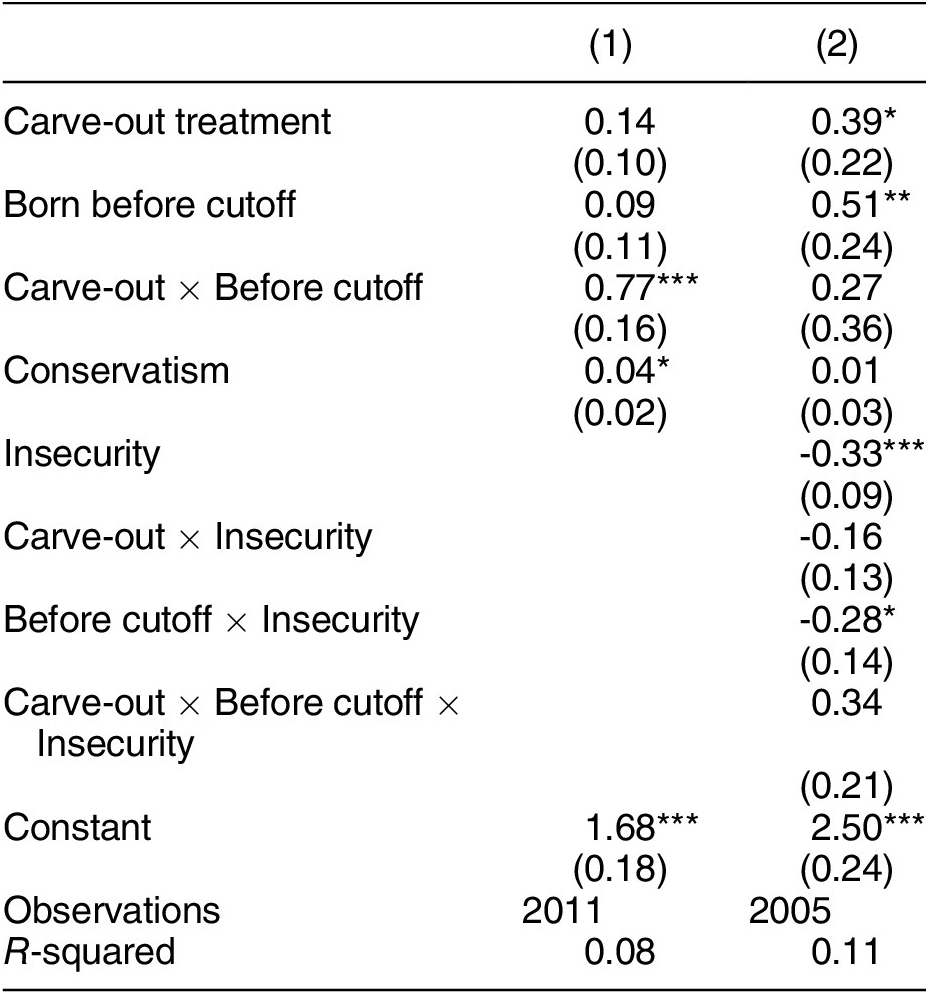
To adjudicate between the effects of self-interest (H5a) and ideology (H5b), I ran a simple regression of approval on a treatment indicator, a dichotomous variable identifying respondents born before the cutoff, an interaction between the two indicators, the 7-point conservatism measure, and a series of controls (gender, education level, income, and seven race/ethnicity indicators, though results for the controls are omitted for space).Footnote 18 The results of this model are displayed in Column 1 of Table 1. As expected, higher levels of conservative ideology are associated with higher approval of the reform proposal, though the effect is small and only marginally statistically significant (p = 0.09). A change equal to the full range of the ideology scale (from “very liberal” to “very conservative”) produces an increase of just 0.28 in support (less than one-sixth of a standard deviation), an effect that pales in comparison with the effect of self-interest (about 0.77 in this regression, nearly identical to the effect visible in Figure 1). H5a is clearly supported over H5b,Footnote 19 though this appears to be a poor test case for comparing the effect of self-interest against ideology, given ideology’s weak effect on this particular policy attitude. This muted effect is a reflection of the broad consensus among the American public in favor of maintaining the social insurance entitlements (Social Security and Medicare) in their current form.
Models of Policy Approval Incorporating Ideology and Health and Retirement Insecurity

Note: Standard errors in parentheses; higher values of the dependent variable indicate higher levels of approval; control variables included but not displayed for space. * p < 0.10, ** p < 0.05, *** p < 0.01.
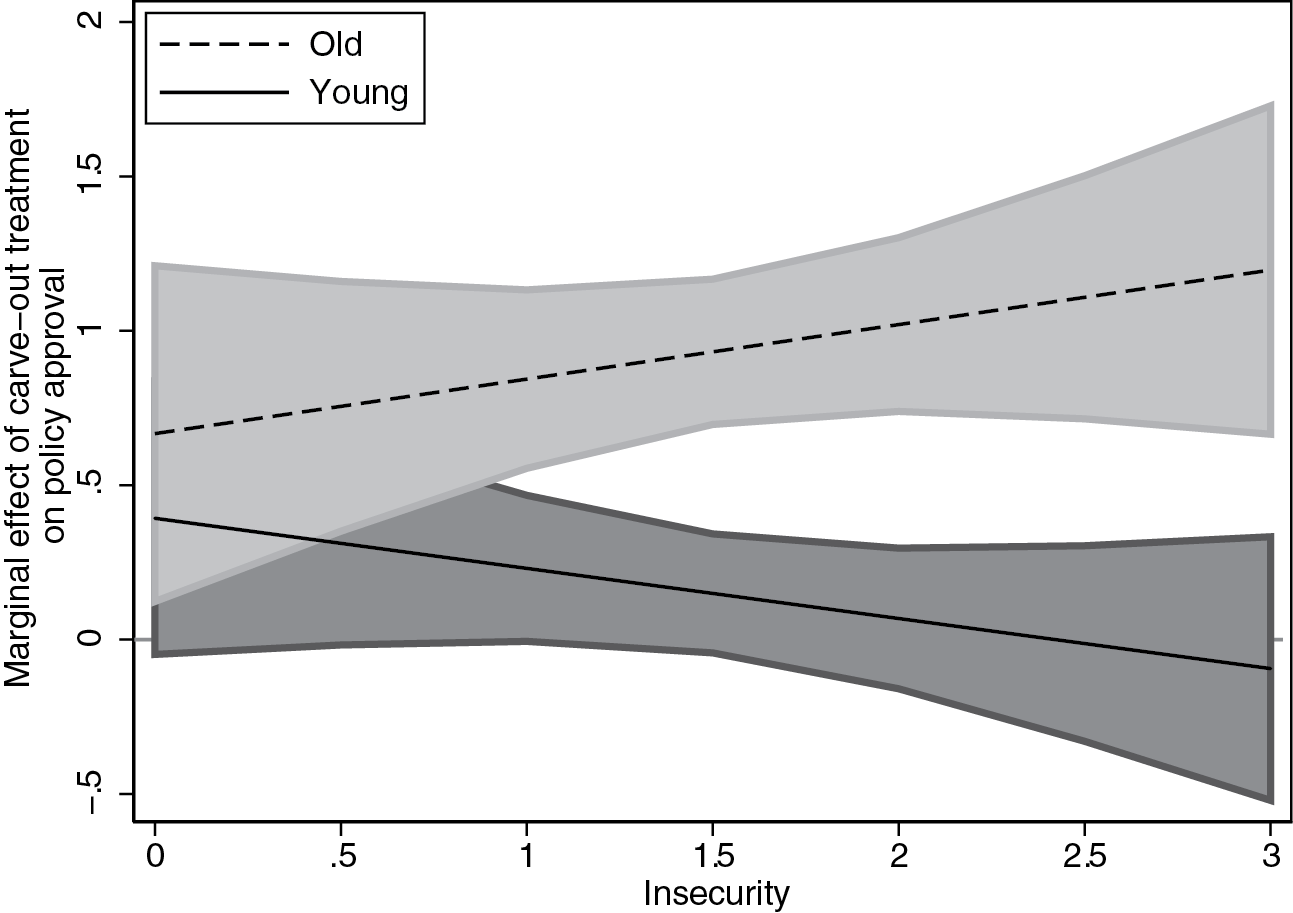
Column 2 of Table 1 tests the hypothesis that those more reliant on Medicare will show larger self-interest effects (H6) by including a triple interaction of the carve-out treatment, the age indicator, and the health and retirement insecurity scale.Footnote 20 Before considering the hypothesis, it is worth noting the constituent term of the insecurity variable is negative and statistically significant, indicating that for younger respondents in the “no carve-out” condition, those who feel less secure about their health and retirement are more strongly opposed to moving toward Medicare privatization. Given the difficulty of interpreting triple interactions, and the inadequacy of coefficients alone to determine the significance of interactions involving continuous variables (Brambor, Clark, and Golder Reference Brambor, Clark and Golder2006), Figure 2 plots the marginal effect of the carve-out treatment for each age group across the range of the insecurity measure. As the figure suggests, the treatment has at most a small effect at lower levels of insecurity among both those who would be spared by it (the older respondents) and those who would not, and there is no evidence this effect differs across the groups. As insecurity increases, the effect grows for those with a self-interested stake, and the groups diverge. These results support H6 and suggest that intensity of need does moderate the effect of self-interest on policy attitudes as existing theory predicts.
Marginal Effect of the Carve-Out Treatment on Medicare Proposal Approval by Age Group and Health and Retirement Insecurity, with 95% Confidence Intervals.

I now turn to the experiment on the student debt relief proposal. H1, the simple expectation that the inclusion of a carve-out will reduce support among all respondents, is clearly supported here as well. Among all respondents, the proposal is remarkably popular, with a mean approval score of 6.15 on the 7-point scale and a standard deviation of 1.36; in fact, the median respondent answered 7, or “strongly approve.”Footnote 21 In the no-carve-out group, this popularity reaches truly impressive heights, with a mean score of 6.60 on the 7-point scale. The inclusion of a carve-out dampens this support considerably to 5.73, a statistically significant difference (p < 0.001). In substantive terms, the effect is moderate-to-large at 0.64 standard deviations. In particular, the treatment seems to have had the biggest effect in the “strongly approve” category—72% of respondents in the no-carve-out condition gave this answer, compared with only 45% in the carve-out condition (again, a statistically significant difference at the p < 0.001 level).
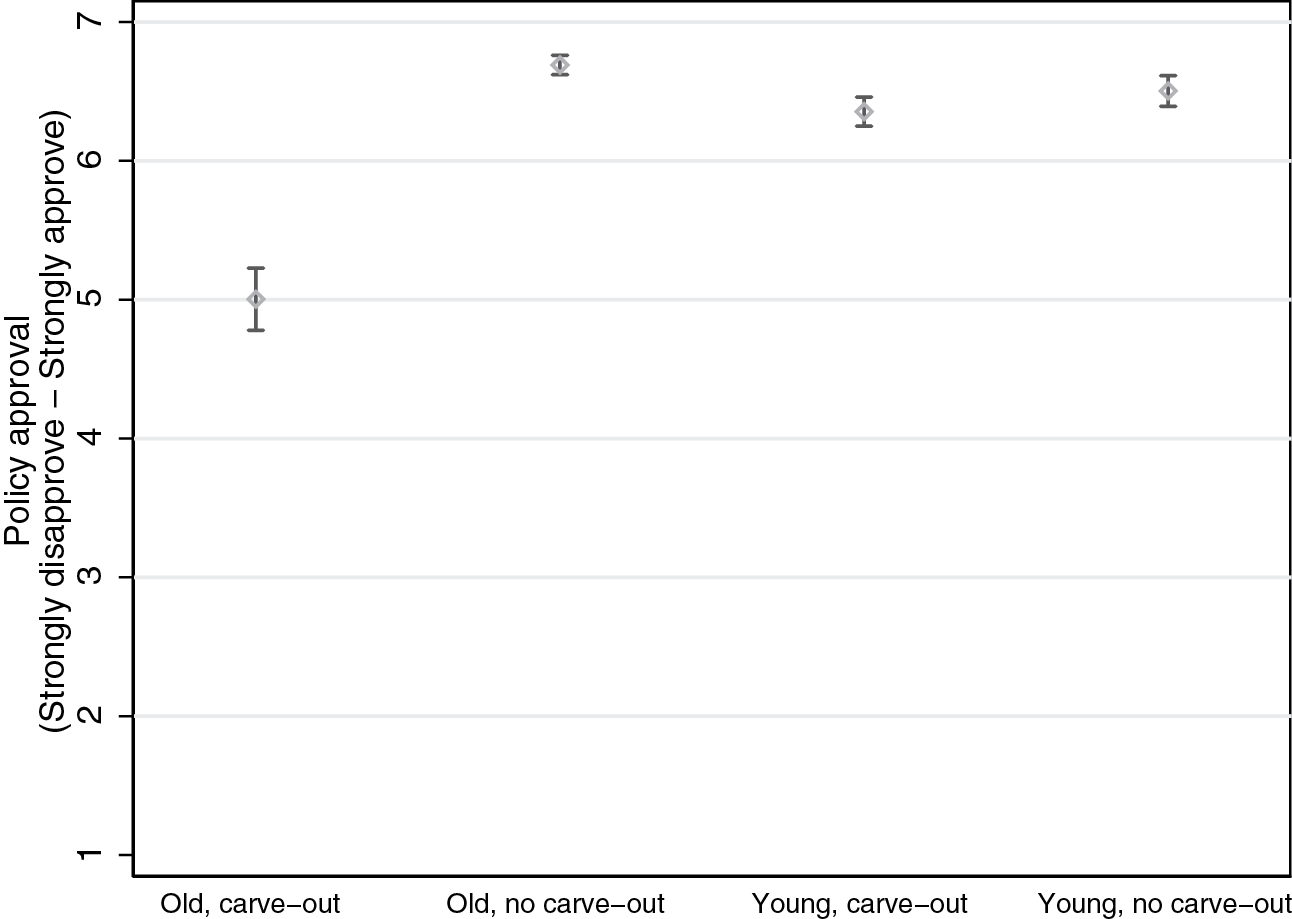
Figure 3 displays mean approval by experimental condition and age, with 95% confidence intervals. Again, the “old” respondents (those born before the cutoff) are the ones for whom the carve-out has direct self-interest implications. There is overwhelming evidence for H2, the self-interest hypothesis: the effect of the carve-out treatment among older respondents is clearly much larger than for younger respondents. In the “old” subcategory, mean approval drops from 6.69 in the no-carve-out condition to 5.00 in the carve-out condition—a very large effect equal to 1.24 standard deviations in the dependent variable (much larger than that observed in the Medicare study). A simple regression with an interaction term confirms that the effect is significantly larger for older respondents (p < 0.001). Nearly three in four older respondents in the control group (74.4%) answered “strongly approve,” compared with just 28.3% in the carve-out condition (p < 0.001). H3, the group-oriented sociotropism hypothesis, also finds support: among younger respondents, for whom the carve-out has no self-interest implications, its inclusion still causes a drop in mean support from 6.50 to 6.35.Footnote 22 This effect is substantively small (0.12 standard deviations) and marginally statistically significant (p = 0.055). Once again, this group-oriented sociotropism effect is most apparent when focusing on the extremes of policy attitudes: only 60% of younger respondents in the carve-out condition chose “strongly approve,” compared with 70% in the control (p = 0.01).
Mean Student Debt Relief Proposal Approval Ratings across Experimental Conditions and Age Groups, with 95% Confidence Intervals.

Also in support of group-oriented sociotropic motivations, it should be noted that, despite the large negative effect of the carve-out among older respondents, the proposal remains remarkably popular among them with a mean score of 5. In fact, the modal response (28%) among these respondents—debtors who were explicitly told the proposal would do nothing to help them—remains 7, “strongly approve.” Still, self-interest, at least as it is measured here, has a much bigger effect than sociotropism, so these results clearly militate in favor of H4a over H4b.Footnote 23
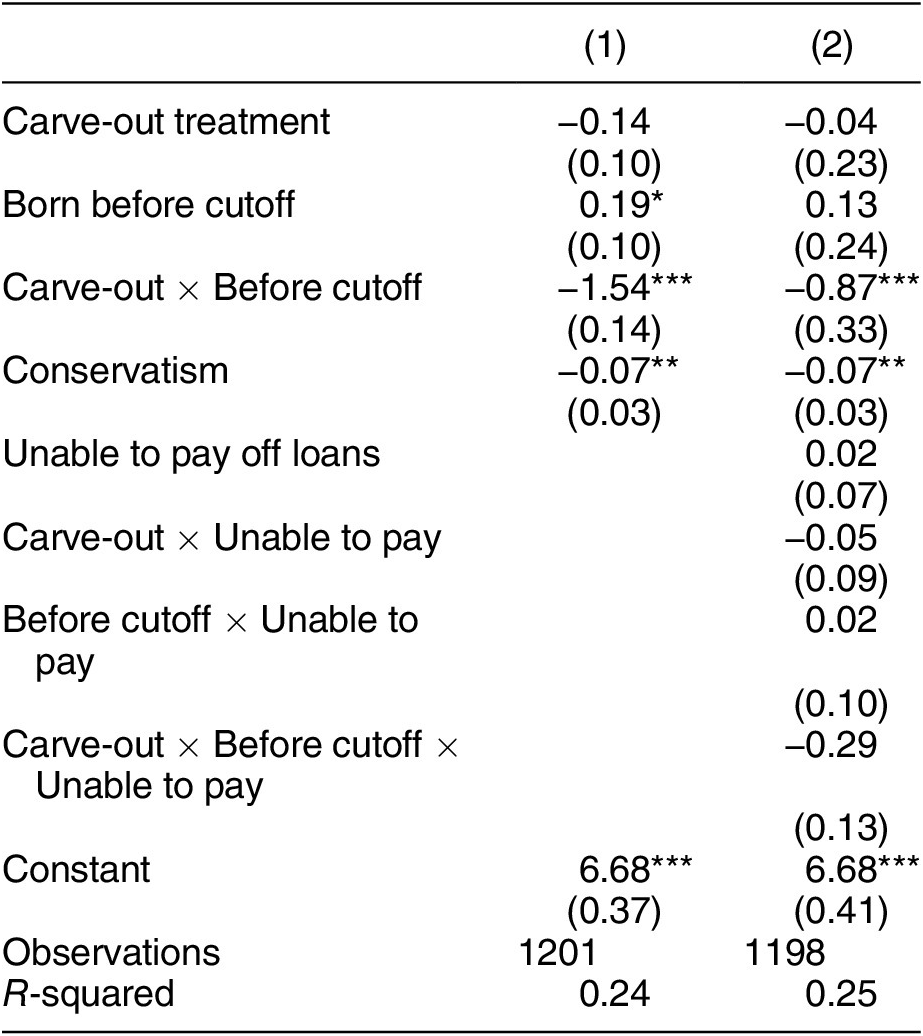
Next, I adjudicate between H5a (self-interest) and H5b (ideology) with a regression of approval on a treatment indicator, an indicator of respondents born before the cutoff, an interaction of the two indicators, the 7-point conservatism measure, and a series of controls described above.Footnote 24 The results are displayed in column 1 of Table 2. Once again, the self-interest effect swamps the ideology effect—a full 7-point shift in conservatism (from “very liberal” to “very conservative”) is associated with a change on the approval scale of just –0.48, compared with the coefficient of –1.54 for the interaction term (the latter represents the pattern visible in Figure 3). This difference in effects is statistically significant in a postestimation test (p < 0.001), indicating strong support for H5a over H5b. Once again, this may not be the ideal test case for the relative effects of ideology and self-interest, given the very modest role that left-right ideology seems to play in this scenario.
Models of Policy Approval Incorporating Ideology and Confidence in Ability to Pay Off Student Loans

Note: Standard errors in parentheses; higher values of the dependent variable indicate higher levels of approval; control variables included but not displayed for space. * p < 0.10, ** p < 0.05, *** p < 0.01.
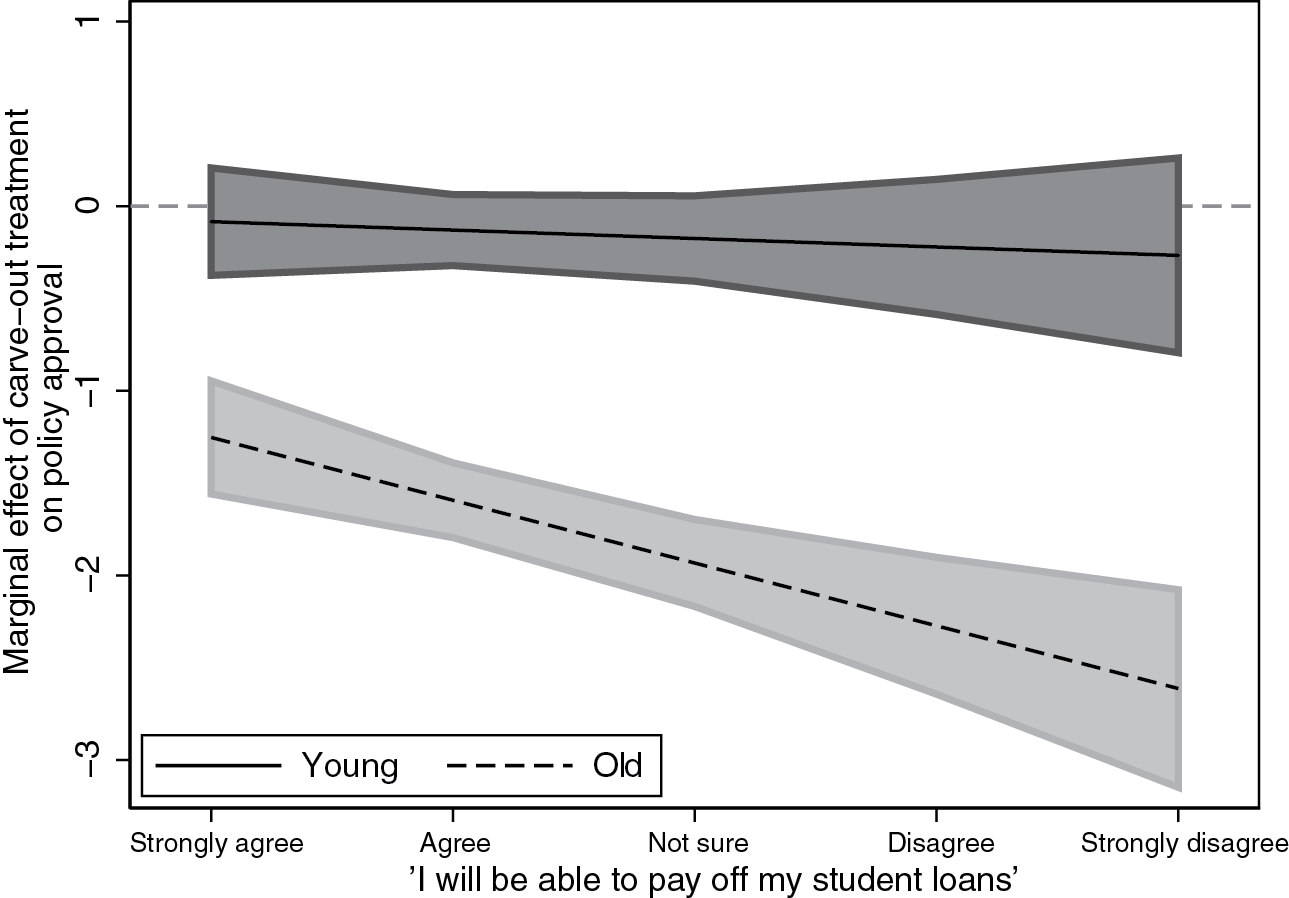
Column 2 of Table 2 displays the results of the model testing the policy reliance hypothesis (H6). The model includes a triple interaction of the treatment, the age indicator and the respondent’s agreement with the statement that they could afford to pay back their student loans (higher values indicate disagreement, or more intense need for the policy intervention). The null results for the loan payoff constituent term and the simple interaction terms with the age and treatment indicators suggest that personal need for student debt relief is not related to policy support among younger respondents in either condition or among older respondents in the no-carve-out condition, while the negative sign and statistical significance of the triple interaction demonstrates that it has a strong effect for older respondents in the carve-out condition. Figure 4 displays this pattern clearly—the negative effect of the treatment/age interaction grows along with the respondent’s level of disagreement with the statement that they will be able to pay off their loans (though it is substantial and significant even for respondents in the “strongly agree” category). This indicates support for H6, though this support is tempered by the results of the follow-up studies (see below).
Marginal Effect of the Carve-out Treatment on Student Debt Relief Proposal Approval by Age Group and Ability to Pay Off Student Loans, with 95% Confidence Intervals.

While the results of these two initial experiments suggest an important role of narrowly defined self-interest in policy attitudes, they offer little insight on the effects of the carve-out treatment beyond simple approval or disapproval of the policy. In order to better understand how people react to such provisions, I conducted two small follow-up studies in March of 2020 (see Appendix E for details). The surveys largely mirrored the original Medicare and student debt studies, but they added additional questions intended to serve as manipulation checks on the treatments and to explore the nature of the effects documented in the main study. Specifically, after the policy approval question, respondents were asked whether the policy would affect them personally and instructed to rate the policy’s likely effects (from very positive to very negative on a 5-point Likert-type scale) on a series of groups and concepts. For both studies, this list included “you personally,” “people like you,” “younger generations,” “the country as a whole,” and “the federal budget.” In the Medicare study, respondents were also asked about “retired people” and “people who are retiring soon,” while the student debt study included “people who are paying back student loans” and “people who are in college now.”
Each follow-up study closely replicated the experimental subgroup effects from the corresponding main study (Figures E.1 and E.12).Footnote 25 The manipulation checks related to self-interest also establish that the treatment–age interaction had the intended effect in terms of establishing the respondents’ personal stake in the proposal. In the Medicare study, older respondents in the carve-out were only one-third as likely to believe the policy would affect them as their counterparts in the other subgroups (Figure E.2). In the student debt study, 44% of older respondents in the carve-out condition believed they would be affected, compared with over 75% in the other three subgroups (Figure E.13). In terms of positive or negative effects on oneself, the results in both studies were as expected: the average response among “carved-out” older respondents was very close to “neutral” (3), while the other three subgroups offered significantly more negative appraisals in the Medicare study (Figure E.3) and positive ratings in the student debt study (Figure E.14). Furthermore, younger respondents clearly understood that the carve-out did not apply to them, as their responses to these items are virtually indistinguishable across treatment groups. This establishes that the significant group-oriented sociotropism effect in the student debt study (which is replicated here) is not simply an artifact of misunderstood self-interest. The same could be said for the corresponding effect in the Medicare study, which is again in the expected direction, though it falls short of statistical significance. Once again, both of these effects would inflate estimates of self-interest effects on approval were they not accounted for.
What effects did the carve-out treatments have on variables measuring other concepts? Among younger respondents for whom the carve-out was personally irrelevant, the carve-out had the expected effect on ratings for “retired people” in the Medicare study (Figure E.5), and it also resulted in significantly more negative ratings of the effect on “younger generations” (Figure E.7). In the student debt study, the carve-out treatment had no significant effect on any variable aside from policy approval for younger respondents (Table E.2), though there is some suggestion that it may have negatively influenced their ratings of how the policy would affect the country as a whole (p = 0.26, Figure E.19). Notably, while carve-outs obviously have fiscal implications, this was not reflected in the main treatment effects for the “federal budget” variable in either study (Figures E.9 and E.20).
Interestingly, for older respondents, it appears that self-interest spilled over into a number of other responses. Perhaps understandably, the interaction effects for “people like you” largely mirrored those for “you” in both studies (Figures E.4 and E.15). Self-interest also spilled over into ratings of how the policy would affect retired people (Figure E.5) and people who are retiring soon (Figure E.6) in the Medicare study and people who are paying back loans (Figure E.16) in the student debt study. More remarkably, being “carved out” significantly (and illogically) affected respondents’ assessments of the likely fiscal impact in the student debt study (Figure E.20) and significantly improved respondents’ beliefs about how the Medicare proposal would affect the country as a whole (Figure E.8).
To summarize the follow-up study results, the experimental design was successful in activating self-interested concerns among the targeted subgroups of respondents. More interestingly, they suggest that the dichotomy between self-interest and sociotropic concerns may not be as distinct as previously assumed. Triggering concern about self-interest, even in a narrow and precise way, appears to color respondents’ views about how the policy would affect others and society at large. This may be because individuals believe their own personal circumstances to be representative of the circumstances of others, or it may be due to an emotional response arising from self-interest. This demonstrates the value of carefully constructed experiments like these, which use narrowly drawn samples and objective, exogenous criteria (birthdate in this case) to randomly assign a self-interested stake to some respondents and not others. It also suggests that, just as apparent self-interest effects may be inflated by social identification, some apparently other-regarding considerations may be influenced by self-interest.
Lastly, the follow-up studies suggest that the findings supporting H6 (the interaction of policy reliance and self-interest) in the main study should be taken with a grain of salt. The findings for the Medicare study (Figure 2) are not replicated (Figure E.11), perhaps due to differences in question ordering. The basic pattern of the interaction of self-interest and the “unable to pay off student loans” variable (Figure 4) is replicated in Figure E.21 (though statistically insignificant in the smaller sample), but an alternative measure of policy reliance (one tapping “concern” about being able to pay back loans) does not produce a similar result (Figure E.22).
Discussion and Conclusion
This study makes a number of contributions to our understanding of the attitudinal effects of self interest in general and the effect of “carve-out” provisions in particular, the latter being an under-studied phenomenon in politics and public policy.
First, both experiments make clear that narrowly defined self-interest can indeed play a role in attitude formation as well as behavior and mobilization. Consistent with existing literature, I find effects in a situation where the personal stake in policy is clear and salient, and these effects are more pronounced when individual need is greatest (though the findings of the follow-up study suggest the latter results may not be robust). In terms of substantive size, these self-interest effects dwarf group-based altruism (i.e., concern for others affected by a cutoff) and ideological concerns, though caution is warranted with respect to generalizing the latter finding, given that ideological effects were small in both studies. It appears that the most pronounced effects of self-interest came at the extreme ends of the approval scale—increasing or reducing the proportion of respondents who selected “strongly approve” or “strongly disapprove”—rather than at the threshold between support and opposition. This is consistent with past findings that self-interest motivates behavior more clearly than attitudes—one possible mechanism for this dynamic would be that self-interest increases attitude intensity and therefore mobilization (Boninger, Krosnick, and Berent Reference Boninger, Krosnick and Berent1995; McCombs Reference McCombs1999).
How relevant are these findings to politics in the real world? While “carving out” is a policy and political strategy that elected officials do pursue from time to time, and while the experimental prompts presented here were designed to be as realistic as possible, they were still presented to respondents in an artificial setting. In real life, members of the public learn about policy proposals from politicians, the media, and interest groups seeking to mobilize them in support or opposition—the way these elites present this information, and the way that individuals perceive these elites, is very important in shaping public opinion (Zaller Reference Zaller1992). Would the effects documented here really matter in a more realistic political scenario? I argue that there is reason to believe that they would. Again, existing work (Boninger, Krosnick, and Berent Reference Boninger, Krosnick and Berent1995; McCombs Reference McCombs1999) has established self-interest as a mobilizing force, and the nature of these attitudinal effects is consistent with that—the largest differences between treatment and control involve the extremes of the 7-point scales. To use the Medicare findings as an example, the likely real-world effect of such a carve-out strategy would not be to change the minds of those opposed to austerity, but to blunt some of the fiercest opposition, which would, in turn, reduce the likelihood of mobilization from current retirees. Perhaps a card-carrying member of the American Association of Retired Persons who would otherwise have responded to the organization’s call to write his representatives in opposition to an entitlement reform plan might decide it is not worth his while after finding out that the plan would not affect his own bottom line, even as he continues to believe the plan is bad policy. Perhaps a liberal Democrat with student loan debt who would have joined a march or rally to demand passage of a relief plan that would help her would be less eager to do so after finding out that the plan carves her out.
Moreover, it is easy to see how carve-outs could matter not just as another covariate in a model of attitudes that also includes partisan or interest group elite cues, but as a rhetorical shield or bludgeon employed by those same elites. A Republican proponent of entitlement reform can promise that “current retirees will not be affected,” while a left-wing Democrat calling for a more radical approach to student debt might attack the hypothetical loan relief proposal from this study as “doing nothing for those who are already struggling with debt.” The effectiveness of such messages would depend in part on the partisan identity of the people hearing them, but these findings suggest that self-interested considerations would also magnify or dampen the effects.
Still, these findings should be kept in perspective. It bears repeating here that these populations were very narrowly and carefully selected to maximize the size of self-interest effects. While the self-interest effect in the student debt study was quite large, the effect in the Medicare study was surprisingly modest at less than one half of a standard deviation. Moreover, in both studies, self-interest was clearly far from the whole story—Medicare privatization was overwhelmingly unpopular and student debt relief overwhelmingly popular across the board.
This study also makes an important contribution to the self-interest literature in its distinction between true self-interest and affinity for those similar to oneself, a distinction many studies do not make. Failure to account for the effect of the treatment among those who would not be personally affected would have overstated the apparent effect of self-interest by about 0.08 standard deviations in the Medicare study and 0.12 standard deviations in the student debt relief study (the latter being a statistically significant difference, the former nearly so). While these differences were small, they demonstrate that empathy towards others in one’s social group can bias the measurement of self-interest effects. In the case of the Medicare study, if I had not accounted for group-oriented sociotropism, I would have concluded that the self-interest effect was about 20% larger (0.52 standard deviations rather than 0.44). In both studies, group-oriented sociotropism significantly inflated the effects of the carve-out treatment on strong approval or disapproval. Moreover, the results of the follow-up studies, which included alternative dependent variables tapping respondents’ beliefs about how the policy would affect others, suggest that the distinction between self-interest and sociotropism is surprisingly fuzzy. Together, these findings suggest caution in the measurement of ostensible self-interest effects and, more importantly, a more nuanced view of self-interest and sociotropism. It may be more appropriate to think of these concepts as opposite ends of a spectrum, with points in between representing concern for others similar to oneself rather than generalized altruism.
Of course, this study does have some important limitations. Notably, it examines two policy issues where left-right ideology (and partisanship) plays a relatively small role, at least among the targeted subpopulations who took part in the experiments. A study of more polarizing or divisive policy issues may well find that ideology and partisanship swamp any effects of self-interest on policy attitudes. Moreover, while the difference in effect size between the two studies is surprising given that much existing work in the vein of prospect theory (Kahneman and Tversky Reference Kahneman and Tversky1979) leads us to expect losses to be a more powerful motivator than gains, the numerous other differences between the two samples and studies make it impossible to assign much significance to this difference. Lastly, the findings of the manipulation checks in the follow-up study (Appendix E) suggest that self-interest considerations may affect policy attitudes through complex mechanisms (such as motivated reasoning), which this study was not designed to disentangle. These limitations point to a need for more experimental and observational research on the politics of “carving out.”
Supplementary Materials
To view supplementary material for this article, please visit http://dx.doi.org/10.1017/S0003055420000465.
Replication materials can be found on Dataverse at: https://doi.org/10.7910/DVN/RSSRRV




Comments
No Comments have been published for this article.