Introduction
The World Health Organization (WHO) defines palliative care (PC) “as an approach that improves the quality of life of patients and their families facing the problem associated with a life-threatening illness, through the prevention and relief of suffering by means of early identification and impeccable assessment and treatment of pain and other problems, physical, psychosocial and spiritual” (World Health Organization, 2017).
Palliative care is beneficial for patients with advanced cancer in both the outpatient and inpatient settings (Dalal & Bruera, Reference Dalal and Bruera2017). Previous studies have demonstrated that PC improves cancer patients’ quality of life, mood, satisfaction with care (Bakitas et al., Reference Bakitas, Lyons and Hegel2009; Temel et al., Reference Temel, Greer and Muzikansky2010; Zimmermann et al., Reference Zimmermann, Swami and Krzyzanowska2014), healthcare-related outcomes such as costs of care, and end-of-life (EOL) quality care indicators such as number of emergency department visits, hospitalizations, hospital deaths, and intensive care unit admissions (Greer et al., Reference Greer, Tramontano and McMahon2016; Higginson & Evans, Reference Higginson and Evans2010; Hui et al., Reference Hui, Kim and Roquemore2014).
Based on this evidence, current guidelines and position statements from the American Society of Clinical Oncology, European Society for Medical Oncology, and other influential organizations recommend that PC should be integrated early in the disease trajectory of patients with advanced cancer, concurrently with cancer-directed therapies (Ferrell et al., Reference Ferrell, Temel and Temin2017; Jordan et al., Reference Jordan, Aapro and Kaasa2018; Sepúlveda et al., Reference Sepúlveda, Marlin and Yoshida2002).
Despite this recommendation and the well-recognized growing need for PC because of the aging of the world population and the increase in cancer prevalence, PC is underdeveloped in most parts of the world, and most patients have late or no access to PC (Connor & Bermedo, Reference Connor and Bermedo2014). In the last Worldwide Palliative Care Alliance/WHO report that mapped the level of PC development among 234 nations, only 8.5% (most of which were in high-income countries from North America and Europe) have achieved an advanced stage of PC integration into the national healthcare systems (Lynch et al., Reference Lynch, Connor and Clark2013b). Furthermore, little is known about the outcomes of cancer patients referred to specialized inpatient PC teams in developing countries (Hannon et al., Reference Hannon, Zimmermann and Knaul2016).
In a recently published systematic review examining several patient-reported and healthcare-related outcomes of patients with advanced cancer referred to an inpatient PC team, there were no studies including patients from developing nations (Yang et al., Reference Yang, Neo and Lim2016). Hence, there is a great need to examine the outcomes of cancer patients referred to specialized PC teams in the developing regions of the world.
In Brazil, the largest country of Latin America and world's ninth-largest economy (World Development Indicators, 2016), the National Cancer Institute estimates that 600,000 new cancer cases will occur each year for the 2018–2019 biennium (Instituto Nacional de Câncer, 2018). Similar to other low- and middle-income nations, although the number of cancer patients needing PC is growing rapidly, the availability of specialized PC services is generally low (Connor & Bermedo, Reference Connor and Bermedo2014). The aim of our study was to examine the timing of PC access and outcomes of patients with advanced cancer admitted to a tertiary care general hospital in Brazil and referred for the first time to an inpatient PC team.
Methods
At our institution, a 657-bed private practice tertiary care general hospital, a consultation team of three physicians and a nurse provide specialized PC to the inpatient population. PC consultations include a thorough assessment and management of patients’ physical and emotional symptoms, illness understanding and goals of care, psychosocial and spiritual needs, and EOL issues. Discussions regarding the risk and benefit of all clinical interventions, procedures, and medications, as well as advanced care planning discussions, are frequently held with patients, families, and the primary referring team to develop a personalized plan of care based on the patient's individual needs, goals, values, and prognosis. If necessary, members of other disciplines, such as psychologists, physical therapists, nutritionists, and social workers, are available upon demand. All patients are followed on a daily basis by the PC team.
The eligibility criteria for this retrospective study included (1) diagnosis of advanced cancer, defined as locally advanced, recurrent, or metastatic for solid tumors, and relapse or refractory for hematologic malignancies; (2) age 18 years or older; and (3) patients with advanced cancer referred for the first time to the inpatient PC team during admission.
We retrospectively reviewed the institutional database to identify all consecutive patients with advanced cancer referred for the first time to the inpatient PC team between April 2015 and December 2016. From the 124 patients with advanced cancer identified, 13 were excluded because they were seen for a comprehensive geriatric assessment before starting cancer therapy instead of for a PC consultation by one of the PC team members, who is also a geriatrician. The medical records of the remaining 111 inpatients consulted were assessed to collect data on patient's demographics (age, gender, and religion), clinical characteristics (cancer type, Eastern Cooperative Oncology Group performance status, Charlson Comorbidity Index, and reason for admission), primary referring team, final disposition (death or discharge), length of hospital stay, and settings of PC consult and inpatient death (i.e., ward, step-down unit, or intensive care unit). Also, we retrieved information regarding the use and types of scheduled medications, including the use of any analgesics, opioids, coanalgesics, antibiotics, antipsychotics, statins, antiemetics, thromboprophylaxis, and antihypertensive agents; and documentation of EOL preferences as registered by the PC team in the patient assessment note. The latter includes the willingness to receive orotracheal intubation, intensive care treatment, cardiopulmonary resuscitation, and artificial nutrition (enteral or parenteral) at the day of PC referral and at the last day of admission.
Information on clinical interventions, including the use of artificial nutrition (enteral or parenteral), dialysis, vasopressors, mechanical ventilation, chemotherapy, and radiation therapy, was collected at the day of PC referral and reviewed for any changes occurring during the admission period. A comparative analysis of before-and-after PC consultation was performed. In addition, we assessed the institutional PC forms to capture the core domains addressed by the PC team during admission. Finally, to study the timing of PC access, we calculated the interval between hospital admission and first PC consultation as well as the time from PC consultation to death or discharged.
This study received approval from the Institutional Review Board of Hospital Israelita Albert Einstein (project number CAAE: 69522417.1.0000.0071). Because of retrospective data collection, the need for informed consent was waived.
Statistical analysis
The categorical variables were summarized by absolute frequencies and proportions and the numerical variables by medians, quartiles, and minimum and maximum values (Altman, Reference Altman1990). The McNemar tests for paired proportions were used to compare medication use, clinical interventions, and EOL preferences before and after the PC consultation. Statistical tests were performed with SPSS software at a 0.05 significance level (IBM Corp., 2016).
Results
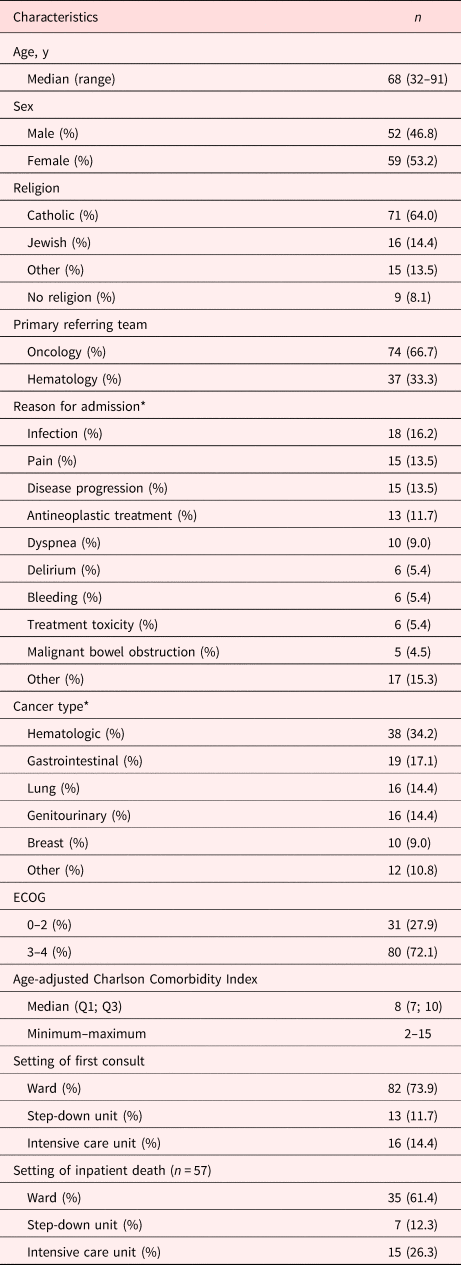
One hundred eleven patients were included. Median age was 68, and 53% of patients were female. Main reasons for admission were infection (16.2%), pain (13.5%), and disease progression (13.5%). Most had an Eastern Cooperative Oncology Group performance status ≥3 (72%) and were consulted on the regular wards (74%). Median age-adjusted Charlson Comorbidity Index was 8 (first interquartile = 7; third interquartile = 10). Fifty-seven patients died during admission, most of them in a regular ward (61.4%). Other patient characteristics are described in Table 1.
Patient demographics and clinical characteristics (n = 111)

ECOG, Eastern Cooperative Oncology Group; Q1, first quartile; Q3, third quartile.
*Sum does not add up 100% because of rounding.
The median length of stay was 17 days (first interquartile = 9; third interquartile = 40). The median time between hospital admission and initial PC consultation was 5 days (first interquartile = 2; third interquartile = 17), whereas the median interval from first PC consultation to death or discharge was 9 days (first interquartile = 3; third interquartile = 19).
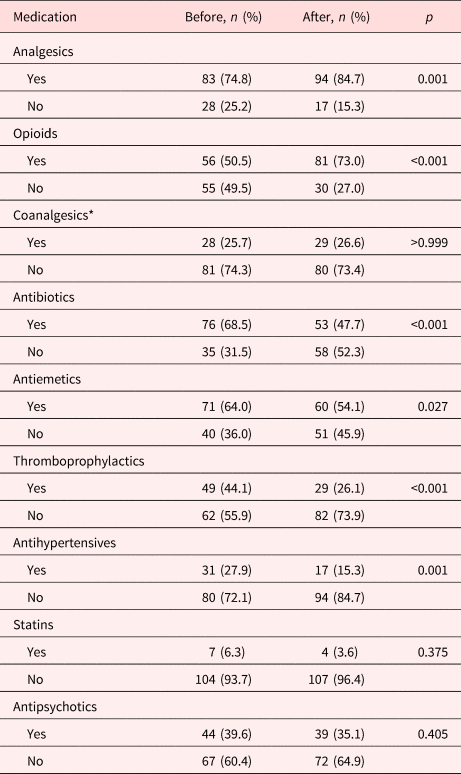
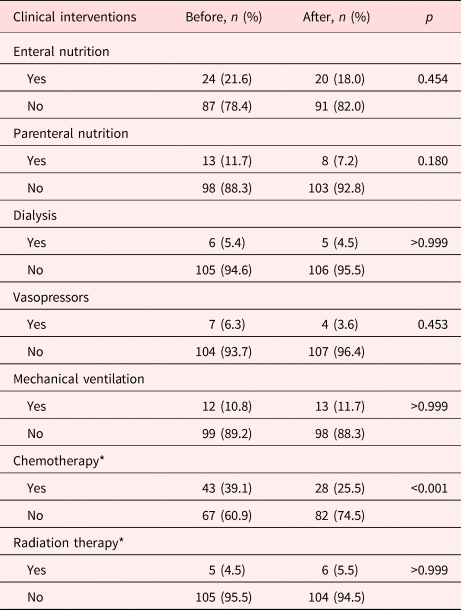
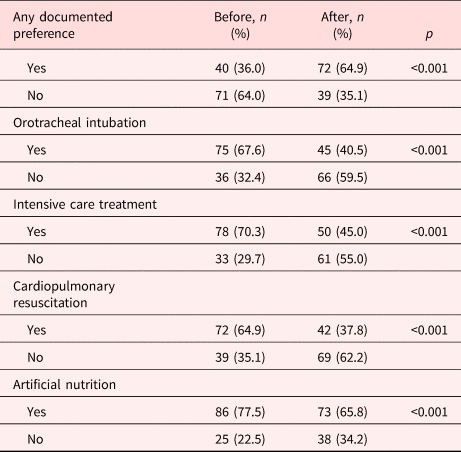
After PC consultation, the use of analgesics (from 75% before to 85% after, p = .001) and opioids (from 50% to 73%, p < .001) increased, and fewer patients were receiving antibiotics (68% before vs 48% after, p < .001), thromboprophylaxis (44% vs 26%, p < .001), antihypertensives (28% vs 15%, p = .001), and antiemetic agents (64% vs 54%, p = .027) (Table 2). Chemotherapy use decreased from 39% to 25% (p < .001) (Table 3). Also, after PC consultation more patients had an EOL preference documented (36% vs 65%, p < .001) and more were not willing to receive intubation (32% vs 60%, p < .001), intensive care treatment (30% vs 55%, p < .001), cardiopulmonary resuscitation (35% vs 62%, p < .001), and artificial nutrition (22% vs 34%, p < .001) (Table 4). No other significant differences in patients’ medication use, clinical interventions, or EOL preferences were found (Tables 2–4).
Medication use before and after PC

PC, palliative care.
*Two patients were excluded from this analysis because of missing data.
Clinical interventions before and after PC

PC, palliative care.
*One patient was excluded because of missing data.
End-of-life preferences before and after PC

PC, palliative care.
The domains most frequently assessed and managed by the PC team were family distress (74%), emotional distress (67%), EOL care/issues (64%), and symptom management (41%) (Appendix 1).
Discussion
To our knowledge, this is the first study to examine the timing of PC access and outcomes of patients with advanced cancer admitted and referred to an inpatient PC consultation team at a private practice tertiary care general hospital in Brazil. We found that, although PC referrals occurred late in the disease trajectory, there were an increase in the use of analgesics; decrease in the prescription of antibiotics, antihypertensives, antiemetics, and thromboprophylactic agents; a reduction in the use of chemotherapy; and an improvement in patients’ preferences toward less aggressive EOL care.
In our study, patients were referred exceedingly late to PC during the course of their illness: Most had a poor performance status at referral, and the time from initial consultation to death or discharge was only a few days (median = 9). Limited PC exposure periods, within the range of days, have been found in other studies conducted in countries from the same WHO PC development group as Brazil (group 3a) (Lynch et al., Reference Lynch, Connor and Clark2013a), where the provision of PC is isolated and the level of integration between PC services and the mainstream health system is low (Baek et al., Reference Baek, Shin and Choi2011; Al-Saleh et al., Reference Al-Saleh, Al-Awadi and Soliman2017). For example, in a retrospective review of patients receiving palliative cancer care referred to the first independent PC center in Kuwait, a developing country in the Eastern Mediterranean area, Al-Saleh et al. (Reference Al-Saleh, Al-Awadi and Soliman2017) found that the median time from PC referral to death was 41 days, with a majority of patients (58%) being seen within 30 days from death. Similarly, in a study conducted by Baek et al. (Reference Baek, Shin and Choi2011) in a cohort of patients with advanced cancer registered in 34 inpatient PC services in Korea, the median survival after the first PC encounter was <30 days (median = 18).
On the other hand, in countries where the level of PC development and integration is much more advanced (WHO group 4) (Lynch et al., Reference Lynch, Connor and Clark2013a), longer intervals from referral to death have been found (Cheng et al., Reference Cheng, Willey and Palmer2005; Nitecki et al., Reference Nitecki, Diver and Kamdar2018). In two North American cohorts of patients treated at tertiary care medical centers with access to subspecialty PC services, one including patients with ovarian cancer and the other including patients with advanced cancer of different primary sites, the median time from PC referral to death was 3.36 months (Nitecki et al., Reference Nitecki, Diver and Kamdar2018) and 1.9 months (Cheng et al., Reference Cheng, Willey and Palmer2005), respectively. Therefore, the very limited time between an initial PC consult to death in our study possibly reflects the low level of PC development and integration at our institution and in Brazil as a whole, placing patients at risk of not being able to receive the well-known benefits of a timely PC referral (Bauman & Temel, Reference Bauman and and Temel2014; Davis et al., Reference Davis, Temel and Balboni2015).
Barriers to early PC referrals may include the absence of PC education and training among oncology health care providers, leading to misconceptions that PC is synonymous with EOL and hospice care (Hui et al., Reference Hui, Park and Liu2015b); lack of financial resources to implement structures that permit early referrals, such as outpatient PC clinics (Hui et al., Reference Hui, Elsayem and De La Cruz2010); and the absence of standardized referral criteria that are tailored to patient needs and local resources (Hui & Bruera, Reference Hui and Bruera2016). Future research is needed to develop and test strategies that can overcome these barriers, ultimately optimizing referrals and enhancing the integration of PC into oncology care at our institution and in the healthcare systems of developing countries.
After the specialized PC team was involved in patients’ care, we found significant changes in their medication profiles. A higher proportion of patients were receiving pain control medications, such as opioids. Fewer were taking drugs for comorbid conditions, such as antihypertensives and thromboprophylactic agents; in addition, a lower proportion was receiving antibiotics and antiemetics. Except for the less frequent use of antiemetics (which could be related to the significant reduction in the use of chemotherapy that we also found), this overall pattern of change suggests that by regularly assessing pain and other symptoms and the risks and benefits of all medications, the PC team was able to direct patients’ medication profile toward the use of drugs for symptom control. They also could reduce the prescription of agents with an unfavorable risk/benefit ratio for EOL use.
Previous studies had similar results (Hui et al., Reference Hui, Li and Chisholm2015a; Masman et al., Reference Masman, van Dijk and Tibboel2015). For instance, among a cohort of PC patients, mainly with a cancer diagnosis (89%), and admitted to a PC center with a multidisciplinary team in place, Masman et al. (Reference Masman, van Dijk and Tibboel2015) found that the use of analgesics increased from 56.7% to 94.6%, with the prescription of opioids increasing from 42% to 92%. Also, in a retrospective study analyzing the chronological changes in the medication profiles of patients with advanced cancer referred to an inpatient PC consultation team and later admitted to an acute PC unit, Hui et al. (Reference Hui, Li and Chisholm2015a) observed a pattern very similar to ours, characterized by an increase in the use of symptom-directed drugs, such as corticosteroids, laxatives, neuroleptics, and antiulcer agents; a decrease in the proportion of patients receiving antilipemics and antihypertensives; and a trend toward less EOL use of anti-infectives.
With regard to the frequency of clinical interventions, use of chemotherapy decreased significantly, denoting that this population of frail patients with advanced cancer received a better quality of EOL care after the involvement of the specialized PC team. Previous data have shown that chemotherapy for patients with terminal cancer is associated with worse quality of life and increased risk of receiving more aggressive EOL care and is not associated with prolonged survival (Prigerson et al., Reference Prigerson, Bao and Shah2015; Wright et al., Reference Wright, Zhang and Keating2014). Hence, both American Society of Clinical Oncology and the National Quality Forum have endorsed chemotherapy use near death to be a poor indicator of the quality of EOL care (American Society of Clinical Oncology, 2018; National Quality Forum, 2012). Nevertheless, although a 15% reduction in chemotherapy use is a noteworthy result of our study, we believe that this effect could have been even higher if PC referrals did not occur too late in the disease course. As has been previously demonstrated, the timing of PC access directly influences EOL quality care indicators, with a more prominent improvement in the aggressiveness of EOL care when the PC initial encounter occurs earlier, months before death, and when patients are being seen in the outpatient setting (Hui et al., Reference Hui, Kim and Roquemore2014; Triplett et al., Reference Triplett, LeBrett and Bryant2017). Currently, our institution is implementing a novel outpatient PC clinic embedded in the oncology center to promote early integrated palliative cancer care. Further research is warranted to evaluate the outcomes of this measure on chemotherapy use and other EOL quality care indicators at our hospital and other private practice institutions in Brazil.
The overall documentation of EOL preferences improved after the delivery of concurrent palliative cancer care was initiated, with more patients preferring not to receive life-sustaining measures. This implies that despite the limited time from PC consult to death or discharge, the integration of the specialized PC team in patients care was able to enhance patients’ accurate understanding of their disease. This hypothesis is supported by the fact that one of the most frequent domains assessed and managed by the inpatient PC team in the current cohort was the EOL care/issues domain (Dahlin, Reference Dahlin2009), of which assessing and documenting patients’ EOL preferences are integral parts. Furthermore, recent studies have shown that patients with terminal cancer who accurately understand their disease are more likely to prefer comfort-directed care instead of life-prolonging measures (Mack et al., Reference Mack, Weeks and Wright2010; Tang et al., Reference Tang, Liu and Chow2014), and that inpatient PC teams are capable of improving prognostic awareness in this population (Loke et al., Reference Loke, Rau and Huang2011; Lu et al., Reference Lu, Shen and Kao2016). On the other hand, at least one-third of the patients were still willing to receive at least one aggressive EOL measure, pointing again to the need of promoting earlier PC integration, now as a means of improving patients’ understanding of their illness (Bauman & Temel, Reference Bauman and and Temel2014).
This study has several limitations. First, it was conducted in a single, academic, private practice general hospital, which limits the generalizability of our findings to other settings and advanced cancer patient populations. Second, the sample size of our cohort and the lack of a control group prevent us from drawing conclusions based on our results. Third, we did not capture data after admission on discharged patients, which might have affected our findings as part of them are amenable to changes over time (i.e., EOL preferences). Fourth, because EOL preferences were retrieved as registered by the PC team in the patient assessment note, this could have biased the accuracy of these variables.
In conclusion, PC referrals occurred exceedingly late in the cancer disease trajectory. Nevertheless, positive changes were observed in the medication profiles, use of clinical interventions, and EOL preferences of patients with advanced cancer referred to a specialized inpatient PC team at a tertiary care private practice general hospital in Brazil. Further efforts are needed to improve early palliative cancer care in developing countries.
Supplementary material
The supplementary material for this article can be found at https://doi.org/10.1017/S1478951518000597.
Acknowledgments
Special thanks go to the statistics department of Hospital Israelita Albert Einstein.
Conflicts of interest statement
The authors declare that there are no conflicts of interest.