Introduction
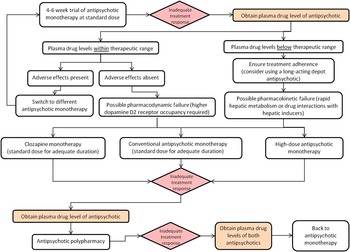
Guidelines for treating schizophrenia with antipsychotics are well known, but when patients with psychosis and violent behavior fail to respond to standard treatments or continue to exhibit violent behavior despite control of psychosis, there is little consensus on what to do (Figure 1).Reference Stahl, Morrissette and Citrome 1 Here we review the neurobiological rationale as well as evidence- and practice-based treatment strategies that utilize dosing of antipsychotics above the range normally recommended in published treatment guidelines, as well as the somewhat controversial practice of combining 2 antipsychotics for addressing psychotic and impulsive violence in patients with schizophrenia who fail to respond adequately to standard treatment.
Antipsychotic treatment algorithm. Following several unsuccessful atypical antipsychotic monotherapy trials, a trial with a conventional antipsychotic or with clozapine is recommended. High-dose monotherapy may also be considered for such treatment-resistant patients. Antipsychotic polypharmacy is recommended only after antipsychotic monotherapy has failed. Note that throughout the treatment algorithm, monitoring of plasma drug levels of each antipsychotic is critical when determining the next course of action.

Evaluation of Violence and Treatment of Comorbidities Before Going Beyond the Guidelines
Patients with schizophrenia who exhibit violent behavior in inpatient settings should first be treated according to published guidelines for all patients with schizophrenia, including a series of monotherapies with atypical antipsychotics and a trial of clozapine (Figure 1).Reference Stahl, Morrissette and Citrome 1 If a patient with schizophrenia continues to exhibit violent behavior, that violence should be categorized as psychotic, impulsive, or predatory; predatory behavior is not an appropriate target for antipsychotic treatment, but psychotic and impulsive violence can be.Reference Stahl 2 , Reference Citrome and Volavka 3 Most violent acts in forensic and state hospital settings (where patients mostly suffer from psychotic disorders) are impulsive, with predatory violence and psychotic violence being less frequent.Reference Warburton 4 – Reference Quanbeck, McDermott, Lam, Eisenstark, Sokolov and Scott 9 Psychotic violence is hypothetically linked to excessive neuronal activity in the mesolimbic dopamine pathway, and can often, but not always, be successfully treated with standard antipsychotic monotherapies, including clozapine.Reference Stahl 10 – Reference Frogley, Taylor, Dickens and Picchioni 13 Impulsive violence is also common in psychotic patients in forensic and state hospital settings, even after positive symptoms of psychosis have been controlled with standard antipsychotic treatment.Reference Coccaro, McCloskey, Fitzgerald and Phan 14 – Reference Bobes, Fillat and Arango 16 Impulsive violence is hypothetically linked to an imbalance between “top-down” cortical inhibitory controls and “bottom-up” impulsive drives, and, empirically, high dosing and polypharmacy can reduce these behaviors in some patients who respond inadequately to standard treatments.Reference Stahl 2 , Reference Stahl and Morrissette 11 , Reference Siever 12 , Reference Meyer 17 – Reference Pavlov, Chistiakov and Chekhonin 19 However, before considering high dosing or polypharmacy for schizophrenic patients with psychotic or impulsive violence who have failed to respond adequately to standard antipsychotic treatments, it is important to treat and stabilize any coexisting cognitive dysfunction or substance abuse issues.Reference Nolan, Czobor and Roy 5 , Reference Volavka and Citrome 7 , Reference Fazel, Grann and Langstrom 20 – Reference Song and Min 27
Treatment of Violence and Aggression: Attaining Sufficient Dopamine D2 Receptor Occupancy
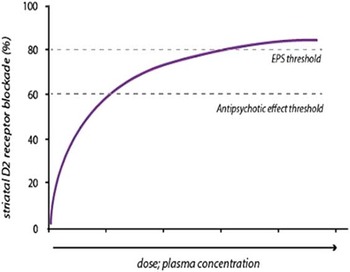
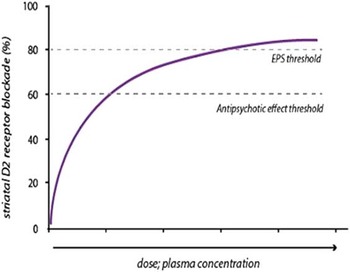
Neuroimaging studies have repeatedly shown that blockade of at least 60% of D2 receptors by antipsychotic treatment is necessary in order to reduce psychosis.Reference Stahl 10 , Reference Stahl and Morrissette 11 , Reference Uchida, Takeuchi, Graff-Guerrero, Suzuki, Watanabe and Mamo 28 At greater than 80% occupancy of D2 receptors, the threshold for extrapyramidal symptoms (EPS) is reached in many patients. Thus, antipsychotics at standard doses aim to achieve between 60–80% D2 receptor occupancy (Figure 2).Reference Uchida, Takeuchi, Graff-Guerrero, Suzuki, Watanabe and Mamo 28 – Reference Uchida, Takeuchi, Graff-Guerrero, Suzuki, Watanabe and Mamo 31 Data indicate that obtaining sufficient D2 receptor occupancy and achieving the downstream therapeutic effects of D2 receptor blockade by an antipsychotic often take more than 6 weeks to manifest.Reference Stauffer, Case and Kollack-Walker 32 , Reference Robinson, Woerner and Alvir 33 In fact, it may be necessary to treat schizophrenia with an antipsychotic for as long as 1–2 years before a significant improvement in psychotic symptoms is evident, although this may not be practical in forensic settings where violent behavior must be controlled.Reference Stahl 34 – Reference Ritsner 37 Additionally, there are some data to suggest that nonresponse to an antipsychotic after 4 weeks of treatment predicts nonresponse at 12 weeks.Reference Stentebjerg-Olesen, Jeppesen and Pagsberg 38 In this particular study by Stentebjerg-Olesen et al, patients who were early treatment responders had a significantly greater chance of being treatment-responsive at 12 weeks compared to early treatment nonresponders.Reference Stentebjerg-Olesen, Jeppesen and Pagsberg 38 However, we do wish to point out that over one-third of patients who were considered early treatment nonresponders did ultimately respond to treatment by week 12.Reference Stentebjerg-Olesen, Jeppesen and Pagsberg 38
Dopamine D2 receptor occupancy. Antipsychotic blockade of at least 60% of D2 receptors in the striatum is necessary to ameliorate psychotic symptoms. However, when 80% or more of D2 receptors are blocked, extrapyramidal symptoms (EPS) are likely to occur. Standard doses of atypical antipsychotics are based on achieving 60% D2 receptor occupancy without exceeding the 80% EPS threshold. Note that the slope of the curve flattens out with increasing dose; that is, at higher doses, large increases in dose are needed to obtain substantial increases in D2 receptor occupancy.
Pharmacokinetic failure, treatment resistance, and violence
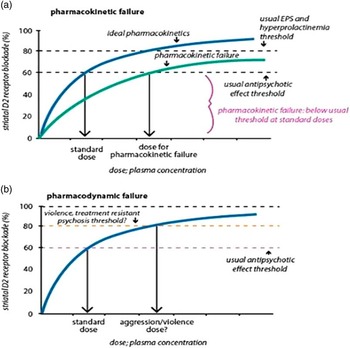
When a patient with schizophrenia who exhibits either psychotic or impulsive violence fails to respond to standard doses of antipsychotic monotherapy of adequate duration and with adherence to treatment, this can be due to either pharmacokinetic failure or pharmacodynamic failure.Reference Correll 29 Pharmacokinetic interactions describe the effects of a biological system on a medication and include rapid metabolization, cytochrome P450 polymorphisms, poor absorption (eg, due to gastric bypass), and interactions with other medications/substances. In the case of pharmacokinetic failure, plasma drug levels do not reach adequate levels (and therefore D2 receptor occupancy is less than 60%) despite standard antipsychotic doses (Figure 3A). Often, pharmacokinetic failure presents as a lack of both therapeutic and adverse effects at standard antipsychotic doses. Therapeutic drug monitoring is essential for determining if a pharmacokinetic issue or treatment nonadherence underlies treatment nonresponse; in these cases, plasma drug levels will be lower than expected.Reference Stahl 18 , Reference Mauri, Volonteri, Colasanti, Fiorentini, De Gaspari and Bareggi 39 Solutions to pharmacokinetic failure include increasing the antipsychotic dose to achieve sufficient plasma levels, switching to a different antipsychotic monotherapy (such as one with a sublingual or intramuscular formulation), instituting antipsychotic polypharmacy, or simply taking the antipsychotic with food.Reference Meyer 17
Pharmacokinetic and pharmacodynamic failures. The failure of a patient to respond to antipsychotic treatment may be due to either pharmacokinetic or pharmacodynamic failure. (A) Pharmacokinetic failure occurs in cases in which the therapeutic threshold (~60% D2 occupancy) is not achieved despite dosing at standard therapeutic levels. (B) Pharmacodynamic failure occurs in cases in which occupancy of greater than 80% of D2 receptors may be required before therapeutic effects are achieved. Pharmacodynamic failure therefore alters antipsychotics' threshold for therapeutic effects and may be quite prevalent in patients with psychotic or impulsive aggression.

Pharmacodynamic failure, treatment resistance, and violence
Pharmacodynamic interactions describe how antipsychotics impact biological systems once they occupy 60–80% of D2 dopamine receptors. Pharmacodynamic failure occurs when there is a lack of therapeutic response despite attaining adequate plasma drug levels (Figure 3B).Reference Correll 29 Why some patients do not respond to the usual degree of D2 receptor occupancy remains a quandary, but can include insensitive D2 receptors, or even supersensitive D2 receptors, where increasing doses of antipsychotics may be necessary in order to reduce psychotic symptoms.Reference Remington and Kapur 40 – Reference Seeman 42 Interestingly, several factors, including substance abuse, can increase dopamine supersensitivity.Reference Seeman 42 These treatment-resistant patients may present with excessive psychotic symptoms and violence leading to institutionalization in forensic settings. For these individuals, it may be necessary to use treatment strategies (including high-dose antipsychotic monotherapy and antipsychotic polypharmacy) aimed at greater than 80% D2 receptor occupancy in order to relieve psychotic symptoms (Figure 1).Reference Meyer 17 , Reference Correll 29
Heroic treatment strategies such as high-dose monotherapy or antipsychotic polypharmacy may not be necessary for typical patients with schizophrenia included in clinical research studies and for which the evidence in the literature is generated. In fact, most clinical trial data do not show any superior benefit from using high-dose monotherapy or antipsychotic polypharmacy for such patients.Reference Ritsner 36 , Reference Ritsner 37 Those patients with pharmacodynamic or pharmacokinetic failures and who may require bold treatment measures are often treatment-resistant to standard doses of a single drug and present with violent or aggressive behaviors.Reference Stahl 18 Unfortunately, these patients (who are the most likely candidates for high-dose antipsychotic monotherapy or antipsychotic polypharmacy) are excluded from clinical trials because they are too psychotic, too substance-abusing, too aggressive, or too treatment-resistant to meet inclusion criteria or give informed consent.Reference Correll 29 , Reference Davis and Chen 43 , Reference Krakowski, Kunz, Czobor and Volavka 44 Thus, it is not surprising that many (but not all) of the published clinical trial data have failed to find any clear benefit of antipsychotic polypharmacy or high-dose monotherapy over standard therapeutic doses of a single antipsychotic. It may therefore be difficult for the prescribing clinician to know the best strategy to optimize care for treatment-resistant, violent, or aggressive patients given the paucity of studies that include the patients who require it. However, most studies that investigate the actual use of high antipsychotic dosing (including high dosing that results from combining two antipsychotics) find that those patients for whom high dosing is used are often the most treatment-resistant, aggressive, or otherwise difficult-to-treat cases, and that clinicians who utilize high-dosing strategies are often those with the most clinical experience.Reference Gisev, Bell and Chen 45 – Reference Suokas, Suvisaari, Haukka, Korhonen and Tiihonen 53
These data suggest that currently available guidelines fall short for many patients in real-world clinical practice, especially in forensic and state hospital inpatient settings or for outpatients on compulsory treatment orders.Reference Gisev, Bell and Chen 45 These same patients may exhibit psychotic or impulsive violence, and there is substantial practice-based evidence for the use of treatment measures including high-dose monotherapy and antipsychotic polypharmacy.Reference Ritsner 36 , Reference Ritsner 37 Most guidelines for the treatment of schizophrenia advocate several trials of antipsychotic monotherapy (using both first- and second-generation agents), followed by a trial of clozapine, and either do not advocate antipsychotic polypharmacy or reserve it for only the most difficult cases (Figure 1).Reference Roh, Chang, Kim, Cho, An and Jung 46 , Reference Fleischhacker and Uchida 48 A trial of clozapine is a critical, yet often bypassed, step, since there is an abundance of data that shows the superior efficacy of clozapine for treatment-resistant patients as well as for the amelioration of aggression.Reference Roh, Chang, Kim, Cho, An and Jung 46 , Reference Fleischhacker and Uchida 48 , Reference Freudenreich and Goff 54 , Reference Goren, Meterko and Williams 55 Even so, as many as 40% of patients may experience only partial or no response to clozapine.Reference Englisch and Zink 56 While adherence to these published guidelines is likely the best course of action for the majority of patients, what is the clinician to do when a patient is persistently psychotic and possibly aggressive following several standard-dose monotherapies and an unsuccessful trial of clozapine? In the following sections, we offer guidance and recommendations for using high-dose antipsychotic monotherapy and antipsychotic polypharmacy based on practice-based evidence involving patients who are chronically violent or aggressive and for whom standard guidelines typically fall short (Figure 1).
Antipsychotic Polypharmacy
Although data supporting the use of antipsychotic polypharmacy (the simultaneous use of two antipsychotics) are somewhat limited, this practice is very common in psychiatry; as many as 30% of patients receive antipsychotic polypharmacy.Reference Langle, Steinert and Weiser 57 , Reference Essock, Schooler and Stroup 58 In fact, despite several guidelines recommending that polypharmacy should only be used as a last resort (following failure of several monotherapies and a trial of clozapine), many clinicians attempt polypharmacy as the rule, rather than the exception.Reference Stahl 18 , Reference Barnes and Paton 47 Alarmingly, a recent study showed that as many as one-quarter of patients are not treated using prescribing pathways that are consistent with treatment guidelines, with up to 65% receiving antipsychotic polypharmacy as their first antipsychotic treatment.Reference Goren, Meterko and Williams 55 Such prescribing practices appear to have led to some backlash, with calls and efforts to reduce antipsychotic polypharmacy, including several articles authored by ourselves.Reference Barnes and Paton 47 , Reference Stahl and Grady 59 – Reference Stahl 65 We advocate here that published treatment guidelines should be adhered to, and will likely be effective for the majority of patients.Reference Stahl, Morrissette and Citrome 1 Recent studies have shown that as many as two-thirds of patients treated with antipsychotic polypharmacy can be successfully switched to monotherapy, supporting the notion that antipsychotic polypharmacy may not be necessary for the majority of patients.Reference Essock, Schooler and Stroup 58 , Reference Suzuki, Uchida and Tanaka 66 The study by Essock et al Reference Essock, Schooler and Stroup 58 in particular showed that not only did patients who were switched from polypharmacy to monotherapy have no worsening of symptoms or increased hospitalization, but many also had reversal of the metabolic effects that were presumably due to antipsychotic polypharmacy. However, it is important to note that polypharmacy was necessary for symptom management in one-third of all patients in the Essock et al study. Also, although many studies have failed to show a benefit of antipsychotic polypharmacy over standard-dose monotherapy, more recent investigations do show some evidence for the benefit of combining antipsychotics.Reference Fleischhacker and Uchida 48 , Reference Correll, Rummel-Kluge, Corves, Kane and Leucht 67 , Reference Iasevoli, Buonaguro and Marconi 68 Notably, in line with our previous assertion that time may itself be like a drug, there is some evidence to suggest that treatment with antipsychotic polypharmacy must be continued for at least 10 weeks before a significant therapeutic effect is seen.Reference Morrissette and Stahl 35 , Reference Correll, Rummel-Kluge, Corves, Kane and Leucht 67 Together, these data support the notion that a subpopulation of patients, likely including those who are treatment-resistant or violent, may require treatment measures such as antipsychotic polypharmacy.Reference Stahl 18 Resorting to antipsychotic polypharmacy is probably not necessary for most patients and should be reserved for those patients for whom several antipsychotic monotherapy trials have failed and a trial with clozapine is unsuccessful or cannot be attempted.
Antipsychotic polypharmacy is often employed as a method for increasing dopamine D2 receptor occupancy, but also may be used to recruit additional properties of antipsychotics in order to treat non-positive symptoms such as depression and anxiety.Reference Barnes and Paton 47 , Reference Correll, Rummel-Kluge, Corves, Kane and Leucht 67 Atypical antipsychotics bind to a variety of receptors, some of which are hypothesized to have therapeutic benefit.Reference Stahl 10 Indeed the recruitment of various serotonergic and noradrenergic receptors may help to normalize the aberrant neurotransmission associated with violence and aggression.Reference Coccaro 69 – Reference Winstanley, Theobald, Dalley, Glennon and Robbins 71 For example, increasing serotonergic neurotransmission in the prefrontal cortex (PFC) may, in theory, improve top-down cortical control of the limbic system and thereby improve impulsive aggression.Reference Stahl 10 , Reference Stahl and Morrissette 11 , Reference Coccaro, Sripada, Yanowitch and Phan 15 , Reference Coccaro 69
Unfortunately, each atypical antipsychotic also binds to receptors associated with increased risk of intolerable effects (eg, sedation), so using two antipsychotics simultaneously can increase the side effect burden. A recent study by Langle et alReference Langle, Steinert and Weiser 57 suggested that patients with schizophrenia on antipsychotic polypharmacy have a worse clinical course compare to those on monotherapy. However, it is unclear if worse clinical outcome was caused by antipsychotic polypharmacy or if it is simply a matter of more treatment-resistant or otherwise difficult patients being the most likely to require more extreme treatment measures such as polypharmacy. Earlier studies also suggested that antipsychotic polypharmacy was associated with increased mortality; however, subsequent studies do not support this idea, and, in fact, a more recent analysis suggests that antipsychotic polypharmacy may actually be associated with reduced mortality as well as fewer psychiatric hospitalizations.Reference Lochmann van Bennekom, Gijsman and Zitman 51 , Reference Suokas, Suvisaari, Haukka, Korhonen and Tiihonen 53 , Reference Englisch and Zink 72 , Reference Katona and Czobor 73
If polypharmacy is attempted, antipsychotics should be combined in a rational manner, based on the binding profiles of each antipsychotic for various receptors.Reference Fleischhacker and Uchida 48 , Reference Freudenreich and Goff 54 The logic of combining 2 antipsychotics should take into account not only the desired boost in D2 antagonism, but also the potential therapeutic and adverse effects of recruiting additional non-dopamine receptors. Combinations of antipsychotics that have similar side effect profiles should be avoided, and potential interactions of antipsychotics should be considered, especially with respect to the cytochrome P450 system.Reference Fleischhacker and Uchida 48 , Reference Ballon and Stroup 74 Interestingly, antipsychotic polypharmacy may actually be preferable as a way to increase D2 receptor occupancy while avoiding particular adverse effects that may occur with high-dose monotherapy.Reference Barnes and Paton 47 , Reference Freudenreich and Goff 54 For example, a recent study showed that the addition of aripiprazole to clozapine treatment resulted in a reduction in clozapine-induced cardiometabolic effects.Reference Fleischhacker, Heikkinen and Olie 75 Although this particular study did not show improvement in symptoms (measured using the Positive and Negative Symptom Scale [PANSS]) using a combination of clozapine and aripiprazole, other studies of clozapine and aripiprazole have found some symptom improvement.Reference Englisch and Zink 72 , Reference Chang, Ahn and Park 76 It is also important to note that combining aripiprazole with a non-clozapine antipsychotic may actually worsen symptoms of psychosis due actions of aripiprazole as a partial agonist with high binding affinity for D2 receptors.Reference Freudenreich and Goff 54
Antipsychotic combinations that include clozapine have the most evidence for efficacy.Reference Fleischhacker and Uchida 48 , Reference Correll, Rummel-Kluge, Corves, Kane and Leucht 67 When clozapine is not an option, most clinicians who utilize antipsychotic polypharmacy appear to prefer a second-generation antipsychotic (SGA) in combination with a first-generation antipsychotic (FGA), and there are some data to support this.Reference Englisch and Zink 56 , Reference Correll, Rummel-Kluge, Corves, Kane and Leucht 67 Often the rationale for antipsychotic polypharmacy involves combining an antipsychotic with relatively weak binding affinity for D2 receptors (such as clozapine or olanzapine) with an antipsychotic that binds more strongly to D2 receptors (such as sulpiride or amisulpride); in this way D2 receptor occupancy can be maximized while taking advantage of the vast molecular non-D2 binding affinities inherent to many SGAs.Reference Barnes and Paton 47 , Reference Englisch and Zink 56
The rationale for attempting polypharmacy should be carefully documented, along with any therapeutic or side effects that occur. Throughout the course of treatment, plasma levels of both antipsychotics should be monitored in order to ensure treatment adherence and rule out pharmacokinetic issues.
High-Dose Monotherapy
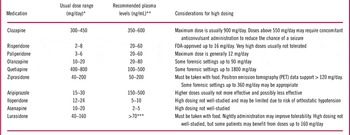
High-dose monotherapy is another strategy for increasing D2 receptor occupancy, although this strategy may also increase the risk of intolerable side effects (notably EPS and akathisia) and, as with antipsychotic polypharmacy, can be associated with substantially higher medication costs, especially for newer agents, than standard dose monotherapy. As with all off-label practices, dosing of antipsychotics above standard therapeutic levels warrants informed consent and increased monitoring of the patient. As the pharmacodynamic and pharmacokinetic characteristics vary from patient to patient, it is virtually impossible to predict what daily dose will be needed in order to achieve an antipsychotic effect.Reference Thompson 77 Antipsychotic dosing should be started at the low FDA-approved dose and then titrated upward accordingly until therapeutic efficacy or intolerable side effects occur; thus antipsychotic plasma levels should be continuously monitored as the dose is escalated.Reference Schwartz and Stahl 78 The standard dose ranges for atypical antipsychotics and special considerations for high dosing are summarized in Table 1. In the following sections, we review the art and science of prescribing each of the FDA-approved atypical antipsychotics at high doses. As antipsychotics are dosed at a level that blocks 60–80% of D2 receptors (with the exception of clozapine), it is important to note that any receptor binding that is stronger than that of D2 receptors will also be occupied at levels greater than 60% and will likely cause additional therapeutic and adverse effects.Reference Stahl 10 It is essential to keep the relative receptor binding affinities in mind when dosing an atypical antipsychotic at higher-than-usual levels to attain >80% occupancy of D2 receptors, so that potential effects of binding to receptors other than D2 can be anticipated and monitored.
High-dose considerations for atypical antipsychotics

* Based on oral formulation in adults.
** Based on recommendations from the AGNP Therapeutic Drug Monitoring consensus guidelines.Reference Hiemke, Baumann and Bergemann 83
*** From Potkin et al.Reference Potkin, Keator and Kesler-West 84
Clozapine
Clozapine is not recommended as a first-line treatment strategy due to the risk for serious adverse effects, most notably agranulocytosis; however, in patients who have failed several first-line atypical antipsychotic monotherapies, a trial of clozapine is warranted. Clozapine has been well-documented for treatment-resistant patients and those who are violent or aggressive, and is therefore recommended for such patients.Reference Volavka and Citrome 6 , Reference Volavka, Czobor and Nolan 79 Interestingly, the anti-aggressive effects of clozapine are somewhat independent of its ability to improve positive symptoms.Reference Volavka and Citrome 7 Usual doses of clozapine (plasma levels of 400–600 ng/mL) actually bind less than 60–80% of dopamine D2 receptors; however, clozapine often has antipsychotic effects at 20–67% D2 occupancy, suggesting that the antipsychotic effects of clozapine go beyond its ability to block D2 receptors.Reference Uchida, Takeuchi, Graff-Guerrero, Suzuki, Watanabe and Mamo 31 This is not surprising given the vast molecular binding profile of clozapine. Clozapine has relatively weak affinity for dopamine D2 receptors compared to its affinity for many other receptors, including histaminic H1, adrenergic alpha-1, serotonin 5HT2B, and muscrinic M1 receptors, as well as a host of other receptors. Due to these high binding affinities for receptors other than D2, high dosing of clozapine may cause sedation (due to antagonism of M1, H1, and alpha-1 receptors), hypersalivation and constipation (due to antagonism of M1), cardiometabolic issues (due to antagonism of H1 and 5HT2C receptors, as well as the hypothesized receptor “X”), and seizures (mechanism unknown).Reference Stahl 34 A meta-analysis by Davis and ChenReference Davis and Chen 43 showed that patients with high plasma levels of clozapine responded more frequently than those with low plasma levels, indicating that doses above 400 mg/day may be required by many patients. Titration of clozapine to high doses should be done by increasing the dose every 5–7 days.Reference Correll 29 , Reference Davis and Chen 43
Risperidone/paliperidone
Risperidone and its active metabolite paliperidone have similar receptor binding profiles, with relatively strong affinity for dopamine D2 receptors. In the “average” patient, dosing of risperidone at 2–4 mg/day is associated with 70–80% D2 receptor occupancy and is rarely useful at doses above 8 mg/day.Reference Nord and Farde 30 , Reference Stahl 34 Both risperidone and paliperidone are associated with increased risk of EPS in a dose-dependent manner, so care must be exercised when increasing the dose of these agents.Reference Davis and Chen 43 Titration of risperidone or paliperidone to high doses should be executed by increasing the dose every 5–7 days.Reference Correll 29 One pharmacokinetic difference between paliperidone and risperidone is that paliperidone is not metabolized in the liver so has less chance of drug–drug interactions or effects from cytochrome P450 polymorphisms.Reference Stahl 34 Paliperidone may also be more tolerable, with less sedation and fewer EPS, and should be dosed higher than risperidone.Reference Stahl 34 Both of these agents are also available as long-acting depot formulations, so an alternative strategy for achieving high D2 receptor occupancy would be to simultaneously use the depot formulation along with its oral counterpart.
Olanzapine
Olanzapine is perhaps the most well-studied atypical antipsychotic in terms of its use at high doses.Reference Stahl and Grady 59 The risk of EPS is minimal, even at high doses of olanzapine; however, among the atypical antipsychotics, olanzapine carries one of the greatest risks for cardiometabolic effects due to its strong binding affinity for histaminic H1 and serotonin 5HT2C receptors.Reference Stahl 34 Olanzapine has also been shown to improve both cognitive and aggressive behavior in patients with schizophrenia.Reference Volavka and Citrome 7 Doses of olanzapine between 10–20 mg/day often correspond to 60–80% D2 receptor occupancy, but at plasma levels above 700–800 ng/mL, olanzapine is associated with QTc prolongation.Reference Uchida, Takeuchi, Graff-Guerrero, Suzuki, Watanabe and Mamo 31 , Reference Stahl 34 , Reference Mauri, Volonteri, Colasanti, Fiorentini, De Gaspari and Bareggi 39 Several studies have indicated that olanzapine may be most effective at higher doses (40–60 mg/day) and may be useful in treatment-resistant violent patients in forensic settings at doses as high as 90 mg/day.Reference Mauri, Volonteri, Colasanti, Fiorentini, De Gaspari and Bareggi 39 , Reference Barnes and Paton 47 , Reference Stahl and Grady 59 , Reference Schwartz and Stahl 78 Olanzapine titration to higher doses should take place with dose escalation every 5–7 days.Reference Correll 29 Olanzapine is also available in a long-acting depot formulation that can be supplemented with oral olanzapine to achieve high D2 receptor occupancy.
Quetiapine
Quetiapine is available as both immediate release (IR) and extended release (XR) formulations. Quetiapine binds dopamine D2 receptors with relatively weak affinity; it has far greater affinity for many other receptors, including histaminic H1, adrenergic alpha-1, and serotonin 5HT2C receptors, as well as the norepinephrine transporter (NET). Because of this binding profile, high doses of at least 800 mg/day are usually required for quetiapine to have antipsychotic effects. Quetiapine has a very low risk of EPS associated with it, even at high doses, but is associated with a moderate risk for sedation and metabolic syndrome due to its high binding affinity for H1 and 5HT2C receptors. Most literature suggests that 1200 mg/day is no more effective than 600 mg/day, but anecdotal use in forensic settings of doses up to 1800 mg/day may be effective in violent patients who tolerate but do not respond to lower doses.Reference Stahl 34 , Reference Davis and Chen 43 , Reference Schwartz and Stahl 78 Titration of quetiapine usually involves daily dose increases, but the dose should be increased at a slower rate when exceeding 800 mg/day.Reference Stahl 34 , Reference Correll, Rummel-Kluge, Corves, Kane and Leucht 67
Ziprasidone
Ziprasidone has a fairly high binding affinity for dopamine D2 receptors, surpassed only by its affinity for serotonin 5HT2A and 5HT1B receptors. Ziprasidone is associated with virtually no risk of metabolic effects, and earlier concerns about QTc prolongation have not been supported.Reference Stahl 34 Importantly, ziprasidone must be taken with food in order to optimize its absorption. There are data to suggest that higher doses of ziprasidone may be most effective, and doses as high as 360 mg/day have been reported.Reference Stahl 34 , Reference Mauri, Volonteri, Colasanti, Fiorentini, De Gaspari and Bareggi 39 , Reference Barnes and Paton 47 , Reference Schwartz and Stahl 78 For titration of ziprasidone to high doses, daily increases in dose can be done.Reference Correll 29
Aripiprazole
Aripiprazole is a unique member of the approved atypical antipsychotics. Rather than dopamine D2 receptor antagonism, it acts as a partial agonist at D2 receptors. What this partial agonism means is that in the presence of a full D2 receptor agonist (eg, dopamine), aripiprazole will act as an antagonist at D2 receptors; however, in the presence of a D2 receptor antagonist (eg, another antipsychotic), aripiprazole will act more as a D2 receptor agonist.Reference Stahl 34 Due to this partial agonism and its very high binding affinity for D2 receptors, aripiprazole may actually be less effective for psychosis at higher doses and may reduce the effectiveness of another antipsychotic if an attempt at polypharmacy is made.Reference Stahl 34 Aripiprazole is not associated with significant risks for sedation, EPS, or metabolic syndrome, but it may cause akathisia in some patients. Although the initial titration of aripiprazole can be rapid, dose increases after a steady state has been reached should be done every 10–14 days.Reference Correll 29
Asenapine, iloperidone, and lurasidone
Asenapine, iloperidone, and lurasidone are the newest atypical antipsychotics on the market, so less is known regarding their use at high doses. When looking to use a high-dose strategy, it would be prudent to first try a high-dose trial of one of the older atypical antipsychotics that have more clinical experience.
Asenapine has moderate binding affinity for dopamine D2 receptors and is usually not associated with increased risk for EPS or metabolic syndrome. Asenapine is available only as a sublingual formulation, and therefore it may be a good option for patients who have pharmacokinetic failures in response to other antipsychotics due to hepatic metabolism or poor absorption.Reference Stahl 34 Doses as high as 30–40 mg/day can be used but must be administered 10 mg at a time given at least 1 hour apart. The titration of asenapine should be done by increasing the dose every 5–7 days.Reference Correll 29
Iloperidone is most distinguished by its high binding affinity for adrenergic alpha-1 receptors. Due to this binding property, iloperidone is associated with a high risk of orthostatic hypotension and sedation, so it must be titrated slowly and is not recommended for use at high doses.Reference Stahl 34
Lurasidone is the newest antipsychotic approved for use in the United States. It has moderately high binding affinity for dopamine D2 receptors but is most notable for its antagonism of serotonin 5HT7 receptors. Lurasidone is approved up to 160 mg/day and, importantly, lurasidone should be taken with food to optimize absorption.Reference Stahl 34 Although the original trials on lurasidone suggested that side effect risk increased with higher dosing, recent data indicate that administration of lurasidone in the evening may minimize the risk of adverse side effects.Reference Kantrowitz and Citrome 80
Conclusion
Heroic treatment measures aimed at achieving adequate D2 receptor occupancy may be effective for the treatment of psychotic or impulsive, but not predatory, violence in patients with psychotic illness such as schizophrenia. One strategy for using such intrepid treatment measures, either antipsychotic polypharmacy or high-dose monotherapy, involves combining a long-acting depot formulation with an oral antipsychotic.Reference Barnes and Paton 47 , Reference Aggarwal, Sernyak and Rosenheck 81 For example, depot risperidone can be combined with oral risperidone (high-dose monotherapy) or with oral clozapine (antipsychotic polypharmacy). Numerous FGAs and SGAs are available as long-acting depots, providing a variety treatment options. If either a high-dose monotherapy or antipsychotic polypharmacy treatment strategy is attempted, the importance of therapeutic blood monitoring cannot be overstated. In addition to obtaining therapeutic blood levels for any antipsychotic given, it is critical to define therapeutic endpoints and discontinue a treatment strategy should adverse effects become evident or if clinical efficacy is not achieved. Increasing D2 receptor occupancy can lead to the development of EPS that necessitate the use of anticholinergic medications, which may exacerbate cognitive impairment.Reference Gallego, Bonetti, Zhang, Kane and Correll 50 Given the connection between cognitive deficits and aggression, such a treatment strategy may actually worsen violent and aggressive behaviors, and caution is warranted.Reference Lochmann van Bennekom, Gijsman and Zitman 51 , Reference Elie, Poirier, Chianetta, Durand, Gregoire and Grignon 82
If either heroic measure of antipsychotic polypharmacy or high-dose monotherapy is successful in a treatment-resistant, violent patient, it may be tempting to simply continue with the successful treatment regimen. However, it is recommended that an attempt be made to switch the patient to more conventional antipsychotic therapy.Reference Stahl 2 Documented decompensation upon discontinuing antipsychotic polypharmacy or high-dose monotherapy provides substantial evidence that the patient is a part of the subpopulation who requires heroic treatment measures.
Disclosures
Debbi Morrissette does not have anything to disclose. Stephen Stahl’s disclosure information: Stephen M. Stahl, MD, PhD is an Adjunct Professor of Psychiatry at the University of California, San Diego School of Medicine, Honorary Visiting Senior Fellow at the University of Cambridge, UK and Director of Psychopharmacology for California Department of State Hospitals. Over the past 12 months (March 2013 – April 2014) Dr. Stahl has served as a Consultant for Astra Zeneca, Avanir, Biomarin, Envivo, Forest, Jazz, Lundbeck, Neuronetics, Noveida, Orexigen, Otsuka, PamLabs, Servier, Shire, Sunovion, Taisho, Takeda and Trius; he is a board member of RCT Logic and GenoMind; on the Speakers Bureau for Astra Zeneca, Janssen, Otsuka, Sunovion and Takeda and he has received research and/or grant support from AssureX, Eli Lilly, EnVivo, Janssen, JayMac, Jazz, Lundbeck, Mylan, Neuronetics, Novartis, Otsuka, Pamlabs, Pfizer, Roche, Shire, Sunovion, Takeda, Teva and Valeant.