Introduction
Growing old with a diagnosis of schizophrenia is a profound challenge. However, impact and course of the disorder vary widely among individuals, resulting in a strong heterogeneity in outcome in later life (Cohen et al., Reference Cohen, Meesters and Zhao2015). Evaluation of outcome has been inspired by the recovery concept that acknowledges the relevance of including both clinical and personal dimensions in its evaluation. Clinical-based definitions of recovery focus on remission of core psychotic symptoms as well as the ability to function in the community. Although consensus on operational criteria for clinical recovery is lacking, measures are primarily concerned with the absence of disease and impairments as assessed by observer-based evaluation of symptoms and role functioning. In contrast, patient-centred definitions of recovery (often called personal recovery) prioritize the possibility to live a personally valued and meaningful life, even in the presence of ongoing symptoms (Van Eck et al., Reference Van Eck, Burger, Vellinga, Schirmbeck and de Haan2018). Consequently, personal recovery is a more challenging concept to evaluate through quantitative research methods. Ideally, measures for personal recovery should capture the individual’s own appreciation of his life and state of mind, esteeming values such as subjective well-being, hope, and self-determination (Chan et al., Reference Chan, Mak, Chio and Tong2018). Traditionally, achieving personal recovery was considered to be within reach only for clinically recovered individuals. However, this assumption has been challenged by more recent research in younger patients with schizophrenia. A meta-analysis found only a small to medium association between clinical and personal recovery (Van Eck et al., Reference Van Eck, Burger, Vellinga, Schirmbeck and de Haan2018).
In older schizophrenia patients, research on recovery is limited and mainly cross sectional. Recently, a longitudinal study evaluated recovery in a New York City convenience sample of schizophrenia patients aged 55 years and over (Cohen and Reinhardt, Reference Cohen and Reinhardt2020). At baseline, 27% of 102 participants met criteria for clinical recovery, defined by the authors as combined symptomatic remission and community integration. At mean follow-up of 52 months, this rate was 21% (nonsignificant decline). Over time, 12% of the participants remained in clinical recovery, while 18% never met the criteria. The remaining 70% fluctuated between various states of partial recovery. This study was the first in the present era to document the course of clinical recovery in older persons with schizophrenia. However, the sample was restricted to early-onset patients with the majority living in supported community residences. No measures of personal recovery were evaluated.
We here present data on the five-year course of measures of clinical recovery and subjective well-being in a sample of older Dutch schizophrenia patients, employing a catchment-area based design that included both community living and institutionalized patients regardless of the age of onset of their disorder. We restricted our focus to measures of subjective well-being, acknowledging that although being a key element, subjective well-being is not identical to the more demanding and longer-term phenomenon of personal recovery.
Methods
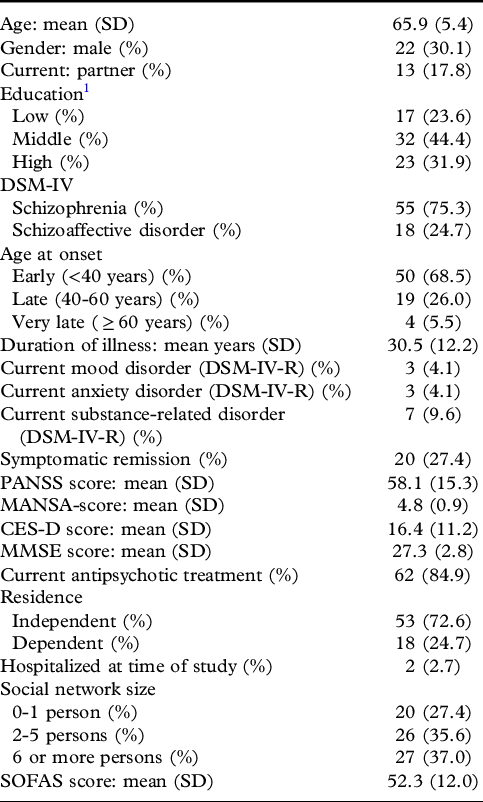
For a detailed description of the design of this study, we refer to our earlier publication (Lange et al., Reference Lange, Meesters, Stek, Wunderink, Penninx and Rhebergen2019). Briefly, in a psychiatric catchment area in Amsterdam, the Netherlands, all individuals in contact with mental health services, aged 60 years and over, and diagnosed with schizophrenia or schizoaffective disorder (DSM-IV-TR criteria) were screened for study eligibility. Of 177 eligible patients, 109 (62%) provided study consent and participated in the baseline (T1) assessment. At five-year follow-up (T2) all 109 patients were traced, of which 73 (67%) could be assessed. Thirty-six patients could not be included because of emigration (n = 1), poor physical health (n = 2), severe cognitive impairment (n = 7), and refusal of consent at T2 (n = 7), or death (n = 19). Attrition was nondifferential with respect to gender, education, diagnosis, and T1-remission status, but persons lost to follow-up were older (72.1 vs. 65.9 years; Student’s t-test −3.82; p < 0.001). Table 1 presents the demographic, clinical, and social characteristics of the 73 participants. The Medical Ethics Committee of the VU University Medical Center, Amsterdam approved the study.
Characteristics of study participants (n = 73) at baseline (T1)

SD = standard deviation; PANSS = Positive and Negative Syndrome Scale; MANSA = Manchester Short Assessment of Quality of Life; CES-D = Center for Epidemiologic Studies Depression Scale; MMSE = Mini Mental State Examination; SOFAS = Social and Occupational Functioning Assessment Scale
1 : 1 case missing
Clinical recovery
Although no consensus definition of clinical recovery is available, remission of psychotic symptoms and appropriate community functioning are considered key elements. We selected four criteria for participants to qualify for clinical recovery: (a) remission of psychotic symptoms, as documented by the Remission in Schizophrenia Working Group’s severity criterion score ≤3 on eight PANSS items and no psychiatric hospitalization in the preceding six months; (b) living independently, i.e. residence without supervision by psychiatric staff; (c) social network size ≥2 persons (18 years or older) with whom the participant has a regular and meaningful contact; kin and nonkin included, persons belonging to the household excluded (valuing the relevance of social interaction outside of the household); (d) social and Occupational Functioning Assessment Scale (SOFAS)-score ≥70 (range 0-100), indicating little or no social impairments in the previous week (scored by the interviewer).
Subjective well-being
Subjective well-being relates to an individual’s sense of happiness and satisfaction with life (Chan et al., Reference Chan, Mak, Chio and Tong2018). To qualify for subjective well-being, participants had to score positively on two self-report instruments: (a) Quality of life: Manchester Short Assessment of Quality of Life (MANSA) (Priebe et al., Reference Priebe2010) mean score ≥5, including score ≥5 on the first item (“How satisfied are you with your life as a whole?”). The MANSA assesses a person’s satisfaction at present with life in general and with different life domains (12 items; Likert scale scores 1-7, with score 5 representing ´mostly satisfied´); (b) Mood: Center for Epidemiologic Studies Depression Scale (CES-D) score <8. The CES-D evaluates depressive symptoms during the previous week (20 items; scale scores 0-3). Scores <8 indicate the absence of clinically relevant depressive symptoms.(Cohen and Ryu, Reference Cohen and Ryu2015). The internal reliability of both scales was satisfactory (Cronbach’s alpha scores MANSA: T1 α = .83, T2 α = .83; CES-D: T1 α = .89, T2 α = .91).
Results
In this sample of 73 participants, at baseline (T1) criteria for clinical recovery were met by 4 participants (5.5%) and at five-year follow-up (T2) by 9 participants (12.3%) (p = 0.18; exact McNemar’s test). Subjective well-being was reported by 15 participants (20.5%) at T1 and by 20 participants (27.4%) at T2 (p = 0.27; exact McNemar’s test). Concurrent clinical recovery and subjective well-being were met by only one participant (1.4%) at T1 and by two participants (2.7%) at T2.
Clinical recovery and subjective well-being were not correlated neither at T1 (p = 0.82; phi = 0.027) nor at T2 (p = 0.71; phi = −0.044). There was no significant correlation over time between clinical recovery at T1 and subjective well-being at T2 (p = 0.30; phi = 0.122) nor between subjective well-being at T1 and clinical recovery at T2 (p = 0.45; phi = −0.088).
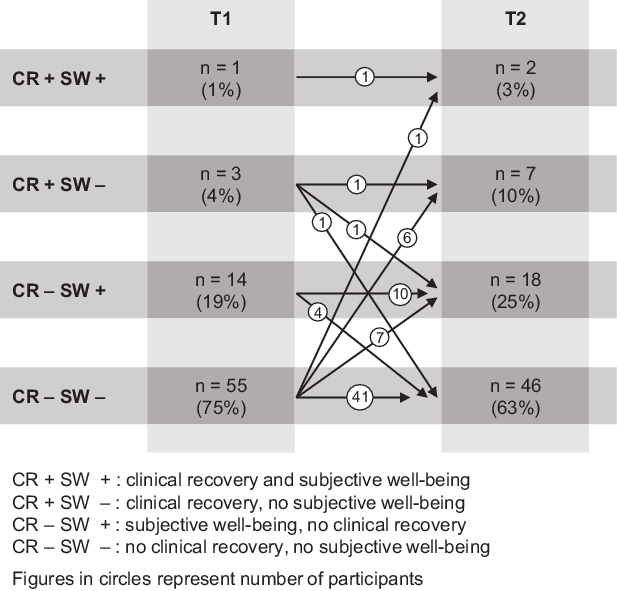
Figure 1 shows the individual transitions between states of clinical recovery and subjective well-being from T1 to T2. Regarding clinical recovery, over time 87.7% of all participants persisted in the same status (either recovered or nonrecovered); 9.6% changed from nonrecovery to recovery, while 2.7% had lost their initial recovered state at follow-up. Considering subjective well-being, 82.2% reported the same status at T1 and T2, 12.3% changed from non-well-being to well-being, while 5.5% had lost their initial state of subjective well-being at T2.
Transitions in clinical recovery and subjective well-being states from baseline to 5-year follow up (n = 73 participants).

Discussion
Clinical recovery was relatively rare in our sample of 73 participants, both at baseline (5.5%) and at five-year follow-up (12.3%). In our earlier study on the five-year course of symptomatic remission (one of our four criteria for clinical recovery in the present study), we found substantially higher rates for remission, both at baseline (27.3%) and at follow-up (49.4%) (Lange et al., Reference Lange, Meesters, Stek, Wunderink, Penninx and Rhebergen2019). This implies that a substantial number of symptomatically remitted participants did not qualify for clinical recovery due to missing out on our criteria for appropriate community functioning. Our clinical recovery rates are lower than those of the above-cited NYC study (Cohen and Reinhardt, Reference Cohen and Reinhardt2020), in which 27% of participants qualified for clinical recovery at baseline and 21% at follow-up. However, in the NYC study, the majority of participants lived in supported community residences, which in contrast to our study did not preclude qualification for clinical recovery. In an earlier North American cross-sectional study by Auslander and Jeste (Reference Auslander and Jeste2004), only 12 of 155 (8%) independently living schizophrenia patients (mean age 57 years) attained “sustained remission,” defined by criteria close to those for clinical recovery in our study.
Subjective well-being was reported by a moderate number of participants: 20.5% at baseline and 27.4% at follow-up. Concurrence of clinical recovery and subjective well-being was exceptional (1.4% at T1; 2.7% at T2). No significant correlations could be demonstrated between clinical recovery and subjective well-being, both at baseline and at follow-up. These findings implicate that clinical recovery was not a prerequisite for participants to experience subjective well-being, with 20.3% (at T1) and 28.1% (at T2) of clinically nonrecovered participants reporting well-being. Of note, at both T1 and T2, approximately only one in four of the clinically recovered participants reported subjective well-being. This aligns with the finding by Auslander and Jeste (Reference Auslander and Jeste2004) that the 12 patients in sustained remission did not differ in quality of well-being from 12 nonremitted patients, although the small numbers may have impacted on this observation. In younger patient populations, a meta-analysis reported a small to medium negative correlation between symptom severity and personal recovery (20 studies, 3994 mainly chronic patients, mean age 42 years) (Van Eck et al., Reference Van Eck, Burger, Vellinga, Schirmbeck and de Haan2018). In addition, only a small positive association was found between general functioning and personal recovery. Of note, the heterogeneity across studies was substantial.
A study by Palmer and colleagues evaluated happiness as a key element of subjective well-being (measured by four CES-D items) in 72 symptomatically nonremitted schizophrenia outpatients (mean age 50 years) (Palmer et al., Reference Palmer, Martin, Depp, Glorioso and Jeste2014). Patients reported lower mean levels of happiness than healthy peers, but there was substantial heterogeneity within the patient group. Happiness correlated with positive psychosocial factors but not with severity of psychotic symptoms. Apparently, a substantial number of schizophrenia patients succeed in leading a satisfying life in the face of persisting psychosis. This phenomenon of “flourishing with psychosis” is also acknowledged in younger patient groups (Chan et al., Reference Chan, Mak, Chio and Tong2018). Qualitative studies may help to shed light on this intriguing finding. Older patients are of special interest in this respect as a lifelong experience of living with psychosis may have fostered enduringly effective coping mechanisms. Lessons may be learned from their experiences that can inform their younger peers.
On the flipside, for the majority of our participants (75.3% at baseline, 63.0% at follow-up), neither clinical recovery nor subjective well-being was within reach. This sobering finding suggests that for most patients with schizophrenia in older age, their disorder continues to impact negatively on their lives. However, this should not discourage endeavors to enhance their conditions. Although recovery as a final goal may remain elusive, smaller achievements can also make meaningful differences for these patients.
We consider the catchment-area based design, including patients regardless of age at onset and place of residence, as well as the fact that we traced all 109 participants at follow-up, as strengths of our study. However, the size of our study sample was relatively small. In addition, a number of other limitations should be acknowledged. First, as consensus definitions are lacking for both clinical recovery and subjective well-being, we selected provisional sets of criteria that in our view aligned with the literature. Due to their provisional character, the cut-offs of some criteria (e.g. social network size, SOFAS score) are open to criticism, and future research may lead to adaptations. Second, the dichotomous outcome options for clinical recovery and subjective well-being do no justice to in-between states. In addition, we had no information on the interval between the two assessments. Obviously, transitions between states will have occurred more frequently than reported. Third, concern has been raised about the capacity for self-report in schizophrenia due to impairments in cognition and insight. However, it has been demonstrated that schizophrenia patients can report subjective quality of life with high degrees of reliability and concurrent validity (Voruganti et al., Reference Voruganti, Heslegrave, Awad and Seeman1998). Quality of life and mood scales are known to correlate substantially, by the nature of the overlap in the constructs they measure that partially reflect the same underlying affective state. In our sample, the correlations of the MANSA and CES-D scales were moderate to strong (T1: Pearson’s r (73) = −0.652, p < 0.001; T2: Pearson’s r (73) = −0.599, p < 0.001). Nonetheless, in our opinion, employing two self-report measures to evaluate subjective well-being contributed to the representation of the perspective of the participants.
In summary, the transitions over time in states of clinical recovery and subjective well-being in our sample confirm other reports of the dynamic course of schizophrenia in later life, with room for improvement (Cohen et al., Reference Cohen, Meesters and Zhao2015). We found no linkage between clinical recovery and subjective well-being. Traditionally, treatment in schizophrenia has prioritized remission of symptoms and mitigation of disability. Without calling into question the importance of these aims, recognition is growing that in spite of ongoing symptoms and impairments a substantial number of schizophrenia patients can experience subjective well-being and thus may find “wellness within illness” (Palmer et al., Reference Palmer, Martin, Depp, Glorioso and Jeste2014). This study shows that this also holds true for older individuals living with schizophrenia. Therefore, novel interventions that may foster subjective well-being in later life should be welcomed (Meesters et al., Reference Meesters, van der Ham, Dominicus, Stek and Abma2019).
Conflict of interest
The authors have no conflicts of interest to declare.
Description of authors’ roles
Dr. Meesters designed and carried out the original study, analyzed the data, and supervised the writing of the manuscript. Dr. Lange assisted with the data analysis and in the writing of the paper. Dr. Wunderink, Dr. Stek, and Dr. Rhebergen assisted in the writing of the paper.
Acknowledgments
The authors thank Anna Paauw and Karin Vermond for their assistance in the collection of the data.