INTRODUCTION
Primary dystonia is a neurological disorder characterized by twisting or repetitive movements or abnormal postures that develop in the absence of any apparent cause (Fahn, Reference Fahn1988; Tarsy & Simon, Reference Tarsy and Simon2006). In addition to these motor symptoms, there is some evidence for distinct cognitive alterations in primary dystonia, particularly in the domain of executive functioning (Jahanshahi et al., Reference Jahanshahi, Torkamani, Beigi, Wilkinson, Page, Madeley and Tisch2014). Executive functions allow for the pursuit of complex goals by exerting top–down control on cognitive representations (Diamond, Reference Diamond2013; Elliott, Reference Elliott2003). Cognitive flexibility (i.e., the ability to adapt cognitive sets to changing environmental demands) has been identified as one of the most basic executive functions (Miyake et al., Reference Miyake, Friedman, Emerson, Witzki, Howerter and Wager2000).
Cognitive flexibility in primary dystonia has most frequently been investigated using the Wisconsin Card Sorting Test (WCST) (Berg, Reference Berg1948; Grant & Berg, Reference Grant and Berg1948; Heaton, Chelune, Talley, Kay, & Curtiss, Reference Heaton, Chelune, Talley, Kay and Curtiss1993). The WCST is the best-established neuropsychological procedure to assess cognitive flexibility (Rabin, Barr, & Burton, Reference Rabin, Barr and Burton2005) with documented sensitivity to frontal lobe lesions (Demakis, Reference Demakis2003; Milner, Reference Milner1963), to neurodegenerative diseases (Dirnberger & Jahanshahi, Reference Dirnberger and Jahanshahi2013; Lange, Vogts, et al., Reference Lange, Vogts, Seer, Fürkötter, Abdulla, Dengler and Petri2016), and to healthy aging (Kopp, Lange, Howe, & Wessel, Reference Kopp, Lange, Howe and Wessel2014; Rhodes, Reference Rhodes2004). On the WCST, participants have to sort cards in accordance with one of three viable task rules. After several trials, the valid task rule changes. Participants are then required to identify the new task rule by evaluating the experimenter’s feedback. When having found the correct new rule, participants have to maintain it until they are informed that the rule has changed again.
When compared to healthy controls, patients with primary dystonia have been described to perform worse on the WCST (Alemán, de Erausquin, & Micheli, Reference Alemán, de Erausquin and Micheli2009; Bugalho, Corrêa, Guimarães, & Xavier, Reference Bugalho, Corrêa, Guimarães and Xavier2008; but see Jahanshahi, Rowe, & Fuller, Reference Jahanshahi, Rowe and Fuller2003). Similarly, dystonia patients appeared to be impaired on the intra-/extradimensional set-shifting task (Scott et al., 2003; but see Balas, Peretz, Badarny, Scott, & Giladi, Reference Balas, Peretz, Badarny, Scott and Giladi2006), an executive functioning test similar to the WCST.
This dystonia-related deficit in cognitive flexibility might be due to functional or microstructural alterations in the basal ganglia and their cortical projection sites (Romano et al., Reference Romano, Bertolino, Gigante, Martino, Livrea and Defazio2014). Primary dystonia has been found to be associated with metabolic, physiological, and microstructural changes in cortico-basal ganglia loops (Breakefield et al., Reference Breakefield, Blood, Li, Hallett, Hanson and Standaert2008; Lehéricy, Tijssen, Vidailhet, Kaji, & Meunier, Reference Lehéricy, Tijssen, Vidailhet, Kaji and Meunier2013; Neychev, Gross, Lehéricy, Hess, & Jinnah, Reference Neychev, Gross, Lehéricy, Hess and Jinnah2011; Zoons, Booij, Nederveen, Dijk, & Tijssen, Reference Zoons, Booij, Nederveen, Dijk and Tijssen2011). In addition to their role in motor control, cortico-basal ganglia loops have been hypothesized to underlie executive functioning (Frank, Loughry, & O’Reilly, Reference Frank, Loughry and O’Reilly2001; Hazy, Frank, & O’Reilly, Reference Hazy, Frank and O’Reilly2007; Monchi, Petrides, Petre, Worsley, & Dagher, Reference Monchi, Petrides, Petre, Worsley and Dagher2001; Monchi, Petrides, Strafella, Worsley, & Doyon, Reference Monchi, Petrides, Strafella, Worsley and Doyon2006; Robbins & Cools, Reference Robbins and Cools2014; Saint-Cyr, Reference Saint-Cyr2003). Although it appears plausible to attribute cognitive inflexibility in primary dystonia to pathophysiological changes in cortico-basal ganglia loops, this conclusion is hampered by several confounding factors.
The available evidence for cognitive inflexibility in primary dystonia comes from studies comparing dystonia patients with healthy controls. While these groups might differ with regard to the integrity of cortico-basal ganglia loops, other variables might account for differences in cognitive flexibility as well. For instance, depression is more prevalent in patients with primary dystonia than in general population (Lencer et al., Reference Lencer, Steinlechner, Stahlberg, Rehling, Orth, Baeumer and Hagenah2009) and its presence is associated with cognitive inflexibility (Snyder, Reference Snyder2013). Moreover, patients might generally perform worse than healthy controls because the label of “being a patient” induces an expectation to perform worse (Schwarz, Reference Schwarz2015). Finally, in contrast to healthy controls, dystonia patients might be distracted by their motor symptoms during cognitive testing (Jahanshahi et al., Reference Jahanshahi, Torkamani, Beigi, Wilkinson, Page, Madeley and Tisch2014, Reference Jahanshahi, Rowe and Fuller2003; Stamelou, Edwards, Hallett, & Bhatia, Reference Stamelou, Edwards, Hallett and Bhatia2012). These confounds can be eliminated by examining cognitive flexibility in dystonia patients and in control patients who show similar motor symptoms, but who do not suffer from a comparable central pathophysiology.
The present study aimed to contrast cognitive flexibility between primary blepharospasm patients and patients with hemifacial spasm. Blepharospasm is characterized by abnormal bilateral contractions of the eyelid, leading to excessive blinking or difficulty opening the eyes (Tarsy & Simon, Reference Tarsy and Simon2006). Patients with hemifacial spasm also suffer from abnormal eyelid contractions, but these are typically restricted to one side of the face (Wang & Jankovic, Reference Wang and Jankovic1998). In most cases, hemifacial spasm can be attributed to peripheral facial nerve damage, whereas primary blepharospasm has been related to microstructural (Etgen, Mühlau, Gaser, & Sander, Reference Etgen, Mühlau, Gaser and Sander2006; Obermann et al., Reference Obermann, Yaldizli, de Greiff, Lachenmayer, Buhl, Tumczak and Maschke2007) and functional (Obermann et al., Reference Obermann, Yaldizli, de Greiff, Konczak, Lachenmayer, Tumczak and Maschke2008; Schmidt et al., Reference Schmidt, Linden, Goebel, Zanella, Lanfermann and Zubcov2003) alterations in the basal ganglia.
The comparison of primary blepharospasm and hemifacial spasm thus offers the possibility to investigate basal ganglia contributions to cognitive inflexibility in primary dystonia while controlling for typical confounds of patients-versus-healthy-controls studies (Dias et al., Reference Dias, Doyle, Kummer, Cardoso, Caramelli and Teixeira2009). Both groups are affected by motor symptoms and might be distracted by their occurrence during cognitive testing. Similarly, facial spasms are associated with mental distress giving rise to an increased risk for depression both in blepharospasm patients (Müller et al., Reference Müller, Kiechl, Wenning, Seppi, Willeit, Gasperi and Poewe2002) and in patients with hemifacial spasm (Tan et al., Reference Tan, Lum, Fook-Chong, Chan, Gabriel and Lim2005). However, only primary blepharospasm is associated with basal ganglia changes. Here, we compared patients with primary blepharospasm and patients with hemifacial spasm with regard to their performance on a computerized version of the WCST.
PATIENTS AND METHODS
Participants
Nineteen patients with primary blepharospasm (BSP) and 21 patients with hemifacial spasm (HSF) were recruited from the outpatient clinic of the Department of Neurology of Hannover Medical School. The diagnosis was made by an experienced neurologist in the field of movement disorders (D.D.). In two of the patients, BSP was combined with oromandibular dystonia. All patients were free of psychiatric disease and neurological disorders other than the cranial muscle contractions. All patients were treated with local subcutaneous injections of botulinum toxin on a regular basis and had normal or corrected-to-normal vision. In one blepharospasm patient and two patients with hemifacial spasm poor performance on the computerized WCST (cWCST, see below) resulted in an insufficient number of trials for analysis (i.e., less than 30 of 40 possible runs were completed). These patients were excluded from all analyses.
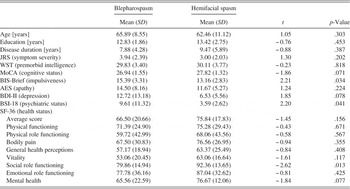
Within the final sample, the two patient groups were matched with regard to gender (blepharospasm: 10 female, 8 male; hemifacial spasm: 11 female, 8 male), age, and education (see Table 1). All patients were compensated for their participation by payment (25 €). The study was reviewed and approved by the local ethics committee. All patients gave informed consent in accordance with the Declaration of Helsinki. The patients with blepharospasm were also included in an event-related potential study that will be reported in a separate publication (Lange et al., Reference Lange, Seer, Salchow, Dengler, Dressler and Koppunder review).
Demographic, Clinical, and Psychological Characteristics of the Patients with Blepharospasm (N=18) and Hemifacial Spasm (N=19) Examined in our study

Note. JRS=Jankovic Rating Scale, WST=Wortschatztest (German vocabulary test of premorbid intelligence), MoCA=Montreal Cognitive Assessment, BIS-Brief=Barratt Impulsiveness Scale-Brief, AES=Apathy Evaluation Scale, BDI-II=Beck’s Depression Inventory, BSI-18=Brief Symptom Inventory – short version, SF-36=Short Form Health Survey.
Neuropsychological and Clinical Testing
In addition to the cWCST, patients were examined using several cognitive tests, clinical ratings, and psychometric questionnaires. General cognitive status was examined using the Montreal Cognitive Assessment (MoCA; Nasreddine et al., Reference Nasreddine, Phillips, Bedirian, Charbonneau, Whitehead, Collin and Chertkow2005). Premorbid intelligence was estimated using a German vocabulary test (Wortschatztest, WST; Schmidt & Metzler, Reference Schmidt and Metzler1992). The Jankovic Rating Scale (JRS; Jankovic & Orman, Reference Jankovic and Orman1987) served as a measure of the severity and frequency of eyelid contractions. Throughout the manuscript, we report the sums of the scores on the severity and on the frequency item with a range from 0 (indicating the absence of any symptoms) to 8 (indicating the frequent occurrence of severe symptoms). Patients further completed self-report measures of psychiatric symptoms (Beck’s Depression Inventory, BDI-II; Beck, Steer, Ball, & Rainieri, Reference Beck, Steer, Ball and Ranieri1996; Brief Symptom Inventory – short form, BSI-18; Derogatis, Reference Derogatis2001), health status (short form 36 health survey, SF-36; Ware & Sherbourne, Reference Ware and Sherbourne1992), impulsiveness (Barratt Impulsiveness Scale-Brief, BIS-Brief; Steinberg, Sharp, Stanford, & Tharp, Reference Steinberg, Sharp, Stanford and Tharp2013), and apathy (Apathy Evaluation Scale, AES; Marin, Biedrzycki, & Firinciogullari, Reference Marin, Biedrzycki and Firinciogullari1991).
The Computerized WCST
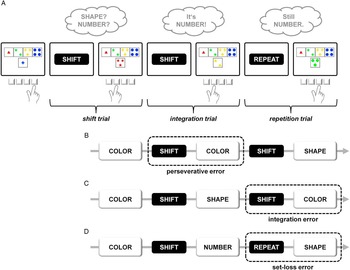
Patients completed an established computerized version of the WCST (cWCST, Barceló, Reference Barceló2003; Kopp & Lange, Reference Kopp and Lange2013; Lange, Vogts, et al., Reference Lange, Vogts, Seer, Fürkötter, Abdulla, Dengler and Petri2016; Lange, Seer, Finke, Dengler, & Kopp, Reference Lange, Seer, Finke, Dengler and Kopp2015; Lange, Seer, Müller, & Kopp, Reference Lange, Seer, Müller and Kopp2015). The task required participants to match cards according to one of three possible sorting rules. Target displays consisted of four key cards which appeared invariantly above one stimulus card, all configured around the center of the computer screen (Figure 1). Stimulus cards varied on three dimensions (color, shape, number), and these dimensions equaled the three viable task rules. None of the 24 different stimulus cards shared more than one attribute with any of the keycards, so the sorting rule applied by the participant could unambiguously be identified (Barceló, Reference Barceló2003; Nelson, Reference Nelson1976).
Four exemplary trial sequences in the computerized Wisconsin Card Sorting Test. Each sequence begins with a negative feedback cue (“SHIFT”), signaling that the previously correct rule is no longer valid. In (A), the examinee shifts away from the previously correct rule on the shift trial. However, the selected rule is not the correct one as signaled by a second negative feedback cue. The examinee then needs to integrate the information about the previously applied rules to infer the correct task rule on the integration trial. Here, this integration is successful. Following the identification of the correct rule (signaled by a positive feedback cue, “REPEAT”), the individual repeats sorting by this rule. B: This examinee does not shift to another sorting rule on the shift trial, but repeats sorting by the rule that has been signaled to be incorrect. S/he commits a perseverative error. C: As in (A), the examinee shifts rules on the shift trial, but then fails to integrate the information about the previously applied rules which results in an integration error, that is, a sort by rule that could have already been eliminated. D: This examinee directly shifts to the correct new rule on the shift trial. However, after positive feedback has signaled that this rule needs to be repeated, the examinee fails to maintain set. S/he commits a set-loss error.

Participants were required to match the stimulus card with one of the four key cards in accordance with the appropriate rule. They indicated their sorting choice by pressing one of four keys on a response pad. Target displays remained on screen until a response was recognized.
After an interval of 800 ms following participants’ response, a feedback cue was presented for 400 ms indicating whether the applied sorting rule should be maintained or changed on the upcoming trial. The German words for “REPEAT” (“BLEIBEN”) and “SHIFT” (“WECHSELN”), displayed in 28-point Arial, were used as feedback cues. Subsequent target stimuli appeared 1200 ms after feedback-cue onset.
Rules changed in an unpredictable manner (Altmann, Reference Altmann2004) after runs of two or more rule repetitions (average run length: 3.5 trials). Participants completed 40 runs involving 39 rule shifts. Before the experimental sequence, five practice runs were administered. Participants were informed about the three possible sorting rules and about the fact that the valid rule would change from time to time.
Data Analysis
The cWCST allows distinguishing between three different situations that place demands on dissociable facets of cognitive flexibility (Barceló, Reference Barceló1999; Barceló & Knight, Reference Barceló and Knight2002; Lange, Kröger, et al., Reference Lange, Kröger, Steinke, Seer, Dengler and Kopp2016; Lange, Vogts, et al., Reference Lange, Vogts, Seer, Fürkötter, Abdulla, Dengler and Petri2016). The first trial after patients have been informed that the rule has changed constitutes a shift trial. On shift trials, patients have to disengage from the old and adopt a new mental set (set shifting). Failures to perform a set shift result in perseverative errors (Figure 1B). Even when patients do not perseverate they can be expected to shift to a wrong rule in 50% of the trials. In these trials, they are informed (by means of a feedback cue) that they have chosen the wrong of the two remaining task rules. On the following trial, patients have to integrate information about previous card sorts and feedback cues to infer the correct rule (rule inference). We refer to these trials as integration trials, and to errors on these trials as integration errors (Figure 1C). Once patients have inferred the correct rule, a feedback cue signals that this rule needs to be repeated (set maintenance). The following trial constitutes a repetition trial. Failures to maintain cognitive set manifest in set-loss errors (Figure 1D).
Error rates (i.e., the percentages of erroneous responses) and response times on shift trials, integration trials, and repetition trials were compared between blepharospasm patients and patients with hemifacial spasm by means of 2×3 mixed analyses of variance (ANOVAs) involving the factors group (blepharospasm vs. hemifacial spasm) and trial type (shift vs. integration vs. repeat).
Responses were only considered for response time analysis when participants met the task demands (i.e., they had to shift rules on shift trials, to infer the correct rule on integration trials, and to repeat the rule on repeat trials). Response times smaller than 100 ms or greater than three standard deviations above the individual mean for each patient were excluded before mean response times were calculated.
We further explored whether measures of cognitive flexibility on the cWCST were associated with indicators of health status or psychiatric symptoms in blepharospasm and hemifacial spasm patients. Specifically, Pearson correlations were calculated between the percentages of perseverative errors (as a measure of set shifting), integration errors (as a measure of rule inference), and set-loss errors (as a measure of set maintenance) on the one hand, and measures of impulsiveness, apathy, depression, psychiatric symptoms, health status, symptom severity, and disease duration on the other hand. As we did not have any specific a priori hypotheses with regard to these relationships, correlation analyses were conducted in an exploratory way.
RESULTS
BSP and HFS patients did not differ significantly with regard to premorbid intelligence, general cognitive status, disease duration, symptom severity, apathy, or depression (see Table 1). Significant group differences were observed with regard to impulsiveness (as measured by the BIS-Brief; t(35)=2.21; p=.034; d=0.73), global psychiatric status (as measured by the BSI-18; t(35)=2.20; p=.041; d=0.72), and social role functioning (as measured by the SF-36; t(34)=–2.62; p=.013; d=−0.87).
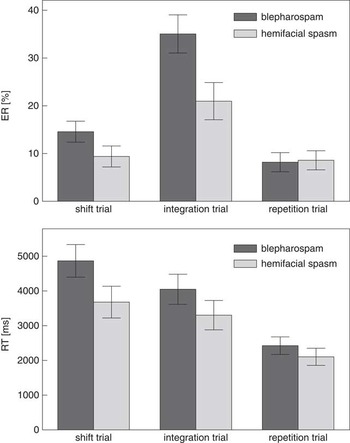
Overall, BSP patients committed more errors (M=19%) on the cWCST than HFS patients (M=13%), as indicated by a significant main effect of group in the 2×3 mixed ANOVA, F(1,35)=4.20, p=.048, η p 2=.11. This effect was moderated by a significant group×trial type interaction, F(2,70)=5.33, p=.015, η p 2=.13. In contrast to HFS patients, BSP patients made significantly more errors on integration trials, t(35)=2.54, p=.018, d=0.84, but not on shift trials, t(35)=1.67, p=.104, d=0.55, or repetition trials, t(35)=−0.17, p=.868, d=−0.06.
The 2×3 mixed ANOVA on RT data revealed no significant main effect of group, F(1,35)=2.15, p=.151, η p 2=.06. The group×trial type interaction did not reach statistical significance, F(1,35)=2.15, p=.079, η p 2=.07. The percentages of errors committed on shift trials, repetition trials and integration trials as well as response latencies on these trials are depicted in Figure 2.
Error rates and response times from the computerized Wisconsin Card Sorting Test. Error bars indicate standard error of the mean.

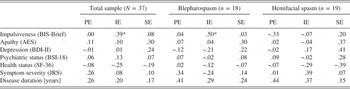
The percentage of integration errors as a measure of rule inference on the cWCST was correlated with patients’ impulsiveness (as indicated by the BIS-Brief, see Table 2). In the whole sample, impulsiveness was significantly associated with integration errors (r=.39; p=.017), but not with perseverative errors (r=.00; p=.989) or set-loss errors (r=.08; p=.631). The correlation between impulsiveness and integration errors could only be observed in blepharospasm patients (r=.50; p=.034), but not in patients with hemifacial spasm (r=−.07; p=.788).
Associations (Pearson Correlation Coefficients) between Error Measures from the Computerized Wisconsin Card Sorting Test and Measures of Clinical Status

Note. BSP=Blepharospasm, PE=perseverative error, IE=integration error, SE=set-loss error, BIS-Brief=Barratt Impulsiveness Scale-Brief, AES=Apathy Evaluation Scale, BDI-II=Beck’s Depression Inventory, BSI-18=Brief Symptom Inventory – short form, SF-36=Short Form Health Survey, JRS=Jankovic Rating Scale.
*p<.05.
DISCUSSION
We examined executive functioning on a computerized version of the WCST in patients with blepharospasm and patients with hemifacial spasm. Blepharospasm patients committed significantly more errors than patients with hemifacial spasm. A detailed analysis of patients’ error rates revealed that this group difference was mainly driven by the percentage of integration errors. The increase in integration errors in patients with blepharospasm is indicative of dystonia-related rule-inference deficits on the cWCST. In addition, we found integration errors on the cWCST to specifically relate to self-reported impulsiveness in patients with blepharospasm.
In line with previous studies (Alemán et al., Reference Alemán, de Erausquin and Micheli2009; Bugalho et al., Reference Bugalho, Corrêa, Guimarães and Xavier2008), our analysis revealed impaired performance on a variant of the WCST in patients suffering from a form of primary dystonia. However, previous studies comparing dystonia patients with healthy controls did not allow attributing this cognitive flexibility deficit to the pathomechanisms underlying primary dystonia. In contrast, by comparing dystonia patients to a clinical control group, we were able to eliminate confounding factors such as symptom-related distraction (Jahanshahi et al., Reference Jahanshahi, Rowe and Fuller2003, Reference Jahanshahi, Torkamani, Beigi, Wilkinson, Page, Madeley and Tisch2014; Stamelou et al., Reference Stamelou, Edwards, Hallett and Bhatia2012).
Both the group of blepharospasm patients and the control group of patients with hemifacial spasm suffered from eyelid spasms, and symptom severity did not differ significantly between these groups. Hence, the executive deficits observed in blepharospasm patients are unlikely to result from distracting motor symptoms or attempts to control them. Instead, our results provide new support for the possibility that the blepharospasm-related deficit in cognitive flexibility results from microstructural and functional alterations in cortico-basal ganglia loops that occur in blepharospasm but not in hemifacial spasm. The basal ganglia do not only play a role in the selection of motor programs, but they have also been proposed to be critical for the selection of more abstract cognitive programs (Hazy et al., Reference Hazy, Frank and O’Reilly2007). Specifically, the need to dynamically update the selection of abstract sorting rules on the WCST has been shown to rely on basal-ganglia activity (Monchi et al., Reference Monchi, Petrides, Petre, Worsley and Dagher2001, Reference Monchi, Petrides, Strafella, Worsley and Doyon2006). When being disrupted by dystonia-related basal-ganglia alterations, this selection process might become less reliable, resulting in WCST performance deficits in patients with primary dystonia. Along the lines of Parkinson’s disease research (Monchi et al., Reference Monchi, Petrides, Doyon, Postuma, Worsley and Dagher2004; Monchi, Petrides, Mejia-Constain, & Strafella, Reference Monchi, Petrides, Mejia-Constain and Strafella2007), it is now important to characterize how basal-ganglia alterations give rise to these executive deficits in primary dystonia using neuroimaging methods.
Our results further point to a potential role for impulsiveness in dystonia-related cognitive inflexibility. Blepharospasm patients reported significantly higher levels of impulsiveness than patients with hemifacial spasm. Moreover, individual differences in impulsiveness were related to the percentage of integration errors in patients suffering from blepharospasm. This association was markedly specific as it could not be observed in patients with hemifacial spasm or with regard to any other type of cWCST error. Elevated levels of impulsiveness may thus partially account for the observed pattern of cWCST deficits in patients with blepharospasm. Impulsiveness as measured by the BIS-Brief is characterized by, for example, a lack of self-control, deficits to concentrate and a tendency to act on the spur of the moment (Patton, Stanford, & Barratt, Reference Patton, Stanford and Barratt1995; Steinberg et al., Reference Steinberg, Sharp, Stanford and Tharp2013). These traits may specifically relate to integration errors on the cWCST because integration trials require acting on more than just the most recent piece of information (Lange, Kröger, et al., Reference Lange, Kröger, Steinke, Seer, Dengler and Kopp2016). On shift trials and repetition trials, participants can directly follow cue instructions: they just have to focus on the most recent feedback cue to know whether they have to shift or to maintain the rule. On integration trials, however, participants have to combine information about tested rules across the last two trials to infer the correct rule. A tendency to act only “on the spur of the moment” likely leads to a large number of errors on these trials.
Importantly, the relationship between integration errors committed on the cWCST and impulsiveness also illustrates that cognitive inflexibility might have profound impact on the everyday life of patients with primary dystonia. Impulsiveness is associated with an increased risk of engaging in deviant or addictive behavior as well as with impaired decision-making and difficulties inhibiting inappropriate responses (Dalley, Everitt, & Robbins, Reference Dalley, Everitt and Robbins2011; de Ridder, Lensvelt-Mulders, Finkenauer, Stok, & Baumeister, Reference de Ridder, Lensvelt-Mulders, Finkenauer, Stok and Baumeister2012; Lange & Eggert, Reference Lange and Eggert2015). Cognitive inflexibility and impulsiveness thus appear to be relevant points to consider in the study of the non-motor syndrome of primary dystonia (Stamelou et al., Reference Stamelou, Edwards, Hallett and Bhatia2012).
Note that we have excluded one patient with blepharospasm and two patients with hemifacial spasm because poor cWCST performance resulted in an insufficient number of trials for analysis. As the mean JRS score (indicating the severity and frequency of eyelid contractions) of these patients (3.33) was lower than the mean JRS score of the included patients (3.46), it is unlikely that performance deficits in the excluded patients were primarily caused by motor symptoms. Instead, we have observed (in the present sample and in previous studies using a similar paradigm; Lange, Vogts, et al., Reference Lange, Vogts, Seer, Fürkötter, Abdulla, Dengler and Petri2016; Lange, Kröger, et al., Reference Lange, Kröger, Steinke, Seer, Dengler and Kopp2016) that the cWCST can be very challenging for some participants, even in the absence of a neurological condition. While the loss of data due to task difficulty was tolerable in the present study, it might be advisable to use simplified paradigms when studying cognitive flexibility in more severely impaired patients.
Limitations
It is widely accepted that the construct of executive functioning is multidimensional rather than unitary (Delis, Kramer, Kaplan, & Holdnack, 2004; Miyake et al., Reference Miyake, Friedman, Emerson, Witzki, Howerter and Wager2000). According to an influential taxonomy, cognitive flexibility (as assessed by, e.g., the WCST) constitutes one of the basic factors of executive functioning (next to inhibition and updating) (Miyake et al., Reference Miyake, Friedman, Emerson, Witzki, Howerter and Wager2000). In our study, we focused on the processes that give rise to cognitive flexibility on the WCST. To this end, we used a computerized variant of the WCST that involved considerably more trials and rule shifts than the established manual versions of the WCST. Only by using such an extensive test version, we were able to obtain reasonable estimates of response latency and accuracy on the separate trial types and hence to contrast processes of set shifting, rule inference, and set maintenance. This focus on cognitive flexibility necessarily implies that our results do not paint a complete picture of executive functioning in blepharospasm and hemifacial spasm. As a consequence, our finding of impaired cognitive flexibility in patients with blepharospasm cannot be generalized to other domains of executive functioning such as inhibition or updating. To examine which facets of executive functioning are affected by dystonia-related changes in which way, further studies involving more comprehensive test batteries are required.
Although our approach of comparing blepharospasm patients to patients with hemifacial spasm eliminates some of the confounding factors involved in patients-versus-healthy-controls studies, our design does not allow inferring a causal relationship between pathophysiological changes and cognitive flexibility in primary dystonia. Similarly, it is not possible to map deficits in cognitive flexibility to dysfunction in a specific neural area or circuit. One possible way to further elucidate the relationship between pathophysiological and cognitive alterations in primary dystonia is to examine the effects of deep-brain stimulation on cognitive processes (Hälbig et al., Reference Hälbig, Gruber, Kopp, Schneider, Trottenberg and Kupsch2005; Jahanshahi et al., Reference Jahanshahi, Torkamani, Beigi, Wilkinson, Page, Madeley and Tisch2014; Pillon et al., Reference Pillon, Ardouin, Dujardin, Vittini, Pelissolo and Cottencin2006). Of interest, both in the study by Jahanshahi et al. (Reference Jahanshahi, Torkamani, Beigi, Wilkinson, Page, Madeley and Tisch2014) and in the study by Pillon et al. (Reference Pillon, Ardouin, Dujardin, Vittini, Pelissolo and Cottencin2006), the number of non-perseverative errors but not the number of perseverative errors on the WCST decreased following deep-brain stimulation of the internal segment of the globus pallidus (GPi). By pointing to a differential sensitivity of WCST measures to GPi modulation, these results highlight the potential of combining deep-brain stimulation with the in-depth analysis of distinct executive processes involved in WCST performance.
Given the lack of prior research on the correlates of cognitive inflexibility in primary dystonia and the rather small size of our sample, correlation analyses were necessarily exploratory. This implies that especially our results with regard to the selective association between integration errors and impulsiveness should be regarded as preliminary. Larger confirmatory studies are needed to arrive at a reliable estimate of the strength of this relationship.
CONCLUSION
We found evidence for cognitive inflexibility in patients with blepharospasm when compared to patients with hemifacial spasm who show similar motor symptoms, but who do not share a central pathophysiology. Thus, our study design allowed for a test of the widely held distraction hypothesis (Jahanshahi et al., Reference Jahanshahi, Rowe and Fuller2003, Reference Jahanshahi, Torkamani, Beigi, Wilkinson, Page, Madeley and Tisch2014; Stamelou et al., Reference Stamelou, Edwards, Hallett and Bhatia2012). Our results suggest that the observed pattern of cWCST performance deficits is related to the pathophysiological processes underlying blepharospasm. Studies using different imaging techniques or deep-brain stimulation may help to further characterize the exact relationship between neural alterations (e.g., in cortico-basal ganglia circuits) and cognitive inflexibility in primary dystonia. Additional research is also needed to examine the effects of cognitive inflexibility on daily functioning and quality of life in dystonia patients. To this end, the study of impulsiveness and related constructs might prove useful to improve our understanding of dystonia-related cognitive changes and to mitigate the consequences of cognitive inflexibility in primary dystonia.
Acknowledgments
Florian Lange received funding from the German National Academic Foundation. In addition, the research reported here was supported by a grant to Bruno Kopp from the Petermax-Müller-Stiftung, Hannover, Germany. The authors thank Dimitri Gebauer, Julia Jablonowski, Max Joop, Christian Lange, Dorothea Müller, Sarah Rudolph, Carolin Salchow, Alexander Steinke, and Ronja Weiblen for helping with data collection. The authors declare no competing financial interests.