


1. INTRODUCTION
The fast breeder reactor is one of the options of sustainable energy sources for the next generation. From the point of view of safety, however, the meltdown of the fast reactor core (Gnanadhas et al., Reference Gnanadhas, Sharma, Malarvizhi, Murthy, Rao, Kumaresan, Ramesh, Harvey, Nashine, Chellapandi and Chetal2011) followed by a strong compaction of the molten fuel can lead to a reactivity excursion accompanied by an explosive disassembly of the reactor (Hofmann, Reference Hofmann1970). Along with such extremely severe nuclear accidents, nuclear terrorisms with compact nuclear devices are of particular concern in recent international security issues (Buddemeier et al., Reference Buddemeier, Valentine, Millage and Brandt2011). These catastrophic events can be regarded as fast hydrodynamic phenomena driven by rapid pressure rise due to the release of fission energy. Equation of state (EOS) of the material is a key parameter which relates the pressure and other thermodynamic state functions such as the density and temperature. Therefore, the data of high-pressure EOS not only of the coolant but also of nuclear fissile materials are essential for assessment of the damage due to these extremely energetic events. Also in high-energy astrophysics and inertial confinement fusion studies, EOS is an important parameter which must be embedded in numerical simulation codes. However, especially in “warm dense matter (Committee on High Energy Density Plasma Physics, Plasma Science Committee, National Research Council, 2003)” regions, the error between the existing EOS data (More et al., Reference More, Warren, Young and Zimmerman1988; Lyon & Johnson, Reference Lyon and Johnson1992) sometimes exceeds 10% (Logan et al., Reference Logan, Davidson, Barnard and Lee2004).
EOS of nuclear materials such as uranium oxide at temperatures up to 104 K (kT ≈ 14; 1 eV) has been studied elsewhere (Morita & Fischer, Reference Morita and Fischer1998; Ronchi et al., Reference Ronchi, Iosilevski and Yakub2004; Iosilevskiy & Gryaznov, Reference Iosilevskiy and Gryaznov2005; Pflieger et al., Reference Pflieger, Colle, Iosilevskiy and Sheindlin2011). However, the data in the temperatures over ≈ 104 K are generally not available by static methods. In the past, high-pressure EOS data of fissile materials were obtained by underground nuclear tests (Ragan, Reference Ragan1982). Recently, high-pressure gas guns (Heller, Reference Heller2004), pulsed lasers, and z-pinch devices (Medalia, Reference Medalia2013) are employed as alternatives. Most of these measurements are based on the compression by means of strong shock wave, and can be performed only in military facilities. In addition, samples of at least some ≈ 1 g are required. Also for peaceful uses of nuclear energy, a safe, reliable, and inexpensive method to evaluate high-energy EOS of nuclear materials is demanded for safety or damage assessment of the explosive nuclear incident above. Furthermore, from the point of view of nuclear nonproliferation, it is preferable that only small amount (e.g., ≈ 10−3 g) of fissile sample is used, and compression of the sample does not occur during the measurement.
It is known that high-energy short-pulsed heavy-ion beam is an appropriate energy driver to heat the sample targets homogeneously (Hoffmann et al., Reference Hoffmann, Fortov, Lomonosov, Mintsev, Tahir, Varentsov and Wieser2002; Lomonosov, Reference Lomonosov2007; Tahir et al., Reference Tahir, Matveichev, Kim, Ostrik, Shutov, Sultanov, Lomonosov, Piriz and Hoffmann2009). In fact, an experimental EOS study of uranium and uranium-dioxide using intense pulsed heavy-ion beams has been proposed (Iosilevskiy & Gryaznov, Reference Iosilevskiy and Gryaznov2002). To realize this experiment, however, a huge accelerator system was necessary, since very high (≈ 100 MeV/u) energies were needed for heavy projectiles in order to achieve required heating homogeneities.
In this paper, in a similar manner to previous studies (Barnard et al., Reference Barnard, Armijo, More, Friedman, Kaganovich, Logan, Marinak, Penn, Sefkow, Santhanam, Stoltz, Veitzer and Wurtele2007; Armijo & Barnard, Reference Armijo and Barnard2011), we propose a simple, safe, and inexpensive experimental setup, where a small amount of fissile sample is almost homogeneously and instantaneously heated by an intense short-pulsed medium-energy heavy-ion beam. For precise assessment of high-pressure EOS of fissile materials, subsequent hydrodynamic motion is examined in detail. A method to homogenize the energy deposition density in the sub-range sample target is proposed in relation to the velocity dependence of the projectile stopping power. We examine the feasibility of an EOS experiment, in which pressures at off-Hugoniot conditions can be evaluated as a function of internal energy from the measurement of the target surface expansion velocity.
2. METHOD OF THE CALCULATION
For the waveform of the pulsed beam flux in the hydrodynamic calculation, we assumed
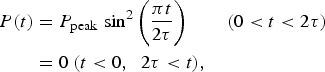 $$\eqalign{ P\lpar t\rpar & = {P_{{\rm peak}}}\ {\sin ^2}\left({\displaystyle{{{\rm \pi} t} \over {2{\rm \tau} }}} \right)\quad \quad \lpar 0 < t < 2{\rm \tau} \rpar \cr & = 0\ \lpar t < 0\comma \; \; 2{\rm \tau} < t\rpar \comma \; }$$
where P peak and τ denote the peak beam power on the target and the full width at half maximum pulse duration, respectively. The time t = 0 is defined as the start of the beam irradiation. Considering the recent progress of the longitudinal beam compression technologies (Roy et al., Reference Roy, Yu, Henestroza, Anders, Bieniosek, Coleman, Eylon, Greenway, Leitner, Logan, Waldron, Welch, Thoma, Sefkow, Gilson, Efthimion and Davidson2005; Seidl et al., Reference Seidl, Barnard, Faltens and Friedman2013), τ was assumed to be 1 ns. It follows that the full duration is 2τ = 2 ns. As the peak beam power P peak, we employed 5 GW/mm2, which is comparable to that in a high-current accelerator design proposed for warm dense matter experiments (Friedman et al., Reference Friedman, Cohen, Grote, Sharp, Kaganovich, Koniges and Liu2013). After the example of a previous study (Oguri et al., Reference Oguri, Kondo and Hasegawa2014), 23Na+ was selected as the projectile ion species.
Even for such short pulse duration, in order to realize almost instantaneous heating of the sample, we need a careful consideration on the target thickness so that the rarefaction wave cannot propagate the whole target thickness during the pulse duration. Accordingly, we used a low-density foam target to keep the target mass thickness (g/cm2) constant. In this work, as an example, we examined the hydrodynamic response of a slab of uranium foam with ρ = 0.03ρsolid (ρsolid ≡ solid density = 19.05 g/cm3) to the incident beam.
To heat the slab target almost homogeneously, we used a method based on the Bragg peak proposed by Grisham (Reference Grisham2004). The combination of the target thickness and the incident beam energy were determined, so that the energy deposition could occur at the top of the Bragg peak and inhomogeneity of the stopping power could be ±5%.
The electrons in the target atoms are excited and partially ionized when irradiated by the beam. Moreover, the averaged distance between target atoms/ions increases with the hydrodynamic expansion. Such a change of electronic structure can affect the stopping power of heavy ions in the target. Thus, to calculate the beam-energy deposition in the target during the heating, we used density- and temperature-dependent projectile stopping data obtained with a finite-temperature Thomas-Fermi target atomic model (Salzmann, Reference Salzmann1998) together with degeneracy-dependent dielectric response functions (Arista & Brandt, Reference Arista and Brandt1984). The motion of the target during and after the irradiation was calculated with a one-dimensional hydrodynamic code MULTI7 (Ramis et al., Reference Ramis, Schmalz and Meyer-ter-Vehn1988).
Since the purpose of this paper is to propose a method to evaluate an EOS data, the data may be completely unknown. However, the above method requires at least an initial EOS data to start the hydro calculation. We thus utilized the SESAME table (Lyon & Johnson, Reference Lyon and Johnson1992) as such a trial data.
3. RESULTS AND DISCUSSION
3.1. Density- and Temperature-Dependent Projectile Stopping Power in Uranium Targets
Figure 1 shows the stopping cross section of 23Na projectiles calculated as a function of the projectile energy for different U target temperatures. Especially at low projectile energies, the stopping cross section increases with the target temperature. In addition, the position of the Bragg peak moves to the lower energy region. Such an increase of the stopping power has been observed for low-Z targets, where ionization degree can be very high even at moderate temperatures (Hoffmann et al., Reference Hoffmann, Weyrich, Wahl, Gardés, Bimbot and Fleurier1990; Gardes et al., Reference Gardes, Servajean, Kubica, Fleurier, Hong, Deutsch and Maynard1992; Belyaev et al., Reference Belyaev, Basko, Cherkasov, Golubev, Fertman, Roudskoy, Savin, Sharkov, Turtikov, Arzumanov, Borisenko, Gorlachev, Lysukhin, Hoffmann and Tauschwitz1996; Hasegawa et al., Reference Hasegawa, Nakajima, Sakai, Yoshida, Fukata, Nishigori, Kojima, Oguri, Nakajima, Horioka, Ogawa, Neuner and Murakami2001; Sakumi et al., Reference Sakumi, Shibata, Sato, Tsubuku, Nishimoto, Hasegawa, Ogawa, Oguri and Katayama2001). However, according to the Thomas-Fermi calculation, the ionization degree of the ρ = 0.03ρsolid U target at kT = 20 eV was only 8%. Accordingly, the increase of the stopping power seen in Figure 1 at high temperatures can be attributed not only to free electrons but also to electrons promoted to highly exited states of the target atom. Another calculation showed that the stopping power increased when the target density decreased.
Calculated stopping cross section of U as a function of the 23Na projectile energy for different target temperatures.

Figure 2 summarizes the change of the Bragg peak shape due to the change of the target temperature at different target densities. We see that, the change of the Bragg peak shape is more significant when the target density becomes lower due to hydrodynamic expansion.
The position and the height of the Bragg peak as a function of the target temperature at (a) ρ = 0.0001ρsolid and (b) 0.1ρsolid.
3.2. Optimization of the Target Thickness and the Projectile Energy
Using the above method, the 23Na projectile stopping cross section in a U target with ρ = 0.03ρsolid at room temperature (kT = 0.025 eV) was calculated. The result is plotted in Figure 3 as a function of the incident energy. For the given inhomogeneity of ±5%, from the curve in this figure, the incident energy E in and the exit energy E out were uniquely determined to be 2.020 MeV/u and 0.291 MeV/u, respectively. The total energy deposition in the target is ΔE = E in − E out =1.729 MeV/u. Thus, 86% of the incident projectile energy could be utilized effectively for the heating. In addition, it automatically follows that the target mass thickness is 10.1 mg/cm2, which corresponds to an geometrical thickness of 176 µm for the ρ = 0.03ρsolid U target.
The target thickness and the incident projectile energy determined for the given inhomogeneity of specific energy deposition (±5%). The target density and the temperature are 0.03ρsolid and 0.025 eV (room temperature), respectively.
3.3. Target Hydrodynamic Behavior
We examined hydrodynamic behavior of the target during and after the irradiation, not only for the optimum incident energy of E in = 2.02 MeV/u, but also for E in = 1.50 MeV/u and 3.00 MeV/u, which are too low and too high compared with the optimum energy, respectively. Figure 4 shows the calculated temperature distribution in the target at the end of the irradiation (t =2 ns). When the projectile incident energy is optimum (2.02 MeV/u), the temperature is rather uniform. This is due to the fairly good homogeneity of the energy deposition profile achieved by using the top of the Bragg peak. On the other hand, when the incident energy is too low (1.50 MeV/u), only the side facing the beam is selectively heated. In the case of E in = 3.00 MeV/u, the opposite surface of the target exhibits the highest temperature, because the energy deposition occurs only on the high-energy side of the Bragg peak. In fact, if the target is not very hot, the inhomogeneity of the specific energy deposition expected from Figure 3 is ±8%. In addition, since the top of the Bragg peak is not effectively utilized, the attainable temperature is relatively low.
Temperature distribution at the end of the pulse duration (t = 2 ns) for different incident beam energies. The position x = 0 corresponds to the target surface facing the incident beam.
Figure 5 shows the temporal evolution of the temperature distribution for different incident beam energies. We see that in every case the propagation of the rarefaction wave during the pulse duration (0 < t < 2 ns) is negligible and the target could almost be isometrically heated. If the optimum incident energy of 2.02 MeV/u is used, the target temperature during the heating is quite uniform, and the subsequent expansion is rather symmetric. In addition, since no pressure gradient is induced in the target, compression due to shock wave does not occur. Simple hydro motions starting from such a well-defined thermodynamic state allows a precise evaluation of the EOS of the beam-produced high-energy density state. However, if E in was increased to 3.00 MeV/u, we see from Figure 3 that E out =1.44 MeV/u. The corresponding energy efficiency ΔE/E in is only 52%, As a result, the temperature shown in Figure 5 is always lower than that for E in =2.02 MeV/u, although the symmetry of the hydrodynamic expansion looks fairly good. On the other hand, when E in =1.50 MeV/u, target expansion occurs almost on the beam side. It is noteworthy that, in this case, if the target is cold, the projectile range is larger than the target thickness and the projectiles go through the target. However, after the temperature of the central part of the target reached 3.5 eV at t = 0.64 ns, we could not identify the penetration of the projectiles any more. This result can be explained by the increase of the stopping power due to the increase of the temperature. As a result, the expansion behavior exhibited a strong asymmetry which is not suitable for the evaluation of the EOS.
Temporal evolution of the temperature distribution in the target. Note that the target was heated only during 0 < t < 2 ns.
3.4. Sensitivity and Accuracy of the Indirect Determination of the Target Pressure
Practically, the evaluation of the EOS data may be implemented in such a way that the initial “trial” EOS data are iteratively adjusted until the measured target expansion behavior can be well reproduced. Pressure as a function of the density and temperature is an essential part of the EOS. To simulate the uncertainty of the pressure data determined by the above method, we intentionally varied the pressure value embedded in the hydro code within the range of ±10%, and the effect on the hydrodynamic motion was examined. Figure 6 shows the change of the calculated expansion velocity of the target surface at t =20 ns as a function of the relative variation introduced into the pressure data in the hydro code. In this calculation, we used the velocity of the layer with ρ =0.001ρsolid, which was very near to the real surface of the expanding target, as the surface expansion velocity. The incident energy E in was 2.02 MeV/u. We see the calculated expansion velocity fluctuates by a few percent, due probably to the small number (102) of the Lagrangian mesh in the calculation. Nevertheless, from this graph we found that, to determine the pressure with an accuracy of ±10%, the accuracy of the target expansion velocity measurement must be better than ±3 − 4%.
Change of the calculated expansion velocity of the target surface at t = 20 ns as a function of the variation introduced in the pressure data embedded in the hydro code.
4. CONCLUSIONS
The numerical results have shown that the proposed experimental setup based on the Bragg peak of the projectile energy deposition profile enables evaluation of the EOS of fissile materials in relation to extremely energetic nuclear phenomena in the range up to kT ≈ 10 eV. No shock compression is expected to occur during the experiment. In addition, only very small amount (≈ 10 mg/cm2) of the sample is enough to perform the measurement. These are consistent with conditions of nuclear non-proliferation.
To put the above scenario in practice, however, development of a high-current short-puled heavy-ion accelerator in the MeV/u range is absolutely essential. A setup for precision target diagnostics with a high time resolution is also one of the new development challenges to be addressed.
ACKNOWLEDGEMENT
We thank S. Kawata for careful reading of the manuscript.



