The chemical structures of volatile sex and aggregation pheromones of cerambycid beetles (Coleoptera: Cerambycidae) are often highly conserved within genera and subfamilies. For example, males of a number of species in the subfamily Cerambycinae produce pheromones that are 6, 8, or 10 carbons in length with hydroxyl or carbonyl groups on C2 and C3 (reviewed in Millar et al. Reference Millar, Hanks, Moreira and Lacey2009). In the subfamily Lamiinae, male Monochamus galloprovincialis (Olivier) produce the aggregation pheromone 2-(undecyloxy)-ethanol, termed “monochamol” (Pajares et al. Reference Pajares, Álvarez, Ibeas, Gallego, Hall and Farman2010), which is also a pheromone of several other Monochamus Dejean species (Teale et al. Reference Teale, Wickham, Zhang, Su, Chen and Xiao2011; Hanks et al. Reference Hanks, Millar, Mongold-Diers, Wong, Meier and Reagel2012). Moreover, several other lamiine species are attracted to (E)-6,10-dimethyl-5,9-undecadien-2-ol (fuscumol), the pheromone of Tetropium fuscum (Fabricius) (Cerambycidae: Spondylidinae) (Silk et al. Reference Silk, Sweeney, Wu, Price, Gutowski and Kettela2007; Mitchell et al. Reference Mitchell, Graham, Wong, Reagel, Striman and Hughes2011). The analogue (E)-6,10-dimethyl-5,9-undecadien-2-yl acetate (fuscumol acetate), which is a pheromone component of the South American Hedypathes betulinus (Klug) (Cerambycidae: Lamiinae), is also attractive to several other lamiine species (Fonseca et al. Reference Fonseca, Vidal and Zarbin2010; Mitchell et al. Reference Mitchell, Graham, Wong, Reagel, Striman and Hughes2011). There is evidence that some cerambycid beetles are attracted to pheromone components that are not produced by their species (Hanks et al. Reference Hanks, Millar, Moreira, Barbour, Lacey and McElfresh2007; Mitchell et al. Reference Mitchell, Graham, Wong, Reagel, Striman and Hughes2011), and to date, it was unclear whether lamiines that were attracted to fuscumol and fuscumol acetate actually produced these compounds, or instead exploited them as kairomones to find desirable hosts. Until now, there have been no reports that North American lamiines produce either of these two compounds.
Astyleiopus variegatus (Haldeman) is a North American lamiine species in the tribe Acanthocinini. The larvae feed in the branches of Kentucky coffeetree (Gymnocladus dioicus (Linnaeus) Koch; Fabaceae) and red buckeye (Aesculus pavia Linnaeus; Sapindaceae); they also infest various hardwoods, shrubs, vines, and conifers (Yanega Reference Yanega1996; Lingafelter Reference Lingafelter2007). Adult beetles are attracted to ultraviolet lights, suggesting they may be nocturnal (Yanega Reference Yanega1996). Both sexes are attracted to racemic (E/Z)-fuscumol or (E/Z)-fuscumol acetate as individual components or as a blend (Mitchell et al. Reference Mitchell, Graham, Wong, Reagel, Striman and Hughes2011; Hanks et al. Reference Hanks, Millar, Mongold-Diers, Wong, Meier and Reagel2012). Here, we report that males of A. variegatus do indeed produce both fuscumol and fuscumol acetate, and determine the absolute configurations of these two pheromone components.
One live male A. variegatus was collected on 8 August 2011 from a cross-vane flight-intercept panel trap (Alpha Scents Inc., Portland, Oregon, United States of America) located at Purdue University Martell Forest, Tippecanoe Co., Indiana, United States of America. One live female A. variegatus was captured on 22 July 2012 and two males were captured on 8 August 2012 in panel traps located at Black Rock Barrens Nature Preserve, Warren Co., Indiana, United States of America (Permit No. NP12-26). Traps were suspended from frames constructed of polyvinyl chloride pipe (see Graham et al. Reference Graham, Mitchell, Reagel, Barbour, Millar and Hanks2010) and baited with a lure that contained 100 mg of a 1:1 mixture of racemic (E/Z)-fuscumol mixed with 1 mL of ethanol in a polyethylene sachet suspended from the centre of the trap.
On the day beetles were captured, a single A. variegatus was placed in a glass vacuum trap (0.3 L) with aluminium screen provided as a perch. An adsorbent filter made of a disposable glass pipette containing 100 mg of 80/100 mesh HayeSep®-Q (Ohio Valley Specialty Company, Marietta, Ohio, United States of America) was attached to one end of the vacuum trap with a 5-cm-long section of Tygon® tubing (Saint-Gobain Precision Plastics, Aurora, Ohio, United States of America), and a filter containing 0.3 g of activated charcoal was attached to the other end. Air was pulled through the charcoal filter and into the apparatus by a vacuum attached to a variable power source to control the flow ∼0.8 L/minute). Aerations were conducted in a greenhouse under natural day/night cycle. In 2011, headspace volatiles were collected for a diurnal (10:00–18:00 hours) and a nocturnal period (18:00–10:00 hours) over four consecutive periods from 8–10 August. Volatiles were also collected concurrently from an empty vacuum trap as a control. A single female A. variegatus was aerated for one diurnal (10:00–18:00 hours) and one nocturnal period (18:00–10:00 hours) from 20–21 July 2012. Two males were also aerated simultaneously in separate vacuum traps for a diurnal and nocturnal period from 8–9 August 2012. After each collection period, the adsorbent filter was eluted with three 0.5-mL aliquots of methylene chloride (CH2Cl2) and replaced with a new filter. Extracts were stored at −20 °C until analysis.
Samples were analysed by coupled gas chromatography–mass spectrometry (GC–MS) with electron impact ionisation (EI, 70 eV) using a Hewlett-Packard 6890 GC (Hewlett-Packard, Sunnyvale, California, United States of America) equipped with a DB-5MS capillary column (30 m × 0.25 mm × 0.25 μm film; J&W Scientific, Folsom, California, United States of America) in splitless mode, interfaced to an HP 5973 mass selective detector (Hewlett-Packard), with helium carrier gas. The oven temperature was programmed from 40 °C for one minute, ramped to 250 °C at 10 °C/minute, and held for five minutes at 250 °C. Injector temperature was 100 °C. Compounds were identified by matching their retention times and mass spectra with those of authentic standards (see below).
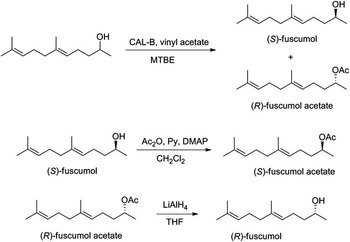
Chiral fuscumol and fuscumol acetate were prepared by kinetic resolution of fuscumol with an immobilised lipase, similar to the method of Vidal et al. (Reference Vidal, Fonseca and Zarbin2010; see Fig. 1). Thus, racemic fuscumol (2 g, Bedoukian Research, Danbury, Connecticut, United States of America), 4 mL vinyl acetate, 25 mL methyl t-butyl ether (MTBE), and 0.6 g of Candida antarctica lipase immobilised on acrylic resin (Sigma-Aldrich, St. Louis, Missouri, United States of America, product L4777) were combined in a 125 mL Erlenmeyer flask, and the mixture was stirred on an orbital shaker (32 °C, 100 rpm) for 35 minutes, at which point the ratio of fuscumol to fuscumol acetate was determined to be 53:46. The enzyme was removed by filtration, and after concentration, the residue was purified by vacuum flash chromatography on silica gel (hexane/EtOAc, 95:5 to 5:1) to give (R)-fuscumol acetate (0.96 g, 97.6% enantiomeric excess (ee)) and (S)-fuscumol (1.08 g, 75.8% ee). The immobilised enzyme was dried and saved for reuse.
Synthesis of chiral fuscumol and fuscumol acetate. MTBE, methyl t-butyl ether; DMAP, dimethylaminopyridine; THF, tetrahydrofuran.

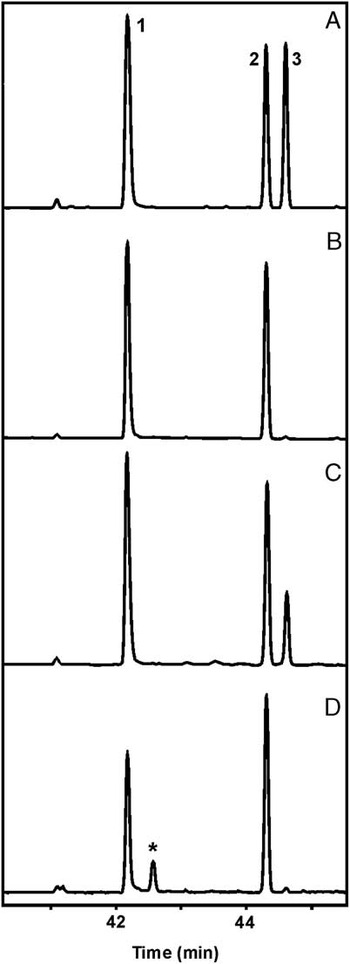
Enantiomeric purities were determined by analysis on a Cyclodex B column (J&W Scientific) programmed from 40 °C for two minutes, then ramped at 3 °C/minute to 220 °C. The fuscumol acetate enantiomers were resolved to baseline (Fig. 2A (S): 41.82 minutes, (R): 42.11 minutes). However, fuscumol was not well resolved, so a sample of the enantiomerically enriched (S)-fuscumol was converted to its acetate. Thus, 0.020 g (S)-fuscumol, 1 mL CH2Cl2, 16 μL pyridine, 14 μL acetic anhydride, and a catalytic amount of dimethylaminopyridine (DMAP) were stirred overnight. Saturated aqueous NaHCO3 was then added and the mixture was stirred for 20 minutes. The mixture was then extracted with hexane, and the hexane layer was washed with 1 M HCl and brine, then dried over anhydrous Na2SO4 before analysis on the Cyclodex B column as described above.
Analyses on chiral stationary phase Cyclodex B column. (A) Standards of racemic fuscumol (1) and fuscumol acetate (2 = (S)-enantiomer, 3 = (R)-enantiomer); (B) Insect extract; (C) Insect extract spiked with racemic fuscumol acetate; and (D) Insect extract after partial acetylation of fuscumol, showing that only the peak due to (S)-fuscumol acetate increases in size. Peak marked with an asterisk is an impurity.

The enantiomerically enriched (S)-fuscumol was subjected to kinetic resolution again (0.3 g lipase, 2 mL vinyl acetate, 13 mL MTBE) for 90 minutes (GC ratio: fuscumol 84.3%, fuscumol acetate 14.9%). After filtration and concentration, the residue was purified by vacuum flash chromatography to give (S)-fuscumol (0.89 g, 98.8% ee).
(R)-fuscumol was obtained from reduction of (R)-fuscumol acetate with LiAlH4. Thus, a solution of (R)-fuscumol acetate (3.94 g, 16.5 mmol) in tetrahydrofuran (THF) (10 mL) was added to a suspension of LiAlH4 (0.63 g, 16.5 mmol) in THF (35 mL) cooled at 0 °C. The mixture was stirred for 2.5 hours while gradually warming to room temperature, then cooled to 0 °C and quenched by sequential addition of water (0.63 mL), 15% aqueous NaOH (0.63 mL), and water (1.89 mL). After stirring for 10 minutes, the mixture was filtered through Celite® (Fisher Scientific, Fairlawn, New Jersey, United States of America) to remove the white granular precipitate, and the filtrate was dried over anhydrous Na2SO4 and concentrated to give (R)-fuscumol (3.08 g, 95% yield).
(S)-Fuscumol acetate was obtained from acetylation of (S)-fuscumol. A solution of (S)-fuscumol (2.38 g, 12.1 mmol), pyridine (2.0 mL, 24.2 mmol), and DMAP (0.074 g, 0.61 mmol) in CH2Cl2 (25 mL) was cooled to 0 °C and acetic anhydride (1.7 mL, 18.2 mmol) was added. The mixture was stirred for three hours at room temperature, then saturated aqueous NaHCO3 was added and the mixture was stirred for 20 minutes. The mixture was extracted with hexane and the organic layer was washed with 1 M HCl, water, and brine, and dried over Na2SO4. The crude product was purified by vacuum flash chromatography (hexane/EtOAc = 95:5) to give (S)-fuscumol acetate (2.72 g, 94% yield).
For long-term storage, the enantiomers of fuscumol and fuscumol acetate were Kugelrohr distilled to remove traces of silica gel and other nonvolatile impurities that might catalyse degradation. Fuscumol was distilled at an oven temperature of ∼90–95 °C (0.1 torr), and fuscumol acetate was distilled at ∼95–100 °C (0.1 torr).
The absolute configurations of fuscumol and fuscumol acetate in extracts of insect-produced volatiles were determined on a Cyclodex B column as described above. The extract was first analysed without derivatisation to determine the absolute configuration of the insect-produced fuscumol acetate. Because the fuscumol enantiomers were not resolved, the extract was then acetylated, and reanalysed. Thus, ∼100 μL of extract was mixed with 25 μL of a 20 mg/mL solution of acetyl chloride in ether and 25 μL of a 40 mg/mL solution of pyridine in ether in a 1 mL glass test tube. The test tube was sealed and held at room temperature for four hours. Then 5 μL of ethanol was added, and the solution was held a further two hours. The mixture was then concentrated under a stream of nitrogen, and partitioned between 100 μL water and 200 μL of pentane, vortexing to mix. The pentane layer was removed, and the aqueous layer was extracted with a further 100 μL pentane. The combined pentane extracts were dried over anhydrous Na2SO4 and analysed on the Cyclodex B column as described above.
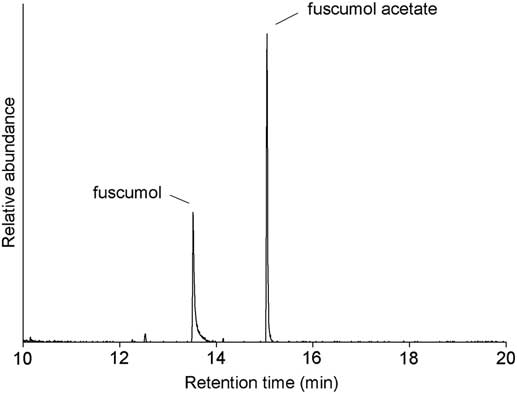
Two of the extracts of volatiles collected from the male A. variegatus captured in 2011 were dominated by two large peaks (Fig. 3) that were identified as fuscumol (diagnostic ions: m/z 196, 178, 109, 69) and fuscumol acetate (diagnostic ions: m/z 248, 178, 109, 69) by comparison of their mass spectra and retention times with those of standards. These two compounds were only present in overnight aerations (18:00–10:00 hours), suggesting that males release pheromones at night. Fuscumol and fuscumol acetate were absent in both of the diurnal aerations taken between the two nocturnal aerations, and all of the control samples, proving that these compounds were not simply contaminants. Furthermore, at the time of these collections, we did not have fuscumol and fuscumol acetate enantiomers on hand with which to contaminate the samples. Fuscumol and fuscumol acetate were not detected in extracts from either of the males or the one female A. variegatus aerated in 2012.
Representative total ion chromatogram of the headspace volatiles collected from male Astyleiopus variegatus.
Fuscumol and fuscumol acetate were released in an ∼1:2 ratio during each calling period (n = 2; 184 ± 60 μg and 396 ± 71 μg, respectively). In field tests, both male and female A. variegatus were attracted to traps baited with either fuscumol or fuscumol acetate, but displayed a stronger response to a blend of both compounds (Mitchell et al. Reference Mitchell, Graham, Wong, Reagel, Striman and Hughes2011; Hanks et al. Reference Hanks, Millar, Mongold-Diers, Wong, Meier and Reagel2012). The fact that males produce both compounds provides an explanation for their increased attraction to the blend.
Analysis of an underivatised aliquot of the aeration extract on a chiral stationary phase GC column showed that the insects produced (S)-fuscumol acetate of at least 97% enantiomeric purity (Fig. 2B). Reanalysis of the extract after acetylation showed that only the peak due to (S)-fuscumol acetate was enhanced (Fig. 2D), confirming that the insects produced (S)-fuscumol, as might be expected from the presence of (S)-fuscumol acetate.
(S)-Fuscumol is also produced by male T. fuscum and Tetropium cinnamopterum Kirby in the subfamily Spondylidinae (Sweeney et al. Reference Sweeney, Silk, Gutowski, Wu, Lemay and Mayo2010). In contrast, in the subfamily Lamiinae, male H. betulinus (Klug) (tribe Acanthoderini) are reported to produce a scalemic blend of (R)- and (S)-fuscumol (82.3% and 17.6%, respectively), (R)-fuscumol acetate, and geranyl acetone (Vidal et al. Reference Vidal, Fonseca and Zarbin2010).
Despite our attempts to collect pheromones from 10 other species of lamiines on 31 different occasions in Indiana, United States of America, we have successfully collected and characterised possible pheromone compounds only from this single male A. variegatus to date, suggesting that lamiines do not readily call under the unnatural conditions imposed by headspace analyses in the laboratory. We believe this to be the first report of a North American cerambycid species in the subfamily Lamiinae being shown to produce fuscumol and its acetate, and the first report of a cerambycid producing (S)-fuscumol acetate. Although various species may superficially appear to use similar pheromones composed of fuscumol and/or fuscumol acetate, the chirality of each compound must be taken into consideration because the enantiomers will be perceived as different structures by the insect species that use these compounds as pheromones.
Acknowledgements
The authors thank the Indiana Department of Natural Resources, Division of Nature Preserves and NICHES Land Trust Corporation for permitting us to collect beetles at Black Rock Barrens Nature Preserve. This research was funded by Purdue University Agricultural Research Programs, and this work was in partial fulfillment of a Ph.D. degree for G.P.H. from Purdue University.