Specific learning difficulties (SpLD) is a term used to describe particular difficulties with the way in which information is acquired and processed as a function of neurological (cognitive) deficits that impact on learning and, most often, the acquisition of language, literacy and numeracy skills. A student with a SpLD is distinct from one with a general learning difficulty, in that the latter will be more likely to present difficulties in all or most curricular areas (Clancy, Reference Clancy2001). SpLDs include dyslexia, dyspraxia, dysgraphia, dyscalculia, and attention deficit disorder (ADD) and some comorbidity of difficulties across the spectrum is common (Beacham & Trott, Reference Beacham and Trott2005; Brunswick, Reference Brunswick2012; Nichols et al., Reference Nichols, McLeod, Brown, Smith, Summerfield and Holder2008).
The number of students with disabilities accessing higher education (HE) in Ireland has increased eightfold between 1993 and 2011, with 7,957 disabled students registered in higher education institutions (HEIs) in 2011/2012 (AHEAD, 2012). Students with SpLDs accounted for 57.2% of those registered with a disability in 2012 (AHEAD, 2012). Current estimates of the incidence rate of SpLD in the general population range from 4% to 18% (Butterworth, Reference Butterworth1999; Nag & Snowling, Reference Nag, Snowling and Rey2012). While 40% of students with SpLD in HE in the UK are diagnosed with dyslexia in third level (Goldsmiths University, 2012; London School of Economics, 2010; Singleton, Reference Singleton2004), there is no robust comparable data for Irish HEIs.
Assessment of Dyslexia in Higher Education
Research into the screening and assessment of dyslexia for adults in HE in the United Kingdom and beyond has grown over recent years. Nicolson and Fawcett (Reference Nicolson and Fawcett1997) recognised the need for effective screening for dyslexia and researched two screening tools normed on a UK population: the Dyslexia Adult Screening Test (DAST; Fawcett & Nicolson, Reference Fawcett and Nicolson1998) and the Adult Dyslexia Index (ADI; Fawcett & Nicolson, Reference Fawcett and Nicolson1993). Findings suggested that the DAST was a quick and informative screening tool, and the ADI was an effective tool for an objective dyslexia diagnosis, and together they could be used as a two-stage screening procedure in HEI.
Hatcher, Snowling, and Griffiths (Reference Hatcher, Snowling and Griffiths2002) highlighted some of the common difficulties faced by British adults with dyslexia in HE, such as a phonological deficit, slow reading speed and poor written expression, and stressed the importance of appropriate support programs for these students. Overall, they found that dyslexia can be identified in this population with 95% accuracy, using a small battery of simple tests: spelling, non-word reading, digit span, and writing speed. Nichols et al. (Reference Nichols, McLeod, Brown, Smith, Summerfield and Holder2008) found the Bangor Dyslexia Test (BDT; Miles, Reference Miles1997) and the DAST (Fawcett & Nicholson, Reference Fawcett and Nicolson1998) to be effective screening tools in HE, and recommended that the screening process could be improved with the addition of a visual stress test in order to quickly identify print difficulties that commonly co-exist with dyslexia.
Wolff and Lundberg (Reference Wolff and Lundberg2003) have argued that it is possible to develop a sensitive battery of non-vocalised tasks (consisting of phonological related tasks, spoonerisms, and a working memory task) to screen Swedish adults in HE in a group setting. They also included a self-report questionnaire that enhanced the assessment results and, overall, found the battery to be both time saving and cost effective. In Australia, the York Adult Assessment (YAA) was used to identify students in HE with dyslexia in an efficient and cost-effective way (Chanock, Farchione, Paulusz, Freeman, & Lo Guidice, Reference Chanock, Farchione, Paulusz, Freeman and Lo Guidice2010). While significant differences were found between the dyslexic and non-dyslexic group, findings included the occurrence of false negatives. Conversely, Warmington, Stothard, and Snowling (Reference Warmington, Stothard and Snowling2013) used a revised version of the YAA with a UK sample, and found it to be a suitable assessment tool to identify students at HE with dyslexia, having good reliability and discriminatory power.
Much of the research from the United Kingdom has focused on creating cost-effective, time-efficient, and accurate ways of screening and assessing for dyslexia, in order to provide evidence-based recommendations for acceptable testing and reporting procedures to the SpLD Assessment Standards Committee (SASC, 2013). A publication by the Higher Education Equality Unit in University College Cork, Ireland (McGrath, Reference McGrath2000) highlighted the need for HEIs in Ireland to similarly address the challenges of dyslexia among students in HE. The extensive work carried out by the National Working Party on Dyslexia in HE (Singleton, Reference Singleton1999) in the United Kingdom was acknowledged, consequently stressing the need for the adoption of national and institutional policies on dyslexia within HE in Ireland. It also stated that, at a national level, there is a need for a clear commitment to resourcing support services, the development and monitoring of assessment services, and the provision of awareness and teaching support in HEIs. These recommendations, made 13 years ago, have still not been addressed in Ireland.
Screening and Assessment of SpLD in HE in Ireland
In order to register with the Disability Service in an HEI, students must provide a full psycho-educational assessment as evidence of a disability. While some HEIs stipulate that documentation must be dated within 3 to 5 years, others do not impose an age limit. The National Office for Equity of Access to Higher Education (National Access Office) was established in 2003 to facilitate educational access and opportunity for groups who are under-represented in higher education, and administers the FSD provided through the European Social Fund (Government of Ireland, 2007). This fund provides for a range of supports and is available only for those students with an existing diagnosis. Currently, students must provide a psycho-educational assessment of SpLD that is no older than 5 years.
For those students who do not have a diagnosis of SpLD but who experience difficulties that are impeding academic progress, the route to assessment is not straightforward. Currently, no qualification or guidelines equivalent to the UK SASC model are in practice in Ireland with respect to standardised screening or assessment of SpLD in HE, and each HEI applies their own policies and practices in regards to such assessments. In general, students who present with indicators of SpLD on the basis of a screening are referred externally to obtain a full psycho-educational assessment. No review of screening and assessment services has yet been conducted; thus, one of the aims of this research is to investigate current policy and practice operating within HE in Ireland.
AHEAD is an independent, non-profit Irish organisation that works to promote participation of students with disabilities within FE and HE, and has produced a handbook offering practical guidelines for supporting students with dyslexia (Loftus, Reference Loftus2009). This guide recommends a ‘tripartite’ approach to identifying dyslexia in HE: (1) initial screening, (2) formal assessment, and (3) needs assessment for future supports. AHEAD provides guidelines for pre-assessment and screening, which may be conducted by a counsellor (status not defined in the guide) or an experienced HE Learning Support Tutor (LST). The guidelines are brief and do not identify appropriate psychometric qualification or training required for administration of screening tests; a limited list of screening tests is provided, two of which are computer based: DAST (Fawcett & Nicholson, Reference Fawcett and Nicolson1998), Adult Dyslexia Checklist (Vingrad, Reference Vingrad1994), Lucid Adult Screening Test (LADS; Singleton, Horne, & Thomas, Reference Singleton, Horne and Thomas2004), and Quickscan (Zdzienski, Reference Zdzienski1997).
The second stage — external psycho-educational assessment — requires the test administrator to be ‘a fully qualified psychologist with a recognized qualification in assessment’ (Loftus, Reference Loftus2009, p. 19). However, no detail is provided as to the level of academic or professional qualification that is sufficient or appropriate; for example, undergraduate degree, Masters, PhD, British Psychological Society (BPS) Test User qualifications, field of psychology (e.g., clinical, educational, counselling, organisational), or whether the assessor should be a Registered Member of the Psychological Society of Ireland (PSI). Suggested tests for psycho-educational assessment mirror those provided by the SASC (2013).
Finally, a needs assessment should be conducted within the HE, usually by a LST, who may discuss impact of difficulties in relation to the student's course, assistive technologies, and intervention strategies. The LST is deemed to have ‘specialist knowledge and training in working with students with dyslexia’ (Loftus, Reference Loftus2009, p. 19), again with no further information regarding the level of training or qualification required. While AHEAD (Loftus, Reference Loftus2009) has made a strong attempt at providing guidelines for HEIs for supporting students with dyslexia, such guideline are not enforced by HEIs in Ireland. There is no clear national definition of the term ‘fully qualified psychologist’, and while statutory registration with the Health Professional Council has been required in the United Kingdom since 2009, this is not yet mandatory for psychologists in Ireland. Additionally, the lack of a required set of approved tests means HEIs in Ireland can select any screening and assessment method they wish, regardless of suitability, reliability, and validity.
Aims
The aims of this study were twofold: (a) to summarise the general practice of screening and assessment for SpLDs in HEIs in Ireland, in order to provide evidence for the adoption of a standardised approach; and (b) to recommend the components of an SpLD assessment procedure that is suitable for accessing reasonable accommodations in HE in Ireland, without the requirement for a full psycho-educational assessment.
Method
Sample
Disability Services in HEIs in Ireland (n = 22) were invited to participate in an online survey of dyslexia screening and assessment procedure. These included universities, colleges and Institutes of Technology (IoTs), and were nationally representative. A total of 14 HEIs participated in the survey (64% response rate).
Materials
A Survey Monkey™ questionnaire was used to gather data via an embedded link sent in an email to each Disability Service. The questionnaire comprised four sections: (1) general information (e.g., name of institution, type of SpLDs screened, screening referral procedure, profile and qualifications of screening assessor; (2) assessment procedure (e.g., frequency of screening appointments, waiting period, gathering of background information, individual or group screening provision; (3) assessment tools (e.g., tests used, frequency of test battery review, costs to students; and (4) screening statistics for the academic year 2011–2012 (e.g., the number of screenings conducted, referrals to other services/external agencies, and indications of comorbidity).
Results
General Information
Eleven HEIs screen only for dyslexia, and no other SpLD. One HEI screens for both dyslexia and dyscalculia, one HEI screens for dyslexia, dyspraxia, ADD and visual stress, and only one HEI screens across the spectrum of SpLD, including dyspraxia, dysgraphia, dyscalculia, ADD and Asperger's syndrome.
Nine HEIs reported that it is the sole responsibility of the Learning Support Officer/Tutor to conduct screenings for SpLD. Of the remaining HEIs, two include the assistance of the Disability Officer, one designates responsibility to the Disability Advisor, one to the Disability Officer with the assistance of a Disability Administrator, and in one HEI it is the responsibility of the Disability Officer in tandem with a psychologist.
Two screening assessors have a SpLD postgraduate qualification, and three a British Psychological Society Level A Certificate of Competence in Educational Testing (CCET) qualification, while four assessors hold both qualifications. Two assessors hold a CCET qualification and a psychology qualification and are members of the Psychological Society of Ireland (PSI) and the British Psychological Society (BPS), while one assessor holds a CCET and psychology qualification. One HEI assessor is a qualified teacher, has a PATOSS certificate, SpLD postgraduate qualification, a psychology qualification, and is a member of the PSI/BPS.
Assessment Procedure
Background information and educational history is mainly gathered during the assessment appointment (n = 8), with three HEIs also gathering information prior to screening using a pre-screening form or questionnaire. Three HEIs gather this information from the pre-screening form or questionnaire only; two HEIs did not respond to this question, and one submitted an ‘other’ response, without elaborating further.
Assessment Tools
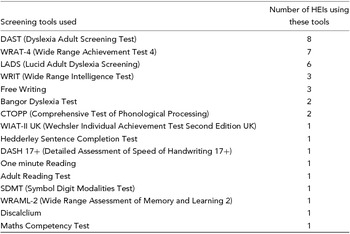
Thirteen HEIs specified screening tests used. Two HEIs use the LADS computerised assessment only, and one HEI uses the DAST only. The remaining 10 HEIs use a combination of between two and eleven assessment tools. The most commonly used are the DAST (n = 8), the WRAT-4 (n = 7), and the LADS (n = 6). Three HEIs use the WRIT, three use the Free Writing task, while two use the Bangor Dyslexia Test. Two HEIs use the CTOPP, one uses the WIAT-II UK, one uses the Hedderley Sentence Completion Test, and one the DASH 17+. Table 1 illustrates this.
Screening Tools Used

A range of individuals within the Disability Service of each HEI determine the particular tests that are used and purchased: Disability Officer (n = 5), Disability Advisor (n = 1), Learning Support Officer/Tutor (n = 5), Student Support Office (n = 1), and Disability Administrator (n = 1), while one HEI responded that it was a communal decision via the ASCENT Project, a Regional Assessment and Resource Centre promoting access and retention for people with disabilities/specific learning difficulties in third-level education (Higher Education Authority, 2010). Seven HEIs review test batteries annually, and the remainder review tests every 2–5 years (n = 4).
Thirteen HEIs provided information regarding charging of a screening fee. The majority (n = 11) make no charge for individual assessments, one HEI charges €20, and another more than €45, in order to cover the cost of assessment (materials and assessment time). HEIs who conducted group assessments did not charge any fee (n = 9).
Five HEIs provided data on screening outcomes for the academic year 2011–2012. Between 13 and 45 students were screened across the year (average 22.8) reflecting the size of the HEI (i.e., fewer screenings in small IoTs, a larger number in universities), with a range of 8 to 20+ students in each HEI receiving a positive indication of SpLD, and between 1–11 students (an average of 6.2) receiving a negative result. Between 0 and 16 students (an average of 7.3) subsequently registered with the Disability Service in the HEI.
Nine HEIs provided data on indications of comorbidity during screenings, and while many did not know or test for any other SpLD (n = 7), one HEI identified a student with DCD and three with visual stress, while a second HEI identified one student with ADHD/autistic spectrum disorder/dysgraphia, and one with ADHD/autistic spectrum disorder.
Finally, nine HEIs responded to registration with the Disability Service on the basis of positive screening results, for exam accommodations only. Five HEIs permit students to do so, two do not accept screening results as evidence for registration, while two report that they allow registration on a case-by-case basis.
Discussion
Fourteen HEIs responded to the questionnaire and the results demonstrate that although practices vary throughout each HEI, some similarities are evident. The components of the assessment battery are usually reviewed annually, and assessors are well qualified to a minimum of a postgraduate qualification in SpLD (n = 2), and/or a CCET qualification (n = 11). Background information is usually gathered during the assessment appointment, and occasionally students complete a pre-assessment questionnaire. Although this latter can save time, mistakes or misinterpretation of questions can happen; thus, it is still important to discuss this information during the appointment; only three HEIs adopt this practice. All HEIs provide individual screenings, while two also provide group screenings. Again, while this can save both time and resources, valid and reliable screening and assessment tools suitable for group assessment are sparse.
A significant finding was the variety of screening tools used by HEIs. Three HEIs use only the LADS (Singleton et al., Reference Singleton, Horne and Thomas2004) or the DAST (Fawcett & Nicholson, Reference Fawcett and Nicolson1998) to identify dyslexia, and six HEIs include use of the LADS in their test battery. The LADS computerised assessment package is one of the most common tools in use, advantages being precise measurement of performance, more controlled timings and presentation speeds, and a more non-judgmental environment for students who may be anxious about making mistakes in front of the assessor. Conversely, no information is provided on test behaviour (inattentive behaviour, effects of external distraction, use of coping strategies), poor test performance can be exaggerated, and consciously or unconsciously, it is possible to use the number keypad to assist with the Working Memory subtest. With respect to the psychometric properties of the LADS, it is deemed to be an unsuitable test for the university population (Casale, Reference Casale2006) as the Working Memory subtest lacks sensitivity and has a high false positive rate at 30.6%, above the level advocated for effective screening (25%). LADS has not been re-normed since its initial publication in 2004.
The DAST is also a popular screening tool, used by eight of the HEIs. This is an individually administered test that investigates many of the areas associated with dyslexia, claiming an accuracy rate of 94% and a 0% false identification rate. It produces an overall ‘at risk’ quotient (ARQ), indicating whether further investigation is necessary, rather than a positive/negative diagnosis. However, Harrison and Nichols (Reference Harrison and Nichols2005) found that the DAST correctly identified only 74% of students diagnosed with SpLDs as ‘highly at risk’ for dyslexia, with 26% of students with no history of academic difficulties identified as ‘at risk’.
The WRAT-4 is the most frequently used test to assess literacy and numeracy attainment levels in order to provide evidence as part of a discrepancy model of dyslexia. However, subtests are normed on a US population, and are less sensitive to the adult Irish population than the WIAT-II UK in respect to single word items and reading comprehension content.
Brunswick (Reference Brunswick2012) estimates that 30–50% of students with SpLD have a co-occurring developmental disorder, with Nichols et al. (Reference Nichols, McLeod, Brown, Smith, Summerfield and Holder2008) identifying 57% of students presenting with two or three of dyslexia, dyspraxia, and visual stress. Beacham and Trott (Reference Beacham and Trott2005) stated that 40% of the dyslexic population have some difficulty with mathematics, with 4–6% presenting with dyscalculia alone. Thus, there is a high incidence of other SpLDs in addition to or independent of dyslexia, which should be provided for in the screening assessment. However, while all of the HEIs in this study assess for dyslexia, other SpLDs such as dyspraxia, dysgraphia, dyscalculia, ADD, AS, and visual stress are screened in only two HEIs.
Finally, only five HEIs (23%) provided data on screening outcomes for the academic year 2011–2012. Methods of recording screening outcomes varied widely in depth and accuracy. Only one HEI records screening profiles for variables such as age, gender, academic standing, course studied, and areas of strengths and weaknesses, and provides a statistical comparison of results for 2007 to 2014. On this basis, it is impossible to accurately measure the incidence of unidentified SpLDs in HE in Ireland, although from the data gathered it is suggested that 27% of students requesting a screening received a positive indication.
Conclusion
This study has provided a comprehensive overview of the general practice of screening and assessment of SpLDs in HEIs in Ireland, and a number of inconsistencies between HEIs are highlighted. First, although all of the HEIs provide a screening service for dyslexia, the high prevalence of SpLD comorbidity supports the idea that screening methods should be broadened to capture more complex profiles, and should include a self-assessment questionnaire, checklist or self-rating scale, a pre-assessment interview, and observation of test behaviour during the assessment. Second, while the range of screening tests and procedures reflects the lack of best practice guidance at HE level for screening and assessment of SpLD, the adoption of SASC (2013) guidelines would ensure that only current, valid, and reliable tests are used; it is suggested that the introduction of a small screening fee would cover the costs of updating tests. While there is some conformity of screening assessor qualifications throughout the responding HEIs, most frequently the CCET Level A, there is no policy or best practice guidelines that ensures continuing professional development in psychometric testing, or research into SpLDs. Finally, capturing screening data across the HE sector is crucial to establishing the incidence of students presenting with unidentified SpLDs, as a basis for discussing the need to provide for such students in the absence of formal psycho-educational assessment.
The second research aim was to recommend an assessment procedure that would provide a uniformity of screening and assessment procedures, meaning that all students are assessed on an equal basis, irrespective of the HEI they attend. Additionally, standardised assessment would permit registration with the Disability Service, without the need to source a full psycho-educational assessment, for access to minimal supports in HE such as library borrowing privileges, assistive technology, and exam accommodations.
The Trinity Model
The Disability Service (DS) in Trinity College Dublin (TCD) provides a screening assessment through a staged approach (https://www.tcd.ie/disability/services/dyslexia-screening.php), which is based on SASC (2013) guidelines. First, a self-assessment questionnaire is completed by the student, together with an academic referral form completed by their tutor, and returned to the Disability Officer for review. Subsequently, the student is provided with an appointment for assessment with an in-house psychologist with PSI and BPS graduate membership. Finally, a report is compiled, and after review by the Disability Officer, the student is invited to a feedback session where decisions are made with regard to support and provisions.
The DS has carefully selected a variety of screening tests with appropriate psychometric properties that are reviewed annually by the Disability Officer. This battery of tests mirrors a full psycho-educational assessment, with the exception of a measurement of intelligence; however, it includes measurement of cognitive areas that are most likely to impact on academic performance: visual, verbal and Working Memory, attention and concentration, and speed of processing. The current battery consists of the Wide Range Assessment of Memory and Learning 2 (WRAML-2; Sheslow & Adams, Reference Sheslow and Adams2003), the Wechsler Individual Achievement Test (WIAT-II UK; Wechsler, Reference Wechsler2005), the Detailed Assessment of Speed of Handwriting 17+ (DASH 17+; Barnett, Henderson, Scheib, & Schulz, Reference Barnett, Henderson, Scheib and Schulz2010), Symbol Digit Modalities Test (Smith, Reference Smith1982), and the Mathematics Competency Test (Vernon, Miller, & Izard, Reference Vernon, Miller and Izard2009). Students are advised that while screening results do not constitute a formal diagnosis, if results indicate areas of difficulty consistent with SpLD, they may register with the DS for reasonable accommodations that are not funding dependent. In some cases, where ADHD, dyspraxia, autistic spectrum disorder, or mental health conditions are indicated, students are referred internally or externally for further assessment.