Introduction
The Atlantic cod, Gadus morhua (Linnaeus, 1758), is found in the North Atlantic Ocean and its adjacent seas (Cohen et al., Reference Cohen, Inada, Iwamoto and Scialabba1990), and a subspecies, Gadus morhua callarias, exists in the Baltic Sea. Cod is one of the most economically important species of Baltic fish and is significant for fisheries in northern Europe.
Cod is known to be an intermediate, paratenic or definitive host for a large number of parasite species (Hemmingsen & MacKenzie, Reference Hemmingsen and MacKenzie2001), and numerous studies on cod parasites and/or host–parasite interactions have been conducted on both sides of the North Atlantic (Andersen, Reference Andersen1993; Hemmingsen et al., Reference Hemmingsen, Lile and Halvorsen1995; Khan & Chandra, Reference Khan and Chandra2006; Perdiguero-Alonso et al., Reference Perdiguero-Alonso, Montero, Raga and Kostadinova2008). The most hazardous helminths for human health are the nematodes that belong to the Anisakidae family: Anisakis simplex (Rudolphi, 1809), Pseudoterranova decipiens (Krabbe, 1878) and, rarely, Contracaecum osculatum (Rudolphi, 1802). The consumption of raw (as well as inadequately cooked, marinated, salted or smoked) fish may lead to several disorders that are caused by the ingestion of viable nematodes. Thousands of cases of the disease called anisakidosis have been reported in Japan, where dishes prepared using raw seafood are common and might be the source of infection (Ishikura & Namiki, Reference Ishikura and Namiki1989; Ishikura & Kikuchi, Reference Ishikura and Kikuchi1990). Anisakidosis has been reported nearly all over the world and also in many European countries, including Denmark (Andreassen & Jorring, Reference Andreassen and Jorring1970), the Netherlands (van Thiel, Reference van Thiel1976), Germany (Möller & Schröder, Reference Möller and Schröder1987), France (Bourree et al., Reference Bourree, Paugam and Petithory1995), Belgium (Vercammen et al., Reference Vercammen, Kumar, Bollen, Lievens, Van den Bergh and Vervoort1997), Spain (López-Serrano et al., Reference López-Serrano, Gomez, Daschner, Moreno-Ancillo, de Parga, Caballero, Barranco and Cabañas2000; Repiso Ortega et al., Reference Repiso Ortega, Alcántara Torres, González de Frutos, de Artaza Varasa, Rodríguez Merlo, Valle Muñoz and Martínez Potenciano2003), Norway (Eskesen et al., Reference Eskesen, Strand, Andersen, Rosseland, Hellum and Strand2001), Iceland (Skirnisson, Reference Skirnisson2006), Italy (Ugenti et al., Reference Ugenti, Lattarulo, Ferrarese, De Ceglie, Manta and Brandonisio2007), the United Kingdom (Pozio, Reference Pozio2008) and Austria (Kapral et al., Reference Kapral, Haditsch, Wewalka, Schatzlmayr, Lenz and Auer2009). Indeed, Japanese cuisine is becoming more popular in many European countries (including Poland). According to Takei & Powell (Reference Takei and Powell2007), the incidence of cases of anisakidosis is expected to increase with the increasing popularity of sushi and sashimi.
The European Food Safety Authority (EFSA) stated that, if intended to be eaten raw or nearly raw, all wild-caught fish must be considered at risk of containing any viable parasite of concern to human health (EFSA, 2010). Although adequate cooking, freezing or frozen storage kills the parasite (Wharton & Aalders, Reference Wharton and Aalders2002), the allergenic proteins of anisakid nematodes are thermostable (Audicana et al., Reference Audicana, Ansotegui, de Corres and Kennedy2002; Moneo et al., Reference Moneo, Caballero, Gonzalez-Munoz, Rodriguez-Mahillo, Rodriguez-Perez and Silva2005).
Generally, the examination of fish or fishery products for the presence of parasites is focused on detecting nematodes in the flesh (fillets). Inspection of the liver and other visceral organs is occasionally ignored. It must be emphasized that the liver is used for the production of cod-liver oil, which is commonly utilized as source of omega-3 acids. The consumption of cod liver is popular in many European countries. Cod liver and fresh cod-liver oil are a part of the traditional North Norwegian dish mølje. Canned cod liver is also available in markets in Iceland, Latvia, Lithuania, Russia, Poland and Norway. According to a notification from the Rapid Alert System for Food and Feed (RASFF), nematodes were found in canned fish liver that originated from Poland. Parasites in fishery products of possible public health risk in the Baltic Sea include A. simplex, C. osculatum and P. decipiens (EFSA, 2011). Moreover, in many countries, there is a ban on the use of cod liver from Baltic fish due to the high dioxin and polychlorinated biphenyl (PCB) content (Karl & Lahrssen-Wiederholt, Reference Karl and Lahrssen-Wiederholt2009), which may have hazardous consequences for human health.
Anisakid nematodes represent a complex of sibling species: A. simplex sensu stricto (s.s.) (formerly differentiated as A. simplex B) is distributed in the North Atlantic Ocean and is the only Anisakis species recorded in the Baltic (Mattiucci et al., Reference Mattiucci, D'Amelio and Rokicki1989, Reference Mattiucci, Nascetti, Cianchi, Paggi, Arduino, Margolis, Brattey, Webb, D'Amelio, Orecchia and Bullini1997). Contracaecum osculatum (Rudolphi, 1802) (s.s.), formerly named C. osculatum C by Nascetti et al. (Reference Nascetti, Cianchi, Mattiucci, D'Amelio, Orecchia, Paggi, Brattey, Berland, Smith and Bullini1993), is found from Iceland to the Baltic Sea. It is the only species of the C. osculatum complex present in the Baltic (Mattiucci & Nascetti, Reference Mattiucci and Nascetti2008). In the same paper, the authors revised the taxonomy of the Pseudoterranova species complex and proposed the name of P. krabbei instead of P. decipiens A and P. decipiens s.s. for P. decipiens B.
The presence of larvae of three nematode species with zoonotic potential, C. osculatum, A. simplex and P. decipiens, was recorded in the liver of Baltic cod. The life cycles of these nematodes are similar and involve crustaceans and many species of fish that serve as intermediate or paratenic hosts, with marine mammals as the final hosts (McClelland et al., Reference McClelland, Misra and Martell1990). Important cetacean hosts for A. simplex that are also reported in the Baltic Sea are the harbour porpoise, Phocoena phocoena (Herreras et al., Reference Herreras, Balbuena, Aznar, Kaarstad, Fernández and Raga2004), the white-beaked dolphin, Lagenorhynchus albirostris, and the common bottlenose dolphin Tursiops truncatus (Smith & Wootten, Reference Smith and Wootten1978). The grey seal, Halichoerus grypus, is considered to be the most important final host for C. osculatum (Fagerholm, Reference Fagerholm1990), and the common seal (harbour seal), Phoca vitulina, is the most important final host for P. decipiens (Aspholm et al., Reference Aspholm, Ugland, Jødestøl and Berland1995). However, C. osculatum and P. decipiens were found to co-occur in both of these pinniped species (Lunneryd, Reference Lunneryd1991; Ólafsdóttir & Hauksson, Reference Ólafsdóttir and Hauksson1998; Paggi et al., Reference Paggi, Mattiucci, Gibson, Berland, Nascetti, Cianchi and Bullini2000; Lehnert et al., Reference Lehnert, Raga and Siebert2007). Contracaecum osculatum has been noted only sporadically in the ringed seal, Phoca hispida botnica (Valtonen et al., Reference Valtonen, Fagerholm and Helle1988).
Parasitic infection in marine fish is a serious problem for the fishing industry in many countries. Cod is one of the fish species that is most heavily infected with anisakid nematodes in the Barents Sea (Aspholm et al., Reference Aspholm, Ugland, Jødestøl and Berland1995), North Sea (Strommes & Andersen, Reference Strommes and Andersen2000; McClelland, Reference McClelland2002), Celtic Sea (Perdiguero-Alonso et al., Reference Perdiguero-Alonso, Montero, Raga and Kostadinova2008) and Icelandic waters (Hauksson, Reference Hauksson2011).
There are only a few reports on nematode parasites of Baltic cod from the Polish Exclusive Economic Zone (EEZ). Cod individuals from the southern Baltic were examined in 1987–1994 (Rokicki et al., Reference Rokicki, Valter and Myjak1993; Myjak et al., Reference Myjak, Szostakowska, Wojciechowski, Pietkiewicz and Rokicki1994). Szostakowska et al. (Reference Szostakowska, Myjak, Wyszyński, Pietkiewicz and Rokicki2005) reported levels of infection with anisakid nematodes in cod from several regions of the Polish EEZ that were sampled during the same time period. Pilecka-Rapacz & Sobecka (Reference Pilecka-Rapacz and Sobecka2004) described the composition of the parasite fauna in cod from the Gulf of Puck but only for young fish. The last investigation of cod in the Polish EEZ was conducted in 2001–2003 (Sobecka, Reference Sobecka2007). Thus, current knowledge about the level of cod infection in the Polish waters of the Baltic Sea is insufficient. The presence of anisakid nematodes was recorded in the Baltic cod that were investigated in 2002–2003 (Perdiguero-Alonso et al., Reference Perdiguero-Alonso, Montero, Raga and Kostadinova2008) and 2004–2010 (P. decipiens) (ICES, 2011), but these findings were for fish sampled in the Swedish EEZ.
The aim of our study was to evaluate the prevalence, intensity of infection and species composition of anisakid nematodes in the liver of Baltic cod. The second aim was to compare infection dynamics in the Polish EEZ with previous data on nematodes in cod liver. This organ was chosen for investigation because anisakid nematodes migrate from the viscera not only to the muscle tissue but also to the internal organs and often occur in the liver of hosts. Furthermore, the liver was found to be the most frequently infected organ in cod (Szostakowska et al., Reference Szostakowska, Myjak, Wyszyński, Pietkiewicz and Rokicki2005). The influence of the changes in sea mammal populations in the Baltic on levels of nematode parasite infection in cod was taken into consideration. Changes in parasite infection dynamics might also cause problems for fisheries, with some implications for consumer health.
Materials and methods
Collection and examination of cod
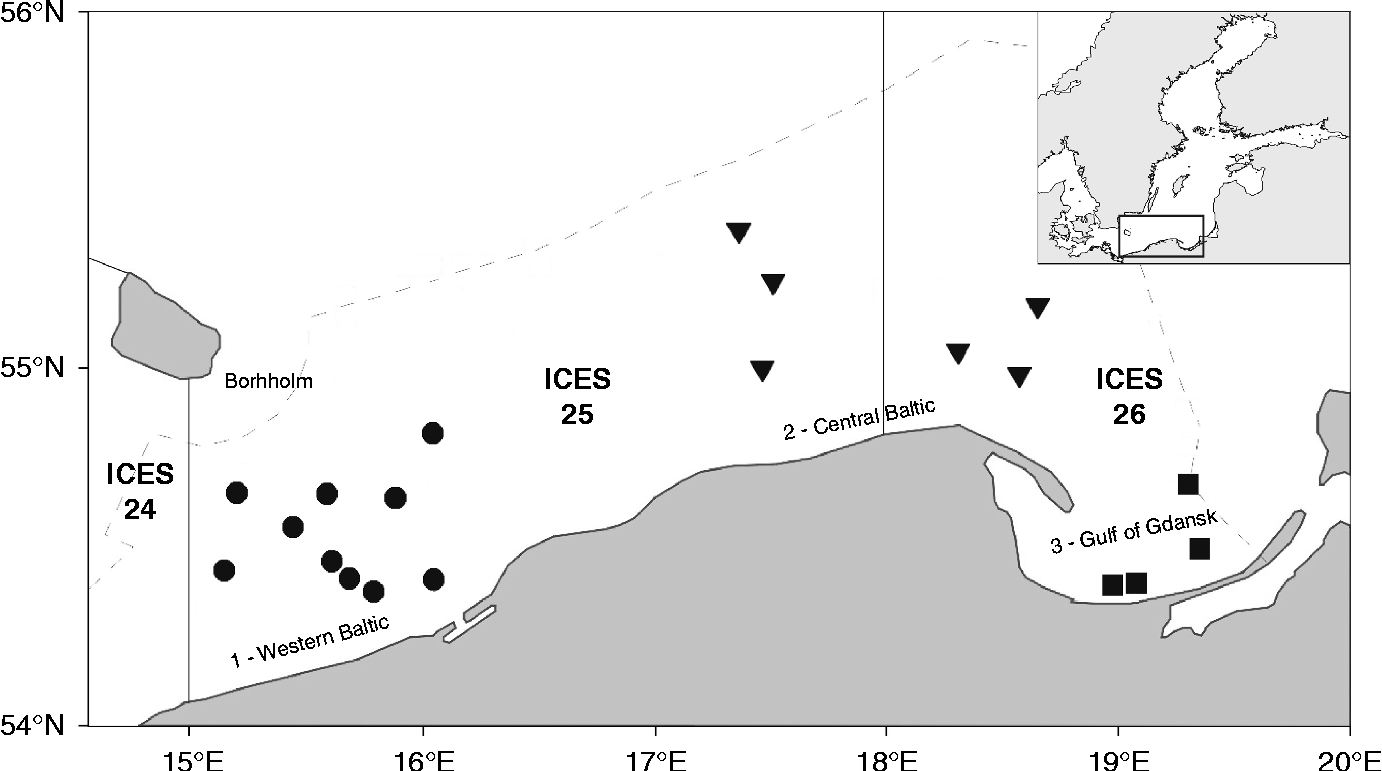
Samples of cod were collected during a survey of the research vessel Baltica in the southern Baltic Sea during the period 14 February to 1 March 2011 (fig. 1). A total of 490 individual fish caught in the Polish EEZ were examined for the presence of nematodes in the liver. Standard measurements of each fish were performed. Otoliths were collected from individuals to estimate their age. Age was determined by counting annual growth increments in sagitta otoliths. For each fish, Fulton's body condition factor, K (Fulton, Reference Fulton1904), was calculated as follows:
 $$\begin{eqnarray} \end{eqnarray}$$
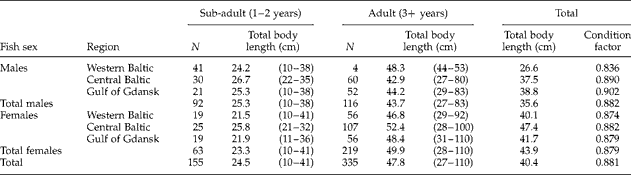
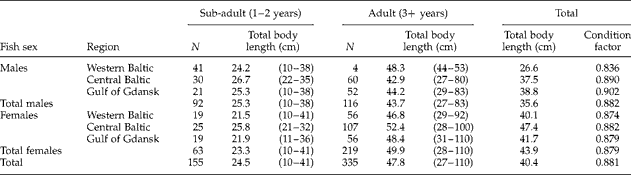
where W is the total weight and L is the total length of the fish. The condition factor was not corrected for gonad weight. The biological parameters (age, sex, body length and condition factor) recorded for the examined fish are presented in table 1.
Sampling sites of cod: 1, Western Baltic (black circles); 2, Central Baltic (black triangles); 3, Gulf of Gdansk (black squares). ICES 24, 25 and 26 refer to Baltic Sea subdivisions of the International Council for the Exploration of the Sea.

Biological parameters: age (in years), sex, body length (cm) and condition factor of cod sampled in three regions of the southern Baltic Sea. N= number of fish examined.
The whole liver (surface and parenchyma) of each fish was inspected visually for the presence of nematodes (the number and taxonomic position of individual parasites). Parasites were examined using a Nikon SMZ 1000 stereomicroscope and identified based on the morphological descriptions given by Berland (Reference Berland1961, Reference Berland and Möller1989) and Fagerholm (Reference Fagerholm1982).
Data analysis
The intensity and prevalence of the parasitic infection were calculated according to the definition given by Bush et al. (Reference Bush, Lafferty, Lotz and Shostak1997). Generalized linear models (GLMs) (McCullagh & Nelder, Reference McCullagh and Nelder1989) were applied to analyse the prevalence of cod infection with Anisakis sp. and Contracaecum sp. regarding the dependency on biological and spatial parameters. The following model was fitted:
 $$\begin{eqnarray} \end{eqnarray}$$
where G is a link function and inf represents the prevalence of infection with Anisakis sp. or Contracaecum sp. The total body length (TL) and condition factor (K) were taken as covariates, whereas the region, age, sex and gonad developmental stage were treated as factors. The error distribution was assumed to be binomial, and the logit link function was used. Corner point parameterization was used, i.e. factor effects for level one were assumed to be zero for all of the factors. Thus, the factor effects for the other levels may be regarded as the difference between the effect at any given level and the effect at level one. First, the initial model (which included all of the considered variables and factors) was fitted. The significance of the factors and covariates was then tested, and only significant terms were left in the final model. Tests were performed by deletion and those terms whose deletion did not result in a significant increase in deviance (i.e. the GLM measure of discrepancy between the modelled and observed values) were excluded from the model. Similarly, factor levels that did not produce a significantly different response were grouped into new factor levels. Distributions of the model residuals were analysed to test the model assumptions and performance.
Results
The biological characteristics of the examined cod (age, sex, body length and condition factor) are presented in table 1. The investigated cod were aged between 1 and 12 years. The proportion of sub-adult fish (1–2 years old) was highest in the Western Baltic, and males dominated in this age group. Cod length ranged from 10 to 110 cm. On average, males were smaller than females. The body condition factor ranged from 0.836 to 0.902.
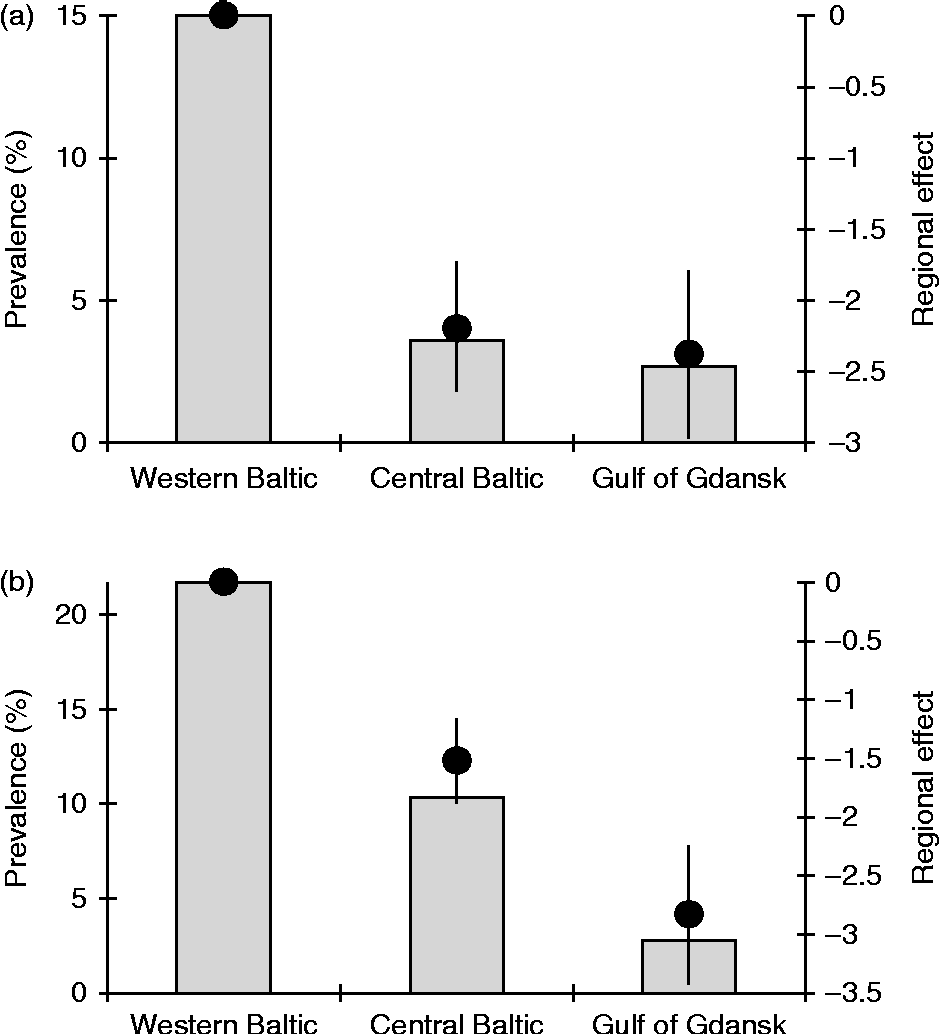
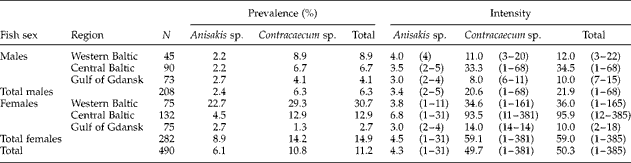
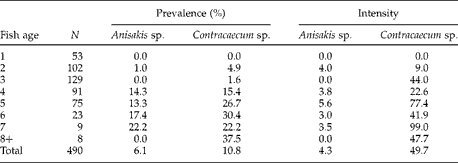
Anisakid nematodes belonging to the Anisakis, Contracaecum and Pseudoterranova genera were found in the livers of Baltic cod, with a prevalence of infection in the Polish EEZ of 11.2%. The prevalence of infection was highest in the Western Baltic (22.5%), intermediate in the Central Baltic (10.4%) and lowest in the Gulf of Gdansk (3.4%) (fig. 2). The intensity of infection ranged from 1 to 385 (table 2). The levels of prevalence and intensity of infection of cod with anisakid larvae were lower for males compared with females (table 2). Contracaecum sp. were dominant, representing 95.2% of anisakid nematodes found in the liver of fish, less frequent were Anisakis sp. (4.7%) and only three Pseudoterranova sp. larvae were found in one single infected fish (0.1%). The smallest parasitized fish (37 cm in length) was infected only with Anisakis sp. larvae. Nematodes were not recorded in fish aged 1 year. The prevalence of infection with anisakid nematodes increased with age, with some variability. The intensity of infection with Contracaecum sp. was markedly higher when compared to Anisakis sp. (table 3).
The prevalence of larval infections of Anisakis sp. (a) and Contracaecum sp. (b) in cod, relative to the regional effect included in the model (with SE). Grey bars, values observed; black circles, values estimated.
The prevalence (%) and intensity of infection of cod with anisakid larvae in the southern Baltic Sea, relative to fish sex. N=number of fish examined. Range in larval numbers is given in brackets.
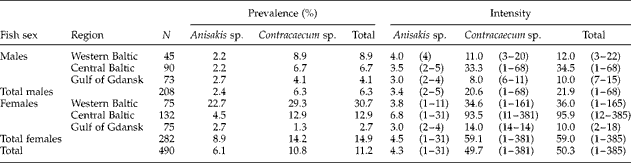
Pseudoterranova sp.: Prevalence 0.8% (Western Baltic); Total prevalence 0.2%; Intensity 3.
The prevalence (%) and intensity of infection of cod with anisakid larvae relative to age of fish (in years). N= number of fish examined.
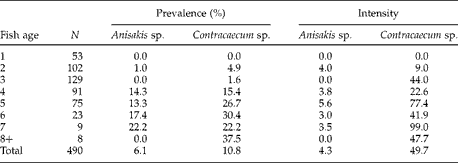
Pseudoterranova sp.: Total prevalence 0.2%; Intensity 3.
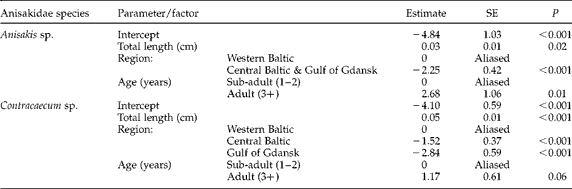
In the GLM infection models, effects of region, age and fish body length were significant. The model of the prevalence of infection with Anisakis sp. accounts for 22.7% of the variance. The effect of region was significant (P < 0.001) and higher in the Western Baltic than in other regions (estimated prevalences for the Central Baltic and the Gulf of Gdansk were not significantly different and were grouped into one factor level). The prevalence of infection was significantly higher (P= 0.01) in adults (3+years old) compared to sub-adult cod individuals ( < 3 years old) and correlated with the length of the fish (P= 0.02).
In the prevalence model for Contracaecum sp., 24.7% of the variance was accounted for. The effect of region was significant (P < 0.001) and was highest in the Western Baltic. This effect decreased eastward, and the lowest level was estimated for the Gulf of Gdansk. As in the model for Anisakis sp., the prevalence of infection was similarly correlated with the length of the host (P < 0.001), and the age effect was higher in adults compared to sub-adult cod. The prevalence of cod infection with species of the Anisakidae and the regional effect of the prevalence model (with standard errors, SE) are presented in fig. 2. Parameter estimates are given in table 4.
Parameter estimates (with SE) for the prevalence models of anisakid larval infections of cod from the southern Baltic.
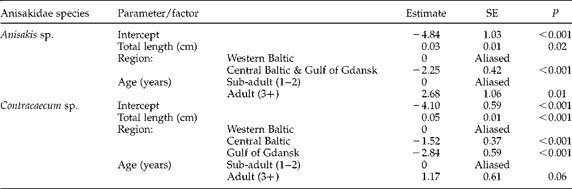
Variance accounted for in models: Anisakis sp. 22.7%; Contracaecum sp. 24.7%. Aliased: parameters that are not estimated by the procedure (set to zero in the model).
Discussion
In the present study, parasites were identified based on the anatomy and morphology of larvae, and diagnostics were not supplemented with molecular methods. Due to the poor morphological variation of the larval forms of these nematodes, their identification is possible only at the genus level. However, according to previously published genetic data, A. simplex s.s. is the only Anisakis species (Mattiucci et al., Reference Mattiucci, Nascetti, Cianchi, Paggi, Arduino, Margolis, Brattey, Webb, D'Amelio, Orecchia and Bullini1997), and C. osculatum is the only species of the C. osculatum complex, recorded in the Baltic (Mattiucci & Nascetti, Reference Mattiucci and Nascetti2008).
Cod is one of the fish species that is most heavily infected with anisakid nematodes in the North Atlantic and its adjacent seas. Aspholm et al. (Reference Aspholm, Ugland, Jødestøl and Berland1995) examined Norwegian Arctic cod from coastal and oceanic waters of the Barents Sea for the presence of A. simplex in fillets, and found that 96% of cod were infected, and the mean number of larvae in fillets ranged from 4.3 in the oceanic cod to 6.1 in the coastal cod. Strommes & Andersen (Reference Strommes and Andersen2000) studied the seasonal variation of cod infected with A. simplex larvae in the coastal area of Central Norway and found that the prevalence of infection ranged between 80 and 100%, with an average abundance of 14 (3.6–52.4), and the peak of abundance was in April. Perdiguero-Alonso et al. (Reference Perdiguero-Alonso, Montero, Raga and Kostadinova2008) recorded a high prevalence of cod infection with A. simplex larvae in the Celtic Sea (92%) and Icelandic waters (99%); the prevalence of cod infected with P. decipiens exceeds 50% in these areas.
Early reports on the presence of anisakid larvae in Baltic cod were provided by Kahl (Reference Kahl1938a, Reference Kahlb, Reference Kahl1939). In 1946, Petrushevsky & Shulman (Reference Petrushevsky and Shulman1955) recorded a high prevalence of cod infection with Contracaecum aduncum larvae in three regions of the Baltic Sea: Shventoii (87%), the Gotland trench (77%) and Liepaya (88%); while in the Gulf of Riga, the prevalence was only 7.7%. Fagerholm (Reference Fagerholm1978) stated that Contracaecum larvae found in livers of Baltic cod belong to C. osculatum. Until the late 1970s, anisakid larvae in cod livers were also considered to be Hysterothylacium, but then they were correctly defined as C. osculatum larvae, with warm-blooded final hosts, by Fagerholm (Reference Fagerholm1978). According to Fagerholm (Reference Fagerholm1982), the prevalence of infection with C. osculatum in cod from the Baltic Sea, sampled between 1973 and 1979, was 33%. For a similar time period (1974–75), the average prevalence of cod infection with C. osculatum in the Polish EEZ was 28%, with intensities of 1–24 (Grabda, Reference Grabda1976). The presence of A. simplex in the liver of cod was recorded in this area for the first time (Grabda, Reference Grabda1976). According to Reimer & Walter (Reference Reimer and Walter1993), the prevalence of Baltic cod infection was 4.8 and 2.5% for A. simplex and P. decipiens, respectively. The presence of A. simplex was noted in cod sampled in International Council for the Exploration of the Sea (ICES) subdivisions 22 and 24 (the German EEZ), but P. decipiens was recorded only in ICES 22. An investigation carried out over the period 1996–2005 in the Russian EEZ of the Baltic (including the Vistula and Curonian Lagoons) indicated that the prevalence of cod infection with C. osculatum was 5.2% (Rodjuk & Eliseev, Reference Rodjuk and Eliseev2006). Perdiguero-Alonso et al. (Reference Perdiguero-Alonso, Montero, Raga and Kostadinova2008) reported the prevalence of P. decipiens (sensu lato) larvae in Baltic cod (3.9%) in 2002–2003.
The studies in the southern Baltic conducted by Myjak et al. (Reference Myjak, Szostakowska, Wojciechowski, Pietkiewicz and Rokicki1994) from 1988 to 1993 also indicated that nematodes were mainly found in the liver. Contracaecum osculatum was the most frequently identified nematode; however, other species of the Anisakidae, including Hysterothylacium auctum (syn. H. aduncum) and A. simplex were also noted. The investigation of Szostakowska et al. (Reference Szostakowska, Myjak, Wyszyński, Pietkiewicz and Rokicki2005) conducted from 1987 to 1994 revealed the presence of the following four species of the Anisakidae in Baltic cod: C. osculatum, A. simplex, H. auctum and P. decipiens. The latter species was recorded in only 1 of 3036 fish examined. The majority of the larvae (98%) were located just beneath the liver serosa or within the liver parenchyma (only 2% on the pyloric processes or on the peritoneum) (Szostakowska et al., Reference Szostakowska, Myjak, Wyszyński, Pietkiewicz and Rokicki2005). During an investigation conducted in 2001–2003, Sobecka (Reference Sobecka2007) recorded the presence of A. simplex and C. osculatum in the liver of cod sampled in the Gulf of Gdansk and the Pomeranian Bay.
Our investigation of cod livers revealed the presence of Contracaecum sp., Anisakis sp. and Pseudoterranova sp. The most abundant nematode was Contracaecum sp. (comprising 95% of collected nematodes), which confirmed the findings of Szostakowska et al. (Reference Szostakowska, Myjak, Wyszyński, Pietkiewicz and Rokicki2005) that this species dominates in the liver of Baltic cod (92%). Similar to the findings of Myjak et al. (Reference Myjak, Szostakowska, Wojciechowski, Pietkiewicz and Rokicki1994), mixed infection with A. simplex/C. osculatum and C. osculatum/P. decipiens was observed in a portion of individuals.
In 2011, the prevalence of cod infected with Anisakidae was 11%, whereas it was only 4% in the study conducted from 1987 to 1993 by Szostakowska et al. (Reference Szostakowska, Myjak, Wyszyński, Pietkiewicz and Rokicki2005). The prevalence of infection with C. osculatum ranged between 1.8 and 3.2% in cod sampled from several Polish fishing grounds, but the highest prevalence (10.7%) was found in the Swedish EEZ. In the case of A. simplex, the prevalence ranged from 0.69 to 12.5% in the fishing grounds in the vicinity of Bornholm (Myjak et al., Reference Myjak, Szostakowska, Wojciechowski, Pietkiewicz and Rokicki1994).
According to Sobecka (Reference Sobecka2007), the prevalence of Baltic cod infected with A. simplex larvae ranged from 1.9% in the Gulf of Gdansk to 8.9% in the Pomeranian Bay (the Western Baltic). The values for infection prevalence with C. osculatum were higher in the Gulf of Gdansk (9.8%) and lower in the Pomeranian Bay (2.5%).
Myjak et al. (Reference Myjak, Szostakowska, Wojciechowski, Pietkiewicz and Rokicki1994) compared the prevalence of infection during particular months (for the period of time from 1987 to 1993), but this comparison did not reveal any clear seasonality for nematode occurrence in cod. Myjak et al. (Reference Myjak, Szostakowska, Wojciechowski, Pietkiewicz and Rokicki1994) and Szostakowska et al. (Reference Szostakowska, Myjak, Wyszyński, Pietkiewicz and Rokicki2005) only recorded the presence of anisakid nematodes in fish that were 33 cm in length and longer. In our investigation, the smallest infected fish was 37 cm in length, and indeed, the prevalence of infection significantly increased with the length of the host, which was confirmed by our GLM analysis. Myjak et al. (Reference Myjak, Szostakowska, Wojciechowski, Pietkiewicz and Rokicki1994) reported an increasing trend in the intensity and the prevalence of infection of C. osculatum with the length of cod. The comparison of those results with our investigation indicated that the intensity increased from 14.5 (in 1987–1993) to 50 and the average prevalence increased from 2.6% (in 1987–1993) to 11%. Both intensity and prevalence increased markedly in all compared length classes of fish. Although mean prevalence and intensity of infection of females was higher than those of males, statistical analyses did not reveal a significant difference in prevalence of infection with anisakid nematodes between sexes. Length of fish is the variable that significantly impacts the prevalence of infection, which has been verified by GLM models. Males were smaller than females (see table 1) and this is the reason why males were less infected than females.
The percentage of cod infected with anisakid nematodes was not uniformly distributed in the Baltic. Szostakowska et al. (Reference Szostakowska, Myjak, Wyszyński, Pietkiewicz and Rokicki2005) noted that the prevalence of infection was higher in fish from northern fishing grounds (also in the Swedish EEZ). The results of the GLM presented in this paper indicated that the prevalence of infection with Anisakis sp. and Contracaecum sp. larvae was significantly higher in the Western Baltic compared to the other regions (the Central Baltic and Gulf of Gdansk). In the case of Contracaecum sp., the prevalence of infection decreased eastward.
According to the data presented in the ICES WGPDMO report (ICES, 2011), a significant, increasing trend in the prevalence of infection with A. simplex larvae has been observed in Baltic herring since 2007, with the highest prevalence noted in herring caught in the Western Baltic. Cod is a predatory fish, and herring is an important prey of adult cod; thus, herring may be a source of A. simplex infection in the Baltic. Marine crustaceans (the first intermediate host) play an important role in completing the life cycles of Anisakidae species, but it is rather difficult to specify infected food items, the areas where cod might become infected and which prey are eaten (in the Baltic and/or outside the Baltic). Young cod are more stationary. Because cod is a migratory fish species, the presence of nematodes may coincide with its feeding areas rather than the location where it is caught. The migration distance of adult cod can extend up to 1000 km (Sualamo & Neuman, Reference Sualamo and Neuman2002). The spatial and temporal distribution patterns of cod in the Baltic varies seasonally and between years (Aro, Reference Aro2000), and the feeding migration of Baltic cod seems to occur in all directions and without clear patterns. Young cod are rather sedentary, whereas adult individuals from the Arkona region may reach western areas (the Belt Seas) and extend eastwards across the Polish EEZ (Aro, Reference Aro2000). There are two stocks of cod inhabiting the Baltic area: the western Baltic cod stock (Gadus morhua morhua L.), which occurs west of Bornholm Island in the Belt Sea and the Sund (ICES subdivisions 22–24), and the eastern stock (Gadus morhua callarias L.), which is distributed east from Bornholm up to the northern part of the Bothnian Sea and to the Gulf of Finland (Aro, Reference Aro2000). The border between these two stocks is diffuse, and stock mixing occurs in the Arkona and Bornholm Basins (Bagge et al., Reference Bagge, Thurow, Steffensen and Bay1994).
Despite the dominance of sub-adult fish (especially males) in cod sampled from the Western Baltic, the prevalence of infection with Anisakidae was significantly higher there, compared to the other examined regions, suggesting that the western population of cod undergoes feeding migration to areas where parasites are abundant in prey. According to Hauksson (Reference Hauksson2011), the prevalence, abundance and density of Pseudoterranova sp. larvae were the highest in Icelandic cod sampled in areas where grey seals were the most abundant. The feeding areas of Baltic cod overlap with areas where seals (the final hosts) are commonly found, and the life cycle of C. osculatum could be completed in the Atlantic and also in the Baltic Sea.
Three species of seals live in the Baltic Sea: the grey seal (H. grypus), ringed seal (P. hispida) and harbour seal (P. vitulina). The grey seal is found in both coastal regions of the North Atlantic Ocean and is also currently the most abundant pinniped species in the Baltic. According to Hiby et al. (Reference Hiby, Lundberg, Karlsson, Watkins, Jussi, Jussi and Helander2007), the estimated total population size in the Baltic Sea has increased from 4000 in the late 1970s to over 15,000 in the year 2000. The population size of the grey seal in the entire Baltic Sea has continued to increase over the past few years to 20,000–22,000 seals, with an annual growth rate of 8.5% (HELCOM, 2011).
The harbour seal is the most widely distributed pinniped, inhabiting temperate and subarctic coastal areas on both sides of the North Atlantic and North Pacific Oceans. The harbour seal populations in European waters were reduced by approximately 50% after two epizootics of phocine distemper seal virus (PDV) in 1988 and 2002 (Härkönen et al., Reference Härkönen, Dietz, Reijnders, Teilmann, Thompson, Harding and Hall2006). After the second epidemic in 2002, the majority of the Scandinavian harbour seal populations showed annual growth rates that varied between 4 and 20% (Teilmann et al., Reference Teilmann, Rigét and Harkonen2010).
It was documented in the literature that C. osculatum and P. decipiens were found in grey and harbour seals (Fagerholm, Reference Fagerholm1990; Aspholm et al., Reference Aspholm, Ugland, Jødestøl and Berland1995; Ólafsdóttir & Hauksson, Reference Ólafsdóttir and Hauksson1998; Paggi et al., Reference Paggi, Mattiucci, Gibson, Berland, Nascetti, Cianchi and Bullini2000; Lehnert et al., Reference Lehnert, Raga and Siebert2007) and in the Baltic populations of both of these seal species (P. decipiens in harbour seals – Lunneryd, Reference Lunneryd1991; C. osculatum in grey seals – Mattiucci & Nascetti, Reference Mattiucci and Nascetti2008). According to Mattiucci & Nascetti (Reference Mattiucci and Nascetti2008), mixed infection with P. decipiens (s.s.) and P. krabbei (previously referred to as P. decipiens A by Paggi et al., Reference Paggi, Nascetti, Cianchi, Orecchia, Mattiucci, D'Amelio, Berland, Barttey, Smith and Bullini1991) is often recorded in the same individual of grey and harbour seals. However, in the eastern waters of the Atlantic, when detected in sympatry with P. decipiens (s.s.), P. krabbei prevails in the grey seal rather than in the common seal (Mattiucci & Nascetti, Reference Mattiucci and Nascetti2008).
The investigation conducted along the eastern coast of Sweden from 2004 to 2010 revealed a high prevalence of infection with P. decipiens in cod from the southern Baltic. In the Trelleborg area, the presence of this nematode species was detected in the muscles of 74% of the fish examined (ICES, 2011). According to Königson (Reference Königson2011), the dispersal of P. decipiens in the Baltic has become a growing problem in cod fisheries, with the rapid increase in the number of the grey seals in the central and southern Baltic. This issue was also discussed by Buchmann & Kania (Reference Buchmann and Kania2012), who suggested that an increasing seal population in the Baltic may impact the occurrence of P. decipiens in cod fillets. The presence of P. decipiens in cod has not been previously considered to be a problem for Baltic cod because this nematode has not been frequently reported during the past few decades. The occurrence of P. decipiens in cod may be an effect of the re-colonization of the Baltic with seals. This phenomenon may apply to other anisakids because the grey seal is also a final host for C. osculatum; therefore, an increasing seal population size may impact the dispersion of these nematode species in the Baltic.
The findings presented in this article suggest that the prevalence of cod infected with anisakid nematodes (especially Contracaecum sp.) increased compared to the results of studies conducted in the past three decades. However, our investigation was limited to one season and may not fully represent the actual status of the infection level. On the other hand, anisakid nematodes encapsulated in fish may survive for years, and a cod may accumulate parasites during its lifetime (Gibson & Jones, Reference Gibson and Jones1993). Sufficient monitoring of economically important fish species for the presence of anisakid nematodes is very important for food safety. Furthermore, additional complex studies are needed to evaluate the current level of parasitic infection and the potential hazard to human health.