The integration of immigrant communities in the host country is a social issue of great interest. Host countries face important sociocultural changes due to ethnic, cultural, and religious changes. These countries must understand the influence of the social environment on integration to enhance the coexistence and psychological well-being of social groups (de Luca, Bobowik, & Basabe, Reference de Luca, Bobowik and Basabe2011). After France, Spain is the European country with the second-largest number of Moroccan immigrants (Haas, Reference Haas2014). In 2013, there were 759.273 Moroccan nationals legally living in Spain (Spanish Statistics Institute: Instituto Nacional de Estadística -INE, 2013), but the actual number is estimated to be close to one million. In particular, Andalusia has a foreign population of 8.13% (Arroyo-Pérez, Reference Arroyo-Pérez2010) and has one of the largest Moroccan communities (Center for Andalusian Studies: Centro de Estudios Andaluces -CEA, 2009). This group has certain peculiarities in terms of their method of migration and family ties. The large percentage of reunification and the future projects of these immigrants suggest the strengthening of their settlement (CEA, 2009). Thus, this population will have a permanent presence and lower returns to their country, and their integration is an important issue. Moreover, there are differences among communities in their patterns of acculturation, and Moroccan immigrants tend to feel the need for less integration than other groups (Navas, López-Rodríguez, & Cuadrado, Reference Navas, López-Rodríguez and Cuadrado2013). However, Spain and Morocco have very different traditions and cultures. Although the number of Moroccan women who arrive with their partners or families is very high, Moroccan women immigrants seem to be less integrated in Spain than men.
This lack of integration of Moroccan women in Spanish society may be due to a conflict between two attitudes: the liberation of women (in the host country) and the culture of honor (in the culture of origin and the group reference). This process may be mediated by emotional variables. In this study, we analyze the impact of culture (the culture of honor) and individual (emotional intelligence) variables on the acculturation process of Moroccan women immigrants in Spain.
Acculturation
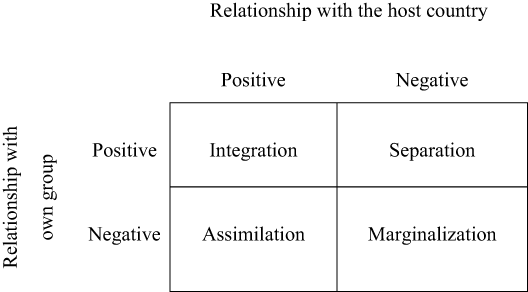
The increase in the immigrant population has led to the need to contextualize the study of acculturation. The general processes of acculturation are applicable to the relationship between two cultural groups in any country. Graves (Reference Graves1967) argued that acculturation is a cultural phenomenon that affects the entire group as well as a phenomenon that influences individuals, involving a series of changes in attitudes, behaviors, lifestyles, values, and identity (a phenomenon known as psychological acculturation). Berry (Reference Berry and Berman1990) proposed the Acculturation Model to analyze this phenomenon and its psychological consequences, suggesting two separate attitudinal dimensions for the way that immigrants address the acculturation process: whether immigrants consider their cultural identity and traditions valuable enough to maintain in the host society and whether relations with other individuals or groups in the host society are sufficiently valuable to seek and encourage. The combination of these answers (positive or negative) provides a model of four possible acculturation styles (see Figure 1). According to Berry, each dimension describes a continuum in which an individual may score high or low. When an immigrant positively values both his or her own group and the host group, the integration style emerges. However, when an immigrant negatively values both groups, marginalization is the resulting style. There is also the possibility of positively valuing one group and negatively valuing the other. When one’s own group is positively valued but not the host group, separation is the style adopted, whereas the opposite approach produces the assimilation style.
Results of the Acculturation Styles.

These strategies imply a type of behavior that involves the culture of origin and the host culture. In particular, Berry (2010, p. 12) notes that assimilation is the result of the acculturation process when an individual wishes to diminish or decrease the significance of the culture of origin and desires to identify and interact primarily with the other culture, typically with the dominant culture if one comes from an ethnic minority group. However, if the individual wishes to retain the original culture and avoids interacting or learning about the other culture(s), separation takes place. When individuals show little involvement in maintaining the culture of origin or in learning about the other culture(s), marginalization is the result of acculturation. Finally, integration occurs when a person shows an interest in maintaining the original culture and in learning about and participating in the other culture(s).
The Relative Acculturation Extended Model (RAEM; Modelo Ampliado de Aculturación Relativa; MAAR Navas et al., Reference Navas, Pumares, Sánchez, García, Rojas, Cuadrado and Fernández2004; Reference Navas, García, Sánchez, Rojas, Pumares and Fernández2005) proposes a theoretical framework for acculturation that is adapted to the Spanish social context. The main references for the MAAR are Berry and colleagues’ (Berry, Reference Berry and Berman1990, Reference Berry1997, Reference Berry, Chun, Organista and Marín2003, Berry, Kim, Power, Young, & Bujak, Reference Berry, Kim, Power, Young and Bujak1989) and Bourhis, Moïse, Perreault, and Senecal’s (Reference Bourhis, Moïse, Perreault and Senécal1997) models of acculturation. This model also considers proposals by other researchers with regard to the limitations of previous models. In particular, Rudmin (Reference Rudmin2003) argued the need of focusing on subcultures, on dominant groups’ attitudes and not only in minority groups. This author also makes some recommendations to carry out studies, as being alert to researches biases, identify responses of indifference or being aware that acculturation is a normal process (Rudmin, Reference Rudmin2003) and a universal human experience (Rudmin, Reference Rudmin2010) that can be measured and sometimes studied independently of health issues (Rudmin, Reference Rudmin2009).
The MAAR, like Berry and Bourhis’ models, discusses the acculturation attitudes of immigrants and natives. This model proposes the need to consider different sociocultural areas of reality, which may involve different acculturation strategies and attitudes. As other authors have recognized (although with different intensities) (e.g., Arends-Tóth & van de Vijver, 2003, 2007, Berry & Sam, Reference Berry, Sam, Berry, Segall and Kagitcibasi1997; Kwak & Berry, Reference Kwak and Berry2001), there is no unique strategy and/or acculturation attitude; rather, there is a complex adaptive process in which immigrants may prefer different options at the same time and a relative process, in which immigrants do not always prefer the same options when interacting with people from other cultures in different areas (e.g., work relations, family relations, religious beliefs, and traditions). The key contribution, and difference from Berry´s model, of the MAAR is the separation by scope and the operationalization of these scopes as well as the combination of the actual/ideal aspects of different acculturation options (strategies and attitudes). Initially, the MAAR distinguished seven scopes of acculturation comprising two spheres: the peripheral or public (politics, work, economy) and the central or private (the hardcore of culture —family, religion, and ways of thinking) (Navas et al., Reference Navas, García, Sánchez, Rojas, Pumares and Fernández2005). Social well-being was subsequently included in the public sphere, and values replaced ways of thinking in the private sphere (e.g., Navas, García, Rojas, Pumares, & Cuadrado, Reference Navas, García, Rojas, Pumares and Cuadrado2006). We follow this last proposal and focus on the private sphere (family, religion, and values) of Moroccan women immigrants in Spain. In particular, because Moroccan immigrant women seem to be less integrated than immigrant men, we hypothesize that their attitudes and strategies will differ.
Hypothesis 1. In the attitudinal sphere, Moroccan women prefer integration but actually separate or marginalize from the host culture
Cross-cultural research has shown the predictive role of personal and group variables in the process of acculturation/integration. Age, educational level, gender, geographical area of origin, ethnicity, and immigration status have been identified as factors that affect the adaptation process (Navas et al., Reference Navas, Pumares, Sánchez, García, Rojas, Cuadrado and Fernández2004; Reference Navas, López-Rodríguez and Cuadrado2013; Navas, Rojas, Pumares, Lozano, & Cuadrado, Reference Navas, Rojas, Pumares, Lozano and Cuadrado2010). Additionally, research shows that acculturation styles are consistently correlated with personality traits and cognitive styles (e.g., Schmitz & Berry, Reference Schmitz, Berry, Deustch, Boehnke, Kühnen and Boehnke2011), and emotional intelligence has recently been related to acculturation (see Schmitz & Schmitz, Reference Schmitz and Schmitz2012). In contrast, analyses of social variables, such as the culture of honor have received little attention.
Culture of Honor (CH)
Concerns about honor are strongly associated with cultural values (Guerra, Giner-Sorolla, & Vasiljevic, Reference Guerra, Giner-Sorolla and Vasiljevic2013). Honor involves self-worth in one’s own eyes and in the eyes of others (Pitt-Rivers, Reference Pitt-Rivers and Peristiany1966, Reference Pitt-Rivers1977). It is an individual aspect that a person acquires through his/her behavior and that others recognize. It also includes a social and group sense because it stems from the social group to which one belongs, and individuals can choose whether to maintain honorable behavior to remain in the group or to be excluded (Lopez-Zafra, Reference Lopez-Zafra, Morales, Moya, Gaviria and Cuadrado2007a). Cultures in which individuals endorse honor as an important value are cultures of honor (CH). Studies about CH have analyzed individuals’ reactions to offenses to honor (e.g., in the US, Cohen & Nisbett, 1994; Cohen, Nisbett, Bowdle, & Schwarz, Reference Cohen, Nisbett, Bowdle and Schwarz1996; Nisbett & Cohen, Reference Nisbett and Cohen1996; in the Netherlands, Rodriguez-Mosquera, Manstead, & Fischer, Reference Rodriguez-Mosquera, Manstead and Fischer2002a; in Spain, Lopez-Zafra & Rodríguez-Espartal, Reference Lopez-Zafra and Rodríguez-Espartal2008) along with cross-cultural studies (e.g., Guerra et al., Reference Guerra, Giner-Sorolla and Vasiljevic2013 or Rodriguez-Mosquera, Manstead, & Fischer, Reference Rodriguez-Mosquera, Manstead and Fischer2000; Reference Rodriguez-Mosquera, Manstead and Fischer2002b). These studies have found that individuals in cultures of honor are expected to protect their own reputation and the reputation of their group. These expectations are thought to be important for both women and men (Rodriguez-Mosquera, Reference Rodriguez-Mosquera2011). However, to our knowledge, no study has analyzed how the CH can determine the acculturation process of immigrants. In Morocco, as both a Mediterranean and an Arabic country, the sense of honor is of great importance. Thus, relationships are determined by the values and principles inherent in the CH.
Both women and men endorse the CH in honor cultures (e.g., the Mediterranean). However, no study has focused only on women in relation to the CH. In this study, we select a sample of women because women play an important role in the transmission of the CH (Shackeldford, Reference Shackelford2005) and in the maintenance of values. Additionally, Moroccan women immigrants may endorse stereotypes related to the private sphere. For example, Arends-Tóth and Van de Vijver (Reference Arends-Tóth and Van de Vijver2007) found that of four different immigrant groups studied, Moroccans showed the strongest association of household tasks and child-care responsibilities with women compared to the native Dutch. Thus, many Moroccan women immigrants may focus on the private sphere, and differences among them may emerge due to the importance given to CH. Bearing these comments in mind, we hypothesize the following:
Hypothesis 2: The high importance given to CH will determine the chosen acculturation style of Moroccan immigrant women
Women may decide to continue belonging to their reference group, their country of origin. In this case, this decision would limit their adaptation to the host country. Specifically, we hypothesize that Moroccan women immigrants in Spain who attribute high importance to CH are more likely to adopt a separation (if they also have a negative attitude toward Spain) or integration strategy (if they have a positive attitude toward Spain) rather than marginalization or assimilation in the core areas related to values and family relationships.
Emotional Intelligence, the Culture of Honor, and Acculturation
Although no study has analyzed the three concepts together, a few studies have identified the relationships between CH and emotional intelligence (EI) and between EI and acculturation.
EI refers to the proper interaction between emotion and cognition, which allows an individual to adapt adequately to his or her environment (Salovey & Grewal, Reference Salovey and Grewal2005). People differ in their ability to identify, express, use, and regulate their feelings and those of others (Mikolajczak, Menil, & Luminet, Reference Mikolajczak, Luminet and Menil2006). Research shows that EI benefits diverse areas of human functioning (Brackett, Rivers, & Salovey, Reference Brackett, Rivers and Salovey2011; Extremera, Fernández-Berrocal, & Salovey, Reference Extremera, Fernández-Berrocal and Salovey2006; Fernández-Berrocal & Extremera, 2010; Joseph & Newman, Reference Joseph and Newman2010). Being emotionally intelligent helps people to manage their behavior and to analyze both their own and other people’s behavior to create a balance between them. Two main approaches emerge in the study of EI: the ability model and the mixed model (see Matthews, Zeidner, & Roberts, Reference Matthews, Zeidner and Roberts2011 for a review of the models). We focus on the ability model, in which EI refers to the way individuals perceive, value, and express emotions (i.e., how they process emotional information) and the analysis of the capabilities that are required for such processing (Brackett, Rivers, Shiffman, Lerner, & Salovey, Reference Brackett, Rivers, Shiffman, Lerner and Salovey2006; Mayer & Salovey, Reference Mayer, Salovey, Salovey and Sluyter1997; Mayer, Roberts, & Barsabe, Reference Mayer, Roberts and Barsade2008). This model views EI as a combination of abilities from four areas: (a) accurately perceiving emotion, (b) using emotions to facilitate thought, (c) understanding emotion, and (d) managing emotion (Mayer & Salovey, Reference Mayer, Salovey, Salovey and Sluyter1997).
Recent research has focused on this relationship, demonstrating a relationship between EI and the preference for specific acculturation styles. Specifically, a study by Schmitz and Schmitz in Germany (Reference Schmitz and Schmitz2012) showed that individuals with high EI chose integration followed by assimilation, whereas separation and marginalization were inversely related to IE.
Regarding the relationship between EI and CH, a study by Lopez-Zafra, Rodríguez-Espartal, and Jiménez (Reference Lopez-Zafra, Rodríguez-Espartal and Jiménez2008) found a relationship between both concepts. In particular, higher EI was inversely related to CH. Thus, individuals who gave less importance to CH showed higher EI than individuals who endorsed the CH.
Because EI is related to both concepts, we believe that this emotional variable may act as a mediator in the relationship between CH and acculturation. Thus, we hypothesize the following:
Hypothesis 3. EI mediates the importance given to CH and the process of acculturation among Moroccan immigrant women
In particular, we believe that EI can help to create a balance between the value of the immigrant’s own culture and the host culture and to regulate interpersonal relationships with both the reference group and the host group, maintaining the values of the culture of origin and taking other values from the host culture. In this case, we hypothesize that immigrants would more frequently choose the integration strategy of acculturation.
Method
Participants
In this study, 129 out of 192 Moroccan women who were asked to participate (67.18%) completed a questionnaire that included measures of interest. Their mean age was 29 years (SD = 9.40; range 16–67), and they had lived in Spain for an average of six years (SD = 3.60). All of the respondents and their parents were born in Morocco. They differed in their level of education: 17 had no education, 21 had completed primary school, 56 had college studies, and 35 had graduated. Furthermore, 51.2% were living with their partners, 19.7% lived with their parents, and 29.1% lived alone.
Instruments
Acculturation Strategies and Attitudes Questionnaire, immigrants’ version (Navas et al., Reference Navas, Pumares, Sánchez, García, Rojas, Cuadrado and Fernández2004)
We chose eight items scored as six response alternatives that were related to the core areas (family, religion, values) (examples of items: the way women relate to their partners, the way people educate children, the role distribution in the family, the importance of religion in their lives). These items were repeated in two blocks (attitudes and strategies). Attitudes evaluate the positive and negative perceptions immigrants hold about their culture of origin and the host country's culture. Strategies evaluate the real behavior that indicates the degree of maintenance of the culture of the country of origin and the level of adoption of the host culture. The resulting strategy or attitude depends on perceptions about the core values measured.
Culture of Honor Scale (Lopez-Zafra, Reference Lopez-Zafra2007b)
This scale measures attitudes or predispositions that give importance to the defense of honor. On a five-point Likert scale, the participants responded to 17 items comprising three factors: individual honor (e.g., it is very important for women to be loyal and honorable; α = .59); society and laws around honor (e.g., society instills in men and women to defend honor; α = .70); and legitimacy of the use of violence for an offense (e.g., one should protect honor even with violence; α = .81). In addition, an overall index was obtained (α = .82).
Perceived Emotional Intelligence
We used the Spanish version by Fernández-Berrocal, Pérez, Repetto, and Extremera (Reference Fernández-Berrocal, Pérez, Repetto and Extremera2004) of Wong and Law's Emotional Intelligence Scale (WLEIS; Wong & Law, Reference Wong and Law2002). It consists of 16 items that include four factors: evaluation of one's emotions or intrapersonal perception (I have a good understanding of my own emotions; four items, α = .67) assessing the emotions of others or interpersonal perception (I am a good observer of others’ emotions; I am sensitive to the feelings and emotions of others; four items, α = .70); the use or assimilation of emotions (I always tell myself I am competent; four items, α = .72); and emotion regulation (I am able to control my temper and handle difficulties rationally; I can always calm down quickly when I am very angry; four items, α = .73). The overall reliability was Cronbach’s alpha .88.
Sociodemographic data
Participants reported their age, the nationality of their parents, their country of birth, their education level, time in Spain, with whom they lived, the type of permission for residence, the nationality of their partner, whether they worked, and the type of work.
Procedure
Due to the characteristics of the sample and the data from a pilot test that we conducted in Spanish, we decided to adapt the questionnaire to Arabic, the official language in Morocco. To develop this version, we followed the instructions of the International Test Commission (ITC, 2010) involving a combination of forward/backward translation. Specifically, one of the researchers with a high command of both languages (Moroccan and Spanish) translated the scale into Arabic. Then, an expert in the Arab language and the Spanish language translated the scale into Spanish. Several difficulties emerged in this process due to different understandings of the sentences in Arab and Spanish. Thus, to ensure that the meaning was the same in both languages, the two researchers and the Arab expert conducted a judging session. Lastly, the questionnaire was reviewed by an Arab literature teacher to avoid any orthographic or vocabulary errors. Once the questionnaire was available, we counterbalanced the order in two forms. The A-form included the scales as listed in the instruments section, and the B-form was the reversed order.
To contact the women participants, we signed agreements with the institutions where most immigrants go to solve their problems (Foreign Office, Spanish Red Cross, Jaén Hosts, association AMIN). Two interviewers asked women at these institutions for their voluntary and anonymous collaboration. This procedure was completed using snowball sampling. Ultimately, 40% of the women responded in the collaborating institutions, and 60% responded through direct interviews. We used the double-blind method to eliminate bias.
Results
Analyses were conducted using SPSS v IBM. 19. As a preliminary step, we analyzed whether the order of application (A or B forms) produced an effect on the results. There was no difference (p > .05), so this variable was dropped for the subsequent analyses. For the sake of clarity and simplicity, we present the results in response to the hypotheses.
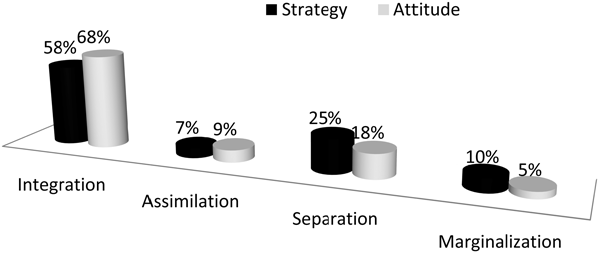
To test which acculturation attitudes Moroccan women preferred and the actual acculturation strategies they used (Hypothesis 1), we analyzed the percentage of each acculturation strategy and the attitude chosen by the women (see Figure 2).
Percentages of strategies and attitudes in the acculturation process.

When analyzing attitudes, Moroccan immigrant women preferred integration as an acculturation style (68%). However, although integration was the preferred behavior or strategy (58%), both the separation and marginalization strategies increased significantly, and assimilation was the least preferred. Thus, although Moroccan women want to integrate (attitude), the real situation (strategy) is that more than half of this sample is integrated, whereas 25% are separated, 10% are marginalized, and only 7% are assimilated. This incongruence between the real (strategy) and ideal (attitude) perceptions of Moroccan immigrant women suggests that the acculturation strategy depends not only on the desires of the immigrant but also on other external variables. Thus, we focus on the real acculturation strategy adopted by these women to analyze the relation of acculturation with CH and EI.
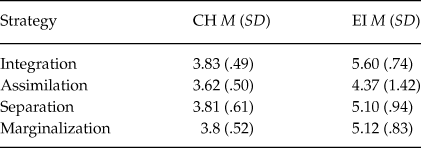
To analyze whether there was a relationship between the acculturation strategy and CH (H2), we conducted a one-way ANOVA with the strategy of acculturation as the predictor and the CH dimension as the criterion. Our results show that no significant differences emerged in the scores given for CH and the acculturation strategies of the Moroccan immigrant women (F(3, 99) = .233; p = .87; see Table 1).
Means and standard deviations for total EI and CH on the acculturation strategies

To analyze the influence of EI on the chosen type of acculturation and the possible mediation role in the relation between acculturation strategy and CH (H3), we conducted a one-way analysis with the acculturation strategy as the independent factor and EI as the criterion variable. In this case, there were significant differences between the acculturation strategies depending on the women’s level of EI. In particular, women who preferred the integration strategy scored highest on EI, whereas the assimilated immigrants showed the lowest scores for EI F(3, 92) = 4.63; p = .005; see Table 1.
Thus, the separately analyzed results yielded no relationship between CH and the acculturation strategy adopted, but a difference was observed in the acculturation strategy chosen depending on the level of EI. In fact, the results show that CH correlates significantly with the valuation of the country of origin (r = .215, p <.005); that is, women who value their culture of origin also give high importance to CH, and EI relates positively to the valuation of the country of origin (r = .220, p < .005) and with the maintenance of the culture (r = .396, p < .001) and adaptation to the host society (r = .322; p < .001). Additionally, a regression analysis between the valuation of the culture of origin and the CH shows that CH is predictive of the valuation of the country of origin (β = 0.284, adjusted R 2 = .036, F change = 4.32; p < .041), and EI has a predictive role in maintaining the culture of the country of origin (β = 0.409, adjusted R 2 = .147, F change = 16.346, p <.006) as well as adaptation to the host country (β = 0.373, adjusted R 2 = .093, F change = 10.06, p <.002).
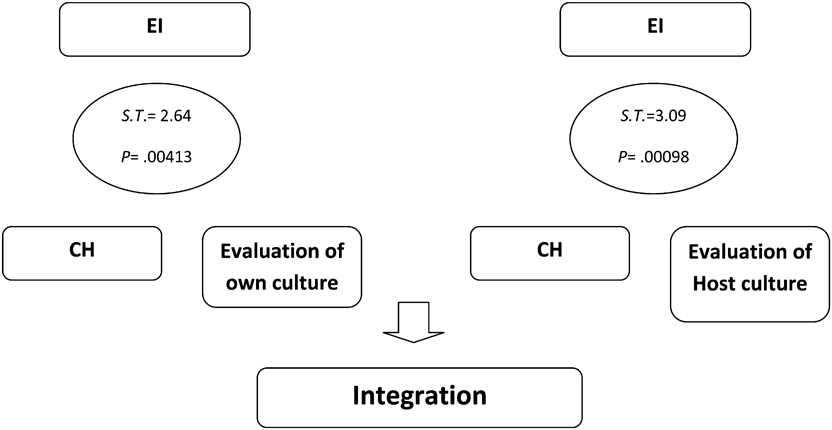
Thus, to analyze a possible mediating role of EI on the relationship between CH and the maintenance of the culture of origin as well as the adaptation to the host country's culture, we conducted mediation analyses with the Sobel test. A high value for the culture of origin implies the maintenance of the immigrant’s own culture (separation or marginalization acculturation strategies), and a high value for the host culture implies the adoption of the new culture (integration or assimilation acculturation strategy). Our results show that only in the case of integration does EI mediate between CH and the value given to the immigrant’s own and host cultures. That is, EI helps to create balance and to maintain the culture of the country of origin. EI also facilitates adaptation to the culture of the host country, even if the immigrant attributes high importance to the culture of origin. Thus, EI helps these women choose integration as an acculturation strategy (see Figure 3). No mediation effects emerge when analyzing the other acculturation strategies.
Mediation between EI, CH, and Strategic Acculturation.

Discussion
Immigration is an important phenomenon that affects relations among groups and among individuals. Research about the way immigrants face a new culture has been conducted under the paradigm of acculturation. Depending on whether an immigrant accepts the host society, the style of acculturation differs and may involve separation, integration, marginalization, or assimilation. These results may reflect attitudes or strategies. This complex process may be influenced by other social and individual variables. In this research, we analyzed the influence of social (CH) and individual (EI) variables on the process of acculturation in the strategic sphere due to the incongruence observed between the ideal (attitude) and real (strategy) acculturation. Our sample was composed of Moroccan immigrant women, who are one of the most numerous groups in Andalucía and who often have difficulties with integration.
Our results confirm that the acculturation process is complex. Half of the women in our sample were integrated, but almost the other half were separated or marginalized and only a low percentage (5%) were assimilated. However, regarding hypothesis 2, no significant differences were found in the strategy followed due to the CH level. Thus, CH is a cultural pattern for women, but it does not impede them in integrating or determining which strategy to follow. Of interest is that, although not significantly different, women with a lower level of CH were the most assimilated. Because no previous study has analyzed this relationship, this result should be analyzed in other studies with other samples and cultures. Also, other aspects as their profession or educational level may play a role in this integration. Younger women or university students may feel and be more integrated than older or non-educated women.
In this study, EI showed a relationship to the acculturation strategy of Moroccan women. In particular, women with a higher level of EI showed a pattern of integration, whereas the lowest scores for EI related to an assimilation strategy. This result is partly in agreement with the study by Schmitz and Schmitz (Reference Schmitz and Schmitz2012), which showed that individuals with high EI chose integration strategies followed by assimilation strategies, both of which are supported by a good evaluation of the host culture. However, in our case, assimilated women had the lowest EI scores. This new result indicates that other variables (e.g., generational differences, gender differences, and other sociodemographic variables) should be considered. Also, as Rudmin (Reference Rudmin2009) proposes, socio-economic aspects may help to explain this result.
Taken together, results show that Moroccan immigrant women who are assimilated score the lowest both in CH and EI, whereas women who are integrated score the highest in CH and EI. Thus, EI may be the variable that helps to “negotiate” between the maintenance of the own culture and the adoption of the host culture.
EI plays a mediating role between CH and the acculturation process (H3), regulating the emphasis on the culture of origin and promoting openness in the host culture. Thus, EI helps to establish a balance between the two cultures and integration. This result confirms that EI is a variable that regulates the process of acculturation, reducing its impact and maintaining a level of emotional and social balance. These results are in line with Berry et al. (Reference Berry, Kim, Power, Young and Bujak1989), who consider integration the least stressful process.
The limitations of this study include the absence of previous references to studies about immigrant women in Spain. The majority of the research to date focuses on the male Moroccan community. Furthermore, we use the scale of the culture of honor with a Moroccan sample. This scale was constructed to assess the perception of CH in Spain and was adapted to the Moroccan. The concept of honor is similar in all Mediterranean countries, but the content of the items may not have the same connotations for different groups. In fact, the factor of individual honor yielded low reliability. However, our results are not invalidated as there was adequate reliability in the other factors, and we focus on global CH, which has good reliability. This result confirms that although Mediterranean cultures are similar, each culture and/or country has its peculiarities. Future studies should focus on women immigrants and the relationship between acculturation and other variables, in addition to sociodemographic variables, that influence this process.