A large body of research has focused on correlates and predictors of global levels of externalizing problem behavior among children and adolescents. The term “externalizing problems” has been a useful summary variable for a heterogeneous cluster of behaviors encompassing individual differences in children's physical aggression, oppositional behavior, covert aggression, emotion dysregulation, impulsive/overactive behavior, and rule-breaking behavior (Dodge, Coie, & Lynam, Reference Dodge, Coie, Lynam, Damon and Eisenberg2006). Cross-sectional factor analytic studies across a wide range of age periods and life circumstances have shown that individual differences in externalizing behavior comprise a cohesive and stable dimension of problem behavior (Achenbach & Rescorla, Reference Achenbach and Rescorla2001). In what follows, we argue that the success of traditional broadband measures of child externalizing behavior provides a foundation for a different approach, one that highlights finer distinctions within this heterogeneous construct (e.g., Frick & White, Reference Frick and White2008; Hinshaw, Reference Hinshaw2002; Rowe et al., Reference Rowe, Rijsdijk, Maughan, Eley, Hosang and Eley2008).
The field of developmental psychopathology has been devoted to examining changing constellations of age-appropriate and atypical behavior as children grow, as well as placing current behavior in a pathway from prior adaptations or maladaptations to future ones (e.g., Cicchetti, Reference Cicchetti, Cicchetti and Cohen2006; Rutter & Sroufe, Reference Rutter and Sroufe2000). In the current study, we use this approach to examine the course of five distinct constructs that contribute to externalizing behavior.
Distinct Forms of Problem Behavior Within the Externalizing Spectrum
We briefly describe five theoretically meaningful subdimensions of externalizing behavior that can be extracted from children's scores on the most widely used measure of children's externalizing problems, the Child Behavior Checklist (Achenbach & Rescorla, Reference Achenbach and Rescorla2001): oppositional defiant behavior, overt aggression, covert aggression, impulsivity/inattention, and emotion dysregulation. As shown below, although these subdimensions are intercorrelated, evidence suggests the desirability of distinguishing among them.
Overt aggression
Overt aggression appears early in life (Alink et al., Reference Alink, Mesman, vanZeijl, Stolk, Juffer and Koot2006). Behaviors such as hitting, pushing, biting, shoving, kicking, or hair pulling are clearly evident in early toddlerhood and peak between ages 2 and 3 years (Hay, Reference Hay, Tremblay, Hartup and Archer2005). Subsequently, overt aggressive behaviors decline across development, with steep drops occurring between the toddler and school-age years (Nagin & Tremblay, Reference Nagin and Tremblay2005). For example, in a large longitudinal study of normally developing children in day care (NICHD Early Child Care Research Network, 2004), mothers rated the frequency of children's physical aggression at ages 24, 36, and 56 months and through the early school-age years. The most frequent form of early aggression, hitting others, occurred in 70% of the sample at ages 2 and 3, but declined to 20% at ages 4 and 5 and to 12% in the third grade. Overt destructive behavior (e.g., “destroys others' things”) also showed marked declines across the preschool and early school-age years (NICHD Early Child Care Research Network, 2004).
These normative trends summarize average behavioral tendencies across large groups of children. A sizable body of evidence has shown that individual differences in early aggressive and destructive behaviors remain moderately stable across the preschool to school transition (Campbell, Shaw, & Gilliom, Reference Campbell, Shaw and Gilliom2000). That is, although normally expected levels of aggression decline with development, a child's position in relation to his/her peers is fairly stable, even across major developmental transitions. Thus, some preschool-age children continue to show high levels of problem behavior across the school-age years (Broidy et al., Reference Broidy, Nagin, Tremblay, Bates, Brame and Dodge2003; NICHD Early Child Care Research Network, 2004; Shaw, Gilliom, Ingoldsby, & Nagin, Reference Shaw, Gilliom, Ingoldsby and Nagin2003).
Covert aggression
Covert aggression is marked by surreptitious rule breaking and antisocial behaviors such as stealing, cheating, lying, and vandalism. The development of covert aggression has received much less research attention than that of overt forms of externalizing problem behavior (Hinshaw, Reference Hinshaw2002). Symptom clusters of covert and overt aggression can be reliably differentiated (e.g., Frick et al., Reference Frick, Van Horn, Lahey, Crist, Loeber and Hatl993; Tackett, Krueger, Iacono, & McGue, Reference Tackett, Krueger and Iocono2005). Moreover, children's covert aggression appears to follow a different pattern of development than that of overt aggression (Barker et al., Reference Barker, Seguin, White, Bates, Lacurse and Carbonneau2007; Cote et al., Reference Cote, Vaillancourt, Leblanc, Nagin, Brendgen and Tremblay2006; Patterson, Shaw, Snyder, & Yoerger, Reference Patterson, Shaw, Snyder and Yoerger2005). For example, using longitudinal data from the Oregon Youth Study, Patterson and Yoerger (Reference Patterson and Yoerger2006) found significant intraindividual growth in maternal ratings of boys' covert antisocial behavior. Boys in Grades 4–12 resided in high-crime areas. Boys who showed significant levels of growth in covert antisocial behavior had relatively high levels of later juvenile offenses and adult recidivism. Barker et al. (Reference Barker, Seguin, White, Bates, Lacurse and Carbonneau2007) affirmed and broadened these findings by examining boys' trajectories of physical violence and theft between adolescence and early adulthood. Individual growth in the development of physical aggression and stealing behavior was asymmetrical: relatively few boys increased in the frequency of physically aggressive behavior, whereas the majority increased in the frequency of stealing. Thus, subcomponents of overt and covert aggression have shown contrasting patterns of individual growth across development.
Oppositional defiant behavior
Oppositional behavior appears in the toddler period and is common across the preschool and early school-age years (Dix, Stewart, Gershoff, & Day, Reference Dix, Stewart, Gershoff and Day2007; Olson, Sameroff, Lunkenheimer, & Kerr, Reference Olson, Sameroff, Lunkenheimer, Kerr, Olson and Sameroff2009). Typical problem behaviors include arguing back, refusing to comply with parents' requests, and testing the “limits” of parental control (American Psychiatric Association, 2000). Clinically significant manifestations of oppositional behavior are marked by the frequency, severity, and persistence of the child's oppositional behavior in relation to normally developing age peers (Eyberg, Reference Eyberg, Fisher and O'Donohue2006; Keenan & Wakschlag, Reference Keenan and Wakschlag2004). Early oppositional behaviors often serve as the first bellwether of continuing and worsening patterns of disruptive behavior (Keenan & Shaw, Reference Keenan, Shaw, Lahey, Moffitt and Caspi2003; Lahey, McBurnett, & Loeber, Reference Lahey, McBurnett, Loeber, Sameroff, Lewis and Miller2000). In population-based studies of school-age children and adolescents, symptoms of oppositional defiant disorder have shown very high correlations with symptoms of overt and covert aggression (e.g., Lahey et al., Reference Lahey, Rathouz, Van Hulle, Urbano, Krueger and Applegate2008). However, oppositional and aggressive behaviors have also been associated with different risk factors and age profiles (Dick, Viken, Kaprio, Pulkkinen, & Rose, Reference Dick, Viken, Kaprio, Pulkkinen and Rose2005; Rowe, Costello, Angold, Copeland, & Maughn, Reference Rowe, Costello, Angold, Copeland and Maughan2010). For example, in the Great Smoky Mountains Study, Rowe et al. (Reference Rowe, Costello, Angold, Copeland and Maughan2010) found that symptoms of aggressive behavior in school-age children and youth predicted behavioral outcomes in early adulthood, whereas irritable and headstrong behaviors had stronger links with later emotional disorders. Moreover, according to rules specified in the DSM-IV, oppositional defiant disorder cannot be diagnosed in the presence of conduct disorder. Thus, longitudinal studies of individual growth in oppositional defiant behavior independent of co-occurring aggression have been scarce. Existing data have suggested that oppositional defiant behavior declines across the primary grades, then increases during the transition to puberty (Kroneman, Hipwell, Loeber, Koot, & Pardino, Reference Kroneman, Hipwell, Loeber, Koot and Pardini2011; Nagin & Tremblay, Reference Nagin and Tremblay2005). However, a small subgroup of children show continuously high levels of oppositional defiant symptoms across development (Nagin & Tremblay, Reference Nagin and Tremblay2005).
We have discussed the differentiation of overt, covert and oppositional defiant forms of problem behavior within the externalizing problems spectrum. Other promising research efforts have focused on differentiating aggressive, destructive behavior from problem behavior that maps onto two salient temperament constructs: impulsivity/inattention and emotion dysregulation. These two behavioral subdimensions reflect constructs of temperament that have been identified across the lifespan (Rothbart & Bates, Reference Rothbart, Bates, Damon and Eisenberg2006). As shown below, both subdimensions have been found to co-occur with aggressive and oppositional problem behaviors; in addition, symptoms of emotion dysregulation have been used to define narrowband measures of aggressive behavior (Achenbach & Rescorla, Reference Achenbach and Rescorla2001).
Impulsivity/inattention
Substantial attention has been given to differentiating individual differences in impulsivity/inattention/hyperactivity, core symptoms of attention-deficit/hyperactivity disorder, from oppositional and aggressive behavior (e.g., Nigg & Nikolas, Reference Nigg, Nikolas, Beauchaine and Hinshaw2008; Rutter, Reference Rutter2003). Children and youth who have shown high levels of impulsivity and inattention also tend to show high levels of oppositional defiant and aggressive behavior (Lahey, Reference Lahey, Beauchaine and Hinshaw2008). Within the externalizing problem spectrum, the strongest levels of overlap have been found for symptoms of impulsivity/inattention and oppositional defiant behavior (e.g., Lubke, Muthen, Moilerin, McGough, & Loo, Reference Lubke, Muthen, Moilerin, McGough and Loo2007; Rommense et al., Reference Rommelse, Altink, Fliers, Martin, Buschgens and Hartman2009). Despite these high levels of co-occurrence, exploratory and confirmatory factor analyses have supported the distinction of inattentive/impulsive, oppositional, and aggressive problem behaviors (D'Onofrio et al., Reference D'Onofrio, VanHulle, Waldman, Rodgers, Harden and Rathouz2008; Loeber, Burke, & Pardini, Reference Loeber, Burke and Pardini2009). Moreover, Jester et al. (Reference Jester, Nigg, Adams, Fitzgerald, Puttler and Wong2005) found that symptoms of inattention/hyperactivity and aggression showed different patterns of individual growth between early childhood and adolescence. Symptoms of impulsivity/hyperactivity tended to remain relatively constant, whereas overt aggression significantly declined across development. Another large body of work has shown that symptoms of impulsivity/inattention and aggression, albeit highly intercorrelated, have strikingly different associations with genetic, neurobiological, and environmental risk factors (Beauchaine & Neuhaus, Reference Beauchaine, Neuhaus, Beauchaine and Hinshaw2008; Lahey, Reference Lahey, Beauchaine and Hinshaw2008).
Emotion dysregulation
Emotion dysregulation is another important dimension of temperament that has been mixed with symptoms of other externalizing problems. In addition to symptoms of overt and covert aggression, many items on the Child Behavior Checklist Aggressive Behavior Scale assess the child's propensity for inadequate regulation of negative emotions, (e.g., frequent temper tantrums, moodiness, and irritability; Achenbach & Rescorla, Reference Achenbach and Rescorla2001). Problems of emotion dysregulation, particularly frequent, intense outbursts of anger that are easily elicited, are central to definitions of disruptive behavior problems (Belden, Thompson, & Luby, Reference Belden, Thompson and Luby2008; Cole, Hall, & Radzioch, Reference Cole, Hall, Radzioch, Olson and Sameroff2009). Symptoms of emotion dysregulation and aggressive, disruptive behavior have been found to be moderately intercorrelated (Singh & Waldman, Reference Singh and Waldman2010), but several lines of research suggest the usefulness of distinguishing among them. For example, scholars have differentiated distinct subtypes of aggressive behavior that reflect different patterns of emotion regulation (Dodge & Pettit, Reference Dodge and Pettit2003). Children who manifest a reactive style of aggression have shown high levels of poorly regulated anger mixed with aggressive behavior, particularly in response to perceived provocations from peers and adults. In contrast, children whose symptoms fit a proactive style of aggression have shown far more “cool” and calculating forms of aggressive behavior, often used to achieve instrumental social or material advantages (Dodge et al., Reference Dodge, Coie, Lynam, Damon and Eisenberg2006). Similarly, in comparison with symptoms of overt aggression and disruptive behavior, symptoms of emotion dysregulation have been independently linked to genetic risk factors (Deater-Deckard, Petrill, & Thompson, Reference Deater-Deckard, Petrill and Thompson2007). However, relatively little is known about individual growth in emotion dysregulation across development. Mean levels of negative affect have been found to decline across a period of 23 years (Charles, Reynolds, & Gatz, Reference Charles, Reynolds and Gatz2001). Within a smaller window of time, maternal ratings of children's emotion dysregulation declined across the transition from preschool to early school age, albeit with strong individual variability in symptom levels (Blandon, Calkins, Keane, & O'Brien, Reference Blandon, Calkins, Keane and O'Brien2008).
Summary and Implications
In summary, the statistical co-occurrence of narrowband dimensions of problem behavior does not indicate “developmental isomorphism” (Stormshak, Bierman, & the Conduct Problem Prevention Research Group, Reference Stormshak and Biermanl998). The success of traditional composite measures of externalizing behavior has provided an empirical and conceptual foundation for a different approach, one that highlights finer distinctions within these heterogeneous constructs. Examining individual differences in different subdimensions of externalizing behavior may enhance our understanding of the etiology, development, and prevention of disorder (Barker et al., Reference Barker, Seguin, White, Bates, Lacurse and Carbonneau2007; Hinshaw, Reference Hinshaw2002; Stormshak et al., Reference Stormshak and Biermanl998). Hinshaw (Reference Hinshaw2002) has argued cogently for a configural approach to understanding development of psychopathology. We believe that a fundamental building block of a configural approach is providing sound descriptive data on the development of major subcomponents of externalizing behavior. If, as we have argued, identifiable components of externalizing behavior have different antecedents and consequences, then it is important to study their developmental growth patterns. To this end, we examined individual differences in the growth of children's oppositional behavior, overt aggression, covert aggression, impulsivity/inattention, and emotion dysregulation using eight waves of data spanning school entry through middle adolescence. Data were drawn from the Child Development Project (CDP), a well-known prospective longitudinal study of the development of behavioral adjustment (Dodge, Bates, & Pettit, Reference Dodge, Bates and Pettit1990; Pettit, Laird, Dodge, Bates, & Criss, Reference Laird, Jordan, Dodge, Pettit and Bates2001). Most previous studies of child externalizing behavior have used maternal ratings of child behavior problems that are subject to single informant biases and may provide an underestimation of the extent of externalizing problems expressed in classroom and peer situations. To provide a conservative test of the coherence and growth of subcomponents of child externalizing behavior and to assess children's externalizing problems in situations where impulsivity, inattention, and aggression may be more salient than at home, we used teacher reports of each child's behavioral adjustment that were contributed by different individuals each year.
The five subcomponents of problem behavior highlighted in this study differed from those derived by Achenbach in the development of the Teacher Report Form (TRF; Achenbach & Rescorla, Reference Achenbach and Rescorla2001). In the TRF, two subscales comprise the Externalizing Problems Scale: rule breaking and aggressive behavior. Ours differed significantly for several reasons. We wished to construct identical item composites across all nine waves of data. Thus, rule breaking was not included, because the number and type of problem behavior items changed substantially between early childhood and early adolescence. Other differences reflected theoretical issues. In prior research, items describing overt aggression, covert aggression, emotion dysregulation, and oppositional defiant behavior have been confounded by lumping them into composite measures of externalizing behavior. As described above, there are sound theoretical reasons for differentially examining the growth properties and risk correlates of these problem behavior subconstructs. Finally, individual differences in impulsivity/inattention were included because they index fundamental self-regulation deficits that strongly co-occur with children's aggressive and destructive behavior (e.g., Nigg & Nikolas, Reference Nigg, Nikolas, Beauchaine and Hinshaw2008). Given the exploratory nature of our study, we considered impulsivity and inattention together as proxies for self-regulation difficulties that underlie attention-deficit/hyperactivity spectrum disorders.
We emphasize that we are not challenging the construct validity of broadband externalizing problem scales. The validity of these measures has been amply demonstrated. Rather, we are questioning whether theoretically meaningful subdimensions of externalizing behavior may show different patterns of growth and different associations with common risk factors across development. This knowledge has important implications for determining how we can improve longitudinal models of the development of children's externalizing problems. With regard to risk factors, as an initial step we examined three fundamental background characteristics that have been related to children's behavioral adjustment in many previous studies: family socioeconomic status (SES), child ethnicity, and child gender. Across hundreds of studies, low levels of family SES have been found to be consistent predictors of elevated child externalizing problems (e.g., Dearing, McCartney, & Taylor, Reference Dearing, McCartney and Taylor2006; Duncan, Kalil, & Ziol-Guest, Reference Duncan, Kalil and Ziol-Guest2008). However, it is unknown whether variations in SES contribute differentially to growth in specific components of child externalizing problems. We hypothesized that low SES would be related to higher initial levels of each subdimension and to accelerated growth in each subdimension over time. Similarly, ethnicity has been identified as a possible moderator of the development of child externalizing problems, with some studies showing different patterns of risk factors for African American and European American subsamples (e.g., Bradley, Corwyn, Burchinal, McAdoo, & Garcia Coll, Reference Bradley, Corwyn, Burchinal, McAdoo and Garcia Coll2001; Lansford, Deater-Deckard, Dodge, Bates, & Pettit, Reference Lansford, Deater-Deckard, Dodge, Bates and Pettit2004; Supplee, Skuban, Shaw, & Prout, Reference Supplee, Skuban, Shaw and Prout2009). Especially when examined independently of variations in family SES, it is unknown whether ethnicity contributes differentially to growth in selective subcomponents of externalizing problems. Given that there are ethnic differences in the prevalence of diagnoses of, for example, attention-deficit/hyperactivity disorder and oppositional defiant disorder (Pastor & Reuben, Reference Pastor and Reuben2005; Teplin et al., Reference Teplin, Abram, McClelland, Mericle, Dulcan and Washburn2006), we hypothesized that there would be ethnic differences in growth of different subcomponents of externalizing (steeper slopes among children from minority backgrounds). Finally, given that many previous studies have featured male-only samples, it is important to determine whether boys and girls show different patterns of growth in externalizing behavior (Crick & Zahn-Waxler, Reference Crick and Zahn-Waxler2003). If externalizing behaviors are considered as a broadband construct, boys and girls may appear to demonstrate similar patterns of growth, but this growth may be accounted for by growth in impulsivity and inattention for boys, for example, and by emotion dysregulation for girls. To the best of our knowledge, determining whether child gender moderates differences in the growth of selective subcomponents of externalizing behavior is a unique contribution. We hypothesized that boys would show higher initial levels and accelerated growth in overt aggression, covert aggression, oppositional defiance, and impulsivity/inattention compared to girls, whereas girls would show higher initial levels and accelerated growth in emotion dysregulation compared to boys.
Research Objectives
Our major research goals were as follows:
1. to determine whether teacher ratings of five different subcomponents of child externalizing behavior (i.e., oppositional defiant behavior, overt aggression, covert aggression, impulsivity/inattention, and emotion dysregulation) can be reliably differentiated across nine longitudinal assessments spanning kindergarten through middle school;
2. to examine individual differences in the growth of externalizing problem subcomponents between kindergarten and eighth grade, comparing these slopes with one another and with a total problems index; and
3. to determine whether key background variables such as family SES, ethnicity, and child gender predict individual differences in the growth of different subcomponents of externalizing problems between kindergarten and eighth grade.
Method
We used the kindergarten to eighth-grade (child ages 5–13 years) longitudinal data set from the CDP (Dodge et al., Reference Dodge, Bates and Pettit1990), a multisite, multicohort longitudinal study. The CDP recruited a normative community sample from three sites (Nashville and Knoxville, Tennessee, and Bloomington, Indiana) during the summer prior to kindergarten entry (when children were 5 years old). Two cohorts (one beginning in 1987 and one beginning in 1988) were initially assessed with extensive in-person interviews. Since then, participants have been assessed annually through mailed questionnaires, and telephone and face-to-face interviews.
The goals of the CDP are to examine the social development and adjustment of children longitudinally from school entry, across schooling age (early and middle childhood and adolescence), and into adulthood. To that extent, information about the child has been collected from a wide variety of sources, including parents, teachers, and peers (see Dodge et al., Reference Dodge, Bates and Pettit1990; Pettit et al., Reference Pettit, Laird, Dodge, Bates and Criss2001; Weiss, Dodge, Bates, & Pettit, Reference Weiss, Dodge, Bates and Pettit1992). For the purposes of this paper, we focused on information about the child's socioemotional behaviors as provided by the child's teacher.
Local institutional review boards for all sites reviewed and approved study materials and consent forms. Signed informed consent was obtained from all participants prior to administration of study materials.
Sample
The CDP has an available sample of 585 participants, nearly equally split across the two age cohorts (53% in Cohort 1, started kindergarten in 1987; 47% in Cohort 2, started kindergarten in 1988). Males comprise just over half of the sample (n = 304, 52%), and the racial/ethnic composition of the sample includes 81% European American, 17% African American, and 2% other. For the purposes of these analyses, the sample was limited to those who were uniquely identified into one race/ethnic category (as either European or African American, N = 574). We also limited the sample with respect to the socioemotional information that was available for a participant. Our analysis focuses on examining information longitudinally across nine time points (from kindergarten to eighth grade); recent papers on growth modeling suggest a minimum of three observations because three points are the minimum number required to identify a linear growth pattern (Curran, Obeidat, & Losardo, Reference Curran, Obeidat and Losardo2010). Therefore, we limited our sample to those individuals for whom there were data available for three or more of the nine time points. This further reduced our sample to 543 participants.
SES in the CDP was measured with the Hollingshead (Reference Hollingshead1979) Four Factor Index, a composite index score based on parental education and occupation information. For our sample, the mean score on the Hollingshead was 39.43 (SD = 13.97), which corresponds to skilled craftspeople, clerical workers, and sales workers in the Hollingshead system; the sample ranged from 8 (unskilled laborers) to 66 (doctors, lawyers, and other highly educated professionals). The median level of education for both mothers and fathers was graduation from high school. See Table 1 for further demographic information for the sample.
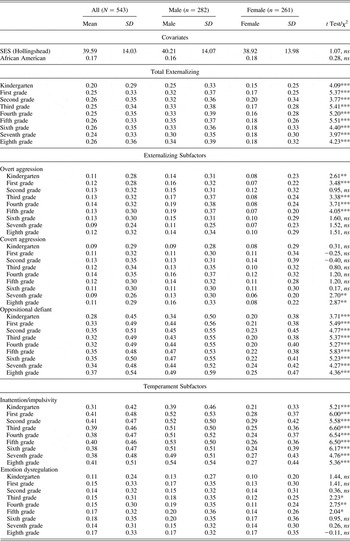
Observed means and standard deviations for covariates, total externalizing, and the five externalizing subfactors, estimated together and separately by gender

Note: SES, socioeconomic status.
*p < .05. **p < .01. ***p < .001.
Measures
For the purposes of this study, the measures of interest were those examining the socioemotional behaviors of the participants. Teachers completed the 112-item TRF (Achenbach, Reference Achenbach1991) at each of the nine waves (kindergarten through eighth grade). Items on the TRF are rated on a 3-point scale (0 = not true of the student, 1 = somewhat or sometimes true of the student, and 2 = often or very true of the student). Based on our research goals, we created five subscales: overt aggression, covert aggression, oppositional defiant, impulsivity/inattention, and emotion dysregulation. Items that corresponded to each problem behavior category were selected for inclusion if identical composites could be created within all nine waves. Thus, inclusion was based not only on rational considerations but also on whether there was sufficient variability in those items across each wave of data, permitting the creation of identical composites. Each subscale was created within a wave by averaging across relevant items. Overt aggression was defined by the relative frequency of cruelty/bullying, destruction of others' property, fighting, physically attacking, and threatening others (5 items); covert aggression was defined by the relative frequency of lying/cheating and stealing (2 items); oppositional defiant was defined by the relative frequency of arguing, disobedience, disturbing classmates, disrupting class, and behaving irresponsibly (5 items); inattention/impulsivity was defined by the relative frequency of inability to sustain attention, restlessness, impulsivity, clowning behavior, distractibility, excessive talkativeness, failing to complete tasks, and loudness (8 items); and emotion dysregulation was defined as the relative frequency of jealous behavior, screaming, irritability, sudden mood changes, and temper displays (5 items). Participants had to have all of the items that comprised a scale in order to have a value calculated. The internal reliability of each subscale was calculated within each of the nine waves. Alpha coefficients were acceptable, ranging from 0.47 (covert aggression) through 0.92 (both oppositional defiant and inattention/impulsivity). In addition, an overall externalizing spectrum score was created using the 25 items that comprised the subscales. The composite index was included to demonstrate the models and conclusions that would be drawn from contrasting the subscales to an omnibus externalizing problems construct.
Analysis plan
In order to evaluate the statistical coherence of the subscales, we initially performed a confirmatory factor analysis (CFA) specifying a single-factor solution using Mplus 5.2 with full-information maximum likelihood estimation to account for missing data (Muthén & Muthén, Reference Muthén and Muthén2008). Each subscale was examined separately within each wave in order to confirm that items loaded on discrete structural components. Initial CFAs were performed for the full sample and then separately by gender. Model fit for each CFA was assessed using χ2 and standard fit indices such as the comparative fit index (CFI), the root mean square error of approximation (RMSEA), and the standardized root mean square residual (SRMR; Hu & Bentler, Reference Hu and Bentler1999; McDonald & Ho, Reference McDonald and Ho2002).
According to traditional fit statistic interpretation, models with generally “good” fit have nonsignificant χ2s (CFI > 0.95, RMSEA < 0.05, SRMR < 0.05). Models with “moderate” fit typically have nonsignificant or significant χ2s (χ2/df < 3, CFI > 0.90, RMSEA < 0.08, and SRMR < 0.08). All models included robust maximum likelihood estimation (MLR) in order to account for potential nonnormativeness in the factor indicators.
Next, growth modeling was performed using Mplus 5.2 (Muthén & Muthén, Reference Muthén and Muthén2008); missing data were accounted for through full-information maximum likelihood estimation in Mplus (Schafer & Graham, Reference Schafer and Graham2002). In addition, in all models, MLR estimation was used to account for possible bias in estimates due to deviations in multivariate normality across the measured indicators or created subfactors. It is not possible to directly compare nested models using traditional χ2 difference tests with statistics resulting from models with MLR estimation; therefore, the Satorra–Bentler scaled χ2 difference test was used for model comparisons (Satorra, Reference Satorra, Heijmans, Pollock and Satorra2000) as described on the Mplus website (www.statmodel.com).
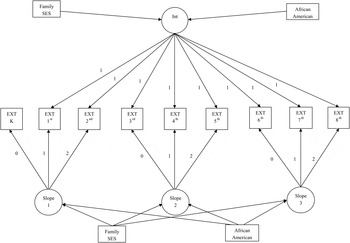
The first step in these analyses was to use latent growth curve models for each subscale across the nine time points in order to identify the functional form of growth for that particular construct. Because of the timing of data collection, the model estimated kindergarten as Time 0 (initial status) through eighth grade (as Time 8). In all models, SES and race were included as covariates, with the intercepts and slopes for each construct regressed onto the SES variable and a dummy variable identifying African American children (see Figure 1 for a depiction of the analytic model). Our a priori hypothesis regarding the functional form of growth was that there would be three developmentally appropriate growth periods: early school age (kindergarten to second grade), late school age (third to fifth grade), and early adolescence (sixth to eighth grade). Therefore, all scores were analyzed using piecewise regression with a single intercept (identifying initial status at kindergarten) and three slopes, one for each developmental period.Footnote 1 In order to determine whether the piecewise model was justified, the slopes for the three pieces were constrained to be equal and the model fit for this nested model was compared to one in which the slope parameters were free to vary across the three pieces.
The conceptual figure of the piecewise growth model, conditioned on socioeconomic status and race.

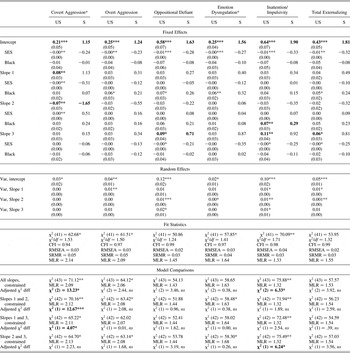
Initially we examined an unconditional model with only the fixed and random effects and no demographic covariates. Based on the significant random effects estimates, which justified adding covariates, we then added SES (as measured with the Hollingshead) and ethnicity (a dummy variable scored 1 for African Americans and 0 for European Americans) and regressed each of the four growth parameters (the intercept and three slopes) on these two demographic covariates (see Table 2).
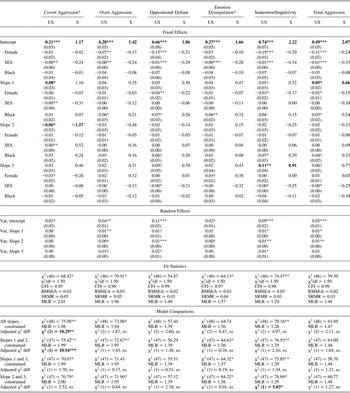
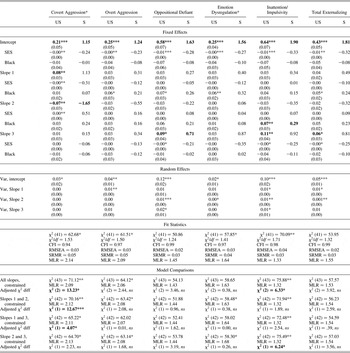
Fit statistics, unstandardized, and standardized growth curve parameters for subconstructs for the full model (males and females estimated together), controlling for SES and ethnicity
Note: All model comparisons are relative to the fit statistics for the unconstrained conditional model with males and females estimated together and used the Satorra–Bentler adjusted chi − square comparison test. Standard errors are in parentheses. SES, socioeconomic status; US, unstandardized estimates; S, standardized estimates; CFI, comparative fit index, RMSEA, root mean square error of approximation, SRMR, standardized root mean square residual; MLR, maximum likelihood robust.
*p <. 05. **p < .01. ***p < .001.
Finally, in order to examine moderation by gender, each model was tested on the sample together and split by gender. In the models split by gender, further multiple group analyses were performed through the use of constraining the parameters (intercepts and then slopes), to be equal across the gender groups in order to identify gender differences in initial status and growth for each of the five subdimensions of behavior.
Results
Descriptive analyses
Preliminary analyses were performed to examine potential differences between those with complete and incomplete data across the nine waves of data. We examined potential bias in missingness by gender (male vs. female), ethnicity (European vs. African American) and SES (as measured by the Hollingshead) using χ2 and t tests for the missing versus nonmissing samples. The nonmissing sample was defined as those individuals who had three or more valid waves of data for each of the five subscales. Missing data analyses of SES, race, and gender characteristics between the included and excluded sample were not significant. In addition, for the problem behavior items that had sufficient data for the excluded sample, independent samples t tests were performed for the included versus excluded sample. None of these comparisons were significant, suggesting that patterns of missing data were not systemically related to study variables.
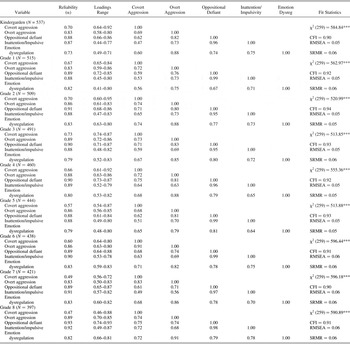
Mean differences across gender were assessed using t tests of each subscale within each time point (see Table 1). In the majority of problem behavior subscale comparisons, boys had significantly higher scores than girls. Given these mean-level differences, the next question concerned whether the pattern of interrelationships among the subscales also would differ by gender, providing justification for examining the moderation of growth by gender in the analyses. Confirmatory factor analyses of the subscales also were performed in order to confirm the reliability of the measures. The CFA models revealed that the subscales had moderate to good fit indices and thus were adequately measuring these latent constructs. (See Appendix A, Table A.1, for the reliabilities, range of subscale loadings, subscale intercorrelations, and fit indices for the CFA models.) Intercorrelations between subscales suggested that the majority were related yet distinct constructs. However, this was not true for inattention/impulsivity and oppositional defiant behavior, which had extremely high levels of co-occurrence across all waves.
Growth models
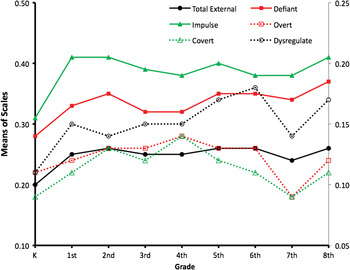
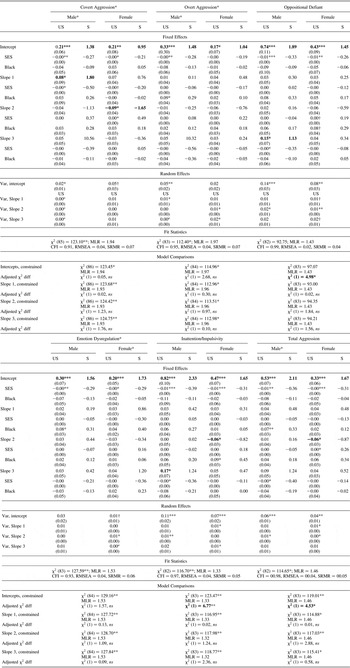
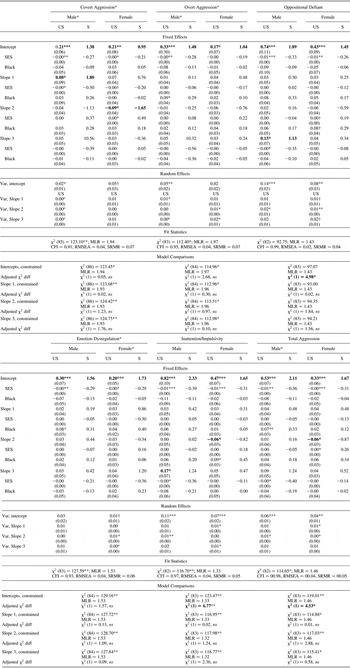
A major goal was to determine whether growth in the externalizing subscales differed from growth in the externalizing total score. Figure 2 provides a graphic illustration of these patterns, using mean scores. Table 2 and Table 3 present the unstandardized, standardized, and standard error estimates for both the fixed effects (the means/intercepts for the four growth parameters) and the random effects (the variance for each of the four growth terms). Table 2 presents the results from the model with SES and ethnicity, and Table 3 reports the same model, analyzed separately by gender. The fit statistics for each model are included below the variance estimates. The bottom halves of Tables 2 and 3 also present the results from comparison models in which the estimates for the three slope growth parameters were held equal in order to evaluate whether the slopes for the three developmental periods were the same or suggested significantly different growth patterns. The fit statistics for these nested models are presented with the results from the χ2 difference test (with the Satorra–Bentler adjustment) appearing directly below the fit statistics. Each of these constrained nested models was compared to the original model in which the three slope terms were unconstrained.
Externalizing aggression and subscales from kindergarten to eighth grade (overall). Solid lines use the scale on the left y axis, and dotted lines use the scale on the right y axis. [A color version of this figure can be viewed online at http://journals.cambridge.org/dpp]

Fit statistics and standardized for growth curve parameters for subconstructs for males and females estimated separately, controlling for SES and ethnicity
Note: All model comparisons are relative to the fit statistics for the unconstrained conditional model with gender estimated separately and used the Satorra–Bentler adjusted chi-square comparison test. For the constrained models, the estimate for males was constrained to be the same as for females. Standard errors are in parentheses. SES, socioeconomic status; US, unstandardized estimates; S, standardized estimates; CFI, comparative fit index, RMSEA, root mean square error of approximation, SRMR, standardized root mean square residual; MLR, maximum likelihood robust.
†p < .01. *p < .05. **p < .01. ***p < .001.
Unconditional models
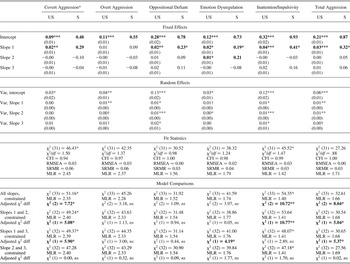
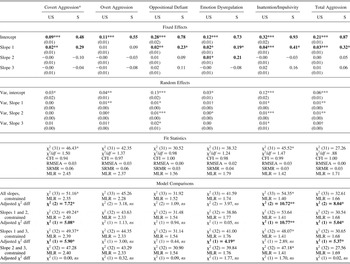
The fit statistics suggested that the unconditional models fit the data relatively well (all CFIs > 0.94, all RMSEAs < 0.06; see Appendix A, Table A.2). The total problem score and all of the subscales had significant intercept estimates, interpreted as the initial status of each construct at kindergarten being significantly greater than zero. In addition, all of the subscales had significant and positive growth terms for the first early school-age slope (kindergarten to second grade), with the exception of overt aggression. All of the subscales, except for overt aggression, significantly increased from kindergarten to second grade. In the second school-age slope (third to fifth grade), only emotion dysregulation had a significant slope estimate, increasing from third to fifth grade. None of the subscales demonstrated significant growth (positive or negative) in the third developmental period (sixth to eighth grade). Follow-up model comparisons that constrained the first slope piece to be equal to the other growth periods resulted in significantly worse fitting models for all constructs except oppositional defiant behavior. These comparisons suggested that most constructs of externalizing behavior increased significantly across the early childhood period relative to middle childhood and early adolescence. Almost all of the parameter estimates for the random effects (the variances of the growth parameters) were significantly different from zero, suggesting that there was unexplained variability in the growth terms.
Conditional models
Given this unexplained variability in the growth parameters, in subsequent models we added SES and ethnicity as predictors of each of the fixed effects growth terms. As seen in Table 2, for all of the models SES was significantly associated with the initial behavior status at kindergarten; individuals from higher SES backgrounds had significantly lower levels of all scores. The effect of SES was similar in magnitude across the measures (standardized βs = –0.23 to –0.35). When we examined the slopes, there was only one significant relation between SES and growth during both early school age and late school age, an increase in covert aggression. However, during early adolescence, there was a significant negative relation (standardized βs = –0.21 to –0.25, all ps < .05), such that students from higher SES households manifested a decreased rate of growth (less problem behavior) in total score, oppositional defiant, and impulsivity/inattention behaviors relative to students from lower SES households. This was not evident in the covert and overt aggression or emotional dysregulation scores during this period.
Ethnicity was not significantly related to the initial behavior status. However, being African American was significantly associated with higher slopes across early school age in four of the six models. African American students experienced a significantly steeper, positive slope for total problem score, overt aggression, oppositional defiant behavior, and emotional dysregulation but not covert aggression or impulsivity/inattention. The magnitude of the significant relations was similar across the constructs (standardized βs = 0.21 to 0.32, all ps < .05). After early school age only oppositional defiant continued to show positive growth into late school age (β = 0.21, p = .05) but now joined by positive growth in impulsivity/inattention (β = 0.29, p < .01). By early adolescence (sixth to eighth grade), there were no significant relations between growth and ethnicity on any scale.
With respect to the growth patterns for the constructs, once controls for SES and ethnicity were included, some of the significant growth terms seen in the unconditional models were not present. However, there were a few parameters that were not present in the unconditional model that emerged in the controlled models. Covert aggression had a significant positive slope estimate for early school age. Conversely, during late school age there was a significant negative slope for covert aggression. Finally, the slopes for impulsivity/inattention remained fairly stable until early adolescence, when a significant, positive slope emerged. Oppositional defiant behaviors also followed a similar form with nonsignificant slope terms until early adolescence, during which defiant behaviors significantly increased. Our follow-up model comparisons, which evaluated changes in slope across the three periods versus constraining this growth to be the same, resulted in significantly worse fitting models for covert aggression and impulsivity/inattention. These results show that assuming a similar growth pattern across the entire developmental period between kindergarten and eighth grade did not accurately capture the functional changes in development occurring during this time. In addition, it is useful to note that if we were simply examining the functional form of the total externalizing problem scale, we would not have detected these developmental variations; none of the growth terms in this model were significant. Disaggregating externalizing behaviors into these more specified components allowed the unique patterns to emerge. The fit statistics for these models also suggested moderate to good fit (all CFIs > 0.94, all RMSEAs < 0.036).
Moderation by gender
Given the gender differences that emerged in our initial t tests of each of the measures (boys > girls), our next step was to examine the models controlling for SES/ethnicity with males and females estimated separately.Footnote 2Table 3 provides the estimates for both the fixed and the random effects. There were some gender differences in initial status; specifically, oppositional defiant behavior, impulsivity/inattention, and the total externalizing problem constructs had significantly worse fitting models when the intercepts were constrained to be equal across gender. With respect to growth, however, we did not see strong gender differences in our slope terms (the adjusted χ2 difference tests for the models with the slopes constrained versus unconstrained were nonsignificant, suggesting models with equally good fit). Thus, no further analyses were conducted.
Discussion
Our primary goal was to determine how the developmental course of salient subcomponents of the broad externalizing problems spectrum differed across the school years spanning kindergarten through eighth grade. In preliminary analyses, we established the internal reliability of five subdimensions of problem behavior that had identical item content across the developmental period spanning school entry through early adolescence. Items corresponding to overt aggression, covert aggression, oppositional defiant behavior, impulsivity/inattention, and emotion dysregulation were composited into identical subscales within each successive year of development. CFA performed within each wave indicated that all five subdimensions of child problem behavior showed acceptable levels of internal reliability across the nine successive years of teacher ratings. Moreover, intercorrelations between different subscales across the nine waves of teacher ratings indicated that the majority of measures were related but distinct constructs. A notable exception was found for intercorrelations between symptoms of oppositional defiant and inattentive/impulsive behavior, which were extremely high. These findings converged with those of prior studies showing extremely high levels of co-occurrence between symptoms of oppositional and inattentive/impulsive behaviors (e.g., Lubke et al., Reference Lubke, Muthen, Moilerin, McGough and Loo2007; Rommelse et al., Reference Rommelse, Altink, Fliers, Martin, Buschgens and Hartman2009). In the current study, that intercorrelations above .90 were found across all waves, beginning in kindergarten, suggested that individual differences in these two types of problem behaviors become intertwined at an early age and remain so across significant expanses of development. It would be fascinating to study the developmental sequencing and etiology of these co-occurrences. One genetically informed study indicated that symptoms of oppositional defiant disorder and attention-deficit/hyperactivity disorder were strongly intercorrelated at the level of behavioral phenotypes, but they did not map onto a shared endophenotype (Rommelse et al., Reference Rommelse, Altink, Fliers, Martin, Buschgens and Hartman2009). Further research is needed.
We hypothesized that individual differences in the growth of each problem behavior subdimension would map onto three distinct growth periods reflecting key developmental transitions: early school age (kindergarten–second grade), late school age (third through fifth grades), and early adolescence (sixth through eighth grades). Therefore, growth was analyzed using piecewise regression with a single intercept (initial status at kindergarten) and three slopes that corresponded to each different period. In addition to reflecting a priori hypotheses about significant transition periods in development, this practice also was consistent with recent approaches to growth modeling across a large number of time points (Curran et al., Reference Curran, Hussong, Cai, Huang, Chassin and Sher2008). Subsequent analyses confirmed that alternative models (e.g., linear and quadratic functions) did not adequately fit growth patterns in these data and that retaining three separate slopes provided a better estimate of individual growth than retaining fewer slope functions. However, patterns of growth between the subconstructs were more similar than different, with notable exceptions. All of the scales (including the total score) had significant and positive growth across the first slope (kindergarten through second grade) except for overt aggression. Within the second slope piece, Grades 3 through 5, only emotion dysregulation continued to have a significantly positive slope. Finally, no subconstructs of problem behavior had significant slopes between sixth and eighth grades. In further analyses, we examined change in slopes across all three periods by constraining the slopes of the first piece to be equal to the others. This resulted in significantly worse fitting models for covert aggression and impulsivity/inattention.
Thus, taking a developmental approach to the description of growth trends in children's externalizing problem behaviors was strongly supported. Assuming similar patterns across the entire developmental period did not capture changes in the growth of symptoms that occurred between these three different developmental periods. Moreover, had we used a total score index, these differential growth trends between different time periods would not have emerged.
Our findings have implications for preventive efforts with at-risk children. For example, knowing that growth in most aspects of externalizing behavior occurred between kindergarten and second grade supports arguments for intervening during or prior to school entry. It also was fascinating that individual differences in overt aggression did not follow the early growth trend that other components showed, suggesting the importance of addressing high levels of overt aggression well before school entry.
Another research goal was to provide a basis for examining whether growth in subcomponents of externalizing behavior had different predictors. As an example, we tested whether two important family background measures, SES and ethnicity, differentially impacted individual differences in the growth of subdimensions of child and adolescent externalizing problems. Preliminary analyses suggested the desirability of adding major demographic covariates to each model. For example, examination of the variances of the growth parameters revealed significant levels of unexplained variability across development. Thus, family SES and ethnicity were added as predictors of fixed growth effects. For all constructs, family SES was associated with initial behavior status (i.e., kindergarten level ratings of maladjustment), but only one subscale (covert aggression) had initial growth that was predicted by family SES, in a positive direction. However, by early adolescence, family SES was associated with negative growth in oppositional defiant behaviors and impulsivity/inattention: students in higher SES households manifested declining levels of oppositional defiant behaviors and impulsivity/inattention relative to those in lower SES families. It is noteworthy that youths from higher SES families did not show declining levels of growth in covert aggression, overt aggression, or emotion dysregulation.
In prior analyses of the CDP, low family SES has been linked with teachers' ratings of child externalizing behavior in kindergarten though second grade (e.g., Dodge, Pettit, & Bates, Reference Dodge, Pettit and Batesl994). The current analyses affirmed that children from low-SES households began kindergarten with heightened risk for all varieties of externalizing problem behavior; in other words, the adverse influence of socioeconomic disadvantage extended to the full spectrum of externalizing problem behaviors. However, our findings also showed that variations in family SES were most strongly linked with growth in some subdimensions of externalizing problems but not others. A surprising finding was that children from higher SES households showed more positive growth in covert aggression (lying and stealing) than those from lower SES households. This interesting and unexpected finding suggested that norms for covert aggressive behavior may differ from those for more overt forms, recalling the burgeoning literature on relational aggression (e.g., Murray-Close, Ostrov, & Crick, Reference Murray-Close, Ostrov and Crick2007) and research by Luthar and Goldstein (Reference Luthar and Goldstein2008) showing that adolescents from high-SES families are at heightened risk for certain forms of covert antisocial behavior, especially abuse of illicit substances. A more predictable finding was that children from low-SES families were at elevated risk for growth in oppositional defiant behaviors and inattention/impulsivity during the tumultuous period between Grades 6 and 8. As a whole, these data were unique in showing that a major demographic risk factor was differentially related to growth in some subcomponents of the externalizing spectrum but not others; in the case of covert aggression, the direction of association differed from expectations based on global constructs of externalizing behavior.
Our findings regarding effects of family ethnicity on the growth of children's externalizing problems were fascinating and cautionary. In contrast with family SES, which was associated with a broad range of externalizing problems in kindergarten, African American and European American kindergartners did not differ significantly from one another on any externalizing problem index. However, according to their teachers, African American children manifested steeper positive slopes in behavior problems than children from European American backgrounds during the period spanning kindergarten through second grade. For oppositional defiance, this trend continued into middle childhood. By early adolescence, however, there were no significant associations between growth in problem behavior and the child's ethnicity. Because these risks were not evident in kindergarten, we must question what factors in the elementary school promoted relatively high levels of growth in externalizing problems among African American children (e.g., Spencer, Reference Spencer2006). Key risk factors may include racial discrimination (Brody et al., Reference Brody, Chen, Murry, Ge, Simons and Gibbon2006); contextual features of children's classrooms, such as racial density and race of teacher (Jackson, Barth, Powell, & Lochmamm, Reference Jackson, Barth, Powell and Lochman2006); differences in educational opportunity structures for children from racial minority backgrounds; and/or differences in patterns of family support of educational involvement (e.g., McLoyd, Reference McLoyd2004). Early externalizing problems may set some children on a pathway to “cascading” patterns of adjustment problems in later childhood and adolescence (e.g., Dodge, Greenberg, Malone, & the Conduct Problems Prevention Research Group, Reference Dodge, Greenberg and Malone2008). This sobering finding indicates the need for further research into risk and protective factors associated with declining levels of early school adjustment among young African American children.
Finally, given the high importance of child gender as a moderator of the development of externalizing symptoms (e.g., Crick & Zahn-Waxler, Reference Crick and Zahn-Waxler2003; Keenan & Shaw, Reference Keenan, Shaw, Lahey, Moffitt and Caspi2003), gender was examined as a potential moderator of initial levels and growth in each problem behavior subscale. Controlling for family SES and ethnicity, we examined growth in the five subdimensions of problem behavior, with boys and girls estimated separately. There were predictable differences between boys and girls in initial behavior problem status: boys exceeded girls in kindergarten levels of oppositional defiance, impulsivity/inattention, and overall externalizing problems. However, examination of individual growth in overall levels and subdimensions of externalizing problem behavior did not reveal strong evidence for sex-differentiated patterns of change.
Strengths and limitations
This exploratory study had several noteworthy strengths and limitations. A major strength was the availability of a large sample of children who were tracked across the entire school-age period and assessed at yearly intervals by different raters. Moreover, the sample contained significant levels of diversity in child gender, family ethnicity, and SES. These features provided an ideal basis for examining growth in children's problem behavior across three significant transition points in development and for relating growth patterns of specific problem behavior subcomponents to key distal risk factors.
As noted earlier, our omnibus index of externalizing problem behavior was idiosyncratic to this study, used as a heuristic for examining the relative advantages of broad versus narrow measures of child externalizing spectrum behavior. We caution that our summary measure should not be confused with the broadband Externalizing Problems Scale of the TRF. Similarly, the five subcomponents of problem behavior highlighted in our study were based on theoretical issues and differed from narrowband scales derived in the development of the TRF.
Another limitation of the study was our exclusive reliance on teacher ratings of child externalizing behavior. Without further study, we do not know whether our findings would generalize to parent ratings of similar problem behavior constructs. Moreover, some scholars have argued that when different teachers rate the same child at different ages, this may introduce “noise” in the form of unmeasured variability in teacher characteristics (Greven, Asherson, Rijsdijk, & Plomin, Reference Greven, Asherson, Rijsdijk and Plomin2011). It would be fascinating to conduct the same analyses with parent ratings of child externalizing behavior, and we plan to take this step with the current database.
Our assessment of covert aggression was limited. By definition, covert aggression is difficult to assess. Because we constructed item composites that were identical across all nine waves of data, our index contained only two items. That is, we had to use items that were as meaningful for kindergarteners as they were for eighth graders, excluding many of the usual adolescent-relevant forms of covert rule breaking. Given the paucity of research on the long-term growth of covert aggression, this effort provides a promising beginning, albeit one that should be followed with research using other samples and measures.
Similarly, although the emotion dysregulation subscale had sufficient items, the scale content bears further scrutiny in light of advances in knowledge of this important construct. For example, some may question the inclusion of an item such as “jealous behavior” as a valid index of dysregulated affect.
Finally, we combined inattentive and impulsive symptoms as a means of examining self-regulation problems that co-occurred with growth in different forms of aggressive and oppositional behavior. However, given that inattention and impulsivity have been treated as independent symptoms clusters in the DSM and have shown somewhat different growth patterns (e.g., Greven et al., Reference Greven, Asherson, Rijsdijk and Plomin2011), a cogent argument could be made for breaking this subscale into two parts.Footnote 3 Likewise, our decision to segment children's development into three periods that corresponded to salient developmental transitions was fruitful. However, other ways of segmenting the developmental spectrum may be plausible as well.
Conclusions and Implications
Large summary variables such as externalizing behavior are useful for aggregating a variety of related constructs that may be more predictive than the constructs considered separately. A potential drawback of this approach is that aggregation may mask a variety of separate time courses related to the biological and social development of the child. We found that whereas the overall externalizing problem score increased during the first few years of elementary school and remained flat after that, several subcomponents showed different patterns of increase and decrease across all three age periods, especially when SES and ethnicity were considered. There have been separate genetic polymorphisms, hormonal factors, and brain areas related to these subcomponents over time. In addition, the importance of social influences in the family, school, and peer group have been shown to wax and wane over time. An externalizing score may be a good summary of the child's behavior, but it may be far less useful for intervention and treatment where the causal chains become the targets.
Moreover, summary variables are subject to the endogeneity question in that there may be other factors that are producing the intercorrelations of items in the externalizing score. Sameroff (Reference Sameroff, Sameroff, Lewis and Miller2000) discussed the complex issue of the nonrandomness of co-occurrences among mental health disorders. The more severely children were affected in any domain of psychopathology, the more likely they were to be affected in a variety of others. Thus, the more serious the disturbance, the more likely is co-occurrence not only between disorders but also among multiple deviant pathways within a disorder (Loeber et al., Reference Loeber, Wung, Keenan, Giroux, Stouthamer-Loeber and VanKammen1993).
To be clear, we are not arguing that “splitting” heterogeneous constructs of child externalizing behavior is always better than “lumping” them into an omnibus measure. Rather, we look to longitudinal data to tell us under what conditions does focusing on subconstructs of psychopathology give us more useful information than focusing on broader constructs. This is an empirical question.
Finally, our findings clearly indicated the necessity of applying a developmental perspective to the examination of growth in children's externalizing problems. With the exception of overt aggression, all subcomponents of externalizing problems showed the highest levels of positive growth between kindergarten and second grade. These data provide guideposts for future analyses of growth in problem behavior across the developmental period and affirm the early school-age period as an opportune time for preventive intervention. In the case of overt aggression, however, intervening well before school entry is strongly indicated.
Appendix A
Reliabilities, fit statistics, and correlations among factors from confirmatory factor analyses by wave

Fit statistics and standardized growth curve estimates for subconstructs for the unconditional model for males and females estimated together
Fit statistics and standardized growth curve parameters for subconstructs for males and females estimated together, controlling for gender, SES, and ethnicity