Introduction
Diadegma semiclausum (Hellén) (Hymenoptera: Ichneumonidae) is arguably the most successful parasitoid of the diamondback moth, Plutella xylostella (Linnaeus) (Lepidoptera: Plutellidae). It has been widely and successfully used over large areas of southeast and south Asia when pesticide resistance of P. xylostella had lead to the failure of crop protection programmes in crucifer production (Lim et al., Reference Lim, Sivapragasam, Loke, Sivapragasam, Kole, Hassan and Lim1996; Shelton et al., Reference Shelton, Perez, Tang, Van den Berg, Sivapragasam, Kole, Hassan and Lim1996; Uk & Harris, Reference Uk, Harris, Sivapragasam, Kole, Hassan and Lim1996; Verkerk & Wright, Reference Verkerk and Wright1996). The first importation of the species was from England to New Zealand (Hardy, Reference Hardy1938) where it afforded partial control of the pest. From New Zealand, D. semiclausum was shipped to Sumatra in 1946 and released in the highland cabbage production areas. However, the releases did not result in noticeable improvement of the situation until broad-spectrum pesticides were replaced with Bt-based biopesticides that were harmless to the parasitoid (Sastrosiswojo & Sastrodiharjo, Reference Sastrosiswojo, Sastrodihardjo, Talekar and Griggs1986). In the late 1980s and early 1990s, the parasitoid found its way to other countries of Southeast Asia (Ooi, Reference Ooi and Talekar1992; Poelking, Reference Poelking and Talekar1992; Talekar et al., Reference Talekar, Yang, Lee and Talekar1992; Biever, Reference Biever, Sivapragasam, Kole, Hassan and Lim1996; Eusebio & Morallo-Rejesus, Reference Eusebio, Morallo-Rejesus, Sivapragasam, Kole, Hassan and Lim1996) and Japan (Iga, Reference Iga1997). In most situations, especially when the introductions were combined with a change to biocontrol-compatible pesticide use for the control of other cabbage pests, the parasitoid greatly contributed to reduced pesticide applications (Sastrosiswojo & Sastrodiharjo, Reference Sastrosiswojo, Sastrodihardjo, Talekar and Griggs1986; Talekar et al., Reference Talekar, Yang, Lee and Talekar1992; Biever, Reference Biever, Sivapragasam, Kole, Hassan and Lim1996).
In spite of this long-lasting effort to improve diamondback moth management through biological means, long-term studies of the impact of the parasitoid are scarce. In most biological control projects cited above, very little or no information was available about the existence and role of indigenous natural enemies or, more important in times of discussions about the importance of biodiversity, the fate of indigenous natural enemies after introduction and release of a supposedly superior competitor. Detailed studies on the parasitoids and diseases affecting P. xylostella were only conducted in countries where introduction biocontrol was never implemented, such as Canada (Harcourt et al., Reference Harcourt, Backs and Case1955); and the USA (Oatman & Platner, Reference Oatman and Platner1969; Hamilton, Reference Hamilton1979; Ru & Workman, Reference Ru and Workman1979). The only exception is South Africa, where Ullyett (Reference Ullyett1947) and Kfir (Reference Kfir, Endersby and Ridland2003) have provided detailed information about occurrence and role of indigenous natural enemies. It was also in South Africa where the first introduction and release of D. semiclausum (as Angitia cerophaga Gravenhorst) in Africa took place in 1936 (Evans, Reference Evans1939). The parasitoid was recovered in 1937 and assumed established by Greathead (Reference Greathead1971). However, it was never again recovered and it is doubtful whether the parasitoid is established.
Crucifers are not as important and diverse vegetable crops in East Africa as they are in Southeast Asia. This may have been the major reason why the experiences in Asia took so long to be applied in Africa. Nevertheless, crucifers do play a major role in East Africa, particularly in Ethiopia (Ayalew et al., Reference Ayalew, Löhr, Baumgärtner, Ogol, Kirk and Bordat2004) and Kenya (Macharia et al., Reference Macharia, Löhr and DeGroote2005). In Kenya, kale is considered a valuable relish in many homesteads, providing necessary dietary vitamins and minerals in a maize-based diet. The crop is a source of cash for farmers in the rural and peri-urban areas, thus alleviating poverty and creating employment. Favourable weather conditions or availability of irrigation water allow for year-round production and in the highlands, farmers can grow at least three crops in a year. However, continuous production under poor crop management practice creates an environment for pest build-up including P. xylostella, which is the most economically important pest of crucifers in Kenya (Kibata, Reference Kibata, Sivapragasam, Kole, Hassan and Lim1996; Oduor et al., Reference Oduor, Löhr, Seif, Sivapragasam, Kole, Hassan and Lim1996). Currently, synthetic pesticides are the predominant means of combating vegetable pests and diseases. Due to increasing pest pressure, farmers resorted to increased pesticide dosage and frequency of applications or application of cocktails, which has led to the development of widespread pesticide resistance (Kibata, Reference Kibata, Sivapragasam, Kole, Hassan and Lim1996). In order to overcome this situation, the International Centre of Insect Physiology and Ecology, in collaboration with the Kenya Agricultural Research Institute and the Asian Vegetable Research and Development Centre, initiated a biological control programme based on importation and release of exotic parasitoids. In this paper, data are presented on temporal dynamics of P. xylostella and parasitoids for 15 months before and three years after the release of D. semiclausum in two pilot release areas in Kenya.
Materials and methods
Site description
Two areas in the highland cabbage growing zone of Kenya were assigned by the Kenya Plant Health Inspectorate Service for pilot releases of D. semiclausum: Wundanyi Division in Coast Province and Limuru Division in Central Province. Data presented here were collected at the release sites in both areas, Werugha Location (03°26′16″S; 38°20′24″E) of Wundanyi Division in Taita Taveta District, Coast Province; and Tharuni Location (01°08′12″S; 36°37′51″E) of Limuru Division, Kiambu District, Central Province of Kenya. A detailed description of the pilot release areas is provided in Momanyi et al. (Reference Momanyi, Löhr and Gitonga2006). The studies were started from April and June 2001 (Werugha and Tharuni, respectively) and carried through for 15 months before and three years after release.
Data collection
Sampling started in April 2001 at Werugha and, until July 2003, fortnightly samplings were conducted, which were changed to once every four weeks from August 2003 until the end of observations in July 2005. At Tharuni, fortnightly sampling was conducted from July 2001 to September 2003 followed by once every four weeks until September 2005. On 26 July 2002, 25 pairs of D. semiclausum were released in each of five fields at Werugha and the same number was released on 20 September 2002 at Tharuni.
The aim was to evaluate 15 farmer-managed farms in both areas at each sampling date. This was possible without problems at Werugha, where farmers used bucket irrigation and moved production from the terraces into valley bottoms in the dry season. At Tharuni, a place without access to irrigation water, the number of cabbage fields declined so much during the height of the long dry season, that in some occasions only six fields could be sampled. Fields were selected at random with the help of the local extension officer in each area. A field was eligible for sampling from two weeks after transplanting onwards, and the same field was visited until it was harvested. When a field had been harvested, a recently transplanted field in the immediate vicinity was chosen as replacement. Crop type and age, field management, pesticide applications and general conditions of the field were recorded. Ten plants were selected at random in each field and thoroughly checked. The number of small larvae, large larvae, pupae and adults of P. xylostella was counted and recorded separately. Other pests found on individual plants were also recorded. The damage caused by diamondback moth was estimated using a damage score of 0–5 (see Momanyi et al., Reference Momanyi, Löhr and Gitonga2006). Up to a maximum of five P. xylostella larvae (third instar or older) or pupae were collected from each plant and put in individual vials for further investigations in the laboratory. The first five encountered in these two stages were collected, which largely excludes bias, as the plants were systematically searched from the outer to the inner leaves. Larvae were retained singly on a fresh cabbage leaf in labelled 30 ml plastic vials at ambient temperatures of 21±2°C and checked daily until emergence of adult moths or parasitoids. Emerged parasitoids were identified, sexed and counted. Parasitism was calculated as the number of parasitized larvae/pupae divided by the total number collected. A data logger (Hobo Pro Series, Onset Computer Corp. Pocasset, Massachusetts, USA) was used to record temperatures and relative humidity (hourly records), while rainfall records were obtained from the Kenya Meteorological Services.
Data analysis
The impact of the parasitoid on P. xylostella numbers was evaluated using three different methods: firstly, overall average P. xylostella population of the year before release was compared to each year after release; secondly, in recognition of the influence of rainfall on P. xylostella populations, the before and after release years were also compared using the five months of highest and lowest population density to determine effects on the P. xylostella peaks and on the base population during unfavourable conditions. For graphic presentation, the data of population dynamics and parasitism data collected within the same month during the first 27 months of observation were pooled.
The changes in P. xylostella damage were compared using several approaches: firstly, whole year average damage score data were compared. In addition, the proportion of attacked plants and, finally, the percentage plants with a damage score >2 (where the market value is reduced) was calculated and compared for the years before and after release. Changes in parasitism were analysed comparing the before release overall parasitism rate to each year after release. One-way analysis of variance (ANOVA) was used to compare all these parameters; individual sampling dates were treated as repeated measures. Before calculations, the datasets were checked for normal distribution, which was fulfilled for all count data, hence those were not transformed. Where proportional data were used, raw data were arcsine transformed. However, all data presented in the tables are nontransformed values. Whenever ANOVA resulted in a significant F-value, means were separated using Tukey's honest significant difference (HSD) test at 5% level of significance. Statistical software SAS version 9.1 (SAS Institute Inc., 2002) was used for all the analyses. For both release areas, linear regressions (PROC REG, SAS Institute, 2003) were calculated between P. xylostella population, parasitism by D. semiclausum and total parasitism and the progressing sampling dates starting from the date of release. A regression was also calculated between the total parasitism and parasitism by the introduced species. Original field data were used for all regression calculations, and the slopes of the regression lines were compared to determine differences (at P<0.05).
The parasitoid guild composition was compared before and after release using the Shannon diversity index (Mugurran, Reference Mugurran1988). The diversity index obtained was subjected to a t-test to compare differences before and after release following the procedure described by Batten (Reference Batten1976).
Results
Rainfall, temperature and relative humidity in the release areas
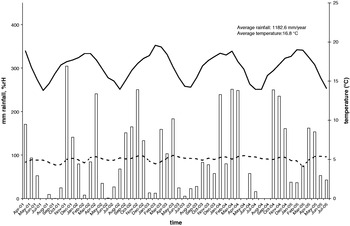
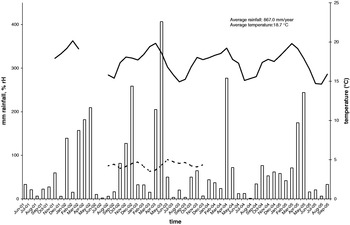
Werugha received relatively regular rainfall (1182 mm annually during the study period, fig. 1) and complementary irrigation is easily available; while at Tharuni, rainfall was more erratic (fig. 2), the total amount was considerably lower (867 mm) and complementary irrigation is not available. The average monthly temperature was 2°C higher at Tharuni while relative humidity seemed to be considerably lower. Unfortunately, the data logger was faulty and most of the data records for relative humidity were corrupted. With these conditions, the two areas represent two extremes for cabbage production in Kenya.
Average monthly rainfall, relative humidity and temperature at Werugha, Wundanyi Division, Coast Province of Kenya. Averages were calculated for the three full years (2002–2004) of operations. (□, rainfall (mm/month); - - -, % relative humidity; —, temperature (°C))

Average monthly rainfall, relative humidity and temperature at Tharuni, Limuru Division, Central Province of Kenya. Averages were calculated for the three full years (2002–2004) of operations. (□, rainfall (mm/month); - - -,% relative humidity; —, temperature (°C))

Diamondback moth population and damage before release
Werugha
Diamondback moth dynamics was bimodal with peaks during the dry seasons (fig. 3). Higher counts were recorded during the months of September to November and again January to March, reflecting the rainfall pattern (fig. 1). The highest mean number of P. xylostella per plant in any of the collections was reached during the pre-release year on 16 October 2001 (16.8 per plant, not shown because of pooling of data), in spite of bi-weekly insecticide applications by most farmers. The build-up of the second peak started in December 2001, but heavy rains in late December and early January disrupted the population build-up (fig. 3). From May 2002, the population rose again until the release was made in August. The after-release population curve indicates a considerable reduction in numbers of P. xylostella starting already from three months after release (fig. 3). The population curve showed a steadily declining trend for the three after-release years with the bimodal population dynamics still clearly visible but greatly decreased amplitude (fig. 3).
Dynamics and composition of diamondback moth population before and after release of an exotic parasitoid, Werugha, Wundanyi Division, Coast Province of Kenya. Data were collected from ten plants in each of 15 farmer-managed fields. Sampling dates within one month were pooled for ease of presentation. (- - -, small larvae; –·–, big larvae; , pupae;▬, total)

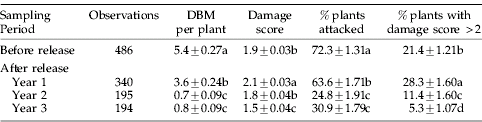
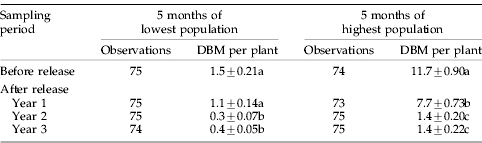
Average population density of P. xylostella during the pre-release period was 5.4 per plant (table 1). This value declined significantly in the first year after release and even more sharply in the second year to 0.7 per plant and then remained stable. Similarly, the percentage of attacked plants declined in the first and second year after release and then remained stable at around 30%. The damage score increased from the year before release (1.9) to the first year after but then declined and attained a significantly lower value (1.5) in the third year after release (table 1). The proportion of plants in damage score >2 also increased in the first year after release but declined by a factor of four to 5.3% at the end of the observations.
Diamondback moth (DBM) population and damage before and after introduction of the exotic parasitoid, Diadegma semiclausum, Werugha, Coast Province of Kenya.
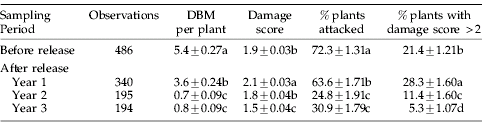
Means with different letters within a column are significantly different (P<0.05), Tukey's honest significant difference test.
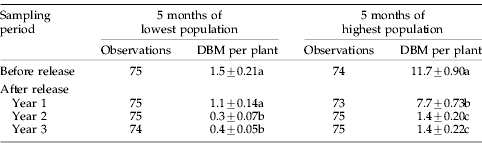
When the periods of highest population levels were compared over the four years, a factor eight reduction was recorded (table 2), while the reduction during the five months of low population levels was only by a factor of four. The age structure of the population did not change (data not shown); small larvae always constituted the largest part of the population.
Diamondback moth (DBM) population during the five months of lowest and highest infestation before and after introduction of the exotic parasitoid, Diadegma semiclausum, Werugha, Coast Province of Kenya.
Means with different letters within a column are significantly different (P<0.05), Tukey's honest significant difference test.
Tharuni
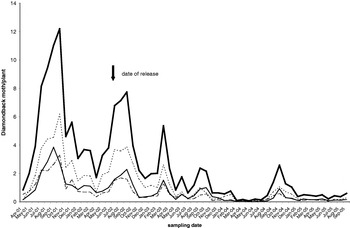
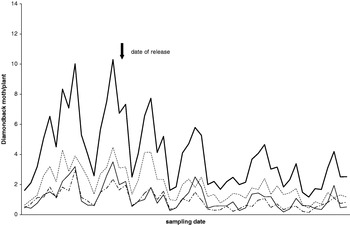
The highest population of P. xylostella was recorded on 8 February 2002 (12.8 per plant, not shown); and peak periods were also in the dry seasons from June to October and February to March. Peak rainfall (fig. 2) coincided very well with great reductions in the population (fig. 4). After release of the parasitoid, there was a declining trend of the population like at Werugha, but the final population remained higher (2.5 per plant).
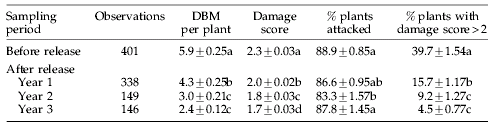
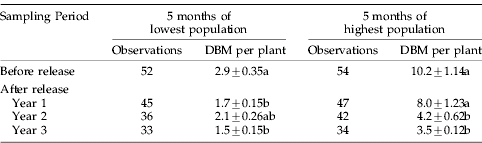
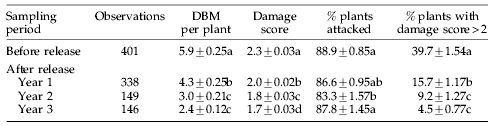
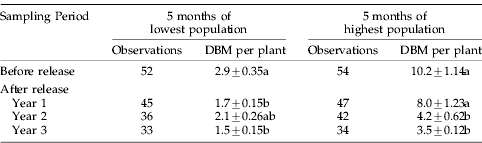
Overall, average P. xylostella population declined year after year and ended at 2.4 per plant in the third year after release. A similar development was recorded for the damage (table 3). There was no clear change in the proportion of plants attacked; however, the plants in the damage score group >2 declined significantly in the first two years to stabilize between 9.2 and 4.5% (table 3). As at Werugha, the highest reduction (by a factor of three) of the population was registered during the period of population peaks while the reduction during the low population period was only by 50% (table 4). The age distribution of the population did not alter much and small larvae were always the most frequent.
Dynamics and composition of diamondback moth population before and after release of an exotic parasitoid, Tharuni, Limuru Division, Central Province of Kenya. Data were collected from ten plants in each of up to 15 farmer-managed fields. Sampling dates within one month were pooled for ease of presentation. (- - -, small larvae; –·–, big larvae; —, pupae; , total)

Diamondback moth (DBM) population and damage before and after introduction of the exotic parasitoid, Diadegma semiclausum, Tharuni, Central Province of Kenya.
Means with different letters within a column are significantly different (P<0.05), Tukey's honest significant difference test.
Diamondback moth (DBM) population during the five months of lowest and highest infestation before and after introduction of the exotic parasitoid, Diadegma semiclausum. Tharuni, Central Province of Kenya.
Means with different letters within a column are significantly different (P<0.05), Tukey's honest significant difference test.
Development of parasitism
Four species of indigenous parasitoids were collected at both sites: Diadegma mollipla (Holmgren) (Hymenoptera: Ichneumonidae), Oomyzus sokolowskii (Kurdjumov) (Hymenoptera: Eulophidae), Apanteles sp. (Hymenoptera: Braconidae, undescribed species) and Itoplectis sp. (Hymenoptera Ichneumonidae), all primary parasitoids. A single specimen of a suspected hyperparasitoid (Hymenoptera: Ichneumonidae) was collected at Werugha, but the cocoon was discarded before a dissection had been conducted to confirm the status of the parasitoid.
Werugha
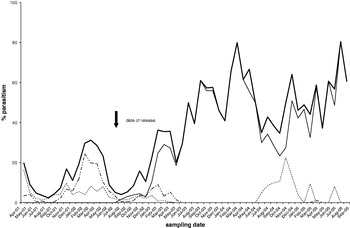
Pre-release parasitism was low from April 2001 until February 2002 when the total parasitism surpassed 20% for the first time (fig. 5). The highest level reached was 38.3% at the beginning of April (not shown) and from the end of May the rate dropped sharply again. Oomyzus sokolowskii was the parasitoid responsible for this rise and was the only parasitoid with strongly expressed seasonality (fig. 5). Diadegma mollipla was present in most collections, even though at a very low level. The first collection after release (August 2002) yielded D. semiclausum and even though numbers remained low until mid February 2003, the species was present in all collections. From the end of February, D. semiclausum parasitism surged and peaks of 80% parasitism were reached in March 2004 and again in June 2005. From June 2003, the indigenous parasitoids disappeared almost completely, and only D. mollipla parasitism recovered slightly starting from June 2004 (fig. 5).
Variation in field parasitism and parasitoid guild composition of diamondback moth before and after release of an exotic parasitoid, Werugha, Taita Hills, Coast Province of Kenya. Data were collected from ten plants in each of 15 farmer-managed fields. Sampling dates within one month were pooled for ease of presentation. (- - -, Diadegma mollipla; –·–, Oomyzus sokolowskii; —, Diadegma semiclausum; , Total parasitism)

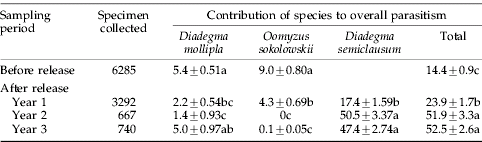
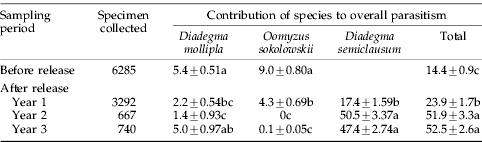
Even though the number of specimens collected for laboratory rearing to establish levels of parasitism cannot be considered strictly as a parameter (and was thus not subjected to statistical analysis), the decline of almost 50% in the first year and of 89.8 and 88.6% (year 2 and 3, respectively) indicates the huge reduction in the field population of the pest (table 5). The major parasitoid species recorded before release of the exotic species were O. sokolowskii and D. mollipla. The introduced parasitoid surpassed the overall parasitism rate of all indigenous species combined even in the first year after its release, and the final rate of parasitism was around 50% (table 5).
Field parasitism of diamondback moth before and after introduction of the exotic parasitoid, Diadegma semiclausum, Werugha, Coast Province of Kenya.
Means with different letters within a column are significantly different (P<0.05), Tukey's honest significant difference test.
Tharuni
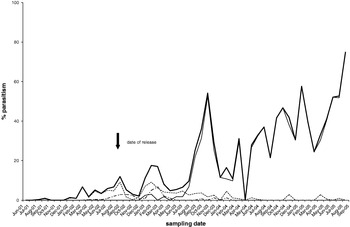
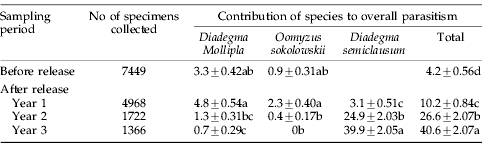
Parasitism was almost non-existent until March 2002 (fig. 6). From then, low rates of D. mollipla were recorded. After release, there was a slight surge in parasitism by the former and O. sokolowskii in January 2003, which faded again in April. The first recovery of D. semiclausum was in January 2003, when eight specimen were recovered. Parasitism remained low until September 2003 but increased to 54% in November. After very erratic rises and declines, the introduced parasitoid finally became firmly established from September 2004 onwards and reached the highest rate of parasitism (75.0%) at the end of the observations in September 2005 (fig. 6). Diamondback moth larvae collected for laboratory observation of parasitism declined by 33% and 65% (first and second year after release, respectively) and only marginally thereafter (table 6). Parasitism by the indigenous parasitoids increased slightly in the first year after release, then these species almost vanished. Diadegma semiclausm parasitism increased very slowly in the first year and reached 39.9% in the third year after release, comprising almost 100% of overall parasitism (table 6).
Variation in field parasitism and parasitoid guild composition of diamondback moth before and after release of an exotic parasitoid, Tharuni, Limuru Division, Central Province of Kenya. Data were collected from ten plants in each of up to 15 farmer-managed fields. Sampling dates within one month were pooled for ease of presentation. (- - -, Diadegma mollipla; –·–, Oomyzus sokolowskii; —, Diadegma semiclausum; , Total parasitism)

Field parasitism of diamondback moth before and after introduction of the exotic parasitoid, Diadegma semiclausum, Tharuni, Central Province of Kenya.
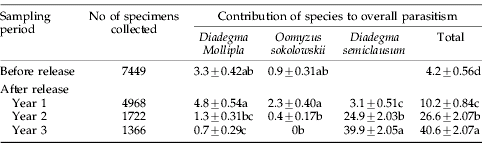
Means with different letters within a column are significantly different (P<0.05), Tukey's honest significant difference test.
Comparison of the two release areas
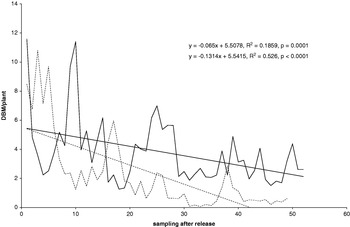
Development of P. xylostella populations and parasitism after release were compared between the two pilot areas using regression analysis. The population decline at Werugha was considerably, and significantly, faster than at Tharuni (F 1,98, 24.91, P<0.0001) (fig. 7). While the regression line for Werugha cuts the zero population mark at sampling 43, the position of the regression line for Tharuni indicates that the population decline may not have reached a final level yet.
Diamondback moth population development after release of an exotic parasitoid in two pilot release areas, Werugha, Wundanyi Division, Coast Province and Tharuni, Limuru Division, Central Province of Kenya. (—, Tharuni; - - -, Werugha; ——, linear regression Tharuni; - - -, linear regression Werugha)

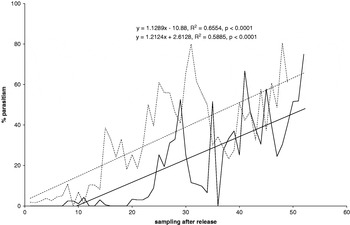
The increase in parasitism rates of D. semiclausum after the first field recovery was similar at both sites (F 1,97, 0.20, P=0.645) even though the first recovery at Tharuni was only three months after release (fig. 8). No differences were found between the release areas in total parasitism development after release and within release areas between total parasitism and the contribution of D. semiclausum (not shown).
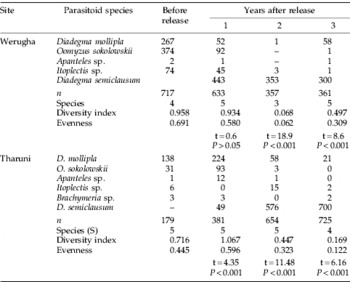
Parasitoid species diversity and evenness at Werugha were similar before and one year after release (table 7). In the second and third year after release, both indices declined sharply with the displacement of almost all indigenous parasitoid species. At Tharuni, diversity and evenness increased in the first after-release year and then declined to below before-release levels in years 2 and 3 (table 7). Indigenous parasitoids also disappeared almost completely.
Development of parasitism of diamondback moth after release of an exotic parasitoid in two pilot release areas (Werugha, Taita Hills, Coast Province and Tharuni, Limuru Division, Central Province of Kenya). (—, Tharuni; - - -, Werugha; ——, linear regression Tharuni; - - -, linear regression Werugha)

Shannon index for species diversity and evenness of the diamondback moth parasitoid guild before and after the introduction of an exotic parasitoid species, Werugha, Coast Province and Tharuni, Central Province of Kenya.

t-tests were conducted to compare differences with the previous year.
Discussion
In spite of the great number of introductions of D. semiclausum against P. xylostella in Southeast Asia, long-term studies of parasitoid impact on P. xyostella populations and indigenous parasitoids are not available. Poelking (Reference Poelking and Talekar1992) gave a detailed account of the early impact of D. semiclausum releases in the Philippines with >95% parasitism towards the end of the first after-release cabbage season. In Taiwan, Talekar et al. (Reference Talekar, Yang, Lee and Talekar1992) reported establishment after a single release in the highlands. Establishment at Werugha was similarly fast as reported in the Philippines and was documented by Momanyi et al. (Reference Momanyi, Löhr and Gitonga2006) in field mortality studies of larvae and pupae. However, establishment of the parasitoid at Tharuni was only noted three months after introduction and impact on the P. xylostella population took even longer to show. Momanyi et al. (Reference Momanyi, Löhr and Gitonga2006) adduce climatic differences, in particular considerably lower rainfall and resulting dusty conditions, to explain the delay in parasitoid establishment. We believe that the erratic rainfall with an evapotranspiration deficit of probably nine out of twelve months every year and the resulting discontinuity of cabbage production at Tharuni must also have contributed to the slow pace of D. semiclausum establishment. The difficulties of the exotic species are not surprising as marginal conditions for parasitoids at Tharuni were already indicated by the extremely low parasitism rate by indigenous species before introduction. Natural expansion of D. semiclausum from later releases in neighbouring areas (approximately 10 km distance) may have contributed to the fast increase in parasitism when expanding populations could provide much higher and permanent parasitoid numbers for invasion of the marginal areas than the initial release.
Studies of the competitive displacement of indigenous parasitoids of P. xylostella after the introduction of exotic species are not available in spite of the introductions made in many parts of the world. In our case, the displacement of the indigenous species by D. semiclausum may have been caused by the superior host searching capability and better association with cruciferous host plants, at least as far as its congeneric indigenous species is concerned (Rossbach et al., Reference Rossbach, Löhr and Vidal2005). The aforementioned authors actually consider D. mollipla a generalist parasitoid as it was originally described as Limneria mollipla (Holmgren) from potato tuber moth, Phthorimaea operculella (Zeller) (Lepidoptera: Gelechiidae). It is reported to be indigenous to southern and eastern Africa but the original host is unknown (Broodryk, Reference Broodryk1971; Gupta, Reference Gupta1974; Azidah et al., Reference Azidah, Fitton and Quicke2000). Unfortunately, similar information about the other indigenous parasitoids is not available. Nevertheless, we assume that all indigenous parasitoids must have alternative hosts in addition to P. xylostella and have just made use of a largely unexploited resource, P. xylostella larvae, in the absence of other more specialized parasitoids. After the introduction of D. semiclausum, they were displaced from the system. Similar cases have been reported from other host–parasitoid systems. Bennett (Reference Bennett1993) reported the displacement of Pseudhomalopoda prima Girault (Hymenoptera: Encyrtidae), a local opportunist parasitoid of the introduced scale Chrysomphalus anoidum (Linnaeus) (Homoptera: Diaspididae), after the introduction of Aphytis holoxanthus DeBach (Hymenoptera: Aphelinidae), an exotic specialist parasitoid, to California. In West Africa, Anagyrus niombae Boussienguet (Hymenoptera: Encyrtidae) (Boussienguet, Reference Boussienguet1988) and other species of Anagyrus adapted to the introduced cassava mealybug but were displaced after the introduction of Apoanagyrus lopezi (DeSantis) (Hymenoptera: Encyrtidae), a host-specific cassava mealybug parasitoid from South America (Bassiangama et al., Reference Bassiangama, le Rü, Iziquel, Kiyindou and Bimangou1989; Boussienguet et al., Reference Boussienguet, Neuenschwander and Herren1991). Nevertheless, the speed of the displacement in the present case was surprising; it was almost complete when parasitism by D. semiclausum was still moderate and many unparasitized diamondback moth larvae were available.
A close look at the dramatic increase in parasitoid guild diversity and evenness at Tharuni in the year immediately after introduction suggests that this was rather an effect of the much better rainfall (five months with around 100 mm or considerably more, fig. 2) allowing better crop growth and hence parasitoid activity than a direct effect of the introduced parasitoid. In comparison, in the period before release from June 2001 to February 2002, there were seven consecutive months with a rainfall deficit.
The almost complete absence of hyperparasitoids is surprising and must have contributed to the fast establishment and impact of D. semiclausum. During the course of the work presented here, 3943 parasitized P. xylostella larvae and pupae were collected and there was only one doubtful case of hyperparasitism at Werugha by an ichneumonid. This is in stark contrast to the situation in South Africa, where Kfir (Reference Kfir1997) and Ullyett (Reference Ullyett1947) identified a number of hyperparasitoids, some of which were shared between D. mollipla and Cotesia plutellae (Kurdjumov) (Hymenoptera: Braconidae). Poelking (Reference Poelking and Talekar1992) stated briefly that D. semiclausum is attacked by the same hyperparasitoids as C. plutellae. We have observed hyperparasitoids (yet unidentified Pteromalidae and Eulophidae) of Apanteles sp. attack cocoons of C. plutellae in the lowlands; however, so far none of these has attacked D. semiclausum in more than 12 months of observations (B. Löhr et al., unpublished data).
The present data indicate that the effect of the release of D. semiclausum on P. xylostella populations and damage, both under favourable (Werugha) and unfavourable (Tharuni) conditions, are substantially larger than in the assumptions made for the prediction of the economic impact of this biological control project for Kenya by Macharia et al. (Reference Macharia, Löhr and DeGroote2005). In that paper, a cost benefit ratio of 1:23.7 for cabbage production in Kenya was predicted with the assumptions of a 50% reduction in pesticide use and a reduction of the damage by 30%. For the damage we can now consider a 50% reduction from our data. When the corresponding loss abatement figure is inserted in the sensitivity analyses conducted by Macharia et al. (Reference Macharia, Löhr and DeGroote2005), the cost benefit value increases to 1:34.4 and the internal rate of return to 100.1%.
The reduction of pesticide overuse was one of the major aims of the Diamondback moth biocontrol project and activities to document this are still ongoing. However, at the pilot sites this was not the major thrust of the work. Assessing pesticide reduction is therefore difficult, but a rough estimate can be obtained using intervention thresholds for control operations for which between 0.3 and 1.0 larvae per plant have been suggested (Simonet & Morisak, Reference Simonet and Morisak1982; Cartwright et al., Reference Cartwright, Edelson and Chambers1987; Amend & Mangalli, Reference Amend and Mangalli1992). If an intervention threshold of one large P. xylostella larva per cabbage is assumed valid for Kenyan conditions, where quality requirements are lower than in developed countries, a pesticide application would have been required before parasitoid release after 76% of the sampling occasions at Tharuni and 57% at Werugha. Three years after release only 7.7% of the samplings at Tharuni and none at Werugha would have triggered pesticide application, a reduction of >90%. This figure is also realistic considering experience with farmers from various cabbagegrowing areas. When a conservative 70% reduction in pesticide use is added to 50% loss abatement for the economic impact analysis, the benefit increases to 1:38.1 and the internal rate of return to 104.5% (I. Macharia, personal communication). We therefore expect that this biological control project will rank as a very highly successful one when the final economic impact assessment is concluded.
Acknowledgements
Due to the long duration of the study and the spatial separation of the two pilot areas, a number of different persons and institutions were involved in this work: F. Nangˈayo and M. Kusewa of the Kenya Agricultural Research Institute were transferred and did not see this effort through until the end; N. Mwikya, F. Nyamu, R. Mukiti, G. Gachanja, C. Kanyi of the International Centre of Insect Physiology and Ecology and P. Onano and S. Juma of the District Agricultural Office, Taita Taveta District, are gratefully acknowledged for their huge input into these studies. Anthony Wanjoya and L. Nedorezov provided advice and guidance with statistical analysis. We thank all the farmers who allowed us to work in their fields, over 200 in total over the period of four years. Thanks are also extended to the German Federal Ministry of Economic Cooperation and Development (BMZ) who funded the Diamondback Moth Biocontrol Project through the German Agency of Technical Cooperation (GTZ).