INTRODUCTION
Brazilian mangroves are among the largest in the world (Lara, Reference Lara2003), extending from the States of Amapá to Santa Catarina (Schaeffer-Novelli et al., Reference Schaeffer-Novelli, Cintrón, Rothleder, Daime and Camargo1990). The Amazon macrotidal mangrove coast has an estimated area of 7591 km2, representing a little over half (56.6%) the total mangrove area in Brazil (Souza-Filho et al., Reference Souza-Filho, Lessa, Cohen, Costa, Lara, Dillenburg and Hesp2009). The mangrove is a coastal ecosystem representing the transition between terrestrial and marine environments, providing food, protection and nursery areas for many animal species (Schaeffer-Novelli, Reference Schaeffer-Novelli1995).
The benthic fauna is composed of animals that are associated with mangrove substrates, at least during part of their life cycle, where individuals usually either attach to, move about or burrow into the substrate (Levinton et al., Reference Levinton2001). The epifauna is found on the mangrove sediment surface and logs, as well as on roots, trunks and branches of mangrove trees (Alongi & Sasekumar, Reference Alongi, Sasekumar, Robertson and Alongi1992; Nagelkerken et al., Reference Nagelkerken, Blaber, Bouillon, Green, Haywood, Kirton, Meynecke, Pawlik, Penrose, Sasekumar and Somerfield2008). The mangrove infauna spends part or all of their life cycle within the substrate (Nagelkerken et al., Reference Nagelkerken, Blaber, Bouillon, Green, Haywood, Kirton, Meynecke, Pawlik, Penrose, Sasekumar and Somerfield2008), either boring or burrowing into hard or soft substrates, respectively (Oliveira & Mochel, Reference Oliveira and Mochel1999; Thurman & Trujillo, Reference Thurman and Trujillo2004).
The burrows created by shipworms inside logs and fallen trunks are ideal habitats for many animal groups, especially for small benthic invertebrates (Turner & Johnson, Reference Turner, Johnson, Jones and Eltringham1971). Aviz et al. (Reference Aviz, Mello and Silva2009) is the only study of the Amazon macrotidal mangrove coast log fauna, which is dominated by the phyla Annelida, Arthropoda and Mollusca, notably class Polychaeta, sub-phylum Crustacea (Decapoda and Isopoda) and class Bivalvia, respectively. This fauna is important for the decomposition of mangrove wood (Santos Filho et al., Reference Santos Filho, Tagliaro and Beasley2008), promoting mineralization, nutrient recycling and mangrove primary productivity (Koch & Wolff, Reference Koch and Wolff2002).
The richness, abundance and composition of estuarine benthic assemblages may vary on a spatial scale (Morrisey et al., Reference Morrisey, Howitt, Underwood and Stark1992a), for example, among different tidal levels in the mangrove forest (Frith et al., Reference Frith, Tantanasiriwong and Bathia1976). The level of flooding in mangroves may cause changes in salinity, nutrient availability and structure of mangrove forests (Lara et al., Reference Lara, Cohen, Szlafsztein, Saint-Paul and Schneider2010), and in the distribution of macrofaunal assemblages on different substrates (Cantera et al., Reference Cantera, Thomassin and Arnaud1999), which may be composed of members of both the terrestrial and estuarine faunas (Nagelkerken et al., Reference Nagelkerken, Blaber, Bouillon, Green, Haywood, Kirton, Meynecke, Pawlik, Penrose, Sasekumar and Somerfield2008). In order to survive and reproduce in the mangrove habitat, the fauna exhibits certain behaviours, for example, climbing up tree trunks at high tide (Nilsen, Reference Nilsen1997) and adaptations, such as physiological mechanisms that allow individuals to remain in the substrate during high tide (Nilsen, Reference Nilsen2006).
Seasonal variation in the abundance and composition of the macrofauna (Morrisey et al., Reference Morrisey, Underwood, Howitt and Stark1992b; Ysebaert & Herman, Reference Ysebaert and Herman2002) is influenced by factors such as precipitation (Dippner & Ikauniece, Reference Dippner and Ikauniece2001), salinity (da Silva et al., Reference Silva, de Souza, Souza-Filho and Rosa-Filho2011), temperature (Nagelkerken et al., Reference Nagelkerken, Blaber, Bouillon, Green, Haywood, Kirton, Meynecke, Pawlik, Penrose, Sasekumar and Somerfield2008) and relative humidity (Omena et al., Reference Omena, Junqueira and Silva1990). Variation in these factors may cause a temporal shift in species composition (Kathiresan & Bingham, Reference Kathiresan and Bingham2001). This paper investigates the effects of distance from tidal channel and sampling date on the abundance and taxonomic composition of the macrofauna associated with logs in two mangrove forests from northern Brazil.
MATERIALS AND METHODS
Study area
Sampling was carried out in two mangrove forests: Ilha da Fortaleza (00°46′47.27″S47°10′51.88″W) near São João de Pirabas in September 2008, January 2009 and April 2009, and Furo do Meio (00°52′26.00″S46°38′59.00″W) near Bragança in September 2009, January 2010 and April 2010. Rhizophora mangle L. is the predominant mangrove species in both study areas (Menezes et al., Reference Menezes, Berger and Mehlig2008).
Both mangrove forests are located on the macrotidal mangrove coast of Pará State, northern Brazil (Saint-Paul & Schneider, Reference Saint-Paul and Schneider2010; see map in Supplementary Materials). The tidal regime is semi-diurnal, varying from 4 to 6 m (Moraes & Lopes, Reference Moraes and Lopes2003). The climate is hot and humid, with well-defined seasonality (Martorano et al., Reference Martorano, Pereira, César and Pereira1993) with over 75% of the annual precipitation falling between January and June. From September to November, rainfall is usually less than 30 mm (INMET, 2013). Annual rainfall in the region (Tracuateua weather station) was 2897 mm in 2008, 3284 mm in 2009 and 1987 mm in 2010 with 16.6 and 1 mm in September 2008 and 2009, 173 and 118.2 mm in January 2009 and 2010, and 507.8 and 379.5 mm in April 2009 and 2010, respectively (INMET, 2013).
Sampling
A 20 × 250 m area was delimited parallel to the main tidal channel in each mangrove forest. Within each area, a search was carried out for Rhizophora mangle logs with a diameter of approximately 10 cm every 10 m to ensure independence of observations. Searching took place at each of the distances 2, 10 and 20 m from the tidal channel. When logs were abundant, these were labelled and a random sample of five logs was selected at each distance. When logs were scarce searching continued until at least five logs were found at each distance. On each sampling date, a total of 15 logs were obtained at each forest, giving a grand total of 90 logs.
The selected logs were cut to a standard length of 40 cm from either one of the free ends, or from the free end if attached to a larger trunk (Santos Filho et al., Reference Santos Filho, Tagliaro and Beasley2008). Logs were cut and excavated over a plastic sheet to prevent loss of animals. Logs were opened initially using a small hatchet and afterwards excavated using forceps to carefully remove macrofauna and wood fragments. The logs were occasionally washed with water during excavation in order to remove animals and fine detritus. All washes took place over a 0.3 mm sieve, which was also used to rinse away mud and fine detritus from the animals and debris removed from the log. Animals were anaesthetized in magnesium chloride (10%) and kept in labelled plastic bags in the field until arrival in the laboratory. Individuals were then fixed in neutral formalin (5%) for approximately 24 h and then stored in ethyl alcohol (70%) for subsequent counting and identification. Individuals that could not be identified but were morphologically distinct were numbered to distinguish them from others of the same taxon.
Statistical analysis
Two logs from Ilha da Fortaleza sampled in September at distances 10 and 20 m, did not contain any macrofauna and were not included in the data analysis. The density (number of individuals), number of taxa and the reciprocal Berger–Parker dominance index were calculated for each log. A three-factor analysis of variance (ANOVA) was used to compare mean values of density, number of taxa and Berger–Parker dominance between mangrove forests (Ilha da Fortaleza, Furo doMeio), and among sampling dates (September, January and April) and distances from the tidal channel (2, 10, 20 m). Diagnostic graphs were used to verify ANOVA assumptions of normality and homogeneity of variances, residual distribution and outliers. A Box–Cox transformation was used if variances were heterogeneous. Tukey's multiple comparison tests were used when significant (P < 0.05) differences were detected by ANOVA.
Abundance data from the individual logs at each combination of forest, sampling date and distance were aggregated to create a reduced dataset of (2 mangrove forests × 3 sampling dates × 3 distances) 18 replicates. A distance matrix using the Czekanowski dissimilarity index was calculated from non-standardized fourth root transformed (to increase the contribution of rarer species to dissimilarity) macrofaunal abundance. Patterns in macrofaunal structure (abundance and composition) in relation to mangrove forests, sampling dates and distances from tidal channel were investigated using ordination by non-metric multidimensional scaling (nMDS) (Clarke & Ainsworth, Reference Clarke and Ainsworth1993). Permutational multivariate analysis of variance (perMANOVA), using function adonis in the GNU-R vegan package (Oksanen et al., Reference Oksanen, Blanchet, Kindt, Legendre, Minchin, O'Hara, Simpson, Solymos, Stevens and Wagner2012) was used to formally test for differences in macrofaunal structure among mangrove forests, sampling dates and distances from tidal channel. All data were analysed using the software GNU-R (R-Project, 2012).
RESULTS
The total number of individuals found in both mangrove forests was 5437, with an overall average (±SD) of 61.8 ± 60.4 individuals per log (see complete data set in Supplementary Materials). Numbers of individuals increased from September through January to April with 1397, 1459 and 2581 individuals with average values (±SD) of 49.9 ± 59.6, 48.6 ± 57.2 and 86.0 ± 58.6 individuals per log, respectively. A total of 85 taxa were distributed among four phyla: Mollusca (14 taxa), Annelida (17 taxa), Arthropoda (53 taxa) and Nemertea (one taxon). The most abundant species with 2609 individuals was Neoteredo reynei (Bartsch, 1920), representing 48% of total abundance. Other abundant (≥2% total abundance) taxa represented 30.5% of total abundance: Isopoda 2 (6.5%), the ant Pheidole sp. (4.4%), Capitellidae (4%), Tubificidae (3.8%), Littoridina sp. 1 (3.7%), Littoridina sp. 2 (3.5%), Melampus monilis (Bruguìere, 1789) (2.6%) and Nereididae (2%).
A total of 3073 and 2364 individuals were found at Ilha da Fortaleza and Furo do Meio, with an average (±SD) of 71.5 ± 70.3 and 52.5 ± 48.1 individuals per log, respectively. At Ilha da Fortaleza, the macrofauna was represented by 61 taxa, 19 of which were unique, whereas at Furo do Meio, 66 taxa were found, 22 of which were unique. In both mangrove forests, the most abundant taxon was Neoteredo reynei, with 45% and 52% of total abundance at Ilha da Fortaleza and Furo do Meio, respectively. At Ilha da Fortaleza, other abundant taxa represented 40.8% of the total abundance: Isopoda 2 (7.3%), Capitellidae (7%), Tubificidae (5.6%), Littoridina sp. 1 (5%), Littoridina sp. 2 (4.8%), Sphaeroma annandalei Stebbing, 1911 (3.4%), Nereididae (2.9%), Blauneria heteroclita (Montagu, 1808) (2.5%) and Littoridina sp. 3 (2.3%). At Furo do Meio, other abundant taxa represented 25.7% of the total abundance: Pheidole sp. (10%), Isopoda 2 (5.5%), Melampus monilis (4.7%), Solenopsis sp. (2.9%) and Namalycastis sp. 2 (2.6%).
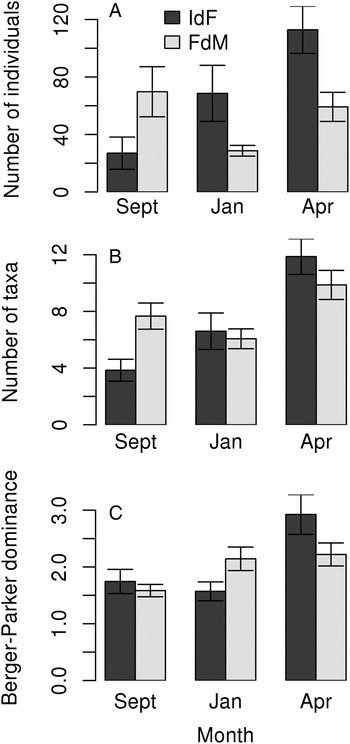
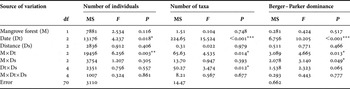
Numbers of individuals, numbers of taxa and Berger–Parker dominance differed significantly among sampling dates but not between forests nor among distances (Table 1). Interaction between forest and sampling date was significant for all three variables. At Ilha da Fortaleza, numbers of individuals and numbers of taxa increased during the study (Figure 1A, B), whereas dominance was similar in September and January, but increased in April (Figure 1C). At Furo do Meio, the number of individuals (around half of which were Neoteredo reynei) was initially high in September, decreasing in January and increasing again in April (Figure 1A). The number of taxa at Furo do Meio was similar in September and January (Figure 1B) and increased in April, whereas dominance was low in September, increasing in January and April (Figure 1C).
Mean number (±SD) of individuals (A), taxa (B) and Berger–Parker dominance per log (C) from mangrove forests sampled in September 2008, and January and April 2009 at Ilha da Fortaleza (IdF), and in September 2009 and January and April 2010 at Furo do Meio (FdM), Pará, Brazil. Data were aggregated for distances of 2, 10 and 20 m from the tidal channel at each forest.

Summaries of analyses of variance of numbers of individuals, numbers of taxa and Berger–Parker dominance of macrofauna in mangrove logs sampled at distances of 2, 10 and 20 m from the tidal channel in September 2008, and January and April 2009 at Ilha da Fortaleza, and in September 2009, and January and April 2010 at Furo do Meio, Pará, Brazil.

df, degrees of freedom; MS, Mean Square; *, P < 0.05; **, P < 0.01; ***, P < 0.001.
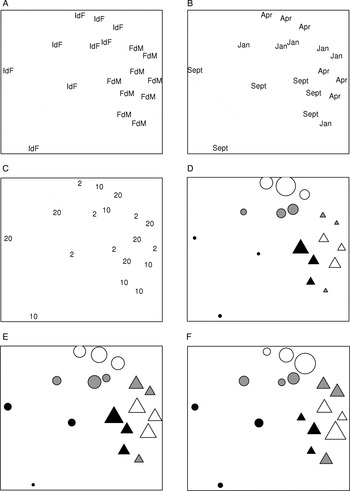
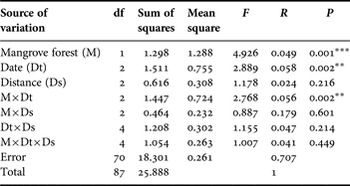
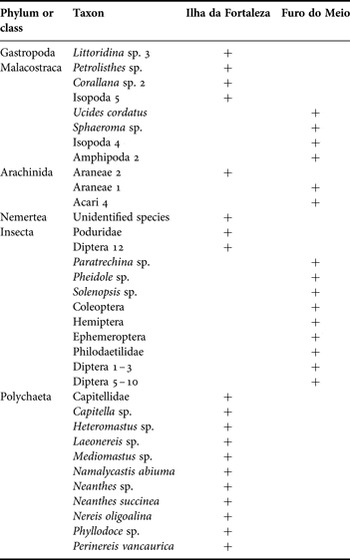
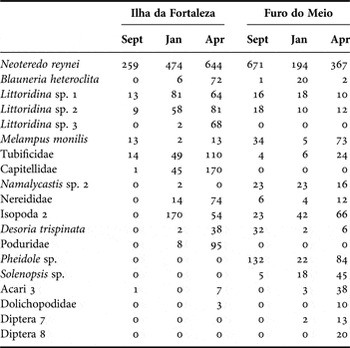
There were significant differences in macrofaunal structure (see aggregated data set in Supplementary Materials) between mangrove forests and among sampling dates with significant interaction between these factors (Table 2). Two groups of macrofauna associated with logs from each mangrove forest (Ilha da Fortaleza and Furo do Meio) are clearly distinct in the ordination (Figure 2A), which had a final stress value of 15%. The groups differed in terms of the taxa unique to each forest (Table 3) where more insect taxa were unique to Furo do Meio and more polychaete taxa unique to Ilha da Fortaleza. There were also differences in the abundance of taxa common to both mangrove forests (Table 4). Blauneria heteroclita, Littoridina sp. 1 and sp. 2, Tubificidae, Nereididae and Isopoda 2 were more abundant at Ilha da Fortaleza whereas Melampus monilis and Namalycastis sp. 2 were more abundant at Furo do Meio (Table 4).
Ordination by non-metric multidimensional scaling of mangrove logs sampled in September 2008, and January and April 2009 at Ilha da Fortaleza (IdF), and in September 2009, and January and April 2010 at Furo do Meio (FdM), Pará, Brazil, based on a Czekanowski distance matrix using fourth root transformed macrofaunal abundance data. Mangrove forests (A), sampling date (B) and distance from tidal channel (C). Overlays of numbers of individuals (D), numbers of taxa (E) and Berger–Parker dominance (F), where symbols represent the mangrove forests: circles (IdF) and triangles (FdM), and colours represent the sampling dates: black (September), grey (January) and white (April). Final stress value 15%.

Summary of permutational multivariate analysis of variance of macrofaunal abundance and composition in mangrove logs sampled at distances of 2, 10 and 20 m from the tidal channel in September 2008, and January and April 2009 at Ilha da Fortaleza, and in September 2009, and January and April 2010 at Furo do Meio, Pará, Brazil.

df, degrees of freedom; *, P < 0.05; **, P < 0.01; ***, P < 0.001.
List of mangrove log macrofaunal taxa occurring uniquely at either Ilha da Fortaleza or Furo do Meio, Pará, Brazil. Numbered taxa are morphologically distinct from others of the same taxon.

Total number of individuals of the most common taxa of macrofauna associated with mangrove logs (N = 15) sampled in September 2008, and January and April 2009 at Ilha da Fortaleza, and in September 2009, and January and April 2010 at Furo do Meio, Pará, Brazil. Numbered taxa are morphologically distinct from others of the same taxon.

Differences in macrofaunal structure between sampling dates were more obvious at Ilha da Fortaleza than at Furo do Meio (Figure 2B). At Ilha da Fortaleza, abundance of Neoteredo reynei, Blauneria heteroclita, Littoridina sp. 1 and sp. 2, Tubificidae, Capitellidae, Nereididae, Desoria trispinata (Mac Gillivray, 1896) and Poduridae increased from September to April. Certain taxa were present only in April (Nemertea, Amphipoda 3, Orthoptera, Dolichopodidae and Xylophagidae). At Furo do Meio, patterns in macrofaunal abundance were less clear where some taxa, such as Littoridina sp. 1 and sp. 2 and Namalycastis sp. 2, remained at similar abundances over the study period and others either increased (Tubificidae, Nereididae, Isopoda 2 and Solenopsis sp.) or decreased (Desoria trispinata and Acari 2) from September to April. Other taxa were more (Blauneria heteroclita) or less (Melampus monilis and Pheidole sp.) abundant in January. Certain taxa were only present (Diptera 8, 9, 10, 11, Dolichopodidae, Chilopoda and Acari 4) in April at Furo do Meio (see examples in Table 4). There were no clear patterns in macrofaunal structure among distances from the tidal channel at either Ilha da Fortaleza or at Furo do Meio (Figure 2C).
At Ilha da Fortaleza, an increase from September to April in the number of individuals, taxa and Berger–Parker dominance (Figure 2D–F) is clear, whereas for Furo do Meio, this pattern is not so clear, where there is a reduction in the number of individuals and taxa in January (Figure 2D, E). However, Berger–Parker dominance did appear to increase from September to April at Furo do Meio (Figure 2F).
DISCUSSION
The number of macrofaunal taxa associated with mangrove logs in the present study was 85, which is higher than the 31 taxa recorded by Aviz et al. (Reference Aviz, Mello and Silva2009) in mangrove logs from São Caetano de Odivelas, Pará. The values are reasonably comparable since the total volume of logs sampled by Aviz et al. (Reference Aviz, Mello and Silva2009), 0.38 m3, was similar to the 0.28 m3 sampled in the present study. The number of taxa in mangrove logs appears to be much higher than that found in surveys by Fernandes (Reference Fernandes and Fernandes2003) in mangrove sediment at Ilha de Maracá, Amapá (15) and in muddy sediment along the Caeté estuary, Pará (17) (Rosa-Filho et al., Reference Rosa-Filho, Busman, Viana, Gregório and Oliveira2006). However, the total volume sampled in both studies (0.071 m3 and 0.025 m3, respectively) was much lower than that of the present study, and so further sampling effort could potentially reveal more taxa associated with mangrove sediments.
The macrofauna surveyed in mangrove forests from São João de Pirabas and Bragança was composed of both estuarine and terrestrial taxa. Aviz et al. (Reference Aviz, Mello and Silva2009) found a similar estuarine–terrestrial division in the macrofauna associated with logs from a mangrove forest in São Caetano de Odivelas, Pará, which is in the same region as the present study. Such a diverse composition of benthic macrofauna indicates the influence of terrestrial environments adjacent to the mangroves (Kathiresan & Bingham, Reference Kathiresan and Bingham2001). Terrestrial environments contribute to increased macrofaunal diversity in mangroves, insects being a good example, which may be either permanent or temporary residents in mangroves (Kathiresan & Bingham, Reference Kathiresan and Bingham2001). In the present study, insects made a significant contribution to macrofaunal diversity in mangrove logs. The diversity of insects in mangroves may be high, and they may belong to different trophic levels, such as herbivores, saprophages, parasites or predators (Nagelkerken et al., Reference Nagelkerken, Blaber, Bouillon, Green, Haywood, Kirton, Meynecke, Pawlik, Penrose, Sasekumar and Somerfield2008). Insect survival may be enhanced by the availability of microhabitats in which to live or shelter, such as trunks, roots and decaying wood (Kathiresan & Bingham, Reference Kathiresan and Bingham2001; Nagelkerken et al., Reference Nagelkerken, Blaber, Bouillon, Green, Haywood, Kirton, Meynecke, Pawlik, Penrose, Sasekumar and Somerfield2008).
Annelida, Crustacea and Mollusca are the predominant groups in the macrofauna of mangrove sediments (Oliveira & Mochel, Reference Oliveira and Mochel1999; Aviz et al., Reference Aviz, Mello and Silva2009) and logs (Aviz et al., Reference Aviz, Mello and Silva2009: present study) in northern Brazil. The relative abundances of Mollusca (61.7%), Annelida (12.7%), Crustacea (11.1%) and non-crustacean Arthropoda (14.1%) in the present study were greater, similar, lower and higher, respectively, than those recorded in a mangrove forest in the same region as the present study by Aviz et al. (Reference Aviz, Mello and Silva2009): Mollusca (27.5%), Annelida (10.8%), Crustacea (53.4%) and non-crustacean Arthropoda (6.3%).
The macrofauna of sediments is usually dominated by polychaetes, which generally have the highest relative abundance (da Silva et al., Reference Silva, de Souza, Souza-Filho and Rosa-Filho2011), whereas in mangrove logs the most abundant taxon is Bivalvia (present study) or Crustacea (Aviz et al., Reference Aviz, Mello and Silva2009). In the sediment infauna of mangroves at Ilha de Maracá, Amapá State, Brazil, marine taxa, such as Mollusca, Annelida and Crustacea, were relatively more abundant (0.18, 0.41 and 96.3%) than terrestrial ones, such as Collembola, Coleoptera and Chilopoda, (0.04, 0.09 and 0.22%) (Fernandes, Reference Fernandes and Fernandes2003). In sediments from the Furo do Meio mangrove forest, Bragança, Pará, the most abundant faunal group was Polychaeta (Beasley et al., Reference Beasley, Fernandes, Figueira, Sampaio, Melo, Barros, Saint-Paul and Schneider2010). The relatively lower proportion of terrestrial fauna in mangrove sediment may be due to very low concentrations of oxygen and high concentrations of sulphides and other toxic substances. The mangrove log may provide the macrofauna, especially those of terrestrial origin, an island of microhabitat with more favourable conditions than that of the sediment.
In the present study, Mollusca (class Bivalvia) was the most abundant faunal group, dominated by Neoteredo reynei. The teredinids (shipworms) are capable of entering and excavating mangrove logs (Moraes & Lopes, Reference Moraes and Lopes2003), thereby facilitating the entry of other macrofauna and providing refuge and a food supply for other benthic organisms (Dame, Reference Dame1996). The larger surface area of the exposed log (Reis, Reference Reis1995) enables an increasing number of bacteria (Alongi & Sasekumar, Reference Alongi, Sasekumar, Robertson and Alongi1992) and fungi (Sotão et al., Reference Sotão, Campos, Gugliotta, Costa and Fernandes2003) to colonize the log, thus increasing the rate of their decomposition (Kohlmeyer et al., Reference Kohlmeyer, Bebout and Volkmann-Kohlmeyer1995). Neoteredo reynei tolerates wide fluctuation in salinity (Reis, Reference Reis1995), has adaptations for gas exchange and dessication (Turner, Reference Turner1966) and are not dependent on suspension-feeding (Moraes & Lopes, Reference Moraes and Lopes2003). Such characteristics contribute to their survival in mangrove areas that are not frequently flooded by tides (Lopes et al., Reference Lopes, Domaneschi, Moraes, Morita, Meserani, Harper, Taylor and Crane2000) allowing these shipworms to resist changes in air humidity and tidal inundation all year round.
Isopoda was the second most abundant taxon in the present study. A total of 3154 species of marine isopods have been described from different habitats, with 40% of these species from tropical regions (Poore & Bruce, Reference Poore and Bruce2012). Isopoda are often associated with mangrove roots and logs, aiding in their decomposition (Svavarsson et al., Reference Svavarsson, Osore and Ólafsson2002). Mangrove logs provide refuge from predators for isopods (Ellison & Farnsworth, Reference Ellison and Farnsworth1992) and food in the form of woody detritus (Poore & Bruce, Reference Poore and Bruce2012), although some are filter feeders (Si et al., Reference Si, Bellwood and Alexander2002). The logs serve as habitat for reproduction as some females give parental care, sheltering the offspring in logs (Thiel, Reference Thiel1999). Poore & Bruce (Reference Poore and Bruce2012) found that the number of isopods varied from 1 to 48 individuals per log, whereas in the present study, the numbers varied from 1 to 162 per log, distributed in two genera (Corallana and Sphaeroma), the species Sphaeroma annandalei and four unknown morphospecies.
The ant genus Pheidole sp., which despite being a member of a typically terrestrial faunal group (family Formicidae), is adapted to survive in the microhabitat found in mangrove logs (Nagelkerken et al., Reference Nagelkerken, Blaber, Bouillon, Green, Haywood, Kirton, Meynecke, Pawlik, Penrose, Sasekumar and Somerfield2008). To prevent drowning, some species find refuge on trunks or branches above the high tide mark as their galleries may become partially or totally submerged during high tide (Cannicci et al., Reference Cannicci, Burrows, Fratini, Smith III, Offenberg and Dahdouh-Guebas2008). Other species of ant are able to survive submersed during high tide by means of physiological adaptations that allow partial anaerobic respiration, and thus no longer need to seek a place of refuge (Nilsen, Reference Nilsen2006).
The family Nereididae was relatively abundant in both mangrove forests. Varying in size from a few millimetres to a metre, they are considered sedentary, with detritivorous or herbivorous feeding habits (Santos & Lana, Reference Santos and Lana2001). The genus Namalycastis, the most abundant member of this family in the present study, is commonly associated with fallen logs in mangroves (Glasby, Reference Glasby1999) and in roots of Rhizophora mangle (Santos & Lana, Reference Santos and Lana2001)
Zonation and the distribution of mangrove species are related to tidal amplitude. In the high intertidal zone, decapod crustaceans dominate, whereas in the low intertidal zone, the fauna consists of filter-feeders, such as oysters and barnacles (Koch & Wolff, Reference Koch and Wolff2002). Zonation of species also depends on the coastal topography (Alongi & Sasekumar, Reference Alongi, Sasekumar, Robertson and Alongi1992), variation in temperature (Koch & Wolff, Reference Koch and Wolff2002) and the distribution of organic matter, which is an important food source (Wolff et al., Reference Wolff, Koch and Isaac2000). In the present study, no significant difference in macrofaunal structure occurred among distances up to 20 m from the tidal channel in either of the mangrove forests. The relative homogeneity of the macrofauna at this spatial scale may indicate relatively similar conditions in mangrove logs despite different distances from the tidal channel. Although the study area is situated in a high intertidal zone and is subject to infrequent tidal flooding, mangrove logs may represent a stable island microhabitat for the macrofauna, retaining humidity, maintaining a stable temperature and protecting against desiccation.
Macrofaunal structure also depends on seasonal variation (Ysebaert & Herman, Reference Ysebaert and Herman2002). In the present study, macrofaunal structure associated with mangrove logs varied greatly among sampling dates with higher abundance and numbers of taxa in the wetter season. Similarly, marked temporal differences were found in the composition and abundance of the macrofauna associated with aggregates of the polychaete Phyllochaetopterus socialis Claparède, 1870 (Albano & Obenat, Reference Albano and Obenat2009). In general, such variation in macrofaunal structure may be caused by seasonal changes in precipitation (Dippner & Ikauniece, Reference Dippner and Ikauniece2001), salinity (da Silva et al., Reference Silva, de Souza, Souza-Filho and Rosa-Filho2011), temperature (Nagelkerken et al., Reference Nagelkerken, Blaber, Bouillon, Green, Haywood, Kirton, Meynecke, Pawlik, Penrose, Sasekumar and Somerfield2008), tidal level (Dittmann, Reference Dittmann2000), and air humidity (Omena et al., Reference Omena, Junqueira and Silva1990).
Seasonal variation in macrofaunal structure differed in each mangrove forest. At Ilha da Fortaleza, seasonal variability was high, where the abundance and number of taxa increased threefold during the study. This may occur due to the fact that Ilha da Fortaleza is less influenced by river discharge and is thus a more marine environment. However, seasonal rainfall may cause wide variation in salinity along the Amazon mangrove macrotidal coast (Souza-Filho et al., Reference Souza-Filho, Lessa, Cohen, Costa, Lara, Dillenburg and Hesp2009). In the Furo do Meio mangrove forest, seasonal variation in macrofaunal structure was much lower. Although the same seasonal pattern occurred in Furo do Meio, there was greater similarity among sampling dates. This may be due to the greater influence of river discharge at this mangrove forest (Souza-Filho & El-Robrini, Reference Souza-Filho and El-Robrini1997), which tends to reduce seasonal variation in salinity and thus reduce variation in the macrofauna. In conclusion, the mangrove log macrofauna appears to be relatively diverse at both forests in this study. However, macrofaunal structure was dominated by estuarine taxa at Ilha da Fortaleza and by terrestrial taxa at Furo do Meio. Such differences between sites are greater at certain times of the year when rainfall and salinity change.
ACKNOWLEDGEMENTS
J. Andrade and N. Palhano are grateful to the Programa Institucional de Bolsas de Iniciação Científica/Conselho Nacional de Desenvolvimento Científico e Tecnológico at the Universidade Federal do Pará (UFPA) for undergraduate scholarships. J. Andrade also thanks the Fundação de Amparo à Pesquisa do Estado do Pará for a postgraduate scholarship. We thank L.R.L. Simone (Museu de Zoologia da Universidade de São Paulo) for identifying gastropods, T.M.C. Ferreira (UFPA) for identifying ants and A.S. Souza (UFPA) for identifying decapods. We are also grateful to T.C. Sousa for help in the field and to two anonymous referees for greatly improving the manuscript.
FINANCIAL SUPPORT
This research received no specific grant from any funding agency, commercial or not-for-profit sectors.