Introduction
With the establishment of the World Trade Organization (WTO), a lively scholarly debate has emerged about the effect of more judicialized adjudication of trade complaints, in comparison with the GATT's political-diplomatic system of dispute settlement. The strengthened enforcement mechanism of WTO rules means that member states can expect to face high costs if they breach those rules (Zangl, Reference Zangl2008). The dispute settlement mechanism (DSM) of the WTO delegated adjudication to an independent third party (panels and Appellate Body) and strengthened enforcement by introducing a credible threat of multilaterally authorized sanctions in case of non-compliance. This evolution has been referred to as the legalization or judicialization of the present international trade regime.Footnote 1
Scholars have inquired into how judicialization affects the trade-related interests of, and the trade policymaking dynamics among, domestic actors in WTO member states (key economic interest groups and policymakers alike) in two ways. One strand of literature analyzes the effects of judicialization on the prospects for further cooperation in the WTO. Some authors suggest that a high degree of bindingness of trade rules may decrease the propensity of WTO members to commit to new agreements (Goldstein and Martin, Reference Goldstein and Martin2000), while others have argued in the opposite direction (De Bièvre, Reference De Bièvre2006; Poletti, Reference Poletti2011; Rosendorff, Reference Rosendorff2005)
A second strand of literature focuses on the politics of WTO dispute settlement, investigating why states decide to initiate disputes (Busch et al., Reference Busch, Reinhardt and Shaffer2009), why disputes escalate (Busch, Reference Busch2000; Davis, Reference Davis2012; Guzmann and Simmons, Reference Guzman and Simmons2002), and under what conditions parties comply with WTO dispute settlement panels decisions (Bown, Reference Bown2004; Goldstein and Steinberg, Reference Goldstein and Steinberg2008).
To date, surprisingly little effort has been devoted to integrating these two largely separate strands of literature. Journalists' accounts, policy-oriented research, and even scholarly studies on the Doha Round of multilateral trade negotiations have hinted at the ‘shadow of WTO law’ as a key determinant of policy preferences, bargaining strategies, and tactics of parties prior to and during the Doha Round. For instance, several studies concur that the expiration of the ‘peace clause’ of the Uruguay Round Agreement on Agriculture (URAA) and the subsequent disputes against EU and US agricultural subsidies strongly influenced the Doha Round negotiations concerning agriculture (Poletti, Reference Poletti2010; Porterfield, Reference Porterfield2006; Sumner, Reference Sumner2005). Similarly, WTO disputes against EU precautionary principle-based regulations influenced negotiations on so-called trade-and-environment issues (Kelemen, Reference Kelemen2001; Poletti and Sicurelli, Reference Poletti and Sicurelli2012; Skogstad, Reference Skogstad2003). Despite this evidence, to our knowledge, no systematic, theoretically informed study has yet been produced to investigate whether, under what conditions, and how the decision by one WTO member to initiate a legal dispute against another affects cooperative dynamics in the context of WTO negotiations. Although Busch and Reinhardt (Reference Busch and Reinhardt2000) have shown how uncertainty about each sides' preference in a WTO dispute might encourage settlement before the dispute escalates, the question of how the threat (or use) of litigation affects bargaining dynamics in multilateral trade negotiations remains unaddressed.
This analysis offers a systematic investigation of the causal mechanisms that link legal vulnerability in the WTO (i.e., the credible threat to resort to and the actual use of WTO litigation) and multilateral trade negotiations. In this article, we seek to explain why and under what conditions the initiation of a WTO dispute, while multilateral trade negotiations are ongoing, may make successful negotiations more likely. More specifically, we contend that legal vulnerability can increase the set of feasible agreements for both sides, relative to the status quo ante, thus potentially increasing the likelihood of cooperation in multilateral negotiations. It is obvious why a member state challenged in WTO litigation would have an interest in drowning the controversy in ongoing, broad-based, multilateral negotiations. For a defendant, shifting the issue to the bargaining table of multilateral trade negotiations provides opportunities to minimize or offset the likely adjustment costs of an adverse WTO panel ruling (Poletti, Reference Poletti2010). It is much less obvious why the complainant in such a dispute would acquiesce to the defendant's strategy, seeking a solution to the controversy through multilateral negotiations, if it can expect to win (or has won) such a case in WTO litigation. We contend that while the ability to impose costs on a defendant by way of litigation increases the complainant's bargaining power, the complainant's preference for loss-mitigation over gains from retaliation augments the defendant's leverage. The balance between these two forces opens a bargaining window, ultimately increasing the chances for cooperation in multilateral trade negotiations. The complainant's increased bargaining power, however, is conditional, to some extent, upon a belief that litigation will produce a compliant response on the part of the defendant. If the defendant is not expected to comply, then, although a bargaining window will still exist, the complainant will be able to extract fewer concessions from the defendant. Therefore, our argument encompasses two potential sources of variation: the existence of a judicialization regime, and the likelihood that the defendant will comply with an adverse ruling. The first affects whether a bargaining range exists, while the second helps to explain where on that range a potential agreement is likely to be located.
In line with standard international political economy approaches, the assumption underpinning our analysis is that governments' choices over trade policies can be conceived of as a function of the preferences and political pressures emanating from key economic interest groups defined by society as a result of a rational calculation about the expected distributional consequences of cooperative agreements. We thus conceive of political actors not as advocates of a specific trade policy independent of constituency demands, but rather as office maintainers and seekers, avoiding the mobilization of political enemies (Frieden, Reference Frieden1991; Milner, Reference Milner1988; Rogowski, Reference Rogowski1989).
With this piece, we contribute to the debate on the institutional underpinnings of cooperation in the international trade regime in different ways. Contrary to earlier expectations (Goldstein and Martin, Reference Goldstein and Martin2000), we show how the increased bindingness of international trade rules may ignite a positive dynamic of cooperation between two trading partners, within the broader context of multilateral trade negotiations. Our argument does not suggest that judicialization will necessarily lead to the success of a multilateral trade round; rather, it can enhance the ability of a given pair of trading partners to reach an agreement. In short, although legal vulnerability does not ensure round success, all else being equal, it should increase the probability of a multilateral agreement. In addition, we complement the findings of the literature on the politics of dispute settlement, showing that retaliation backed by law not only can increase the likelihood of negotiated settlement during the consultation phase of WTO litigation (Busch and Reinhardt, Reference Busch and Reinhardt2000; Reinhardt, Reference Reinhardt2001), but can also increase the chances of cooperation in multilateral trade rounds. We suggest that legal vulnerability can generate a larger set of feasible agreements between two trading partners in multilateral rounds than in single-issue bilateral negotiations, such as those occurring during consultations in dispute settlement.
The paper proceeds as follows. First, we review the literature that deals with the question of how the WTO affects the domestic politics of trade policymaking. Second, we develop an argument that shows why judicialization can increase domestic actors' propensity to conduct issue linkage negotiations in the WTO. Third, we subject our argument to empirical scrutiny by carrying out an in-depth qualitative analysis of how potential defendants (the European Union (EU) and the United States (US)) and a potential complainant (Brazil) in WTO disputes approached agricultural trade negotiations in the Doha Round. In the final section, we draw our conclusions.
1. Legal vulnerability and the domestic politics of trade policymaking
The existing literature on how WTO judicialization affects cooperation concentrates on the fundamental question of how such an institutional innovation affects a member state's preferences when deciding whether to expand the range of rules to which they should be committed. It has been convincingly argued that stronger enforcement of rules can make further cooperation less likely in the WTO (Goldstein and Martin, Reference Goldstein and Martin2000). While increased enforceability makes agreements more credible, it also makes them more tightly binding. Because governments value institutional flexibility as a tool to deal with the uncertainty of future economic interactions, it is plausible to expect them to believe that the costs of signing such agreements outweigh the benefits.
This argument is consistent with and largely overlaps scholarly research focusing on the relationship between uncertainty and the design of international institutions (Downs and Rocke, Reference Downs and Rocke1995; Koremenos et al., Reference Koremenos, Lipson and Snidal2001). These analyses however, focus only on how prospective enforceability of future agreements can affect an actor's propensity to commit to such agreements. In the context of the WTO, this perspective essentially questions whether member states will be prone to widen organizational jurisdiction to a host of new issue areas. However, WTO member states do not simply face a choice between committing or not committing to new binding agreements, they are already bound by a wide array of agreements within the organization. This means that member states may happen to negotiate under the shadow of WTO law: they may engage in multilateral negotiations while foreign partners could (and sometimes do) challenge them through WTO litigation. Thus, whenever such negotiations touch upon issues already governed by organizational law, member states may face a choice between litigation and negotiation if trading partners initiate legal disputes against them while negotiations are ongoing. But how exactly does litigation affect multilateral trade negotiations? Does it increase the bargaining space in negotiations or does it create new obstacles on the path toward agreement? And when does it empower a complainant?
In the next sections, we make two arguments. First, during multilateral trade negotiations, when a member state has the option to challenge another (successfully) through WTO dispute resolution mechanisms, the set of feasible agreements for both sides may increase and overlap, strengthening the chance of agreement relative to the status quo ante. Second, the efficacy of this mechanism is dependent in part upon the willingness of the defendant to comply with a ruling in the complainant's favor.
Below, we present a simple game in which two states bargain over the reduction of trade-distorting measures in the shadow of judicialization. Negotiations on the liberalization of international trade in the trade regime take the shape of exchanges of reciprocal market access concessions between trading partners. Exporters in one WTO member state mobilize, demanding that their government seek the removal of trade-distorting measures, which provide import-competing producers in the other state with protection from foreign competition. Whether an agreement will be struck depends on whether the sets of feasible agreements for the parties involved in the negotiations overlap at a particular point in time. Since the introduction of a quasi-judicial mechanism of dispute resolution in the trade regime, however, governments possess an additional tool to target trade-distorting measures that are incompatible with WTO rules. Indeed, member states that enjoy the benefits of protectionism through legally vulnerable policy tools can no longer consider the status quo as a cost-free strategy, as those seeking the removal of WTO-incompatible policies can impose adjustment costs on them through the imposition of retaliatory measures, following authorization from a WTO dispute settlement or Appellate Body ruling. As the analysis of the following model shows, when a WTO member successfully takes legal action (or can credibly threaten to take legal action) against another member state, it can significantly affect negotiations by increasing the set of feasible agreements both sides are ready to accept. However, this mechanism is mediated by the complainant's belief that the defendant will eventually comply with the ruling.
It is important to note that our argument holds only when two scope conditions are met. First, we assume that the two sides involved in a dispute value the other's market as a destination for their exports, and are in a position to pursue or threaten to pursue policies that can generate losses for the other side. We call this an interdependent trading relationship. Second, we assume that the potential complainant has legal capacity, defined as ‘resources available to identify, analyze, pursue, and litigate a dispute’ (Guzman and Simmons, Reference Guzman and Simmons2005: 559). If it is lacking the capability to use the dispute settlement mechanism, then judicialization is effectively non-existent.
1.1 Model setup
Suppose that during multilateral trade negotiations, a WTO member state (A) demands concessions from a trading partner (B), who has implemented some trade-distorting measure. Let the present size of the measure be normalized to one and let zero represent full compliance with A's demand, so that any number on the open interval between zero and one represents a correspondingly reduced barrier size. Assume that A and B have linear, monotonic, and competing preferences over the trade barrier, such that B's utility is strictly increasing in barrier size, while A's is strictly decreasing. Suppose further that B can be of two types: the non-compliant type (B NC ), for whom there is some additional penalty to be paid for full compliance, and the compliant type (B C ), for whom there is no additional cost. Let this additional cost for the non-compliant type be represented by ε > 0. State B's type is the result of an initial draw by nature, such that B is compliant with probability 0 < p < 1 and non-compliant with complementary probability. This type is private information for B, but the distribution of types is common knowledge.
State A's beliefs about state B's type are potentially based on two factors. First, they are affected by the prior probability that state B is compliant. Empirically, this probability is a function of the state's ties to import-competing industries, who will attempt to punish governments that concede too much. A government that is able to preserve some or all of its trade violation will not face any punishment from import competitors, while one that completely concedes to the opponent's demands, without getting anything in return, is seen as selling out the domestic industry, and pays a cost premium. Second, state A will take into account any previous observations of state B's behavior. In cases in which A has previously observed B complying or not complying with judicial rulings, it will incorporate this information according to Bayesian principles.
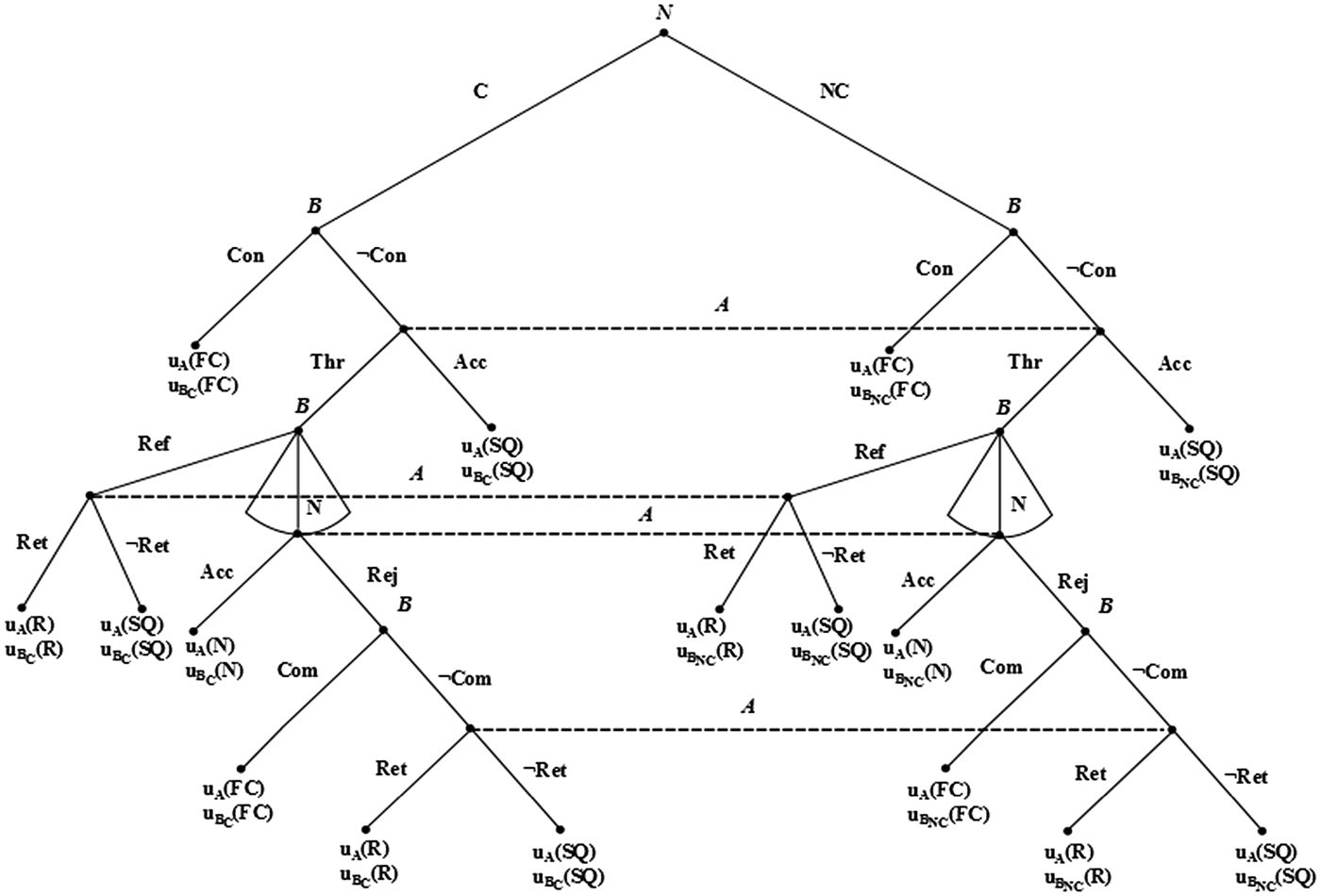
The game is depicted in Figure 1, below. It begins with Nature drawing B's type, following a demand by A that B remove its trade-distorting policy. State B can then either concede to the demand or refuse to concede. If it concedes, then the game ends and both states receive payoffs according to their valuation of the full concessions outcome. If B does not concede, A can either accept this decision or threaten to litigate.Footnote 2 If it accepts, then the game ends, and both states receive the status quo payoff. If A threatens to litigate, then B can choose to refuse to comply completely, or it can offer a negotiated settlement. If B refuses, then litigation occurs and A acquires the ability to impose retaliatory measures against B. These measures will be equal in magnitude to the initial trade-distorting measure imposed by B, and will thus harm state B's exporters to the same degree that the initial measure benefits B's import-competing industries. Therefore, it will cancel out any gains from the initial measure. Retaliation may also provide a similar benefit to A's domestic industries. However, because A's import-competing industries did not mobilize for the benefit, the ultimate value of retaliation for the state is reduced by some factor, α ∈ (0,1). If B chooses to negotiate, then it makes a proposal to A, of N ∈ [0,1], where N represents the size of the reduction of the measure. State A can choose to accept or reject this offer. If it accepts, then the two states agree to reduce the trade-distorting measure to N. We assume that the round ends successfully, that the settlement is implemented, and that both states receive their respective payoffs from negotiation. If it rejects, then A proceeds with litigation. Again, we assume that if litigation occurs, the complainant (A) wins with certainty.Footnote 3 Given this outcome, B can comply with the judgment or it can opt not to comply. If it complies, then the two states receive the full compliance payoff. If it refuses to comply, then A is authorized to retaliate, and can choose whether or not to do so. If it does, then the states receive the retaliation payoff; otherwise, they receive the status quo payoff.
Bargaining in the shadow of WTO litigation

Players' preferences over outcomes are as follows. For A, the ideal outcome is full compliance by B, which it prefers to retaliation, wherein it will recover only α of the cost. Retaliation is in turn preferred to the status quo. Formally, u
A
(FC) > u
A
(R) > u
A
(SQ). A's preference with respect to a negotiated settlement depends on where the settlement falls. It prefers offers such that N is low to those for which it is high. B, by contrast, most prefers the status quo, as it continues to enjoy the benefits of its trade-distorting measure. It prefers this to retaliation by A, which will eliminate any such benefits. The compliant type, B
C
, is indifferent between retaliation and full compliance; the non-compliant type, B
NC
, strictly prefers retaliation to compliance. Formally,
 ${u_{B_C}}(SQ) \gt {u_{B_C}}(R) = {u_{B_C}}(FC)$
and
 ${u_{B_{NC}}}(SQ) \gt {u_{B_{NC}}}(R) \gt {u_{B_{NC}}}(FC)$
. Like A, B's preference with respect to N depends on its value. It prefers larger values of N to smaller ones.
This is a game of incomplete information, requiring a Perfect Bayesian Equilibrium (PBE). It can be solved using backward induction. We make the assumption that, when indifferent, a state has a preference for the more peaceful choice (i.e., concession, negotiation, compliance, or non-retaliation), and that in the case of off-the-equilibrium-path (OTEP) play, A believes B to be of the compliant type. We discuss the latter assumption below.
1.2 Analysis
Given our assumptions, players have dominant strategies at each node, and thus there is a unique pure strategy equilibrium. Moreover, there exist no non-degenerate mixed strategy equilibria. Beginning from the final node, players' equilibrium strategies follow. If litigation has proceeded and B refuses to comply, A strictly prefers retaliation, which allows it to recoup some of the costs of the barriers, to non-retaliation. Given this strategy, when faced with an adverse judgment, B C will prefer to comply, while B NC will refuse, strictly preferring retaliation to compliance. Because A is unaware of what type of B it is facing, its decision following a negotiated offer by B will be a function of the probability that B is compliant (p). In particular, it will accept any proposed barrier level, N ⩽ p(0) + (1 − α)(1 − p), and reject any larger proposal. Given these preferences and A's beliefs, the optimal offer for both types of state B will be at state A's reservation value, N * = (1 − α)(1 − p).Footnote 4 Because this value must be strictly positive, both types will prefer offering N * to refusing to negotiate. The feasible equilibrium values of N * span the open unit interval. Because N * < 1 in equilibrium, A will prefer (the threat of) litigation to acceptance of the status quo. Finally, given the initial choice between concession and refusal to concede, the fact that N * > 0 will lead both types of B to refuse concessions initially. The equilibrium beliefs for A are simply that B is of type B C with probability p, and of type B NC with probability 1 − p. Because both types behave similarly on the equilibrium path, state A's prior and posterior beliefs are equivalent in equilibrium. Given any off-the-equilibrium-path play by B, A believes B to be of type B C with probability one.
The equilibrium outcome in this game is a negotiated proposal by B, N * = (1 − α)(1−p), which is accepted by A. The equilibrium offer depends on the distribution of types of B and on the benefit to A of retaliatory barriers. As the likelihood that B is of the non-compliant type increases, the equilibrium value of N * also increases, leading to a larger portion of the trade-distorting measure remaining in effect. On the other hand, as the benefit from retaliating grows, the equilibrium value of N * decreases, leading to a reduction in the agreed-upon trade distortion level. In all cases, however, negotiation is expected to occur, with the states' beliefs about the outcome of litigation influencing the agreed-upon settlement.
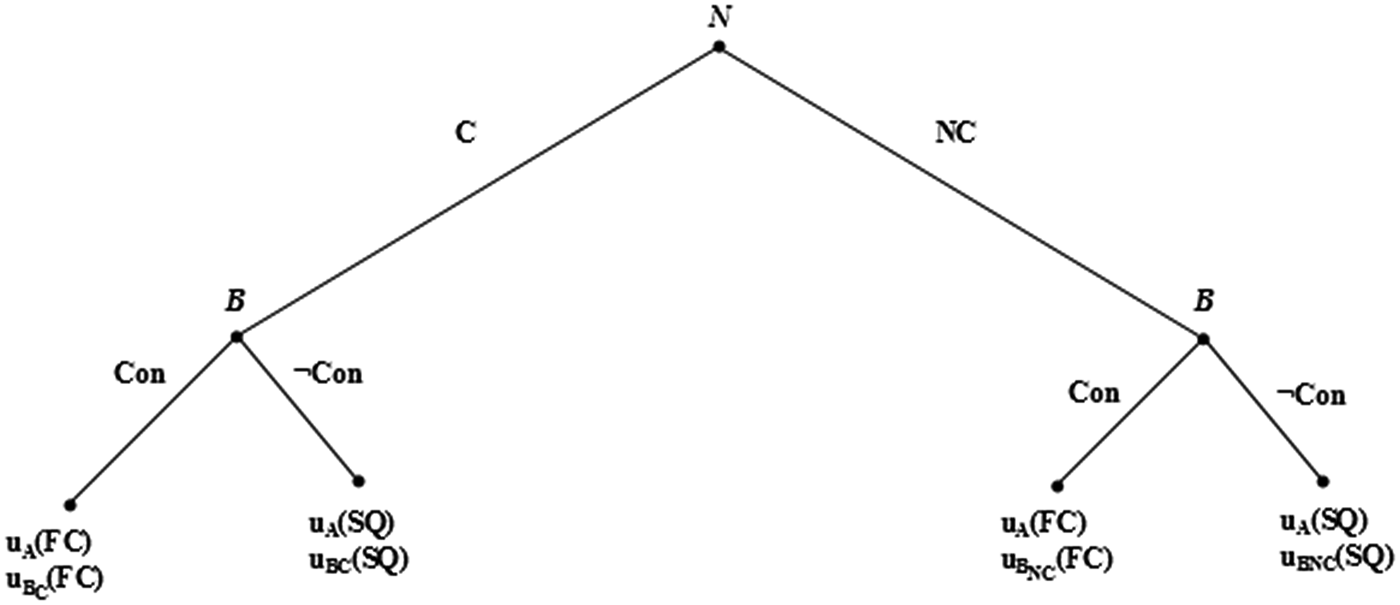
The driving force in the model above is the authorization to retaliate (or, perhaps more importantly, the credible threat of retaliation) that A receives from successful litigation. We can contrast this to the situation depicted in Figure 2, in which trade negotiations do not occur under the shadow of litigation In such a scenario, A lacks any sort of stick with which to coerce B into reducing its trade distortion. Its only option is simply to demand that B comply with WTO rules. If state B agrees, then it receives the concession outcome, and if it does not, the status quo remains in place. Faced with the simple choice between reducing and maintaining its level of protection, with no other consequences, both types of state B would prefer to keep the measure intact. Judicialization, therefore, provides A with an important weapon in multilateral negotiations that can induce cooperation (if not full compliance) without ever actually being used.
Bargaining in the absence of legal vulnerability

We would note that although this paper concentrates exclusively on multilateral negotiations, there is no reason why the mechanism outlined above could not have an effect on bilateral negotiations as well. However, during multilateral negotiations, the set of feasible agreements should be larger than in bilateral talks, such as consultations in WTO dispute settlement. Indeed, single-issue bilateral negotiations, such as those during early settlement, increase the visibility of the issue to domestic constituencies (Davis, Reference Davis2004) and thus the likelihood that decision makers will have to posture, making it more difficult to concede (Stasavage, Reference Stasavage2004).Footnote 5 This raises the probability that the defendant is a non-compliant type. In multilateral rounds, meanwhile, negotiations occur over packages of multiple issues that present wider distributional stakes and a broader spectrum of constituencies in the domestic policy process. This makes it more difficult for protectionist interests to influence the process. Thus, states engaged during multilateral rounds should be more likely to be of the compliant type, and should, therefore, be willing to make greater concessions.
1.3 Empirically observable implications
The argument presented so far captures how litigation in the WTO affects ongoing multilateral trade negotiations. Before proceeding to the empirical analysis, we turn to identifying a number of observable empirical implications of our theory. One of the key premises of our model is that a WTO member (or group of members) is in a position to threaten (credibly) the imposition of concentrated costs on another WTO member by initiating a complaint at the WTO, and thereby to threaten to impose retaliatory measures in the case of non-compliance. Thus, our implications are conditioned on this assumption. First, we expect to observe that litigation is a key factor influencing the strategic calculus of WTO member states involved in the dispute. This means that we should be able to trace the (credible) threat or initiation of a dispute to an increase in the set of feasible agreements between the two disputants in the context of multilateral trade negotiations relative to the status quo ante. When a state cannot credibly threaten to litigate, the bargaining window will not expand, and thus we expect a negotiated settlement to be unlikely. Second, the location of the agreement (if one exists), should be a function of the credibility of the first state's threat to litigate and the probability that the second state is of the compliant type. A state should be able to extract greater concessions through negotiations when its threats are believed and when its opponent is likely to comply with an adverse ruling. Empirically, factors such as the level of organization of various domestic groups will cause the likelihood that a given state is compliant to vary across issue areas. However, an opponent should still be able to infer something about a state's likelihood of compliance on a given issue if it observes it complying (or not complying) in previous instances. Third, our argument does not suggest that litigation affects the likelihood of success for multilateral trade negotiations. Our analysis is limited to an examination of how litigation affects the likelihood of agreement between the two sides involved in the dispute. For this agreement to be implemented, the dyad's overlapping set of feasible agreements would have to intersect with the win-set of all other participants – a negotiation outcome analysis that is beyond the scope of this paper. Thus, we are more interested in the results of dyadic negotiations than in outcomes per se.
2. Agricultural trade liberalization in the shadow of WTO law
We demonstrate the empirical plausibility of our theoretical argument by analyzing the interactions between one potential (and sometimes actual) complainant, Brazil, on the one hand and two potential defendants, the EU and the US, on the other. We examine how these interactions affected bargaining dynamics on agricultural trade liberalization in the Doha Round. Both cases meet the scope conditions of our argument, as they concern pairs of WTO members with large and attractive markets in a position of trade interdependence, a necessary condition for a potential defendant to worry about the threat of retaliation by a potential complainant, and Brazil possessed sufficient legal capacity to bring disputes against both parties.
One attractive feature about the cases that we investigate is temporal in nature. Both cases occurred around the time that litigation became an option for WTO disputants, providing us with important variation within cases. Therefore, we are able to trace how states' behaviors evolved in response to changes in the value of one of our key explanatory factors. In addition, the two cases displayed significant variation with respect to the second independent variable, namely the defendant's expected likelihood of compliance. In both instances, the message of a credible threat to resort to the DSM was conveyed to the potential target and the opposing state could reasonably expect to lose the case. However, while the EU's behavior signaled to Brazil that it was likely to be a compliant type, the actions taken by the US demonstrated a reluctance to comply. We show that these differences significantly affected the outcomes in the respective cases. Finally, agricultural interests tend to be perceived to be particularly influential amongst organized societal groups (see Bernauer and Meins, Reference Bernauer and Meins2003). If this is, in fact, true, then policymakers should be especially unlikely to make concessions on agricultural issues, as they will face higher domestic costs. Thus, agricultural cases constitute a markedly difficult test for our theory.
2.1 Agricultural negotiations and the pending expiration of the peace clause: the EU and Brazil
The Uruguay Agreement on Agriculture (URAA) bound WTO members to a set of clear commitments, limiting export subsidies and domestic support and ensuring market access. The quantitative impact of market-access-enhancing tariff reductions in the URAA on agricultural trade was marginal because the cuts in import tariffs took place from a base value that was frequently inflated to high levels – a practice known as ‘dirty tariffication’ (Tangermann, Reference Tangermann1999). In addition, domestic support policies of major developed countries were required to make only minor changes to bring them in conformity with the rules of the agreement (Josling, Reference Josling1998). Yet, the agreement contained the seeds for deeper trade liberalization to be obtained in future negotiations. First, in order to meet the concerns of those WTO members that were aware of the limited potential for agricultural trade liberalization of the URAA, the text included a so-called ‘built-in agenda’ (Article 20) mandating WTO members start a new round of negotiations on agriculture by the end of 1999.Footnote 6 Second, the agreement contained an important provision, the so-called ‘peace clause’ (Article 13), which granted immunity to countries against which legal action could be initiated on the basis of the provisions of Agreement on Subsidies and Countervailing Measures (SCM). This WTO agreement disciplined the use of subsidies and regulated the actions countries could take to counter the effects of subsidies. In essence, the ‘peace clause’ protected domestic and export subsidies programs actionable on the basis of the SCM agreement until the end of 2003, provided that states complied with the reduction commitments contained in the URAA.Footnote 7 The expiration of the peace clause at the end of 2003 would open up the possibility for potential complainant WTO members to challenge agricultural domestic and export subsidies through the DSM (Steinberg and Josling, Reference Steinberg and Josling2003; Swinbank, Reference Swinbank1999).
As middle-income agriculture-exporting countries such as Brazil would reap the largest share of the benefits arising from further agricultural trade liberalization (OECD, 2005), it is unsurprising that in the late 1990s groups representing agricultural interests organized intense lobbying efforts to push for further agricultural trade liberalization, particularly to increase their market access opportunities in the highly protected markets of developed high-income countries, such as the EU and the US (Cairns Group Farm Leaders, 1998, 1999b, 2000).
As our model suggests, the prospect of the peace clause expiration was deemed by both relevant interest groups and policymakers to provide Brazil with an effective tool to extract concessions in the negotiating game. Although the threat to resort to the DSM after 2003 was certainly a powerful tool in the hands of Brazilian policymakers, it offered no certainty that Brazilian agricultural exporters would be better off. As reform of agricultural policy was known to be particularly difficult to achieve in the EU (Swinnen, Reference Swinnen2008), the possibility that non-compliance would follow an adverse WTO ruling was a scenario that needed to be contemplated. Therefore, Brazil opted for a constructive engagement in negotiations, while maintaining a credible threat to resort to litigation. In the period preceding the launch of the Doha Round, private sector representatives and policymakers in Brazil combined calls for an ambitious agenda aimed at the elimination of all trade-distorting subsidies and a substantial improvement in market access, with an explicit reference to the prospect that the expiration of the peace clause would eliminate all constraints against the use of the DSM to challenge developed countries (Cairns Group, 2000b, 2000c; Cairns Group Farm Leaders, 2001; Cotta, Reference Cotta2001; Ragawan, Reference Raghavan2001).
As the largest provider of trade-distorting agricultural subsidies, the EU was one of the main targets of those potential complainants. Organizations representing European farmers' interests, as well as public decision makers in DG Agriculture, knew that these domestic policies were likely to be deemed WTO incompatible by an eventual ruling following a dispute in the WTO.Footnote 8 It is estimated that in the late 1990s roughly 45% of the EU's producer support estimates (PSE)Footnote 9 were vulnerable to legal challenges (Poletti, Reference Poletti2010). As was noted at the time, compliance with a succession of hostile panel reports following the expiration of the peace clause might lead to the death of the European Common Agricultural Policy (CAP) by a thousand cuts (Swinbank, Reference Swinbank1999: 45).
The position of legal vulnerability was among the reasons why European farmers and EU policymakers aligned in support of the strategy of comprehensive negotiations in the Doha Round. This kind of negotiation appealed to these actors, as trade-off deals increased the likelihood of a compromise entailing fewer agricultural concessions (Agra Europe, 2 November 2001; Brittan, Reference Brittan1999; COPA-COGECA, 1999a, 1999b).Footnote 10
When a deal on the agenda of the new round of trade negotiations was reached at the Doha WTO Ministerial meeting in November 2001, agricultural negotiations became part of a single undertaking, scheduled to end by January 2005. Although the text was understandably vague and ambiguous, it identified the parameters within which a future agreement would have to be based: improvements in market access, reductions of (with plans to phase out) all forms of export subsidies, and substantial reductions in trade-distorting domestic support (WTO, 2001).
In the first phase of negotiations, the two sides took very different positions. The first proposal tabled by the EU in February 2003 was defensive and sought to keep intact the structure of URAA (WTO, 2003), whereas the position adopted by Brazil and other members of the Cairns Group was more aggressive, including requests for a complete phasing out of export subsidies with a three-year implementation period, the elimination of blue and amber box direct payments with a five-year implementation period, a tighter definition of green box payments, significant tariff cuts, and opposition to any extension of the peace clause (Cairns Group, 2000a, 2000b, 2000c). Yet, the two developments strictly connected to the EU's legal vulnerability contributed to a softening of its bargaining position and to a partial convergence toward the positions of countries such as Brazil.
First, in late 2002, Brazil (together with Australia and later Thailand) initiated a WTO dispute against the EC sugar regime, arguing that the EU was subsidizing exports in excess of the volume and expenditure limits set down in the Uruguay Round (WTO, 2002a).The explicit aim of the dispute was not simply to seek a favorable WTO ruling, but rather to communicate to the EU the unfairness of its agricultural policies and Brazil's readiness to use all instruments at its disposal to extract concessions in the Doha Round (Camargo, Reference Camargo2008). By the summer of 2003, the EU realized it would lose the case (Ackrill and Kay, Reference Ackrill and Kay2009), and would be forced to comply with WTO rules, or face retaliation; and, indeed, in both 2004 and 2005, the WTO Appellate Body ruled in favor of Brazil (WTO, 2004a, 2005). As Anania and Bureau (Reference Anania and Bureau2005: 548) note, by proving that developing countries can beat the main players in the WTO, the dispute had two main consequences for negotiations: it enhanced the bargaining power of countries such as Brazil by showing they could obtain significant benefits by resorting to WTO dispute settlement and, in turn, weakened the position of countries that proved vulnerable to the disputes, such as the EU.
Second, in parallel and in connection to these developments, the EU began a further reform of CAP. With the June 2003 agreement on the Fischler reforms, the structure of CAP was significantly transformed by decoupling most direct aid from production requirements, turning the largest share of potentially actionable policy instruments into WTO compatible ones, while reducing support provided to European farmers only marginally (Swinnen, Reference Swinnen2008). Overcoming the likely effects of the expiration of the peace clause was clearly a key factor behind this reform. First, the reform was adopted only a few months before the expiration of the peace clause. Second, it had the most pronounced impact on the likely targets of legal challenges in the WTO, and was explicitly aimed at enabling the EU to allocate the new direct payments into the WTO-compatible green box (European Commission, 2002).Footnote 11 It should come as no surprise that after the adoption of the reform, EU negotiators stressed that the agreement represented a ‘significant decision for WTO talks' (Agra Europe, 2003). Indeed, Commissioner Fischler declared that ‘today we have largely said goodbye to an old system of support which distorted trade. The new agricultural policy is trade-friendly … this will put us on the offensive at the WTO negotiations' (Fischler, Reference Fischler2003).
These developments paved the way for a gradual convergence of positions between the two sides. Having realized that Brazil was both willing and able to use litigation to its advantage, and using domestic reform to increase its room to maneuver, the EU began to soften its position in August 2003, joining the US in launching a proposal to eliminate export subsidies of particular interest to developing countries.
The proposal prompted an immediate response from what became known as the G20 group of developing countries.Footnote 12 The G20 presented a framework proposal for directing agricultural negotiations, proposing a number of drastic measures such as the abolition of the blue box, tighter discipline of the green box, and the elimination of export subsidies for all products.
As the September 2003 ministerial in Cancun ended in failure, the G20 made clear that it was in a position to extract substantial concessions from the EU, and did not want to approve an extension of the ‘peace clause’ (Agra Europe 8 August 2003). As a result, the EU took a further step in negotiations by putting export subsidies on the negotiating table. In May 2004, in an attempt to re-launch negotiations, the EU made itself available to discuss a complete phasing out of export subsidies (European Commission, 2004; WTO, 2004b). This decision was largely motivated by a desire to forestall being forced to dismantle these instruments as a result of legal rulings, which the EU feared in the wake of the sugar case.Footnote 13
The deal on export subsidies was greeted by the Brazilian government as a victory that would entail significant cost reductions for the domestic agricultural industry, while serving as the beginning of the end of agricultural subsidies (Agra Europe, 6 August 2004). Meanwhile, the EU had started an internal discussion about how to change its sugar regime to implement the WTO ruling, which culminated in a reform adopted by the Council of Agricultural Ministers in November 2005 that allowed the EU to substantially comply with the far-reaching requirements of the WTO (Daugbjerg and Swinbank, Reference Daugbjerg and Swinbank2008). The EU's willingness to comply with the WTO ruling against it on sugar subsidies allowed Brazil to update its beliefs about the EU's type: its compliance on one issue suggested that it would be more likely to comply on related issues. In terms of the model, following EU compliance with WTO rules on sugar subsidies, Brazil expected p to be higher, and thus believed that it could demand more.Footnote 14 Indeed, in 2005, Brazil sought to extract significant concessions on market access and domestic support (G20, 2005). However, the Fischler reforms had reduced the scope of issues on which the EU remained legally vulnerable: Brazil would be able to extract additional concessions from the EU, but only within the parameters of the Fischler reforms. Among those issues that remained legally vulnerable, Brazil and the G20 were able to gain significant concessions. On domestic support, in Hong Kong, the G20 asked for a reduction of both AMS and overall trade-distorting support by 80%, while the EU made itself available to cut both by 70%. On market access, the G20 had asked for a 75% reduction of the highest tariffs, while the EU offered a maximum cut of 60% and an average cut of 46% coupled with a request to be able to designate 8% of tariff lines as sensitive. Further convergence could be achieved at the subsequent July 2006 Ministerial in Geneva, when the EU improved its offer on market access, getting close to the tariff reductions demanded by the G20 group (an average tariff cut of 54%) and lowering its demands on sensitive products to 5% (Blustein, Reference Blustein2009). While in Hong Kong, the two sides were still somewhat remote from each other, by the July 2006 Ministerial in Geneva, EU Trade Commissioner Mandelson positioned himself as an ally of the G20, and Brazil de facto accepted the reality that the concessions it had extracted on issues on which the EU was legally vulnerable – namely, export subsidies and domestic support – were a sufficient basis for a deal (Agra Europe, 28 July 2006; Blustein, Reference Blustein2009).
Although a deal could not be struck in Geneva – mostly as a result of US inflexibility in both asking for greater market access concessions from the EU, and refusing to meet EU demands for greater domestic support reductions, Brazil continued to strive for a negotiated compromise with the EU in the Doha Round, rather than shifting to litigation. Although its updated beliefs about the EU suggested an increased likelihood of compliance, some fears remained that powerful farm lobbies in the EU might encourage a less compliant attitude, were Brazil to litigate (Camargo, Reference Camargo2008).
Further developments in negotiations corroborate the claim that the parameters of an eventual compromise had been already identified. Indeed, in the last document that sets the limits of a potential compromise in agricultural negotiations, the Revised Draft Modalities for Agriculture of December 2008, the figures were roughly similar to those identified in the July 2006 Ministerial, namely an average tariff cut by 54% with the possibility to designate 4% of tariff lines as sensitive products, a 70% reduction of AMS and an 80% reduction of overall trade-distorting support (WTO, 2008).
The prospects for a successful conclusion to the Doha Round have been bleak, if not non-existent, since 2008. The narrative developed so far however, shows that the two sides have been able to move closer to each other throughout negotiations, and that, both in terms of content and timing, such convergence was largely due to legal vulnerability. While an agreement on further liberalization of agricultural trade may not reach implementation due to the impossibility of finding common ground among the positions of all negotiating partners, it is clear that legal vulnerability acted as a trigger to increase the set of agreements acceptable to both the EU and Brazil concerning agriculture. Had Brazil been unable to litigate, it is unlikely that any mutually acceptable agreements would have existed.
2.2 Agriculture negotiations and the pending expiration of the peace clause: the US and Brazil
Much like the EU position on agriculture, the US position in the Doha Round's agricultural negotiations was an attempt to strike a delicate balance between significant pressure from Congress to protect farm subsidies and the constraints of a judicialized WTO. A variety of analyses have demonstrated that, as in the EU case, a wide array of domestic support schemes for farmers in the US would likely become challengeable by third parties in the WTO after the expiration of the peace clause (Josling et al., Reference Josling, Zhao, Carcelen and Arha2006; Kennedy, Reference Kennedy2008; Porterfield, Reference Porterfield2006; Steinberg and Josling, Reference Steinberg and Josling2003; Sumner, Reference Sumner2005). Consistent with our expectations, the US negotiating strategy was largely affected by legal vulnerability.
With the approval of the 1996 Farm Bill, agricultural domestic support schemes were transformed by eliminating deficiency payments and replacing them with production flexibility contract (PFC) payments, fixed payments that would gradually decrease over a period of seven years. While the United States Department of Agriculture projected that this new approach to farm subsidies would keep the United States far below the $19.1 billion URAA limit, these estimates proved inaccurate. Indeed, when commodity prices collapsed in the late 1990s, Congress responded with a series of supplemental bills that provided market loss assistance payments to producers of the same commodities that were eligible for PFC payments (Porterfield, Reference Porterfield2006).
Agricultural domestic support schemes were further increased with the 2002 Farm Bill, permitting spending to increase by about $8 billion per year above the levels projected by the 1996 Farm Bill and institutionalizing additional payments tied to commodity prices, thus creating larger production incentives (Sumner Reference Sumner2005). The 2002 Farm Bill established that the bulk of US subsidies would be provided through market loan program payments, direct payments, and countercyclical payments.
Under both bills, US domestic farm subsidies were vulnerable to WTO legal challenges. Moreover, the famous WTO ruling on US cotton subsidies clearly showed that, with respect to the 1996 Farm Bill, the US was contravening WTO rules. In 2002, Brazil initiated a WTO dispute against the US involving several substantive challenges to US cotton support programs enacted between 1999 and 2002 (WTO, 2002b). After two years of consultations, filings, and panel meetings with the parties, a WTO panel decision released in September 2004 and an Appellate Body ruling in 2005 upheld Brazil's claims (WTO, 2004c, 2005b). The dispute settlement panel and Appellate Body found that certain programs the US claimed were WTO compatible green box subsidies (production flexibility contract payments and direct payments) were more than minimally trade distorting, and the US was found to exceed the $19.1 billion cap on permissible amber box support. For this reason, US policy was ruled to have caused prejudice to Brazil's interests by causing significant price suppression in the world market for cotton (Sumner 2005a). Notably, the United States declined to comply with the WTO ruling, eventually allowing Brazil to impose sanctions. Ultimately, the dispute was not resolved until 2010 when, following a number of compliance complaints by Brazil, the two parties agreed on a negotiated settlement of the controversy (USTR, 2010).
Interestingly for our analysis, this case can be considered as the first ‘post-peace clause’ challenge to farm subsidies (Josling et al., Reference Josling, Zhao, Carcelen and Arha2006). Under the standards established in the cotton case, it became clear that a wide array of farm subsidies provided under the 2002 Farm Bill would also be vulnerable to legal challenges. A variety of legal and economic analyses have noted that, on the basis of the standards set in the cotton case, policy tools created by the 2002 Farm Bill such as marketing loan program payments, counter-cyclical payments, and, to a lesser extent, direct payments could also become challengeable under the SCM Agreement on the grounds that they cause serious prejudice to foreign competitors in the US domestic or international markets (Schnepf and Womach, Reference Schnepf and Womach2007; Steinberg and Josling, Reference Steinberg and Josling2003).Footnote 15
That the cotton ruling would open up the possibility to challenge a wide array of US domestic farm subsidies was clear to relevant actors in both the US and Brazil. In 2003, the President of the American Farm Bureau Federation, Bob Stallman, expressed concern that the US could face further challenges, leading him to support an extension of the peace clause (Inside US Trade, 15 August 2003). After the issuing of the AB ruling in 2005, US Agriculture Secretary Johanns noted that ‘the US has two choices: it can sit back and watch as our farm policy is disassembled piece by piece, or begin WTO talks on a new policy that would provide a safety net for US producers' (Inside US Trade, 7 October 2005). After the 2006 Geneva WTO Ministerial Meeting failure, both US Trade Representative Susan Schwab and Agriculture Secretary Johanns again expressed their concerns, claiming to expect an upsurge in legal challenges against US farm programs (Inside US Trade, 24 July 2006).
Brazil's government was obviously also aware of this situation and, as a result, was keen on conveying the message that WTO litigation was a credible and powerful weapon at its disposal. After the adoption of the 2005 Appellate Body ruling, Pedro Camargo, the former Brazilian Secretary of Production and Trade in the Ministry of Agriculture, forcefully stressed the link between the cotton case and other potential cases against US farm subsidies when, in the face of a US refusal to implement the WTO ruling, he argued that ‘the dispute settlement system will again have to produce essential jurisprudence on levels of trade-distorting support acceptable in international competition. Potential cases on rice, wheat or dairy would also have to go this route’ (Camargo, Reference Camargo2005: 4).
In this context, and consistent with our model's predictions, the US considered multilateral trade negotiations as the best venue to deal with its legally vulnerable agricultural trade-distorting policies. First, the most visible effect of the cotton dispute on the Doha talks was the US agreement in August 2004 to begin negotiations on the so-called ‘Cotton Initiative’, a proposal by a group of least-developed cotton-exporting countries (Benin, Burkina Faso, Chad and Mali) to deal with questions such as cutting cotton subsidies and tariffs and assisting farm productivity growth in Africa. The initiative led to two significant commitments by developed countries in the Hong Kong WTO Ministerial Conference in 2005: to eliminate all forms of export subsidies for cotton in 2006, and to provide duty-free and quota-free access for cotton exports from least-developed countries (WTO, 2005c). These concessions were, of course, conditional on the successful conclusion of the Doha Round.
Second, and more generally, the US conceived of multilateral negotiations as an opportunity to engage in trade-off deals that would allow it to minimize concessions on legally vulnerable policies while simultaneously pushing its offensive interests. More specifically, since the initiation of the so-called ‘upland cotton dispute’ by Brazil, the United States has attempted to protect farm subsidy programs by linking limited concessions regarding permissible levels and classifications of subsidies under the Agreement on Agriculture to counter-concessions on market access, while securing a new Peace Clause that would limit challenges to farm subsidies under the SCM Agreement (Porterfield, Reference Porterfield2006). For instance, the July 2003 joint EU–US proposal preceding the Cancun Ministerial Conference called for an expansion of the scope of the blue box so as to enable the US to shift some of its previously labeled amber box spending into the blue box (Kerremans, Reference Kerremans2004). Moreover, in successive proposals the US took a strong position on market access while seeking to minimize concessions on domestic support. The proposal presented by the US in October 2005 in the run-up to the December Hong Kong WTO Ministerial Conference included bold requests on market access such as a cut of 90% in the highest agricultural tariffs and limiting the number of ‘sensitive products’ to 1% of tariff lines. Yet, the proposal was very timid regarding the domestic support pillar, where it offered to cut its AMS spending by 60% and its de minimis spending by 50%. These concessions in the US' plans would be enabled by shifting most of previously labeled amber box support into the WTO compatible blue box (USTR, 2005).
Brazil did not passively accept the terms of negotiations offered by the US. Indeed, Brazil fought hard to resist the US strategy of shifting trade-distorting and legally vulnerable domestic farm subsidies into WTO-compatible spending. Moreover, while siding with the US in its requests for large cuts in agricultural tariffs, Brazil sought to push the US toward greater concessions with respect to the actual percentage reductions in domestic support (G20, 2005).
However, despite the limited concessions it was able to extract on domestic support, Brazil continued to deem WTO multilateral negotiations the best venue to deal with US domestic farm subsidies, rather than making use of the available strategy of litigation. The reason for this was likely linked to the United States' aforementioned non-compliance on the cotton issue. Observing US unwillingness to comply with previous WTO rulings, Brazil updated its beliefs about the US type, leading to a smaller value of p, in model terms. Thus, Brazil was ready to accept a smaller negotiated settlement, rather than risk litigating against a non-compliant trading partner. Indeed, in 2002, immediately after filing the complaint on US cotton subsidies, Brazil's government explicated that
[t]he threat of new subsidies cases after the expiration of the peace clause would eventually serve as an incentive for members to agree to new reductions in domestic subsidies and agricultural tariffs. Even a deal that is not exactly what Brazil wants would ward off subsidies cases since such a deal would be preferable to a series of disputes (Inside US Trade, 1 November 2002).
Even in the aftermath of the 2005 Appellate Body ruling against the US, when it was clear that the concessions that could be extracted from the US were limited, the Brazilian government reiterated on different occasions its preference for seeking convergence on domestic farm support rules in the context of the Doha Round, rather than resorting to WTO litigation (Cairns Group, 2005, 2006, 2007). For Brazil, negotiations in the present were clearly preferable to litigation in the future (Camargo, Reference Camargo2005), especially if the ultimate outcome of the strategy – even if Brazil was victorious in litigation – was unclear.
These reactions are very much in line with what our model suggests. As in the case of the challenge against EU sugar export subsidies, Brazil had used the cotton dispute to get a better deal in the Geneva negotiations. Brazilian officials however, knew that the road toward implementation of the WTO ruling was loaded with political landmines because of the tremendous political influence of farmers in the US system and the visibility the cotton issue had acquired in the US (Goldberg et al., Reference Goldberg, Lawrence and Milligan2004). The political resistance to the implementation of WTO rulings by the US proved that these expectations were correct (see Schnepf, Reference Schnepf2011 for a timeline), and that the US was relatively unlikely to comply with adverse WTO rulings. In other words, the US was perceived to be (and acted as) a non-compliant type of disputant. In this context, it is not surprising that although Brazil could revert to a credible strategy of litigation against the US, it preferred to continue engaging in negotiations that would likely entail a small amount of concessions rather than risk non-compliance in litigation.
As noted above, the Geneva 2006 WTO Ministerial Conference failed to identify a common ground for compromise. Among the many contentious issues that remained unresolved, the US insistence on greater market access concessions by the EU and its refusal to improve its offers on domestic support stand out as major bones of contention, and the positions of the key players did not change substantially by December 2008. The lack of an actual agreement in agricultural negotiations, however, does not run directly counter to our argument. Reaching an agreement would require a compromise between all major stakeholders involved in the negotiations process. As for the dyadic relationship between the US and Brazil considered here, it seems likely that the chance of any overlap in the negotiating positions of the two parties would have been even less likely in the absence of legal vulnerability. Consistent with our expectations, both parties preferred to tackle existing barriers trade that could be challenged in the WTO DSM through negotiations rather than litigation, and gradually moved toward a compromise (though one that entailed relatively few concessions) eventually allowing them to minimize costs for the potential defendant and to reduce at least some of the costs incurred by exporters in the potential complainant.
Conclusion
In this article, we have investigated how legal vulnerability from extant WTO rules affects multilateral trade negotiations. We demonstrated formally that the ability to impose retaliatory measures provides potential complainants with a weapon that they can use against trading partners who are engaging in unfair practices. The credible threat to use this weapon can encourage concessions from otherwise obstinate trade distorters. Negotiated agreements can be beneficial to both parties, as the defendant can bargain for a smaller reduction than would be required under an adverse judgment, while the complainant still gains relief for its exporters. As we have shown, however, the complainant's beliefs about the defendant's willingness to comply with a judgment against it matter. Complainants are willing to accept fewer concessions from trading partners who are likely to be non-compliant.
Empirically, we have illustrated how potential and actual legal challenges in the form of WTO disputes brought by Brazil against EU and US trade-distorting agricultural subsidies affected these players' negotiations for the liberalization of agricultural trade in the Doha Round. In line with our model, the empirical analysis shows that Brazil's ability to challenge the trade-distorting policies of its trading partners successfully and to impose costs on them significantly affected the latter states' behavior. When Brazil could not credibly threaten to litigate, neither the EU nor the US was willing to bend in negotiations; when Brazil's litigation threat became credible, both were willing to offer concessions that would not otherwise have been on the negotiation table. In line with our model's predictions, the US was able to concede less than the EU, due to Brazil's beliefs about its (lack of) willingness to comply. Our empirical narrative raises the question of why – if they could anticipate the potential loss in relative bargaining power – the US and the EU would agree to strengthen the WTO enforcement mechanisms. As we focus primarily on the ways in which changes in structure can affect the optimal strategies for WTO members in negotiations, this question falls beyond the scope of our paper. However, Elsig and Eckhardt (this volume) address precisely this point, showing that the US, which supported judicialization from the beginning, initially expected to be a beneficiary of the new system, while the EU went through a process of experiential learning that ultimately led it to support institutional reform, despite its initial reluctance.
One caveat associated with our analysis is that the mechanism that we highlight assumes that the issue under dispute is sufficiently important to the defendant to induce some non-zero probability of non-compliance. In those cases in which the costs of compliance are sufficiently low or broadly distributed, compliance may be a foregone conclusion, and a complainant can simply opt for litigation with the assurance that it will receive everything it desires. While this limits the cases for which we can expect legal vulnerability to increase the chances for cooperation, those that remain tend to be among the most relevant and important. Moreover, while the agricultural cases considered here speak to our theoretical model particularly well, the applicability of the argument is by no means restricted to this particular issue area. For instance, our argument may apply equally well to the case of the Doha Round negotiations concerning WTO rules on antidumping, as the initiation of litigation by the EU, Japan, and Korea over the US's so-called ‘zeroing’ practice for counting dumping margins also seems to have triggered a willingness on both sides to pursue a negotiated settlement.
Our findings have important implications for the study of the effects of international trade institutions on preference formation and state behavior in WTO member states. First, our analysis advances the debate on the conditions for international cooperation. The conventional wisdom posits that the odds of defection are greater when actors engage in negotiations concerning prospective agreements that they expect to be highly enforceable (Fearon, Reference Fearon1998; Koremenos et al., Reference Koremenos, Lipson and Snidal2001). In line with this argument, some have suggested that increased enforceability of rules may end up endangering the stability of the world trading system by decreasing the propensity of WTO members to further commit to trade liberalization (Goldstein and Martin, Reference Goldstein and Martin2000). This analysis may well be correct. The opposition of key WTO players to the expansion of the WTO's regulatory reach to a host of areas such as labor standards and the so-called Singapore issues, as well as other members' reluctance to deepen existing trade liberalization commitments indeed seem to support the view that stronger enforcement of rules may deter cooperation in the trade regime. Our analysis, however, complements this argument in an important way. While judicialization may well have increased members' reluctance to commit to binding agreements in new areas, judicialization also may increase members' willingness to deepen already existing commitments when these members negotiate under the shadow of WTO law. This has important real-world implications. So far, observers and analysts have concurred in stressing that the DSM is efficient because more trade disputes get resolved and compliance with WTO rules has been strengthened (Zangl, Reference Zangl2008). Our analysis shows that the DSM may be efficient in an even more fundamental way. Not only can more disputes get resolved, but the threat or the actual use of a litigation strategy may ignite a dynamic of cooperation when existing commitments cast the shadow of WTO law incompatibility. This statement may initially seem at odds with the current stalemate of Doha negotiations. However, our analysis suggests that the prospects for a negotiated agreement – already very slim because of the rise of Brazil and India, the deteriorating trade position of the US and the EU, and the complex nature of negotiating regulatory issues – would have been even less likely in the absence of the shadow of WTO law.
Second, in addition to showing that bargaining under the shadow of WTO law may enhance the prospects for a negotiated agreement, our argument speaks to the question of actors' bargaining power. We show that disregarding WTO rulings as a defendant enhances the credibility of non-compliance threats, ultimately improving the defendant's bargaining position when trying to come to a negotiated settlement.
Finally, our analysis suggests an easily expandable research program. Besides assessing the explanatory power of our argument in other areas of negotiations, future research could further develop our argument along comparative lines. For instance, it seems plausible to expect the nature of the issue at stake to determine whether legal vulnerability can trigger this positive dynamic of cooperation. A necessary condition for our argument to hold is thus that the issue at stake be divisible, as it would allow such a middle-ground compromise to be reached. Further research could thus investigate whether legal vulnerability plays out differently across issue areas, comparing its effects when relatively continuous issues are at stake (e.g., tariffs, non-zero quotas, and subsidies), and when more discrete issues are at stake (e.g., health and safety regulations, product classification issues, and bans). Such research would greatly improve our understanding of negotiating behavior in the shadow of WTO law.