Introduction
Insight is a complex concept, usually referring to awareness of having an illness, its consequences, and the need for treatment. The most commonly and systematically used definition of insight comprises a multi-dimensional concept that includes: (1) awareness of having a mental disorder, (2) understanding of the social consequences of the disorder, (3) awareness of the need for treatment, (4) awareness of specific signs and symptoms of the disorder, and (5) attribution of symptoms to the disorder (Markova & Berrios, Reference Markova and Berrios1992; Amador & Gorman, Reference Amador and Gorman1998).
Lack of consensus in definition necessarily leads to lack of consensus in assessment methods and therefore in results. There are many inconsistencies in the literature regarding the relationships between insight and treatment compliance, insight and psychopathology, and even as to whether insight is a symptom characteristic of particular disorders or is instead an individual trait and, in that case, whether it is more related to individual personality, coping strategies or defence mechanisms. Lack of insight seems to be typically present in certain disorders, particularly in psychosis, and probably more frequently in specific psychotic disorders such as schizophrenia (David, Reference David1992; Amador et al. Reference Amador, Flaum, Andreasen, Strauss, Yale, Clark and Gorman1994; Smith et al. Reference Smith, Hull, Israel and Willson2000). Some authors consider it a core symptom of schizophrenia (Cuesta & Peralta, Reference Cuesta and Peralta1994). In fact, the American Psychiatric Association (APA) considers poor insight into the psychotic nature of the illness a manifestation of schizophrenia rather than a coping strategy (APA, 2000, p. 304). Previous studies estimate that between 50% and 80% of patients with schizophrenia do not believe they have a disorder (Fennig et al. Reference Fennig, Everett, Bromet, Jandorf, Fennig, Tanenberg-Karant and Craig1996; Amador & Gorman, Reference Amador and Gorman1998), and some studies, such as the International Pilot Study of Schizophrenia, consider this to be the most common symptom in schizophrenia (Sartorius et al. Reference Sartorius, Shapiro, Kimura and Barrett1972; Carpenter et al. Reference Carpenter, Strauss and Bartko1973). However, some authors consider lack of insight to be a psychological coping mechanism aimed at preserving emotional well-being (Lysaker et al. Reference Lysaker, Bryson, Lancaster, Evans and Bell2003), and others, the result of some cognitive or psychological dysfunction (Young et al. Reference Young, Davila and Scher1993; McEvoy et al. Reference McEvoy, Hartman, Gottlieb, Godwin, Apperson and Wilson1996; Laroi et al. Reference Laroi, Fannemel, Ronneberg, Flekkoy, Opjordsmoen, Dullerud and Haakonsen2000). Furthermore, some authors conceptualize insight as a kind of neurological mechanism similar to anosognosia (Lele & Joglekar, Reference Lele and Joglekar1998; Arango et al. Reference Arango, Adami, Sherr, Thaker and Carpenter1999a).
Poor insight domains have been correlated with poor pre-morbid or present adjustment (Debowska et al. Reference Debowska, Grzywa and Kucharska-Pietura1998), severity of psychopathology (McEvoy et al. Reference McEvoy, Freter, Everett, Geller, Appelbaum, Apperson and Roth1989; Cuesta & Peralta, Reference Cuesta and Peralta1994; Varga et al. Reference Varga, Magnusson, Flekkoy, David and Opjordsmoen2007), moment in the course of illness (Kim et al. Reference Kim, Sakamoto, Kamo, Sakamura and Miyaoka1997), poor outcome (McEvoy et al. Reference McEvoy, Freter, Everett, Geller, Appelbaum, Apperson and Roth1989), including increased number of hospitalizations (McEvoy et al. Reference McEvoy, Freter, Everett, Geller, Appelbaum, Apperson and Roth1989; Cuesta & Peralta, Reference Cuesta and Peralta1994), violent behaviour (Arango et al. Reference Arango, Calcedo Barba, Gonzalez and Calcedo Ordonez1999b; Soyka et al. Reference Soyka, Graz, Bottlender, Dirschedl and Schoech2007), and lower treatment adherence (McEvoy et al. Reference McEvoy, Freter, Everett, Geller, Appelbaum, Apperson and Roth1989; David et al. Reference David, Buchanan, Reed and Almeida1992; Perkins, Reference Perkins2002). The association between insight and different psychopathological domains is a matter of controversy. The main arguments used to explain the contradictions in the literature are methodological, including inconsistency in the operational definition of insight and reliability of measurement tools, sampling methods, heterogeneous and/or small sample sizes, or inappropriate statistical methods (e.g. mixing chronic and acute psychosis patients) (Schwartz et al. Reference Schwartz, Skaggs and Petersen2000; Mintz et al. Reference Mintz, Dobson and Romney2003).
A meta-analysis by Mintz et al. (Reference Mintz, Dobson and Romney2003) designed to summarize the direction and magnitude of the relationships between insight and other psychopathological variables and to determine moderator variables associated with variations in effect sizes across studies showed that, as positive, negative and general symptoms increased, the degree of insight decreased, and as the degree of insight increased, depressive symptoms increased.
Regarding the nature of insight in relation to either personal or disease-related factors, the appearance of a psychotic episode for the first time during adolescence might be characterized by different clinical and individual correlates than adult-onset cases. Very little research has been conducted to assess the effect on insight of having the first episode of psychosis at this age, before personality and neurobiological maturation is completed. In a comparative study of early- and late-onset cases, no difference in lack of insight was found between the two groups (Howard et al. Reference Howard, Castle, Wessely and Murray1993). However, the ‘early-onset’ group was composed of individuals under 45 years of age at onset. Other studies with younger populations are available (Mintz et al. Reference Mintz, Addington and Addington2004), but their age range (mid-twenties) does not include adolescents. To our knowledge, there is only one cross-sectional study that assesses insight in adolescents with psychoses to determine its influence on post-psychotic depression and suicide. It concludes that unawareness of disease correlates with negative symptoms, and that unawareness of disease and in particular unawareness of psychotic symptoms are negatively correlated with depression and suicide risk (Schwartz-Stav et al. Reference Schwartz-Stav, Apter and Zalsman2006). To our knowledge, no previous study has assessed insight prospectively in an early-onset first-episode psychosis (FEP) cohort, nor has any study assessed clinical correlates of insight in a sample of early-onset psychosis patients.
The aim of this study was therefore to assess the social and clinical correlates of insight in first episodes of early-onset psychosis, and its validity as a predictor of specific diagnosis and functional outcome. Our hypotheses were that (i) within first episodes of psychosis there is poorer insight at baseline and at 6 months in patients who receive a diagnosis of schizophrenia at 12 months follow-up compared with patients who receive a diagnosis other than schizophrenia, (ii) better insight is cross-sectionally associated with less prominent positive, negative and general symptoms of psychosis and with better general functioning, and (iii) among the different insight dimensions, good awareness of need for treatment shows the strongest association with clinically judged medication compliance at 6 and 12 months follow-up.
Method
The study population consisted of 110 consecutively attended FEP patients with an early (age <18 years) and recent onset (<6-month history of psychotic symptoms), recruited as part of a national longitudinal multi-centre study (Castro-Fornieles et al. Reference Castro-Fornieles, Parellada, Gonzalez-Pinto, Moreno, Graell, Baeza, Otero, Soutullo, Crespo-Facorro, Ruiz-Sancho, Desco, Rojas-Corrales, Patino, Carrasco-Marin and Arango2007). Inclusion criteria for patients included onset of positive psychotic symptoms less than 6 months prior to baseline assessment and age between 7 and 17 years. Exclusion criteria were: the presence of a concomitant Axis I disorder at the time of evaluation that might account for the psychotic symptoms (such as substance abuse or dependence, autistic spectrum disorders, post-traumatic stress disorder, or acute stress disorder), mental retardation, pervasive developmental disorder, neurological disorders, history of head trauma with loss of consciousness, and pregnancy or breastfeeding. Extended information on the characteristics of the sample and method of the study is reported elsewhere (Castro-Fornieles et al. Reference Castro-Fornieles, Parellada, Gonzalez-Pinto, Moreno, Graell, Baeza, Otero, Soutullo, Crespo-Facorro, Ruiz-Sancho, Desco, Rojas-Corrales, Patino, Carrasco-Marin and Arango2007).
Clinical assessment
Diagnosis was made according to the DSM-IV criteria (APA, 1994) and using the Kiddie Schedule for Affective Disorders and Schizophrenia, Present and Lifetime version (K-SADS-PL; Kaufman et al. Reference Kaufman, Birmaher, Brent, Rao, Flynn, Moreci, Williamson and Ryan1997), Spanish adaptation (Soutullo, Reference Soutullo1999) at baseline. Socio-economic status (SES) was estimated with the Hollingshead Redlich scale (Hollingshead & Redlich, Reference Hollingshead and Redlich1958) and parental years of formal education. Psychopathology was assessed with the Spanish adaptation of the Positive and Negative Symptom Scale (PANSS; Kay et al. Reference Kay, Fiszbein and Opler1987; Peralta & Cuesta, Reference Peralta and Cuesta1994b). The reliability of the different clinicians administering the PANSS was evaluated and within-class correlation coefficients were >0.8.
Pre-morbid adjustment was assessed with the Premorbid Adjustment Scale (PAS; Cannon-Spoor et al. Reference Cannon-Spoor, Potkin and Wyatt1982). The areas explored with this scale were: sociability and withdrawal, peer relationships, scholastic achievement, adaptation to school, and ability to establish socio-affective and sexual relationships. The scale considers different age ranges: childhood (⩽11 years), early adolescence (12–15 years), late adolescence (16–18 years), and adulthood (⩾19 years). For each subject, all the subscales whose range included the age of the patient were completed.
Insight assessment
Insight was measured by the abbreviated version of the Scale to Assess Unawareness of Mental Disorder (SUMD; Amador et al. Reference Amador, Strauss, Yale, Flaum, Endicott and Gorman1993) and the insight item of the PANSS (item G12). The SUMD has become a very frequently used instrument in recent years. It has been widely used to assess insight in schizophrenia and its relationship to psychopathology (Amador & Gorman, Reference Amador and Gorman1998). It uses the aforesaid multi-dimensional approach, and was therefore chosen as the reference model for insight. Although the SUMD is not designed for the assessment of children and adolescents, to our knowledge there is no scale designed to assess their insight into psychotic symptoms. We therefore decided to use a scale that is widely used in adults and compare the results with those from the literature. As it is a scale administered by a Child Psychiatrist (not self-administered), the evaluators adapted the language and concepts used with the patients to their mental age level, as is done regularly with other scales.
The SUMD was completed by the clinician in the context of an interview and with all the information from the complete history, mental state examination, and the chart. The first three items assess the subject's general awareness of a mental disorder (SUMD1), the effects of medication on the disorder (SUMD2), and a general understanding of the consequences of the disorder (SUMD3). These three items were completed for all subjects and their level of awareness was rated on a five-point Likert scale (1=full awareness and 5=no awareness). Items 4–9 pertain to specific symptoms and were asked only if it had been established that the patient experienced any of these symptoms (score of ⩾3 on the PANSS for that symptom). The same five-point Likert scale was used. If the subject showed awareness of a symptom, defined as a score between 1 (full awareness) and 3 (partial awareness), the subject's attribution of the symptom was assessed and rated on a five-point Likert scale (1=correct attribution and 5=incorrect attribution). Along with SUMD items 1–3, awareness (SUMD Total1) and attribution of symptoms (SUMD Total2) can be considered the five dimensions of insight. In all items, there is the option to score 0=not relevant, which was not counted in subsequent analyses.
The patients in this study were acutely psychotic when recruited. The majority of the patients (83%) were admitted at the time of first evaluation. A baseline assessment was performed shortly after admission (either in the in-patient unit or the out-patient clinic), except for the SUMD scale, which was administered prior to discharge or at the time of best mental state within the episode.
Functional outcome and compliance
Two scales of general symptom severity were used, the Clinical Global Impression Scale (CGI; Guy, Reference Guy1976), which assesses severity and improvement of global symptomatology on a scale of 1–7, and the Children-Global Assessment of Functioning Scale (C-GAF; Shaffer et al. Reference Shaffer, Gould, Brasic, Ambrosini, Fisher, Bird and Aluwahlia1983), which measures symptom severity and level of functioning on a scale from 1 to 100. Compliance was measured only by means of a question with five possible answers that the clinician asked after the entire assessment visit was completed, with information given by the patients and their parents and their own clinical judgement. The answers range from 1 to 5: 1=good compliance, 2=probable good compliance, 3=doubtful, 4=probable poor compliance, and 5=definitively poor compliance. All scales were completed by the attending psychiatrists, who have extensive experience in attending adolescents with early-onset psychosis, both clinically and in research.
Longitudinal assessment
Six and 12 months after the baseline visit, the clinical, insight and present functional outcome assessments were repeated. Additionally, a further follow-up assessment was performed at 12 months post-recruitment. This assessment was made to reassess the clinical measurements and review the DSM-IV diagnostic criteria to determine the type of psychosis, once the time criterion for some of the diseases was met. Eighty-one per cent of the patients were available for follow-up. This is a very reasonable percentage, given the data available from other longitudinal studies (McEvoy et al. Reference McEvoy, Johnson, Perkins, Lieberman, Hamer, Keefe, Tohen, Glick and Sharma2006; Rosenbaum et al. Reference Rosenbaum, Valbak, Harder, Knudsen, Koster, Lajer, Lindhardt, Winther, Petersen, Jorgensen, Nordentoft and Andreasen2006).
Statistical analysis
A Kolmogorov–Smirnov test was used to test for the normality of variables. PANSS subscales had a normal distribution, whereas SUMD subscales did not (except for awareness of having psychotic symptoms, SUMD Total1). The total PAS scale followed a normal distribution, but parental education did not. Therefore, non-parametric association tests were used to examine the relationship between insight dimensions and social status, parental education, pre-morbid adjustment, and psychopathology. Paired t tests and Wilcoxon rank tests were used to assess the changes in PANSS and SUMD over time. Spearman correlations were used to assess the relationship between insight and psychopathological scores and global functioning. A Mann–Whitney test and a t test (in the case of SUMD Total1, which showed a parametric distribution) were used to evaluate the differences in insight measurements between the diagnostic groups (12-month diagnosis). We did not perform multiple comparison corrections because our hypotheses had a clear direction (Perneger, Reference Perneger1998). A univariate analysis of variance was used, with the positive, negative and total subscales of the PANSS as covariables, to determine whether psychopathology underlay the differences in the SUMD Total1 found between diagnoses.
Binary logistic regression analysis and linear regression analysis were used respectively to assess the predictive validity of insight measurements for diagnosis and functioning at follow-up. All variables that showed a p value ⩽0.1 in the association analyses or that were clinically relevant were introduced into the respective equation as independent variables. The same criteria were used to choose the independent variables for prediction of functioning. The number of variables seemed appropriate, given the sample size (less than one variable for every 10 patients). Significance was established at p<0.05.
All statistical analyses were performed with SPSS version 15.0 (SPSS Inc., Chicago, IL, USA).
Results
The sample comprised 110 FEP patients (74 males and 36 females), with a mean age of 15.53 years (range 9–17 years). Extended demographic data are reported elsewhere (Castro-Fornieles et al. Reference Castro-Fornieles, Parellada, Gonzalez-Pinto, Moreno, Graell, Baeza, Otero, Soutullo, Crespo-Facorro, Ruiz-Sancho, Desco, Rojas-Corrales, Patino, Carrasco-Marin and Arango2007). Diagnoses at the 12-month follow-up were schizophrenia for 33 of the patients (30%), bipolar disorder with psychotic symptoms for 16 of the patients (14.5%), and other psychoses for 48 of the patients (43.6%). The diagnoses were not available in 13 cases (11.8%).
Insight correlates with sociodemographic and pre-morbid data
Age, gender and parental education were not associated with any of the insight measurements. Better pre-morbid adjustment was associated with some of the insight dimensions both at baseline and at the 6-month follow-up. Insight into need for treatment and into the consequences of the disorder at 12 months was also better in those with better pre-morbid adjustment (see Table 1). Mean duration of illness before the first assessment was 2.1 months (s.d.=1.73). Duration of illness correlated inversely with level of functioning at baseline (Spearman's ρ=−0.269, p<0.01). It was not associated with functioning at 6 or 12 months or with total insight at baseline, 6 or 12 months.
Correlations between insight measurements over the 12-month follow-up and pre-morbid adjustment (total PAS)

PAS, Premorbid Adjustment Scale; SUMD, Scale to Assess Unawareness of Mental Disorder; SUMD1, insight into illness; SUMD2, insight into social consequences; SUMD3, insight into the need for treatment; SUMD Total1, insight into psychotic symptoms; SUMD Total2, attribution of psychotic symptoms to mental disorder.
Course of insight and psychopathology from baseline to 6- and 12-month assessments
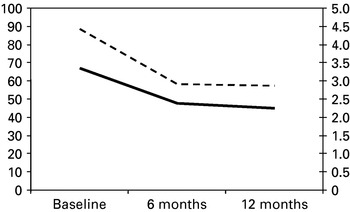
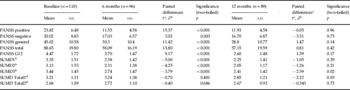
The changes in insight and psychopathology from baseline to the 12-month assessment are presented in Table 2. Psychopathology improved from baseline to 6 months but not thereafter. Insight into having a mental disorder, its social consequences and the need for treatment also improved during the first 6 months after the first episode. Subsequently, only insight into the consequences of the disorder and awareness of having psychotic symptoms improved from month 6 to month 12. Change in insight into having a disorder correlated with change in total psychopathology during the first 6 months (Spearman's ρ=0.422, p<0.001) (see Fig. 1).
Changes in psychopathology and insight into having a disorder. The left vertical scale represents the Positive and Negative Symptom Scale (PANSS; - - -) total score. The right vertical scale represents the Scale to Assess Unawareness of Mental Disorder (SUMD; –––) score, subscale 1 (insight into illness).

Insight and psychopathological changes over 12 months of follow-up

PANSS, Positive and Negative Symptom Scale; SUMD, Scale to Assess Unawareness of Mental Disorder; s.d., standard deviation; G12, insight item of the PANSS; SUMD1, insight into illness; SUMD2, insight into social consequences; SUMD3, insight into the need for treatment; SUMD Total1, insight into psychotic symptoms; SUMD Total2, attribution of psychotic symptoms to mental disorder.
a Paired t test.
b Wilcoxon signed rank test.
c Comparison between 6 months and 12 months.
d Sample sizes for SUMD Total1 and SUMD Total2 (which are analysed only when there are psychotic symptoms present) are: SUMD Total1 baseline n=92, 6 months n=69, 12 months n=48; SUMD Total2 baseline n=68, 6 months n=45, 12 months n=39.
Cross-sectional correlations between the PANSS insight item and SUMD scores
To examine the concordance of the two different measurements of insight, we correlated the SUMD scores and the PANSS insight item (G12). Item G12 correlated positively with all of the SUMD subscores, at baseline, 6 months and 12 months (Spearman's ρ at baseline: 0.36–0.55, p<0.01; 6 months: 0.47–0.69, p<0.01; and 12 months: 0.32–0.77, p<0.03), except with the ‘attribution of symptoms’ subscore at baseline and total awareness of symptoms and their attribution, at 12 months.
Cross-sectional correlations between insight and symptomatology
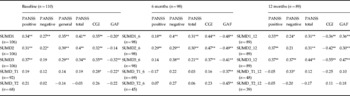
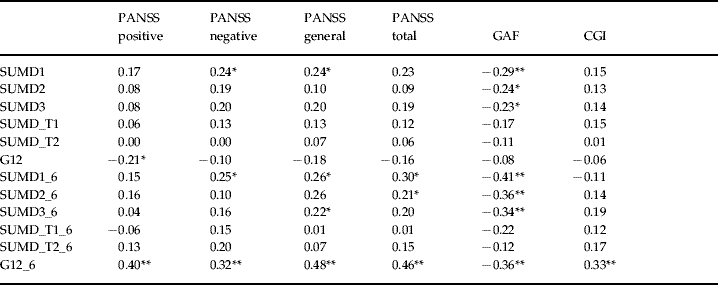
At baseline, 6 months and 12 months, there were significant correlations between three domains of insight (poor awareness of having a disorder, need for treatment, and consequences of the disorder) and severity of symptomatology (total, positive, negative and general) and global functioning, as measured by the PANSS, CGI and GAF respectively (see Table 3). In addition, better awareness of psychotic symptoms and their attribution to a mental disorder were associated with better functioning at 6 months.
Cross-sectional Spearman correlations between insight and psychopathology and severity of symptoms at baseline, 6 and 12 months

PANSS, Positive and Negative Symptom Scale; CGI, Clinical Global Impression Scale; GAF, Global Assessment of Functioning Scale; SUMD, Scale to Assess Unawareness of Mental Disorder.
SUMD1, baseline SUMD1; SUMD2, baseline SUMD2; SUMD3, baseline SUMD3; SUMD_T1, awareness of psychotic symptoms at baseline; SUMD_T2, attribution of symptoms at baseline; SUMD1_6, 6-month SUMD1; SUMD2_6, 6-month SUMD2; SUMD3_6, 6-month SUMD3; SUMD_T1_6, 6-month awareness of psychotic symptoms; SUMD_T2_6, 6-month attribution of symptoms; SUMD1_12, 12-month SUMD1; SUMD2_12, 12-month SUMD2; SUMD3_12, 12-month SUMD3; SUMD_T1_12, 12-month awareness of psychotic symptoms; SUMD_T2_12, 12-month attribution of symptoms.
* Correlation is significant at the 0.05 level (two-tailed). ** Correlation is significant at the 0.01 level (two-tailed).
Treatment compliance and insight
Treatment compliance at 6 months did not correlate with baseline SUMD subscores but did correlate with insight into having a disorder (Spearman's ρ=0.21, p=0.039), its consequences (Spearman's ρ=0.28, p=0.006) and the need for treatment (Spearman's ρ=0.26, p=0.012), at 6 months. Compliance at 12 months did not correlate with any of the SUMD insight measurements (baseline, 6 or 12 months).
Over-time correlations between insight and outcome
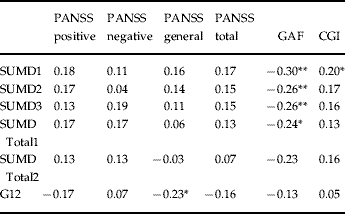
To evaluate the relevance of insight for symptomatic and functional outcome, we correlated baseline insight with outcome at 6 months (measured by PANSS, GAF and CGI scores), and baseline and 6-month insight with outcome at 12 months. Poor insight into having a disorder and its different symptoms, the consequences of having a disorder and the need for treatment at baseline all correlated with poor adjustment (as measured by the GAF) at 6 and 12 months of follow-up, as shown in Tables 4 and 5. Baseline PANSS G12 did not correlate with CGI or GAF measurements at 6 months, but 6-month PANSS G12 correlated with 12-month GAF.
Baseline insight scores and symptomatology and level of functioning at 6 months

PANSS, Positive and Negative Symptom Scale; GAF, Global Assessment of Functioning Scale; CGI, Clinical Global Impression Scale; SUMD, Scale to Assess Unawareness of Mental Disorder; SUMD1, insight into illness; SUMD2, insight into social consequences; SUMD3, insight into the need for treatment; SUMD Total1, insight into psychotic symptoms; SUMD Total2, attribution of psychotic symptoms to mental disorder; G12, PANSS item 12.
* Correlation is significant at the 0.05 level. ** Correlation is significant at the 0.01 level.
Baseline and 6-month insight scores and symptomatology and global functioning at 12 months

PANSS, Positive and Negative Symptom Scale; GAF, Global Assessment of Functioning Scale; CGI, Clinical Global Impression Scale; SUMD, Scale to Assess Unawareness of Mental Disorder, SUMD1, insight into illness; SUMD2, insight into social consequences; SUMD3, insight into the need for treatment; SUMD_T1, insight into psychotic symptoms; SUMD_Tot2, attribution of psychotic symptoms to mental disorder; G12, PANSS item 12; SUMD1_6, insight into illness at 6 months; SUMD2_6, insight into social consequences at 6 months; SUMD3_6, insight into the need for treatment at 6 months; SUMD_T1_6, insight into psychotic symptoms at 6 months; SUMD_T2_6, attribution of psychotic symptoms to mental disorder at 6 months; G12_6, PANSS item 12 at 6 months.
* Correlation is significant at the 0.05 level (two-tailed). ** Correlation is significant at the 0.01 level (two-tailed).
Insight and diagnoses
When the group of patients was divided into schizophrenia (n=33) and non-schizophrenia (n=64), the only insight dimension in which there was a difference was baseline insight into psychotic symptoms (SUMD Total1), with schizophrenia patients having poorer insight than patients with a non-schizophrenia psychosis (t=−2.25, p=0.028), an effect that was independent of differences in symptomatology between the two groups. We then compared schizophrenia versus bipolar patients (n=16), patients with schizophrenia showed poorer insight into having a mental disorder (Mann–Whitney Z=−2.6, p=0.007) and into its consequences (Mann–Whitney Z=−2.4, p=0.015) at 6 months. A very similar picture appeared at 12 months for insight into having a disorder (Mann–Whitney Z=−2.95, p=0.003).
Prediction analysis
To decide which variables were relevant for a prediction analysis, the schizophrenia and non-schizophrenia groups were compared on baseline and 6-month characteristics. PANSS subscales scores, SUMD scores, global functioning (C-GAS score) and pre-morbid adjustment (total PAS score) were compared. In addition to the poorer baseline general insight in schizophrenia already reported, pre-morbid adjustment was poorer in the schizophrenia group (Z=−2.34, p=0.019). None of the baseline psychopathological measurements (PANSS subscales) differed between the schizophrenia and non-schizophrenia groups. When the 6-month characteristics were compared between the two groups, only the negative symptoms subscale score was different, with more negative symptoms in the schizophrenia group (p<0.001). The variables included in the two different logistic regression analyses to predict diagnosis at 12 months (one equation for baseline characteristics and the other for 6-month characteristics) were: baseline G12 and PANSS negative, SUMD1 and SUMD Total1, and total PAS as possible baseline predictors of 12 month diagnosis. For the prediction of 12 month diagnosis from 6-month characteristics, we included 6-month G12 and Total negative score, SUMD1, SUMD3 and SUMD Total2.
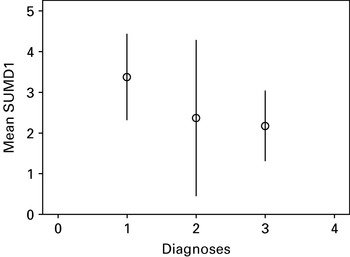
Poor insight into having a mental disorder at baseline [odds ratio (OR) 1.4, 95% confidence interval (CI) 1.05–1.97] and negative symptoms at 6 months (OR 1.19, 95% CI 1.05–1.36) increased the risk of a diagnosis of schizophrenia at 12 months. Awareness of having a mental disorder at 6 months came into the predictive model with a p value of 0.06. Removing this variable from the predictive model made a significant difference (p=0.047). Fig. 2 shows the mean and CIs of baseline SUMD1 for the three different diagnoses within psychosis.
Baseline awareness of experiencing symptoms of mental disorder and final diagnosis. Diagnoses: 1, schizophrenia; 2, bipolar disorder; 3, other psychoses. SUMD1, Scale to Assess Unawareness of Mental Disorder score, subscale 1. Error bars denote 95% confidence intervals.

To analyse predictive variables for subsequent functioning (measured by the GAF) with a linear regression analysis, we used the same criteria as with the logistic regression. All variables included followed normal distributions. The two linear regression analyses (with GAF at 6 and 12 months respectively as dependent variables) included baseline SUMD Total1, total PAS, and PANSS positive, PANSS negative and PANSS G12 scores as possible predictors. For the 12-month analysis, we also included 6-month SUMD, PANSS positive, PANSS negative, PANSS G12, and GAF scores. The only variable that predicted 6-month functioning was pre-morbid adjustment (p=0.04) and the only variable that predicted 12-month global functioning was 6-month global functioning (p<0.001). No insight or pre-morbid variables predicted functioning at 12 months.
Discussion
In our adolescent FEP sample, insight into having a mental disorder, its consequences and the need of treatment improved over the early phases of treatment. This is consistent with other longitudinal studies in first episodes of psychosis (McEvoy et al. Reference McEvoy, Johnson, Perkins, Lieberman, Hamer, Keefe, Tohen, Glick and Sharma2006; Sim et al. Reference Sim, Chua, Chan, Mahendran and Chong2006). However, it has also been shown that SUMD dimensions remain stable after an acute psychotic episode, although this has been shown in studies with repeated episodes (Cuesta et al. Reference Cuesta, Peralta, Zarzuela and Zandio2006) and not recent-onset cases such as ours. The only dimensions of insight that improved in our study 6 months post-episode were insight into the symptoms of psychosis and insight into the consequences of the disorder. Our study does not determine why this is the case, but the fact that the sample is very young should be explored. An effect of learning on the nature of psychotic disorders in a population lacking personal or life experience could be an explanation. The analysis of the data does not allow any conclusions to be drawn regarding awareness of mood symptomatology, as this is not measured by the instrument used.
Overall, poorer insight was associated with more prominent positive, negative and overall psychotic symptoms, at both baseline and follow-up. This finding may partially explain the improvement in insight during the first 6 months post-episode, as psychotic symptoms also improved in that period. This result is in accordance with the majority of studies in the adult literature, which show that, on cross-sectional analysis, there exists an inverse relationship between insight and degree and variety of psychotic symptoms (Markova & Berrios, Reference Markova and Berrios1992; Debowska et al. Reference Debowska, Grzywa and Kucharska-Pietura1998; Keshavan et al. Reference Keshavan, Rabinowitz, DeSmedt, Harvey and Schooler2004). However, there is no full agreement on the relationship between insight and severity of symptoms (Peralta & Cuesta, Reference Peralta and Cuesta1994a; Amador & Gorman, Reference Amador and Gorman1998). In fact, the lack of association between degree of psychopathology and insight (Cuesta & Peralta, Reference Cuesta and Peralta1994) has been used to support the notion of insight as a trait rather than a state marker of schizophrenia. The correlation of insight with symptom severity, together with the previously discussed finding that insight improves after a first episode but not after subsequent episodes, may argue in favour of insight being partially dependent on the mental status of the patient but also having some trait value. In fact, the effect sizes shown in the meta-analysis of Mintz et al. (Reference Mintz, Dobson and Romney2003) were very modest, indicating that only 3–7% of the variance in insight was accounted for by the severity of symptomatology. The clinical significance of the association was therefore seriously questioned.
One of the most salient findings in this study is that baseline insight is associated with poor global functioning at 6 and 12 months. However, although we did find significant associations between different dimensions of insight with both better pre-morbid and future global adjustment, we did not find that insight into illness, or any dimension of insight, including insight into the need for treatment as measured by the SUMD, was associated consistently with treatment adherence. The same association between poor pre-morbid adjustment and insight, which in turn is associated with poorer outcome, has been shown in adults (Addington & Addington, Reference Addington and Addington2005). The importance of functioning in the course of psychotic disorders is such that trying to improve insight from the very early stages of the disorder and assessing its effect on later functioning warrants studies with this specific target. Recent-onset psychosis is of particular interest, for the risk for depression and suicide in the first year following onset of psychosis has been shown to be significant (Addington et al. Reference Addington, Addington and Patten1998; Schwartz & Petersen, Reference Schwartz and Petersen1999; Birchwood et al. Reference Birchwood, Iqbal, Chadwick and Trower2000). Insight-related variables may further modulate this risk (Addington et al. Reference Addington, Addington and Patten1998; Schwartz & Petersen, Reference Schwartz and Petersen1999; Birchwood et al. Reference Birchwood, Iqbal, Chadwick and Trower2000). Therefore, insight improvement should be a target for psycho-educational or specific cognitive intervention studies. The interventions need to be adapted to young populations to reconcile realistic information about the illness with the psychological damage that could be derived from accepting a chronic disorder at such an early age.
Regarding treatment adherence, we need to acknowledge that measurement of compliance comprises some of the weakest data in this study, based as it is on only a subjective item. Allowing for this limitation, the literature does not support a strong correlation between general awareness and attitudes to treatment (David et al. Reference David, Buchanan, Reed and Almeida1992; Peralta & Cuesta, 1994 a; Cuesta et al. Reference Cuesta, Peralta, Zarzuela and Zandio2006). However, the cross-sectional correlation between insight and compliance at 6 months that does not persist at the 12-month follow-up warrants new studies and analysis of other variables that may influence this. Hypothetically, the more intensive intervention after the episode of psychosis could be one of the mediators of this association.
Poor insight into having an illness was associated not only with poorer functioning at follow-up but also with an increased likelihood of being diagnosed with schizophrenia at 12 months. Again, it is important to note that the assessment of insight was performed after most of the acute symptoms of psychoses had waned, just before discharge in the case of admitted patients or when the acute episode had significantly improved. No difference was found in baseline insight between schizophrenia and bipolar patients. However, at 6 and 12 months, schizophrenia patients showed poorer insight than bipolars. A study conducted under basic conditions similar to ours (first admission in FEPs with insight measured before discharge and at 6-month follow-up), but in an adult population (age range 15–60 years), showed that impaired insight at baseline was strongly associated with diagnosis, with the majority of psychosis-depressed patients having insight at that time, whereas fewer of the schizophrenia, bipolar and other psychoses patients had such insight (Fennig et al. Reference Fennig, Everett, Bromet, Jandorf, Fennig, Tanenberg-Karant and Craig1996). By the 6-month follow-up, the majority of the bipolar patients had gained insight into their illness, which the authors venture to explain by the fact that their psychosis had cleared up by then. However, many schizophrenia patients and a substantial proportion of the ‘other psychoses’ patients remained without insight at follow-up. The authors conclude that lack of insight seems to be associated with the presence of psychosis at the height of the episode but is differentially distributed by diagnosis later in the 6-month course. In the same way, our results suggest that, once the symptomatology has decreased at the 6-month assessment, other disease-related factors that were hidden by symptomatology at baseline may play a more significant role. During the acute psychotic episode, the severity of the symptoms seems to take precedence over other factors. Once the episode is more distant, the nature of the disorder or other associated characteristics (neurocognitive, psychological, etc.) may in turn influence gaining a more stable or illness-related insight into the disorder. This also argues in favour of poor insight having some trait value for schizophrenia. Regarding the diagnoses made in this study, we need to acknowledge the fact that the stability of diagnoses of the different psychoses in adolescence is very poor for disorders other than schizophrenia or affective psychosis (Hollis, Reference Hollis2000). We would therefore expect that adolescents in the ‘Other psychoses’ group would change to the bipolar or the schizophrenia groups. That will increase the numbers in these groups and therefore the statistical power of the results.
Adult studies using the same insight scale as we do have shown that nearly 60% of adult patients with schizophrenia have moderate to severe unawareness of having a mental disorder (Amador & Gorman, Reference Amador and Gorman1998). Using the very restrictive criterion of considering lack of insight a score of 5 on the SUMD subscales, our sample of adolescents with schizophrenia show null insight at baseline in 33–46% of the cases and null insight at 6 months in 9–15% of the cases, depending on the dimension of insight assessed.
With regard to the way of assessing insight during psychotic illnesses, the two methods used, the PANSS item G12 and the specific SUMD scale, seem to be similar in their main characteristics. They correlate with each other both at baseline and at follow-up, and have similar psychopathological correlates. However, in our study, the two ways of measuring insight differ in several aspects. First, G12 does not correlate with the attribution of symptoms dimension of the SUMD. Second, baseline PANSS G12 does not correlate with pre-morbid or 6-month functioning, whereas several subscales of the baseline SUMD do. Only after 6 months of disease course does PANSS G12 correlate with subsequent functioning. Third, the dimension ‘attribution of the symptoms to a mental illness’ behaves very differently from the other dimensions of the SUMD and the G12, with regard to both clinical correlates and changes over time. Correct/incorrect attribution of symptoms does not improve over time. Contrary to the other dimensions, it is not associated with severity of psychopathology at baseline or at follow-up. Cross-sectionally, more accurate attribution of symptoms is associated with better functioning at 6 months. The attribution of symptoms dimension therefore seems to capture some information that is not found in the other dimensions or the G12 and is probably related not only to the presence of acute symptoms but also to other individual characteristics. Finally, in our study, the SUMD had a predictive value in relation to the diagnosis of schizophrenia, but the G12 did not. Although individual studies (Amador et al. Reference Amador, Strauss, Yale, Flaum, Endicott and Gorman1993; Debowska et al. Reference Debowska, Grzywa and Kucharska-Pietura1998) and also a meta-analysis (Mintz et al. Reference Mintz, Dobson and Romney2003) have shown that using a uni-dimensional measurement of insight such as the PANSS item does not seem to differ substantially from using a multi-dimensional method, others have questioned this. According to Amador et al. (Reference Amador, Strauss, Yale and Gorman1991), this is explicit in the two main dimensions of insight: awareness of illness/symptoms and their attribution. Attribution of symptoms also appears in other studies as a dimension independent of the others (David et al. Reference David, Buchanan, Reed and Almeida1992; Varga et al. Reference Varga, Magnusson, Flekkoy, David and Opjordsmoen2007). This added dimension warrants the use of an extended evaluation of insight during first episodes of psychoses.
In addition to the measurement of compliance being subjective (although the information was gathered from two informants, parents and patient), the main limitation of this study is that reliability tests were performed for some of the assessment measurements (including the PANSS) but not for all (e.g. the SUMD).
As one of the first studies to assess insight specifically in childhood and early-onset schizophrenia and other early-onset psychosis, the longitudinal nature of the study and using a multi-dimensional assessment method for insight are the main strengths of this study.
Acknowledgements
This study was supported by CIBER07/09, CIBER de Salud Mental (CIBERSAM), and by the Spanish Ministry of Health, Instituto de Salud Carlos III.
Declaration of Interest
None.