

Identifying the place of policy models in technological learning processes
The ability of developing countries to raise incomes by diversifying and upgrading industries is encountering strong headwinds. Long-term trends, such as the increasing prevalence of long-distance production networks coordinated abroad and “premature deindustrialization,” mix with more immediate political threats to the stability of existing international trade regimes. This new context has prompted observers to surmise that the days of “easy,” rapid industrialization are over.Footnote 1 It has also enhanced the importance of understanding how successful industrial transformations, involving the acquisition of novel functional capacities, take place in the Global South—a question central to the “new industrial policy” literature.Footnote 2
This article contributes to this question by offering a perspective that asserts the dynamism and changing needs of the technological learning involved in industrial transformations. It builds on the controlled case comparison of two important capital-intensive industries, automobiles and petroleum, in Brazil and Mexico. By tracing the divergent pathways of technological learning taken by these four industries from 1975 to 2000, the proposed argument underscores the role of alternating state- and market-led industrial policy approaches in fostering the development and adoption of new industry-level functional capacities. It suggests that those paradigm alternations elicit cumulative episodes of March's (Reference March1991) “exploration” and “exploitation,” enhancing the acquisition of industry-level functional capacities. Specifically, state-based approaches, with their emphasis on overcoming power asymmetries that prevent local access to complex, tacit knowledge-based assets, are more likely to spawn efforts to uncover new market opportunities, relations, and potentially profitable technologies (i.e., exploration); while market-based approaches, which force firms and industries to compete and maximize the use of existing resources and capabilities, encourage the refinement of these existing capacities (i.e., the process of exploitation).
The four industry cases also suggest that two background conditions intervene decisively in the successful sequencing of policy approaches. The first, prior investments in learning, establishes whether an industry will be positioned on the exploration or exploitation phase of a learning cycle at a given time. Insofar as alternations elicit learning, this position indicates the subsequent changes that would be most complementary. Exogenous shocks constitute the second background condition. They generate opportunities for changes to business learning modes and industrial policy by disrupting status quo business models and forcing industry-level actors to reconsider how firms compete.
Taken together, these factors suggest a dynamic perspective on industrial policy—one that both elucidates how the type of prior learning affects new learning opportunities, and clarifies the role of punctuated exogenous shocks in creating crucial opportunities for shifts in direction in ongoing learning processes. Whereas previous industrial policy theory treats state- and market-based policy approaches as either comprehensive and mutually exclusive, or hybridized,Footnote 3 this study identifies complementary relations between them via the production of cumulative exploration-exploitation learning cycles. The proposed perspective also inspires a framework that recognizes three main learning pathways formed through different configurations of the independent variable and background conditions. This framework can be deployed as a rough predictive tool to assess how other industries might most effectively increase their technological sophistication.
The following sections develop the proposed argument for industry-level technological learning. Section 2 reviews the literature on technological learning, the new industrial policy, and the complementary processes of exploration and exploitation. Section 3 discusses our case selection and research methods. In section 4 we undertake a comparative review of the four industry case studies. Section 5 discusses some of the main theoretical implications of the argument and presents the proposed framework.
Updating the new industrial policy: From hybrid approaches to dynamic sequencing
A changing international context, alongside the discrediting of the once-dominant “Washington Consensus,” have reinvigorated academic interest in industrial policyFootnote 4—defined as any state-based intervention in markets in order to favor selected activitiesFootnote 5—as an important avenue to foster technological learning. This renewed interest has also brought with it an agreement on two rather broad assumptions. For one, most scholars share the view that, though elusive and contentious,Footnote 6 an ideal industrial policy approach, which balances market- and state-based sources of allocative decision-making, exists. That ideal hybrid follows neither the state-led “old industrial policy” of the post-war period nor the market-friendly Washington Consensus of the 1980s and 1990s. Instead of conceiving of them as rivals, it pursues a synthesis between the two.Footnote 7
The second common assumption of the new industrial policy literature suggests that once they strike that ideal state-market balance, public and private actors should, in a sense, “stick to it.” That is, they should maintain the same industrial policy approach, conceived of at the national level, over time. Given these two assumptions, Rodrik concludes that “getting the balance [between state and market perspectives] right is so important that it overshadows … all other elements of policy design.”Footnote 8
The search for this ideal balance represents the central task of two of the more prominent frameworks in the new industrial policy literature—the “self-discovery” and “national innovation systems” perspectives. The self-discovery perspective promulgates a policy model in which the state seeks feedback from the private sector to improve firms’ access to investment capital and production knowledge.Footnote 9 The state is called upon to cooperate with the private sector on policy design so as to avoid any “crowding out” of market information.Footnote 10
For its part, the national innovation systems (NIS) perspective focuses more on public goods provision and market regulation than state-supervised cost discovery. It emphasizes general education, research and development, and vocational training, as well as regulation of trade, antitrust, intellectual property rights, and market entry and bankruptcy.Footnote 11 These public investments in human capital and organizational know-how are ultimately intended to balance market competition.
Despite some differences in their favored policies, both perspectives display the new industrial policy's common features. That is, they seek to identify an optimal state-market balance as a largely “one-shot” proposition. This is not to say that these perspectives disown any notion of policy learning or a variety of available options. Rather, their solutions are largely determined up-front, and fail to explicitly account for the possibility that shifting learning needs at the industry level over time may require significant changes to how the state intervenes.Footnote 12
This article inquires into the basis of these assumptions. The central outcome of interest is the industry-level adoption of competitiveness-enhancing new functional capacities.Footnote 13 A new functional capacity can include the invention or adaptation of new product designs, production processes, branding and/or marketing.Footnote 14 It captures the process of technological learning.
Improvements in global competitive position, in turn, involve firms’ growing capacity to invest in further learning (e.g., increased profit margins), and/or their achievement of a given episode of functional learning necessary to accomplish subsequent ones (e.g., learning new computer software in order to develop new product designs). When an industry adds new functional capacities that allow it to create successful products and/or production processes that do not exist elsewhere, we refer to this as extending the “global technological frontier.” Progress toward this frontier embodies the transformation of workforce skills and accumulation of surplus that lie at the core of economic development.Footnote 15
Firms fall on a spectrum with regard to their rate of acquisition of functional capacities, and the extent of the consequent improvement in their global competitive position. To designate different levels of achievement along this spectrum, we propose three basic categories: “rapid” adoption of new functional capacities, in which an industry shifts from less technological knowledge than its competitors to extend the global technological frontier; “moderate” adoption of capacities, in which an industry enhances its technological position relative to its competitors without necessarily surpassing them; and “constrained” adoption, in which an industry's technological advancement is subordinated to preserve the existing competitive advantages of global leading firms.Footnote 16
In locating industries along this spectrum and revealing the sources of their differing performance, this study examines four cases—the petroleum and automotive industries of Mexico and Brazil—and takes a long-term perspective of their development. The review of a more extended period departs from the existing industrial policy literature, which advocates policy alternatives on the strength of their contrast to now out-of-favor Washington Consensus policies, but rarely subjects them to long-term tests of their own. Instead, we agree with Schneider's assertion that, in the new industrial policy literature, “apt metaphors are better drawn from evolving biological systems than from one-shot chemical reactions.”Footnote 17 Thus, the case analyses begin with the oil shocks of the 1970s and debt crisis of the early 1980s, and conclude by 2000, when the Washington Consensus model began to fall from favor. The argument that emerges from this analysis brings together key concepts from outside and within the industrial policy literature. We consider them next.
Sequencing industrial policy approaches via exploration and exploitation
The longitudinal comparison of the four cases suggests a more dynamic and adaptive perspective than those found in new industrial policy literature. Far from remaining stable, effective industrial policy approaches must respond to learning needs that shift over time between searches for new functional opportunities, on the one hand, and efforts to rationalize the discoveries produced by these searches, on the other. Competing policy approaches differentially support one type of learning mode over the other. Like any ideology or theoretical framework, they provide guidance and direction that highlight some issues, problems, and means of resolution while overlooking others. Most prominently, state-led approaches tend to emphasize the first mode by overcoming power asymmetries that prevent local access to complex, tacit knowledge-based assets. More market-led approaches speak more to the second mode by forcing actors to make the best possible use of existing assets and capabilities through exposure to stringent tests of market competition.
These findings echo March's (Reference March1991) observation that organizations must continually strive to balance between “exploration” of new functional capacities and “exploitation” of existing ones. Exploration is associated with “variation, risk taking, experimentation, play, flexibility, discovery, [and] innovation.”Footnote 18 It offers organizations the opportunity to gather information about alternative market niches and technologies. The outcomes of this learning mode are usually highly uncertain and remote in time, which explains why an emphasis on state assistance might be especially well-suited to supporting it.
Exploitation, by contrast, entails the deployment of information already available in an organization to enhance the efficiency of its existing technologies and functional capacities. March describes exploitation as involving “refinement, choice, production, efficiency, selection, implementation, [and] execution.”Footnote 19 Thus, a heavier emphasis on the rationalizing and disciplining effects of market-based competition may better serve this latter learning mode.
As March (Reference March1991) notes, it is complementarity rather than synthesis (as in the new industrial policy literature's hybrids) or rivalry (as between old industrial policy and the Washington Consensus) that maximizes the benefits of exploration and exploitation. He further cautions against excessive concentration on either learning mode, for it is in the concatenation of exploration-exploitation learning cycles that firms and industries may find the highest rewards. This admonition extends to the state- and market-led policy approaches. That is to say, overzealous state-based exploration may expend too many resources on new experiments without rendering them globally competitive. Conversely, a bias toward market-based exploitation may establish firms as highly competent in inferior activities, or deprive them of accessible alternatives during times of turbulence.Footnote 20
The case analyses below bear out March's insight on the complementarity of the two learning models. But they also illustrate some important industry-level “background conditions” that affect this healthy alternation. First is an industry's prior investment in learning. While scale of investment has long been a concern in development economics,Footnote 21 the salience of prior learning here revolves around its usefulness as an indicator of an industry's most recent position in an exploration-exploitation learning cycle. Such an understanding clarifies where policymakers and industry decision-makers should look for the most complementary subsequent efforts. Under an exploration-exploitation rubric, it indicates how states can target an industry's pathways for improvement in ways not suggested by the consultative tools of “self-discovery” or the broad-spectrum investments of NIS approaches.
Exogenous shocks to industries constitute the second background condition observed in the cases. That is because occasions for reform, and possible shifts in learning modes, are precipitated by moments of crisis. The insight suggests another potential indicator of how industries are successfully shepherded through cycles of exploration and exploitation. Evidenced consistently in the cases as well as in a variety of other studies on institutional and industrial change,Footnote 22 it adds dynamism to the relatively static approach of new industrial policy arguments. Although shocks in the form of severe recessions and incursions of new foreign competitors carry noteworthy risks, they also seem to serve as important learning opportunities where the reassessment of prevailing business models can be more approachable.
In sum, the longitudinal comparison reveals that these two critical background conditions—prior investment in learning, and shocks that provoke reassessments of the status quo—set the stage for the sequencing of different industrial policy approaches. Such sequencing is conducive to the addition of new functional capacities that move industries closer to the technological frontier. It is in underscoring the blessings of these policy paradigm alternations that the proposed argument offers suggestions not found in today's industrial policy literature.
Research design and methods: Establishing contrasts between the Brazilian and Mexican automotive and petroleum industries
Case selection
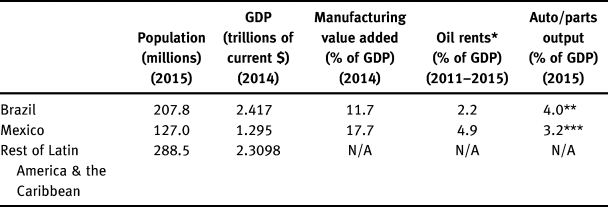
To examine the relationship between different industrial policy approaches and industry-level adoption of functional capacities, this article takes a long-term perspective focused on the experience of four industries: the petroleum and auto industries of Mexico and Brazil. The time period covers the last quarter of the twentieth century, bookended by the oil shocks of the 1970s and Debt Crisis of the 1980s on one side, and the collapse of the Washington Consensus in the late 1990s and early 2000s, on the other. This time period allows us to consider a common international context while also covering the rise and fall of a major development paradigm, the Washington Consensus.Footnote 23 The choice to compare the same industries in Mexico and Brazil, in turn, facilitates the observation of distinct national tendencies in the policy approach of two large, medium-income developing economies (see table 1). Indeed, scholars recognize their divergence, with Mexico tending toward a market-led policy design,Footnote 24 whereas Brazil frequently moves more in the direction of state-led development.Footnote 25
Descriptive statistics for the selected countries and industries

Although they adopted distinct approaches, neither country can be reduced to a simplified avatar of a single “market-led” or “state-led” approach to development. National-level contestation and subnational variation ensure that a number of hybrids and variants manifest in each country. Informed by studies at the industry level, this investigation homes in on the four industries—petroleum and automotive manufacturing in Brazil and Mexico—with attention to interactions between national-level economic and policy shifts, and industry-level attempts at reform.Footnote 26
The petroleum and automotive industries, while relatively technologically advanced within emerging economy contexts,Footnote 27 offer a set of contrasts that help isolate features of learning processes not specific to industry structure. Petroleum is in general much more capital-intensive than automotive manufacturing due to the size and cost of equipment in exploration, extraction, and processing.Footnote 28 State involvement in the petroleum industry has been historically much higher than automobiles, with state-owned petroleum monopolies displaying significant levels of domestic investment in both Mexico and Brazil for most of the twentieth century. Meanwhile, the relatively less capital-intensive automobile industry typifies a “producer-led” industry structure in which an established assembler from an advanced country orchestrates production through international supplier networks.Footnote 29 As such, the automotive industries present examples with less prior capital investment and state involvement.
By following these four industries’ evolution over a quarter century, this study explains how different sequences of industrial policy approaches impacted the accumulation of new functional capabilities. The following section describes the data collection and analysis process employed.
Data collection and analysis
This study draws from a thorough review of published literature and statistical sources to explain the relationship between industrial policy approaches and cross-industry differences in the adoption of functional capacities. The review drew from accounts of domestic learning in each industry since its founding to help ensure adequate context for the time period of focus (1975–2000). The countries, industries, and time period were selected deliberately to clarify useful explanatory patterns.
The case selection has advantages as well as limitations, including the questions of bias and generalizability. These concerns make it important to note three points. First, the variation in the outcome (i.e., acquisition of new functional capabilities) across the case industries was significant, facilitating informative comparisons. Second, the cases were not selected based on their outcomes, but on two key independent factors informed by the literature: national-level policy tendencies, and the industry structure. Finally, in terms of generalizability, the explanatory account developed here is pertinent primarily to relatively technology- and capital-intensive industries in middle-income countries.Footnote 30 These industries and countries occupy a significant portion of the space in which policymakers and business leaders are searching for ways to move into more knowledge-intensive, higher-technology fields that may spur economic growth.
Accounting for industry-level technological learning trajectories
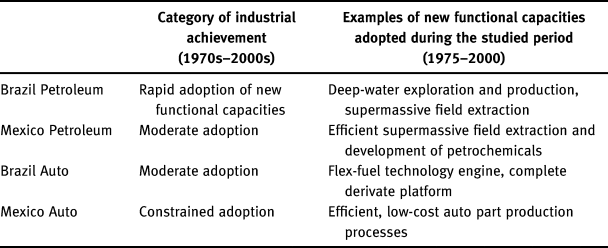
Table 2 highlights the variation across the cases in terms of the acquisition of functional capacities. By this measure, the Brazilian petroleum industry offers a case of “rapid” adoption. From 1975–2000, the industry developed new technologies not possessed by other global leaders in the same industry. It accomplished this by extending the global frontier in deep-water exploration and production, as well as serving as a leader in joint ventures with the world's most advanced private firms. The Offshore Technology Conference, the main association for the offshore oil industry, recognized Petrobras for its technical achievements, granting it its highest honor in 1992 and 2001. The discovery of massive reserves compounded such technological prowess, vaulting Brazil from a heavily import-dependent energy economy to one of the major exporting prospects of the coming century.Footnote 31
Expected and observed levels of technological learning for the studied industries, 2000

The Mexican auto industry languished at the opposite extreme, its “constrained” performance providing only limited examples of novel and unique functional capacities. While its increased integration with the United States market boosted the industry's total production and exports, the industry's growth was premised upon imported technology and low-wage, non-unionized labor. And though it became efficient in producing complex components (e.g., engines), almost all product design and development took place abroad, leaving domestic firms and workers largely without capacity to create difficult-to-replicate products and processes related to the design and production of auto parts, models or platforms. Instead, despite high levels of foreign direct investment (FDI), the industry has maintained a largely unchanged position as a global supplier since the 1970s,Footnote 32 leaving it vulnerable to new entrants.
Ahead of the Mexican auto industry but behind the Brazilian petroleum industry, the Mexican petroleum and Brazilian auto industries accomplished “moderate” adoptions of new functional capacities that allowed them to reach a position alongside a smaller number of global competitors. The Mexican petroleum industry achieved high productivity within a largely vertically integrated domestically-owned industry structure. During the 1970s, it discovered and exploited supermassive fields in the South of Mexico, establishing the country's proven reserves as the world's eighth-largest globally, and increasing output over fourteen-fold from 1973 to 1982. That made Pemex the third-largest oil-producing firm in the world. It achieved a highly efficient production model, attaining impressive operating profits (pre-tax) of over 56 percent, higher than Norway's Statoil and Russia's Gazprom, and well ahead of leading private oil companies’ average (15 percent) as well as that of Petrobras (11.5 percent).Footnote 33 The industry also made inroads in petrochemical research and development in the 1970s and 1980s, such that the state-owned petrochemicals research agency (IMP) designed, in partnership with researchers at Mexican universities, over forty refining catalysts that it sold to Pemex and other private-sector clients.Footnote 34
Finally, the Brazilian auto industry hosted the largest number of MNC assemblers of any country in the worldFootnote 35 and stood out for its adoption of a number of distinct functional capacities. One involved the local design and development of a unique flex-fuel technology engine, which allowed Brazilian manufacturers to produce cars running on varying proportions of ethanol and gasoline. Brazilian automakers also advanced significantly through the local design and production of partial and complete derivate platforms suited to the particular conditions of emerging economies. Examples include the Volkswagen BX and Fox families, the Fiat P178 family (not including the Fiat Palio), and the General Motors Meriva family.Footnote 36 As Lema et al. (Reference Lema, Quadros and Schmitz2012) explain, not only did substantial R&D occur in Brazil, but the country also became a hub for subsidiaries’ development of new products geared toward Global South markets. Thus, though automakers in the country have not yet designed an entirely new platform—a functional capacity that would put their progress on par with Brazilian petroleum industry—their innovations moved the industry closer to the global frontier, well ahead of its Mexican counterpart.
Background conditions: Prior investments in learning and exogenous shocks
If table 2 demonstrates the significant variation across the four studied industries in terms of their adopted functional capacities, it also shows that no simple ordering of the outcome by country (i.e., Brazilian industries ahead of Mexican ones, or vice versa) or industry (i.e., petroleum industries ahead of auto ones, or vice versa) exists. Rather, the analysis of the four cases suggests a more complex set of relationships, in which prior histories interact with ongoing changes to determine industry-level learning. Here we consider the relevance of the two background conditions: the content of an industry's most recent episode of learning, and the exogenous shocks that open discrete “windows of opportunity” for new learning episodes.
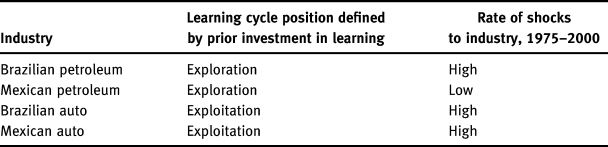
The role of industry structure emerges as relevant in terms of how it affects an industry's recent investments. The case histories show that, because of their specific structures and institutional arrangements, the industries each had distinct organizational and capital investments during the time immediately preceding the studied period, influencing their initial position on the exploration-exploitation cycle. The petroleum industries of the two countries favored exploration early on (see table 3). Both were state-owned, with large employment bases. The Brazilian government spent billions of dollars from the 1950s through the 1970s on Petrobras’ entire supply chain, from exploration, to distribution and petrochemicals.Footnote 37 Likewise, Mexico's Pemex has been described as “the most perfect self-contained, vertically integrated monopoly.”Footnote 38 In both, the state also invested in national institutes for research and training, large infrastructure such as pipelines and refineries, and their citizens’ advanced technical training abroad.Footnote 39
Background conditions by industry, 1975–2000

By contrast, the auto industries largely focused on exploitation, thus lacking comparable investments in domestic exploration at the onset of the period. The most knowledge-intensive functions for both auto industries remained in overseas MNC headquarters. Local subsidiaries preferred to exploit existing technology,Footnote 40 and governments in both countries mostly avoided exploration-supporting interventions.Footnote 41
Beyond prior investments, the prevalence of exogenous shocks at the industry level also proves an important background condition shaping outcomes. In rendering status quo business models untenable, shocks may challenge prevailing industrial policy approaches by underlining their limitations.Footnote 42 Such disruptions add a mechanism of change during learning processes. They open windows for industry-level decision-makers to reassess the policies deployed to encourage new advancements. It therefore makes sense to say that the greater the number of shocks encountered by a given industry, the more often its main decision-makers are prompted to seek new functional capacities.
The variation in the extent to which the four industries encountered exogenous shocks during the period of study shows an important relationship to their learning outcomes. Both auto industries and the Brazilian petroleum industry faced numerous shocks, occasioning frequent reassessment and readjustment. The Brazilian auto industry encountered consistent balance of payments problems in the 1970s, the oil shocks of 1973 and 1978, and back-to-back recessions in the 1980s and 1990s, among other shocks. The Mexican auto industry was also rocked by numerous shocks, including balance of payments crises in the 1970s, labor unrest in the 1980s, and recessions in the 1980s and 1990s. The Brazilian petroleum industry, in turn, saw balance of payments problems, oil shocks, and growing competition in the 1970s; the debt crisis of the 1980s; and the structural adjustment programs of the 1990s.
Such shocks fostered significant changes. For example, in Brazil's auto industry, the oil shocks of the 1970s incited discussions among assemblers and policymakers about ways reduce gasoline usage. In Mexico's auto industry, labor mobilizations in the 1980s raised debates about tensions between export competitiveness and labor costs. And in Brazil's petroleum industry, the country's continued balance of payment problems forced re-examinations of public investment in state-owned firms, where Petrobras, as the primary agent of Brazil's pursuit of national energy independence, took center stage.
Mexico's petroleum industry provides an interesting contrast to these cases insofar as it largely avoided immediate shocks to its business model after one at the beginning of the studied period. While Mexico's national economy underwent massive structural reforms almost throughout 1975–2000, its national petroleum industry remained surprisingly stable after an early shift toward the export market.Footnote 43 This underscores the importance of a specific focus on the industry-level: Pemex's phase of massive expansion in the late 1970s–early 1980s established it as a bastion of stability and even “slack”Footnote 44 for the Mexican state, supplying as much as 40 percent of the government's annual revenue,Footnote 45 and thus creating a degree of insulation from industry-level restructuring during national-level shocks. This absence of direct shocks challenging the industry's viability deprived it of many opportunities to adapt and update its business model with new functional learning, which went mostly unchanged from the early 1980s forward.
These observations underscore how, while an emphasis on variation in recent prior investments in learning represents a first challenge to the new industrial policy literature's assumptions about a purportedly “ideal” state-market balance, the role of exogenous shocks as opportunities and signals for change further undermines its expectations about the desirability of the stable implementation of that same “ideal” approach over time. Instead, attention to exogenous shocks suggests a multi-faceted, process-oriented industrial policy approach.
However, while the presence of exogenous shocks may create openings for new industry-level shifts, a review of the cases shows that they are in no way deterministic. That is because how the studied industries took advantage of such opportunities varied and, as the following section explains, that variation proved crucial in influencing outcomes.
Policy sequencing and the complementary processes of exploration and exploitation
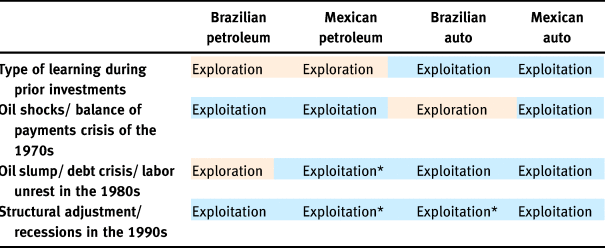
While prior investments and shocks established crucial background conditions for industry-level variation, it was the alternation of exploration and exploitation processes, fostered by sequenced state- and market-led industrial policy approaches, which emerged as the prominent explanatory factor in the cases. Indeed, the case studies reveal a positive, relatively linear relationship between the number of successful exploration and exploitation cycles, and increased functional capabilities. Table 4 presents an initial illustration of that relationship.
Prior investments, shocks, and industrial policy approach alternations by industry, 1970s–2000s

*Shocks not felt at the industry-level
The table shows that all of the industries with the exception of the Mexican auto industry underwent alternations between exploration and exploitation buttressed by industrial policy sequencing. First, the Brazilian petroleum industry, which achieved “rapid” adoption of new functional capacities, entered the period in an exploration phase bequeathed by prior investments. It then took a turn to exploitation in the 1970s, before moving through a full cycle of exploration and exploitation over the 1980s and 1990s. The questions that arise are how these alternations came about, and how they manifested a stronger impact on learning in that industry.
During the studied period, Petrobras went from largely processing imported oil to become one of the world's leaders in deep water petroleum exploration and production (E&P). It entered the period with a partially-developed E&P capability based on prior public investment during the 1960s and early 1970s.Footnote 46 Slow results combined with urgent energy and budget crises prompted a switch to exploitation in the mid-1970s as the state pressured Petrobras to hasten its E&P capacity by inviting foreign competition.Footnote 47 Petrobras committed to intensive honing of its capacities. This culminated in the early 1980s with a series of discoveries of massive fields in the Campos Basin,Footnote 48 bringing the possibility of national energy independence within reach for the first time.
That long-held dream faced a considerable setback in 1986, when surplus petroleum from OPEC and anemic global demand created a global oil price slump and industry contraction. The exogenous shock sent a clear signal, as foreign firms abandoned deep-water projects, which were risky and expensive. This left Petrobras in control of massive recent discoveries, but at depths inaccessible to any existing technology; and Petrobras had no ready partners to extract it.
Responding to the shock, Petrobras, with significant state support, swung its efforts back towards exploration in order to bring the Campos Basin into production.Footnote 49 As Furtado and Freitas ((Reference Furtado and de Freitas2000), 32) note, Petrobras sought to advance from “stage 1” projects devised to co-sponsor technology customization into “stage 2” projects, in which foreign partners would share the costs of the firm's in-house innovations. These “stage 2” projects generated innovative semi-submersible platforms with pumping mechanisms at unprecedented sea floor depths, producing a series of world records by the start of the 1990s and allowing Petrobras to begin its operations in the Marlim field, the world's deepest underwater oil well at 721 meters.Footnote 50
However, when Brazil's staunch persistence in debt-financed import-substitution efforts finally collapsed in an IMF-sponsored structural adjustment program at the end of the 1980s, Petrobras suffered a sharp reduction in investment along with the rest of the Brazilian economy.Footnote 51 Petrobras’ budget constraints prevented it from meeting its production goals,Footnote 52 causing much frustration in the Brazilian state. This frustration immediately translated into a new phase of change for the firm, as state decision-makers introduced a liberalization program in 1995. The program significantly increased opportunities for foreign competition to extract Brazilian reserves, pressuring Petrobras to learn to use its new technologies in a globally competitive manner. The liberalization program also reformed corporate governance, enhancing the firm's decision-making autonomy while rendering it answerable to international shareholders, from whom it could also access much-needed investment capital.
These changes forced a shift from exploration to exploitation, unleashing the organization's capabilities. In the first six years after liberalization, Petrobras’ total factor productivity doubled, while its labor productivity nearly tripled. Able to capitalize on its prior investments in world-leading technologies, Petrobras doubled domestic petroleum output and increased its known domestic gas reserves sevenfold between 1997 and 2007.Footnote 53 By the end of the liberalization period, it had achieved the goals of national self-sufficiency and established itself as a global leader in deep water E&P.
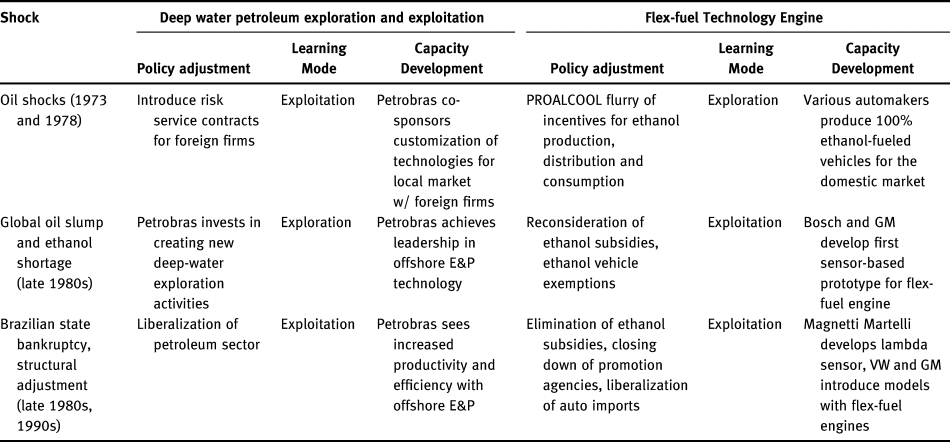
The remarkable success of Brazil's petroleum industry was only partially matched by the country's auto industry, which offers some interesting parallels in its learning successes despite a smaller number of exploration-exploitation cycles and, consequently, less overall technological learning during the time period. In this case, a series of exogenous shocks led advocates in the public and private sector to introduce policy sequencing conducive to alternations between the two learning modes. These delivered new and unique functional capacities, including the ability to design commercially viable flex-fuel technology engines (see table 5).
Exploration, exploitation, and the adoption of new functional capacities in Brazil: Deep water petroleum exploration and exploitation, and the Flex-Fuel Technology Engine

The first stage of the development process of the flex-fuel engine, involving exploration, originated with the oil shocks of the 1970s, which underscored the problems associated with surging oil demand.Footnote 54 In response, the national government, in collaboration with the industry, sought to foster a shift to ethanol-powered vehicles. It instituted the sprawling National Alcohol Program (PROALCOOL) to spur sugar-based ethanol production, distribution and consumption. It also offered tax exemptions costing around USD $30 billion over twenty years for ethanol-fueled cars and subsidies for ethanol consumers. The main automakers and their tier 1 suppliers quickly responded with exploratory learning. Fiat developed its first model in 1979, followed soon after by the Volkswagen Gol. By 1981, the first 100 percent ethanol-powered cars were sold in the domestic market. Over the next few years, demand surged, with sales peaking in 1985–86, when they represented 90 percent of new domestic vehicle purchases.Footnote 55
However, that state-led period of exploration would come to an abrupt end with new shocks in the late 1980s, ushering in an era of exploitation. Falling oil prices, coupled with a paralyzing shortage of ethanol in the domestic market, undermined consumer interest in exclusively ethanol-fueled cars.Footnote 56 The signal was clear: Without changes, ethanol-fueled cars would not survive in the new environment. Moreover, the federal government's bankruptcy on the heels of the debt crisis severely curtailed its generous support for an ethanol-based economy, as it cut subsidies, closed down promotion agencies and even opened the market for car imports.Footnote 57
The outcome of this crisis was two-fold. Initially, ethanol-fueled car sales plummeted. But the shocks, and the competition they spawned, also instigated an urgent search for an engine that, while retaining the capacity to run on ethanol, could also use gasoline. This prompted a process of exploitation that built on the previous exploratory ethanol-fuel stage. The refinement of such a novel flex-fuel technology engine to commercial viability took close to a decade of intensified market competition. The main difficulty involved engine detection and adjustment to changing gasoline-ethanol ratios.
The main competitors were the Brazilian-based subsidiaries of three tier 1 suppliers (Bosch, Delphi, and Magnetti Martelli) and two large automakers (Volkswagen and General Motors). After an initial Bosch sensor-based prototype (modeled after a flex-fuel engine developed in Detroit in 1988) failed in 1994 due to its high cost and excessive sensitivity to the water in Brazilian ethanol, Magnetti Martelli produced a successful alternative—the so-called lambda sensor—in the late 1990s. The technology became commercially available in 2003, as Volkswagen and General Motors rolled out their Gol (Magnetti Martelli) and Polo (Bosch), and Corsa (Delphi) models, respectively. Over the next decade, the technology would prove to be a remarkable success.Footnote 58
If the Brazilian petroleum and auto industries engaged in cycles of exploration and exploitation that spanned the entire studied period, the Mexican petroleum industry only underwent such a shift early on. And, like the Brazilian auto industry, it only achieved a “moderate” adoption of new functional capacities. The industry had entered the period in a phase of exploration that resulted in new capacities in the early-mid 1970s. A federal plan announced by President Echeverría in 1970 committed $18 billion USD in investment for economic self-sufficiency, paving the way for discoveries of some of the country's largest fields in in the Bay of Campeche in 1972, as well as early progress in R&D in petrochemicals that delivered results with the completion of an own-designed hydrodesulfurization catalyst in 1974. These developments were the basis for Pemex's massive expansion as a global petroleum exporter.
The policy pendulum began to swing toward exploitation in the late 1970s, when onerous payments on an IMF loan, slow domestic growth, and volatile global demand prompted a new Pemex director, Jorge Díaz Serrano, to commit the firm to major increases in output and exports. Although a “populist” faction that supported more state-led policies ousted Díaz Serrano, their victory came just before the massively destructive Debt Crisis struck in 1982. The crisis plunged Mexico into a decade of severe austerity and political-economic transformation. State investment in petroleum and other industries was choked off, and the high-productivity, high-export model became the template for Pemex. The industry also emerged as a bastion of government revenue and much-needed stability in the midst of a protracted transformation of the state's relationship to capital, both domestic and foreign, as well as labor. Under these circumstances, Pemex had to maintain its level of output while undergoing massive cuts in state investment, its oil revenues facilitating the state's pivot toward market liberalization. That challenge of maintaining existing results with less resources persisted from the mid-1980s forwardFootnote 59—as did the market-led approach and its associated exploitation learning mode.
Lastly, the Mexican auto industry, with its “constrained” adoption of new functional capacities, illustrates the possible limitations to repeated reforms within the same learning mode. Although the industry was battered by numerous exogenous shocks, its decision-makers responded not by sequencing industrial policy approaches, but by steadily pursuing the same market-led approach associated with exploitation. Thus, for instance, the debt crisis and labor strife of the 1980s led to the refinement of Mexico's ongoing integration as an assembly site in North America by accelerating the shift of much of the industry's production to the northern border, along with a transition from union-based labor relations to the non-union, low-skill “California” alternative.Footnote 60 Similarly, the 1990s recession resulted in market-oriented import liberalization, further reducing the priority given to the domestic market. As a result of this emphasis on market-based exploitation, the industry acquired few new functional capacities, leaving it subservient to global brands’ imported technology, and devoid of the ability to engage in novel designs, whether at the level of components or overall vehicles. Instead, the industry has leveraged its privileged NAFTA access to greatly expand efficiency and output, boosting its exports. While this carries some advantages, the industry's weaknesses are becoming increasingly evident as discussions of changes to NAFTA, as well an increasing number of countries capable of similar production expertise, cast a growing shadow over its future prospects.
Industry-level technological learning: Punctuated, dialectical, and political
The case analyses reveal that, in accounting for industry-level adoption of functional capacities in the four industries, the key differentiating factors included two background conditions—prior investments in learning and exogenous shocks—and one central explanatory factor, the sequential alternations between policy paradigms that trigger shifts between processes of exploration and exploitation. Not only do these factors account for the observed variation; they also suggest some modifications to the dominant view of “new industrial policy” as a method of combining the best of different approaches.
As it stands, the conventional wisdom on new industrial policy rests on two important assumptions: first, that “old” industrial policy can be rehabilitated by actively involved states that strike a new, more nuanced balance between the public and private sectors’ roles in allocative decision-making; and second, as a consequence of the first, that a one-shot model of reform that responds to bottlenecks evident at a given moment across the national economic landscape should be pursued. The findings from the cases suggest that this model is in need of a greater recognition of how appropriate policy responses change from industry to industry based on recent experiences in market competition and technological learning, as well as how effective policies anticipate changing learning needs over time.
For one, bringing attention to an industry's recent investments in functional capacities clarifies where it is situated on the exploration-exploitation learning cycle at a given moment. This is important information for would-be reformers—its recognition in the Mexican automobile industry, for example, might have converted more learning attempts into gains for that industry's functional capacities. But more is needed than awareness of the most recent type of learning mode pursued.
In particular, the importance of exogenous shocks is apparent throughout the cases. Across industries, when a shock disrupted the capacity to compete effectively or to meet existing demand, decision-makers mobilized to diagnose the problem and enact corresponding responses. While consistent across the cases and documented elsewhere,Footnote 61 this pattern entails two caveats: First, given prior investments, responses to the openings for reform prompted by shocks must build appropriately on the preceding learning mode. The Mexican auto industry, which experienced frequent shocks but largely repeated similar reforms each time, again illustrates the need to consider recent experience.
Second, the salience of an exogenous shock can vary based on an industry's status relative to other sectors in its national context. Although the Mexican economy went through numerous painful shocks and structural reform efforts throughout the studied period, its petroleum industry remained remarkably stable after an early shift. This partially negative case suggests that actors can either view an industry as a source of “slack”Footnote 62 to provide resources to help respond to crises, or as the site of crisis itself. During a time where the state was struggling to minimize social conflict while it reconfigured itself and its growth model, Pemex remained a cornerstone of national tax revenues. The fact that shocks register differently for industries based on their status relative to other state projects shows that further consideration is needed of how industries fit into a national political economy.
Finally, the case studies illustrate an overarching dynamic: If an industry employed a state-led approach in one episode, and turned to a market-led approach in the next, it was likely to attain better overall cumulative learning results than if the same approach was applied consecutively. This finding appears paradoxical through the lens of both older and newer industrial policy arguments, insofar as it suggests that progress is made not through steadfast commitment to market- or state-led approaches, nor through their hybridization, but rather through a dialectic between them. Different paradigms highlight distinct issues, problems, and means of resolving them, and the case studies reveal the benefits of sequencing them. This phenomenon was prominent in Brazil, where it led to remarkable advances, including deep water E&P, and flex-fuel engine technologies in the petroleum and auto industries, respectively. It also arose early in the case of the Mexican petroleum industry, where new discoveries and investments in field exploration and petrochemical capacity in the early 1970s were capitalized upon in the late 1970s and early 1980s to form an organizational model of efficient, high-volume production that undergirded the Mexican political economy the next thirty years.
The changes from one period to the next in the cases support March's (Reference March1991) “exploration-exploitation” model of organizational learning. During the application of state-led approaches to reform, industries tended to invest in new functional capacities, corresponding to the exploration side of the dynamic. This was the case during the 1970s in both petroleum industries, and in the Brazilian auto industry. In contrast, during episodes of market-led reform, industries were exposed to foreign competition and pressured to pursue efficiency gains with respect to existing capacities, thereby engaging in “exploitation.” This process unfolded in the Brazilian petroleum industry, both in the surprise policy shift to risk contracts in 1975 and the liberalization process of the 1990s. It also arose in the Mexican petroleum industry early in the 1980s. Similar instances of exploitation were evident in the Brazilian auto industry during the 1990s.
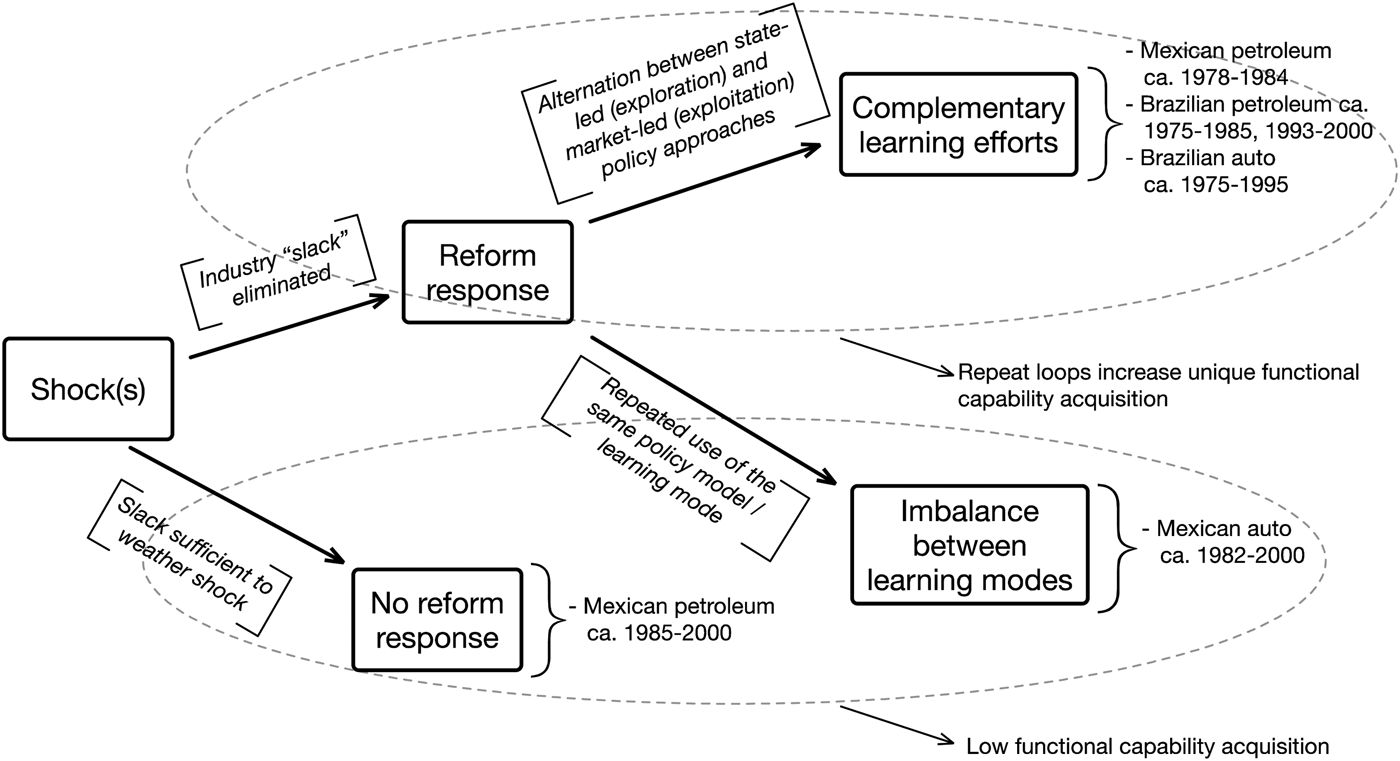
These aforementioned findings provide the building blocks for a framework (see figure 1) to assess how the background conditions of prior investments in learning and exogenous shocks, along with the central explanatory factor of policy shifts, all relate to the production of different degrees of new functional capacity at the industry-level. The framework recognizes three main pathways based on the status of the key variables. First, it assumes that sooner or later industries will experience shocks of some sort, whether through foreign competition, domestic macroeconomic shifts, or changes in consumer demand. Attention to such shocks is important because these are the moments when actors are most likely to commit to potentially costly efforts at changing business models and policy approaches. Yet even with a major shock to the industry's status quo, a pathway of non-reform is possible if the industry possesses enough “slack”—whether through its own resource base or due to its position relative to other industries in a national economy—to allow actors to choose to weather the crisis rather than undertake serious reconsiderations of the industry's competitive model. This pathway is exemplified by the Mexican petroleum industry after the debt crisis of the 1980s until the end of the case study time period.
Functional Learning Pathways

If, however, a shock affects an industry's stability enough for decision-makers in the public and private sector to seek significant changes to its business model, two more pathways are possible. If the reforms undertaken are of the same variety as those that were undertaken in a previous phase—say, consecutive rounds of market-based reforms that emphasize the exploitation of existing functional capacities—the risk runs high of an imbalance between learning modes along the lines of what the Mexican auto industry experienced throughout the studied period. If, however, the current reform episode alternates with recent efforts—either searching for new functional capacities after recently honing previous ones, or honing newly-acquired capacities—then the industry is much more likely to benefit from the complementarity of learning modes. This was observed in the Mexican petroleum industry during the early portion of the study period, as well as throughout one cycle of exploration and exploitation in the Brazilian automotive industry. The fact that the Brazilian petroleum industry experienced the highest degree of new functional learning—in terms of benefits for market competitiveness as well as uniqueness among global industry peers—and also experienced a second alternation between exploration and exploitation is suggestive of cumulative benefits of undergoing more cycles between learning modes. Given the background factors observed, such a benefit to alternation would also be conditional on attention to the importance of shocks and recent learning episodes.
This framework can be deployed as a rough predictive tool to assess how industries might most effectively increase their technological sophistication based on A) what are the potential or actual sources of disruption that might motivate coordinated efforts to reform an industry, B) what an industry's most recent efforts at new learning consisted of, and C) what subsequent effort would be most complementary to the previous one in terms of cycles of exploration and exploitation. The basis of the model in a small-n case study means that the known configurations leading to different outcomes can currently only be crudely drawn—factors such as shocks and slack can only be described as present or absent, for example. Likewise, we are dependent on the variation among four cases for the spectrum and types of differences in functional learning observed. Furthermore, the sources of variation in the causal factors that were discovered in the case analysis—e.g., the incidence of exogenous shocks, or the sources of shifting preferences for policy approaches—will have to be a subject of future research.
Already in evidence in the industry cases are some dynamics that would have to be addressed in a causal account of a policy paradigm's political emergence. This is a question of how coalitions that form in response to changes in the relationship between domestic industries and the global economy. Such coalitions, in evidence across the four cases, comprise alliances between actors in the public sector, distinct subsets of firms (e.g., domestically vs. foreign-owned, clusters in different regions), organized labor, and other civil society groups. Coalitional approaches to policy reform in developing countries have been introduced through a number of informative political science studies.Footnote 63 They could be usefully connected to our explanatory framework, helping to pinpoint the sources of policy alternations at the industry level by applying and extending the literature's lessons at the subnational level.
At the same time, the evidence on-hand suggests interrelations between crises, coalitions, and policy ideas that are too complex for political coalitions to serve strictly as independent variables in determining industry learning outcomes. This is in evidence across the cases insofar as policy changes sometimes occurred when governing coalitions were stable, while new coalitions sometimes preserved or extended existing paradigms even across crisis events. The first possibility (stable coalitions shifting policy models) is exemplified by cases such as Mexico in the 1980s, when the same governing party (the PRI), once confronted by an almost total exit of domestic and foreign investment, abandoned state-led approaches in favor of one that was much more market-driven and foreign investment-led. Likewise, there were times when new coalitions came to power and built on, rather than reversed, their predecessors’ and rivals’ approaches, even in times of instability, such as the transition from the centrist Social Democratic party (PSDB) under Cardoso to the further-left Workers’ Party (PT) under Lula at the end of the observed period. Thus, while political coalitions are centrally involved in the process of reform, in the cases and data analyzed here, their actions appear to be highly influenced by large-scale pressures that indicate when a given policy model is tenable versus exhausted. This poses a question for future research: how do governing coalitions determine when “the writing is on the wall,” so to speak, that it is time to seek a new policy approach? This study's focus on only the crises that manifested with the highest magnitude does not allow for such contingency to be observed. Therefore, future analyses should collect more primary data regarding a wider range of events, with market shocks and political economy shifts of different sources and magnitudes.
Future research will also need to further consider the role of institutions and groups that mediate between national-level policy reforms and firm-level shifts in business models and practices. The argument proposed here suggests that the broad outlines of these meso-level institutional arrangements are, at least in part, captured by the background condition of prior investment; and that their roles are, at any given time, mostly shaped by the prevailing policy approach of the dominant coalition. At the same time, a more thorough account of mediating institutions’ influence would incorporate more cross-sectional comparisons of the same types of institutions, and/or more longitudinal explorations of changes within the same institution over time.
The framework's constraints also highlight other scope conditions of the argument proposed here, as well as additional promising avenues for future studies. Above all, the observed advantages of sequential alternations between exploration under state-led reforms, and exploitation under market-led ones, suggests that forthcoming research and policy need to recognize a place for both paradigms, and perhaps healthy competition between them. As pronouncements of the “death” of one policy paradigm after another arise, the natural response has been to look for something entirely new, often with ambiguous results. An alternative identified here is that more attention is needed on the relationships between existing approaches. This can hopefully facilitate further discovery regarding the formation of appropriate long-term learning sequences. Future research could build on the findings offered here by identifying more precisely the indicators of an industry's position in a learning sequence, as well as what policies help industries make effective transitions between episodes of exploration and exploitation.
By undertaking these tasks, and building on the argument and framework presented here, scholarship on development can move forward on the long-important question of how industries learn and specialize in a competitive global market. Such efforts hold the promise of helping to respond to emergent shifts in the contours of globalization—shifts poised to alter fundamental aspects of the established opportunity structure for development.