INTRODUCTION
One of the many intricacies of language that young children must manage is that individual objects can invite many labels from speakers. Sometimes these labels can occur at different levels of description, such as when a cat is referred to by its proper name (Vince) and animal type (cat), but in many cases the labels occur at the same level of description. For example, ‘Vince’ the cat has also invited a variety of nicknames (stinky, kitty, Ibsen), depending on the speakers' intent in producing the label (e.g. Clark, Reference Clark1997; Tomasello, Reference Tomasello1999). Previous research suggests that preschoolers will sometimes initially resist accepting second labels for already named objects and that this initial resistance is predicted by a variety of word learning heuristics (e.g. mutual exclusivity and others; e.g. Golinkoff, Mervis & Hirsh-Pasek, Reference Golinkoff, Mervis and Hirsh-Pasek1994; Jaswal, Reference Jaswal2010; Jaswal & Hansen, Reference Jaswal and Hansen2006; Markman, Reference Markman, Gunnar and Maratsos1992, Reference Markman, Gleitman and Landau1994) and pragmatic assumptions (Clark, Reference Clark, Seiler and Wannenmacher1983) that may result in children assuming that objects have only one name. With sufficient information children override an initial tendency to reject second labels, and are clearly able to manage situations in which single objects are referred to with multiple, different labels (e.g. Clark, Reference Clark1997, Reference Clark2004; Clark & Svaib, Reference Clark1997). In the present study, we investigate the amount of information children require to accept second labels. In particular, we ask whether learning one versus multiple languages affects children's willingness to accept second labels for familiar objects.
Learning one versus several languages has been shown to influence children's social and cognitive development (e.g. Mohades, Struys, Schuerbeek, Mondt, Craen & Luypaert, Reference Mohades, Struys, Schuerbeek, Mondt, Craen and Luypaert2012; Morales, Calvo & Bialystok, Reference Morales, Calvo and Bialystok2013). Specifically, compared to monolingual peers, bilingual children have more robust inhibitory control (e.g. Bialystok & Martin, Reference Bialystok and Martin2004), show superior perspective taking abilities (e.g. Farhadian, Abdullah, Mansor, Redzuan, Gazanizad & Kumar, Reference Farhadian, Abdullah, Mansor, Redzuan, Gazanizad and Kumar2010; Goetz, Reference Goetz2003; Kóvaks, Reference Kovács2009), and are better able to use tone of voice to judge emotion in speech (e.g. Yow & Markman, Reference Yow and Markman2011). Another area in which monolingual and bilingual children might exhibit differences is in their adherence to word learning heuristics.
Word learning heuristics
Word learning heuristics are default biases that limit or constrain the set of possibilities children consider when they are faced with learning a new word. They have been offered as a solution to the problem of induction described by Quine (Reference Quine1960): How does one determine the meaning of a new word given the infinite number of possible meanings available? (See, e.g. Golinkoff et al., Reference Golinkoff, Mervis and Hirsh-Pasek1994; Macnamara, Reference Macnamara1982; Markman, Reference Markman, Gleitman and Landau1994; Markman & Wachtel, Reference Markman and Wachtel1988). Word learning heuristics allow learners to circumvent the problem of induction by offering good first guesses about new word meanings. Heuristics thus enable efficient identification of referents. In practical terms, earlier or more robust use of heuristics may result in faster acquisition of whole object labels.
Several different collections of word learning heuristics have been proposed over the years (e.g. Golinkoff et al., Reference Golinkoff, Mervis and Hirsh-Pasek1994; Markman, Reference Markman, Gleitman and Landau1994; Merriman, Bowman & MacWhinney, Reference Merriman, Bowman and MacWhinney1989), at minimum most include a bias that leads children to attach new labels to unnamed objects (e.g. whole object assumption, object scope), one that supports generalization of newly learned labels to members of the same category (e.g. the taxonomic assumption), and one that leads children to resist applying new labels to already named objects (e.g. mutual exclusivity, N3C). Children's use of these heuristics is in some sense elicited by features of the labeling context. For example, the presence of an unnamed whole object coupled with the presence of a new label leads to application of the whole object assumption. This will support learning first labels for objects. In addition, hearing a novel label in the presence of an already named object would lead to activation of the mutual exclusivity assumption that will block application of the new label to the already named whole. Other authors have argued that children make inferences about speakers' intentions during label learning episodes, and that these inferences, rather than features of the labeling context, lead children to inferences about meaning (e.g. Bloom, Reference Bloom2000; Clark, Reference Clark, Seiler and Wannenmacher1983).
Word learning heuristics can be overridden with sufficient evidence. For example, an initial bias to avoid applying a new label to a whole object (via mutual exclusivity) can be overridden if learners are provided with information that a second label is being offered. Mutual exclusivity, in particular, has been frequently studied in investigations comparing monolingual and bilingual children. The ability to override mutual exclusivity initially or with sufficient evidence may result in early vocabularies that include a more varied set of terms (e.g. more names for single objects, labels for parts and properties). Investigations of children's use of word learning constraints, like mutual exclusivity, thus offer insight into the mechanisms that support the growth of a child's vocabulary.
There is ample evidence that monolingual children make use of mutual exclusivity or similar heuristics to guide their inferences about new word meanings (Au & Glusman, Reference Au and Glusman1990; Jaswal, Reference Jaswal2010; Jaswal & Hansen, Reference Jaswal and Hansen2006; Markman & Wachtel, Reference Markman and Wachtel1988; Merriman et al., Reference Merriman, Bowman and MacWhinney1989). One hypothesis is that bilingual children should be more willing to override mutual exclusivity than monolingual children (e.g. Akhtar & Menjivar, Reference Akhtar and Menjivar2012; Davidson, Jergovic, Imami & Theodos, Reference Davidson, Jergovic, Imami and Theodos1997; Davidson & Tell, Reference Davidson and Tell2005). In principle, this makes sense: bilingual children's increased exposure to two languages may lead to more instances of multiple labels applied to a single object, since they know multiple labels for that object across languages (e.g. the furry animal in the house can be called both dog and perro). Over time, this increased practice with multiple labels applied to single objects, might lead bilingual children to the metalinguistic insight that an object can have multiple labels a bit earlier than monolingual children reach the insight.
In the following section, we discuss a few studies that focus on label learning in bilingual and monolingual preschoolers. We focus our discussion on preschoolers because they are at an age where they may base their label learning on a metalinguistic insight that could affect adherence to mutual exclusivity or other similar word learning biases. All together, the results of the studies reveal relatively few differences between monolingual and bilingual preschool children on tests of mutual exclusivity. The differences that are present are best characterized as differences in degree of adherence, rather than qualitative differences in acceptance of second labels.
Mutual exclusivity in monolingual and bilingual preschoolers
Au and Glusman (Reference Au and Glusman1990) conducted the seminal study that investigated adherence to mutual exclusivity in monolingual and bilingual preschoolers. In their study, three- to six-year-old children were presented with two sets of unfamiliar animals (e.g. 2 lemurs and 2 seals). In Study 1, monolingual children were taught a novel name for one of these sets of animals (for example, that a lemur is called a mido). Children were then asked to show the experimenter a theri. They found that 94% of monolingual children adhered to mutual exclusivity by selecting the unnamed seal when asked for the theri. Bilingual children were not tested using this procedure. Rather, in Study 4, they were given a similar task, except the first novel item was labeled in English, and then the second novel item was asked for in Spanish. Bilingual children were equally likely to choose the familiar and novel item when prompted with second label (i.e. they were at chance in their responding). In Study 6, monolingual children were tested using the same procedure as in Study 4. Their responding was also not different from chance. Although Au and Glusman's (Reference Au and Glusman1990) findings are sometimes cited as evidence of differences in adherence to mutual exclusivity across monolingual and bilingual children (e.g. Akhtar & Menjivar, Reference Akhtar and Menjivar2012; Davidson et al., Reference Davidson, Jergovic, Imami and Theodos1997; Davidson & Tell, Reference Davidson and Tell2005), they did not directly compare the responses of monolinguals and bilinguals. In any case, caution is warranted in interpreting these findings as revealing avoidance of second labels, because neither group differed from chance in their responding (in Study 4 and 6).
In a related study, Bialystok, Barac, Blaye, and Poulin-Dubois (Reference Bialystok, Barac, Blaye and Poulin-Dubois2010) presented three- and 4·5-year-old children with pairs of objects, where one object was novel and one object was familiar. For half of the pairs, the experimenter asked children to select an object using a novel name. For the other half, the experimenter simply told children to “Give me one”. Adherence to mutual exclusivity was measured by calculating the difference between children's choice of the novel object in the test and control trials, with a larger difference score indicating greater adherence to mutual exclusivity. Their findings showed an increasing tendency for both monolingual and bilingual children to adhere to mutual exclusivity with age, but no group differences between monolingual and bilingual children (see also Frank & Poulin-Dubois, Reference Frank and Poulin-Dubois2002; and Merriman & Kutlesic, Reference Merriman and Kutlesic1993, for similar findings).
In related work from Davidson and colleagues, bilingual children were found to adhere to mutual exclusivity “to a lesser extent than monolingual children” (Davidson & Tell, Reference Davidson and Tell2005, p. 42). For example, Davidson et al. (Reference Davidson, Jergovic, Imami and Theodos1997) showed preschoolers pairs of objects that included one familiar item and one novel item. For half of the trials, the child was given the name of the familiar object and asked to point to it, and for the other half of the trials, the child was given a novel name and asked to point to that item. Their results showed that older (five- to six-year-old) bilingual children were less likely than their monolingual counterparts to apply the novel label to the novel object, but they found no significant differences between younger (three- to four-year-old) monolingual and bilingual children. Children's tendency to choose the unfamiliar item after being prompted with the unfamiliar name was significantly different than chance, suggesting reliable label learning (see also Davidson and Tell, Reference Davidson and Tell2005, for similar findings by age and language background).
All together, these studies suggest that bilingual and monolingual children may be more similar than different in their tendency to accept second labels for already named objects. When differences between bilingual and monolingual children have been found, they appear to be the result of bilingual children at older ages being less likely to adhere to the bias. This makes a great deal of sense – resolving differences in perspectives to identify referents of labels will be common to the experience of both groups of children. What may be different is the range of experiences children have had with multiple labels for objects at particular points in development. If this is true, then bilingual children may require different amounts of information than monolingual children to accept second labels for familiar objects.
Objectives and design of the present study
We have two goals in our investigation. The first is to examine whether bilingual children were more willing to accept second labels for familiar objects. The second goal is to examine how much information monolingual and bilingual children need to accept second labels for already named objects. Our hypotheses were that bilingual children would be more likely to accept second labels for familiar objects than monolingual children and that bilingual children would have a lower threshold for acceptance of second labels. That is, they may be more likely to accept second labels for objects even when scant information is offered.
To investigate these hypotheses, we adapted the procedure used by Markman and Wachtel (Reference Markman and Wachtel1988). Previous research has demonstrated that children benefit from multiple, redundant sources of information when they are acquiring new labels (e.g. see Hollich et al., Reference Hollich, Hirsh-Pasek, Golinkoff, Brand, Brown, Chung, Hennon, Rocroi and Bloom2000; Saylor, Baldwin & Sabbagh, Reference Saylor, Baldwin, Sabbagh, Hall and Waxman2004). With this in mind, we offered children increasing amounts of information about a second label for a familiar object across three between-subjects conditions: no information, basic information, and rich information. In all three conditions, children were shown pictures of familiar objects (e.g. a boat) that included a salient unnamed part. If children adhere to mutual exclusivity they should select the part, rather than the whole object, as the referent of a novel label.
In the no information condition, following Markman and Wachtel (Reference Markman and Wachtel1988), children were asked whether a novel label (e.g. skiff), referred to “this whole thing” or “this part here”. In the basic condition, children were offered the familiar whole object term prior to the request. This type of juxtaposition between familiar and novel labels is common in child-directed speech (e.g. Masur, Reference Masur1997; Ninio, Reference Ninio1980; Shipley, Kuhn & Madden, Reference Shipley, Kuhn and Madden1983), and has been found to support children's learning in other studies (e.g. Saylor, Sabbagh & Baldwin, Reference Saylor, Sabbagh and Baldwin2002; Saylor & Sabbagh, Reference Saylor and Sabbagh2004). In addition to the information offered in the basic condition, in the rich condition, children were offered information about the relation between the familiar and novel labels in the form of anchoring information (e.g. “skiff is a kind of boat”). This kind of anchoring information is provided in conversations when parents offer second labels for objects (e.g. Callanan & Sabbagh, Reference Callanan and Sabbagh2004). We also increased the number of repetitions of the novel label across the three conditions, based on research that shows that children are better able to learn labels when those labels are repeated multiple times (e.g. Rice & Woodsmall, Reference Rice and Woodsmall1988).
We predicted that bilingual children would be more willing than monolingual children to accept second labels across language conditions. We also predicted that bilingual children would reach levels of reliable acceptance of labels, even when monolingual children did not. Specifically, we expected bilingual children to reliably accept second labels in both the basic and rich information conditions, while we expected the monolingual children to reliably accept second labels only in the rich information condition.
We also asked children about familiar objects with familiar parts (as a check on children's ability to respond appropriately to our method) and about novel objects with novel parts. This third type of object was included so that we could compare children's selection of the whole object in the no information condition across familiar and novel items; if children adhere to mutual exclusivity they should respond with more whole object responses for novel than familiar objects.
METHOD
Participants
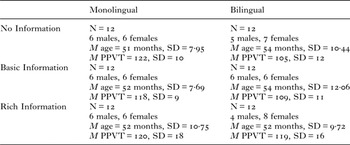
Seventy-two children between the ages of 3;5 and 5;11 participated. Thirty-six of the children were monolingual, and thirty-six were bilingual. See Table 1 for summary of age and gender by condition.
Age, gender, and standard scores on PPVT by condition and language

In addition to English, bilingual participants spoke a variety of languages, including Spanish (n = 10), Japanese (n = 4), French (n = 3; 2 French-speaking children were trilingual, also speaking Italian and Dutch, respectively), Arabic (n = 3), Chinese (n = 2), Dutch (n = 2), Italian (n = 2), German (n = 2), Russian (n = 2), and Turkish, Hindi, Polish, Persian, Bengali, and Urdu (n = 1, for each). Parental report completed prior to the study confirmed that bilingual children were learning two or more languages simultaneously and that their English language proficiency was robust enough to participate in our study. Most of the mothers who participated had completed some graduate school or a postgraduate degree (61%). The remaining mothers had completed college (28%) or an associates/technical degree (2%) or had graduated from high school (2%) or completed some college (7%). Rates of maternal educational attainment did not differ between the parents of monolingual and bilingual participants (t(67) = 1·24, p = ·22). Forty-four participants (23 monolingual, 21 bilingual) were tested in a research lab, and twenty-eight children (13 monolingual, 15 bilingual) were tested in a quiet room at their childcare center. There were no significant differences in children's performance across the two locations for any of the test items (ts(70) ⩽ 1·52, ps ⩾ ·13).
In addition to the seventy-two children included in the final sample, an additional twenty-eight children participated, but their data were not included: twenty children (14 monolinguals, 6 bilinguals) were excluded because of a response bias where children selected either the part or the whole for every item (including familiar, well-known items, e.g. they chose the ‘whole thing’ when asked to indicate a door and tail). Post-hoc examination of PPVT scores for sixteen of the twenty children (PPVTs were not conducted with 4 biased responders to allow them to return to class) revealed that children who showed evidence of biased responding had scores that were approximately 1 SD lower on average (N = 16, M = 99, SD = 16) than children included in the final sample (N = 72, M = 115, SD = 14). This suggests that our procedure may have been too verbally taxing for many of these excluded children. In addition, three bilingual children were excluded due to an inability to speak or understand English, four bilingual children were excluded for being non-responsive, and one monolingual child was excluded for inattentiveness.
Materials and design
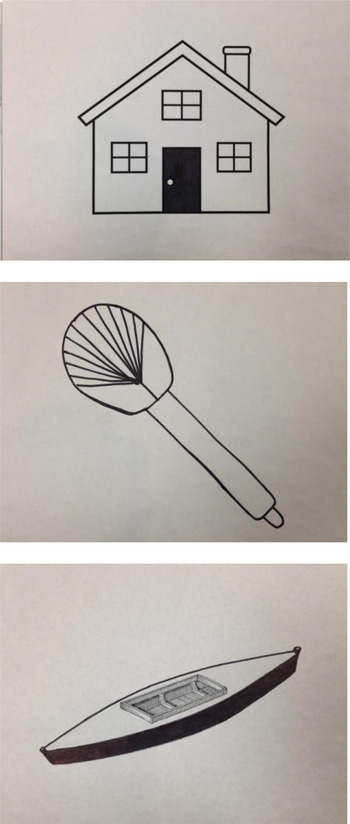
To evaluate children's ability to accept a new label for a familiar object, a modified version of a procedure used by Markman and Wachtel (Reference Markman and Wachtel1988) was used. Each child saw a book with twelve pictures. Each picture was a black and white line drawing of a familiar or novel object. There were three types of pictures: familiar objects with familiar parts, for example a house with a door, unfamiliar objects with unfamiliar parts, for example an avocado slicer called a cado, and familiar objects with unnamed salient parts, for example a boat with a cockpit (seat section) that was called a skiff (see Figure 1). Four random orders of the pictures were created, such that each of the three types of pictures never appeared more than twice in a row, and so that two familiar items with familiar parts came first in the sequence (house/door, cat/tail). These orders were used equally often across conditions. For half of the familiar items (house/door, cat/tail, car/wheel, shirt/pocket, cup/handle, pig/nose) children were asked about the whole thing, and for the others they were asked about the part. Whether children were asked about the whole or the part of the familiar items was counterbalanced.
Sample test items, Familiar object with familiar part (house/door), Unfamiliar object with novel names (avocado slicer called a cado), Familiar object with novel name (boat called a skiff).

Children also saw three familiar objects with novel names (boat/skiff, tree/spruce, shoe/brogue; bird/quail was used instead of tree/spruce two times when parents stated on a pre-study questionnaire that children were familiar with the label spruce). These familiar object/novel name items were used to evaluate children's willingness to accept a second label for a familiar object. To investigate whether the amount of information children received about the new label affected their willingness to accept the second label, children were randomly assigned to one of three information conditions: no information, basic information, or rich information
Procedure
Children sat across from the researcher and she told them she was going to show them some pictures and ask some questions about the pictures. For the familiar items with familiar parts and the unfamiliar items with unnamed parts, children were told, “Now I'm going to show you a (object name)”. The researcher then turned the page to show the child the picture of the object. She then asked, “What's a (object name)? Is a (object name) this whole thing (using finger to circle whole object), or this part here (using finger to point to part of the object)?”
In the no information condition, children were given no extra information about the familiar object/novel name picture. As above, children were told that they were going to see the object and were then asked to select the whole or the part as the referent. Children heard the novel label three times as in “Now I'm going to show you a skiff [page flipped]. What's a skiff? Is a skiff this whole thing [using finger to circle whole object], or this part here [using finger to point to part of the object]?”
In the basic information condition, children were given more information about the relation between the familiar object and the novel name. In this condition, the novel label was repeated six times for each object (once before the object was shown, three times during naming, and twice during the comprehension probe), and juxtaposition information was provided by offering the familiar label before the novel term (e.g. “See this boat? It's a skiff. Here is a boat. It's a skiff. Yeah a boat. It's a skiff.”).
In the rich information condition, children were given increased repetition of the novel label – hearing it twelve times (once before the object was shown, 9 times during naming, and twice during the comprehension probe), the same juxtaposition information from the basic condition, as well as anchoring information to describe the relation between the two labels. For example: “See this boat. It's a skiff. A skiff is a kind of boat. Yeah a skiff is a kind of boat. See this boat. It's a skiff. A skiff is a kind of boat. Yeah a skiff is a kind of boat. Here's a boat. It's a skiff. A skiff is a kind of boat. Yeah a skiff is a kind of boat.” Whether children were asked about the whole or part first (“this whole thing, or this part here”) versus second (“this part here, or this whole thing”) in the test question was counterbalanced across children.
After seeing all twelve pictures, English language vocabulary was measured with the English version of the Peabody Picture Vocabulary Test, Version 4 (PPVT-4; Dunn & Dunn, Reference Dunn and Dunn2012). Because the PPVT measures receptive English language abilities, we predicted bilingual children would have lower standard PPVT scores than monolingual children (Bialystok, Luk, Peets & Yang Reference Bialystok, Luk, Peets and Yang2010b). To align this previous work, we used standard scores to control for age-related differences in vocabulary size. A preliminary analysis of PPVT scores across language and condition failed to confirm these predictions and instead revealed an unexpected significant language group by condition interaction (F(1,66) = 8·94, p = ·002, η p2 = ·12). Post-hoc comparisons revealed this to be the result of bilingual children having higher PPVT scores in the rich (M = 119, SD = 16) than no information condition (M = 105, SD = 12) (t = 2·52, p = ·04). Bilingual children in the rich information condition had standard PPVT scores equal to those of the monolingual children in the no information, basic, and rich conditions, and trending toward being greater than bilingual children in the basic information condition (t = 1·78, p = ·08). As a result, we controlled for differences in standard PPVT by entering standard scores as a covariate in the analyses below. Please see Table 1 for a summary of PPVT scores by language group and condition.
Coding
Our dependent measure was whether children chose the whole object or the part of the object in response to the test questions. Children received a score of 1 for whole responses and a score of 0 for part responses. Scores for each type of item ranged from 0 to 3.
RESULTS
The first goal of this study was to examine whether bilingual children were more willing to accept second labels for familiar objects. The second goal was to examine how much information monolingual and bilingual children require to accept second labels. Before addressing these goals, however, we will first discuss children's responses to the familiar objects with familiar parts and unfamiliar items with novel labels. Standard scores on the PPVT were entered as a covariate in all of the analyses below to control for differences in English language vocabulary size. Adjusted means are reported below and used in the tests against chance.
Familiar wholes and familiar parts
To ensure that there were no differences between groups or across conditions for children's responses to familiar items with familiar parts (e.g. house/door), we conducted two 2 (language: monolingual vs. bilingual) × 3 (condition: no information, basic information, rich information) ANCOVAs: one for responses to items probing familiar wholes (e.g. asked about the house when shown the house/door item), and one for familiar part term responses (e.g. asked about the door when shown the house/door item). Standard scores on the PPVT were entered as a covariate. Neither of these analyses revealed significant main effects by language group or condition or interactions. For familiar whole items, tests against chance responding (1·5) for each condition and language group revealed that all children, in every condition, responded significantly higher than chance (ts(11) ⩾ 7·90, ps ⩽ ·0001). Similarly, for familiar part items, tests against chance revealed that all children, in every condition, responded significantly lower than chance (ts(11) ⩾ 8·21, ps ⩽ 0001). See Table 2. These analyses clarify that children were equally able to answer our test questions when their knowledge of familiar labels was probed.
Adjusted Mean Scores for selection of whole and part when asked about Familiar Items with Familiar Parts (out of 3, score of 3 = all whole response, score of 0 = all part responses). Standard deviations are in parentheses.

Unfamiliar items with novel labels versus familiar items with novel names
One test of mutual exclusivity is to compare children's tendency to attach novel labels to whole objects for unfamiliar items with novel labels (e.g. cado) versus familiar items with novel labels (e.g. skiff) in the no information condition. Higher whole object responses to the unfamiliar items than to the familiar items would indicate adherence to mutual exclusivity. A mixed repeated measures ANCOVA was used to investigate this possibility. Standard scores on the PPVT were entered as a covariate. No significant differences across familiar and unfamiliar items were revealed. However, bilingual children (M = 1·60, SD = 0·89) were significantly more likely than monolingual children (M = 0·62, SD = 0·89) to attach the novel label to the whole object across both types of items (F(1,21) = 5·74, p = ·026, η p2 = ·215). This difference between language groups was unexpected and may reflect children's tendency to treat the novel items similarly to the familiar items (they may have assumed they knew the name for the novel items and therefore treated them the same way they treated the familiar items; with monolingual children resisting applying a second label and bilingual children being willing to apply a second label).
Familiar items with novel names
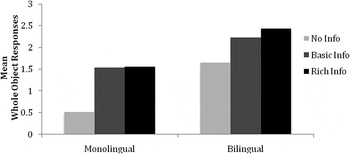
To examine children's willingness to accept second labels, we conducted a 2 (language: monolingual vs. bilingual) × 3 (condition: no information, basic information, rich information) ANCOVA. The ANCOVA revealed significant main effects for both language (F(1,65) = 12·56, p = ·001, η p2 = ·162) and condition (F(2,65) = 5·65, p = ·005, η p2 = ·148). Bilingual children (M = 2·11, SD = 1·05) had more whole term responding across conditions than monolingual children (M = 1·20, SD = 1·05). The significant main effect for condition revealed that both groups benefitted from more information, and increasingly accepted the second label when given more information. Planned comparisons of condition across language groups revealed higher levels of whole object responses in the basic information (M = 1·88, SD = 1·02) and rich information (M = 2·00, SD = 1·03) conditions when compared to the no information (M = 1·08, SD = 1·02) condition (ts(46) ⩾ 2·72, ps ⩽ ·008). The basic and rich information conditions did not differ. There was no significant interaction between language and condition.
To examine our prediction that bilingual children would accept more second labels than monolingual children, we compared responding by the two language groups in each of the information conditions. These tests revealed a significant difference between the groups in the no information condition (t(22) = 2·56, p = ·013) and in the rich information condition (t(22) = 2·09, p = ·040), with bilinguals (no information: M = 1·65, SD = 1·07; rich information: M = 2·43, SD = 1·02) responding with more whole objects than monolinguals (no information: M = 0·51, SD = 1·04; rich information: M = 1·56, SD = 1·03) in each case. There was no difference between language groups in the basic information condition. See Figure 2.
Mean selection of the whole object for familiar items with novel names by condition and language.

Tests against chance
To evaluate whether children's responding differed significantly from chance, their adjusted mean scores were compared to chance responding (1·5). Monolingual children's scores were significantly lower than chance in the no information condition (t(11) = 3·29, p = ·007), but did not differ significantly from chance in either the basic or rich information conditions. Bilinguals, on the other hand, were significantly greater than chance in the basic information condition (t(11) = 2·43, p = ·03) and rich information condition (t(11) = 3·16, p = ·009). Their responding in the no information condition did not differ from chance levels.
GENERAL DISCUSSION
This study investigated differences in bilingual and monolingual children's acceptance of second labels for familiar objects. The findings are consistent with the possibility that bilingual children are more willing to accept second labels for familiar objects. First, bilingual children accepted whole object labels for familiar labels at higher rates than monolingual children. This pattern was seen in overall levels of whole object selection and for two of three study conditions. Bilingual children also achieved reliable learning of second labels, when monolingual children did not. In particular, bilingual children used the information about the relation between familiar and new labels with sufficient fidelity to reliably select the whole object as the referent of the second label. This is in contrast to the monolingual children, who started out reliably rejecting the new label when given no information about the relation between new and familiar labels, and then responded at chance when given information. This at-chance responding is consistent with patterns of label acceptance seen in much of the previous work comparing bilingual and monolingual children's acquisition of second labels (e.g. Au & Glusman, Reference Au and Glusman1990; Bialystok et al., Reference Bialystok, Barac, Blaye and Poulin-Dubois2010a; Davidson & Tell, Reference Davidson and Tell2005). All together, these results are consistent with the possibility that bilingual children have a lower threshold than monolingual children for accepting second labels for familiar objects.
One question is whether this lower threshold for label acceptance equates with a failure to adhere to mutual exclusivity or other similar word learning biases. The current findings do not support this interpretation. In the current study, both groups of children were more likely to accept a second label for a familiar object when they were offered additional information about the relation between familiar and novel labels and increased exposure to the label. This pattern of findings is consistent with a starting bias to resist applying second labels to objects that is overridden with adequate evidence, which is in line with the action of a default heuristic (e.g. see Markman, Reference Markman, Gleitman and Landau1994). What differed between the groups was their initial resistance to the second label. Monolingual children were below chance in their acceptance of the second label as a term for the whole object (favoring a part interpretation instead), while bilingual children were at chance. One possibility is that bilingual children are initially more willing to accept the possibility that a second label can apply to an already named object.
Why might bilingual children start out being more willing to accept second labels? One possibility is that the difference is input driven – because bilingual children may encounter more instances of whole objects with multiple labels, they may reach the insight that objects can be referred to in multiple ways earlier than monolingual children. In addition to frequency of exposure, bilingual children may be more likely to have explicit conversations about the labels referring to the same object (if parents discuss naming across languages with children). It is also possible that bilingual preschoolers are presented with more whole object labels than their monolingual peers. Parents who try to teach a child two names for an object might focus on providing the child with both whole object labels, before moving on to the names for the various parts of an object. This would mean that in terms of the relative proportion of types of names, bilingual children might receive input about whole objects more frequently than monolingual children. These possibilities lend themselves to an exciting body of future study.
Bilingual children may be more creative than monolingual children (e.g. Ricciardelli, Reference Ricciardelli1992; Torrance, Gowan, Wu & Aliotti, Reference Torrance, Gowan, Wu and Aliotti1970). In one study, for example, bilingual children were more likely than monolingual children to draw cross-category items (a giraffe flower) when prompted to “draw a flower that does not exist” (Adi-Japha, Berberich-Artzi & Libnawi, Reference Adi-Japha, Berberich-Artzi and Libnawi2010). The production of these types of items points to greater cognitive flexibility in bilingual children. Bilingual children were perhaps better able think about single objects along multiple dimensions simultaneously. Applying this to the current study, one possibility is that bilingual children may have generated a more varied set of object labels when presented with our test items than monolingual children. While we are confident that the familiar items that received novel labels (tree, shoe, boat) would be nameable to our preschool-aged participants, because we did not ask children to provide labels for the familiar objects, we cannot be certain that the label they would have generated would have matched what the researcher offered them. One unexplored possibility is that bilingual children's tendency to be more likely to accept second labels for familiar objects is related to their ability to generate a more varied set of labels for the items they were presented with. In other words, practice with producing a more varied set of labels for objects may enable children to be more willing to accept additional labels when they are offered. One clear limitation of the current study is lack of independent measures of cognitive flexibility. Future studies should include such measures in addition to measures of linguistic competence to investigate the precise relation between linguistic and non-linguistic skills in supporting acquisition of multiple labels for single objects.
Previous research on differences in bilingual and monolingual children's perspective-taking skills suggest another possibility. In particular, bilingual children may recruit their more robust perspective-taking skills to the task of determining word reference. Previous research demonstrates that bilingual preschoolers understand that people can take multiple perspectives on objects (e.g. understanding that an object that looks like a rock is actually a sponge) about a year earlier than monolingual children (e.g. Goetz, Reference Goetz2003). This earlier understanding may affect how bilingual children interpret labels for objects. They may have an explicit awareness that speakers name things with the intent to draw attention to a particular aspect of the referent. This aspect may be a feature of the object that is relevant to one whole object label (e.g. mother) versus another (e.g. professor) that can be applied to the same entity. This would be consistent with accounts that propose that children's appreciation of the perspectival nature of symbols enables learning and use of multiple labels for single referents (Clark, Reference Clark1997, Reference Clark2004; Clark & Svaib, Reference Clark and Svaib1997; Tomasello, Reference Tomasello1999) and that bilingual children may have earlier and more robust pragmatic insights into differences in the knowledge states of their speech partners (e.g. Tare & Gelman, Reference Tare and Gelman2010). Future studies that include measures of children's perspective-taking skills in combination with second label acceptance are necessary to test this proposal directly.
One important caveat is that the bilingual children who participated in this research were simultaneous bilinguals who were learning English and at least one other language simultaneously from birth or shortly thereafter. Their English language skills were on par with the monolingual children who participated in this research. In addition, both groups of children tended to come from families in which mothers had attended or completed graduate or professional school. A critical question for future work is whether bilingual children from a more varied set of family backgrounds and those who are acquiring a second language later (sequential bilinguals) would show the same types of benefits.
The current research adds to an emerging body of work investigating the benefits of bilingualism. Children in the current study who were learning more than one language were more likely to accept second labels for already named objects and were also more likely to achieve reliable levels of referent selection. These findings are consistent with the possibility that children who acquire more than one language simultaneously may more rapidly reach the insight that single objects may invite multiple labels depending on the perspective of the speaker.