Some confusion seems to exist regarding the plural of seed. Some dictionaries list seed as an alternative plural for the singular seed (American Heritage Dictionary 1985; Webster’s Collegiate Dictionary 1995), whereas others do not (Webster’s Unabridged Dictionary 2001). However, all these sources, and others, list seeds as the preferred plural. The word seed can be properly used for seeds considered in the aggregate, as in “Seed was collected from 20 plants growing in an agricultural field.” The distinction between seeds in the plural and seed as an aggregate can be subtle. We believe that use of seed as a true plural arises from a misunderstanding about the nature of English nouns. English has two classes of nouns, and the distinction has consequences for how we, as scientists, think and write about crops, produce, and seeds (or seed).
The two classes of nouns are count nouns and mass nouns. Count nouns name things that can be counted. They are usually made plural by adding an s or es, although a few are irregular. Thus, the English language allows one to specify one peach, several peaches; one viewpoint, several viewpoints; one bean, several beans; but one woman, several women. Beans merit some additional consideration. Even when one speaks of a great many beans together, as in a bushel or truckload of beans, English conceives of them as a bunch of individual entities. Beans are the paradigm of count nouns in that accountants (i.e., those who count) are frequently referred to as “bean counters.”
Mass nouns are the names given to materials that are dealt with in aggregates and so must be measured rather than counted. They do not have singular and plural forms in the usual sense. Moreover, mass nouns cannot take the indefinite article (a, an). Mass nouns have sometimes been referred to as the collective singular (Dawson Reference Dawson1989), but we find this terminology confusing since, as explained below, some mass nouns take plural verbs and pronouns. Examples of mass nouns include water, information, fruit, infantry, and corn. A native English speaker would not refer to “a corn” or “several corns” when discussing grain, although the corn that makes walking painful is a count noun. The English language always conceives of corn grain as an aggregate substance. Is having corn grain a mass noun but beans a count noun logical? Probably not in modern times, but language, especially English, is not known for being logical, and the speakers of any language have to live with the grammar they inherit.
Using mass syntax with corn but count syntax with beans may have a historical origin. Corn, because it has many kernels per ear, has always been processed in bulk, and in pre-industrial times, it was usually eaten as meal or products made from meal, in which the individual kernels were obliterated. In contrast, until the advent of mechanization, beans were picked and shelled one pod at a time and whole beans could be identified in food as it was eaten. Thus, although measuring the amount of corn but counting beans may seem arbitrary in the present day, it may reflect a distinction in the way our ancestors perceived of these important dietary elements. Middleton et al. (Reference Middleton, Wisniewski, Trindel and Imai2004) have shown that people encountering unfamiliar objects tend to use count noun syntax when objects within an aggregation are easily distinguished as separate items, whereas they use mass noun syntax when elements of the aggregate are small and closely packed. Thus, although the requirement of a noun to use count versus mass syntax may sometimes seem arbitrary, the distinction reflects the way humans, or at least those using English and related languages, perceive the world.
Like corn, other types of grains and pseudograins (e.g., rice, wheat, quinoa) are mass nouns. The status of oats is controversial. For example, the Oxford English Dictionary (2017) indicates that oats is a count noun and speculates that its departure from other grains in this respect may occur because it was formerly eaten primarily as grain rather than as meal. In contrast, Langacker (Reference Langacker2008) argues that it is a mass noun. Because of the s ending, oats takes the plural form of verbs and pronouns. For example, “Oats are planted in early spring because they grow well in cool weather.” But the corresponding singular of oats is not in normal use except as an adjective (e.g., oat flour, oat cakes). An agronomist would probably not say, “We planted one oat per pot in the greenhouse experiment,” but would instead refer to a single grain of oats as an oat seed or oat caryopsis, as she would for a single grain of wheat or barley. Note that other mass nouns ending in s, such as clothes, coffee grounds, and vegetables, also take the plural form of verbs and pronouns. However, they have no singular form and are generally conceived of as bodies of barely differentiated elements. For example, a mother might tell her son to “finish your vegetables” whether the material on his plate is five string beans or a single lump of cauliflower. Basically, mass nouns that end in s take the plural form of verbs and pronouns, not because they are inherently plural, but because that sounds right to speakers who are used to using the plural forms with nouns ending in s. Oats are grain, and grain is conceived of as a noncountable substance. Equating something countable with a substance that is inherently noncountable would require substantial mental gymnastics. We believe that most people who work with oats think of them like any other grain, which is to say, as a mass noun.
In contrast with grain, most fruit and vegetable species produce count nouns (e.g., apples, beets, parsnips, plums), although greens and a few other vegetables are mass nouns (e.g., asparagus, broccoli, kale, spinach). A very few vegetables are both count and mass nouns. Among them are cabbage and zucchini. A produce manager could reasonably say to her assistant, “Put those cabbages (count) out in the store. I have a truckload of cabbage (mass) coming tomorrow.” However, referring to the truckload as cabbages would be equally reasonable. Thus, unlike plums or kale, a quantity of cabbage or zucchini can be conceived of either as an undifferentiated mass or as a collection of individuals, depending on the intent of the speaker or writer.
To talk about individual particles of a mass noun requires a special construction. Thus, an English speaker can refer to several molecules of water, a piece of fruit, or several kernels of corn. In all these cases, the modifying noun (molecule, piece, kernel) is made singular or plural whereas the mass noun itself remains neither singular nor plural. Not surprisingly, the language is messy and some mass nouns are irregular. For example, an element of infantry is an infantryman whereas several of them are infantrymen (or, these days, infantrywomen).
One might object that mass nouns can be plural: Minnesota is a land of many waters, and a farmer can grow fruits and vegetables. However, in these cases the pluralizing s indicates that the speaker refers to multiple types of the mass noun. Thus, Minnesota has many bodies of water within its borders, and the farmer is growing multiple varieties of fruits and vegetables. Since vegetables is a mass noun ending in s, whether multiple types are intended has to be deduced from context. If a man brings a basket of fruit to a party, it may contain all plums or it may include a mixture of pears, plums, and a pomegranate because the fruit in this case is conceived of as a barely differentiated aggregate. But if he brings a basket of fruits to the party, the implication is that the basket contains a mixture of types.
The word amount is commonly misapplied to count nouns, e.g., “The amount of people present was insufficient for a quorum.” The correct word to use in this sentence would be number instead of amount, since people is a count noun. Quantity is similarly misapplied. One might be tempted to say, “The truck contained a large quantity of beans when it overturned.” This would be incorrect since quantity applies to mass nouns. However, saying the truck contained a large number of beans would seem peculiar to most readers. The solution is to rewrite the sentence to specify weight or volume. “The truck contained several tons of beans” is both grammatically more correct and also more specific. Whether referring incorrectly to a count noun or referring correctly to a mass noun, the words amount and quantity frequently indicate that the sentence can be made clearer and more specific.
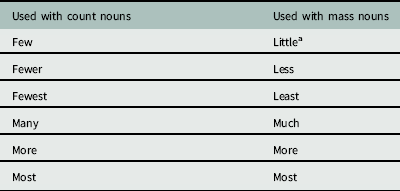
The quantifying adjectives that are appropriate for use with count nouns and mass nouns differ to some extent (Table 1). Thus, “few beans were left in the planter,” but “little corn was left in the planter.” Strangely, more and most can be used with either count or mass nouns. For example, “Most of the corn and most of the beans have been sold.”
Adjectives appropriate for the quantification of count and mass nouns.

a In the sense of not much.
A crop can be considered as distinct from the produce it generates. Consequently, one commonly encounters crops whose produce are count nouns denoted in the singular. This is technically correct since the crop itself is a singular entity. Thus, the statement, “Important vegetable crops of New York State include potato, onion, and snap bean,” is preferable to listing potatoes, onions, and beans in the plural. Occasionally, a crop is stated in the plural to indicate multiple varieties, e.g., “He grows lettuces.” The form will be jarring to most readers and should therefore be avoided. For example, “He grows several varieties of lettuce,” would be clearer.
What does the discussion above have to do with seed versus seeds as the plural of seed? The word seed happens to be one of a small group of English nouns that are both mass nouns and count nouns. A few of the others include several types of drinks, hair, chocolate, and a few vegetables, as mentioned above. Thus, one can order a whisky, or two whiskies (count), but the bartender pours them out of a bottle of whisky (mass). Similarly, one can refer to one hair, several hairs (count), or a head of hair (mass). Unlike the cabbage discussed previously, using the plural to refer to hair, or whisky in the aggregate is incorrect English. If a man were to tell his companion, “Your hairs look beautiful tonight,” the date probably would not go well. The situation with seed is more like cabbage than like hair. We agree with Dawson (Reference Dawson1989) that whether a substantial collection of seeds is referred to as seed (mass) or seeds (count) depends on the intent of the writer. Generally, the larger the mass of seeds involved and the more they are treated as a bulk substance, the more appropriate is the mass form seed. Thus, one pours seed not seeds into the hopper of a planter. But, if fifty dry little carriers of plant DNA are counted out for a germination test, then the most appropriate word for them is seeds. Most English speakers use correct grammatical forms with other mass and count nouns without conscious thought, but given the dual nature of the word seed, some caution is desirable. Generally, writing will be clearest if the count form seeds is used when counting, and seed is reserved for the singular and for seeds in the aggregate.
Acknowledgements
A lecture by Professor John McWhorter of Columbia University in the series Myths, Lies and Half Truths of Language Usage by The Teaching Company was helpful in clarifying our thinking on count versus mass nouns. The linguist E. Ann Wederspahn provided helpful comments on an early version of the manuscript, and Andrew R. Kniss and two anonymous reviewers also provided comments that improved the manuscript.