Introduction
Major catastrophes with enormous numbers of deaths from injuries require effective disaster medical response and management. Catastrophes may result from natural events, epidemics or terrorist attacks. Tsunami floods, hurricanes, and earthquakes lead the list of disasters from natural hazards, both by the number of incidents and the number of deaths from related injuries. The 2004 Indian Ocean earthquake and tsunami and the 2005 Katrina hurricane in the United States are recent examples. Modern epidemic events include the 2002 outbreak of severe acute respiratory syndrome (SARS) that infected approximately 10,000 people in China and Canada, and the 2009 H1N1 influenza outbreak that caused 15,000 confirmed deaths in age groups in which mortality from influenza is a rare event.Reference Booth and Stewart1,Reference Lemaitre and Carrat2
The most deadly of events caused by natural hazards are earthquakes. Four major earthquakes occurred in the first months of 2010 in Chile, Turkey, China, and Haiti. International terrorism has become a worldwide public health concern. The attack on the World Trade Center in New York City on 11 September 2001 is an example of a recent terrorist attack resulting in injuries.Reference Cushman, Pachter and Beaton3
Injuries caused by large-scale events, no matter the character of the event, can overwhelm any medical system. The common denominator in these events is the gap between the need for services and the availability of resources. In the first days after a catastrophe, medical facilities face the challenge of managing extraordinary numbers of victims. Medical personnel frequently are not trained or experienced in the management of large numbers of patients presenting within a short period of time.
The triage protocol that is routinely followed in Emergency Departments is limited to the process of sorting patients according to the level of urgency to determine the sequence of patient treatment. The fact that everyone eventually will be treated is taken for granted. During a disaster, healthcare providers may find themselves in the position of triaging patients with full knowledge that limited facilities will not enable treatment for all.Reference Devereaux, Dichter and Christian4 The shortage of resources, personnel, and/or equipment mandates a different approach.Reference Schultz, Koenig and Noji5
The demands of these special circumstances have led to the emergence of various triage schemes. These schemes take into consideration a number of physiological variables to predict the severity of injuries and determine the subsequent prioritizing of patients. In 1980, one of the first civilian triage systems was developed in Orange County, California, USA. This system, known as Simple Triage and Rapid Transport System (START),Reference Super6 was rapidly adopted across the United States as well as in international settings. It also was adopted by the US Department of Defense as a standard triage system to be used in mass-casualty events.7 Although they have been widely used, START and other triage systems never have been seriously challenged.Reference Kahn, Schultz, Miller and Anderson8 Their criteria presume that all patients, especially those labeled as “immediate,” can be treated. However, every mass-casualty event is unique, and it may be impossible to optimize the use of available resources by applying guidelines developed for other situations. Decision-makers must remain open to the possibility that such guidelines should be tailored according to the situation to achieve the best outcomes.
On 12 January 2010, an earthquake that measured 7.1 on the Richter scale struck close to Port-au-Prince, Haiti. The International Red Cross estimated that 3 million people were affected by the quake, with an official death toll of 230,000. Local authorities estimated that 300,000 people sustained injuries,9 and that as many as one million Haitians were left homeless.
In the hours following the earthquake, the government of Israel decided to launch a medical humanitarian mission. An Israeli field hospital unit departed Israel 48 hours after the quake, and was providing treatment for patients within 89 hours of the event. It was the only field hospital in the area at that time,Reference Kriess, Merin and Peleg10 and encountered tens of thousands of injured people who were seeking medical care.
The field hospital was a multidisciplinary facility capable of providing adults and children with surgery, orthopedics, medicine, obstetrics/gynecology, and neonatology services. The hospital included outpatient facilities, as well as an operating theater, an intensive care unit, a laboratory, and imaging facilities. The field hospital functioned in Haiti for 10 days, with an inpatient capacity of 72 patients.
The major triage dilemma was not how to prioritize the order of treatment, but how to decide who would receive treatment and who would not.Reference Merin, Ash, Levy, Schwaber and Kreiss11 The overall aim was to try to treat as many wounded victims as possible, while maintaining an adequate standard of care. The purpose of this study is to present the triage system used at the field hospital, to delineate the basic principles behind its adoption, and to present the results of working with this system. The goal was to identify any inherent flaws in order that protocols for future application can be adjusted accordingly.
Methods
A computerized registration system was used to record selected details of the major complaints, the surgical procedure(s), and length of stay of all patients who were admitted to the facility; patients who were not admitted did not undergo this registration process. Patient data, including relevant demographic information, a photograph of the patient, admission and discharge dates, where the individual had been hospitalized and the type of surgery, were retrieved from this computerized patient database.Reference Kriess, Merin and Peleg10
To cope with the thousands of wounded with limited resources, a “pre-triage” area was created where only one decision was made: whether or not to admit a particular patient for treatment. This decision was based mainly on two factors: (1) the patient's clinical condition; and (2) whether the resources she/he required at that specific time were available. An important aim of the pre-triage concept was to identify those patients who required urgent care that could be adequately provided with the existing resources, e.g., cases of open infected fractures. These patients were given priority treatment.
The protocol used to triage patients arriving at the hospital consisted of assigning patients to one of four groups: (1) patients with mild injuries (ambulatory patients); (2) pregnant women; (3) patients with open, infected limb injures; and (4) patients with very serious injuries and at a high risk of death.
Ambulatory patients with mild injuries were treated by designated personnel in the ambulatory care area on a “first come, first served” basis, and did not require the resources that were needed by the more critically injured patients. Pregnant women were referred directly to the obstetric facility with no waiting.
A large proportion of individuals treated in the facility had open infected limb injuries. During the first few days after the earthquake, many of them had been left unattended in the streets. The immediate death rate from these injuries, which reportedly was extremely high, dropped to close to zero among most of those who were admitted for treatment as inpatients. However, due to the overwhelming numbers of patients in this category, many did not reach the field hospital.
Patients with very serious injuries and at high risk of death were considered separately. They comprised a group with an advanced infectious process that already had progressed to multi-organ failure, and thus had a lower chance of survival and a higher expected resource requirement.
This retrospective observational study was approved by the Ethical Committee of the Israeli Military Medical Core Review Board.
Results
A total of 1,111 patients received treatment at the field hospital; 44% (n = 489) were males; and 37% (n = 411) were <18 years of age.
During the first three days of field hospital service, 80% of the patients treated were trauma victims. This number decreased to approximately 50% by Day 9, as more patients sought treatment for ordinary health problems and fewer patients presented with injuries secondary to earthquake-caused trauma.
One-third (374) of the patients were treated in the ambulatory care area. Although the waiting period for this group of patients could be many hours, all of these non-urgent patients were treated within 1–2 days of arrival. Some of these patients were treated at the entrance to the hospital and were not registered, while others were treated in the designated ambulatory care area, registered and provided with a discharge note.
Length of stay in the field hospital facilities
* Table excludes 160 (14%) patients for whom data was not available
Length of stay of surgical patients in the fi eld hospital facilities
* Table excludes four (2%) patients for whom data was not available
Of the 1,111 treated individuals, 24% (n = 265) had fractures, 17% (n = 188) had open wounds, and 10% (n = 107) had crush injuries. Some had more than one diagnosis.
A total of 24 pregnant women (2.2% of all patients) presented to the field hospital during its 10-day period of service.
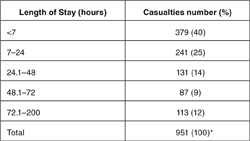
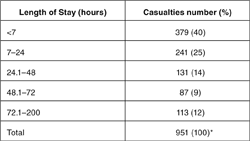
The length of stay in the field hospital for all patients for whom data was available is detailed in Table 1. The median length of stay was 16 hours (mean = 29.7 hours), and 65% (n = 620) were discharged within 24 hours of admission. The time to discharge was not available for 160 patients (14%), and their data were not included in this analysis.
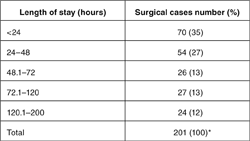
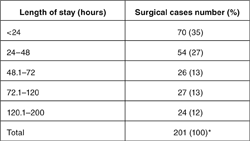
A total of 242 surgical procedures under general anesthesia were performed on 205 patients. Minor debridement procedures and surgery performed under local anesthesia were not included in these numbers. Complete data were available for 201 (98%) of these 205 patients (Table 2). The length of hospitalization for this group of patients was <24 hours in 35% (n = 70) of the operated patients, and up to 48 hours in 62% (n = 124). The median length of hospital stay for all operated patients was 39 hours (mean = 52.6 hours).
The overall mortality was 1.5% (17 of the 1,111 registered patients). Of note, 13 (76.5%) of these fatalities were among the first 500 patients treated (a 2.6% mortality rate for those patients).
Discussion
The American College of Emergency Physicians defines a disaster as a situation in which “…the destructive effects of natural or man-made forces overwhelm the ability of a given area or community to meet the demand for health care.”12 The key element in this classification is that disasters are not defined by their absolute magnitude, but rather, by their relationship to the available resources. Therefore, a disaster exists when demand exceeds local availability of either services or supplies.
The Israeli relief delegation arrived relatively early to a situation in which tens of thousands of the injured were either lying untreated in the streets or concentrated in large compounds without adequate medical care. Many of the patients who had received serious head, chest and/or abdominal injuries already had died. Other patients had injuries that were not immediately life-threatening, but would become so without treatment. This was true of the thousands who suffered infected, open fractures and were at high risk of gangrene and sepsis. Given these extraordinary circumstances, it was decided that the triage not only would differentiate patients according to the severity of their injuries, but also by the resources required, and by the expected outcomes. In order to adjust to these conditions, a system for triaging patients who had the best survival probability in a situation of severely limited resources was devised.
The triage systems that are used in mass-casualty incidents, including Simple Triage and Rapid Transport System (START), Secondary Assessment of Victim Endpoint (SAVE), and other algorithms, allow rapid identification of the critically injured without the need for detailed examination.Reference Super6,Reference Benson, Koenig and Schultz13 While these systems are effective in situations in which the resources do not limit the ability to treat wounded patients, it became quickly apparent that they could not be adapted to the situation in Haiti.
A resource-constrained triage model, the Sacco triage method (STM), has been developed to maximize the expected number of survivors in consideration of the timing and availability of resources.Reference Sacco, Navin, Fiedler, Waddell, Long and Buckman14 However, this model was difficult to implement in an ongoing situation within a facility that was fully occupied within a few hours after the arrival of the first patient, and that continuously encountered casualties with different degrees of injury severity.
Disasters require physicians to shift to “utilitarian-based ethics,” in which medical decisions are based on available resources, much in the way that a triage system prioritizes victims who are predicted to have the best chance of survival.Reference Pesik, Keim and Iserson15 The World Medical Association statement on medical ethics in disasters recognizes these unique situations and states “The physician must act according to the needs of patients and the resources available. He/she should attempt to set an order of priorities for treatment that will save the greatest number of lives and restrict morbidity to a minimum.”16 Although this statement recognizes that not all who need treatment will receive it, and that the availability of the required resources is a major determining factor, it goes on to recommend that “…patients who can be saved but whose lives are in immediate danger should be given treatment straight-away or as a matter of priority within the next few hours.” In reviewing the Israeli field hospital experience in Haiti, it is clear that issues involving allocation of medical resources during a mass-casualty event are complex, and that the prioritizing system used during such a disaster should involve more than just the urgency of the patient's condition. The likelihood of benefit and the amount of resources required to implement the treatment plan are factors that must be included in the decision-making process.
The need for certain healthcare services changed over time following the event. One example is the need for renal dialysis. Neither the field hospital, nor any other in the vicinity, had the necessary equipment to provide dialysis during the first days after the quake. However, patients with crush injuries, many of whom had rhabdomyolysis, quickly developed renal failure. In other circumstances, these patients would have survived with rapid provision of dialysis. However, renal dialysis was not available until one week after the event. One lesson for future aid to earthquake victims is to include dialysis as one of the required capabilities.
The consideration of the patient's likelihood of improvement in his/her quality of life is a controversial issue.Reference Pesik, Keim and Iserson15,17,Reference O'Laughlin and Hick18 Some patients arrived at the field hospital with medical conditions that were irreversible. At least 40 paraplegic casualties sought medical help, confronting the staff with the reality that there were not adequate resources to treat patients with non-reversible conditions; resources had to be earmarked for patients with better long-term prognoses.
The issue of prioritizing patients with better chance of rehabilitation is complex. Age also has been suggested as a factor to consider when resources are limited, because saving a young patient means saving more life-years.Reference White, Katz, Luce and Lo19,Reference Sztajnkrycer, Madsen and Baez20 These controversial issues were not considered in the triage protocol used in the current study.
This study was intended to provide a critical analysis of triage policy. A significant factor in the triage decision-making was the limitation of resources needed by a specific patient, coupled with his/her chances of survival. Patients whose treatment was anticipated to be short-term (up to 24–48 hours) were given priority. This approach proved to be appropriate in the Haitian scenario, where two-thirds of the patients treated were discharged within 24 hours, and two-thirds of the operated patients were discharged within 48 hours. The triage strategies described enabled the admission of on average 110 new patients per day to a 72-bed hospital facility. The challenge in these situations is to admit patients requiring concentrated treatment within a minimum length of hospital stay, without denying treatment to those with high survival probabilities who require a longer stay. The relatively short length of hospital stay of patients in the current study supports the triage policy that was used.
The majority of the first 500 patients treated were those who had sustained severe injuries. The death rate of 2.6% among these patients is difficult to interpret, as there is no benchmark. A high death rate may signify that pre-triage personnel admitted patients who had a low probability of survival. A patient who was treated and subsequently died within the facility would mean that resources used to treat him/her could have been used to treat someone with a higher chance of survival. On the other hand, a very low mortality rate may mean that only less severely injured patients were admitted, leaving those with more severe injuries (i.e., those requiring a large amount of resources) without treatment, despite reasonable chances of survival.
The standard of care must be adapted to the environment.Reference Dara and Farmer21 The US Department of Health and Human Services issued a directive in which it addressed the subject of the need to alter the standard of care in order to save as many lives as possible in disaster situations.22 Taking this into account, and in order to treat as many patients as possible, a policy of early discharge along with an acceptable level of care was implemented.
Triage in the disaster setting requires a basic change in thinking. Of necessity, this includes dealing with ethical dilemmas for which there is little preparation.Reference Merin, Ash, Levy, Schwaber and Kreiss11,Reference Pesik, Keim and Iserson15,16,17,Reference Holt23 Medical leaders must be able to make decisions under unusual and sometimes extremely difficult conditions. This includes the establishment of ad hoc committees for assistance in making difficult decisions10 documentation of all decision-making processes, daily discussions among the team leaders and sharing of responsibility. The burden of these decisions should not be borne by one individual.Reference Schultz, Koenig and Noji5
Because of the complexity of triage in such conditions, the basic concept underlying the process should be decided in advance. In addition, the process must be fair, transparent and meet the principles of distributive justice.Reference O'Laughlin and Hick18 Triage can conflict with human rights legislation, and even with humanitarian laws, but “accountability for reasonableness” can temper the disagreements on the setting of priorities. After a comprehensive evaluation of the actions taken under the extraordinary circumstances during the Haitian relief experience, it was determined that the concept and triage policy used allowed the best chance of survival for the largest possible number of victims.
Although triage in such conditions is complex, the basic concept underlying the triage process to be utilized should be decided in advance, but adjusted according to special on-site conditions. The routine Israel Defense Force triage system was modified in anticipation of the local situation, but had to be readjusted after arrival at the site.
An appropriate triage system must be dynamic, and its components will depend on numerous local conditions, including the magnitude of the event, the available resources, the presence of other international medical teams, coordination, and an understanding of the changes that take place on the ground. The experience in Haiti indicated that the local conditions prior to an event will have an impact on the capabilities to respond to that event. Mass-casualty events are relatively rare, and most medical personnel may never need to deal with them. However, this does not diminish the need to teach the essentials in terms of what to expect, and what could be required as dictated by the nature of the event.
This study has several limitations. The results reported are only short-term because the follow-up period was very limited; the long-term survival of most of the patients treated is unknown. In addition, the patients treated at the field hospital represent only a small fraction of those injured. The majority of the patients who arrived at the field hospital came by chance, and they may not represent all of the victims. This study relates only to the feasibility of treating patients with traumatic injuries, including surgery, with a very short hospital stay. Lastly, patients in this study comprised a mixture of individuals who had been injured as a result of the earthquake, as well as patients seeking medical help not related to the quake.
Conclusion
The field hospital experience in Haiti has shown that surge capacity can be improved either by increasing resource availability, or by reducing resource (inpatient bed) use. The latter was the only option in the Haitian experience. The triage system used in a disaster situation should be flexible and should be re-evaluated daily. Triage should be tailored not only to the specific disaster, but also adapted to the daily changes in both patient profile and available resources.
We support the recommendations for establishing a designated pre-triage protocol for mass-casualty management following terrorist-related disasters.Reference Frykberg24 A designated pre-triage area facilitates making the most difficult decision of whether or not to accept a patient for treatment before the patient actually has entered the hospital. Triage will be a central point in decision-making, and will involve major ethical issues in mass-casualty events. Therefore, it should be performed by a team of personnel competent in deciding who will be admitted into a field hospital at the scene of a disaster.
Acknowledgment
Esther Eshkol is thanked for editorial assistance.
Abbreviations:
SAVE = Secondary Assessment of Victim Endpoint
START = Simple Triage and Rapid Transport System
STM = Sacco triage method