INTRODUCTION
In old-growth tropical moist forests, pioneer tree species typically depend on gaps created by one or more canopy trees for their regeneration. Pioneers are incapable of surviving as seedlings in the forest understorey, and therefore depend on emergence from soil seed banks and on seed rain into existing gaps as sources of seedling recruits. In some forests, pioneers contribute a significant fraction of tropical tree diversity; on Barro Colorado Island (BCI), 47 of 300 tree species present in the 50-ha forest dynamics plot have been classified as pioneers (Hubbell et al. Reference HUBBELL, FOSTER, O'BRIEN, HARMS, CONDIT and WECHSLER1999). How do these species coexist when gap disturbance rates are low, and when the location and timing of gap formation is unpredictable?
Several factors potentially influence whether gaps are colonized by pioneers. Despite high reproductive output for most pioneer species, low adult population densities, frequently coupled with low seed survival rates (Dalling et al. Reference DALLING, SWAINE and GARWOOD1997, Murray & Garcia Reference MURRAY, GARCIA, Levey, Silva and Galetti2002) limits dispersal rates to gaps, particularly for larger-seeded species (Dalling et al. Reference DALLING, HUBBELL and SILVERA1998, Reference DALLING, MULLER-LANDAU, WRIGHT and HUBBELL2002). Recruitment rates are further limited by low probabilities of seedling establishment in gaps, particularly for small-seeded species (Dalling & Hubbell Reference DALLING and HUBBELL2002). As seedlings grow, recruitment patterns may be additionally affected by species-specific differences in gap size requirements (Brokaw Reference BROKAW1987, Kennedy & Swaine Reference KENNEDY and SWAINE1992), or susceptibility to browsing herbivores (Dalling & Hubbell Reference DALLING and HUBBELL2002).
Surface litter conditions also strongly influence seedling recruitment success (Molofsky & Augspurger Reference MOLOFSKY and AUGSPURGER1992). In artificially created gaps on BCI, surface litter removal led to a three-fold increase in pioneer seedling density (Dalling & Hubbell Reference DALLING and HUBBELL2002). The absence of surface litter may also account for the higher density of pioneers on treefall tip-up mounds and pits than elsewhere in gaps (Putz Reference PUTZ1983). The trunks of fallen trees in gaps (nurse logs) provide an additional litter-free microsite that may be important for pioneer species regeneration. Evidence from temperate forests suggests that decaying logs and stumps are especially important recruitment sites for small-seeded and shade-intolerant species that cannot recruit from humus or litter-rich forest soil (Christie & Armesto Reference CHRISTIE and ARMESTO2003, Harmon & Franklin Reference HARMON and FRANKLIN1989, Lusk Reference LUSK1995). Logs may also provide refuges from fungal pathogens (O'Hanlon-Manners & Kotanen Reference O'HANLON-MANNERS and KOTANEN2004, Zhong & van der Kamp Reference ZHONG and VAN DER KAMP1999) and increase light availability or decrease competition from seedling recruits or herbaceous vegetation that survived the treefall (Coomes et al. Reference COOMES, ALLEN, BENTLEY, BURROWS, CANHAM, FAGAN, FORSYTH, GAXIOLA-ALCANTAR, PARFITT, RUSCOE, WARDLE, WILSON and WRIGHT2005, van der Meer et al. Reference VAN DER MEER, STERCK and BONGERS1998, but see Wang & Kembell Reference WANG and KEMBELL2005).
Fallen trees also provide barriers that might limit regeneration of pioneer species. Logs occupy a small fraction of gap areas; dependence on logs may result in significant microsite limitation to regeneration (Christie & Armesto Reference CHRISTIE and ARMESTO2003, Eriksson & Ehrlén Reference ERIKSSON and EHRLÉN1992). Seed germination and seedling survival may also be reduced on logs relative to the soil, due to substrate instability in soft, highly decayed wood (Anderson & Winterton Reference ANDERSON and WINTERTON1996, Harmon Reference HARMON1989) or lower water-holding capacity on relatively undecomposed wood (Gray & Spies Reference GRAY and SPIES1997, McCullough Reference McCULLOUGH1948). Finally, low mineral nutrient availability, especially in wood in advanced states of decay (Takahashi et al. Reference TAKAHASHI, SAKAI, OOTOMO and SHIOZAKI2000), may slow seedling growth, particularly for fast-growing species with low nutrient-use efficiency.
A previous study conducted in lowland tropical forest on BCI, Panama, suggested that pioneer tree species differ in their ability to use nurse logs as recruitment sites (Dalling et al. Reference DALLING, HUBBELL and SILVERA1998). In this study we make a more detailed survey of nurse log use by pioneers. We test the hypothesis that log microsites are more favourable to small-seeded and wind-dispersed pioneers, the seeds of which are more likely to be retained on the surface of logs, and less likely to persist in, or establish from soil seed banks. In addition, we grow seedlings of common pioneer species in pots containing either wood or forest soil to test whether differences in the mineral composition wood and soil favours the growth of some pioneer taxa over others.
METHODS
Study site
The study was conducted on Barro Colorado Island (BCI), a 1500-ha reserve supporting semi-deciduous tropical forest located in Gatun Lake, central Panama (9°10′N, 70°51′W). The flora and fauna of BCI have been described in detail by Croat (Reference CROAT1978). Rainfall on BCI averages 2600 mm y−1, with a pronounced dry season from January until April (Rand & Rand Reference RAND, RAND, Leigh, Rand and Windsor1982). Nomenclature follows Croat (Reference CROAT1978), updated in the Atlas of Trees, Shrubs and Palms of Panama (http://ctfs.si.edu/webatlas/maintreeatlas).
Census of pioneer seedlings in treefall gaps
We located 95 recent gaps that contained fallen tree trunks and that were visible from a walking survey of 30 km of the BCI trail network. Gaps were >30 m apart and were defined according to Brokaw (Reference BROKAW1982), as openings in the canopy down through all foliage levels to an average of 2 m above the ground. The length and width of each gap was measured, and sites classified as small (45–100 m2), medium (100–400 m2) and large (>400 m2). To determine whether there were differences among species in the relative frequency with which recruitment occurs on nurse logs and in the soil, we conducted a census of all seedlings ≥2 cm and <300 cm height of 28 pioneer taxa commonly encountered in soil seed banks or as seedlings recruiting in gaps on BCI (Dalling et al. Reference DALLING, SWAINE and GARWOOD1997, Reference DALLING, HUBBELL and SILVERA1998). We first marked a plot on the log with an area encompassing the distribution of the seedlings present. We then marked out a rectangular plot parallel to, and 1 m from the log, of equivalent length and width dimensions. As logs are likely to occupy relatively well-illuminated central parts of the gap, we located the paired soil plot as close to the log as possible without encountering strong shading effects. The side of the log on which the plot was located was chosen at random. We classified the state of decomposition of each log as ‘intact’ (>75% of the estimated initial volume remaining), ‘partially decomposed’ (25–75% remaining) or ‘mostly decomposed’ (<25% remaining).
Seed germination and seedling growth on wood and soil substrates
To determine whether there were differences in seed germination and seedling growth in soil and wood substrates, we selected 12 common pioneer species that encompass the range of seed sizes, dispersal characteristics and growth rates for pioneers on BCI. Wood and soil substrate were collected from six gaps for the seed germination trials, and from an additional three gaps for seedling growth trials. Wood was collected from logs that were mostly decomposed, and included material from Tachigali versicolor (Caesalpinioideae), Attalea butyracea (Palmae) and Tabebuia guayacan (Bignoniaceae). Soil or wood from the sites were thoroughly mixed before experiments began.
Seedling emergence tests were conducted using 80-ml pots containing soil or wood and were replicated eight times for each species and substrate. Twenty seeds were sown onto the surface of each pot and covered with transparent plastic cups to retain moisture. Seeds of Apeiba aspera and Apeiba tiborbou, Guazuma and Trichospermum were placed in water at 70 °C for 2 min and Ochroma at 100 °C for 2 min to break seed dormancy prior to sowing. For the remaining species, red:far-red light conditions in the growing house (20% full sun) are sufficient to trigger seed germination (Dalling et al. Reference DALLING, SWAINE and GARWOOD1997). Successful germination was scored each week as full cotyledon expansion for 8 wk.
Seedlings from seed germination tests were subsequently used in growth trials. At the end of germination period, seedlings of all species except Miconia were c. 2 cm tall. Miconia seedlings were grown for an extra 2 wk before transplanting and were 0.6 cm tall. For each species, two seedlings were initially transplanted together into 1200-ml pots containing a 50:50 mix of either wood and washed marine sand, or forest soil and marine sand. Seedlings were thinned to one per pot after 3 wk to give seven replicates per substrate per species. Five additional seedlings were harvested at the time of transplant for the calculation of initial leaf area and biomass. Seedlings were grown in the growing house until mean leaf area within a substrate treatment reached approximately 200 cm2 (62–128 d according to species and substrate).
Leaf area of harvested seedlings was measured using an automated leaf area meter (LI-3000A, LI-COR, Lincoln, Nebraska, USA). The mass of foliar, stem and root fractions was measured after drying for 72 h at 70 °C. Relative growth rate (RGR) was calculated as the slope of the relationship between ln total biomass and time between transplant and harvest for each species in each substrate treatment. Per cent growth limitation on wood substrate relative to soil was calculated as 100 × (RGRwood/RGRsoil). Net assimilation rate (NAR; biomass increment per unit leaf area) was calculated for individual plants according to the equation: NAR = ((Wf – Wi) × (t))/((Af – Ai)/(lnAf– ln Ai)), where Wf and Wi are the final and initial dry mass (g), respectively, Af and Ai are the final and initial leaf area (m2) respectively, and t is the duration of the experiment (d). Leaf mass fraction (LMF; leaf mass per unit whole plant mass), stem mass fraction (SMF; stem and petiole mass per unit whole plant mass), root mass fraction (RMF; root mass per unit whole plant mass), leaf area ratio (LAR; leaf area per unit whole plant mass) and specific leaf area (SLA; leaf area per unit leaf mass), were calculated from the final harvest data.
To assess whether seedlings were infected by mycorrhizas, a 5-cm-long section of fine root was collected from each seedling at the time of harvest. Roots were cleared and stained according to Brundrett et al. (Reference BRUNDRETT, BOUGHER, DELL, GROVE and MALAJCZUK1996) and examined under a light microscope. Nutrient analyses of soil and wood were conducted on five samples collected from five pots of each substrate. Nutrients were extracted from 2.5-g samples into Mehlich III solution (Tran & Simard Reference TRAN, SIMARD and Carter1993) and analysed for Al Ca, K, Mg, Mn, P and Zn by Inductively Coupled Plasma Spectroscopy (Perkin Elmer Optima 2100, Perkin Elmer Inc, Wellesley, MA, USA). The same samples were used to determine bulk density, measured as the substrate dry mass.
Statistical analyses
We calculated the expected species richness of pioneer species (± 95% confidence intervals) for soil and wood substrates in EstimateS (purl.oclc.org/estimates), using the Mao Tau estimator (Colwell et al. Reference COLWELL, MAO and CHANG2004). Between-substrate differences in seedling density and diversity were assessed using paired t-tests after checking for equal variance. Effects of gap size on the proportion of logs colonized by pioneers were assessed using a Fisher Exact test; effects of log decomposition on pioneer seedling density were assessed using the Kruskal–Wallis Rank Sum test. We compared the similarity of seedling communities on logs and in the soil, and tested for effects of gap area and substrate type on species composition using non-metric multidimensional scaling (NMDS) ordination implemented using the package ‘vegan’ in the statistics program R (http://www.R-project.org).
To test for individual species associations with wood versus soil substrate we first used a contingency table analysis to test whether the relative abundance of seedlings on each substrate varies across gaps (gap × substrate interaction). As fewer than five seedlings per species were frequently found in individual gaps we used a randomization test to provide an unbiased probability of association, implemented using the program CLUMP (Sham & Curtis Reference SHAM and CURTIS1995). Additionally, we pooled seedling counts across gaps and used the exact binomial test to assess whether, overall, seedling densities on wood versus soil substrates differed from a null expectation of equality. Effects of substrate type and species on seed germination were analysed using a general linear model (GLM) for count data with a Poisson error distribution and log link. Seedling relative growth rate and allocation patterns were analysed as a factorial ANOVA with normal errors. Response variables were log-transformed to determine whether species showed proportionate responses to substrate types. ANOVA and GLM were performed using the statistics program R (http://www.R-project.org).
RESULTS
Seedling recruitment patterns in gaps
In total, 95 recent gaps >45 m2 containing fallen logs were found on our walking survey of BCI. Of these, six gaps completely lacked pioneer recruits. In 49 gaps, pioneers were only found rooted in soil, and in one gap pioneers were restricted to a fallen log. Of the remaining 39 gaps, seedlings were found both in soil and on logs. We restricted subsequent analyses to the 28 gaps containing five or more seedlings of our target list of 28 pioneer species. For these gaps, logs occupied 4.8% (± 1.4% SE) of the total gap area. Most logs, (49%), were moderately decayed (25–75% of volume remaining); similar proportions (25%) were either relatively intact (>75% of volume remaining) or highly decayed (<25% of volume remaining). The pioneer seedling communities recruiting on these logs (15 ± 2.3 species; 95% CI) were significantly less diverse than those recruiting from equivalent areas of soil in the same gaps (23 ± 2.6 species). Nonetheless, seedling densities on the two substrates were not significantly different (paired t-test on log-transformed seedling counts, P = 0.33), with on average 4.1 (± 0.8 SE) seedlings m−2 present on logs, and 3.7 (± 0.8) seedlings m−2 in the soil. The proportion of gaps with seedlings present on logs did not differ significantly across the three classes of gap size (Fisher Exact test, P = 0.62), nor did seedling density on logs differ with the degree of log decomposition (Kruskal–Wallis Rank Sum test, χ2 = 1.2, df = 2, P = 0.55).
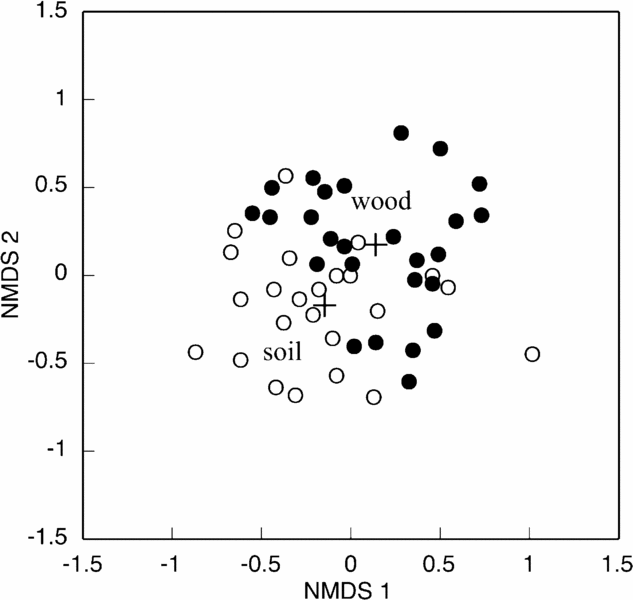
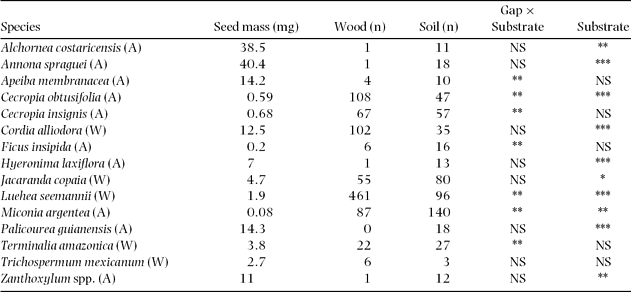
NMDS ordination analysis showed that there was a significant effect of substrate (wood versus soil) on the composition of seedlings present in gaps (r2 = 0.14, P < 0.001; Figure 1). In contrast, gap area did not explain a significant fraction of variation in species composition (r2 = 0.04, P = 0.33). Distribution patterns of individual species were highly heterogeneous. Randomization tests showed that for seven species (including most of the common ones), the relative abundance of seedlings on soil versus wood substrate differed significantly according to the gap surveyed (substrate × gap interaction, Table 1). When the data from individual gaps were pooled, seven species showed a significant main effect of substrate with no gap × substrate interaction, with higher seedling counts in soil than wood for six species. Using pooled seedling count data we also found a significant positive correlation between seed mass and the proportion of seedlings rooted in soil (Spearman's rank correlation S = 860, rs = 0.54, P = 0.04). Animal-dispersed species also had a significantly greater proportion of their seedlings rooted in soil than did wind-dispersed species (Kolmogorov–Smirnov test, D = 0.8, P = 0.02).
Non-metric multidimensional scaling ordination of pioneer seedling communities growing in gaps on wood (filled circles) and in equivalent areas of soil (open circles) in the same treefall gap. The Kruskal stress value (‘badness of fit’) is 25.9%. Centroids for the distribution of communities on wood and soil substrates are shown as cross symbols.

Seed mass, and total number of seedlings of pioneer species encountered on logs and equivalent areas of soil in 28 gaps. Only species for which more than five individuals were found are included. Interactions between gap and substrate type on seedling abundance were assessed using a randomization test; departures from equality of seedling distribution between wood and soil substrates were assessed on data pooled from all gaps using the exact binomial test. The designation after species refers to the mode of dispersal; (A) = animal and (W) = wind. NS = not significant; *= P < 0.05; ** = P < 0.01; *** = P < 0.001.

Nutrient concentrations of wood and soil substrates
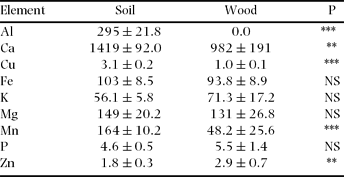
Analysis of the substrate-sand mix used for seedling emergence and growth experiments showed a significantly higher concentration of Al, and of base cations Ca, Cu, Mn and Zn in soil than wood (Table 2). Although concentrations of Mg, K and P did not differ between substrate types, relative availability of nutrients across substrate types is also affected by bulk density. Even after mixing with sand, the bulk density of the wood substrate (mean ± SD = 0.74 ± 0.1 g ml−1) was significantly lower than that of soil (1.2 ± 0.1 g ml−1; t = 6.3, P < 0.001, n = 8).
Mehlich III-extractable soil nutrients (mg kg−1, mean ± SD) for soil and wood substrate mixed with sand and used in the seedling growth experiment (n = 5 per substrate). NS = not significant; ** = P < 0.01; *** = P < 0.001.

Seedling emergence on wood and soil substrate
Overall we found large variation in seedling emergence success among species, ranging from 10% for Trichospermum to 80% for Miconia (deviance = 871, df = 11, P < 0.0001). Substrate also had a significant effect on emergence (deviance = 7.7, df = 1, P = 0.006), albeit small. On average, emergence in soil was 11% higher in soil than wood. There was no interaction between substrate type and species (deviance = 8.7, df = 11, P = 0.64). All species except Guazuma and Ochroma had the same, or slightly higher, emergence success in soil than in wood.
Seedling growth on wood and soil substrate
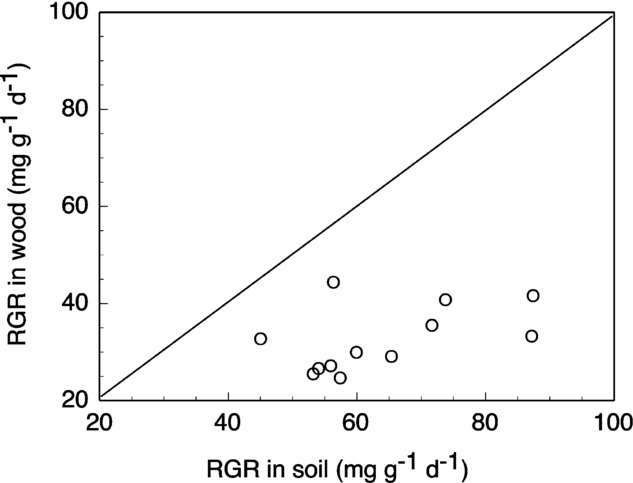
In contrast to seedling emergence, seedling growth was strongly affected by substrate (df = 1,127, F = 454, P < 0.001), with mean RGR in soil twice that in wood substrate. In comparison, species effects on RGR were relatively small (df = 11, F = 10.9, P < 0.001). Although RGR for every species was significantly higher in soil than wood (Figure 2), there was nevertheless a significant species × substrate interaction (df = 11,127, F = 3.46, P < 0.001). Growth limitation on wood, expressed as the RGR on wood as a percentage of RGR in soil ranged from 38% for Cecropia obtusifolia to 79% for Miconia argentea. Overall, RGR in soil was not significantly correlated with RGR in wood substrate (t = 1.72, df = 10, r = 0.48; Figure 2).
Relative growth rates of 12 pioneer species grown in pots in soil and wood substrates. Data points of species means.

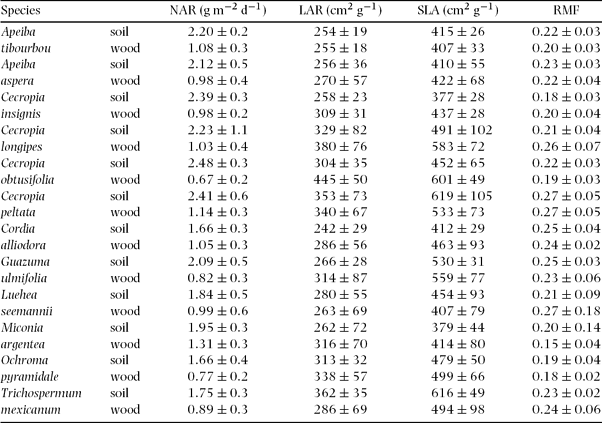
Substrate effects on seedling RGR resulted from both physiological and biomass allocation responses of pioneers (Table 3). Net assimilation rate, a measure of biomass gain per unit leaf area, was significantly lower on wood than soil substrate (df = 1, F = 280, P < 0.001). Reduced NAR may reflect either lower photosynthetic assimilation rates or reduced allocation to leaf area. Here, effects appear to be primarily physiological as neither the proportion of whole-plant biomass invested in leaf area (LMF), nor the leaf area per unit leaf mass (SLA) differed significantly between substrate types (df = 1, F = 3.27, P = 0.07, and df = 1, F = 1.92, P = 0.17 respectively; Table 2). However leaf area per unit plant biomass (LAR) was higher on wood substrate (df = 1, F = 5.94, P = 0.016), although the effect size was relatively small. Substrate differences in LAR in turn reflected differences in stem mass allocation. On average, plants growing on wood substrate invested 14% less in stem tissue. Biomass allocation to roots was unaffected by substrate (df = 1, F = 0.26, P = 0.61).
Mean seedling net assimilation rate, leaf area ratio, specific leaf area and root mass fraction (RMF) (± SE) for 12 pioneer species grown in pots in soil and wood substrates.

Variation in the magnitude of the difference in RGR between soil and wood substrates was not directly related to seed size or dispersal mode, or to any of the allocation traits that were measured on seedlings. Step-wise multiple regression of SLA, LAR, RMF, SMF and LMF failed to detect significant effects on RGR in wood as a proportion of RGR in soil. Differences in growth performance among species may be directly related to the ability to acquire nutrients from decomposing wood, however sectioning and staining of root samples showed the presence of arbuscular mycorrhizal fungi in the roots of all species in both soil and wood substrates.
DISCUSSION
How important are decaying logs for pioneer recruitment?
Decaying logs are important microsites for seedling establishment for canopy trees in both boreal (Hofgaard Reference HOFGAARD1993, Taylor Reference TAYLOR1935), and temperate forests (Christie & Armesto Reference CHRISTIE and ARMESTO2003, Christy & Mack Reference CHRISTY and MACK1984, Harmon & Franklin Reference HARMON and FRANKLIN1989, Lusk & Ogden Reference LUSK and OGDEN1992). In some temperate forests, >90% of recruits of some species occur on fallen logs (Christy & Mack Reference CHRISTY and MACK1984, Knechtel Reference KNECHTEL1903). In contrast, recruitment on ‘nurse logs’ has been considered relatively unimportant in mature tropical forests, with the exception of swamp forests (Hartshorn Reference HARTSHORN1980, but see Lack Reference LACK1991, Lawton & Putz Reference LAWTON and PUTZ1988). Nurse logs may be of most significance for the recruitment sites for pioneers, and play an especially important role in initiating forest succession after agricultural abandonment, where competition with pasture grasses prevents recruitment from soil seed banks (Peterson & Haines Reference PETERSON and HAINES2000, Slocum Reference SLOCUM2000).
In our survey on BCI we found that pioneers recruited on decayed logs in about one third of gaps. In gaps where seedlings were present on logs, similar seedling densities were observed on logs as in adjacent areas of soil. This suggests that early establishment success may be more favourable on logs than in the soil; on logs recruit sources are limited to seeds that dispersed into the gap after the treefall, while in the soil a large fraction can also be contributed from soil seed banks (Dalling et al. Reference DALLING, SWAINE and GARWOOD1997, Putz & Appanah Reference PUTZ and APPANAH1987). High recruitment on logs may reflect reduced competition from existing vegetation and increased probability of establishment in the absence of litter. Alternatively, logs may occupy better-illuminated microsites in the centre of gaps. Nonetheless, logs represent only 5% of the gap area in which recruitment potentially occurs. Strong selection for traits that favour establishment on logs is therefore unlikely unless recruit establishment and survival is much higher on logs than elsewhere in the gap. Van der Meer et al. (Reference VAN DER MEER, STERCK and BONGERS1998) found that both survival and growth of Cecropia obtusa seedlings was significantly higher on logs than on the forest floor; after 3 y the only surviving Cecropia seedlings in a large gap had recruited on a log. In the abandoned pastures in Costa Rica studied by Peterson & Haines (Reference PETERSON and HAINES2000), woody recruits that initially established on logs continued to grow and survive as well as those that established in the soil, with larger individuals rooted through logs and into the soil (C. Peterson, pers. comm.). In our survey we encountered several individuals of Cecropia insignis, C. obtusifolia and Apeiba aspera >2 m tall that had established on logs and had rooted in the soil. Logs therefore seem likely to be suitable microsites capable of supporting successful recruitment to the forest canopy.
Do pioneer species differ in their ability to successfully recruit on decayed logs?
The species richness of pioneers recruiting on logs was significantly lower than that on adjacent areas of soil. Logs therefore present a barrier to recruitment for some species. Differences in ability of species to recruit on logs was reflected in the ordination analysis; overall, the species composition of logs was significantly different from that of adjacent areas of forest soil. Most species, however, were present on both microsites, and many showed highly heterogeneous distributions, recruiting more frequently in the soil in some gaps and on logs in others. These distributions presumably reflect variable substrate and light conditions within and among gaps. Large among-gap variation in seedling distribution patterns indicate that analyses of microhabitat selection using data pooled across gaps should be interpreted with caution. However we found that most species showed biases that were consistent with observations from another, independent sample of gaps (Dalling et al. Reference DALLING, HUBBELL and SILVERA1998). Furthermore, the proportion of seedlings that recruited in soil was significantly positively correlated with seed mass, and was higher for animal- than wind-dispersed species.
The association of small-seeded species with decayed logs is consistent with observations in southern temperate rain forest (Lusk Reference LUSK1995), and was interpreted as resulting in part from a higher probability of retention of small seeds on logs. The association of wind-dispersed seeds with decayed logs may also be related to seed retention. In addition, animal-dispersed seeds tend to persist longer than wind-dispersed seeds in the soil (Dalling et al. Reference DALLING, SWAINE and GARWOOD1997, Swaine & Hall Reference SWAINE and HALL1983), increasing their recruitment potential from the seed bank.
How does substrate affect establishment and growth?
Moisture availability is likely to be a critical factor influencing seedling recruitment on logs. Under continually moist conditions in the growing house, seedling emergence success was only marginally higher in soil than on wood. In the field, however, emergence success is likely to be much more variable. As most canopy gaps close within a few years of forming (Brokaw Reference BROKAW1985, Schnitzer et al. Reference SCHNITZER, DALLING and CARSON2000), pioneers will often be limited to newly fallen logs that are in the early stages of decay. In this study, 75% of logs occupied by pioneer seedlings were in moderate to advanced states of decay. Many of these logs are presumably from trees that died before gap formation. Freshly fallen logs, with bark layers that are intact, have lower water-holding capacity than more decomposed wood, and can limit seedling establishment, particularly in drier or more seasonal forests (McCullough Reference McCULLOUGH1948, Zielonka & Piatek Reference ZIELONKA and PIATEK2001). In continually moist forest moss coverage on the bark of logs and branches retains moisture and may provide a substrate for attachment (Laman Reference LAMAN1995, Santiago Reference SANTIAGO2000); moss cover is rare on trunks on BCI.
On BCI, dry spells of a few days are sufficient to kill newly emerging seedlings of pioneer species establishing in the soil in large gaps (Engelbrecht et al. Reference ENGELBRECHT, DALLING, PEARSON, WOLF, GALVEZ, KOEHLER, TYREE and KURSAR2006). Similar mortality is also likely to occur on logs. Although smaller-seeded species are more likely to disperse onto logs, they may be less likely to germinate there; small-seeded pioneers on BCI germinate more slowly, and at higher water potentials than larger-seeded species (Daws et al. Reference DAWS, CRABTREE, DALLING, MULLINS and BURSLEM2008). Small-seeded species are also more susceptible to desiccation (Engelbrecht et al. Reference ENGELBRECHT, DALLING, PEARSON, WOLF, GALVEZ, KOEHLER, TYREE and KURSAR2006). The species composition of logs may therefore reflect a balance between dispersal and establishment success.
Seedlings are also likely to grow more slowly on wood than in soil, prolonging exposure to drought events during the critical establishment phase. In the growing house, relative growth rates on wood were, on average, only half those on soil. Slower growth in the growing house is presumably due to nutrient limitation. Nutrient extractions from the pot media suggest potential limitation to growth on wood substrate from base cations Ca and Mn, rather than macronutrients K and P. However, the bulk density of wood is significantly lower than that of soil, which may reduce availability of nutrients even if they occur at relatively high concentrations. Nitrogen limitation to growth may also be important on wood, but is difficult to assess using pot experiments. Nitrogen availability is greatly increased in pots relative to field soil (C. Pizano et al., unpubl. data), due to increased mineralization following disturbance (Johnson et al. Reference JOHNSON, WALKER and BALL1995); the same may be true for wood. Furthermore, the rate of mineralization of N from decaying wood depends on the species used (Marx & Walters Reference MARX and WALTERS2006).
Do nurse logs contribute to species coexistence?
This study highlights several ways in which nurse logs may contribute to pioneer species coexistence. Firstly, species differences in recruit densities on logs versus soil indicate that only a subset of species commonly colonizes logs. Recruitment on nurse logs may be especially important for wind-dispersed species that lack persistent soil seed banks (Dalling et al. Reference DALLING, SWAINE and GARWOOD1997), for small-seeded species that have low establishment success in the presence of litter (Dalling & Hubbell Reference DALLING and HUBBELL2002), and where recruitment from seed banks is arrested by canopy litter or competition from lianas (Schnitzer et al. Reference SCHNITZER, DALLING and CARSON2000). Secondly, nurse logs provide a secondary axis of differentiation in growth rates among species. Species RGR on soil vs. wood substrates were uncorrelated (Figure 2). Thus, recruitment on logs may shift competitive hierarchies favouring species such as Miconia argentea that are relatively slow-growing on soil but fast-growing on wood. Nonetheless, an interpretation of the importance of nurse logs must be tempered by the larger area available for recruitment from the soil. The presence of large individuals of some species present on logs suggests that they may play an important role in maintaining populations of some species, however this will require an assessment of the establishment origins of reproductive-sized individuals.
ACKNOWLEDGEMENTS
This research was funded by a Short-Term Fellowship from the Smithsonian Tropical Research Institute (STRI) to ES and a National Science Foundation Grant DEB 0342925 to JWD. We thank Guadalupe Alvarado, Dora Alvarez, Osvaldo Calderon, Carlos Sánchez, Luis Ramirez, Rodolfo Rojas and Salomon Aguilar for assistance in the field and lab, Chris Peterson for comments on the manuscript, and STRI and Oris Acevedo for logistic support.