I. INTRODUCTION
Mg–Sn-based alloys have attracted great interests due to their good applicability to plastic deformation processes, such as rolling and extrusion, which demonstrate the potential for the development of novel wrought Mg products. Reference Ha, Kim, Baek, Kim, Sohn, Shin, Jeong, Park, Yim, You, Lee and Park1–Reference Cheng, Park, You and Koo4 Currently, some of the best heat-resistant Mg alloys, with good mechanical properties at both ambient and elevated temperatures, are those based on the Mg–RE–Zn system. Reference Roostaei, Parsa, Mahmudi and Mirzadeh5 Many previous reports have indicated that the addition of RE elements such as Gd, La, and Y can remarkably improve the heat-resistance and high strength of Mg alloys. Reference Mirzadeh, Roostaei, Parsa and Mahmudi6–Reference Suzuki, Kimura, Koike and Maruyama8 Since the Mg2Sn phase formed in the Mg–Sn alloy system has a high melting point (∼770 °C), it is possible to develop an “RE-free” Mg alloy with superior heat resistance. Reference Zhao, Pan, Zhao, Pan, Song and Tang9 Additionally, alloying elements such as Zn and/or Al have been proved to be effective in improving mechanical properties by grain refinement and precipitation hardening. Reference Cheng, Kim, You, Koo and Park10,Reference Park, Lee, Yu, Yoon and You11 Recently, Kim et al. Reference Kim, Sohn, Kim, Kim and Kim12 have reported that an Mg47.2Zn36.9Al15.9 icosahedral quasicrystal phase (I-phase) could be obtained by selecting a suitable Zn/Al mass ratio in the Mg–Sn alloy system. The I-phase was solubilized in α-Mg after homogenization and would reprecipitate during the subsequent hot deformation process, resulting in a significant increase in strength. However, the effect of the Mg2Sn phase on the formation of the I-phase has not been mentioned in the previous work.
Equal channel angular pressing (ECAP) is one of the effective severe plastic deformations (SPDs) to refine the grains and second phases by inducing a large shear deformation without any changing of shape. Reference Mostaed, Fabrizi, Dellasega, Bonollo and Vedani13 A previous investigation Reference Ha, Kim, Baek, Kim, Sohn, Shin, Jeong, Park, Yim, You, Lee and Park1 indicated that coarse and fine particles within the α-Mg matrix are typically coexisted in the Mg–Sn alloy system. It has also been confirmed that the ECAP process could significantly refine the grain size of the as-cast Mg–10Al–0.5Sb(wt%) alloy and break any coarse rod-shaped Mg3Sb2 particles into small blocks, thereby improving the tensile properties of the alloy at room temperature (RT). Reference Wang, Zhou, Xie, Liang, Liang and Zhao14 It is expected that the relatively large, massive-shaped Mg2Sn phase that is often encountered in Mg–Sn alloys would also be broken into fragments and redistributed together with the dynamic precipitated I-phase during the ECAP process, which in turn would enhance the tensile properties of the alloy.
With a hexagonal close packed (HCP) structure, Mg alloys usually form strong texture after plastic deformation and the texture produced during ECAP cannot be overlooked. Reference Akbaripanah, Fereshteh, Mahmudi and Kim15 Kim et al. Reference Kim and Yoon16 found that mechanical properties of polycrystalline Mg alloys do not comply with the Hall–Petch equation because they are instead determined by the combined effects of grain size and crystallographic texture. The texture influences the strength of HCP polycrystals through its effect on the Hall–Petch constants. Reference Wang and Choo17 Similarly, Yuan et al. Reference Yuan, Panigrahi, Su and Mishra18 have reported that the coefficient of the Hall–Petch equation was proportional with texture intensity, i.e., stronger textures led to higher strength in Mg alloys, while Xin et al. Reference Xin, Zheng, Liu, Liu, Qiu, Li and Liu19 indicated that the strong and complicated textures formed in Mg alloys caused strong anisotropy in the mechanical properties. In addition, previous studies have found that the addition of alloying elements and presence of precipitate particles can influence texture evolution during hot deformation. Reference Chao, Chen, Yan, Su, Song and Zhu20 Therefore, it would be interesting to examine how the formed texture depended on the combined alloying and/or secondary precipitates during the ECAP process.
In the present study, the microstructural characteristics and tensile properties of as-ECAPed Mg–8Sn(wt%)–(5,6,7)Zn–2Al alloys were investigated. The main purpose of the study was to find the optimal Zn/Al mass ratio for the Mg–Sn–Zn–Al alloy system and to determine the dependence of tensile behavior on the gain size, texture, dynamic recrystallization (DRX), and secondary precipitates. This study will be helpful for the further development of the high-strength and low-cost Mg alloys.
II. MATERIALS AND METHODS
The actual compositions of the alloys used in this study were Mg–7.95Sn–4.93Zn–1.96Al (TZA852), Mg–7.89Sn–5.93Zn–1.94Al (TZA862), and Mg–7.89Sn–6.96Zn–1.97Al (TZA872), which corresponded to Zn/Al mass ratios of approximately 2.5, 3, and 3.5, respectively. The ingots were prepared by melting the pure Mg, Sn, Zn, and Al in an electrical resistance furnace, and then poured into the preheated steel mould (preheated to 200 °C) with the protection of mixture gas of CO2 + SF6. Note that there is distinction in the thermally stable temperature of the I-phase (300–380 °C) and Mg2Sn phases (563 °C), which allowed most of the second phase particles to be solubilized into the matrix before the ECAP process. Therefore, the homogenization treatment was carried out using the following processing parameters: 320 °C × 3 h + 450 °C × 24 h.
For ECAP, rectangular samples (10 × 10 × 53 mm) were cut from the homogenized ingots and pressed through a modified ECAP die with an inner arc of curvature φ = 90°, a polarizing angle of α = 2°, and an outer arc of curvature ψ = 20°. Each sample was subjected to two ECAP passes at 300 °C and a pressing speed of 0.04 mm/s using route Bc, with the sample being rotated 90° clockwise (CW) along its longitudinal axis between each successive pass. A graphite lubricant was used to reduce the friction between the samples and die.
The microstructural characteristics of the studied alloys before and after ECAP were analyzed using X-ray diffraction (XRD) with a Y-2000X D type X-ray diffractometer (Dandong Ray Instrument Co. Ltd. Liaoning, China, operated at 36 kV and 26 mA with Cu Kα radiation at a rate of 0.02 °/s), optical microscopy (OM) with a Leica-2700M optical microscope (Leica Microsystem GmbH, Wetzlar, Germany; etching solution: 3 g picric acid, 10 mL acetic acid, 10 mL distilled water, and 100 mL ethanol), scanning electron microscopy (SEM) with a TESCAN MIRA3 scanning electron microscope (TESCAN Ltd., Brno, Czech Republic) equipped with an energy dispersive X-ray spectrometer (EDS), and transmission electron microscopy (TEM) using a JSM-2100F transmission electron microscope (JEOL Ltd., Tokyo, Japan) with an accelerating voltage of 200 kV. The samples for TEM were ground to 50 μm before ion beam thinning (10°, 4.5 kV for 45 min and 5°, 4 kV for 5 min). Furthermore, the average grain size (AGS) was calculated from number fraction in three optical micrographs using the software Image-Pro plus 6.0 (Media Cybernetics Inc., Rockville, Maryland).
Electron backscatter diffraction (EBSD) was used to analyze the texture variation of the processed alloys. The EBSD detector used was an HKL Channel 5 system (Oxford Instruments, London, United Kingdom) equipped in a field-emission SEM (FEI Nova 400, FEI Company, Hillsboro, Oregon). The samples for EBSD analysis were prepared by electrochemical polish at 20 V in a commercial polishing solution AC2 at −20 °C.
For tensile testing, dog-bone shaped specimens with a gauge length of 13 mm, a width of 3.5 mm, and a thickness of 1.5 mm were machined from the as-ECAPed samples along the longitudinal axis. Tensile tests were then performed at RT using a WDW-100KN universal testing machine with an initial strain rate of 1 × 10⁻³ s−1, and the samples were tested along the extrusion direction (ED).
III. RESULTS
A. The microstructures of homogenized alloys
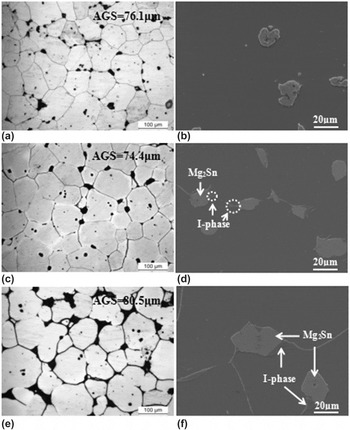
The optical and SEM micrographs of the homogenized billets are shown in Fig. 1. As indicated, all of the homogenized alloys exhibited an equiaxed structure, and most of the second phase particles were dissolved into the matrix with few remaining particles distributed along the grain boundaries and inside the grains. The presence of two different phases (Mg2Sn and I-phase) could be observed in the TZA862 and TZA872 alloys. Note that the Mg2Sn phase exhibited a lighter contrast than did the I-phase, a similar phenomenon has been reported in Ref. Reference Kim, Sohn, Kim, Kim and Kim12. In addition, the size of the remaining second phases was relatively coarse in the alloy with a Zn/Al mass ratio of 3.5, and the fractions of the remaining particles were 6.26, 7.16, and 10.3% for the TZA852, TZA862, and TZA872 alloys, respectively. Note that the Zn/Al mass ratio had no significant influence on the AGS of the homogenized TZA852 (76.1 μm) and TZA862 (74.4 μm) alloys. On the other hand, the AGS of the homogenized TZA872 alloy increased a little to 80.5 μm, which could be related to the weakening of the pinning effect due to the coarsening of the particles at the grain boundary.
The optical and SEM micrographs of the homogenized billets: (a, b) TZA852, (c, d) TZA862, (e, f) TZA872.

B. The XRD patterns
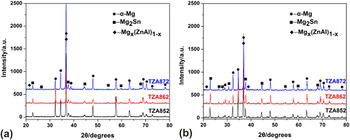
The XRD patterns (Fig. 2) of the homogenized and as-ECAPed TZA852 alloys exhibited two sets of peaks, one for the α-Mg matrix and one for the Mg2Sn phase. As the Zn/Al mass ratio was increased to 3 and 3.5, new peaks corresponding to the formation of the Mg x (ZnAl)1−x phase appeared at approximately 21.4, 36.7, and 38.4°. It could be observed that the relative volume fraction of the Mg2Sn phase experienced a visible increase due to the dynamic precipitation during the ECAP process. Reference Ha, Kim, Baek, Kim, Sohn, Shin, Jeong, Park, Yim, You, Lee and Park1 A previous report Reference Kim, Sohn, Kim, Kim and Kim12 indicated that the I-phase would reprecipitate during subsequent hot deformation. However, the peaks corresponding to the I-phase in this study remained almost constant, indicating that reprecipitation of the I-phase was very weak and that rearrangement or division of the I-phase during the ECAP process has dominated.
XRD patterns of the alloys in different states: (a) homogenized, (b) as-ECAPed.

C. The microstructures of as-ECAPed alloys
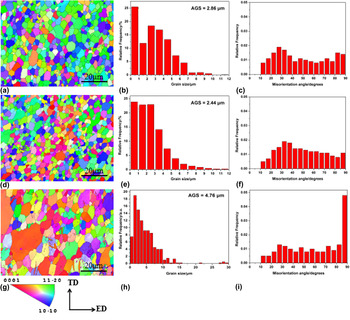
Figure 3 shows the EBSD orientation maps, grain size, and misorientation angle distribution of the as-ECAPed alloys obtained from a longitudinal sectional area. As shown in the EBSD orientation maps [Figs. 3(a), 3(d) and 3(g)], the ECAPed samples exhibited a fully recrystallized structure with a bimodal grain size distribution with different coarse-grain sizes larger than 5 μm and a considerable fraction of grains ranging from 0.15 to 5 μm. It is shown in the grain size distribution of the samples [Figs. 3(b), 3(e) and 3(h)] that the average size of the DRXed grains gradually decreased from 2.86 to 2.44 μm with the Zn/Al mass ratio increased from 2.5 to 3. In the case of the alloy with a Zn/Al mass ratio of 3.5, the AGS notably increased to 4.76 μm. In the misorientation angle distribution map [Figs. 3(c), 3(f) and 3(i)], the peaks at ∼30° suggested that a strong basal texture was developed Reference Hantzsche, Bohlen, Wendt, Kainer, Yi and Letzig21 in the as-ECAPed alloys. Meanwhile, the peaks around 86° indicated that the occurrence of the twins in the samples, Reference Biyiklia, Tokera and Canadinca22 with very few twins present in the TZA852 and TZA862 alloys, and dominantly high peaks (0.047) at approximately 86° in the TZA872 alloy, i.e., severe twinning behavior. This phenomenon was caused by the occurrence of twinning being easier in the coarser grains due to the longer dislocation slip path and more serious stress concentration around the grain boundary. Reference Patrik, Frantisek, Yi, Kseniya, Dietmar and Jan23
EBSD orientation maps, grain size, and misorientation angle distribution of the as-ECAPed alloys: (a, b, c) TZA852, (d, e, f) TZA862, (g, h, i) TZA872.

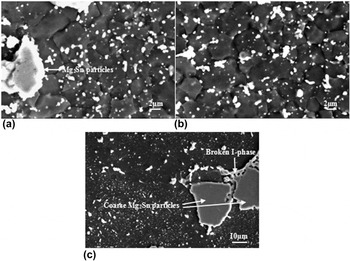
The SEM images of the as-ECAPed alloys are shown in Fig. 4. There are two kinds of particles: the nanoscale precipitated particles and the microscale particles, both of which were broken off during the ECAP process. Through measurements by the Image-Pro plus 6.0 software, the area fractions of nanoscale precipitates were found to be 18.86, 20.06, and 16.36% in the TZA852, TZA862, and TZA872 alloys, respectively. The decreased fraction of the nanoscale precipitates in TZA872 was mainly due to the existence of the large-size Mg2Sn and I-phase regions that consumed much of the solute elements, as shown in Fig. 4(c). Note that, compared to Fig. 1(f), the large-size Mg2Sn and I-phases with porous morphology in the TZA872 alloy [Fig. 4(c)] showed that the particles were partially broken off during the ECAP process and formed a deformed region. It has been reported that nanoscale particles play an important role in restricting DRXed grain growth by the pinning effect. Reference Park, Kim, Cheng, Kim and You24,Reference Jung, Park, Yu, Kim, Lee and You25 Thus, the greater number of nanoscale particles dispersed along grain boundaries in the TZA862 alloy [Fig. 4(b)] was considered to result in a decrease in the size of DRXed grains through an enhanced grain boundary pinning effect. In addition, fine DRXed grains can also be seen in the vicinity of the Mg2Sn particles, which could be explained by the fact that particles >1 μm in diameter are well known to provide potential nucleation sites for DRX during hot deformation through the particle stimulate nucleation (PSN) mechanism, which has previously been reported in a number of different Mg alloys. Reference Mostaed, Fabrizi, Dellasega, Bonollo and Vedani13,Reference Kim and Yoon16,Reference Tang, Park and You26
SEM images of as-ECAPed alloys: (a) TZA852, (b) TZA862, (c) TZA872.

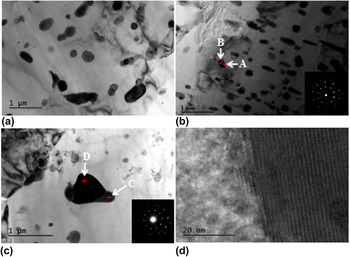
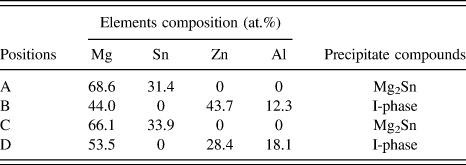
To observe the nanoscale precipitates more clearly and explore the interaction of the Mg2Sn and I-phase, TEM tests were carried out along the [10−10] direction and are shown in Fig. 5. There were three kinds of precipitate morphologies: spherical shaped precipitates with sizes of 100–300 nm, rod-like precipitates (300–500 nm in length), and blocky-like precipitates (500–1000 nm in length). These nanoscale precipitates were related to the dynamic precipitation during the ECAP process. Both of the selected area electron diffraction (SAED) patterns of the I-phases in Figs. 5(b) and 5(c) showed a 5-fold rotational symmetry zone, which is the characteristic of an icosahedral structure. This result was in accordance with the XRD results in Fig. 2. Takeuchi et al. Reference Takeuchi, Murasaki, Matsumuro and Mizutani27 have shown that a thermally stable I-phase forms in the Mg–Zn–Al system with composition near Mg44Zn41Al15. The Mg44Zn41Al15 I-phase is thermally stable up to 653 K, and at higher temperatures, it decomposes into liquid and the remaining phase as a result of a peritectic reaction. According to the TEM-EDS results in Table I, the I-phase in TZA862 (indicated as B) and TZA872 (indicated as D) could be identified as Mg44Zn43.7Al12.3 and Mg53.5Zn28.4Al18.1, respectively. The I-phases in this research were very close to the previously reported compositions of the thermally stable Mg–Zn–Al I-phase. Reference Takeuchi and Mizutani28 Note that most of the I-phases were located between α-Mg and Mg2Sn phases. Liu et al. Reference Liu, Chen and Nie29 have found that Zn atoms invariably segregated to the Mg2Sn–Mg interface in Mg–Sn–Zn alloys, which could partially verify that the formation of the I-phase lagged behind that of two eutectic phases during the solidification and that the Mg2Sn phases act as nucleation sites for the I-phase. High resolution TEM (HRTEM) of the interface between the I-phase and the matrix in the TZA862 alloy [Fig. 5(d)] indicated that the interface was incoherent interface, which could provide an enhanced strengthening effect. Reference Kim, Sohn, Kim, Kim and Kim12
TEM micrographs and EDS of as-ECAPed alloys: (a) TZA852, (b) TZA862, (c) TZA872 (inset: the SAED patterns of the I-phases in positions B and D, respectively). (d) The HRTEM of the interface between the I-phase and the matrix in TZA862. A, B, C, and D represent the position conducted the EDS process.

The EDS results at the positions A, B, C, and D in Fig. 5.

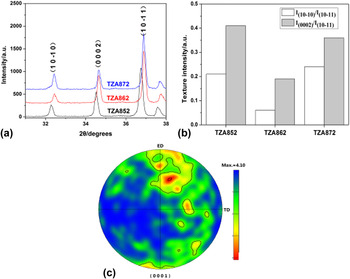
To determine the effect of the Zn/Al mass ratio on the changes in the texture of the as-ECAPed alloys, I(0002), I(10−10), and I(10−11) were chose to denote the intensity of the basal plane peak and prismatic plane peak. Therefore, the relative intensity of the basal plane peak and prismatic plane peak could be obtained from I(0002)/I(10−11) and I(10−10)/I(10–11), respectively. Reference Shang, Deng, Nie, Li, Zhou, Xu and Fan30,Reference Zhang, Deng, Nie, Xu, Su and Liang31 Figure 6(a) shows the enlarged XRD pattern (32–37°) of the ECAPed alloys. The peaks around 32, 34, and 37° represented the (10−10), (0002), and (10−11) planes, respectively, which could be used to obtain the value of I(0002), I(10−10), and I(10−11). As shown in Fig. 6(b), the I(0002)/I(10−11) values in all the ECAPed samples were higher than those of I(10−10)/I(10−11), which illustrated that the basal plane texture was formed in the alloys during ECAP. Note that both the relative intensities of the basal plane and prismatic plane in the TZA862 alloy were the weakest among the alloys, which was related to the occurrence of texture randomization, as shown in Fig. 6(c).
(a) Enlarged 32–37° XRD patterns of ECAPed alloys, (b) I(0002)/I(10−11) and I(10−10)/I(10−11) values of the ECAPed alloys, (c) the pole figure of the as-ECAPed TZA862 alloy.

Many researchers Reference Liu, Jiang, Cai, Kang and Zhang32–Reference Zhang, Xiao, Wang and Ma34 have reported that the addition of rare earth (e.g., Ce, Y, and Nd) and Ca can change the stacking fault energy (SFE) of the basal and non-basal plane, thereby changing the critical resolved shear stress (CRSS) of the slip and twinning and inducing the occurrence of texture randomization. Liu et al. Reference Liu, Jiang, Cai, Kang and Zhang32 have reported that the occurrence of prismatic and pyramidal slips was responsible for the peak intensity of the Mg–1.5Zn–0.2RE alloys exhibiting the TD split texture, in which the position of the basal poles was tilted from ND toward TD. In addition, there has been an evidence that a higher Zn solute content has a positive impact on the modification of the rolling texture of Mg. Reference Bohlen, Nurnberg, Senn, Letzig and Agnew35 Moreover, Zheng et al. Reference Zheng, Du, Liu, Wang and Li36 have reported that the addition of trace Al could also modify the texture through the reduction of the SFE. Based on the aforementioned results, we believe that the combined addition of Zn and Al also has a positive impact on the deformation mode of the Mg–Sn alloy system, through a change in the SFE. In other words, a suitable Zn/Al mass ratio could also induce the randomization of texture, similar to rare earth and Ca.
D. Mechanical properties
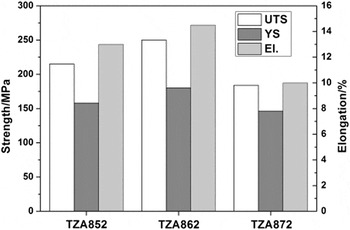
The tensile properties of the as-ECAPed alloys at RT are shown in Fig. 7 and Table II. The results revealed that the yield strength (YS), ultimate tensile strength (UTS), working-hardening capacity (UTS/YS), and elongation (El.) of the samples gradually increased with the Zn/Al mass ratios increase from 2.5 to 3. Compared to the TZA862 alloy, the UTS, YS, and El. of the TZA872 alloy decreased sharply by 26.4%, 18.9%, and 31%, respectively. The results could be explained by the variation in the DRXed grain size, the volume fraction and size of precipitates, and the texture intensity, which are analyzed in detail in the next section.
Tensile properties of as-ECAPed alloys at RT.

Tensile properties of the as-ECAPed alloys at RT.

Figure 8 shows the typical fracture surfaces of the as-ECAPed Mg–Sn alloys with different Zn/Al mass ratios, where they exhibited many dimples on the surfaces of the tensile fraction. The observation of dimples in all the as-ECAPed alloys indicated a significant plastic deformation. Relatively more and deeper dimples in TZA862 were responsible for its elevated ductility. Note that massive cleavage planes and cracks can be observed in TZA872, which were responsible for its lower El.
SEM of the fracture surfaces of as-ECAPed alloys at RT: (a, b) TZA852, (c, d) TZA862, (e, f) TZA872.

IV. DISCUSSION
A. Tensile strength
Recent contributions have indicated that the significant advancement in the mechanical properties of magnesium alloys could be achieved by reducing the grain size, increasing the amount of fine particles, and modifying the texture. Reference Zhang, Tang, Deng and Yang37–Reference Zhang, Geng, Huang, Zhang and Dong40 Generally, there is an inverse relationship between the grain size and the YS, which can be demonstrated by the Hall–Petch equation: σ = σ0 + k d −1/2. Reference Haasen41 As a result, the smallest AGS in TZA862 corresponded to the strongest grain boundary strengthening effect among the alloys. Using a k value of 300 MPa μm−1/2, which was obtained from Mg–Sn-based alloys subjected to indirect extrusion, Reference Cheng, Tian, Yu, Zhang and You42 the increases in YS due to grain refinement from 2.86 (TZA852) and 4.76 (TZA872) to 2.44 μm (TZA862) were approximately 14.7 MPa and 54.6 MPa, respectively.
In addition, it is well known that the precipitated fine particles during the hot working process can play a crucial role in the enhancement of strength by requiring more required stress to move dislocations. It can be determined from the theory proposed by Gladman et al. Reference Gladman43 that the smaller size and higher volume fraction of precipitates will lead to a better precipitation strengthening. Thus, the greater number of nanoscale precipitates in the TZA862 alloy (20.06%) was considered to lead to a better precipitation strengthening.
In general, when an applied stress is parallel to or perpendicular to the basal plane, i.e., Schmid factor is close to zero, the basal plane is hard to activate, which leads to relatively high strength. On the other hand, if the applied stress and basal plane form an angle of approximately 45°, the maximum value of Schmid factor can be obtained, Reference Wang, Guo, Li, Zhong, Shigeharu and Wang44 which results in easy activation of the basal plane. The scattered texture distribution in TZA862 [Fig. 6(c)] with most of the grains tilted to the ED (parallel to applied stress) around 40–50° (soft orientation) makes the basal slip system easy to activate, which led to the strength of TZA862 deteriorated. Moreover, as described above, the texture intensity is directly proportional to the constant term (σ0) and slope (k) in the Hall–Petch relationship in Mg alloys. Reference Yuan, Panigrahi, Su and Mishra18 Therefore, the weakest (relative) texture intensity in the TZA862 alloy contrarily resulted in the decrease of the YS.
In summation, the relatively high strength of the TZA862 alloy mainly arose from the enhanced grain boundary strengthening and precipitation strengthening. On the one hand, the texture randomization in the TZA862 alloy caused a relatively high Schmid factor value. On the other hand, the relative intensities of the basal plane and prismatic plane in the TZA852 and TZA872 alloys were stronger, thus making the basal slip system hard to activate, primarily due to the lower Schmid factor values. Therefore, the distinction in the YS between the TZA862 and TZA852 as well as TZA872 alloys was diminished.
B. Tensile ductility
Note that, in addition to the strength, the El. was also improved in the high strength TZA862 alloy, which was different from the typical relationship between the strength and ductility. Reference Bettles and Gibson45 First, most of the grains being in the soft orientation (tilted to the ED around 40–50°), which was a factor in the increase of El. Moreover, the randomization of the basal texture would contribute to the increment of ductility. Reference Yang, Jiang, He, Song, Liu, Dong and Pan46 Second, the particles with nanoscale presented in the TZA862 alloy were benefit for the higher tensile ductility by retarding the dynamic recovery and enhancing the dislocation storage capability. Reference Pan, Qin, Xu, Fu, Ren, Pan, Gao, Zhao, Yang, She and Song3 Finally, the work-hardening exponents obtained from the Hollomon equation, σ = Kε n , are 0.61, 0.85, and 0.52 for the TZA852, TZA862, and TZA872 alloys, respectively. It is generally known that a large work-hardening exponent leads to low sensitivity to strain localization, resulting in a greater elongation. Reference Tang, Park and You26 Note that the partially broken particles in Fig. 4(c) were large enough to cause a high stress concentration near them due to the pile-up of mobile dislocations during ECAP, which would have an adverse effect on the ductility of the TZA872 alloy.
V. CONCLUSIONS
As-homogenized Mg–8Sn–(5,6,7)Zn–2Al alloys were subjected to two passes of ECAP. The influence of the Zn/Al mass ratio on the microstructures and tensile properties of the as-ECAPed alloys was investigated. The properties of the DRXed grain size, second phase particles, and texture were found to be significantly influenced by the Zn/Al mass ratio, resulting in tensile properties showing both the higher strength and ductility as the Zn/Al mass ratio being 3, which caused by the enhanced grain boundary strengthening, precipitation strengthening, and higher work hardening capacity as well as texture randomization.
ACKNOWLEDGMENTS
This study was supported by the Natural Science Foundation of China (Grant Nos.: 51404166, 51301118), the Projects of International Cooperation in Shanxi (Grant No.: 2014081002), a Research Project Supported by Shanxi Scholarship Council of China (Grant No.: 2014-023), and the Scientific and Technological Innovation Programs of Higher Education Institutions in Shanxi (Grant Nos.: 2013108, 2014017).