I. INTRODUCTION
Thomas Piketty’s recent work on inequalities has raised fundamental questions on the dynamics of both capitalism and democracy (Piketty Reference Piketty2014). Indeed, inequalities are likely to be harmful both at the economic level (negative impact on growth in the long run) and at the sociological level (its social significance in a democracy), because they are not perceived as merit-based (Piketty and Saez Reference Piketty and Saez2014, p. 839). Regardless of whether this question needs addressing in contemporary capitalist Western societies, it is noteworthy that this issue was addressed already a century ago in the Progressive Era (1890s to 1920s).Footnote 1
This occurred particularly in the United States, with inequalities rising significantly in the nineteenth century as the country began industrializing (Glaeser, Scheinkman, and Shleifer Reference Glaeser, Scheinkman and Shleifer2002). It is certain that the United States was not the only country experiencing such a phenomenon. Some authors go so far as to argue that there were undoubtedly more inequalities between countries than within countries from 1820 to WWI (Bourguignon and Morrisson Reference Bourguignon and Morrisson2002). Moreover, others noted a decline in the rise of world inequalities in the interwar period because of the decline of domestic inequalities in several countries (O’Rourke Reference O’Rourke, Pleskovic and Stern2002). In fact, it was a two-sided era: on the one hand, a time of great ambitions, in which wealth was consolidated through new capital arrangements; on the other hand, it was also a period in which capitalists dominated the rest of society and in which unchecked industrialization led to a deteriorating standard of living for workers (Shackel and Palus Reference Shackel and Palus2006).
In this context, academics in social sciences showed concern for improving economic and social well-being as well as the functioning of capitalism—the latter sloughing its skin very rapidly (Ross Reference Ross1991). More specifically, we find authors advocating the emergence of the aforementioned Progressive Era, such as Albion W. Small (1854–1926), the founder of the department of sociology at the University of Chicago in 1892 and of the American Journal of Sociology in 1895, who had been educated in political economy. He was inspired by Albert Schäffle and followed the courses of Adolf Wagner and Gustav von Schmoller, who taught Small when he was studying in Europe between 1879 and 1881 (Christakes Reference Christakes1978). On his return to the United States in 1881, Small was also given the opportunity to connect with heterodox economists and other social researchers such as Richard T. Ely, John Dewey, or John R. Commons, who stood for a more socially oriented capitalism (Fine Reference Fine1951).
Hence, in this paper, we attempt to shed light on Small’s thought on inequalities, and whose legacy is to this day underestimated, for several reasons. Some scholars regard Small as the institutionalist rather than scientific founder of sociology in Chicago (Abbott Reference Abbott1999), which caused his works to be routinely ignored (Faris Reference Faris1970; Matthews Reference Matthews1977). Others view Small’s sociological thought as less relevant in comparison with his followers’, since the latter focused on the city of Chicago as a new laboratory for social sciences research (Bulmer Reference Bulmer1980; Ross Reference Ross1991). Finally, for economists of his time, his analyses were dismissed as lacking relevance due to their dominant sociological slant (Christakes Reference Christakes1978).
Basing our research on Small’s books and papers as well as on his Chicago archives, we take the opposite view in arguing for a reappraisal of his thought. As shall be demonstrated, Small’s insights in this respect are still ringing true in today’s Western world, since it is experiencing the same threats Small warned of a century ago with respect to inequalities resulting from capital concentration. To be more accurate, we try to demonstrate that Small pioneered the analysis of the dynamics and consequences of the rise of inequalities. In his mind, inequalities are harmful economically and socially because they entail a spiral of wealth accumulation, exacerbating class conflict through negative ‘social agitation,’ thereby posing a risk to capitalism and democracy. Small insisted that the most important measure is not only the reduction of inequalities, but the expansion of individuals’ opportunity to access economic resources. Therefore, the treatment of inequalities is a necessary condition to build a reasonable capitalism, improving both the global well-being and the democratic functioning of the society for the benefit of all.
Small was particularly concerned about inequalities resulting from capital concentration—measurable through the relative access of each individual to ownership of capital, and to the relative dynamics of capital accumulation between individuals and social classes. These are viewed as hindrances for each individual to realize their self through their own labor, from which individuals almost exclusively derive their identities. As a result,
the equality that we have in mind, however, is not a quotient obtained by dividing the aggregate of opportunity by the population of the State. It is not the vulgar, ‘One man is as good as another’. The equality which comports with civilization, the equality which is foreshadowed in the personal endowments of people and in the workings of the social process thus far, we have called, for want of a better name, functional equality. (Small Reference Small1905, p. 348)
The paper is organized as follows. The second section surveys the context of inequalities in Small’s time, which influenced his slant on science, and the third section examines Small’s appraisal whereof. The fourth section is a detailed analysis of the State’s instrumental role in fighting inequalities. The fifth section deals with Small’s main proposals to reduce inequalities. The sixth section offers to shed light on the theoretical and intellectual Progressive Era that could lead to thinking about a reasonable capitalism, by explaining the connections of Small to other scholars. The seventh section brings concluding remarks.
II. ADDRESSING INEQUALITIES IN A PERIOD OF TURMOIL: SMALL’S TREATMENT OF SCIENCE IN THE PROGRESSIVE ERA
The period of Small’s writings (1890s to mid-1920s) was for the most part marked by a rise of inequalities. At stake was the strong concentration of capital, particularly evidenced by the rise of big firms and trusts. It is noteworthy that just between 1895 and 1904, 157 new holding companies consolidated 1,800 firms, and 72 of these new mega-firms controlled at least 40% of the market in their respective industries (Diner Reference Diner1998, p. 28). As a result, a handful of Americans rapidly rose to extreme wealth (Lindert and Williamson Reference Lindert and Williamson1985; Lindert Reference Lindert, Atkinson and Bourguignon2000), although on a smaller scale than their European counterparts (Piketty and Saez Reference Piketty and Saez2014). On the other side of the wealth scale, a growing proportion of workers experienced degradation in their conditions.
Jeffrey Williamson’s work (1997) sustains effort in that direction. He devised an inequalities index based on the ratio of unskilled workers’ wages to GDP per worker hour, w/y, reporting the income of those at the bottom of the distribution with a weighted average of all other factors of production’s price. When such a ratio rises, this indicates a decline in inequalities, and vice versa. When the ratio increased from 100 in 1870 to 153/154 in 1914 in some poor European countries, it diminished from 100 to 58 in the United States during the same period.
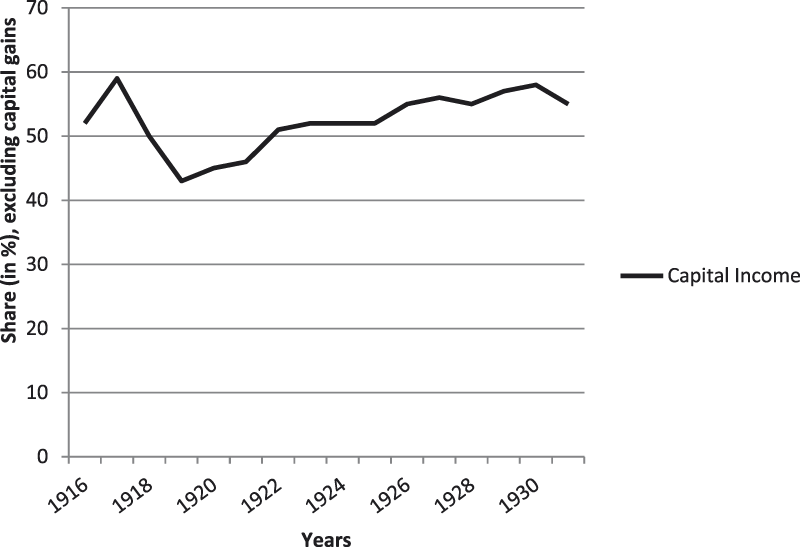
More specifically, the graph below displays the uptrend of the rise of inequalities resulting from capital concentration:
The capital income share in the top 0,5 %, 1916–1931.

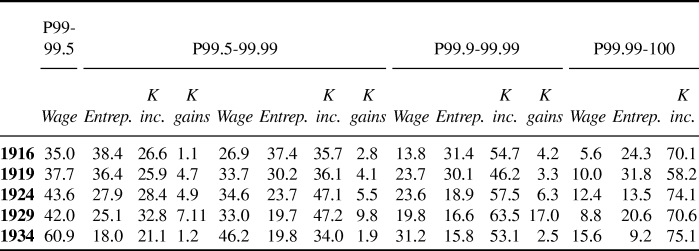
Likewise, the following table shows the extent to which capital-derived income eclipses alternative sources of income for the top tier of the income scale:
Income composition by size of total income, 1916–1934

Source: Authors, from Piketty and Saez (Reference Piketty and Saez2003).
The ‘industrial question’ became central (Diner Reference Diner1998, p. 46), and time was ripe to improve labor relations and workers’ conditions, such as the creation of new institutions like the Commission on Industrial Relations in 1912. This said, we should mention a number of debates among politicians about the opportunity of taxation (Smiley and Keehn Reference Smiley and Keehn1995); and even though important steps were realized, notably with the implementation in 1913 of the first permanent federal income tax, many rebellions and even instances of organized tax-avoidance took place.
The higher-income class, whose members “received more of their income as interest and dividends and less as wages and salaries” (Smiley and Keehn Reference Smiley and Keehn1995, p. 298), lobbied for lower taxes. They succeeded in securing important tax cuts in 1924, a period during which “one of the most prolonged and successful assaults on the taxation of wealth and privilege in the history of the United States” occurred (Campagna Reference Campagna1987, p. 58). It should be added that this coincided with a peacetime tax program where the idea of tax cuts was strongly identified with Andrew Mellon and the Republican Party (Alstott Reference Alstott2006).Footnote 2 Additionally, it was not until the Roaring Twenties that workers’ conditions really improved (Shackel and Palus Reference Shackel and Palus2006). Thus it is important to indicate that until the 1940s, Small’s arguments in favor of taxation, as we discuss below, were respected. Indeed, at this time in the United States, only the wealthiest people paid income tax. Such a situation is of course in total contradiction with the more contemporary practices that coincide with the rise of inequalities and seem to be in opposition to Small’s arguments.
Indeed, Small worried about the tendency of the overall rise of inequalities in American capitalism. To some extent, he was also involved in the ‘industrial question’: during his early years in Chicago, he was engaged in several civil affairs, taking a side in favor of workers during the Pullman strike in Chicago in 1894. He then sat on the National Commission appointed by the Congress on Industrial Conciliation and Arbitration, which investigated the conditions of workers in this company, with a view to modifying employer/employee relationships (Schneirov et al. Reference Schneirov, Stromquist and Salvatore1999). Small often warned about the rise of inequalities in Chicagoan popular journals (Small Reference Small1899b).
For these reasons, Small strongly supported new types of organizations in Chicago, such as the Civic Federation of Chicago, which united scholars, politicians, capitalists, workers, and citizens alike by the goal of improving their well-being through the reduction of inequalities. To Small, this federation exemplified “that social peace depends upon maintaining something more like a balance between property and poverty … placing some of the strength of the strong at the disposal of the weak” (Small Reference Small1895a, p. 93).
However, Small envisioned his role as promoting economic and social reform, mostly in the course of his academic duties but also through direct actions (Christakes Reference Christakes1978). Indeed, Small viewed sociology and social sciences generally as a source of new policies and moral standards. In Small’s mind, this argument of morality is not only part of individuals’ behaviors, but also necessary for building a humane economy (see, recently, Hodgson Reference Hodgson2013), and more broadly a humane society (Small Reference Small1903). Such an anchorage in morals derived, to a large extent, from his family’s religious roots, and he saw social sciences as the best way to scientifically shape social policies consistent with moral values (Small Reference Small1890, p. 81).
More generally, he stressed the need to determine ‘social forces,’ in order to control social change and the economy, tolerating the latter’s continued existence—what he termed “social control” (Small Reference Small1905). As social forces emerge in cases of interaction between individuals with psychological motives, a focus on each individual is necessary. Indeed, all humans have “interests” that correspond to an unsatisfied capacity with respect to a given condition, driving them to undertake certain actions. Small identified six such interests: health, wealth, sociability, knowledge, beauty, and rightness (Small Reference Small1905, p. 435). “Interests” imply “desires” (the subjective development of “interests”) and “wants” (the objective developments of “interests”) (Small Reference Small1905, p. 445).
It is worth noting that, for Small, although “interests are the stuff that men are made of” (Small Reference Small1905, p. 426), interests do not equate to utilitarianism; they involve moral goals—namely, welfare and well-being—from both individual and societal perspectives (Small Reference Small1905, p. 434).
Hence, from his understanding of “interests,” the sociologist is able to define both the social valuations underpinning human actions and the moral standards of society—moral, immoral, and unmoral actions. In Small’s mind, valuations are akin to values. From this point of view, the call for social control in reference to moral standards stemmed from several sources of intellectual influences. As far as sociology is concerned, Small’s main mentors were Lester Ward, to whom he partly owed his dynamic vision of society—and therefore the concept of “social control”—and Gustav von Ratzenhofer, on his vision of the State, which we will develop later (Small Reference Small1905).
Others complemented these sociological influences in political economy (Christakes Reference Christakes1978). First, mention should be made of the economists Schmoller and Wagner, two representatives of the German historical school, whose courses were followed by Small while in Germany. Both academics emphasized the importance of taking into account the totality of economic phenomena as well as their historical specificities (Peukert Reference Peukert2001, p. 94).
Small owed them his concept of “interests,” in the sense that individuals’ interests can emerge only through social interactions and, more broadly, in reference to the global dynamic of the society (Small Reference Small1907, p. 229). To put it another way, “starting from the individual as the basic unit, or atom, of society, Small examines how a complex interdependent society grows and interacts” (Christakes Reference Christakes1978, p. 68).
Moreover, Small shares German economists’ emphasis on the sociological nature of economic actors and institutions, since they all follow strong ethical goals (Richter Reference Richter1996). They all hold morals as key to moving up the ladder of development through the design of the highest ethical principles (Schmoller Reference Schmoller1874, p. 9). Therefore, the reference to ethics is less a set of constraints to individual action than a set of new opportunities to free the individual and build a positive vision of the common good (Peukert Reference Peukert2001). Finally, although the German economists take into account the evolutionary dimension of economic phenomena, they see the latter as controllable (Peukert Reference Peukert2001), which is reminiscent of Small’s concept of “social control.” They seek to improve the functioning of capitalism through State intervention, which would in turn favor the weak. In their view, it was both possible and necessary because of the rise of income and wealth inequalities.
In the wake of the previous developments, the second major influence in political economy came from Richard T. Ely, after Small’s return from Germany. Ely was also close to the German historical school, and stressed the need to incorporate ethical issues into social sciences. According to him, the latter must be directed towards the devising of principles aiming at reducing inequalities while reaching maximum economic prosperity and human development, and promoting a “progressive individualism” (Bradizza Reference Bradizza2008, p. 25).
On the whole, the period of Small’s writing was characterized by a need for radical change at the levels of institutions, law, taxation, and, more widely, of the State’s social policies (Glaeser, Scheinkman, and Shleifer Reference Glaeser, Scheinkman and Shleifer2002). Time was ripe to bring about a new kind of capitalism and a new model of society in order to promote maximal well-being, because the inequalities of that time put both at risk. In particular, inequalities deriving from the concentration of the property of capital seemed to be highly harmful: “More of the gains from the real income growth of the 1920s were realized by higher-income individuals through the growth of property income” (Smiley and Keehn Reference Smiley and Keehn1995, p. 298).
Not content with merely providing an empirical appraisal of the social hardship of his time, Small also proceeded to launch an intellectual attack on the theoretical underpinnings of early twentieth-century capitalism, whose association with capital concentration was perceived as a threat to the social fabric and one’s self-realization through labor—the subject of the next section.
III. AN INDICTMENT OF INEQUALITIES: TOWARDS A REDUCTION OF CAPITAL CONCENTRATION
In order to fully understand Small’s reflections on inequalities, it is necessary first to unveil his conception of “social stratification,” which to a large extent determines the dynamics of inequalities. According to Small, each society is divided into three groups or “ranks”—(1) the privileged; (2) the middle class; (3) those without property, rights, or influence (Small Reference Small1905, p. 275)—and in turn is moved by centrifugal and centripetal forces with respect to the equalization of conditions.
As in modern American capitalism, this stratification reflects the capitalistic industrial order (Small Reference Small1905, p. 275), which has to do with the actors of production involved in the production process. In Small’s view, there were three factors involved in production: labor, capital, and land. Like Karl Marx, he was intellectually close to the labor theory of value and held that only labor creates a value superior to its cost (Small Reference Small1914).
However, even though only labor is empowered to create surplus value, its efficiency depends on its association with capital, and with rentFootnote 3 to a lesser extent. Small distinguished between “tool-capital” (which only the owner uses), “management-capital” (“used by the owner in some sort of dependence upon the acts of others”), and “finance-capital” (used “wholly by others than the owner, and under conditions which he does not and could not maintain by his own individual power,” especially banking and financial institutions) (Small Reference Small1914, p. 728).
As emphasized above, the main problem of the American capitalistic society in Small’s era was the concentration of capital, especially management-capital and finance-capital, even though they could at times be of economic use through better management of resources: “The trust problem, therefore, not economically or culturally, but socially considered, is how to save the technical advantages of organization, and at the same time to seize the social advantage of equitably distributing the results” (Small Reference Small1905, pp. 354–355).
From this point of view, Small agreed with Ely, as well as with the German economists: the great question of his time did not lie only in the sphere of production, and “was not in the capitalists as individuals but in the institutions which allowed the few to ‘monopolize the productive forces’” (Christakes Reference Christakes1978, p. 91). Early twentieth-century America was experiencing problems in the sphere of distribution, through what Schmoller called “the polarization of income (some rich, many poor)” (Peukert Reference Peukert2001, p. 99). Indeed, as Malcolm Rutherford noted, “old institutionalists criticize the performance of market for the inequalities they create in the distribution of income, wealth and economic opportunity” (Rutherford Reference Rutherford1996, p. 130).
Small largely agreed with this view, but focused on the distribution sphere rather than the production sphere: in order to understand the dynamics of capitalism and its inequalities, Small thought, it was insufficient to concentrate on the production sphere, since it can be thought of essentially in ‘technical’ terms (Small Reference Small1907, pp. 1519, 1757). On the contrary, the issue of distribution of wealth was considered more important since it is directly tied to interests, social control, and morals, because what affects one individual necessarily impacts other individuals (Small Reference Small1907, pp. 1335, 1381).
Small went further in highlighting the perils of assigning too much status to capital as well as the social valuation of its concentration. As Small stated, “[W]e have given to capital the legal status of a person, by incorporating capital. Capital thus becomes a titanic superman, incomparably superior to the natural persons who find their interests challenged by this artificial being” (Small Reference Small1905, p. 302).
For Small, this implied that inequalities resulting from capital concentration had to do with his concept of “wealth interest.” It is therefore necessary to go beyond the abstraction of the homo oeconomicus, the so-called economic man (Small Reference Small1907). On the contrary, in order to inquire into such an issue, Small insisted on the need to posit a more complex individual, moved by multiple motives, in the wake of his political economy mentors. Thus, Small considered that social scientists needed to dedicate more scrutiny to individuals’ desires of wealth instead of focusing on the forms of economic action in which the wealth motive is largely mediated (Small Reference Small1905, p. 450).
For instance, Small stressed the danger of wealth inequalities inherent to the hoarding of money, betraying the desire of money for its own sake. Once again, this was particularly true of finance-capital (Small Reference Small1914, p. 742). Therefore, in Small’s mind, inequalities stemming from capital concentration entailed serious problems regarding the valuation of each individual and then the social link and well-being. Instead, Small stressed the need and right for each individual to acquire wealth by reaping the fruits of their labor, especially through the use of tool-capital (Dibble Reference Dibble1975, p. 134).
Indeed, each individual should have the equal ability to realize oneself through labor, which he viewed as ‘real wealth’: “Labor is dignified in proportion as it is mental mastery of materials or conditions. The wealth produced by mental mastery is the regalia of the real man” (Small Reference Small1905, p. 453). On that point, the influence of Ely is conspicuous, since he defended the right for everyone to rise, through “a man’s right to his power to labour” (Ely et al. 2015, p. 367), which must be held “sacred” (Ely et al. 2015, p. 379).
Finally, the concentration of capital posed a challenge to democracy for Small, who equated capital to an economic power that could turn into political power. This is a major criticism that Small addressed to Adam Smith’s view on market, since this institution is at the heart of the transmission of economic power into political power (Small Reference Small1907). As Small underlined, “[T]he radical evil of our present wage system is not that it permits inequality of distribution, but that the inequality is so largely an index of an arbitrary personal inequality, which gives artificial weight to the will of some persons and artificially counts out the will of others” (Small Reference Small1907, p. 966). Therefore, Small disagreed with the belief that people are equal with regard to the distribution process, which Schmoller believed too (Schmoller [Reference Schmoller1900] 1978).
At the bottom end of the social ladder, workers are likely to become pauperized, notably in urban areas in which conditions of living had become intolerable (Small Reference Small1895b), thus jeopardizing their dignity. Small gave them a voice in his Between Eras: From Capitalism to Democracy (Small Reference Small1913), arguably his most radical work (Ross Reference Ross1991).
Therefore, reshaping the role of the State was paramount for Small, which in his eyes was the institution most capable of reducing inequalities. It was all the more necessary as Americans at that time sensed a collusion of the “privileged” involving rich industrial tycoons and the State, entailing some mistrust towards this institution (Glaeser, Scheinkman, and Shleifer Reference Glaeser, Scheinkman and Shleifer2002). Beyond wealth gaps, Small lamented that the State was lacking in justice (Small Reference Small1905, p. 274).
We will now examine Small’s advocacy of a State fulfilling his own criteria of strength and social justice—the “civic State.”
IV. THE STATE AS A VIABLE INSTITUTION FOR REDUCING INEQUALITIES
Small considered the State as the main institution capable of implementing social policies and laws targeting inequalities (as a goal), and of improving the well-being of society as well as individuals within it (as an end). In his vision, the State must be understood in the broad sense of a politically organized society (Dibble Reference Dibble1975, p. 139), embodying the general will of a given society. In other words, Small regarded the State as an institution implementing social policies aiming to reduce inequalities while maintaining economic efficiency.
Small was to a large extent influenced by Ratzenhoffer’s (Small Reference Small1905) as well as by Ely’s conception of the State, the latter viewing it as a key institution to support the equality of opportunity (Bradizza Reference Bradizza2008). Indeed, the State sought to reduce societal conflicts emerging from the interactions of individuals, as well as to improve the functioning of capitalism. Its goal is to channel them towards the pursuit of the general interest: the maximal level of well-being (Small Reference Small1905, p. 239). In this sense, the State should be legitimate in restricting individual liberty and equality if it estimates that the general interest is at stake. Nevertheless, Small felt that a ‘harmonious State’ granting equal opportunities to all was achievable (Dibble Reference Dibble1975). To that end, the State should devise an ‘equalizing program’ based on societal moral standards, as shall be seen later.
Critically, the State can and must evolve (Small Reference Small1905, p. 240). For this reason, the State has mutated throughout history, passing through four stages: 1) the “biologic State”; 2) the “economic State”; 3) the “civic State,” in which “authority becomes sovereignty” (Small Reference Small1905, p. 221); and 4) the “ethical State.”
The fewer inequalities, the closer the State will move towards what Small termed the “civic State,” and the greater the cooperation between individuals and their ability to realize their interests (Small Reference Small1905). Although, in his time, Small regarded the “ethical state” as the ultimate form of State—given that it would facilitate maximum cooperation between individuals—and believed that no country had yet reached this stage. There is no doubt that Small was conscious of the risk of State degeneration, as with a “conquest-State” (Small Reference Small1905, p. 195) or a “despotic-State” (Small Reference Small1905, p. 231), characterized by sometimes self-destructive illusions (Small Reference Small1905, p. 250). Unsurprisingly, Small strongly criticized the German government before and during WWI (Small Reference Small1917).
However, Small believed in the State’s key role as a promoter of revolution-free democratic and social harmony, through the fulfilment of stages that Small called “conflict” (or “struggle”), “moralization,” and “socialization” (Small Reference Small1905, p. 327). Small stressed that such stages were always interlinked because they are to some extent functions of each other. They are differences of degree, not of nature.
Nevertheless, this evolutionary process is inevitable, in Small’s mind. “Socialization,” in particular, unlike “struggle,” is the stage enabling optimal cooperation between individuals, and the stage in which inequalities could be reduced. Indeed, socialization is involved with the highest level of civilization—the two are interchangeable (Small Reference Small1905, p. 363)—namely, the result of people working together through the association and partnership for the general welfare (Small Reference Small1905, p. 344). As a result, civilization holds the highest moral standards, for Small (Small Reference Small1905, p. 347).
It is important to point out that civilization does not come alone. Individuals interact in an increasingly cooperative manner, which implies first a general mindset shift paving the way to higher moral standards (Small Reference Small1905, p. 366). In such cases, individuals gain a heightened awareness of inequalities as they adopt new moral standards.
In addition, the State endorses a leading role as a promoter of higher moral standards, which are necessary to reduce inequalities, since their treatment is a moral imperative. The action of the State is a “struggle based upon the narrowest selfishness, resolving itself gradually into a moralization that tends toward socialization inspired by the broadest selfishness” (Small Reference Small1905, p. 331). Therefore, the law and social policies implemented by the State are key, for Small, because the State embodies the general community welfare (Small Reference Small1905, p. 335). The law is, for instance, necessary to prevent the State from being overwhelmed by lobbies or interest groups, because those exerting power could try to prevent others from earning a share of it (Small Reference Small1905, p. 231).
Small believed that the law could favor workers and improve their conditions as well as protect the weak. In this case, the law would counterbalance the negative influence of capitalists in other institutions because, according to Small, the problems posed by capitalism do not originate in capitalists’ inherent malevolence; instead, they emerge as they gradually gain the ability to monopolize productive forces.
With respect to State policies, the shift from “struggle” to “socialization” necessitates measures such as the need for all individuals to acknowledge others (or groups) (Small Reference Small1905, p. 328). Therefore, “the modern State is both a political organization and an economic system, but it is much more. The State is a microcosm of the whole human process. The State is the co-operation of the citizens for the furtherance of all the interests of which they are conscious” (Small Reference Small1905, p. 226).
As a result, the State’s role with respect to social justice must be to implement policies taking into account fluctuating interests, especially wealth, but also sociability and rightness. The next section will review Small’s proposals for promoting social justice.
V. REDUCING CAPITAL CONCENTRATION IN THREE STEPS
From both a scientific and a moral perspective, Small’s main objective was to demonstrate that a cooperation-based society ought to be attained, and social researchers’ work was to theorize its main features. Such a society would have reached the “socialization” stage, at which point the State would implement social policies aiming to foster cooperation between individuals. Such cooperation should be also consistent with the maximal satisfaction of each individual’s interests, which should be the real purpose of State intervention.
At the beginning of the twentieth century, Small was quite optimistic as far as the likelihood of reducing inequalities was concerned, in particular because the wealthy were willing to make concessions: “It is easy enough to say the rich are divided against the poor, or the strong against the weak, or the educated against the uneducated; but there has never been a time in the history of the world when so much riches was at the service of poverty as today, or so much intelligence devoted to general enlightenment” (Small Reference Small1905, p. 374).
It is also true that Small himself used to admire rich entrepreneurs who funded social projects, as with John D. Rockefeller in the University of Chicago’s department of social sciences (Christakes Reference Christakes1978). Three main proposals of Small’s can be outlined at this point.
The first important measure must be to set up the equality of rights between individuals in order for socialization to take effect. The equality of rights is a condition to improve the moral order (Small Reference Small1905, p. 342). However, equality of rights is not sufficient, for Small. The State ought to go further in reducing inequalities: its function, especially in civilization, is to reduce arbitrary inequalities between people in influence, wealth, and subsequently in opportunity. Indeed, as each individual should realize their interests, equality of opportunity is paramount. According to Small, only inequalities associated with individuals’ ability to contribute to the improvement of the whole social process are fair (Small Reference Small1905, p. 347).
Consequently, in the attempt to reduce inequalities, Small subsequently suggested to reshape the relationship between workers and capitalists, which would take the form of cooperative councils operating within companies. Through cooperative councils, workers and capitalists would reshape the concept of property, and thus would reconsider tool-capital and management-capital while avoiding problems arising from the concentration of finance-capital (see the end of the next section). This is consistent with Small’s belief regarding the functioning of the production process: it is difficult to distinguish precisely the contribution of each factor to production (Small Reference Small1907, pp. 1167–1174).
Moreover, Small wanted workers to sit on the boards of directors in order to foster democratic principles within companies, in keeping with the idea that partnership goes hand-in-hand with representation (Small Reference Small1913, p. 379). Consequently, despite Small’s acknowledging capitalists’ definitive decision-making powers in firms, workers could access a better profit sharing and social rights (such as insurance), thanks to their position on the boards of directors. Using the same concept as Ely, Small called this “new deal” the “Golden means of corporatism” (Small Reference Small1899a, p. 335), a new order of relationships fit to implement representative democracy in firms (Small Reference Small1913). Also, if this framework meant decentralization to some extent, Small considered that cooperative councils should be subjected to State regulation.
Small’s third proposal deals with tax policies. According to Small, taxation is a matter of general interest: “Taxation is in no strict sense simply an economic process. It is a function of the total life of the people” (Small Reference Small1907, p. 2017). Therefore, taxing capital is key to reshaping new kinds of relationships between workers and capitalists, especially to realize the new above-mentioned cooperation. Taxation will compel capitalists as well as the State to gradually take workers’ interests into consideration. On the one hand, the State needs to rely on capitalists to finance its policies through taxation. Capitalists are indispensable inasmuch as they can fund social programs. On the other hand, taxation of capital should be sufficiently high to check the power of capital. As Small underlined, this is of primary ethical importance (Small Reference Small1905, pp. 272–273).
It was, then, important for Small to advance proposals regarding capital taxation consistent with the ‘real’ distribution of wealth, a significant improvement in the dignity of labor, and in fine progress in the realization of interests. His goal was to determine “social valuations” aiming to improve individuals’ interests, especially wealth, sociability, and rightness.
Nevertheless, as Small did not wish the destruction of capitalism per se, he drew up measures aiming to improve the social facet of the system while maintaining its economic efficiency. Like Ely, Small was not willing to scarify the interests of the wealthy in order to benefit the poor (Bradizza Reference Bradizza2008). His goal was to devise a society in which the “harmonious satisfaction of interests” of all classes and of all individuals would be achieved (Christakes Reference Christakes1978, p. 110).
That is why Small emphasized that since profit—and, to a lesser extent, rent—was per se inherent to capitalism, taxation policies should distinguish between ‘profit’ and ‘over profit’ (Small Reference Small1912). The former is acceptable if it corresponds to the remuneration of capital, as well as being redirected towards investments or subsidies, allowing labor to increase its production capacities. In these cases, profit serves social utility. Hence, Small suggested the following five measures in order to reduce capital concentration while ensuring capitalism’s permanence:
1. Stockholders to receive not more than a maximum rate of dividends, x, calculated to be enough above the average rate of return upon securities to serve as a premium upon investment in needed industrials.
2. Stockholders to be restrained from evading the prescribed limitations by voting salaries to themselves for services.
3. Premiums, in the form of pro rata dividends on salaries and wages, to be offered as inducements to increase output.
4. Net profits in excess of the rate provided for in 1 to be divided, in some proportion to be determined by experience, between employees of all sorts and the state.
5. The state’s share of the profits shall not be available for governmental expenses. They shall go to some holding concern, perhaps an adaptation of the present Federal Reserve banks, to be loaned to the most desirable industrial enterprises—desirable from the standpoint not of private but public interest. (Small Reference Small1925, p. 461)
To summarize, these three proposals are interlinked because they all aim to ensure that all individuals are afforded the same opportunities as others to benefit from capital, as with capital-tool. In this perspective, inequalities of capital can be fair if and only if they fulfil this prerequisite—namely, the global existing stock of capital would always promote labor and, by extension, all individuals.
Even though Small did not call for a control of the means of production by the State (Small Reference Small1912), he entrusted the State with a broader place, role, and status in order to devise a new kind of capitalistic system. The latter should be built from human capabilities, because it goes hand-in-hand with democracy.
VI. REASONABLE CAPITALISM AS THE BUILDING BLOCK FOR DEMOCRACY AND SOCIAL COHESION
To resolve inequalities, it is necessary to rethink the nature of capitalism to achieve a better society and a more reasonable capitalism. As Schmoller was one of Small’s mentors—the word “reasonable” is borrowed from the German economist (Schmoller [Reference Schmoller1900] 1978, p. 21)—we therefore consider it perfectly suitable to describe Small’s vision of capitalism. Small was neither a liberal nor a Marxist but a corporatist: capitalism must survive on the condition that its institutions evolve, in particular through State action. As a result, people will cooperate, and then be able to reach a maximal state of well-being. It is both an economic and a moral issue, which also involves the survival of democracy.
In Small’s America, such a view was strongly debated among social scientists. For that reason, we need to compare Small’s reflections with those of other academics. We argue that three main groups can be distinguished, each holding differing views on the dynamics of capitalism and the associated treatment of inequalities:Footnote 4
Group 1: scholars favoring the actual functioning of capitalism, albeit to different degrees. Here we find social scientists, in particular economists, who supported the system as it was, recognizing the smooth functioning of the market and the primacy of economic individual liberty. They did not consider State interventionism as necessary, and tolerated inequalities, since they were perceived as the consequence of the functioning of the market. This group gathers sociologists, for instance, Franklin H. Giddings, and economists—representatives of marginalism and of other traditions—such as James Laurence Laughlin, William Sumner, Francis Walker, Irving Fisher (Sumner’s PhD student), and John B. Clark in his later years.Footnote 5
Group 2: scholars in favor of a new kind of State-regulated capitalism. These academics advocated for individual liberties through the recognition of the superiority of social forces, and the actions of the State that ultimately impacted global well-being. Among those defending this view, we find primarily Small, Ely, Dewey, and Commons, but also Simon Patten, whose vision, while differing from Small’s, nonetheless deserves recognition (see below).
Group 3: scholars in favor of more radical actions towards capitalism, and even the implementation of socialism. The only way to put an end to inequalities, especially those stemming from capital concentration, is to change the economic system. That explains why some members of this group were close to Marxian ideas. Thorstein Veblen is the main representative of this group, as well as Edward Bemis,Footnote 6 another economist of the University of Chicago. At their time, their vehement views were not considered as viable alternatives.
Small had little sympathy or contact with representatives of Group 3, since he was very skeptical of radical ideas. Although Bemis and Small knew each other (Lengermann and Niebrugge Reference Lengermann, Niebrugge and Calhoun2007, p. 88), Bemis accused Small of his ties to ‘great funders’ of the University of Chicago (namely, Rockefeller) (Ross Reference Ross1991), which, he held, prevented Small from acknowledging the real challenges of the issue of property and inequalities. Small wrote a paper to clarify his position (Small Reference Small1895b).
Moreover, the connection between Small and Veblen seems very thin. Small quotes Veblen only twice in his seminal book (Small Reference Small1905, pp. 277, 451), even though Small acknowledges Veblen for his theory of the instinct of workmanship to investigate the issue of men’s desire for wealth. But on the whole, they appear very distant from each other, with regards to many points of disagreement (Vallet Reference Vallet2017).
The relationship between Small and representatives of the first group was characterized by sharp opposition. For instance, debates were lively between Small and other sociologists, such as Franklin H. Giddings. Small attacked him in particular in his article “Scholarship and Social Agitation” (1895c) on two important grounds; first, for Giddings’s distinction between sociology and social ethics; and, second, for his focus in favor of individualism. Such a stance was problematic in Small’s view: as an evolutionary positivist, Giddings saw competition as a universal evolutionary process, entailing a necessary selection and adaptation among society (Ross Reference Ross1991).
This said, it is necessary to mitigate Small’s argument, in light of key insights in Giddings’s work. Indeed, especially by the middle 1880s, Giddings was increasingly preoccupied with the social question and the rise of the “plutocracy spirit,” thereby possibly undermining his own views on the cooperation between humans. Moreover, as we argue below, Giddings did not share ‘extreme’ views towards laissez-faire, as was the case with Sumner’s views. In fact, he believed moderate reforms would encourage equal economic opportunity, social solidarity, and cumulative liberty (Giddings Reference Giddings1896,Reference Giddings1906).
Nevertheless, one of the main criticisms addressed to Small came from Laughlin, another economist from the department of economics of the University of Chicago, who hired Veblen. Laughlin, who was close to the conservative intellectuals and to businessmen but anaemic to marginalism (Ross Reference Ross1991), did not agree with Small’s view on inequalities: Laughlin defended capitalism as it stood and then did not intend to “moralize” the economic system.
Small’s attacks were concentrated on those academics who supported economic liberalism. William G. Sumner, the “American echo of laissez-faire as represented in England by Herbert Spencer” (Small Reference Small1916, p. 733), was one of Small’s targets. Small criticized Sumner for his defense of the survival of the fittest, as well as for his belief that those who fell to the bottom deserved their fate.
Moreover, contrary to Small, Sumner advocated for a small government, whose main task should be to merely protect private property rights and contracts (Sumner [1883] 1978). Sumner feared that additional public expenses would lead to “extravagant governments, abuses of public credit, wasteful taxation, legislative monopolies and special privileges, juggling with currency, restrictions on trade, wasteful armaments on land and sea, and other follies in economy and statecraft are capable of wasting and nullifying all the gains of civilization” (Sumner Reference Sumner1881, p. 190).
Nevertheless, we should emphasize Sumner’s awareness of a possible general tendency towards equality, but on the condition that natural forces and the perpetual struggle for existence dominate. Although Sumner believed human selection is carried out by the industrial process, there could be an ‘efficient’ statesman (Sumner 1906). In this sense, Small himself recognized that differences in emphasis and methods aiming at improving global well-being could coexist within sociology (Small Reference Small1906).
This said, Small criticized scholars perceived as representatives of the neoclassical tradition, such as Edward A. Ross, Fisher, or even J. B. Clark. To Small, their work denied the existence of inequalities and, more problematically, legitimatized the existing system with the free market at its heart: “Economic theory became consequently a supporter of the system which assumed the inviolability of the existing institutions of property in land and capital” (Small Reference Small1907, p. 1174).
Regarding Small’s relationships to scholars belonging to Group 2, while we can consider them as progressives, to some extent, Small did not consider them necessarily as progressive thinkers, in particular Simon Patten, who voiced his criticism of Small at the meeting of the American Economic Association in 1894 (Small Reference Small1895d). Patten altogether rejected Small’s proposals to deal with the subject of inequalities. He even declared in 1899 that “progress is a higher law than equality, and a nation must choose it at any cost” (Ross Reference Ross1991, p. 199), even if this requires recourse to eugenics—the “eradication of the vicious and inefficient” (Ross Reference Ross1991, p 199).
Small fought these social thinkers such as Patten partly for these reasons, indicating the extent to which there were severe oppositions between the two men. However, in spite of Small’s negative assessment, it is worth reminding ourselves of Patten’s breakthroughs within the annals of progressive ideas. Patten sought to reconstruct the world on fairer and more egalitarian grounds, encapsulating in his mind a firm opposition to neoclassical economics, which was associated with the “natural laws of the economy,” clearly rejected by Patten.
Influenced by German economists (especially Johannes Conrad, Patten’s mentor), as was Small, the originality in Patten’s work was to link inequalities with external factors. For instance, he supported a sort of protectionism of industry in order to protect workers, and also developed a general approach to governmental policies to further develop a national industry (Patten [Reference Patten1890] 2008).
Patten thought free trade obligated a country to specialize in only a few sectors—or even just one—thereby reinforcing the power of capitalists over employees. For instance, the author argued that even though rent from land was less developed in the United States than in Great Britain, there was a powerful income in the United States similar to the concept of rent emanating from monopolies and powerful banks, exacerbating the power of capital. For that reason, he called for not only the imposition of tariff trade policies but also taxation on the capital of ‘rentiers,’ but not necessarily of all capitalists. This reminds us of Small’s distinction between “profit” and “over profit.” In other words, while Small emphasized redistribution, Patten stressed the importance of the production of public goods and the development of new social work programs. In this sense, it is worth reminding ourselves what Patten brought to progressives ideas with respect to the treatment of inequalities arising from capital concentration.
However, the most noticeable fact is Small’s intellectual connections as well as friendship with other scholars quoted in Group 1.We have insisted on the legacy of Ely, because Ely also helped delegitimize laissez-faire capitalism. To that aim, rethinking the issue of property was key to reducing inequalities stemming from capital concentration and to establishing a fairer economic and political system.
He especially rejected the idea—upheld by the Founding Fathers of the United States—of the primacy of natural rights individualism (Ely Reference Ely1894), because this belief denied humans’ full social nature as well as the importance of the State to enable social interactions. There could be neither natural rights to property nor social contract between two equal persons because they are unequal by nature, resulting in naturally superior individuals’ constantly rising to the top. State intervention is therefore necessary to set the conditions of their interaction, indicating the extent to which the State precedes the individuals.
What could exist at the time of the Founding Fathers was no longer realistic at a time when industrial-based capitalism had developed, accentuating the complexity of society and the dependence of man on man—with the risk of domination (Ely Reference Ely1902). Therefore, Ely claimed, first, that “if one wants to improve the distribution of wealth one must change men” (Ely et al. [Reference Ely, King and Orth1914] 2015, p. 56). Second, Ely believed that individual property should be recognized—by law in particular—but only on the condition that it should promote the general welfare (Bradizza Reference Bradizza2008). This point entails huge consequences: as the right of individual property has ontologically a social basis that is established by the State, such a right as well as its advantages (especially income) can be regulated by the State, according to the needs of society.
Moreover, one of the major contributors to the debate is the philosopher and psychologist John Dewey. Small seems to be in agreement with Dewey, whom Small held in high esteem (Small Reference Small1905). They even worked together, Dewey publishing in his book My Pedagogical Creed (1897) a paper of Small’s entitled “The Pedagogical Philosophy with Which My Sociology Allies Itself.”
Indeed, Dewey and Small shared the view that education has a great role to improve capitalism and democracy. According to Dewey, the driving force of society is undoubtedly creative democracy, a form of democracy that goes beyond the system of political government to take root in a humanely liberated world, making collective experience a place of sharing, blooming, and republican gathering.
That is why Small found Dewey’s work of great relevance—notably his 1902 essay “Interpretation of the Savage Mind.” In this essay, Dewey explained that society is emergent from social interactions; to that end, education is perceived as a crucial medium to reaching a more just democracy and an improved capitalism. For him, the figure of the savage is central for understanding the role of education in creativity and the emergence of democracy (Dewey Reference Dewey1902).
It is, then, little surprise that both converge on the questions of ethics and interests in progressive thought. Indeed, in his seminal book of 1905, Small quoted the 1893 work of Dewey, Self-Realization as a Moral Ideals, in which Dewey asserts that “if one turns to any of the important ethical discussions of hardly a generation ago, he finds the center of interest in the origin of moral judgments” (Dewey Reference Dewey1893, p. 652). Additionally, Small and Dewey endorsed a similar view of the origins of individuals’ interests: “Interest is impulse functioning with reference to self-realization” (Dewey, cited in Small Reference Small1905, p. 433).
Both shared the idea that individuals are guided by a “collective mentality” behind their interests, which influences their choice: “Only by participating in the common intelligence and sharing in the common purpose as it works for the common good can individual human beings realize their true individualities and become truly free” (Dewey Reference Dewey1935, p. 20), since a progressive society must increase the effective freedom of all through positive actions aiming at enhancing their capacities (Dewey and Tufts Reference Dewey and Tufts1913).
More generally, both Dewey and Small argued that between individual attributes and society lay not only some crucial cognitive media such as interests, but also habits,Footnote 7 as shall be seen later. This similarity allows taking ethics into account in the understanding of the emergence of social orders and in the explanation of social valuations. Individual actions are guided by interests and lead to superior ethical purposes and better collective well-being (see Small Reference Small1905, p. 684, quoting Dewey). It should be noted, moreover, that this idea is strongly emphasized in Small’s Reference Small1903 influential paper “The Significance of Sociology for Ethics.”
Therefore, Small and Dewey argued that ethics is a compass to better capitalism, and launched an attack on economic liberalism, which Dewey indulged in his 1935 book, Liberalism and Social Action. According to him, the liberals believed that social progress could derive only from an economic, non-socially oriented private firm, with the sanctity of private property as its foundation and ultimate achievement—meaning the absence of social control. To Dewey, they tried to make progress rely on a unique trajectory that they wanted to make immutable. To reshape the concept of property in capitalism was, then, key to making democracy and its dissemination an ethical normative ideal to all the organized bodies of society.
In this, Dewey and Small concurred with another influential American thinker, the economist John R. Commons; they shared a willingness to lay the intellectual basis for understanding how capitalism can be transformed. It is nevertheless worth noting that Small did not pay the same attention to the works of Commons as he did to Dewey’s, although he met Commons at Johns Hopkins University when he completed his own thesis between 1888 and 1889.
Be that as it may, we can observe a true intellectual convergence among Small, Dewey, and Commons as three essential progressive scholars devoting part of their research to reflecting on the prerequisites for a better capitalist society. Also a student of Ely’s, Commons was a representative of the Wisconsin school, which embodied the Progressive Era as late as the 1930s. One of his intellectual aims is explicit: to devise a framework of analysis making the market system a “reasonable capitalism,” a kind of capitalism that would involve a form of social control of the economy.
Justification of his motives is to be found in his 1934 book: reasonable capitalism would achieve a superior ideal by making human nature better. In other words, the ambition is to put capitalism under democratic control in order to develop the human community and increase its capacity for emancipation. On this point, Commons put humans’ empowerment at the heart of the reflections to suggest a sustainable recovery of the economic and social development.
In his view, human capacities are also structured by human social habits, an idea that is reminiscent of the concept of “interests” and the capacity of human emancipation therein. Commons (Reference Commons1921) characteristically wrote:
Purpose is anticipation of the future, and pulls forward. Believing is in the present. Purpose and procedure together resolve themselves into the distinguishable but inseparable attributes of the human will, namely, habits, ideals, definitions, investigations, classifications, valuations, choices, behavior. Habits are the sub-conscious setting of body, nerves and brain on the basis of past experience and ready to set off in accustomed directions when touched by stimulus from outside. “Habit is energy organized in certain channels.” (Commons Reference Commons1921, p. 349, citing Dewey)
The practicality of reasonableness will be asserted through a political issue that becomes a normative ideal: the ultimate objective is indeed to build a compromise to reduce conflicts (or make them acceptable), a lasting compromise as a reasonable societal solution to the continuity of the development of the human community. It was in this spirit that Small and Commons took the same side. For Commons, reasonableness lies in adapting rules to compromises. Reasonableness is both performative (a value is reasonable only for a given period) and evolutionary (reasonableness is linked to institutional change, whereas the righteous do not change ‘ontologically’).
To sum up, these four thinkers called for institutional change, an “idealism in action” with a view to taking society to the highest ethical stage. They theorized the improvement of capitalism through a true societal faith: creative democracy must radically transform society, and, in its wake, the modes of human association. Therefore, the issue of a reasonable capitalism is based on individual behaviors, but is also strongly linked to the societal responsibilities of world business firms (Chassagnon Reference Chassagnon2011)—an institution that Small closely analyzed (Vallet Reference Vallet2017).
Three arguments need to be specified at this stage. First, a reasonable capitalism must be able to shift economic power towards the pursuit of the common good in addition to private interests and in a spirit of social responsibility. Second, a collective and ethical economic democracy based on organized aspirations must emerge and, to that end, an economic representativeness capable of revealing reasonable values must be found. Third, in order to create joint action, it is necessary to rebalance the power of individuals through collective bargaining in order to bring about shared control and a collective spirit of cooperation and inter-individual trust (Chassagnon Reference Chassagnon2014). The analysis of the proposed undertaking cannot dissent from even one of these three principles of fairness and reasonableness.
VII. CONCLUSION
The present paper intends to shed light on Albion Small’s views on inequalities, in particular those resulting from capital concentration, in order to establish a reasonable capitalism compatible with democratic institutions. Indeed, along with some other eminent progressive scholars, Small advocated reform in law, taxation policies, and of the State at large. The latter would promote each individual’s ability to use their own “capital-tool,” and subsequently draw benefits from their labor. Such a mutation would entail a rise in global well-being, a historical stage—“socialization”—in which human beings would become ends rather than means. This stage would prevent individuals from being self-centered, a phenomenon Small became increasingly aware of, as individualism soared in post-Civil War America (Small Reference Small1905, p. 478).
As such, Small focused mainly on the general trends of his times, characterized by a rise in inequality. In turn, this helps in understanding a number of normative claims not fully in line with some empirical facts on inequalities, income taxes, and capital concentration, such as a decline in some types of inequalities (Piketty and Saez Reference Piketty and Saez2014). For instance, the Roaring Twenties were characterized by a general increase both in wages and skills benefiting the working class (Shackel and Palus Reference Shackel and Palus2006). Furthermore, the rise of new types of industrial organization and management improved both management–worker relations as well as the global productive environment of workers (Scase Reference Scase1992).
Moreover, Small’s followers within sociology at the University of Chicago demonstrated that even though there were at times difficult living conditions for Chicago workers, especially for migrants, local cooperation between social groups was possible. The work of Robert E. Park (Reference Park1950) on the “race relations cycle” is of particular interest: while there were economic and social hurdles to overcome inequalities, these can be resolved through “assimilation.” In that sense, with respect to inequalities, Park was certainly more optimistic than Small.
This said, Small’s thought has remained relevant to contemporary debates on the treatment of inequalities, for three main reasons. First, his analysis of inequalities calls for a broader reflection on the nature of capitalism and its evolutionary dynamics, since we do believe that the current capitalism is “between eras,” to borrow from Small (Small Reference Small1913). Second, his works address the issue of the nature, and frontier of, property, since the use of capital is not only its owner’s concern. Third, Small’s main breakthrough is to have established that inequalities deriving from capital concentration result in a spiralling of wealth among the few, with the consequence of exacerbating class conflict and becoming harmful to capitalism and democracy. Solving the problem, therefore, raises the issue of inequalities reduction and of the rise of the opportunity for each individual to access wealth.
These three points shed light on the contemporary debate on the ‘return’ of social class warfare, as highlighted for years by the work of Louis Chauvel, for instance. Through his “historical social class spiral,” Chauvel avers that the increase of inequalities is historically likely to entail a rise in class consciousness and its corollary, class warfare (Chauvel Reference Chauvel and Therborn2006). Crossing his analysis with that of Small, the contemporary aggravation of inequalities gives us a glimpse of alternative ways of rethinking our current societies.