INTRODUCTION
Co-infections of the same host by multiple species of parasites have been reported in numerous host populations and have important consequences for community structure as well as host-parasite co-evolution (Esch and Fernandez, Reference Esch and Fernandez1994; Escribano et al. Reference Escribano, Williams, Goulson, Cave, Chapman and Caballero2001). Furthermore, with the more frequent pathogen outbreaks and shifts in their distributions linked to global climate change (e.g. Harvell et al. Reference Harvell, Altizer, Cattadori, Harrington and Weil2009), the impacts of co-infections are increasing in importance. However, while there is good theory and data regarding single-species co-infections (i.e. between-strain competition; see Frank, Reference Frank1996; Mosquera and Adler, Reference Mosquera and Adler1998 for theoretical; and de Roode et al. Reference de Roode, Helinski, Anwar and Read2005; Ben-Ami et al. Reference Ben-Ami, Mouton and Ebert2008; Brown et al. Reference Brown, Inglis and Taddei2009 for empirical examples), the outcome of multiple-species co-infections (i.e. between-species competition) requires a more thorough, system-specific examination.
The timing of infection events has been suggested as an important factor in determining the outcome of co-infections and the overall effects on population dynamics (e.g. Hood, Reference Hood2003; de Roode et al. Reference de Roode, Helinski, Anwar and Read2005; Jäger and Schjørring, Reference Jäger and Schjørring2006; Jackson et al. Reference Jackson, Pleass, Cable, Bradley and Tinsley2006). Specifically, in studies of single-species co-infections across various host-parasite systems, it has been found that parasite strains encountering infected hosts are at a large disadvantage (compared to those infecting naive hosts). The two main reasons for the disadvantage are thought to be a depletion of host resources and priming of the host immune system (e.g. Read and Taylor, Reference Read and Taylor2001; de Roode et al. Reference de Roode, Helinski, Anwar and Read2005). However, the situation at the species level is quite different as the immune response is often species specific, even within invertebrate hosts (Kurtz and Armitage, Reference Kurtz and Armitage2006). Therefore, later residency might offer an advantage to more distantly related parasites, as immuno-compromised hosts may facilitate invasion and exploitation (Rolff and Siva-Jothy, Reference Rolff and Siva-Jothy2003). In addition, different species often have diverse resource needs and occupy different niches, making host-sharing possible, as is known for some gut macroparasites (Holmes, Reference Holmes2002). However, the competitive outcomes of interspecific parasite interactions are complex and context dependent, making generalizations difficult (e.g. Lello et al. Reference Lello, Boag, Fenton, Stevenson and Hudson2004).
In this study, we addressed infections of a single Daphnia genotype by 2 sympatric lake parasites (a single genotype of each); an intestinal protozoan Caullerya mesnili (class Ichthyosporea, Lohr et al. Reference Lohr, Yin and Wolinska2010) and a haemolymph fungus Metschnikowia sp. (family Hemiascomycetes, Wolinska et al. Reference Wolinska, Giessler and Koerner2009). Both parasites are common in lakes throughout Europe (Wolinska et al. Reference Wolinska, Keller, Manca and Spaak2007, Reference Wolinska, Giessler and Koerner2009) and have been observed sympatrically (Wolinska et al., unpublished observations). Therefore, co-infections by these 2 parasites are likely in natural populations of Daphnia. Furthermore, co-infections of Daphnia by a variety of other parasite species have been reported from previous field studies (Stirnadel and Ebert, Reference Stirnadel and Ebert1997; Decaestecker et al. Reference Decaestecker, Declerck, De Meester and Ebert2005; Tellenbach et al. Reference Tellenbach, Wolinska and Spaak2007; Wolinska et al. Reference Wolinska, Keller, Manca and Spaak2007).
To get a basic understanding of the dynamics of multiple infections, we compared parasite and host fitness under single infections and co-infections. In addition, we determined whether the timing of co-infection (simultaneous versus sequential) and the specific order of co-infection (prior versus late residency) influences the outcome of within-host competition.
MATERIALS AND METHODS
Study system
Daphnids are small freshwater zooplankton (crustaceans) living in lakes and ponds, where they are an important component of the aquatic food web (Lampert and Sommer, Reference Lampert and Sommer1999). They are cyclical parthenogens, most frequently producing diploid asexual eggs which develop in a dorsal brood chamber. At 20°C and under good nutrient conditions, offspring are released from the brood chamber after about 4 days and reach maturity in approximately 5–10 days (Ebert, Reference Ebert2005).
Caullerya mesnili (Chatton, Reference Chatton1907) infections are first visible around 11 days post-infection as spore clusters in the gut epithelium (Bittner et al. Reference Bittner, Rothaupt and Ebert2002). Spore clusters reach sizes up to 100 μm in diameter and consist of 8–20 oval-shaped spores (Green, Reference Green1974). C. mesnili castrates its host 1–2 clutches after infection (Bittner et al. Reference Bittner, Rothaupt and Ebert2002; Wolinska et al. Reference Wolinska, Bittner, Ebert and Spaak2006). Metschnikowia sp. is visible approximately 10 days post-infection (Hall et al. Reference Hall, Sivars-Becker, Becker, Duffy, Tessier and Cáceres2007). Needle-like spores accumulate in the haemolymph and are released only after host death and subsequent decomposition of the cuticle (Codreanu and Codreanu-Balcescu, Reference Codreanu and Codreanu-Balcescu1981). Both parasites are only transmitted horizontally (Ebert, Reference Ebert2005) and hosts have never been observed to recover from infections.
Origin and care of host and parasites
The Caullerya mesnili strain was isolated from Greifensee, Switzerland, in 2006, and the Metschnikowia sp. strain was isolated from Ammersee, Germany, in 2008. Both parasites were maintained within the D. galeata clones isolated from their respective lakes. The Greifensee D. galeata clone was used as the experimental host. A previous study has shown that Metschnikowia sp. has constant virulence and infectivity regardless of the parasite strain in question (Duffy and Sivars-Becker, Reference Duffy and Sivars-Becker2007). Therefore, using a Metschnikowia sp. strain reared on a different host clone should not have affected our results. The Metschnikowia sp. used in this study is the same species referred to previously as Metschnikowia bicuspidata (e.g. Hall et al. Reference Hall, Tessier, Duffy, Huebner and Cáceres2006, Reference Hall, Sivars-Becker, Becker, Duffy, Tessier and Cáceres2007). A recent study found this Daphnia-infecting species of Metschnikowia to be phylogenetically distinct from other species also referred to as Metschnikowia bicuspidata, and thus renamed the parasite Metschnikowia sp. to avoid confusion (Wolinska et al. Reference Wolinska, Giessler and Koerner2009). Hosts and parasites were kept in climate chambers at 20°C with a summer photo-period of 16:8 light-dark, in synthetic media (based on ultrapure water, trace elements and phosphate buffer) and fed 3 times a week with 1·0 mg CL−1 unicellular green algae (Scenedesmus obliquus) to avoid food limitation. Stock parasite cultures were maintained by adding uninfected juveniles into the cultures; this procedure was repeated every second week.
Experimental set-up
We conducted a life-history experiment in which we exposed D. galeata to either C. mesnili, Metschnikowia sp. or to both parasites. In total there were 6 treatments: 1 negative control (i.e. uninfected group), 2 positive controls (single C. mesnili or Metschnikowia sp. infections), 1 simultaneous co-infection (C. mesnili and Metschnikowia sp. together), and 2 sequential co-infections (C. mesnili followed by Metschnikowia sp. or Metschnikowia sp. followed by C. mesnili). There were 30 replicates per treatment, resulting in 180 experimental units.
Prior to the experiment, 50 adult monoclonal females (D. galeata clone) were selected from mass cultures and isolated 2 per jar in 30 ml of medium. From these mothers 100 neonates were collected and passed through 3 subsequent generations to remove maternal effects (each kept individually in 30 ml of medium), before serving as the mothers of the experimental animals. The experimental neonates (third brood, born within a 48-h span) were left individually to mature for 6 days before the infections began, this allowed animals to reach a larger size whereby the filtering rate increases, aiding in the infection process (Hall et al. Reference Hall, Sivars-Becker, Becker, Duffy, Tessier and Cáceres2007). Using a split brood design neonates were randomly assigned to 1 of the 6 treatment groups.
Infection regime
Spore cocktails were prepared by crushing infected D. galeata in 2·5 ml Eppendorf tubes. Individuals were crushed until there were no visible remnants of the carapace and the solution appeared homogenized. The solution was shaken thoroughly to mix the spore suspension, after which a 12 μl subsample was taken immediately. The subsample was loaded into a Neubauer Improved counting chamber to determine the spore concentration. The proper amount of this stock solution was then calculated and added to all experimental jars for a given treatment. Spore solutions were shaken before pipetting to ensure the solution remained homogenous.
Each experimental unit consisted of a single 7-day-old (±1 day) Daphnia placed in a jar with 5 ml of medium. The specifics of the treatments were as follows. (a) No infection, negative control (‘CONT’): on day 1 a control cocktail of crushed non-infected D. galeata was added to each jar (concentration 0·1 Daphnia/ml). (b) Single infections, positive controls (‘CAUL’ or ‘METS’): on day 1 a C. mesnili or Metschnikowia sp. spore cocktail of 700 spores/ml was added to each jar, respectively. (c) Simultaneous co-infections (‘CAUL & METS’): on day 1 C. mesnili and Metschnikowia sp. spore cocktails of concentration 700 spores/ml for each parasite were added to each jar. (d) Sequential coinfections (‘1st CAUL & 2nd METS’ or ‘1st METS & 2nd CAUL’): on day 1 a C. mesnili or Metschnikowia sp. spore cocktail of 700 spores/ml was added to each jar, and on day 4, the second parasite species was added.
During the infections all jars were stirred twice per day to re-suspend the spores. On experimental day 4, 5 ml of fresh medium was added to all jars. On day 8 the infection regime ended and all individuals were transferred to new jars with 30 ml of fresh medium. For the remainder of the experiment all individuals were fed daily with 1·0 mg CL−1Scenedesmus obliquus and the medium was changed every third day. The experiment lasted 44 days, at which point all infected animals had died.
Recorded parameters
All individuals were checked every second day for the number of offspring and the appearance of visible signs of infection. For C. mesnili the number of visible spore clusters was recorded every second day from when spores were first visible. As C. mesnili spores are released from the gut (Lohr et al. Reference Lohr, Yin and Wolinska2010), the number of spore clusters observed every second day over the course of the infection was summed and used as an estimate of life-time spore production. For Metschnikowia sp., the number of both mature and immature spores was determined after host death: each individual was homogenized in 0·3 ml of medium, and the concentration of immature and mature spores was counted using a Neubauer Improved chamber (for each individual 2 subsamples were loaded and the average of the 2 values was taken). Immature spores are easily distinguished from mature spores, being considerably smaller and less needle like (Green, Reference Green1974). Finally, regardless of treatment, all animals that died throughout the experiment were dissected to ensure infections were not overlooked.
Data analysis
Data were analysed using PASW statistics version 17.0 (PASW, 2009). Time to host death, time to visible infection, offspring production, number of broods and spore production were analysed using univariate ANOVAs (normal distribution and homogeneity of variance were verified using the Kolmogorov-Smirnov test and Levenes test, respectively). Variables that did not conform to normality were transformed using the Rankit function (rankit: (r-1/2)/w, r=rank and w=number of observations; Harter, Reference Harter1961). The control group was first contrasted against all infection treatments, after which it was excluded from other analyses. When calculating the time to visible infections in the sequential treatments, we subtracted 4 days from either C. mesnili or Metschnikowia sp. when the respective infection was delayed (i.e. given later residency). Prevalence of infection and the number of early deaths (day 10 and earlier) were analysed using a generalized linear model with a binomial distribution and a logit link function. To compare the number of single versus co-infections (within the 3 co-infection treatments) a binomial test was run.
RESULTS
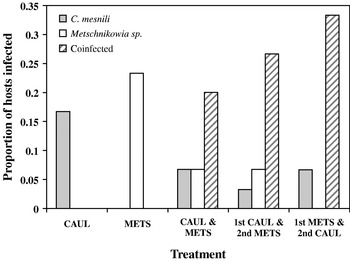
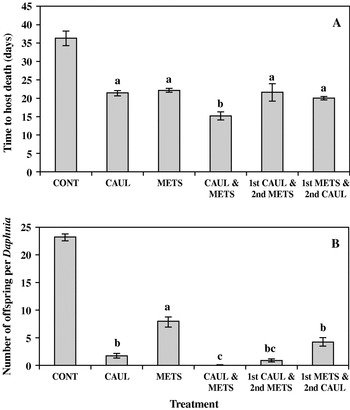
Over the 5 infection treatments 44 of the 150 exposed individuals became infected with one or both parasites (Fig. 1), whereas no control animals became infected. Throughout the first 10 days of the experiment, some Daphnia died without any signs of infection, including in the negative control treatment (in total 46 of 180 experimental units). However, the number of these early deaths did not differ significantly by treatment (Wald χ2=9·5, d.f.=5, P=0·089). Across the 3 co-infection treatments (pooled data), there were significantly more co-infections as compared to single infections (23 and 9 cases, respectively; binomial significance P=0·02, Fig. 1). Across all the infection treatments, only infected animals were included in analyses of parasite characters and parasite-induced traits and in the co-infection treatments, only hosts infected with both parasites were included. Thus, the sample sizes were as follows: CAUL: 5; METS: 7; CAUL & METS: 5; 1st CAUL & 2nd METS: 9; 1st METS & 2nd CAUL: 11. Time to host death in the control treatment was longer than in any of the infection treatments (F5,64=28·2, P<0·001; Fig. 2A), and offspring production by the controls was higher than in the other treatments (F5,64=47·4, P<0·001; Fig. 2B).
Proportion of Daphnia galeata infected with single and co-infections of Caullerya mesnili and Metschnikowia sp. across the infection treatments.

Parasite virulence across the infection treatments. (A) Time to host death and (B) total number of offspring. Values are mean +/− standard error. ANOVA: F4,34=7·7, P<0·001 and F4,34=28·3, P<0·001, respectively. Different letters above the columns indicate significant differences from post-ANOVA contrasts.

Host fitness
The 2 parasites did not differ in their effects on host life span (21·4 and 22·1 days respectively, compared to 36·2 days in the control; Fig. 2A). However, single infections with C. mesnili did lead to a larger decrease in both offspring production (1·8 and 8·6 offspring per host, respectively, compared to 23·2 in the control; Fig. 2B) and number of broods (0·83 versus 1·7 broods, respectively, compared to 6·2 in the control; F4,34=31·6, P<0·001). Simultaneous co-infections were significantly more virulent than single infections, decreasing host life span to 15·2 days (Fig. 2A). In addition, simultaneous co-infections had greater effects on fecundity than the other infection treatments, including single C. mesnili infections (Fig. 2B).
Parasite fitness
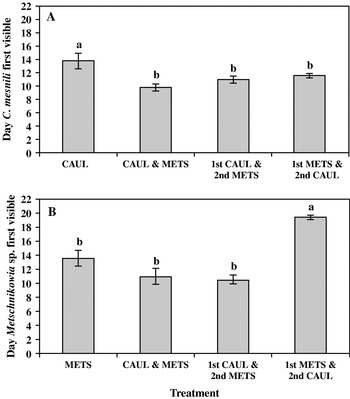
The time to visible infection varied significantly by treatment, indicating different rates of parasite development. For C. mesnili, spore clusters took longest to become visible in the single infection treatment (13·8 days post-infection, compared with 10·0 to 11·6 days in other treatments; Fig. 3A). For Metschnikowia sp., spores were visible latest in the sequential co-infection treatment ‘1st METS & 2nd CAUL’ (19·4 days post-infection, compared with 10·5 to 13·6 days in the other treatments, Fig. 3B).
Day post-infection at which parasites were first visible across the infection treatments. (A) Caullerya mesnili and (B) Metschnikowia sp. Values are mean +/− standard error. ANOVA: F3,27=5·9, P=0·004 and F3,29=35·4, P<0·001, respectively. Different letters above the columns indicate significant differences from post-ANOVA contrasts.

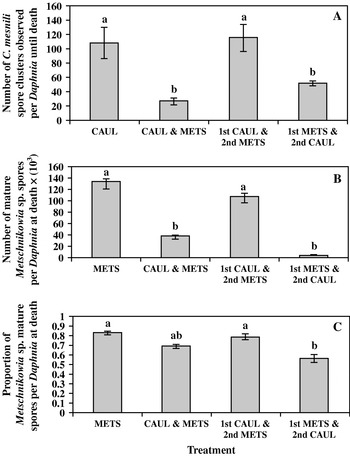
Spore production by both parasites was significantly lower in simultaneous co-infections (‘CAUL & METS’) than single infections (Fig. 4A, B). When C. mesnili infected the host first (sequential treatment ‘1st CAUL & 2nd METS’), both parasites had high fitness, similar to single infections (Fig. 4A, B). In contrast, when Metschnikowia sp. infected the host first (sequential treatment ‘1st METS and 2nd CAUL’), both parasites performed poorly, producing fewer spores (Fig. 4A, B) and furthermore, Metschnikowia sp. produced a lower proportion of mature spores (Fig. 4C).
Parasite fitness (spore production) across the infection treatments. (A) Number of Caullerya mesnili spore clusters, (B) number of Metschnikowia sp. mature spores and (C) proportion of Metschnikowia sp. mature spores (among both mature and immature spores). Values are mean +/− standard error. ANOVA: F3,27=18·3, P<0·001; F3,29=28·9, P<0·001; and F3,29=14·1, P<0·001, respectively. Different letters above the columns indicate significant differences from post-ANOVA contrasts.

DISCUSSION
Using single genotypes of 2 Daphnia parasites (the protozoan Caullerya mesnili, and the fungus Metschnikowia sp.), we determined the impact of the order of infection on both host and parasite fitness, finding simultaneous co-infections the most virulent to the host and the largest fitness reducer to both parasites. In addition, we evaluated whether allowing a period of prior residency would give an advantage to the resident parasite. While prior residency conferred a benefit to 1 of the parasites (C. mesnili), this situation was reversed for the second parasite (Metschnikowia sp.), imparting a disadvantage. Furthermore, changing the order of infection altered the developmental rate of each parasite species. While C. mesnili developed faster in all co-infections, Metschnikowa developed slower in co-infections where it had prior residency.
It is known that host genotypes differ in their susceptibility to and fitness reduction from parasite infection and that, likewise, parasite genotypes vary in their infectivity and virulence (known as ‘genotype-by-genotype interactions’, e.g. Carius et al. Reference Carius, Little and Dieter2001). Similar patterns have also been detected in the context of co-infections (Wille et al. Reference Wille, Boller and Kaltz2002). While we used only 1 genotype per species, the goal of our study was not to determine the overall pattern of co-infections in Daphnia galeata populations infected with C. mesnili and Metschnikowia sp. Instead, what we demonstrate here is that the outcomes of multiple-species co-infections (for both host and parasites) are altered by the timing of infection (simultaneous versus sequential) and by residency (prior versus late).
The infection rate of daphnids with Metschnikowia sp. was lower than in other studies working with the same parasite, using similar spore doses (Ebert et al. Reference Ebert, Zschokke-Rohringer and Carius2000; Hall et al. Reference Hall, Tessier, Duffy, Huebner and Cáceres2006). However, previous studies have used different host species (Daphnia magna and D. dentifera). In addition, in the present study, there were a fair number of deaths during the infection period, perhaps contributed to by the 2-day starvation period. It is possible that some infected individuals died during this period, before signs of infections were visible, leading to a reduction in the total number of infected animals.
In treatments where hosts were exposed to both parasites, the prevalence of co-infections was higher than that of single infections. This result suggests the possible importance of co-infections in natural Daphnia populations. As yet there have been few systematic field studies which investigate the prevalence of co-infections within Daphnia populations. Several studies have observed co-infections while documenting general parasite prevalence (Stirnadel and Ebert, Reference Stirnadel and Ebert1997; Decaestecker et al. Reference Decaestecker, Declerck, De Meester and Ebert2005; Tellenbach et al. Reference Tellenbach, Wolinska and Spaak2007; Wolinska et al. Reference Wolinska, Keller, Manca and Spaak2007). However, in another Daphnia study investigating the prevalence of Metschnikowia sp. and the bacterium Spirobacillus cienkowskii across 7 lakes, no co-infections were found (Duffy and Hall, Reference Duffy and Hall2008). More field research is required to determine the prevalence of co-infections in natural populations. Specifically, understanding the effects of overlapping parasite epidemics would be of great value. For example, recent theoretical work has highlighted the importance of seasonality and immune function in determining the outcomes of interspecific parasite interactions (Lello et al. Reference Lello, Norman, Boag, Hudson and Fenton2008).
In our study, co-infections were most successful in the sequential co-infection treatments, suggesting that the host became more susceptible once a primary infection had been established. It is generally accepted that stressed or otherwise unhealthy hosts are at a greater risk from parasites and pathogens due to decreased immune function (Rolff and Siva-Jothy, Reference Rolff and Siva-Jothy2003). Indeed, host invasion by a second parasite species has been documented for a variety of other host taxa, as a result of decreased host immune function (e.g. crustaceans: Stentiford et al. Reference Stentiford, Evans, Bateman and Feist2003; ants: Hughes and Boomsma, Reference Hughes and Boomsma2004; birds: Haghighat-Jahromi et al. Reference Haghighat-Jahromi, Asasi, Nili, Dadras and Shooshtari2008; mammals: Craig et al. Reference Craig, Tempest, Pilkington and Pemberton2008; and humans: Ampel, Reference Ampel1996).
Strikingly, with prior residency Metschnikowia sp. infections were delayed by approximately 5 days, compared to the single infection treatment. Thus, C. mesnili infection appears to have suppressed development of Metschnikowia sp. This suppression may have been an active process induced by C. mesnili to outcompete a co-infecting parasite; or the result of overall host nutrient drain caused by C. mesnili infection. Suppression of a co-infecting parasite should be advantageous for the other parasite, allowing more time for the production of transmission stages (trade-off model; Anderson and May, Reference Anderson and May1982).It is difficult to understand why suppression of Metschnikowia sp. occurred during the ‘1st METS & 2nd CAUL’ treatment and not in the simultaneous co-infections as well. Obviously, there are many competitive interactions within the host, such as apparent, interference and immune-mediated competition. Further work is required to understand the intra-host dynamics involved.
Prior residency conferred an advantage to C. mesnili and a disadvantage to Metschnikowia sp. The latter result was surprising, as we had expected prior residency to give an advantage to the resident parasite, which should have a temporal advantage in the uptake of host resources. The result of prior and late residency in single-species (i.e. between-strain) co-infections has been shown to change along with a shorter or longer residency period (de Roode et al. Reference de Roode, Helinski, Anwar and Read2005) and a higher or lower spore dose (Fellous and Koella, Reference Fellous and Koella2009). It seems reasonable that similar variation also exists for multiple-species co-infections. Increasing the spore dose increases the probability of host infection, and also increases parasite virulence (Ebert et al. Reference Ebert, Zschokke-Rohringer and Carius2000). Additionally, in single-species co-infections, strains administered with a higher dose are superior competitors (Fellous and Koella, Reference Fellous and Koella2009). In the present study, all co-infection treatments had a doubled dose of total spores (700 spores/ml Metschnikowia sp. and 700 spores/ml C. mesnili) as compared to single infection treatments (700 spores/ml of only 1 parasite). This dose effect may have amplified the negative effects of the co-infection treatments compared to the single infections. However, this potentially confounding dose effect does not apply to the co-infection treatments in our experiment, which all have the same relative and total doses. Additional controls could be run to test this dose effect, such as double-dose single infections for each parasite, or co-infections run at half-dose levels for each parasite (thus equalizing total dose).
We have shown, using single genotypes of 2 Daphnia parasites, that the outcome of multiple-species co-infections depends on the order of infection and that this outcome is not always to the benefit of prior residency. The specific type of infection (i.e. single vs co-infections, simultaneous vs sequential, prior vs late residency) may have important implications for natural systems, such as during overlapping epidemic waves. While the sympatric co-occurrence of different parasite species is common in nature, and known for Daphnia populations, further studies are required to establish the frequency, distribution and implications of co-infections in natural populations.
ACKNOWLEDGEMENTS
We would like to thank R. Jänichen and R. Angiulli for assistance in the lab, C. Schoebel for providing us with the Caullerya lab isolate and C. Laforsch for comments on the manuscript.
FINANCIAL SUPPORT
This research was funded by a DFG grant (#WO 1587/2-1) and a grant from the Volkswagen Stiftung through the EES-LMU program. We also thank two anonymous reviewers for their constructive comments and suggestions.