Introduction
For the communities scattered about its coasts, the Mediterranean Sea was very much a corrupting, enabling and connected place of passage as the final centuries of the Bronze Age played out. The latter half of the second millennium bce saw the first instance of a Mediterranean integrated from west to east, and a steady increase in interregional material and informational exchanges (Broodbank Reference Broodbank2013, 449–505; Dawson & Nikolakopoulou Reference Dawson, Nikolakopoulou and Warburton2020, 155). Copper ingots from the eastern Mediterranean were transported as far distant as southern France and Corsica in the west (Lo Schiavo Reference Lo Schiavo and Tzachili2008); finished products from Sicily, south Italy and Sardinia were occasionally encountered in the Aegean, Cyprus and the Levant (Jung Reference Jung and Driessen2018); and, beyond the parameters of the sea itself, raw materials like Baltic amber networked their way from temperate Europe via a series of overland and maritime routes, turning up at various sites throughout the Middle Sea (Blake Reference Blake2014, 34–65; Maran Reference Maran, Hahn and Weiss2013).
The communities implicated in this network were as diverse as the raw materials, manufactured goods and cultural practices that flowed within it. In the east, large urban communities developed, such as the fortified citadels of mainland Greece, the Neopalatial centres of Crete, several major settlements on Cyprus, the populous city-states of the Canaanite Levant and the key centres of New Kingdom Egypt. In the central and west Mediterranean, by contrast, smaller villages and hamlets were the norm, although even these developed occasionally into ‘proto-urban’ communities, like Roca Vecchia on Italy's Adriatic coast, Thapsos in eastern Sicily and the large, multi-towered Nuragic settlements of Sardinia. Large or small, coastal or inland, however, the level of connectivity at the end of the Bronze Age meant that few communities were truly isolated from the broader, globalized Mediterranean.
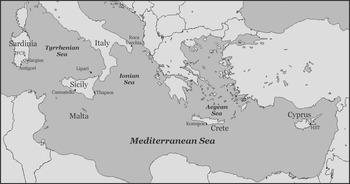
In this study, we develop and refine a maritime perspective on interaction in Mediterranean prehistory. First, we define and present our views on a ‘minimalist’ approach and argue that we need to focus on the nodes (communities) that interlink various networks rather than on the end points of those networks, typically represented by lines drawn on a map. We then characterize the ‘maximalist’ approach in a critique of three recent publications that treat various types of possible interaction between Cyprus and/or the Aegean (including Crete) with Sardinia and Sicily—thus treating four of the main islands that lie at the heart of the Middle Sea. We continue by decoupling the concepts of connectivity, contact and mobility, arguing that—while related phenomena—they must be kept distinct in discussing the material and social aspects of maritime mobility. Following a section on Bronze Age ships and shipping, we present an overview of maritimity, seafaring and maritime connections. We then present our views on a minimalist network by unpacking some of the nodes implicated: Nuraghe Antigori, Cannatello, Kommos and Hala Sultan Tekke (Fig. 1). In so doing we critique the proposed, direct Sardinia–Cyprus trade route and instead attempt to maximize the minimalist perspective. In conclusion, we argue that the study of interconnections between the central and eastern Mediterranean during the Late Bronze (LBA) and early Iron Ages offers the opportunity for multiple viewpoints, and that a true maritime perspective requires more than simply asserting the dominance of Sardinian, Cypriot or Aegean traders on the basis of some exchanged commodities.
The Mediterranean Sea showing the main sites mentioned in the text. FCB (Sardinia) = Funtana Coberta-Ballao; HST (Cyprus) = Hala Sultan Tekke. (Map: Anthony Russell.)

The minimalist perspective reconsidered
The multiple interactions and places of contact mentioned above lie at the heart of what we and others have termed a minimalist perspective. In defining her study of variability in the distribution of Mycenaean pottery in Italy, Blake (Reference Blake2008, 2) explains: ‘this paper takes a minimalist position, attempting to demonstrate that relations between Mycenaeans and the peoples of Italy were infrequent and small-scale, and had, at most, a circumscribed impact, in limited areas’. Russell and Knapp (Reference Russell and Knapp2017, 2–3), citing several other, earlier examples of a minimalist approach, sought to complement Blake's work, but focused attention on Sardinia, on the limited range of Cypriot materials found there and on other artefacts for which claims of a Cypriot origin have been made.
In many ways, minimalist is somewhat of a misnomer for our arguments, particularly given its specific origins in the paper ‘Bronze Age trade: a minimalist perspective’, where Snodgrass (Reference Snodgrass and Gale1991) argued against the notion ‘that the Aegean Sea and the Eastern Mediterranean were criss-crossed by a network of mercantile trade, of ships owned by their masters, carrying cargoes of an unspecified destination’. Unlike Snodgrass, and to some extent Blake, we are not arguing that the overall levels of exchange in the LBA Mediterranean were any less economically intensive or spatially extensive than those presented in maximalist interpretations (see the following section). Rather, we are suggesting that trade was organized along entirely different lines that in no way diminished its scope or intensity. The only aspects of maximalist scholarship we would moderate are: (1) the perceived need for systemic, direct contact between materially connected communities; and (2) the concomitant impacts on social development and material culture—almost always framed in ‘east-upon-west’ terms, supposedly the result of such face-to-face encounters. In fact, our minimalist perspective countenances more ships, more human agents (in number and kind), more integrated regional networks, more motivations for seafaring mobility and more communities engaged in Mediterranean interaction networks.
Critique of recent studies on Cyprus, the Aegean, Sardinia and Sicily
Various possible types of interaction between Cyprus and/or the Aegean with Sardinia and Sicily have come to the fore once again in three recent publications that make the following claims, amongst others:
• ‘the presence of Sardinian imports proves once more the vast connections of this harbour city and transhipment centre [Hala Sultan Tekke, Cyprus], which included not only all regions of the eastern Mediterranean, but also the central Mediterranean’. (Gradoli et al. Reference Gradoli, Waiman-Barak and Bürge2020, 14, emphasis added)
• ‘all indications support the suggestion that during the course of the 14th and 13th centuries bc, Cypriot traders participated, even if sporadically, in maritime trade with Sicily in addition to Aegean merchants distributing both Cypriot and Mycenaean products’. (Tanasi Reference Tanasi2020a, 197)
• ‘the largest number of [oxhide ingot] finds is from Sardinia, suggesting not only a special relationship between Cyprus and Sardinia, but also an intriguing role for Sardinian maritime “enterprises” in the Mediterranean metal trade’. (Sabatini & Lo Schiavo Reference Sabatini and Lo Schiavo2020, 1509)
The authors of these studies are not unaware of other proposals to explain interaction between LBA Cyprus or the Aegean with the central Mediterranean (e.g. Blake Reference Blake2008; Reference Blake2014, 66–112; Russell Reference Russell2017; Russell & Knapp Reference Russell and Knapp2017). Seldom, however, do they engage with them, and their views on Mediterranean maritime trade seem somewhat restricted (e.g. Gradoli et al. Reference Gradoli, Waiman-Barak and Bürge2020, 13; Tanasi Reference Tanasi2020a, 195). Sabatini and Lo Schiavo (Reference Sabatini and Lo Schiavo2020, 1501, emphasis added) have little to say about other views, although they introduce the issue of a ‘maritime perspective’, or at least how ‘strategically positioned actors such as Nuragic Sardinia managed to dominate sea routes’:
The discovery of Nuragic tableware from Hala Sultan Tekke arrives as a welcome addition to a long-lived debate on the character of the specific connections between Sardinia and Cyprus. Despite diverging positions [Russell & Knapp Reference Russell and Knapp2017], the new finds provide strong evidence for the idea of a distinctive and intensive relationship between Cyprus and Sardinia.
As noted elsewhere (Russell & Knapp Reference Russell and Knapp2017, 27–8), maximalist interpretations such as these are typically presented as a ‘discourse of certainty’ that not only discourages alternative viewpoints but also tends to inflate the limited empirical evidence used to substantiate long-held assumptions. In that earlier paper, we also emphasized that our own views represented an interpretation of the evidence, and were not intended to stand in binary opposition to maximalist views. But we argued then and reiterate now that such views tend categorically to dismiss all alternatives.
Beyond their maximalist stance, the authors of these three studies present a great deal of archaeological, archaeometallurgical or other analytical data that at times seem tangential to their arguments, at other times misleading. For example, Sabatini and Lo Schiavo (Reference Sabatini and Lo Schiavo2020, 1502, 1504, 1506–7) continue to overinterpret the results of Lead Isotope Analysis (LIA), assuming that it can determine the provenance of ores, metals or artefacts. This is precisely what LIA cannot do; it can only eliminate provenance and at best indicate compatibility with a source area (Pernicka Reference Pernicka, Roberts and Thornton2014, 249–50). These authors are correct, however, when and how they state that LIA of oxhide ingot fragments from the Funtana Coberta-Ballao (FCB) hoard in Sardinia (Montero-Ruiz et al. Reference Montero-Ruiz, Manunza, Lo Schiavo, Valera, Gil Ibarguchi, Rafel, Sureda, Giumla-Mair and Lo Schiavo2018) confirm ‘an oxhide ingot production with metal of non-Cypriot origin’ (Sabatini & Lo Schiavo Reference Sabatini and Lo Schiavo2020, 1504).
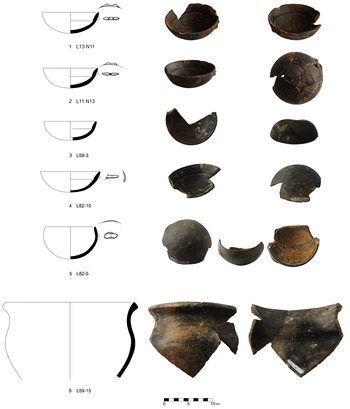
The paper by Gradoli et al. (Reference Gradoli, Waiman-Barak and Bürge2020) presents the results of petrographic (and other) analyses of five (out of six total) hand-made, hard-fired, black burnished, Sardinian vessels found in ‘offering pits’ at Hala Sultan Tekke (HST) on Cyprus (Fig. 2). These are obviously important (if limited) finds for any discussion of contacts between Cyprus and the central Mediterranean. Elsewhere, the excavators of HST suggest that the ‘exotic’ goods contained in the pits and tombs at the site were deposited during mortuary rituals and feasting ceremonies (Bürge Reference Bürge2017, 146–8; Fischer & Bürge Reference Fischer and Bürge2017, 210). Gradoli et al. (Reference Gradoli, Waiman-Barak and Bürge2020, 12) echo this point, asserting that all the exotic items found in the tombs and offering pits at HST, including the Sardinian bowls, represent a ‘genuine Cypriot cultic practice’ involving ‘libation and other ritual ceremonies’. This suggestion, however, neglects to address questions of how and why the Sardinian vessels came to be deposited there in the first place. Given the numerous imports from multiple origins in these mortuary deposits, the Sardinian bowls are in no way remarkable, at least from a Cypriot perspective: they are simply some foreign pieces amongst an array of imported materials whose meanings were probably renegotiated in a local context, which is just what the emphasis on Cypriot ritual practices also suggests. There is no reason to assume that native Cypriots were aware of or interested in their specific origins.
Nuragic Grey/Black Wares from three ‘offering pits’ in Area A at Hala Sultan Tekke Vyzakia, dated to the thirteenth century bce. (Courtesy of Peter M. Fischer. Photograph and drawings: Teresa Bürge.)

At various points in their paper, Gradoli et al. (Reference Gradoli, Waiman-Barak and Bürge2020, 1, 12) also refer to Sardinian pottery from the site of Pyla Kokkinokremos in eastern Cyprus (about 20 km distant from HST) to make a case for broader Mediterranean connections. Sabatini and Lo Schiavo (Reference Sabatini and Lo Schiavo2020, 1510) also refer to Nuragic ‘tableware’ recovered from Pyla, similar to that found at HST, with reference to an unpublished report (Bretschneider et al. Reference Bretschneider, Kanta and Driessenn.d., 1–2, figs. 1–2). Petrographic analysis of two of these Pyla sherds indicates that their fabric is consistent with a Sardinian source (Jones et al. Reference Jones, Levi, Bettelli and Vagnetti2014, 251). The publication and analyses of the Sardinian ceramics from Pyla (three storage jars) are in the very early stages and, at this time, are not as informative as the material from HST in furthering our understanding of the people who produced or brought these objects to Cyprus, and of the means by which they did so.
Sabatini and Lo Schiavo (Reference Sabatini and Lo Schiavo2020, 1508, emphasis added) also argue for Sardinia's role in and beyond the wider Mediterranean:
However, we believe that the body of evidence—paired up with the abundant presence of tin in Sardinian metallurgy … and the large number of finds of Baltic amber on the island—makes a strong case for Nuragic communities being variously involved in the long distance metal trade not only in the Mediterranean, but also with the rest of the European continent.
There is a paradox in this reasoning: the authors emphasize the multiplicity of agents involved in the metals trade across the Mediterranean and perhaps even into northern Europe, as well as the extensive network(s) involved in the spread of oxhide ingots: all of this should temper the idea of a specific, close and direct relationship between Sardinia and Cyprus. Furthermore, the possible existence of Sardinian raw materials and finished Nuragic objects—from the eastern Mediterranean to the Baltic and Scandinavia, in the authors’ view—is not unexpected: if foreign objects and raw materials are found in Sardinia, those objects must have been exchanged for something in return. In other words, by going to such lengths to demonstrate the vast scatter of possible Sardinian goods or materials, the authors weaken their proposal of a specific Sardinia–Cyprus relationship: there are just too many potential ‘middlemen’ involved in such a complex network or networks.
With respect to the wider Mediterranean situation, Tanasi (Reference Tanasi2020a, 195) makes claims of ‘unquestionable Mycenaean influences’ on Sicily, beyond pottery and including metal objects, amber and glass beads, ivory bracelets, domestic and defensive architecture, tholos tombs and more. He continues to view all this evidence, much of it of questionable origin or influence, solely in terms of the amount of data. Beyond simply tallying up numbers, however, a consumption-based approach (e.g. Russell Reference Russell2017, 70–76) not only treats all this material evidence, but also attempts to interpret it with respect to how and why island communities such as those on Sicily (and Sardinia) created and negotiated their various identities.
Sabatini and Lo Schiavo (Reference Sabatini and Lo Schiavo2020, 1509) likewise suggest that there is ‘a great quantity of Mycenaean pottery’ at the site of Cannatello in Sicily. This is at best an exaggeration, or at least a misunderstanding of the evidence, as it is only in the Sicilian context that Cannatello's 39 sherds—the island's high watermark—can be considered a significant amount (Russell Reference Russell2017, 67). There is even more Sardinian and Maltese pottery at the site, which highlights its regional significance and in turn suggests where the real frequency of connectivity lies. The same criticism applies to their mention of a ‘large amount’ (36 vessels) of Mycenaean pottery at Thapsos and ‘a wealth of Cypriot pottery’ at both sites (Russell Reference Russell2017, 66–7).
Although we see no need to re-present in detail here the range of material data upon which these recent works are based, at different points we offer summary discussions of the empirical evidence (see also Russell & Knapp Reference Russell and Knapp2017). Instead, our aim is to present and discuss key issues of interaction, connectivity and mobility, of maritimity and ‘exotica’, and to offer an overview of seafaring, maritime connections and Mediterranean trade during the Late Bronze and earliest Iron Ages.
Decoupling connectivity, contact and mobility
this relative abundance of Mediterranean material and historical evidence has perhaps encouraged descriptive approaches of connectivity tied to physical geography that have sometimes inhibited the development of more social explorations of maritime mobility … (Leidwanger & Knappett Reference Leidwanger and Knappett2018, 6–7)
Connectivity, contact and mobility are related but distinct phenomena. Connectivity describes the material or ideational bridging of disparate communities via several interaction processes, often modelled using network analysis (Leidwanger & Knappett Reference Leidwanger and Knappett2018, 7–9). Contact refers more specifically to the direct, physical interaction of mobile agents with settled populations: it is therefore a subset of connectivity and is the mode of interaction favoured by maximalists, as it facilitates their generation of acculturation interpretations. In turn, mobility is a broader concept, as it embraces not only the movement of people but also of raw materials and finished goods. Thus, mobility is a conceptual tool used to explore material, cultural and social connections between different regions, often separated by the sea. Human mobility is complex and difficult to grasp as it occurs across multidimensional scales (Leppard et al. Reference Leppard, Esposito and Esposito2020). Middleton (Reference Middleton2018, 120–21) recently defined mobility as a ‘temporary or permanent relocation of individuals or small groups … and their ability to travel’; it has been hailed as ‘an adaptive strategy in reaction to changing living conditions’ (Burmeister Reference Burmeister, Meller, Daim, Krause and Risch2017, 58). Mobility is thus a behaviour well suited to consider various forms of movement, from migration to demic diffusion, transhumance, trading and raiding.
Of equal interest is the distinction that Woolf (Reference Woolf, de Ligt and Tacoma2016, 447, commenting on Horden & Purcell Reference Horden and Purcell2000) draws between connectivity as potential or precondition and mobility as the realization of that potential (also noted by Leidwanger & Knappett Reference Leidwanger and Knappett2018, 4). As Woolf (Reference Woolf, de Ligt and Tacoma2016, 441) appropriately cautioned: ‘It is not enough to declare ancient populations mobile: we need to consider in what ways people moved and how different kinds of mobility varied’. Thus, we should consider how and to what extent mobility was affected by the connected land- and seascapes of the maritime Mediterranean. Moreover, given the limited and at times ambiguous direct evidence for seafaring—harbours, shipwrecks, ships’ representations, stone anchors, maritime transport containers—in the pre-Iron Age Mediterranean (Knapp Reference Knapp2018), it is inevitable that prehistorians have focused more on connectivity than on mobility.
Provenance studies (of clays, ores, amber, organic residues, etc.) are often used to argue for the existence of trade routes, interconnections and contact scenarios. Such studies are informative but limited: they enable the placement of points on a map, and occasionally even allow us to postulate likely sea routes, but at best they only tell us about the extreme parameters of an object's biography, i.e. where its raw materials may have been procured, or where the object was finally deposited. The ‘routes’ described by provenance studies are necessarily simplified as single lines. Such studies have nothing to say about any intermediate agencies, nor can they illuminate competing systems of value and meaning. The journey they describe is strictly geographical, with little consideration of social dimensions (Leidwanger et al. Reference Leidwanger, Knappett and Arnaud2014).
Along with Dawson and Nikolakopoulou (Reference Dawson, Nikolakopoulou and Warburton2020, 177), we interpret interregional connectivity as ‘the practices and agency of actual communities, rather than abstract political entities’. The implication is that in order to understand connectivity we cannot look only at routes or movements, whether of people or objects; instead, we should focus on the places where such communities engaged with one another—some because that is where people lived and worked, others because that is where they stopped over. Connectivity was not created on sea journeys or along lines drawn on a map but instead was forged at the nodes of the networks where people encountered each other, and carried out personal, commercial and other business that required them to travel (van Dommelen Reference van Dommelen and Hodos2017, 621).
Bronze Age ships and shipping
Braudel (Reference Braudel1972, 355) called distance ‘the first enemy’ in any commercial endeavour. While naval technology in the LBA enabled the construction of larger, more swift sailing vessels capable of longer voyages (at least in the eastern Mediterranean: Broodbank Reference Broodbank, Anderson, Barrett and Boyle2010, 255; Emanuel Reference Emanuel2016, 271–6), there were other obstacles—beyond the technological and economic ability to build them—faced by those who travelled on larger ships and undertook longer voyages. Seagoing vessels in the Bronze Age Mediterranean were seldom larger than the ship wrecked at Uluburun (off Turkey's southern coast)—up to 16 m in length and about 20 tonnes in capacity (Monroe Reference Monroe2007). Such ships, with bigger cargoes travelling longer routes, were inherently more at risk than smaller, more regionally or locally based vessels; they required a larger, more experienced crew, and were limited by the anchorages or harbour facilities where they could dock and tranship their goods on to other boats, or offload them into land-based networks. In fact, the existence of large ships presupposes the need for even more small ships and terrestrial conveyances to service the extended tendrils of connectivity by sea and land. This is not to say that longer sea routes generate smaller tributary routes; rather, these longer routes are built upon and within existing integrated and overlapping regional and intermediate networks—Tartaron's (Reference Tartaron2013, 189–99) coastscapes and maritime small worlds (see also Ruiz-Gálvez Reference Ruiz-Gálvez, Knapp and van Dommelen2014).
Despite the risks involved, larger ships undertaking (presumably) longer voyages throughout the Mediterranean certainly existed by the later stages of the Bronze Age. We say presumably, because building larger ships could also represent a response to the needs of bulk shipping, regardless of the distances involved (Leidwanger & Knappett Reference Leidwanger and Knappett2018, 3–4). The Uluburun shipwreck is perhaps the best example of such a vessel, and its large and diverse cargo (e.g. Pulak Reference Pulak1998; Reference Pulak, Aruz, Benzel and Evans2008) points more towards multiple combined short trips than to a single long-distance journey. Yet how typical is the Uluburun ship within the broader context of pan-Mediterranean Bronze Age maritime networks? We know of only a handful of contemporary wreck deposits (9–10 in the Middle–Late Bronze Aegean and eastern Mediterranean: Knapp Reference Knapp2018, 51), and none were as large as the Uluburun ship. In order to gauge the likelihood of systemic, long-distance voyages, it is crucial first to recognise the multi-scalar nature of Bronze Age maritime exchange networks, and then to explain how such voyages might work alongside them.
Maritimity, maritime connections and Mediterranean trade
Maritimity has been described as process, a way of understanding the metaphysic between the land and the sea (Tuddenham Reference Tuddenham2010, 8–9), a bridge that links human communities and multifaceted seafaring practices. Whilst the human perspective always consists of both land and sea (Westerdahl Reference Westerdahl2007, 191), the sea accommodates many facets, material and social: commercial exchanges; marine resource exploitation; conduits of exploration, migration and invasion; naval warfare; mobile artisanship, and much more. Activities like these were everyday events for many people living in the Mediterranean during the second half of the second millennium bce (Knapp Reference Knapp2020, 439–41); they go far beyond long-distance, high-status, state-sponsored commercial enterprises.
To illustrate our ideas on maritime interaction, we deconstruct the direct Sardinia–Cyprus trade route—the so-called ‘southern’ or ‘international’ route—proposed by Lo Schiavo and Campus (Reference Lo Schiavo and Campus2013, 158), when Sardinian pottery was first recognized on Cyprus (see also Sabatini & Lo Schiavo Reference Sabatini and Lo Schiavo2020, 1509–11). This route has been defined by the co-presence of Cypriot and Sardinian materials at four sites along its course: Nuraghe Antigori on Sardinia; Cannatello on Sicily; Kommos on Crete; and Pyla Kokkinokremos (to which we can now add Hala Sultan Tekke) on Cyprus. In the maximalist view, this route is regarded as a conduit of human mobility, i.e. a maritime course followed by ships for its full length, in which Cypriot and/or Sardinian mariners were particularly implicated. In its most extreme form, this involves Cypriot-crewed ships travelling from Cyprus to Sardinia and back again, or Sardinian-crewed vessels making the complete circuit in the opposite direction, in what is described as a possibly ‘secret’ undertaking (Lo Schiavo & Campus Reference Lo Schiavo and Campus2013, 158).
By contrast, we do not insist upon the movement of specific human agents, thus avoiding dubious terms like ‘pre-Phoenicians’ (Lo Schiavo & Campus Reference Lo Schiavo and Campus2013, 158). Instead, we propose a material network, one that cannot be portrayed simply as a single line on a map. It does not preclude the possibility of the odd ship (from anywhere in the Mediterranean) travelling the entire route, but it is also not dependent on such voyages. While we see no evidence for the primacy of Cypriot or Sardinian mariners throughout this network, we do not discount their possible involvement. Instead, when we ‘unpack the nodes’ (van Dommelen Reference van Dommelen and Hodos2017, 626) on which this route hinges (see the following section), we find that Cypriot and Sardinian materials invariably represent a minor component of the connectivity narrative at each node.
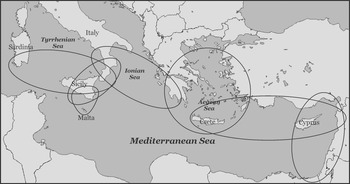
From Nuraghe Antigori in the west to Hala Sultan Tekke in the east, a ship would have to travel over 2300 km (some 1200+ nautical miles). If the end terminals are in fact the ultimate destinations for such ships, then most of their cargoes logically would have been intended for the destination markets, with stops along the way made primarily for smaller shipments, for provisioning, or for taking on or dropping off passengers or supplementary crew. If we envision this as a material network, however, we are dealing with a series of overlapping regional systems (Fig. 3) that include the spread of Sardinian materials eastward and Cypriot goods westward. This goes a long way toward explaining the steady drop-off of Sardinian finds the farther east one goes, and the steady decline in Cypriot objects westward, at least until we encounter the case of oxhide ingots—ostensibly of Cypriot origin—in Sardinia, which outnumber those found anywhere else in the central Mediterranean.
The Mediterranean Sea showing a simplified system of possible overlapping regional interaction spheres, through which materials could have circulated to the east and west via various maritime agencies. (Map: Anthony Russell.)

We say ostensibly because the analytical evidence regarding these ingots is complex and constantly changing. Of nearly 200 oxhide ingots or ingot fragments found on Sardinia (7 whole, over 180 fragments), LIA first confirmed that 31 were made of copper consistent with production from Cypriot ores (Gale Reference Gale2006, 29). Begemann et al. (Reference Begemann, Schmitt-Strecker, Pernicka and Lo Schiavo2001) analysed 29 further ingot fragments using both LIA and elemental analyses, and concluded that most were compatible with Cypriot production; at least three, however, were consistent with production from local Sardinian ores, as were most bun ingots and Sardinian artefacts analysed. More recent copper and lead isotope analyses present a rather different picture: Jansen et al. (Reference Jansen, Hauptmann, Klein, Giumla-Mair and Lo Schiavo2018) suggest that two oxhide ingot fragments from Sardinia are consistent with the copper isotope signature of one of four different Cypriot groups that may be chronologically significant and could reflect individual mines. However, using mass spectrometric elemental and LIA on oxhide ingots from the FCB hoard on Sardinia, and including (previously unavailable) ores from southern Sinai and Timna, Montero-Ruiz et al. (Reference Montero-Ruiz, Manunza, Lo Schiavo, Valera, Gil Ibarguchi, Rafel, Sureda, Giumla-Mair and Lo Schiavo2018) are more circumspect and argue that some of the oxhide ingots from this deposit may have been cast using non-Cypriot ores. Moreover, in view of the overlap between Sardinian and some Sinai ore compositions, they note that questions about the use of local or imported ores in the FCB hoard remain unresolved, which means that all previous provenance data regarding the situation in other hoards must be ‘re-evaluated’ (Montero-Ruiz et al. Reference Montero-Ruiz, Manunza, Lo Schiavo, Valera, Gil Ibarguchi, Rafel, Sureda, Giumla-Mair and Lo Schiavo2018, 154–5). Concerning the identity of the traders involved and how they might have organized the metals’ trade, they state that this ‘must be elucidated on the basis of not only the metal, but of additional data on the whole assemblage of imported material found in Sardinia’.
Addressing a similar point, i.e. the mechanisms of trade that brought foreign cargoes to Sardinia, it is interesting to note Gale's (Reference Gale2006, 33) prescient comment:
Perhaps we should rather think in terms of free lance trade and tramping … which gave ample opportunity for bargaining both for the crew and for merchants who would travel with their wares, and where the round trip was a long succession of selling, buying and exchanging. In the course of the voyage the cargo would change its nature, being partly depleted and replaced by local goods, trading being based on the chances encountered in each port, and not necessarily on a pre-arranged scheme between, say, Cyprus and Sardinia.
Finally, maritime archaeologists working in the first-millennium bce Mediterranean have long argued that complex exchange networks—involving both short-range coastal ventures and long-distance enterprises, as well as ‘segmented navigation’ practices—connected primary and secondary harbours and resulted in compound cargoes transhipped in or redistributed by small carriers, through difficult-to-trace seafaring patterns (e.g. Arnaud Reference Arnaud2005, 107–9; Nieto Reference Nieto and Pomey1997).
Unpacking the nodes
In order to move away from essentialist perceptions of networks, in which abstractions link Mediterranean shores and select only those peoples deemed capable of seafaring, we aim to restore agency to the Middle Sea's coastal and island dwellers, whose daily lives were intimately associated with the sea in myriad ways. Because the nodes of maritime networks are the locales where foreign and local traders, mariners, fishermen and officials met and interacted, we concentrate on these nodes and ‘unpack’ the rich complexity of their objects and practices. Using the Sardinian–Cypriot ‘southern route’ as a case study (Lo Schiavo & Campus Reference Lo Schiavo and Campus2013, 158), we examine its proposed nodes to demonstrate that people, maritimity and maritime interactions create the bases on which the connections are, quite literally, held in place and maintained. We begin in the west, on the shores of southeast Sardinia.
Nuraghe Antigori
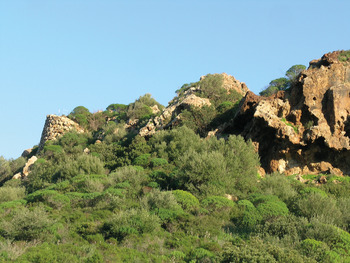
The nuraghe at Antigori is an indigenous settlement situated on the southeast coast of Sardinia, founded sometime during the local Middle Bronze Age (c. 1600–1300 bce) (Ferrarese Ceruti & Assorgia Reference Ferrarese Ceruti, Assorgia and Vagnetti1982) (Fig. 4). The site's advantageous placement, on a 177 m hill overlooking the sea from which most of the Bay of Cagliari is visible, put Antigori in the most strategic position to exploit maritime routes emanating from the south of the island. From the same region, but in the more remote northern suburbs of modern-day Cagliari, we also note the recent discovery of some 39 ‘Mycenaean’ painted sherds at Selargius, another Nuragic village (Manunza Reference Manunza2016).
View of Nuraghe Antigori, Sarroch. (Photograph: Peter van Dommelen.)

Given its location on a rocky peak situated some 500 m from the current seashore, the inhabitants of Antigori would have found themselves involved in maritime networks that stretched to the east and south. There is only a small amount of Cypriot material at the site: several sherds from a single wavy-banded pithos, and possibly the handle from one other vessel (Jones & Day Reference Jones, Day and Balmuth1987, 268; Jones et al. Reference Jones, Levi, Bettelli and Vagnetti2014, 269–71, 299). Beyond these, Antigori yielded evidence for connections to the Aegean (both imported and locally made Late Helladic [LH] pottery), possibly Egypt (faience rosette), and either mainland Italy or Sicily (serpentine fibula) (Giardino Reference Giardino1995, 293, 331; Russell Reference Russell, van Dommelen and Knapp2010, 112). Amber and quartz beads of uncertain provenance, but probably not local, have also been recovered from the site (Vianello Reference Vianello2005, 158).
Thus, Antigori was a materially connected place, one that involved routes and agents that went far beyond Cyprus alone. In fact, the lesser amount of material from Cyprus than from the Aegean is exactly what we would expect to find, given the greater distance between the two islands and the drop off that Renfrew (Reference Renfrew, Sabloff and Lamberg-Karlovsky1975, 41–6) long ago predicted for down-the-line exchange systems. Maximalists tend to ignore the wider range of connections and view Antigori primarily as a place to argue for or against Cypriot or Mycenaean mariners shipping each other's goods. While we acknowledge that Cypriots or Mycenaeans could have travelled to Antigori, a material network perspective allows us to contextualize not only their (possible) role, but also that of Nuragic Sardinians in the wider picture of connectivity at Antigori.
From a local perspective, the possible presence of foreigners at Antigori is a less interesting question than how the consumption and adoption of non-Sardinian goods and practices influenced those living at the nuraghe. One result was the local attempt to manufacture Aegean-style pottery using local clays and local artisanal traditions (Russell Reference Russell, van Dommelen and Knapp2010, 113–15; Jones et al. Reference Jones, Levi, Bettelli and Cannavò2021, 24). This development stands in stark contrast to that in southern peninsular Italy, where the local manufacture of Aegean-style pottery followed a chaîne opératoire identical to that of pottery produced in the Aegean, which unambiguously indicates intensive artisanal interaction (Jones et al. Reference Jones, Levi, Bettelli and Vagnetti2014, 453–60; Reference Jones, Levi, Bettelli and Cannavò2021). At Antigori, by contrast, local potters sought to satisfy the needs of local consumers but did so without access to new production techniques.
Cannatello
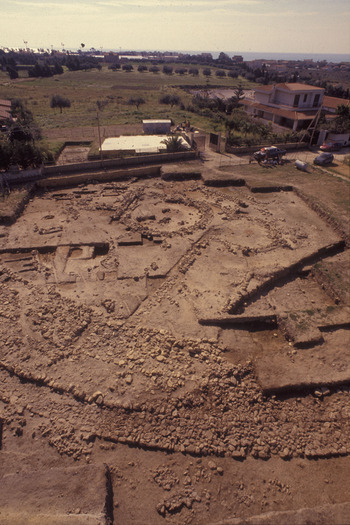
The site of Cannatello is situated today approximately 1.5 km from the seashore, along Sicily's southern coast (Fig. 5). Reaching this location required a 450 km sea voyage from Antigori or a 1040 km voyage from Kommos on Crete, most of which would have required travel upon an open sea (see Fig. 3). Cannatello sits on a low hill, and would have had access to the interior of the island via several river valleys (Sabatini & Lo Schiavo Reference Sabatini and Lo Schiavo2020, 1509). Like Antigori, Cannatello was an indigenous settlement, and has been described as an entrepôt for goods coming from multiple overseas sources. In exchange for such goods, the principal excavator of Cannatello plausibly suggested that archaeologically invisible materials such as sulphur, alum or rock salt—all within easy reach of the site—might have served (De Miro Reference De Miro, De Miro, Godart and Sacconi1996, 1000).
Overview of the Bronze Age settlement at Cannatello, facing south, towards the sea. (Photograph: Sara T. Levi. With permission of the Agrigento office of the Soprintendenza ai Beni Culturali e Ambientali.)

Although only partially excavated, the site seems to have been founded in the fourteenth century bce. The earliest strata included both Thapsos-facies Sicilian pottery and most of the Aegean pottery (LH IIIA sherds) recovered at the site (Albanese Procelli Reference Albanese Procelli2003, 40; De Miro Reference De Miro, La Rosa, Palermo and Vagnetti1999, 448); petrographic analysis of 11 Aegean sherds indicates they are mainly of Peloponnesian origin (Jones et al. Reference Jones, Levi, Bettelli and Vagnetti2014, 265–6). The Cypriot connection is represented by five pottery sherds (Russell & Knapp Reference Russell and Knapp2017, 16), and possibly by an oxhide ingot fragment of uncertain context or origin (Lo Schiavo Reference Lo Schiavo, Giumla-Mair and Lo Schiavo2018, 19); a few other metal finds (daggers, spearheads) recovered in earlier excavations have less certain provenance (Fiorentini Reference Fiorentini1993–94, 719). Petrographic analysis has indicated that two sherds of a wavy-banded pithos similar to the one found at Antigori are compatible with an origin in south central Cyprus (Jones et al. Reference Jones, Levi, Bettelli and Vagnetti2014, 265–6, 297; see also Levi Reference Levi and Cocchi Genick2004, 235).
Beyond eastern Mediterranean materials, however, Cannatello has produced several mainly closed-shaped vessels imported from Malta (Borġ in-Nadur), and ‘clearly recognizable’ Nuragic vessels of both open and closed shapes (Levi et al. Reference Levi, Vanzetti, De Miro, Fotiadis, Laffineur, Lolos and Vlachopoulus2017, 126–7), among them a Nuragic jar and two large, coarse storage jars (Jones et al. Reference Jones, Levi, Bettelli and Vagnetti2014, 230–31). Given Sicily's position intermediate to Malta and Sardinia, this is perhaps unremarkable. Among the Sardinian pottery are some open vessels believed to have been produced locally in Cannatello (Levi Reference Levi and Cocchi Genick2004, 237). Although detailed quantitative data are not yet available, it seems likely that Cannatello served as a key stop in a northwest–southeast conduit between Sardinia and the Maltese archipelago; such a conduit would certainly have been as important to Cannatello as any east–west connection with Cyprus or the Aegean. Thus, Leighton's (Reference Leighton1999, 171) description of Cannatello as a local ‘redistribution centre’ still seems valid today.
In light of the Maltese and Sardinian pottery from Cannatello, it is also useful to note some finds from the wider region around the Strait of Messina (see Fig. 3). On the shores of the Ionian Sea, Thapsos has yielded substantial quantities of Borġ in-Nadur pottery from at least five different areas of the site (Tanasi Reference Tanasi, Tanasi and Cardona2020b), while in the Tyrrhenian Sea to the north, the Aeolian islands are the only place beyond Sardinia where a sizeable and richly varied assemblage of Nuragic ceramic vessels has been documented, on the Lipari ‘Acropolis’ (Cavalier & Depalmas Reference Cavalier and Depalmas2008; Paglietti Reference Paglietti2014; Jones et al. Reference Jones, Levi, Bettelli and Vagnetti2014, 240–41). At both Lipari and Thapsos, smaller amounts of Mycenaean and possibly Cypriot pottery (Alberti Reference Alberti2015) as well as oxhide ingot fragments have also been recorded (Lo Schiavo Reference Lo Schiavo, Giumla-Mair and Lo Schiavo2018, 19); from the island of Salina (just northwest of Lipari), two sherds from a single pithos may have originated in Cyprus (Jones et al. Reference Jones, Levi, Bettelli and Vagnetti2014, 266–67, 297). All these finds signal multiple connections along the eastern and southern Sicilian seaboard, where Cannatello is likely to have been a major hub.
Kommos
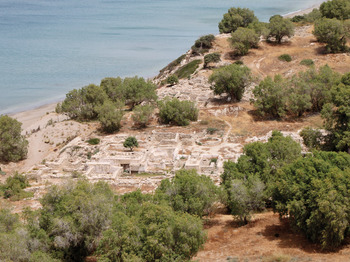
Kommos, situated directly on the coast of southern Crete overlooking the Libyan Sea (Fig. 6), lies over 1000 km from Cannatello; to reach Hala Sultan Tekke or Pyla on Cyprus, mariners would have had to undertake a further 850 km open-sea voyage (see Figure 3).
Aerial view of Kommos on Crete. (Photograph: Olaf Tausch—Wikipedia Creative Commons license BY 3.0: https://commons.wikimedia.org/w/index.php?curid=10977581.)

Building T at Kommos is a monumental structure containing several long, narrow rooms identified as ship-sheds (Blackman Reference Blackman2011, 4–5; Shaw & Blackman Reference Shaw and Blackman2020, 408–9; Shaw & Shaw Reference Shaw and Shaw2006, 847–50). This building most likely served for storage and would have functioned as a distribution centre for goods to be transhipped or, alternatively, transferred inland (Shaw Reference Shaw1985). Indeed, Kommos has been described by its excavator as a harbour servicing the nearby Minoan centres of Phaistos and Ayia Triada (Shaw Reference Shaw, Macdonald and Knappett2013, 137); it may have been established in part for linking these long-established communities to maritime networks.
The Sardinian material from Kommos is all ceramic, and Rutter (in Shaw & Shaw Reference Shaw and Shaw2006, 674–8, table 3.112) originally identified four groups of some 50 examples of Nuragic impasto pottery, including jars, bowls and at least six dolii (storage jars). The jars and dolii are thought to have been containers for scrap metal, while the bowls may have been used as lids for the larger vessels (Rutter Reference Rutter, Maran and Stockhammer2012, 83). Recent petrographic analyses of these Sardinian wares have indicated that two of the fabric groups can no longer be considered Sardinian in origin; currently 20 sherds of the other two fabrics are seen to be compatible with a Sardinian provenance (Jones et al. Reference Jones, Levi, Bettelli and Vagnetti2014, 248–50; see also Watrous et al. Reference Watrous, Day, Jones, Balmuth and Tykot1998, 338–9).
Amongst the 76 examples of Cypriot pottery found at Kommos (Rutter, in Shaw & Shaw Reference Shaw and Shaw2006, 653–8; Rutter Reference Rutter2017, passim) are a range of table wares (cups, bowls, jugs, tankards) and what are defined as storage or transport vessels (pithoi). Neutron Activation Analysis of four Plain White pithoi from Kommos indicate Cypriot production (Tomlinson et al. Reference Tomlinson, Rutter and Hoffman2010, 218). Chemical and petrographic analyses of a pithos rim fragment from Kommos and a body sherd from Antigori indicate that both stemmed from southern coastal Cyprus (Jones & Day Reference Jones, Day and Balmuth1987, 262). Cypriot goods may also be represented by three fragments of copper ingots (unanalysed) found in Building N (Shaw & Shaw Reference Shaw and Shaw2006, 726).
Beyond Cypriot and Sardinian materials, pottery imports at Kommos are extensive, and include examples from the Greek mainland, the Cyclades, Anatolia, Egypt and the Levant (Day et al. Reference Day, Rutter, Quinn and Kilikoglou2011, 552–4; Rutter, in Shaw & Shaw Reference Shaw and Shaw2006, 646–81; Rutter Reference Rutter2017, passim). The harbour at Kommos has been described as ‘having more evidence for intercultural exchange … than any other Bronze Age site in the Aegean’ (Day et al. Reference Day, Rutter, Quinn and Kilikoglou2011, 511). The materials recovered at the site make it clear that at least some people at Kommos were intimately involved in wider Mediterranean connections during the LBA. Moreover, if Kommos also served as the harbour for Phaistos and Ayia Triada, foreign goods recovered from those sites may also have passed through Kommos.
Hala Sultan Tekke (HST)
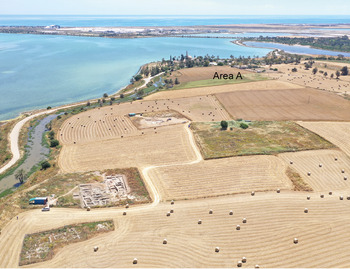
Hala Sultan Tekke Vyzakia, which today lies just west of a large salt lake in southeastern Cyprus (Fig. 7), was directly accessible from the sea during the LBA (Devillers et al. Reference Devillers, Brown and Morhange2015); it served as a prominent maritime centre, attested by an array of goods imported from the Aegean, the Levant, Egypt, possibly Anatolia and—as emphasized—Sardinia. The current series of excavations at the site have revealed several residential and industrial complexes as well as two mortuary areas, including Area A in the easternmost part of the site, where the six Sardinian vessels were uncovered (Fischer & Bürge Reference Fischer and Bürge2018, 5, fig. 1.5). Recent excavations in ‘City Quarter 4’, in the northeastern part of the site closest to the salt lake—with its storage corridor, pithoi and imported goods (pieces of an ostrich egg, a white faience cylinder seal, Canaanite jar fragments, an Egyptian jar)—‘give the impression of an area related to trade, maybe the economic centre of the city considering this quarter's proximity to the ancient harbour’ (Fischer & Bürge Reference Fischer and Bürge2019, 313).
Aerial view of Hala Sultan Tekke from the west, showing the four prominent ‘city quarters’ excavated and Area A, with its wells, tombs and offering pits. (Photograph: courtesy of Peter M. Fischer.)

Five (of six) Sardinian vessels analysed (see Fig. 2)—all classified as Nuragic Grey/Black ware—came from three ‘offering pits’ in Area A. On the basis of several LH IIIB imported wares found within them, the pits are dated to the thirteenth century bce, which is consistent with Sardinian dates for such Nuragic vessels. Other ‘exotic’ goods found in Area A include imported cylinder seals, figurines, ivory objects, gold-mounted scarabs, gold jewellery, carnelian, faience, amethyst and turquoise. Notable amongst imports found elsewhere on the site are Egyptian scarabs and faience objects, Syrian or Mitannian cylinder seals, Canaanite jars, Mycenaean pottery and figurines, and related wares from Crete and other Aegean islands (Fischer & Bürge Reference Fischer and Bürge2018, 613–16). One can only speculate on what the merchants or seafaring agents associated with HST might have offered in exchange for all these imported goods: perhaps copper and other metal objects, purple-dyed textiles, olive oil or wine (Fischer Reference Fischer2019, 246).
Given its location on one of the island's best protected bays, the harbour or anchorage at HST became a centre of international trade, increasingly so as the LBA proceeded. Regarding the Sardinian finds, Sabatini and Lo Schiavo (Reference Sabatini and Lo Schiavo2020, 1512) asserted that ‘people of Sardinian origin were in direct contact with the local population at Hala Sultan Tekke’. But what might lie behind this presumed presence of Sardinians—seafarers or otherwise—on Cyprus? How did they get there? No matter how many Sardinian vessels emerge in future excavations on Cyprus, our own concerns remain with the possible implications of all these objects for maritime trade in the LBA Mediterranean, that is, how these vessels travelled, with whom, for what possible reasons and through what kind of networks.
Overview
As should be clear from this brief survey of the archaeological evidence linking the islands of Cyprus, Crete, Sicily and Sardinia across the Mediterranean, the nodal communities along the route emerge as far more complex and diverse than one would expect if they were mere stop-over points and commercial entrepots. First of all and without exception, they represent indigenous settlements that not only existed well before the commercial connections discussed here but also were fully engaged in local cultural traditions. Although a specialized maritime facility existed at Kommos, all the other nodes examined were also settlement sites engaged in local production—at least of pottery and metalwork, given the available evidence.
A second critical feature shared by these nodes is that their connections with Sardinia and Cyprus were but two among multiple other links; their dominant connection was invariably with the nearest place, e.g. Sardinia with southern Italy and Lipari; Cannatello with Malta; Cyprus with the Levant (and/or the Aegean). Thirdly, most nodes involve more than a single site: Antigori is joined by the Selargius settlement, Cannatello by Thapsos, Kommos by Phaistos, HST by Pyla. This pattern underscores regional involvement, justifies the term maritimity and is the reason that we represent the connections between Sardinia and Cyprus with multiple overlapping spheres rather than individual points (Fig. 3).
In other words, these were well-established indigenous communities that for whatever local motivations became entangled in the expanding Bronze Age maritime networks of their day. When we unpack these nodes, it is clear that their material connections extend far beyond a simple, straight-shot conduit from Sardinia to Cyprus. Predictably, the farther east one looks the more complex these overlapping material networks appear to be. We therefore regard these communities as ‘cosmopolitan’, deliberately borrowing a term more commonly applied to later periods in order to underscore the point that interlocking and overlapping regional networks are not exceptional (van Dommelen Reference van Dommelen, Gailledrat, Dietler and Plana Mallart2018, 227). Even so, our model does not preclude the possibility of some direct, long-range voyages between the two islands, but the material patterning represented by these nodes does not indicate reliance on or prevalence of such a singular route. Indeed, the opposite is more likely true: establishing long-distance routes would have been impossible without the previous existence of smaller, intermediary, regional networks acting as both material conduits and information streams.
Maximizing a minimalist perspective
We support and emphasize the idea of a broadly connected sea from west to east, and the complexity of networks that, in some cases (e.g. the exchange of copper and amber), have tendrils that stretch far beyond the shores of the Mediterranean and well into temperate Europe, the Middle East and north Africa, underscoring the need to recognize non-Mediterranean agents and influences. Our view recognizes the ‘victory of the small ship’ as Braudel (Reference Braudel1972, 300) postulated for historic periods of trade expansion; this results in more ships, mariners and intermediary agents than are envisaged in models promoting systemic, long-distance voyages and intensive, direct relationships between far-flung parties, such as Sardinia and Cyprus.
In order to gain further insights into prehistoric seafaring and maritime networks, our model also requires a degree of archaeological imagination and creativity, recognizing the evidence for spice, drugs, grain, grog, livestock, crops and labour that has long remained elusive but increasingly is coming into focus (e.g. Pérez-Jordà et al. Reference Pérez-Jordà, Peña-Chocarro and Pardo-Gordó2021; see also Knapp Reference Knapp and Gale1991). No less relevant are the socio-economic, symbolic and liminal aspects of maritime space, the real or imaginary experiences and the ‘common sense geography’ of ancient mariners and seafaring traders as they encountered rocky coastal shallows, unfamiliar anchorages or harbours, foreign merchants or, indeed, ‘nomads of the sea’ (Artzy Reference Artzy, Swiny, Hohlfelder and Swiny1997; Geus & Thiering Reference Geus and Thiering2014; Monroe Reference Monroe, Wilkinson, Sherratt and Bennett2011).
Minimalist perspectives are often dismissed as mere complaints about the small amount of data upon which maximalist scenarios are built (e.g. Tanasi Reference Tanasi2020a, 195). While in certain cases we do feel data have been misrepresented to portray a corpus of material as larger than it actually is—a practice that continues in recent publications (see the critique above), our position is better regarded as a fundamentally different way of interpreting the data, regardless of the amount. In fact, the logic at work amongst maximalists seems incongruous: they believe that the more data they produce, the more plausible a long-distance contact and acculturation scenario becomes. We argue the opposite: more data means more involvement of artisans, labourers and agents of mobility, more raw material sources, more ships, more instances of connectivity and more networks—and less opportunity for the likelihood of direct, long-distance contacts, let alone regarding them as the norm.
There is, moreover, a wider dimension to this controversy about long-distance connectivity that runs deeper than the mere differences between minimalists and maximalists. Our emphasis on multiple participating communities, complex short-distance networks and long-distance connections resonates with recent post-colonial scholarship on the ancient world that endeavours to overcome long-standing, one-sided, if not colonialist trends in archaeological scholarship. In the Mediterranean, such biases have singled out a small number of actors and communities, in particular Greek and Roman, as the ones that ‘really mattered’, because they ‘naturally’ precipitated major achievements and developments in the ancient Mediterranean, in prehistoric as well as historical times (Liebmann & Rizvi Reference Liebmann and Rizvi2008; van Dommelen Reference van Dommelen2011).
In the spirit of the postcolonial critique, we suggest that our interpretation of the long-distance connections of the Late Bronze and early Iron Ages as indirect and involving multiple regional or local networks contributes to a decentralized view of expanding and intensifying connectivity. Our multifaceted perspective acknowledges multiple communities beyond the usual suspects (Mycenaeans, Cypriots); by focusing on the local contexts of the nodes that make up the various interlocking networks, we foreground local and indigenous agency in Mediterranean connectivity, whether long- or short-distance.
Conclusions
Connectivity is not simply a by-product of economic expediency, labour requirements or risk management. As others have rightly postulated, Mediterranean interaction webs are social networks, and reflect human relationships (Leidwanger et al. Reference Leidwanger, Knappett and Arnaud2014; Monroe Reference Monroe and Howe2015). It is not impossible to envision human agents from Sardinia and Cyprus coming to some kind of beneficial relationship, one that saw Cypriot copper and possibly information or practices related to metallurgical technology find their way west, and Sardinian pottery and archaeologically invisible goods move east. In order to establish or maintain such a relationship, however, long-distance voyages from one island to the other were not required, and the vast overlapping material networks could have provided either party with ample opportunity for contact.
We reiterate that we do not consider the minimalist view proposed here to be the polar opposite of maximalist frameworks. Some longer-distance routes certainly existed by the end of the second millennium bce but would have been based on specific human or communal relationships that developed over time, and came to be seen as valuable and beneficial enough to offset the greater risk and expense involved. We maintain, however, that such scenarios probably represented only a small part of maritime connectivity during the LBA and early Iron Age, and that such long-distance relationships would not require direct interaction, particularly once they were established. The study of west–east interconnections in the Bronze Age Mediterranean goes far beyond any specific, let alone exclusive, associations that may have developed between Sardinia and Cyprus at the end of the Bronze Age.
Acknowledgements
We thank Peter M. Fischer and Sara Levi for providing images, respectively, of Hala Sultan Tekke and Cannatello. We also thank Sara Levi, Christopher Monroe and Stella Demesticha for helpful comments on earlier versions of this study. Finally, we wish to thank two anonymous reviewers whose perceptive comments motivated us to restructure our arguments and clarify our terminology, which have markedly improved this study.