Introduction
Anastrepha (Schiner) is one of the main genera of the family Tephritidae; this family includes about 180 species. Many of them are serious fruit pests and have economic importance (Norrbom and Kim, Reference Norrbom and Kim1988; Steck, Reference Steck1991; Hernández-Ortiz, Reference Hernández-Ortiz1992; Aluja, Reference Aluja1994). The South American fruit fly Anastrepha fraterculus (Wiedemann) is a widely distributed pest of tropical and subtropical regions of the Americas. Despite its economic significance, environment-friendly management programmes have not yet been developed because this requires a more in-depth knowledge of the biology of this species.
In Argentina, A. fraterculus is present in the subtropical north-east and north-west regions where the weather is warm and humid (Vergani, Reference Vergani1956). These two regions are separated by the biogeographic province of Chaco (Cabrera and Willink, Reference Cabrera and Willink1980), a very arid region where A. fraterculus is normally absent. However, its occasional presence is due to human activity, e.g. commerce and migration, and is therefore restricted to urban or suburban areas (Alberti et al., Reference Alberti, Rodriguero, Gómez-Cendra, Saidman and Vilardi2002).
Because of the economic importance of these flies, Argentina started in 1994 the National Programme of Fruit Flies Control and Eradication (PROCEM) using an integrated pest management (IPM) approach that included a diverse set of techniques: cultural, chemical and genetic control and quarantine restrictions. The success achieved by the programme to control the Mediterranean fruit fly Ceratitis capitata (Wiedemann), the most aggressive tephritid pest, by applying the sterile insect technique (SIT) (Knipling Reference Knipling1959, Reference Knipling1968) has been an encouragement to use this technique to control A. fraterculus as well.
SIT consists of the mass-production and release of γ-irradiated sterile insects whose task is to mate with wild individuals, thereby preventing reproduction in wild flies. Therefore, released flies need to compete for mating with wild flies. Ideally, only males should be released mainly because sterile female flies released in large numbers could inflict important damage to crops, as they sting fruits with their ovipositors (Klassen and Curtis, Reference Klassen, Curtis, Dyck, Hendrichs and Robinson2005) and releasing only males increases the effectiveness of the method (McInnis et al., Reference MacInnis, Tam, Grace and Miyashita1994; Hendrichs et al., Reference Hendrichs, Franz and Rendon1995; Vera et al., Reference Vera, Cladera, Calcagno, Vilardi, Mcinnis and field working group2003). However, the development of automatic sex separation systems requires extensive genetic research to obtain genetic sexing strains such as VIENNA 8 for C. capitata (Robinson and Van Heemert, Reference Robinson and Van Heemert1982; Dyck et al., Reference Dyck, Hendrichs and Robinson2005).
SIT has multiple advantages, including low environmental impact and high specificity. However, the implementation of the technology is sometimes hampered due to political, economic and geographical reasons. Furthermore, some biological factors make the implementation of SIT difficult or impossible such as: multiple mating behaviour of female flies in some species may increase the probability of females to find at least one fertile partner (Vera et al., Reference Vera, Cladera, Calcagno, Vilardi, Mcinnis and field working group2003), migration of inseminated females from outside the protected area (Barclay et al., Reference Barclay, Hargrove, Clift, Meats, Dyck, Hendrichs and Robinson2005), the fact that some species are naturally resilient to the sterilization process (making it impossible to fully sterilize without reducing the competitiveness of the released males) and different morphotypes of the target species in an area may complicate the mating recognition with the released strain (Klassen and Curtis, Reference Klassen, Curtis, Dyck, Hendrichs and Robinson2005). These problems stress the need of acquiring extensive knowledge of the biology and behaviour of the target species.
As the efficiency of SIT increases when the target population density is reduced (Mumford, Reference Mumford, Dyck, Hendrichs and Robinson2005), the method should be preceded or accompanied by other methods that are effective at high target population densities. In fact, SIT is mostly used as part of an IPM approach with the intent of reducing the indiscriminative use of insecticides rather than as a single and direct eradication method (Klassen and Curtis, Reference Klassen, Curtis, Dyck, Hendrichs and Robinson2005).
One major requirement of SIT is that mass-reared and sterilized males can survive in the field and mate with wild females after release. Hence, the ability of laboratory males to disperse, interact with other males and be selected by females for mating becomes crucial for the efficiency of this technique.
In some Anastrepha species (including A. fraterculus) and other tephritids (Malavasi et al., Reference Malavasi, Morgante and Prokopy1983; Shelly and Whittier, Reference Shelly, Whittier, Choe and Crespi1997; Aluja et al., Reference Aluja, Piñeiro, Jácome, Díaz-Fleischer, Sivinski, Aluja and Norrbom2000; Shelly, Reference Shelly2001; Segura et al., Reference Segura, Petit-Marty, Sciurano, Vera, Calcagno, Allinghi, Gómez Cendra, Cladera and Vilardi2007), courtship usually takes place in aggregations of males, known as leks, in which several males simultaneously release sexual pheromones to attract females. Once within a lek, a female chooses a male from a number of available males. Therefore, a male should show a relative advantage in comparison with other males in the lek so as to be chosen by the female. Released sterile males should be able to manage this challenge at least as well as wild males.
The mating success of C. capitata males, judged by their ability to reach the copula stage in mating-choice tests, showed a dependence on the multivariate phenotype (Norry et al., Reference Norry, Calcagno, Vera, Manso and Vilardi1999; Kotiaho et al., Reference Kotiaho, Simmons and Tomkins2001; Rodriguero et al., Reference Rodriguero, Vera, Rial, Cayol and Vilardi2002a,b). Similar results were obtained recently with A. fraterculus (Sciurano et al., Reference Sciurano, Rodriguero, Segura, Gómez Cendra, Allinghi, Cladera and Vilardi2007, Segura et al., Reference Segura, Petit-Marty, Sciurano, Vera, Calcagno, Allinghi, Gómez Cendra, Cladera and Vilardi2007). The phenotype usually reacts to different environmental conditions (Nijhout, Reference Nijhout2002). In some cases, the selection pressure could drive genetic changes that, in turn, manifest themselves at the morphological level. Consequently, mass-reared flies might have important phenotypic differences when compared with wild flies as a by-product of adaptation to artificial laboratory conditions or physiological response to the particular artificial environment. These differences could be easily detectable after even a few generations under laboratory conditions as rapid changes in the gene frequencies of laboratory populations seem to be common in mass-reared insects (Dobzhansky, Reference Dobzhansky1970; Bush et al., Reference Bush, Neck and Kitto1976).
To understand the process of adaptive evolution, it is necessary to identify and quantify the selection pressure on the multivariate phenotype (Janzen and Stern, Reference Janzen and Stern1998). The selection effect is probably better defined in terms of changes caused by selection on the phenotypic distribution (Lande and Arnold, Reference Lande and Arnold1983; Endler, Reference Endler1986; Phillips and Arnold, Reference Phillips and Arnold1989). The relationship between fitness and a particular phenotypic trait could be described by means of partial linear regression of fitness on a group of traits (Lande and Arnold, Reference Lande and Arnold1983; Phillips and Arnold, Reference Phillips and Arnold1989). Directional selection is basically a linear process (Simpson, Reference Simpson1953; Spiess, Reference Spiess1977), whereas other selection types are defined in terms of nonlinear relationships between fitness and traits that produce changes to the secondary and major phenotypic distribution (Phillips and Arnold, Reference Phillips and Arnold1989).
Considering that the laboratory evolution of a sample collected from a wild population provides one of the most readily interpretable assays of the potential for adaptation of a population (Simões et al., Reference Simões, Santos, Fragata, Mueller, Rose and Matos2008), we compared several morphometric traits between flies from a wild population and a derived laboratory strain to evaluate the effects of prolonged artificial rearing on the multivariate phenotype of A. fraterculus.
Materials and methods
Insects
A wild population (WILD) was obtained from larvae collected from infested guavas Psidium guajava L. (Myrtaceae) collected in February 2004 from a non-cultured orchard at Horco Molle, Tucumán Province, Argentina (26°48′S, 65°20′W). Fruits were placed in a tray filled with dry sand in which any larvae coming out of the fruits would pupate. Periodically, the sand was sifted to collect the pupae.
The laboratory strain (LAB) was maintained since 1997 in semi-mass-rearing conditions (Jaldo et al., Reference Jaldo, Gramajo and Willink2001) at Estación Experimental Agroindustrial Obispo Colombres (EEAOC) in Tucumán Province. The flies used to establish this colony were collected from the same population as the WILD flies and no wild material has been introduced in the colony since its establishment. This strain was kept in 0.96 × 0.60 × 0.30 m cages under controlled conditions (25 ± 1 °C, 80 ± 10% relative humidity (RH), 12 h light–12 h dark). Each cage was initiated with 10,000 pupae. Larvae were reared at a density of 15–22 eggs/g of diet (Vera et al., Reference Vera, Abraham, Oviedo and Willink2007).
Pupae from both populations were sent to INTA Castelar, Buenos Aires Province, Argentina (58°40′W, 34°40′S), where they were maintained in glass flasks (3 litres) with a polyurethane-foam lid inside incubators under controlled conditions (23 ± 2 °C, 70 ± 5% RH, 12 h light–12 h dark).
Each day, emerged adults were placed in clean glass flasks (3 litres), and the day after, they were sorted by sex and provided with water and adult diet based on sugar and hydrolysed corn protein (Manso, Reference Manso1998). The water was placed in plastic containers (50 ml) with a piece of cotton fabric. Adults were maintained in the laboratory under controlled conditions (20–27 °C, 60 ± 20% RH, 12 h light–12 h dark) for 5 days, then they were frozen at − 20 °C.
Morphometric measurements
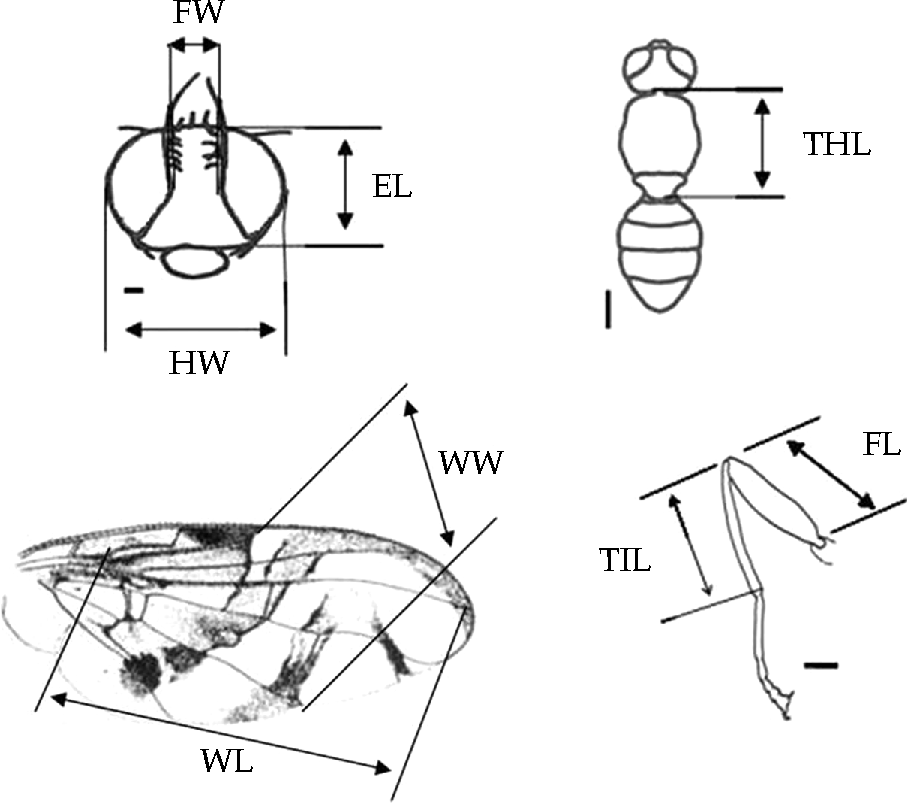
Frozen flies were sent to the Universidad de Buenos Aires where each fly was dissected in a paraffin-filled Petri dish. The thorax, head, wings and the third pair of legs were separated and used to measure eight traits related to body size, head shape and motion ability: thorax length (THL), maximum head width (HW), minimum face width (FW), eye length (EL), wing length (WL) and wing width (WW), and tibia length (TIL) and femur length (FL) (Fig. 1). The chosen landmarks for the wing measurements were located at the junctions of veins at the border of the wing or with another vein. WW was the distance between R1 vein intersecting the wing border and the point where CuA1 vein joins the border (D13 segment in Selivon et al., Reference Selivon, Perondini and Morgante2005). WL measured the distance between R4+5 vein intersecting the external border and the point where the radial vein joins R1 (Fig. 1). The left-body structures of all flies were measured, but when left structures were damaged we used right structures or we discarded the insect.
Depiction of morphometric traits measured in Anastrepha fraterculus individuals from Argentina: HW, head width; FW, face width; EL, eye length; THL, thorax length; WL, wing length; WW, wing width; FL, femur length; TIL, tibia length. Bar = 1 mm. Wing background drawing extracted from: South American fruit fly page (University of Florida Institute of Food and Agricultural Sciences). Available at: http://entnemdept.ufl.edu/creatures/fruit/tropical/frat07.htm (accessed November 2 2011).

All measurements were obtained using a stereoscopic microscope (Leica EZ4HD, Leitz-Wetzlar, Wetzlar, Germany) with a 12.5 × eyepiece zoom provided with a micrometre scale. Head and thorax measurements were obtained when these structures were placed in a Petri dish filled with bacto agar 1% (DIFCO Laboratories, Detroit, MI, USA) in distilled water. Special care was taken to get the pieces in horizontal position to reduce as much as possible parallax error. Wings and legs were mounted between slides and cover slips and then sealed with synthetic Canada balsam (Álwick). FW was measured with the objective 8 × , WW and WL with 1 × and the remaining characters with 4 × . All the measurements were expressed in relative units, with 1 mm = 1, 4 or 8 units for each objective magnification. To avoid difference in the criteria when taking measurements that might affect comparisons, all measurements were taken by the same researcher (P.G.C.).
Measurements were made on 260 flies (66 males and 59 females from LAB, and 59 males and 76 females from WILD).
Statistical analysis
A multivariate analysis of variance (MANOVA) was conducted to evaluate morphometric differences between sexes and origins.
Because of the potential problem of collinearity of variation of size-related traits, two alternative analyses were conducted. First, we conducted a multivariate regression analysis, with origin as the response variable and the measured traits as explanatory variables. This test allows a more precise evaluation of the selection pressure during differentiation on each trait by means of partial regression coefficients. Second, to confirm the results from the previous analyses and taking into account the dichotomous nature of the response variable (origin), we applied a logistic regression model by maximizing the conditional likelihood (Lumley, Reference Lumley2007).
All statistical tests were conducted with the packages ‘stats’ and ‘survival’ of the R software version 2.9.2 (R Development Core Team, 2009).
Results
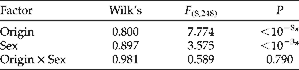
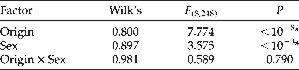
A two-factor MANOVA (sex × origin) (Table 1) indicated highly significant differences between both sexes and origins. Because sex × origin interaction resulted in non-significance, origin differences were analysed separately for each sex.
Results of two-way multivariate analysis of variance, for both sexes and origins (laboratory and wild) for morphometric measurements of eight traits (see Fig. 1) of Anastrepha fraterculus adults from Argentina
* Significant values (P< 0.05).
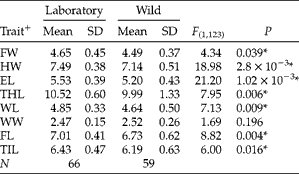
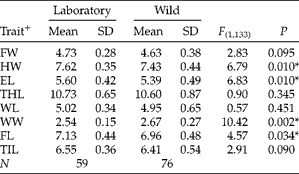
In most cases, the trait mean values were larger and standard errors were smaller in LAB flies compared with WILD ones. Laboratory males were larger than wild ones in all traits except WW (Table 2). In most cases, individual ANOVAs showed highly significant differences, and the results of the MANOVA indicated highly significant differences between origins for the phenotype as a whole (Wilk's = 0.71, P< 10− 5). Females exhibited the same trend (Table 3) but differences were statistically significant for only four traits (HW, EL, WW and FL). The MANOVA for a comparison of female phenotype between origins also showed highly significant differences (Wilk's = 0.823, P= 0.001).
Basic statistics of eight morphometric traits measured in adult male Anastrepha fraterculus from a laboratory strain and a wild population from Argentina
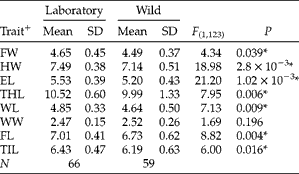
N, number of individuals. F and P provide the results of individual ANOVAs. All measurements are expressed in relative units. 1 unit = 1 mm for WL and WW; 1 unit = 0.25 mm for HW, EL, THL, FL and TIL; and 1 unit = 0.125 mm for FW.
* Significant values (P< 0.05).
+ See Fig. 1 for explanation of abbreviations.
Basic statistics of eight morphometric traits measured in adult female Anastrepha fraterculus from a laboratory strain and a wild population from Argentina
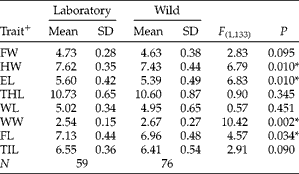
SD, standard deviation; N, number of individuals. F and P provide the results of individual ANOVAs. All measurements are expressed in relative units. 1 unit = 1 mm for WL and WW; 1 unit = 0.25 mm for HW, EL, THL, FL and TIL; and 1 unit = 0.125 mm for FW.
* Significant values (P< 0.05).
+ See Fig. 1 for explanation of abbreviations.
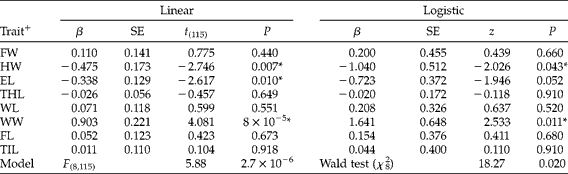
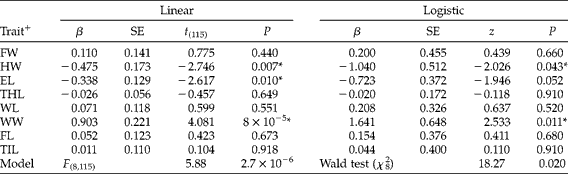
Results from the multiple regression analysis with origin as the response variable and the morphometric traits as explanatory variables are presented in Table 4. For males, a significant effect of origin was detected for HW, EL and WW. A similar trend was found applying linear or logistic models. According to these results, laboratory males had reduced WW as well as increased HW and EL.
Linear and logistic regression parameters for male Anastrepha fraterculus from a laboratory strain and a wild population from Argentina for eight morphometric traits measured
* Significant values (P< 0.05).
+ See Fig. 1 for explanation of abbreviations.
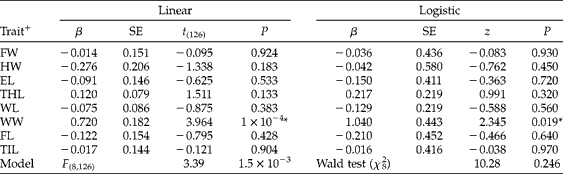
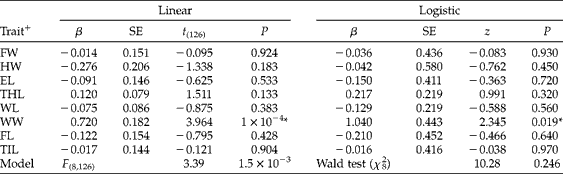
The results showed a similar trend for females (Table 5). However, only WW showed significant differences, with laboratory females having narrower wings than wild females.
Linear and logistic regression parameters for female Anastrepha fraterculus from a laboratory strain and a wild population from Argentina for eight morphometric traits measured
* Significant values (P< 0.05).
+ See Fig. 1 for explanation of abbreviations.
The phenotypic variance/covariance matrices were compared between origins using the Mantel's test. The results indicated that the structure of matrices is highly correlated (r= 0.81, P= 0.005, based on 10,000 permutations).
Discussion
Significant differences between the two populations were found, suggesting that laboratory rearing affects the multivariate phenotype. For most traits, mean values in laboratory flies were larger than those in wild flies. This might be attributed to the different larval feeding regime and food quality between the laboratory and wild flies. Laboratory larvae received high protein content food ad libitum (Jaldo et al., Reference Jaldo, Gramajo and Willink2001) that may explain the larger adult size. However, possible genetic differences between laboratory and wild flies should also be considered to account for the recorded morphometric differences. In fact, not just the body size but the body shape seemed to be affected by laboratory rearing, as WW was reduced while HW and EL were enlarged in laboratory flies in comparison with their wild counterparts. A field-cage study (Gómez Cendra et al., Reference Gómez Cendra, Segura, Allinghi, Cladera and Vilardi2007) showed that laboratory flies (that received the same food as the flies analysed in the present study) lived longer compared with wild flies, a result that could be attributed to diet. Also, a reduction in the trait variance (or SE) of laboratory insects was detected. Such a reduction may be explained partially by the lower environmental variance in the laboratory. However, it may also have a partial genetic cause because genetic drift probably occurred when the strain was first colonized; according to the founder-effect principle (Mayr, Reference Mayr, Huxley, Hardy and Ford1954), this could happen and has already been reported for Anastrepha serpentina (Wiedemann) (Pinson et al., Reference Pinson, Tejada, Toledo, Enkerlin, Celedonio-Hurtado, Valle, Pérez and Liedo2006) and some other tephritids (Liedo et al., Reference Liedo, Sosa, Villarreal, Briceño, Salgado, Valle, Oropeza, Chaclán and Toledo2004, Reference Liedo, Salgado, Oropeza and Toledo2007).
Phenotypic differences between laboratory and wild flies may be explained by both environmental sources (better and more abundant food) and genetic causes, involving founder effect and adaptation to laboratory conditions. As a consequence, laboratory strains may possess behavioural and physiological traits that diverge from those found in wild flies (Cayol, Reference Cayol, Aluja and Norrbom2000). These changes could affect the performance of laboratory insects in open-field conditions through reduced survival or a lower ability to compete for mating (Rodriguero et al., Reference Rodriguero, Vilardi, Vera, Cayol and Rial2002b), although improving competitiveness under appropriate artificial rearing systems is also possible and even desirable. According to our results, laboratory rearing was associated with a reduction in WW and, for males, an increase in head and eye sizes. Wing size may be selectively important in the wild where high mobility in search of resources and mating partners should be an advantage. In fact, higher WW was shown to increase mating success under field-cage conditions (Sciurano et al., Reference Sciurano, Rodriguero, Segura, Gómez Cendra, Allinghi, Cladera and Vilardi2007). However, in the overcrowded conditions in the laboratory, finding food and mating partners no longer requires good flight ability and the importance of WW is reduced. Indeed, a reduction in this trait could even be favoured because, in such overcrowded conditions, smaller wings might facilitate walking to access food sources.
EL was shown to be a potential target of sexual selection (Segura et al., Reference Segura, Petit-Marty, Sciurano, Vera, Calcagno, Allinghi, Gómez Cendra, Cladera and Vilardi2007). In laboratory conditions, where short-distance interactions between sexes are most frequent, the importance of EL as a target of sexual selection might be increased with respect to other traits involved in the mating behaviour. Short-distance interactions between male and female involve face-to-face activities (‘Arrowhead’ in Gómez Cendra et al., Reference Gómez Cendra, Calcagno, Belluscio and Vilardi2011), during which EL may play a recognizing role. In contrast, in open-field conditions, long-distance interactions are pre-eminent, and mating success may become mainly dependent on the ability of male to find a hotspot in a lek and being detected by the visiting females, a process mediated by pheromone production and detection (Malavasi et al., Reference Malavasi, Morgante and Prokopy1983).
One concern in terms of the SIT is that morphometric changes in laboratory strains may negatively affect mating competitiveness in the wild. However, appropriate management of mass rearing is compatible with improving favourable traits. In the present case, it is possible that larger eyes enable better vision, by improving acuity or sensitivity (Rutowski et al., Reference Rutowski, Gislén and Warrant2009), making it easier for laboratory flies to find resources or mates.
Conclusions
These results are of considerable relevance to evaluating whether a trait affected by artificial rearing is also a target of sexual selection; a by-product of laboratory conditions could affect the ability of laboratory flies to mate with wild flies after being released. Sciurano et al. (Reference Sciurano, Rodriguero, Segura, Gómez Cendra, Allinghi, Cladera and Vilardi2007) found that WW (and also thorax length) is a target of sexual selection in A. fraterculus, although its relationship with mating success is not linear. EL has been regarded as a target of sexual selection in C. capitata (Vera, Reference Vera1996; Norry et al., Reference Norry, Calcagno, Vera, Manso and Vilardi1999; Rodriguero et al., Reference Rodriguero, Vera, Rial, Cayol and Vilardi2002a, b). In A. fraterculus, this trait might also be important, but this observation was not confirmed by Segura et al. (Reference Segura, Petit-Marty, Sciurano, Vera, Calcagno, Allinghi, Gómez Cendra, Cladera and Vilardi2007). Therefore, special attention should be given to evaluating whether changes in morphometric traits as a result of mass rearing modify the mating performance in the wild. Until now, semi-mass rearing has not had a detrimental effect on the sterile males from EEAOC; they are able to mate perfectly with wild flies.
Methods of standardizing mass rearing must take into account also the genetic effects of drift, inbreeding and adaptation. Quality control tests should be conducted to verify the viability and mating success of mass-reared flies. Therefore, even when it is impossible to predict the effect of mass rearing on an Argentinian strain of A. fraterculus, it is highly recommended that the stress associated with rearing conditions is reduced as much as possible to avoid possible negative effects on the phenotype by either environmental causes or genetic changes in laboratory flies. As EL, WW and HW seem to present some degree of differentiation, it could be useful to take those traits in consideration, to verify that divergence does not increase with the mass-rearing process.
Acknowledgements
The authors thank Dr Jorge L. Cladera (INTA Castelar) for his help and suggestions, and Dr M. Teresa Vera (EEAOC Tucumán) for providing the biological material. This work was funded by Universidad de Buenos Aires (UBACYT X241, X234), Consejo Nacional de Investigaciones Científicas y Técnicas (PIP 5122) and the International Atomic Energy Agency (RC ARG 13014). The authors are also grateful to two anonymous reviewers for their valuable comments.