Introduction
Executive Function (EF) is a construct referring to the critical cognitive mechanisms that enable the individual to control attention, monitor context, and select a relevant action to navigate through task demands (Diamond, Reference Diamond2013). While there is a notable correlation between EF and academic readiness (Riggs, Blair & Greenberg, Reference Riggs, Blair and Greenberg2003; Diamond, Barnett, Thomas & Munro, Reference Diamond, Barnett, Thomas and Munro2007; Blair & Razza, Reference Blair and Razza2007; Best, Miller & Naglieri, Reference Best, Miller and Naglieri2011), recent literature indicates that the development of EF is largely affected by individuals’ everyday experiences such as cultural practices and language learning. In particular, better EF performance has been found in children from Eastern cultures where early self-regulation is emphasized (Oh & Lewis, Reference Oh and Lewis2008; Sabbagh, Xu, Carlson, Moses & Lee, Reference Sabbagh, Xu, Carlson, Moses and Lee2006b; Yang, Yang & Lust, Reference Yang, Yang and Lust2011; Tran, Arredondo & Yoshida, Reference Tran, Arredondo and Yoshida2015). Furthermore, an even larger literature suggests that exposure and learning more than one language generates cognitive competition that may promote EF, an effect known as the “bilingual advantage” (Costa, Hernandez & Sebastián-Gallés, Reference Costa, Hernández and Sebastián-Gallés2008; Kroll & Bialystok, Reference Kroll and Bialystok2013; Sebastián-Gallés, Albareda-Castellot, Weikum & Werker, Reference Sebastián-Gallés, Albareda-Castellot, Weikum and Werker2012; Singh et al., Reference Singh, Fu, Rahman, Hameed, Sanmugam, Agarwal and Rifkin-Graboi2015; Wimmer & Marx, Reference Wimmer and Marx2014; Yoshida, Tran, Benitez & Kuwabara, Reference Yoshida, Tran, Benitez and Kuwabara2011; Yow & Markman, Reference Yow and Markman2015; Yow, Li, Lam, Gliga, Chong, Kwek & Broekman, Reference Yow, Li, Lam, Gliga, Chong, Kwek and Broekman2017). The bilingual advantage is broadly understood as bilinguals’ enhanced cognitive control ability when compared to their monolingual counterparts. The effect is believed to stem from bilinguals’ daily exposure and use of multiple languages, where learners are required to make fast and adaptive changes from context-to-context (Bialystok, Reference Bialystok1999, Reference Bialystok2001; Bialystok & Martin, Reference Bialystok and Martin2004; Carlson & Meltzoff, Reference Carlson and Meltzoff2008).
However, there are disputes regarding the robust effects and independent contributions of bilingualism and cultural experiences on the development of EF (Paap & Greenberg, Reference Paap and Greenberg2013; Antón et al., Reference Anton, Dunabeitia, Estevez, Hernandez, Castillo, Fuentes, Davidson and Carreiras2014; Duñabeitia, Hernández, Antón, Macizo, Estévez, Fuentes & Carreiras, Reference Duñabeitia, Hernández, Antón, Macizo, Estévez, Fuentes and Carreiras2014; Gathercole, Thomas, Kennedy, Prys, Young, Vinas Guasch, Roberts, Hughes & Jones, Reference Gathercole, Thomas, Kennedy, Prys, Young, Vinas Guasch, Roberts, Hughes and Jones2014). There are three key issues associated with the lack of robust effects. First, although bilingual speakers are often immersed in multiple cultural backgrounds, individuals' cultural background may not always be controlled when testing bilingual children. This has been an issue given the increased studies suggesting the role of culture in EF task performances (Carlson & Choi, Reference Carlson and Choi2008; Carlson & Meltzoff, Reference Carlson and Meltzoff2008; Sabbagh, Moses & Shiverick. Reference Sabbagh, Moses and Shiverick2006a; Yang et al., Reference Yang, Yang and Lust2011; Yang & Yang, Reference Yang and Yang2016). Second, there is an inconsistency in the literature associated with age. The target age group is often narrowly selected to control for other potential influences on cognitive outcomes, such as language achievement and schooling, and thus may not translate beyond the examined age (Anton, Dunabeitia, Estevez, Hernandez, Castillo, Fuentes, Davidson & Carreiras, Reference Anton, Dunabeitia, Estevez, Hernandez, Castillo, Fuentes, Davidson and Carreiras2014; Duñabeitia et al., Reference Duñabeitia, Hernández, Antón, Macizo, Estévez, Fuentes and Carreiras2014; Tare & Linck, Reference Tare and Linck2011). As a result, previous studies may not always capture the important trajectories of how experiences interact with EF in early development, particularly during the preschool period when EF is rapidly changing and developing (Kopp, Reference Kopp1982; Carlson, Reference Carlson2005). Third, different types of EF tasks may operate on different sub-skills – attention, inhibition, task switching, and working memory (Anderson, Reference Anderson1989; Welsh, Pennington & Groisser, Reference Welsh, Pennington and Groisser1991; Zelazo, Carter, Reznick & Frye, Reference Zelazo, Carter, Reznick and Frye1997), yet there is not a clear understanding of the type of experiences different EF tasks are sensitive to. In particular, studies often select a target task to minimize potential confounds when examining various factors, which may leave out the possibility that bilingualism and culture may differentially impact cognitive performances when different EF tasks are considered. The present study addresses these issues in a single study to document the precise nature of the potential impact of bilingualism and culture on the development of early EF.
Culture and executive function
One way of assessing distinctions between Eastern and Western cultures is based on the structural degree of these societies as they differ in relation to their citizens' goals, needs, collectivism and individualism (Triandis, Reference Triandis1994, Reference Triandis, Verma and Bagley1995). Eastern (or collectivistic) cultures place emphasis on obedience to authority figures, interdependence among peers, early maintenance of self-regulation, strict academic training, structured instruction on self-regulating responses, and less focus on the importance of recreation (Tobin, Wu & Davidson, Reference Tobin, Wu and Davidson1989; Ho, Reference Ho, Greenfield and Cocking1994; Wu, Reference Wu and Lau1996; Chen, Hastings, Rubin, Chen, Cen & Stewart, Reference Chen, Hastings, Rubin, Chen, Cen and Stewart1998; Nisbett, Peng, Choi & Norenzayan, Reference Nisbett, Peng, Choi and Norenzayan2001; Parmar, Harkness & Super, Reference Parmar, Harkness and Super2004; Oh & Lewis, Reference Oh and Lewis2008). Western (or individualistic) cultures, on the other hand, value practices of individualism, independence, self-expression, and recreation (Ahadi, Rothbart & Ye, Reference Ahadi, Rothbart and Ye1993; Chao & Tseng, Reference Chao, Tseng and Bornstein2002; Parmar, Harkness & Super, Reference Parmar, Harkness and Super2004).
Cross-cultural studies have reported how Eastern and Western cultural practices affect EF processes differently (Witkin & Berry, Reference Witkin and Berry1975; Markus & Kitayama, Reference Markus and Kitayama1991; Nisbett et al., Reference Nisbett, Peng, Choi and Norenzayan2001; Yang et al., Reference Yang, Yang and Lust2011; Tran et al., Reference Tran, Arredondo and Yoshida2015). In particular, individuals’ cultural backgrounds have been linked to differences in attentional control in adults and children (Oh & Lewis, Reference Oh and Lewis2008; Varnum, Grossmann, Kitayama & Nisbett, Reference Varnum, Grossmann, Kitayama and Nisbett2009; Yang et al., Reference Yang, Yang and Lust2011; Kuwabara & Smith, Reference Kuwabara and Smith2012; Tran et al., Reference Tran, Arredondo and Yoshida2015). For example, four-year-old monolingual children from Korea respond more accurately than their monolingual peers from the U.S. on cognitive measures of attention (Yang et al., Reference Yang, Yang and Lust2011). This Korean cultural advantage has been explained through the Eastern values of disciplined behavior and self-regulation (Chao & Tseng, Reference Chao, Tseng and Bornstein2002; Chen et al., Reference Chen, Hastings, Rubin, Chen, Cen and Stewart1998). Previous studies have also linked Eastern cultural experiences to children's task performances that are relevant to response inhibition, such as those found in delay of gratification tasks (Oh & Lewis, Reference Oh and Lewis2008; Sabbagh et al., Reference Sabbagh, Moses and Shiverick2006a). Delay of gratification tasks require children to inhibit prepotent responses, such as peeking while the experimenter is wrapping the gift (Gift Delay task) or taking the marshmallow when the experimenter is not present (Marshmallow task), to receive a reward (Mischel, Ebbesen & Zeiss, Reference Mischel, Ebbesen and Zeiss1972; Kochanska, Murray, Jacques, Koenig & Vandegeest, Reference Kochanska, Murray, Jacques, Koenig and Vandegeest1996). Other variants of response inhibition tasks include the Day/Night task where children are instructed to say “day” when shown a moon card and “night” when shown a sun card (Gerstadt, Hong & Diamond, Reference Gerstadt, Hong and Diamond1994), and the Bear/Dragon where children perform motor movements when the bear instructs and resist when the dragon commands (Reed, Pien & Rothbart, Reference Reed, Pien and Rothbart1984). These tasks do not require children to recruit multiple cognitive processes for task success, such as flexibility, switching, and monitoring of attention, which are vital in tasks that switch between different rules or dimensions within the same task, such as the Dimensional Change Card Sorting task (Bialystok, Reference Bialystok2017).
In comparison to those tested in Eastern cultures, children from Latin American cultures have received little attention in terms of EF measurement. However, a study by Bornstein and Cote (Reference Bornstein and Cote2004) compared mothers' parenting cognitions, specifically attributions about child-rearing and self-perceptions of parenting effectiveness across different cultures (Japanese, Argentine, and European American in the U.S.) and found that Argentine mothers held parenting views and cognitions that were more closely related to those of European American mothers in the U.S. than Japanese mothers. This finding demonstrates in part that Argentines hold cultural attitudes and behaviors that are between the two extremes of individualism and collectivism, whereas Americans in the U.S. are classified on the extreme end of individualism (Triandis, Reference Triandis, Verma and Bagley1995; Haskins & Eggleston, Reference Haskins and Eggleston2003). Furthermore, research has identified Argentina as having a “less-tight” collective societal structure (versus a more structured collectivistic country such as China), where individuals are considered more liberal-minded and able to express themselves by allowing deviation from the rules and setting fewer standards in their social context (Burns & Charlip, Reference Burns and Charlip2006; Triandis, Reference Triandis1994, Reference Triandis1999; Haskin & Eggleston, Reference Haskins and Eggleston2003). The present study focuses on three cultures (Western, Latin American, and Eastern) that differ in the degrees of individualism/collectivism to document how cultures with different societal structure may influence cognitive performance measuring response inhibition and their relation to bilingualism.
Bilingualism and executive function
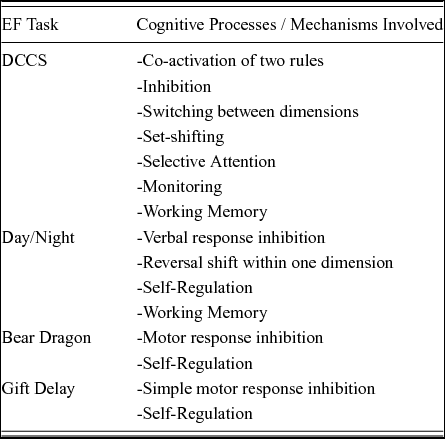
In contrast to cultural influences on response inhibition performance, the bilingual cognitive advantage has often been documented in EF tasks that require multiple dimensional shifts. Dimensional shifting tasks require cognitive control processes including monitoring of source information, switching between multiple rules, selective attention to the relevant feature, and the suppression of stimulus interference (Bialystok & Martin, Reference Bialystok and Martin2004; Carlson & Meltzoff, Reference Carlson and Meltzoff2008; Martin-Rhee & Bialystok, Reference Martin-Rhee and Bialystok2008). Dimension Change Card Sorting (DCCS; Zelazo, Frye & Rapus, Reference Zelazo, Frye and Rapus1996) is a common dimensional shifting task that has been linked to bilingual advantage in preschoolers (Bialystok & Martin, Reference Bialystok and Martin2004; Martin-Rhee & Bialystok, Reference Martin-Rhee and Bialystok2008). In the DCCS task, children are asked to first sort a set of bi-dimensional cards by attending to one dimension (pre-switch; e.g., shape), then they are asked to sort the same cards by shifting their attention to another dimension (post-switch; e.g., color). As such, co-activation of two rules, inhibition of the tendency to attend to a previous relevant feature (e.g., shape), selective attention to the newly relevant feature (e.g., color), and flexible switching between both dimensions are required for success in the DCCS task (Carlson & Meltzoff, Reference Carlson and Meltzoff2008; Frye, Zelazo & Palfai, Reference Frye, Zelazo and Palfai1995; Zelazo, Müller, Frye & Marcovitch, Reference Zelazo, Muller, Frye and Marcovitch2003; Kloo & Perner, Reference Kloo and Perner2005; Fisher, Reference Fisher2011). See Table 1 for processes associated with each EF task employed in the present study.
Cognitive processes associated with the four EF task.

These overlapping cognitive processes are also relevant to the way bilingual children learn and process two languages at the same time (Bialystok, Reference Bialystok2001), where co-activation of two languages in the bilingual brain is required for successful language comprehension and production (Bialystok, Reference Bialystok2017; Blumenfeld & Marian, Reference Blumenfeld and Marian2007; Brysbaert, Reference Brysbaert1998; Francis, Reference Francis1999; Gollan & Kroll, Reference Gollan, Kroll and Rapp2001; Guttentag, Haith, Goodman & Hauch, Reference Guttentag, Haith, Goodman and Hauch1984; Kroll & Dijkstra, Reference Kroll, Dijkstra and Kaplan2002; Smith, Reference Smith, de Groot and Kroll1997). Thus, language processing and selection taps into a general executive system for successful switching between two different languages, that requires selective attention to the relevant language and inhibition of the non-relevant language (Bialystok, Reference Bialystok2017; Bialystok & Martin, Reference Bialystok and Martin2004; Kroll & Bialystok, Reference Kroll and Bialystok2013). Therefore, the present study specifically tests bilingual children by including EF measures that are relevant to the overlapping processes sensitive to the bilingual cognitive effect.
Furthermore, recent literature on bilingualism indicates that diverse bilingual profiles, such as the degree of bilingualism, language-switching experiences, and script variation, impact EF and yield different outcomes (for a comprehensive review see Schwieter, Reference Schwieter2016). For instance, research by Leon-Guerrero, Smith and Luk (Reference Leon-Guerrero, Smith and Luk2016) suggests that the daily use of bilingual preschoolers’ non-dominant language (along with chronological age) has a direct impact on EF tasks. This research highlights the importance of daily bilingual usage and consideration of both languages – dominant and non-dominant – when analyzing the relationship between bilingualism and EF. Moreover, a recent study with children from middle-socioeconomic backgrounds revealed bilingual (Russian–Hebrew) children who were proficient (balanced) in both languages outperformed Hebrew monolinguals and unbalanced bilingual (i.e., those who were more proficient in one language, Russian or Hebrew) on EF tasks measuring response inhibition and shifting (Prior, Goldwasser, Ravet-Hirsh & Schwartz, Reference Prior, Goldwasser, Ravet-Hirsh and Schwartz2016). The present study aims to control SES, vocabulary knowledge, and bilingual language history while following up on the developmental periods when EF is rapidly changing to address the influences of bilingual and cultural experiences on EF performances.
Additive effects of bilingualism and culture
Interestingly, recent cross-cultural work has suggested the potential role of additive effects on cognitive task performances. Research by Yang et al. (Reference Yang, Yang and Lust2011) documented that four-year-old Korean–English bilinguals in the U.S. outperformed monolinguals in Korea and in the U.S. (while Korean monolinguals outperform English monolinguals) on the Attention Network Test (ANT; Fan, McCandliss, Sommer, Raz & Posner, Reference Fan, McCandliss, Sommer, Raz and Posner2002), a non-verbal attention control measure. This additive effect is considered in terms of the combined effect of bilingualism and culture, where processes inherent in bilinguals’ enhanced cognitive control ability and in Eastern cultural emphasis on early behavioral regulation enhances EF performance (Yang et al., Reference Yang, Yang and Lust2011). However, precisely how bilingual and cultural experiences influence EF task performances is not clearly understood. Previous reports on the independent EF effects via bilingualism and cultural experiences (Bialystok, Reference Bialystok1999; Bialystok & Martin, Reference Bialystok and Martin2004; Carlson & Meltzoff, Reference Carlson and Meltzoff2008; Kalashnikova & Mattock, Reference Kalashnikova and Mattock2014; Okanda, Moriguchi & Itakura, Reference Okanda, Moriguchi and Itakura2010; Oh & Lewis, Reference Oh and Lewis2008; Sabbagh et al., Reference Sabbagh, Moses and Shiverick2006a) suggests processes related to response inhibition may be influenced by culture, while tasks measuring general cognitive control abilities (including response inhibition) may also be sensitive to bilingualism. The present study will document whether the additive effect is separately combined or integrated, by documenting the development of response inhibition processes when bilingual and cultural experiences co-occur.
Culture specification
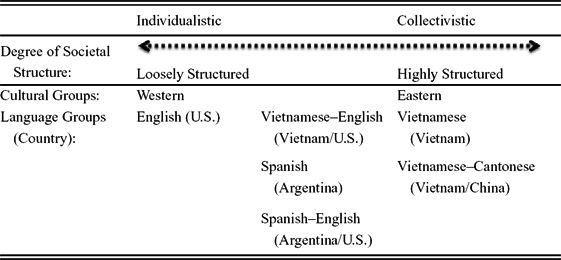
The present study includes three countries: the United States (U.S.), Argentina, and Vietnam, each representing Western, Latin American, and Eastern cultures, respectively in terms of the degrees of individualism to collectivism (Hofstede, Reference Hofstede1980, Reference Hofstede1991, Reference Hofstede2001; Vuong, Reference Vuong1976; Bellah, Madsen, Sullivan, Swidler & Tipton, Reference Bellah, Madsen, Sullivan, Swidler and Tipton1985; Gold, Reference Gold1992a, Reference Gold and Stanfield1992b; Ho & Chiu, Reference Ho, Chiu, Kim, Triandis, Kâğitçibaşi, Choi and Yoon1994; Lytle, Brett, Barsness, Tinsley & Janssens, Reference Lytle, Brett, Barsness, Tinsley, Janssens, Staw and Cummings1994; Nowak, Reference Nowak, Purnell and Paulanka1998; Parrado & Cerrutti, Reference Parrado and Cerrutti2003). An established coding scheme based on the degree of societal structure of different cultures was implemented to classify participants into distinct cultural groups for analysis (see Table 2). In particular, participants are coded based on how each country was rated on Hofstede's scale of individualism-collectivism dimension, where cultures are described from ‘loosely’ structured to ‘tightly’ integrated (Hofstede, Reference Hofstede1980, Reference Hofstede1991, Reference Hofstede2001). This provided a quantifiable scale – collectivism and individualism – to base the present classification of the cultural groups. Specifically, the U.S. ranked #1, and Argentina ranked #22-23 (mid-range) on the individualism-collectivism dimension scale (out of 53; lower scores indicate individualism, higher scores indicate collectivism).
Cultural grouping based on the degree of societal structure.

While Vietnam was not ranked in Hofstede's original scale, the current classification was based on the four associations pooled for the individualism-collectivism data: (1) Wealth: there is a strong relationship between a nation's wealth and individualism, (2) Geography: countries with moderate and cold climates tend to show more individualism, (3) Birth rates: countries with higher birth rates tend to be collectivistic, and (4) History: Confucian countries are collectivistic. As such, based on the country's wealth (relatively poor), geography (hot climate), birth rates (high), and history (heavily influenced by Confucian values due to China's ruling for over 1,000 years), Vietnam was classified as highly collectivistic on the proposed scale (see Table 2). Moreover, similar and surrounding countries to Vietnam were ranked as follows on the individualism-collectivism scale: Hong Kong #37, Singapore #39-41, Thailand #39-41, Taiwan #44, and Indonesia rated #47-48 (Hofstede, Reference Hofstede2001, Exhibit 5.1, p. 215).
By recruiting Vietnamese children, whose cultural contribution in cognitive development has not been explored, we ask a new question: how does culture influence the development of bilingual cognitive advantage during the preschool years? In particular, with the inclusion of Vietnamese–English and Vietnamese–Cantonese bilinguals, we may begin to address how differences in cultural structures may interact with bilingualism to influence EF task performance. The inclusion of Vietnamese–English bilinguals from the U.S. will address the influences of the two extreme ends of culture – collectivism and individualism – as well as Vietnamese–Cantonese bilinguals from Vietnam in order to encompass “tightly integrated” collectivism. Moreover, by including monolingual English from the U.S. and monolingual Vietnamese from Vietnam, the design allows for systematic comparisons between different language groups. Therefore, the study presents a systematic design to fill the critical gap in the bilingual literature, while delving deeper to understand the underlying mechanisms that are influenced by different cultural structures.
Overview
In order to investigate how bilingualism and culture influence the development of EF, the present study includes monolingual (English, Vietnamese, and Spanish) and bilingual (Vietnamese–English, Vietnamese–Cantonese, and Spanish–English) children from three distinct cultures varying in the degree of collectivistic practices. These children were tested longitudinally at three developmental periods (age 3, 3.5, and 4 years) in four EF tasks that have previously demonstrated independent influences of bilingualism and culture (Bialystok & Martin, Reference Bialystok and Martin2004; Martin-Rhee & Bialystok, Reference Martin-Rhee and Bialystok2008; Oh & Lewis, Reference Oh and Lewis2008; Sabbagh et al., Reference Sabbagh, Moses and Shiverick2006a).
We hypothesize that: first, the bilingual advantage effect may be more sensitive to cognitive control processes typically required in tasks involving different rules/dimensions (e.g., the DCCS), such as selective attention, switching, inhibition, and monitoring, due to similar EF mechanisms required in bilingual language processing (Bialystok, Reference Bialystok1999; Bialystok & Martin, Reference Bialystok and Martin2004; Carlson & Meltzoff, Reference Carlson and Meltzoff2008; Kalashnikova & Mattock, Reference Kalashnikova and Mattock2014; Okanda et al., Reference Okanda, Moriguchi and Itakura2010). Second, the culture effect may be attuned to response inhibition processes typically found in single dimension tasks, such as the Day/Night, Bear/Dragon, Gift Delay task, due to specific cultural practices emphasizing early behavioral self-regulation (Gerstadt et al., Reference Gerstadt, Hong and Diamond1994; Bernstein, Atance, Meltzoff & Loftus, Reference Bernstein, Atance, Meltzoff and Loftus2007; Carlson & Moses, Reference Carlson and Moses2001; Carlson, Reference Carlson2005; Chasiotis, Kiessling, Hofer & Campos, Reference Chasiotis, Kiessling, Hofer and Campos2006; Oh & Lewis, Reference Oh and Lewis2008; Sabbagh et al., Reference Sabbagh, Moses and Shiverick2006a; Montgomery, Anderson & Uhl, Reference Montgomery, Anderson and Uhl2008). Finally, the potential combined effects of bilingualism and culture may appear in tasks measuring response inhibition specifically when Eastern culture is considered. In particular, we expect bilingual Vietnamese children (Vietnamese–English in the U.S. and Vietnamese–Cantonese in Vietnam) to outperform their non-Eastern monolingual counterparts (English in the U.S., Spanish in Argentina) on the Day/Night, Bear/Dragon, and Gift Delay task. In this manner, the development of response inhibition/self-regulation processes may be enhanced when specific language status (bilingualism) and cultural groups (Eastern) are coupled.
Method
Participants
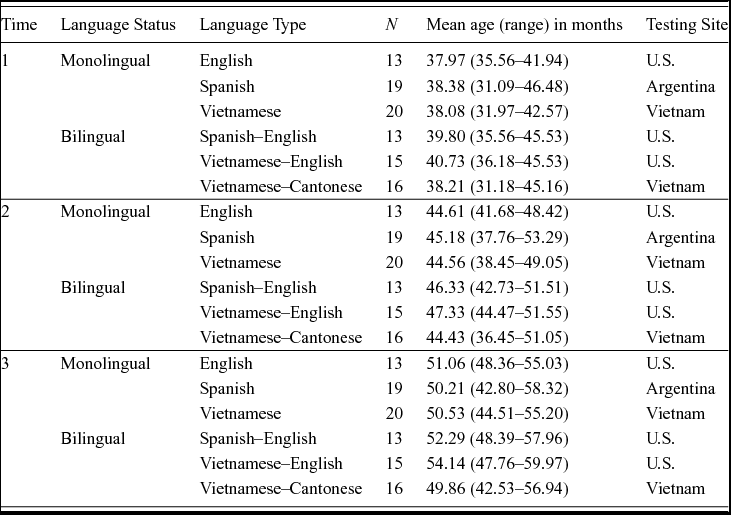
Ninety-six 3-year-old (Mean age [M age] = 38.78 months) monolingual and bilingual children from three countries (U.S., Argentina, and Vietnam) participated in 3 separate sessions every 6 months (M age = 45.35 months at Time 2, Mage = 51.20 months at time 3). Children were recruited from communities in Houston, Texas, U.S.; San Miguel de Tucumán in Argentina; and Đồng Nai in Vietnam. See Table 3 for specific characteristics regarding each sample including size, age, and language status across the time points and sites.
Sample Characteristics.

Monolingual and bilingual children were recruited in the U.S. and Vietnam. No bilingual children were recruited in Argentina since they did not share similar learning environments (i.e., strong tendency to attend small private learning centers) and were of higher SES backgrounds than the monolingual sample in Argentina and bilinguals in the U.S. and Vietnam. Given that high SES has measurable effects on children's cognitive task performances (e.g., Mezzacappa, Reference Mezzacappa2004; Noble, Norman & Farah, Reference Noble, Norman and Farah2005), bilingual Argentinean children who were initially recruited and screened were not included for subsequent longitudinal testing on the EF tasks.
At the time of testing, all of the bilingual children (in the U.S. and Vietnam) were simultaneous bilinguals. Specifically, bilingual children in the U.S. were born in the U.S., had at least one immigrant parent, and were regularly exposed to English and their parents’ non-English native language from birth. Both English and the non-English language were regularly spoken at home by at least one parent, while English was primarily spoken outside of the home. On the other hand, bilingual children in Vietnam were born in Vietnam, had at least one parent fluent in Cantonese, and were regularly exposed to Vietnamese and Cantonese from birth. Both languages were spoken at home, with Vietnamese predominately spoken outside of the home.
Moreover, all bilingual children in the U.S. were second-generation immigrants (i.e., American born with first-generation immigrant parents). Previous research suggests that first-generation immigrants typically adhere to their culture of origin (e.g., more “Eastern” for Vietnamese–English children from the U.S.), while third-generation immigrants typically assimilate to their culture of residence (e.g., more “Western” for Vietnamese–English children from the U.S.; Matsuoka, Reference Matsuoka1990; Phinney, Ong & Madden, Reference Phinney, Ong and Madden2000). The Vietnamese–Cantonese bilinguals, however, were recruited at the local Chinese community center in Đồng Nai, Vietnam, and had a history of ancestors who originated from Guangzhou, China from prior generations.
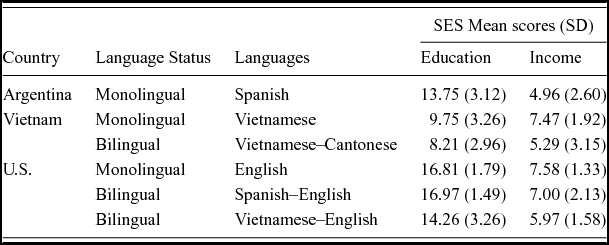
Finally, children who took part in the study were selected to fall within the middle SES range (50th percentile) during the year of data collection (2008-2009). The middle SES income range for each country (based on national statistics) were as follows: $50,000 to $74,999 for the U.S. (John D. & Catherine T. MacArthur Foundation Research Network on Socioeconomic Status and Health), 15.500 to 21.499 pesos for Argentina (Development Economics LDB database, 2008), and 10,400,000 to 13,199,999 Đồng for Vietnam (Development Economics LDB database, 2008). Lastly, the middle SES status also included parental education, which is suggested to play a vital role in children's cognitive development and academic achievement (Smith, Brooks-Gunn & Klebanov, Reference Smith, Brooks-Gunn, Klebanov, Duncan and Brooks-Gunn1997; Bradley & Corwyn, Reference Bradley and Corwyn2002; Davis-Kean, Reference Davis-Kean2005; Biedinger, Reference Biedinger2011). Thus, SES measures of household income and parental education were analyzed individually; see Table 4.
Socio-Economic Status (SES) scores.

Measures
DCCS task (Zelazo et al., Reference Zelazo, Muller, Frye and Marcovitch2003)
Adapted from the original study by Zelazo et al. (Reference Zelazo, Frye and Rapus1996), the stimuli consisted of a set of cards with two shapes (rabbit, boat) and two colors (pink, blue). There were a total of 32 cards (16 shape-matched, but different color; 16 color-matched, but different shape). The DCCS task has two phases: pre-switch and post-switch. There were a total of 32 trials, of which 16 were pre-switching trials. The child's initial response determined the order of the dimension tested first (shape/color), when the child was first presented with a card (e.g., a pink rabbit) and asked to tell the experimenter what they saw. If the child mentioned the shape (rabbit), then the child was asked to sort the cards by shape (and vice versa for color response). Immediately after this sorting (pre-switching trials), children were instructed to sort a stack of 16 cards by the other dimension (post-switching trials) as quickly as possible. To establish prepotent responses and effectively test the ability to switch, it was critical for children to successfully sort the first dimension in the pre-switching trials. Thus, children were encouraged during the pre-switch phase to ensure that they sorted at least ten cards (62.5 %, above chance) correctly during the pre-switching trials. The proportion of successful post-switch scores was considered to measure children's ability to switch dimensions and used in the analysis.
Day/Night task (Gerstadt, Hong & Diamond, Reference Gerstadt, Hong and Diamond1994)
The experimenter engaged children in a conversation about when the sun and the moon come up (i.e., during the day and the night). Children were then presented with a card of a white background and a yellow sun, as well as a card with a black background and a white moon. Children were then instructed to respond “night” when shown the sun card and “day” when shown the moon card. After children had been able to assert the correct answer verbally, they proceeded with the 16 follow-up test trials. Children's responses were either day or night. In this task, children are required to selectively produce the correct (opposite) verbal response of the new association, which involves inhibition of previously learned associations (i.e., the sun comes out during the day, the moon comes out during the night). The number of correct responses was recorded and used in the analysis. The order of presentation used by Gerstadt et al. (Reference Gerstadt, Hong and Diamond1994) was implemented.
Bear/Dragon task (Reed et al., Reference Reed, Pien and Rothbart1984)
Similar to the Simon Says game, children were instructed to perform ten motor commands as instructed by two puppets – a bear or a dragon. Participants were introduced to “Mr. Bear” (in an excited tone of voice) and “Mr. Dragon” (in a deep voice). The objective of the task is for the child to perform correct motor movements when Mr. Bear instructs and refraining from movement when Mr. Dragon commands. After training, participants were presented with ten trials of different motor commands from the bear and dragon in alternating order. For example, “Mr. Bear says, touch your nose” and “Mr. Dragon says, touch your head”. Therefore, success on the Bear/Dragon task involves complex motor response inhibition where children must selectively attend to the correct motor command and inhibit prepotent motor responses (Reed et al., Reference Reed, Pien and Rothbart1984; Carlson & Moses, Reference Carlson and Moses2001; Carlson, Reference Carlson2005; Kochanska, Murray & Harlan, Reference Kochanska, Murray and Harlan2000; Sabbagh et al., Reference Sabbagh, Moses and Shiverick2006a). The number of correct motor actions performed and inhibited was recorded and used for later analysis.
Gift Delay task (Konchaska et al., Reference Kochanska, Murray, Jacques, Koenig and Vandegeest1996)
Children were told that they did a good job and that they would receive a gift for their participation. However, the experimenter “forgot” to wrap the gift, children were then instructed to turn around in their seat while the experimenter wrapped their surprise gift. The experimenter then rifled with the wrapper (gift bag) noisily for 60 seconds, as timed by a stopwatch and peeking behavior was video-recorded. Success on the Gift Delay task involves simple motor response inhibition, where children must self-regulate from turning around, such as peeking or impulsive behavior (Konchaska et al., Reference Kochanska, Murray, Jacques, Koenig and Vandegeest1996; Gerstadt et al., Reference Gerstadt, Hong and Diamond1994; Carlson & Moses, Reference Carlson and Moses2001). The number of seconds spent peeking (from 60 seconds) was recorded, and proportions of the non-peeking time were marked as “correct” responses and used for later analysis.
Other measures
Children's demographic assessments were conducted using the John D. and Catherine T. MacArthur Foundation Research Network on Socioeconomic Status and Health, a parent questionnaire consisting of 16 questions on SES and their child's health. Parental education and income were included in the analysis. Parents were also asked to complete the MacArthur Communicative Developmental Inventory (MCDI) toddler form for the language(s) that their child spoke (Fenson, Dale, Reznick, Thal, Bates, Hartung, Pethick & Reilly, Reference Fenson, Dale, Reznick, Thal, Bates, Hartung, Pethick and Reilly1993). Children's productive vocabularies were screened to predict developmental delays across the language groups. The MCDI checklist forms for English, Chinese, and Spanish were independently developed and normalized (Fenson et al., Reference Fenson, Dale, Reznick, Thal, Bates, Hartung, Pethick and Reilly1993; Ogura & Watamaki, Reference Ogura and Watamaki1997; also Ogura, Yamashita, Murase & Dale, Reference Ogura, Yamashita, Murase and Dale1993). Due to a lack of a Vietnamese MCDI vocabulary checklist form, one was developed by adapting from the Chinese and Japanese MCDIs with replacements of items native to the Vietnamese culture (i.e., food, drinks). Parents of bilingual children were asked to fill out two vocabulary checklists corresponding to the languages their child was regularly exposed to in their environment. In the present sample, we included children whose total vocabulary was above the 20th percentile.
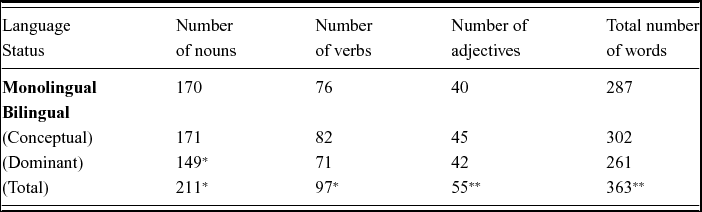
For productive vocabulary scores, the number of words (i.e., total, noun, verbs, adjectives) in the dominant language, total language/s (combined languages for bilinguals), and conceptual knowledge were computed. To fairly assess and compare bilinguals' language knowledge, conceptual knowledge was calculated by subtracting overlapping words known in both languages from the total number of concepts known in both languages. Conceptual knowledge is considered a more valid measure of bilinguals’ vocabulary knowledge, especially when comparing them with their monolingual counterparts (Umbel, Pearson, Fernandez & Oller, Reference Umbel, Pearson, Fernandez and Oller1992; Pearson, Fernández & Oller, Reference Pearson, Fernández and Oller1993; Alvarado, Reference Alvarado2000; Bialystok, Reference Bialystok2001; Oller & Pearson, Reference Oller, Pearson, Oller and Eilers2002; Oller, Reference Oller, Cohen, McAlister, Rolstad and MacSawn2005). An analysis comparing conceptual vocabularies between the language and cultural groups demonstrated no significant differences (p >.1). See Table 5.
Mean productive vocabulary on the MacArthur–Bates Communicative Development Inventories (MCDI) for Conceptual, Dominant, and Total Knowledge at Time 1.

Notes. * p < .05 and ** p < .01 indicate a significant result of a between-sample t-test between monolingual and bilingual groups.
Procedure
During each visit, parents completed the John D. and Catherine T. MacArthur SES and MCDI forms. All testing sessions with children were conducted one-on-one with an experimenter in a quiet room, where children were instructed to sit on a small chair directly across from the experimenter. A mobile video camera attached to a tripod was set up at the corner of the room to record each experimental session for future behavioral coding and analysis. The order of the tasks was counterbalanced for each assessment and randomized across each testing session.
Analysis strategies
To ensure reliability across testing sites, the same experimenter administered the tasks at each respective site every six months (i.e., the first author tested subjects in Vietnam and the U.S., while the second author tested subjects in Argentina and the U.S.). The experimenters were both trained at the same institution; every effort was made to ensure that task procedures, stimuli, and measures were identical. Finally, statistical analyses were implemented to ensure the reliability of test scores. In particular, Cronbach's Alpha tests were performed within each country to ensure the reliability across the three testing sites, where higher values of alpha are considered more desirable for internal consistency (Cronbach, Reference Cronbach1951). Results from the composite scores of all EF tasks indicate their consistency across test sites; alpha scores of .620, .743, and .811 for the U.S., Argentina, and Vietnam, respectively. Scores from Argentina and Vietnam indicate that internal consistency ranged from fair to good, respectively. Although the alpha score for the U.S. approached “fair” for internal consistency (i.e., >.70), the questionable score may be due in part to the inclusion of various cultural and language groups within the sample. Specifically, the U.S. included bilingual Argentinean–American and Vietnamese–American, as well as monolingual English children.
A series of linear mixed model analyses were performed for the present data due to the repeated measurements (made on the same statistical units), small sample size per group, fixed effects (e.g., language status), and random effects (e.g., time point) included in the present design (Laird & Ware, Reference Laird and Ware1982; McLean, Sanders & Stroup, Reference McLean, Sanders and Stroup1991; Singer & Willett, Reference Singer and Willett2003).
The primary question was how bilingualism and culture influence the development of specific EF processes. To address this question, we first examine whether the bilingual advantage effect is more sensitive to tasks involving multiple stimulus dimensions (than single dimensional tasks; i.e., the DCCS), where selective attention, switching, inhibition, and monitoring processes are required for task success. We then examined whether culture may be more influential on processes involved in response inhibition tasks (than dimensional shifting tasks that involve multiple processes), such as the Day/Night, Bear/Dragon, and Gift Delay tasks. Finally, we considered the secondary question regarding the additive effect by testing whether culture and bilingualism generate significant effects on EF tasks that recruit response inhibition processes for task success.
By identifying specific effects of bilingualism and culture on each EF task, the study will reveal the sensitivities of specific EF processes in relation to different language and cultural backgrounds. Thus, for general main effects, we conducted an ANOVA on the model of best fit for each EF task (i.e., DCCS, Day/Night, Bear/Dragon, Gift Delay). For this analysis, the effect of Time (1, 2, and 3; random factor), language status (bilingual and monolingual; fixed factor), culture (Western, Latin American, and Eastern; fixed factor), SES (education and income; fixed factor), Time and language status interaction, Time and culture interaction, and language status and culture interaction were used to predict the EF task scores.
Model comparisons using baseline comparison group
Basing on the model of best fitFootnote 1 for each respective EF task, differences were primarily found with (or without) the inclusion of SES in the mixed model. While both SES measures – education and income – were included in the model of best fit for the DCCS and Day/Night tasks, indicating the relevancy of Education specific to DCCS and Day/Night tasks, only SES – income – was included in the model of best fit for the Bear/Dragon and Gift Delay tasks.
For the four EF task models, the unconditional random intercept model was centered with monolingual (language status; fixed factor), Western (culture; fixed factor), Time 1 (random factor), and SES (education and income; fixed factors) as the baseline comparison group. The unconditional random intercept and random slope model allows Time and intercept to vary across individuals, with all other factors – language status, culture, SES, and interactions among factors – to be fixed. Correlations among individuals were controlled, allowing slope and intercept to vary.
Examining effect sizes with parameter estimates
Parameter estimates, standard errors, test-statistics, and corresponding p-values were obtained for each model in order to understand the precise magnitude of specific factors on task performances. The effect size of each factor was considered when all other factors were controlled at 0, to better understand the precise effect of each factor on task performances when all others factors were controlled. The parameter estimates were standardized by taking the difference of the performance scores of each individual from the grand mean for each task at Time 1, where scores were calculated from the standard deviation of performance score for each individual and then considered in terms of proportion (with a maximum effect size of 1.0). Therefore, values closer to “0” indicate little to no effect on task performances, whereas values closer to “1.0” demonstrate a large effect on task performances. Moreover, positive or negative parameter values demonstrate the direction of the effect size of individual factors on task performances over time (i.e., positive values indicate that the examined factor increases/benefits task performance score over time, whereas negative values indicate the opposite). Significant effect sizes are reported below.
Results
Overall task performances
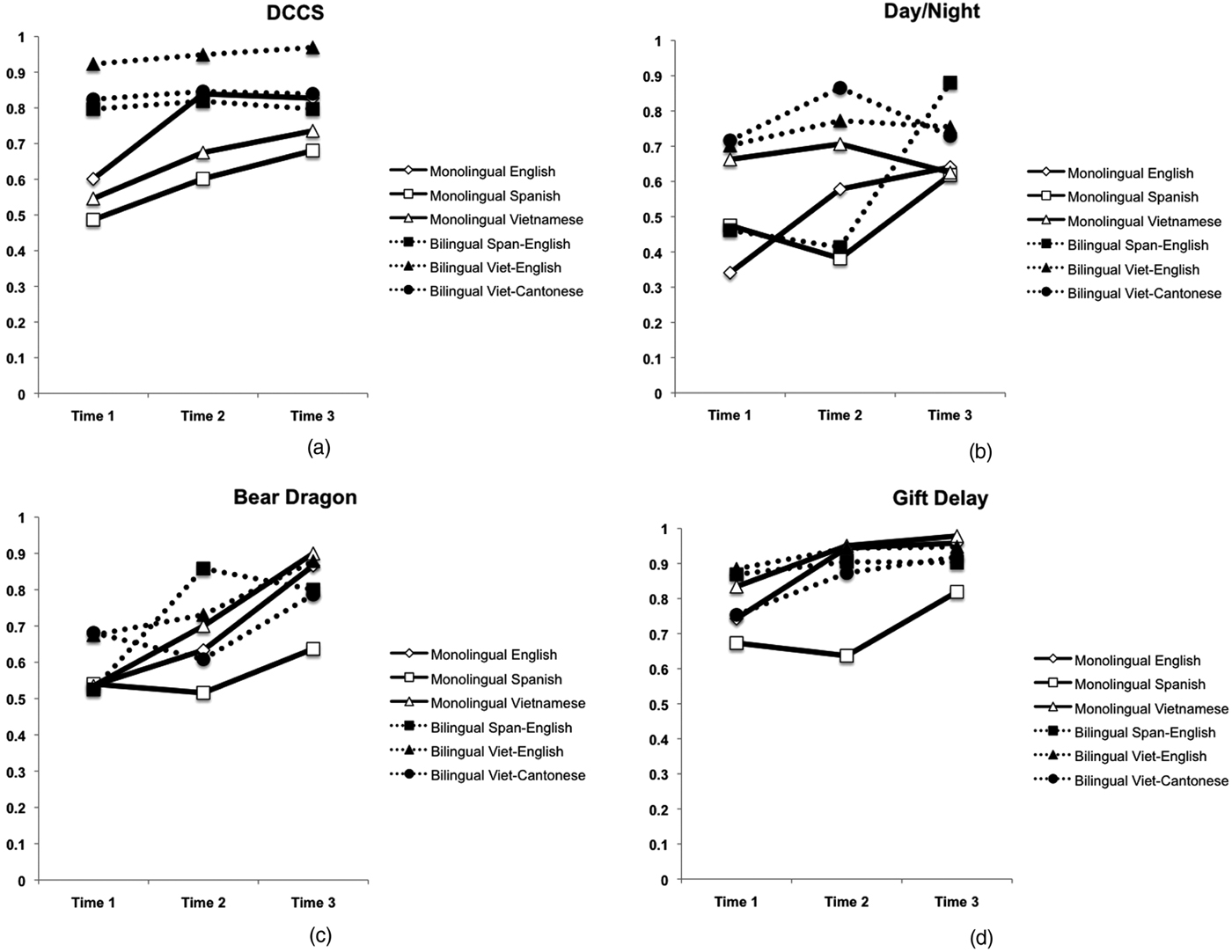
Overall, bilingual children demonstrate better performance than their monolingual peers in the DCCS, Day/Night, and Gift Delay task (p < .001, p < .01, p < .05, respectively). Children from Eastern culture, however, outperformed Western and Latin American children in the Day/Night task (p < .001). See Figure 1 for individual group performances, and Table 6 for mean proportion and standard deviations (SD), on the DCCS, Day/Night, Bear/Dragon, and Gift Delay tasks at each time point. Analyses on skew and kurtosis at each time point for individual EF tasks indicate that the data were normally distributed (skew = ±2, kurtosis = ±3), with the exception of performance of Vietnamese monolinguals on the Gift Delay at Time 2 (skew = −3.3, kurtosis = 12.1). Further analyses indicate the inclusion of one extreme outlier, whose performance on the Gift Delay at Time 2 was .55 (from the general group mean of .97, SD = .05). Central to the research aims, we delve into significant effects between individual groups and report their trends (in detail) below.
Proportion of correct responses in the (a) Dimension Change Card Sorting (DCCS), (b) Day/Night, (c) Bear/Dragon, and (d) Gift Delay tasks at Time 1 (age 3), 2 (age 3.5), and 3 (age 4).

Monolingual and bilinguals’ mean proportion performance scores (standard deviation) on each EF task at Time 1, 2, and 3.

Model analyses
To better understand the contributing factors – bilingualism and cultural background – and its relation to specific EF processes, results of the model analyses on each EF models are reported.
DCCS task
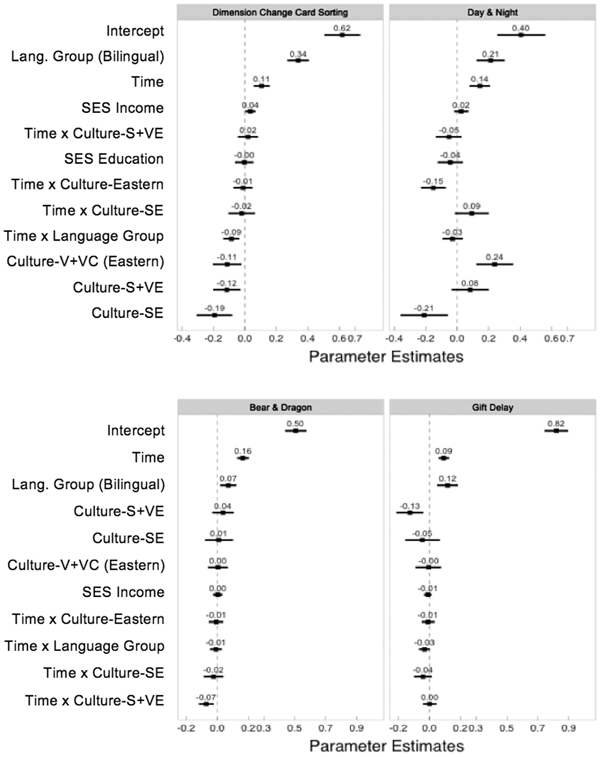
As shown in Figure 2, bilingual children outperformed monolingual children (baseline comparison model) in the DCCS task (F(1, 76) = 26.12, p < .001), with their performance improving with age (F(1, 94) = 8.46, p < .001). Interactions between Time and language status were significant, F(1, 97) = 3.05, p < .05, indicating sharp developmental improvements for monolingual children's task performance. Importantly, parameter estimate comparisons indicate that the largest effect size was seen among language status (0.34, SE = 0.07; p < .001), indicating that performance on the DCCS task was largely influenced by bilingualism. Post-hoc analyses (Tukey's) further revealed that Vietnamese–English bilinguals outperformed Spanish monolinguals at Time 1, Time 2, and Time 3 (p = .001, p = .013, p = .004, respectively), and Vietnamese monolinguals at Time 1 and Time 3 (p = .004, p = .032, respectively), while Spanish–English bilinguals outperformed Spanish monolinguals at Time 1 (p = .004), indicating that bilinguals generally outperformed their monolingual counterparts across different time points; see Figure 1a. The second largest effect size can be seen with Time, which indicates that all children improved in the task at subsequent time points regardless of other factors (0.11, SE = 0.05; p < .01).
Coefficient (parameter estimates) plots for the model of best fit for each EF tasks.

Essential to the study's aims in regards to investigating the separate processes relevant for bilingual and cultural effects, there were no reliable differences (p > .1) among the cultural groups in the DCCS task performances. Although there were no main effects of culture on the DCCS task, significant parameter estimates for Latin American bilinguals (i.e., Spanish–English bilinguals in the U.S.) indicate that, in comparison to the intercept, they demonstrated the least amount of change on the DCCS task over Time (p < .05). See Figure 2 for the magnitude of each effect size from “0”.
Day/Night task
As expected, children from Eastern cultural backgrounds outperformed children from other cultures on the Day/Night task, F(3, 108) = 4.40, p < .001, with their performance improving across development, F(1, 143) = 14.59, p < .001. Interactions between Time and culture were significant, F(3, 144) = 3.54, p < .01, further suggesting that Day/Night performance was mediated by different cultural backgrounds across subsequent time points. Detailed analysis on parameter estimates further indicates that the largest effect size was seen in children from Eastern cultures (0.24, SE = 0.12; p < .01), revealing an advantageous influence of Eastern culture on the Day/Night task. Specifically, post-hoc analyses (Tukey's) demonstrated that children in Eastern culture (Vietnamese monolinguals, Vietnamese–Cantonese bilinguals) outperformed Western children (English monolingual) at Time 1 (p = .010) and Latin American children (Spanish–English bilingual) at Time 2 (p = .042), indicating an Eastern cultural advantage regardless of language status. However, parameter estimates for the Time and culture (Eastern) interaction were relatively small (−0.15, SE = 0.08; p<.05), indicating that although Eastern children initially performed significantly better than their Western and Latin American peers, the children caught up at subsequent time points. Regardless of cultural or language background, all children improved on their task performance in subsequent time points (0.14, SE = 0.06; p < .01).
Moreover, significant main effects of language status demonstrate that bilingual children outperformed their monolingual peers in the Day/Night task, F(1, 101) = 5.92, p < .01, with language status having a moderately smaller effect size than the Eastern culture effect at Time 1 (0.21, SE = 0.09; p < .01). For complete parameter estimates, see Figure 2. Critical to the relation between language and cultural effects, a significant main effect was found for the language status and culture interaction, F(2, 86) = 7.57, p <.01, which supports the present hypothesis regarding the potential additive effects of bilingualism and culture on task performance measuring response inhibition. Post-hoc analyses further indicated that Vietnamese–English bilinguals outperformed English monolinguals at Time 1 (p = .026) and Spanish monolinguals at Time 1 and Time 2 (p = .046, p = .009, respectively). Vietnamese–Cantonese outperformed English monolinguals at Time 1 (p = .030) and Spanish monolinguals at Time 2 (p = .035). These results indicated that Eastern bilingual children outperformed their non-Eastern monolingual peers, but not their Eastern monolingual counterparts; see Figure 1b.
Bear/Dragon task
For the Bear/Dragon task, children's performance improved significantly with age (F(1, 127) . = 75.04, p < .001), where Time demonstrated the largest effect size on task performances (0.16, SE = 0.04; p < .001); see Figure 1c. However, contrary to the present hypothesis, there were no main effects of language status, culture, SES, between Time and language status, between Time and culture, or language status and culture interaction on task performances. Detailed analyses on parameter estimates further confirmed that the effect sizes of language status (0.07, SE = 0.05; n.s.) and culture (Eastern, Western, Latin American; 0.00, SE = 0.06; n.s., 0.04, SE = 0.07; n.s., 0.01, SE = 0.09; n.s., respectively) were non-significant, indicating that bilingualism and culture has little effect on the Bear/Dragon task performances. Therefore, as indicated in Figure 2 with all parameters close to “0”, results suggest that performance in the Bear/Dragon task is the least affected by language status and cultural influences, with significant effects found exclusively in children's improvement on task performances over Time (age).
Gift/Delay task
Finally, children's performance on the Gift Delay increased significantly with age, F(1, 93) = 19.14, p < .001, with bilinguals outperforming monolinguals, F(1, 75) = 3.21, p < .05. Further detailed analyses of parameter estimates indicated that the effect size for language status is the largest for the Gift Delay task (0.12, SE = 0.07; p < 05), although it is relatively small in comparison to the DCCS and Day/Night task; see Figure 2. Further post-hoc analyses reveal that monolingual Spanish children performed significantly worse than monolingual English children at Time 2 (p = .004), Spanish–English children at Time 2 (p = .015), Vietnamese–English children at Time 2 (p = .004), and Vietnamese monolinguals at Time 2 and Time 3 (p = .001, p = .026, respectively), indicating that children in Argentina generally have a difficult time inhibiting the prepotent response (to peek); see Figure 1d. However, contrary to the present hypothesis, there were no main effects of culture, SES, between Time and language status, nor between Time and culture interaction.
Discussion
The present study addresses how cultural background and bilingual experiences influence the development of EF task performances when relevant factors such as language history, SES, and vocabulary are controlled. In the present study, a bilingual cognitive advantage was replicated in dimensional shifting (i.e., DCCS) and in two tasks assessing response inhibition including verbal response inhibition (i.e., Day/Night) and motor response inhibition (i.e., Gift Delay tasks) with the largest bilingual advantage effect demonstrated on dimensional shifting. In contrast, the findings demonstrated that the cultural effect was most pronounced in the verbal response inhibition and remained significant at subsequent time points. Moreover, significant interaction effects of bilingualism and culture on verbal response inhibition suggests the integrated nature of additive effects on task results. These results shed light on the differential influence of bilingualism and culture on distinct EF processes in early development.
Global bilingual cognitive advantage
The stronger link between bilingualism and processes involved in the DCCS task coincide with the idea that switching and selectively attending between two dimensions (i.e., shape, color) may involve processes similar to switching attention and inhibiting between two languages for bilingual learners. Here, the joint activity of bilinguals’ dual-language system involves cognitive control processes, such as selective attention, monitoring, switching, and inhibition, to keep the languages separate (Blumenfeld & Marian, Reference Blumenfeld and Marian2007; Brysbaert, Reference Brysbaert1998; Francis, Reference Francis1999; Gollan & Kroll, Reference Gollan, Kroll and Rapp2001; Guttentag et al., Reference Guttentag, Haith, Goodman and Hauch1984; Kroll & Dijkstra, Reference Kroll, Dijkstra and Kaplan2002; Smith, Reference Smith, de Groot and Kroll1997). This, therefore, works in parallel to processes involved for successful performance in dimensional shifting. The assumptions are that these mechanisms are a part of a domain-general process and that the constant engagement of this process for language selection transfers to cognitive performance. Support for the notion that a domain-general system is recruited for language control derives from neuroimaging evidence demonstrating an overlap in brain networks involved in language selection and nonverbal task switching (Abutalebi & Green, Reference Abutalebi and Green2007; De Baene, Duyck, Brass & Carreiras, Reference De Baene, Duyck, Brass and Carreiras2015; Luk, Green Abutalebi & Grady, Reference Luk, Green, Abutalebi and Grady2012).
Accordingly, the demands of bilingual language processing further replicate and support previous reported findings of bilingual advantage in EF (Arredondo, Hu, Satterfield & Kovelman, Reference Arredondo, Hu, Satterfield and Kovelman2016; Baker, Kovelman, Bialystok & Petitto, Reference Baker, Kovelman, Bialystok and Petitto2003; Bialystok & Martin, Reference Bialystok and Martin2004; Bialystok & Viswanathan, Reference Bialystok and Viswanathan2009) and in particular to the DCCS task (Bialystok, Reference Bialystok1999; Bialystok & Martin, Reference Bialystok and Martin2004; Carlson & Meltzoff, Reference Carlson and Meltzoff2008; Kalashnikova & Mattock, Reference Kalashnikova and Mattock2014; Okanda et al., Reference Okanda, Moriguchi and Itakura2010). The idea here is that similar to bilingual language processing demands, a large bilingual effect can be found in tasks that require multiple cognitive processes working in tandem with one another. Indeed, a recent discussion article by Bialystok (Reference Bialystok2017) purports the idea that dimensional shifting requires the integration of multiple EF constructs for task success, such as flexibility, switching, and monitoring. The current findings support the conjecture that bilingual experiences may be shown broadly within the general executive control system (e.g., inhibition, shifting, and updating), with recent extensions in working memory processes in older children (Morales, Calvo & Bialystok, Reference Morales, Calvo and Bialystok2013; Soliman, Reference Soliman2014; Tran & Yoshida, Reference Tran and Yoshida2012) and adults (Bialystok, Poarch, Luo & Craik, Reference Bialystok, Poarch, Luo and Craik2014). The present findings complement the potential global nature of bilingual cognitive advantage when specific factors such as SES, vocabulary knowledge, and bilingual language characteristics are carefully controlled for (Bialystok, Craik & Luk, Reference Bialystok, Craik and Luk2008; Bialystok, Reference Bialystok2017).
Moreover, the smaller effect of bilingualism found in the Day/Night and Gift Delay tasks may point to the importance of understanding the graded levels on response inhibition task demands. Early practices of behavioral regulation, commonly found with individuals from Eastern cultural backgrounds, may support better performance in response inhibition (than those from non-Eastern cultural backgrounds). In comparison to dimensional shifting, response inhibition does not require multiple cognitive processes (i.e., less cognitive load) for successful performance. Although EF processes are highly interrelated and may be differentially influenced by the level of cognitive demand required for successful task performance, different EF tasks tap into different internal cognitive mechanisms, which in turn will vary how individual processes are influenced by either bilingualism or culture (Miyake, Friedman, Emerson, Witzki, Howerter & Wager, Reference Miyake, Friedman, Emerson, Witzki, Howerter and Wager2000; Garon, Bryson & Smith, Reference Garon, Bryson and Smith2008; Best & Miller, Reference Best and Miller2010). Such could explain the mixed findings on whether bilinguals perform better than monolinguals in response inhibition tasks (Barac, Moreno & Bialystok, Reference Barac, Moreno and Bialystok2016; Bonifacci, Giombini, Bellocchi & Contento, Reference Bonifacci, Giombini, Bellocchi and Contento2011; Carlson & Meltzoff, Reference Carlson and Meltzoff2008; Engel de Abreu, Cruz-Santos, Tourinho, Martin & Bialystok, Reference Engel de Abreu, Cruz-Santos, Tourinho, Martin and Bialystok2012; Esposito, Baker-Ward & Mueller, Reference Esposito, Baker-Ward and Mueller2013; Martin-Rhee & Bialystok, Reference Martin-Rhee and Bialystok2008).
Task-specific effect of cross-cultural differences
To address the limitation regarding the lack of systematic investigation of cultural influences on the bilingual cognitive advantage, the present study included three monolingual groups in the United States, Argentina, and Vietnam that differ in the degree of collectivism, and three bilingual groups in the United States and Vietnam. In the present study, children from Eastern and Latin American cultures outperformed children from Western culture in verbal response inhibition, which measures the ability to inhibit their prepotent response (Diamond, Kirkham & Amso, Reference Diamond, Kirkham and Amso2002; Gerstadt et al., Reference Gerstadt, Hong and Diamond1994; McAuley, Christ & White, Reference McAuley, Christ and White2011; Montgomery & Fosco, Reference Montgomery and Fosco2012; Simpson & Riggs, Reference Simpson and Riggs2005). We speculate that the task demands are reminiscent to the shared collectivistic qualities found in Eastern and Latin American cultures where societies emphasize the importance of early impulse control and self-regulating responses (Tobin et al., Reference Tobin, Wu and Davidson1989; Ho, Reference Ho, Greenfield and Cocking1994; Wu, Reference Wu and Lau1996; Chen et al., Reference Chen, Hastings, Rubin, Chen, Cen and Stewart1998; Parmar, Harkness & Super, Reference Parmar, Harkness and Super2004; Oh & Lewis, Reference Oh and Lewis2008). Also, children with Eastern cultural influences, regardless of language status, outperformed those in Latin American culture (bilingual Spanish–English), thereby suggesting that response inhibition processes may be more sensitive to “tightly integrated” collectivistic qualities. Although those in Latin American culture share collectivistic qualities with those in Eastern cultures, they are considered more loose-structured due to the influences of individualism. Furthermore, the lack of differences in verbal response inhibition among the Vietnamese groups further demonstrates that success may be heavily influenced by the cultural structure among the shared groups.
Contrary to the present hypothesis, performance on motor response inhibition did not demonstrate any systematic differences between cultural groups. This finding suggests that cognitive processes involved in motor response inhibition, but not verbal response inhibition (e.g., Day/Night), may not be directly affected by cultural background experiences. Although these tasks require response inhibition, it differs in the modality involved (hand/body motor movement vs. speech motor movement) and therefore may be differentially affected by language status and cultural background. In particular, the Day/Night task involves verbal response inhibition that may be more pertinent in Eastern cultural practices of self-regulating responses in front of authority figures (Oh & Lewis, Reference Oh and Lewis2008).
Furthermore, the use of puppets in the Bear/Dragon task (versus cards in the Day/Night task) may play a role in the lack of influence. In particular, recent research demonstrates that cognitive performances among 3- to 5- year-old children improve when they are introduced to a doll or a puppet during task administration (Moriguchi, Sakata, Ishibashi & Ishikawa, Reference Moriguchi, Sakata, Ishibashi and Ishikawa2015). The idea is that children improve their self-regulatory behaviors through interpersonal interaction, tools that aid attention and memory, and engagements in pretend play (Lillard & Else-Quest, Reference Lillard and Else-Quest2006; Vygotsky Reference Vygotsky1962, Reference Vygotsky1967). Thus, task specifics and administration are important factors to consider when analyzing task results. However, more research needs to be further carried out to fully examine the effect of different modalities and task administration on the level of required response inhibition. Thus, these results highlight the task-sensitive nature of the processes involved when examining the bilingual and cultural effect on cognitive performance.
The interaction effect between culture and bilingualism
Perhaps an interesting aspect of the present study is the significant interaction effect of bilingualism and culture on measures of verbal response inhibition. A closer look into the analyses demonstrates that Vietnamese bilingual children (Vietnamese–English and Vietnamese–Cantonese) outperformed monolinguals from the U.S. and Argentina, but not in Vietnam. This supports the idea that processes related to response inhibition may be highly influenced by the cultural structure (collectivism) and may be further enhanced when bilingual groups are coupled to promote a more general EF capacity (Yang et al., Reference Yang, Yang and Lust2011).
In particular, previous studies demonstrating the lack of differences between monolingual and bilingual children on response inhibition tasks did not include and/or report children with Eastern cultural influences in their design (Barac et al., Reference Barac, Moreno and Bialystok2016; Bonifacci et al., Reference Bonifacci, Giombini, Bellocchi and Contento2011; Carlson & Meltzoff, Reference Carlson and Meltzoff2008; Engel de Abreu et al., Reference Engel de Abreu, Cruz-Santos, Tourinho, Martin and Bialystok2012; Esposito et al., Reference Esposito, Baker-Ward and Mueller2013; Martin-Rhee & Bialystok, Reference Martin-Rhee and Bialystok2008). As shown in the current study, the Eastern cultural factor displayed the largest effect on task performance, with language status (bilingualism) showing a smaller effect (see Figure 2). As such, the enhanced interaction effect of bilingualism and culture may be more unique to Eastern cultural groups that place emphasis on early behavioral regulation and impulse control.
Addressing discrepancies in culture and bilingual literature and limitations
Culture permeates various aspects of learning – interpersonal reactions of children, testers, teachers, families, the physical layout where they are tested, and language. It is difficult to guarantee that everything is identical in every way, which is an interesting yet complex issue in cross-cultural research. In the present study, we made every effort to ensure tasks were appropriate in these diverse cultures. There are no a-priori or post-hoc reasons to believe that the uncontrolled differences contributed directly to the pattern of results independent of the larger differences in culture. Indeed, cross-cultural studies are never guaranteed to be bias-free (van de Vijver & Tanzer, Reference Van de Vijver and Tanzer2004; He & van de Vijver, Reference He and van de Vijver2012). We further recognize that a number of social and cultural factors seemingly unrelated to such variables may influence performance on the Day/Night task. The social and cultural factor includes, but may not be limited to, familiarity with the sun/moon depictions, practice on delaying gratification, and/or other inhibitory skills. Therefore, the attribution to the specific cultural trait of collectivism/individualism needs further investigation and specific testing to examine differences in cultural traits that vary as they integrate with bilingualism. Moreover, although general linear mixed model analyses effectively address the growth and maximum likelihood of the small sample size and longitudinal design (Sui, Fouladi & Shieh, Reference Sui, Fouladi and Shieh2002) in the present study, future research should extend our populations controlling for factors that may affect task performance. Nonetheless, the current attempt in controlling for relevant factors while capturing the changes of cognitive capacity in a longitudinal design is significant for optimizing systematic comparisons between individuals with different cultural and language learning experiences.
In sum, the present multi-site longitudinal design reveals the impact in task-specific and global nature of cognitive advantages associated with bilingualism, culture, and combined effects when different EF processes and developmental periods are considered. Such complex dynamics may not only explain diverse findings regarding how experiences from different language learning and cultural environments influence EF task performances, but also shed light on the potential mechanisms underlying the individual differences in cognitive development.