


Introduction
Cognitive behaviour therapy (CBT) training in the United Kingdom has expanded rapidly in response to rising mental health demand and national workforce strategies aimed at widening participation and strengthening service capacity (NHS England, 2023). Accredited programmes operate within defined professional frameworks, notably the British Association for Behavioural and Cognitive Psychotherapies (BABCP) Minimum Training Standards, which specify the academic, clinical, and supervisory competencies required for practice (BABCP, 2025) and have helped safeguard treatment fidelity across an increasingly diverse workforce.
Within these programmes, clinical competence is cultivated largely through experiential learning. Foundational models of therapist development position reflective practice, behavioural rehearsal, supervision, and embodied clinical engagement as the primary mechanisms through which competence emerges (Bennett-Levy and Thwaites, Reference Bennett-Levy and Thwaites2007; Bennett-Levy et al., Reference Bennett-Levy, McManus, Westling and Fennell2009). Yet the academic components of training, and the tools used to evaluate competence, remain weighted towards linear written formats, including case studies, research critique, and structured observational measures such as the Cognitive Therapy Scale-Revised (CTS-R; Blackburn et al., Reference Blackburn, James, Milne, Baker, Standart, Garland and Reichelt2001). While the CTS-R has been central to operationalising fidelity, it reflects earlier conceptions of CBT delivery, and subsequent research has highlighted variability in inter-rater reliability and the difficulty of capturing complex therapeutic processes consistently (Loades and Armstrong, Reference Loades and Armstrong2016; Reichelt et al., Reference Reichelt, James and Blackburn2003). More broadly, psychotherapy-education scholarship has questioned whether traditional academic and competence frameworks fully capture relational process, formulation flexibility, and experiential understanding (Muse and McManus, Reference Muse and McManus2013; Roth et al., Reference Roth, Myles-Hooton and Branson2019). A central tension follows: competence in CBT is substantially experiential and relational, yet it is assessed in part through a narrow academic register that may privilege written fluency over therapeutic reasoning (Biggs, Reference Biggs1996).
This tension has consequences for neurodivergent practitioners, whose experience of these structures has received little attention. The neurodiversity paradigm reframes cognitive differences such as dyslexia as natural variation rather than individual deficit, locating disability in institutional design rather than in the person (Armstrong, Reference Armstrong2010; Botha, Reference Botha2021; Kapp, Reference Kapp2020). Higher education, however (including professional training), continues to privilege neurotypical norms of linear reasoning, dense textual engagement, and implicit scholarly convention (Botha, Reference Botha2021; Clouder et al., Reference Clouder, Karakus, Cinotti, Ferreyra, Amador Fierros and Rojo2020; MacCullagh et al., Reference MacCullagh, Bosanquet and Badcock2017). Research consistently shows that dyslexic and other neurodivergent learners encounter structural barriers tied to academic language, heavy writing demands, and unspoken expectations around criticality, and that they engage in extensive compensatory labour, such as iterative rewriting, visual mapping, and over-preparation, at a cost in cognitive fatigue and burnout (MacCullagh et al., Reference MacCullagh, Bosanquet and Badcock2017; Mortimore and Crozier, Reference Mortimore and Crozier2006; Tcherdakoff et al., Reference Tcherdakoff, Marshall, Dowthwaite, Bird and Cox2025). Because such differences are non-visible, disclosure carries its own risks, with many practitioners weighing stigma and threats to professional credibility against access to support (Griffin and Pollak, Reference Griffin and Pollak2009; Hassard et al., Reference Hassard, Yildrim, Thomson and Blake2024). For neurodivergent trainees and educators, this misalignment can be experienced as an ‘academic fog’: a state in which conceptual understanding, clinical reasoning, and therapeutic competence are intact yet obscured by institutional systems that demand fluency in narrow academic codes. Such codes, including those governing research ethics applications, scholarly writing, and senior professional recognition, function as hidden curricula because they are rarely taught explicitly (MacCullagh et al., Reference MacCullagh, Bosanquet and Badcock2017).
Paradoxically, many cognitive styles associated with neurodivergence, such as pattern recognition, non-linear integration of information, relational sensitivity, and holistic formulation (Armstrong, Reference Armstrong2010), align closely with the demands of CBT practice. Where academic structures may marginalise these processing styles, experiential learning environments frequently reveal them as clinical strengths (Bennett-Levy et al., Reference Bennett-Levy, McManus, Westling and Fennell2009). This raises pointed questions about how training programmes conceptualise competence, design assessment, and support diverse learners within an expanding workforce.
Universal Design for Learning (UDL) offers a theoretically grounded response to this systemic misalignment. Rather than relying on individual accommodation, UDL advocates proactive curriculum design incorporating multiple means of engagement, representation, and expression, anticipating learner variability as the norm (Hamilton and Petty, Reference Hamilton and Petty2023; Meyer et al., Reference Meyer, Rose and Gordon2014). Within higher education and health-professions education, UDL-informed approaches have been associated with improved accessibility, engagement, and psychological safety without compromising academic standards (Durgungoz, Reference Durgungoz2025; Morgan, Reference Morgan2011), and they align closely with both the experiential foundations of CBT education and the principle of constructive alignment between learning, assessment, and real-world competence (Biggs, Reference Biggs1996). Despite this relevance, UDL has received limited attention within CBT training contexts.
Two gaps therefore remain. First, trainee and practitioner voices are comparatively under-represented within CBT education scholarship, particularly in relation to the lived experience of learning and assessment systems (Roscoe et al., Reference Roscoe, Bates and Blackley2022). Second, while neurodivergence in higher education has been studied broadly (e.g. MacCullagh et al., Reference MacCullagh, Bosanquet and Badcock2017; Mortimore and Crozier, Reference Mortimore and Crozier2006), there is little examination of applied professional training environments, where academic performance is entangled with clinical competence development, a tension that may be especially salient in CBT, where many trainees enter from applied clinical backgrounds rather than traditional academic trajectories. Practitioner-led inquiry is well suited to illuminating the hidden curricula and institutional barriers that other approaches often render invisible (Burke, Reference Burke2012). Accordingly, this paper adopts a critical autoethnographic approach to examine how neurodivergence has shaped engagement with CBT training, academic practice, and pedagogical leadership within professional education environments governed by CBT accreditation standards. By situating lived experience within neurodiversity theory, experiential learning models, and UDL, the paper seeks to illuminate the systemic processes shaping inclusion, competence development, and curriculum design within contemporary CBT education.
This account is grounded specifically in my experience as a dyslexic and dyspraxic practitioner. These profiles frequently co-occur, and my experience reflects their combined influence rather than either in isolation. Neurodiversity is a broad umbrella, spanning autism, ADHD, dyspraxia, dyscalculia, dyslexia and more, that presents in markedly different ways and carries distinct, often highly individual, needs; no single narrative can represent that range. Where I use the language of neurodivergence, I do so to situate my experience within this wider paradigm and to ask whether certain structural mechanisms identified here, the privileging of the written academic register, the hidden curriculum, compensatory labour, and the dilemmas of disclosure, may resonate beyond my own profile. These are offered as points of possible transferability rather than generalisation: the lived experience described is dyslexic and dyspraxic, while the structural analysis may speak to challenges shared more widely across neurodivergence.
The aims of this study were to:
-
(1) Examine how neurodivergent identity shapes lived experiences of CBT training, academic engagement, and professional development within accredited training environments.
-
(2) Identify the systemic academic and pedagogical barriers that contribute to hidden labour, exclusion, and misalignment between clinical competence and academic assessment.
-
(3) Explore neurodivergent strengths within experiential learning and clinical practice, particularly in relation to formulation, therapeutic flexibility, and reflective practice.
-
(4) Consider the implications of UDL for CBT curriculum design, assessment, and workforce development, with a focus on enhancing accessibility while maintaining rigorous competence standards.
Method
Design
This study adopted a critical autoethnographic methodology to explore how neurodivergent identity shaped engagement with CBT training, academic practice, and pedagogical leadership within professional education environments governed by CBT accreditation standards. Autoethnography positions the researcher’s lived experience as primary data while situating personal narrative within broader cultural, institutional, and theoretical contexts (Adams et al., Reference Adams, Holman Jones and Ellis2015). A critical orientation was employed to examine how academic norms, hidden curricula, and power structures within higher education and professional training influenced inclusion, competence development, and participation.
Autoethnography has become increasingly recognised within health professions education as a rigorous qualitative approach for illuminating systemic processes that are often rendered invisible within traditional research methodologies, and it has been used to examine dyslexia within clinical training specifically (Shaw et al., Reference Shaw, Anderson and Grant2016). Given the absence of neurodivergent practitioner perspectives within CBT training scholarship, this approach enabled in-depth examination of embodied experience alongside pedagogical analysis relevant to professional education.
Researcher positionality and reflexivity
The author is a practising CBT clinician, programme director within NHS-commissioned training, and academic educator with lived experience of dyslexia and dyspraxia. This dual positioning afforded insider knowledge of CBT training cultures, competence frameworks, and assessment processes, while necessitating ongoing reflexive awareness of interpretative influence.
Reflexivity was maintained through analytic journaling, critical incident reflection, and iterative engagement with neurodiversity theory, experiential learning scholarship, and inclusive pedagogy frameworks. Rather than seeking objectivity, the study embraced subjectivity as a source of insight, while grounding analytic interpretation within established theoretical perspectives. The author’s simultaneous roles as trainee, educator, and training leader enabled examination of systemic processes across multiple levels of CBT education. Because this analysis is rooted in the author’s own dyslexic and dyspraxic experience, wider relevance is framed as analytic resonance with, rather than representation of, the broader neurodivergent population.
Data sources
Data were drawn from multiple forms of reflective and narrative material generated across the author’s professional training and leadership trajectory within CBT education. These included:
-
(1) Reflective journals documenting experiences of CBT training, academic study, and professional development.
-
(2) Narrative accounts of critical incidents related to assessment, research processes, supervision, and curriculum design.
-
(3) Reflective notes capturing pedagogical decision-making and leadership responses to inclusion challenges.
Materials spanned clinical training, postgraduate academic study, and subsequent leadership roles within accredited CBT programmes.
Analytic approach
Narrative materials were analysed thematically using reflexive qualitative analysis. Repeated reading facilitated immersion in the data, with analytic memos used to identify recurring experiential patterns and points of systemic tension. Themes were developed through iterative linking between lived experience and relevant theoretical frameworks, including neurodiversity theory, experiential learning models, and UDL.
Rather than prioritising frequency of occurrence, analysis focused on meaning, process, and pedagogical implication, consistent with interpretive qualitative methodologies. The analytic aim was to illuminate how institutional structures shaped experience and how adaptive practices emerged in response.
The four themes were developed through repeated movement between narrative episodes, reflective memos and relevant theoretical frameworks. Particular attention was paid to moments where an experience initially understood as individual difficulty could be reinterpreted as a structural or pedagogical misalignment.
Findings
Academic norms as structural barriers to learning and competence demonstration
It had taken me months to write a narrative of my experiences for an application for senior academic recognition, alongside two case studies. I felt my work was sound, and I was not the only one; people told me I was a convincing candidate. Then I was copied into an email. In passing, and I am fairly sure the writer meant it as a compliment, they wrote that my ability ‘doesn’t come across in the writing, but it’s all there when you speak to her’. I remember reading it and feeling disheartened in a way I could not quite explain at the time. I do not think the writer had any idea what they had just named. It was meant kindly. But that single line crystallised the whole of it.
The remark was compliment and diagnosis at once. My colleague could see the competence the moment it left the medium of formal writing; it was visible to them. What the kindness obscured was the implication that the writing was the place the competence went missing. This is the ‘academic fog’ in its most ordinary register: not a striking failure but a quiet, recurring gap between what a practitioner demonstrably knows and what the dominant academic form is able to render visible.
Academic components of CBT training operated through implicit expectations that privileged particular cognitive styles and forms of cultural capital. Processes such as research ethics applications, scholarly writing, and academic assessment assumed fluency in abstract academic discourse that had not been explicitly taught, reflecting broader descriptions of hidden curricula within higher education (MacCullagh et al., Reference MacCullagh, Bosanquet and Badcock2017). At first, I internalised difficulty with these systems as personal inadequacy, rather than recognising it as a misalignment between institutional design and neurodivergent cognition. I worked extra hard, spending extra time putting my ideas in order and getting my written work proofread.
These barriers functioned not merely as administrative hurdles but as obstacles to demonstrating clinical understanding. My conceptual knowledge of CBT models, formulation logic, and ethical principles was intact; it was the translation of that knowledge into linear academic prose that required disproportionate cognitive effort.
Within CBT training, competence is intended to reflect therapeutic reasoning, formulation coherence, and evidence-based intervention delivery. When academic systems privilege written fluency as a proxy for understanding, they risk conflating academic performance with clinical competence, a concern echoed in psychotherapy education research questioning the construct validity of traditional assessment formats (Muse and McManus, Reference Muse and McManus2013). From a constructive alignment perspective, such assessment may be measuring academic convention rather than CBT competence per se (Biggs, Reference Biggs1996).
The hidden labour of belonging and compensatory learning strategies
It happens all the time. I use software openly to check my spelling and tidy my emails, because left to me the writing is frequently not quite right, and I have never hidden that. Even so, things slip through. I once sent a colleague an invoice and misspelt the word supervision. The reply came back, not about the invoice, but to let me know the word was wrong. People mean it kindly; they think they are helping. But it is a constant drip, drip: someone, again, letting you know you have not done it quite the right way. What sharpens it is the seat I am in. As a senior member of a senior management team, those small corrections land somewhere larger, a recurring, low sense of falling short of the correct, accepted style of English, in a role where I am otherwise trusted to lead.
Individually, each correction is slight and well-intentioned. Cumulatively, they function as something else: a chronic reminder that one’s innate output does not meet an implicit standard. There is an added irony in the detail: the misspelt word was ‘supervision’, a domain in which my competence is accredited and unquestioned, yet the response attended to the spelling rather than the substance. The labour, then, is not only the months of drafting an application or the constant use of corrective software; it is also the emotional work of absorbing these well-meaning corrections without letting them erode professional confidence.
Participation in the academic aspects of CBT training required sustained emotional and cognitive labour aimed at maintaining legitimacy. I employed extensive compensatory strategies to meet normative academic expectations, such as iterative rewriting, reading work aloud, and over-preparation, consistent with findings that neurodivergent learners engage in adaptive overwork to navigate higher education structures (MacCullagh et al., Reference MacCullagh, Bosanquet and Badcock2017; Mortimore and Crozier, Reference Mortimore and Crozier2006). These strategies enabled engagement, but at a cost in fatigue and anxiety.
Concerns about stigma and professional credibility shaped my decisions about disclosing my dyslexia and dyspraxia, reflecting broader research on the concealment of non-visible disability within professional environments (Griffin and Pollak, Reference Griffin and Pollak2009; Hassard et al., Reference Hassard, Yildrim, Thomson and Blake2024; Hamilton Clark, Reference Hamilton Clark2024).
CBT training pathways are already intensive, requiring simultaneous academic study, supervised clinical practice, and skills development. When substantial cognitive resources are diverted towards navigating academic conventions, capacity for the reflective and experiential learning central to competence development is reduced (Bennett-Levy and Thwaites, Reference Bennett-Levy and Thwaites2007). Structural academic barriers may therefore indirectly compromise the very conditions in which competence is best developed.
Neurodivergent strengths within experiential learning and clinical competence development
In my work as a tutor and as a director of service, the feedback that comes back most consistently is about relationships: that I build good ones, that I listen, that I communicate well. When I teach, the response is positive: I can put CBT concepts across in language people actually understand. I have come to think this is a direct asset of my neurodivergence rather than a workaround for it. A concept takes me time; I have to turn it over and translate it into plain, common English before it is mine. Take core beliefs. To grasp schema-level processing for myself, I devised an image of a shaped box: a belief such as ‘I am unlovable’ leaves only a triangle-shaped hole in the lid, so only triangle-shaped information can get in. Open the box, and it is full of nothing but confirmation of the belief. I built that image to solidify the concept in my own head, but it turned out to be exactly how I could teach it. Having had to translate the idea for myself, I could hand it back to trainees in the same form, and it landed.
Here the gap inverts. The slower, effortful, non-linear route to understanding, the part the academic register reads as deficiency, produces a particular fluency at the other end. Because comprehension cannot be assumed, it has to be actively reconstructed in concrete, accessible terms, and that reconstruction is precisely what a learner needs. The shaped box was not a teaching device designed for students; it was first a means of securing my own understanding, which then proved pedagogically powerful. What looks like a longer path to knowledge is, in pedagogical terms, a shorter path to shared knowledge.
In contrast to academic marginalisation, neurodivergent cognition consistently emerged as a strength within clinical practice and experiential learning. Pattern recognition, holistic integration of client information, and relational attunement supported formulation development and flexible therapeutic responding.
Experiential teaching modalities, such as role-play, live supervision feedback, and reflective dialogue, supported deeper understanding than abstract theoretical instruction alone, mirroring established experiential learning models within CBT education (Bennett-Levy et al., Reference Bennett-Levy, McManus, Westling and Fennell2009). Advanced CBT competence requires dynamic formulation, flexible fidelity to evidence-based protocols, and real-time therapeutic decision-making (Bennett-Levy and Thwaites, Reference Bennett-Levy and Thwaites2007). The integrative, non-linear processing described here aligns closely with these mechanisms, suggesting that the experiential components of CBT training may naturally scaffold diverse cognitive strengths.
For a long time, I resisted the idea of dyslexia and, of being neurodivergent at all. When I began facilitating self-practice/self-reflection groups with our students, and doing the work alongside them, I turned the CBT model I teach onto my own experience, and what surfaced was a familiar structure with deep roots. Coming from a non-academic background, and having had early, repeated experiences of being told that my work was wrong, I had developed a core belief that I was an imposter, a fraud who would eventually be found out. The assumption beneath it was conditional: that exposure could be held off only by doing all of the extra things, and that any slip would give me away. The rule that followed was simply to work harder, always. And the trigger was reliable: anything going wrong, however small.
Working with this through the CBT framework experientially changed how I hold myself as both clinician and lecturer. Setting these beliefs within their early-life and cultural context, as self-practice/self-reflection explicitly invites (Bennett-Levy and Thwaites, Reference Bennett-Levy and Thwaites2007; Bennett-Levy et al., Reference Bennett-Levy, McManus, Westling and Fennell2009), made them understandable rather than shameful: they were learned, and what is learned can shift. Coming to higher education from a non-academic background is itself associated with the kind of implicit exclusion that widening-participation scholarship describes (Burke, Reference Burke2012). The rigid rule softened into something more flexible and more humane: that I can do my best, that things can go wrong, and that getting some spelling wrong does not reflect on my overall ability. Feelings of fraudulence and inadequacy of this kind are well documented among learners with dyslexia in demanding clinical training (Shaw and Anderson, Reference Shaw and Anderson2018). This is also where I came to see the wider value of the exercise. A developmental formulation of this kind may be particularly useful for neurodivergent trainees and practitioners, offering a way to understand how their own relationship to learning was formed, and therefore a route to changing the beliefs that grew from it rather than simply enduring them. It brought home, too, that we do not all learn in the same way: self-practice offered me, and offers others, a different and powerfully effective route into understanding, which is precisely why training should honour multiple ways of learning rather than assume a single path.
From lived experience to inclusive pedagogical redesign in CBT training
Something I can do well is pick a thing up and run with it. I think creatively. I build something, and people will ask, ‘How did you do that?’. I cannot always give a coherent answer. What actually happens is that I pull threads together in my head, not in a straight line, and out of it comes something that works. Often the process makes people frown; it is the result they wanted. Budgets are the clearest example: my working-out leaves people baffled, but the product (a workable position out of a reduced budget, a grasp of the finances I am not always assumed to have) is exactly what was needed, and it came from the non-linear way of working, not in spite of it.
The same processing style that the academic register cannot read is, in practice, generative: the threads converge even when the route between them cannot be set out in a straight line. This is the cognitive style that neurodiversity scholarship reframes as variation rather than deficit (Botha, Reference Botha2021; Kapp, Reference Kapp2020). Recognising this changed how I led. If the capability is real but the conventional academic medium cannot render it, then the medium, not the practitioner, is what needs redesigning; and I came to approach curriculum and assessment design with the same constructive, threads-into-a-whole thinking I bring to a budget.
One of the things I aimed to do as programme lead is build inclusive assessment into the programme itself. A clear example was an interactive online platform co-created. It offered short videos students could access with Q&As, decoding the academic conventions that are usually left implicit: how to use the PEEL structure to build a critique, what we mean when we ask for ‘critical analysis’, and what a strong case study looks like and why. When students were required to write case studies, we gave them worked examples and named the hidden expectations out loud, rather than assuming they already knew the code.
This was the moment the logic completed itself. I was not adding an accommodation for individual students who disclosed a difficulty; I was changing the assessment environment for everyone, making explicit the tacit conventions I had once had to decode alone and under disproportionate strain. The same convention that had been a barrier in my own training (unexplained, assumed, gatekept) became something the programme taught openly. This is UDL in its truest sense: not retrofitted support, but proactive design that anticipates cognitive diversity as the norm (Meyer et al., Reference Meyer, Rose and Gordon2014; Hamilton and Petty, Reference Hamilton and Petty2023), reflecting a constructive-alignment logic in which the route to demonstrating competence is made transparent rather than left as a test of academic insider knowledge (Biggs, Reference Biggs1996).
A further change was to bring experts by experience [EBE] into peer-led assessment. EBEs joined trainees as part of the assessment and feedback process, not as an audience, but as people whose judgement counted. It mattered for several reasons at once. It broke down the convention that the lecturer always knows best. It helped trainees build confidence in being a ‘critical friend’, speaking to what they did know rather than performing certainty. And it put the lived experience of receiving therapy at the centre of how competence was judged: an expert by experience might say, ‘the way you came across in your posture and warmth was great’, a form of feedback a rubric might not capture, yet one that goes to the heart of therapeutic skill.
This redesign decentred the very hierarchy that had marginalised my own competence, reflecting inclusive partnership approaches that open a shared ‘third space’ between traditional roles and sources of expertise in higher education (Healey, Reference Healey2020). Where academic assessment privileges written fluency as the proxy for understanding, peer- and service-user-led assessment recognises relational and embodied skill as legitimate evidence in its own right: the competence that, in the opening account, was ‘all there when you speak to her’ but invisible on the page. Centring lived experience in assessment is consistent with both UDL’s commitment to multiple means of demonstrating learning (Meyer et al., Reference Meyer, Rose and Gordon2014) and the relational emphasis of experiential CBT competence models (Bennett-Levy and Thwaites, Reference Bennett-Levy and Thwaites2007).
The platform and the involvement of experts by experience were two of a wider set of inclusive strategies embedded across the programmes, alongside diversified assessment modalities, experiential integration of theory and practice, and explicit teaching of academic conventions, each consistent with UDL principles of multiple means of engagement and expression. Such approaches enhanced accessibility without lowering academic or clinical standards, in line with evidence that UDL-informed design improves engagement across diverse cohorts (Morgan, Reference Morgan2011). In the same spirit, I routinely direct trainees towards audio resources such as the BABCP’s Let’s Talk About CBT podcasts, which offer an alternative and often more accessible route into CBT theory, practice, and research, embodying the principle of multiple means of representation.
Summary of learning and competence trajectory
Across these themes a single pattern recurs. Academic structures at times obscured competence through narrow performance metrics; I compensated through largely invisible labour; experiential environments revealed clinical strengths; and inclusive pedagogical redesign began to close the gap. This trajectory aligns with broader calls within psychotherapy education to re-examine assessment practices and align training structures more closely with real-world therapeutic skill (Muse and McManus, Reference Muse and McManus2013).
Discussion
This critical autoethnographic study examined how dyslexic neurodivergence shaped engagement with CBT training, academic assessment, and pedagogical leadership within accredited professional education environments. Across the four themes, the barriers encountered were rooted not in individual cognitive limitation but in systemic misalignment between traditional academic structures and the experiential nature of CBT competence development. This aligns with contemporary neurodiversity theory, which conceptualises cognitive difference as human variation and locates disability within institutional design rather than the individual (Botha, Reference Botha2021; Kapp, Reference Kapp2020). The discussion that follows interprets each strand of this misalignment and, in the same movement, draws out its implications for CBT training and workforce development.
Assessment, the academic register, and the hidden curriculum
The Findings show academic norms functioning as a hidden curriculum that disadvantages those unfamiliar with dominant scholarly codes (Burke, Reference Burke2012; MacCullagh et al., Reference MacCullagh, Bosanquet and Badcock2017): privileging written fluency risks conflating academic performance with clinical competence, rather than measuring the intended outcomes of formulation, therapeutic flexibility and reflective practice (Biggs, Reference Biggs1996; Loades and Armstrong, Reference Loades and Armstrong2016; Muse and McManus, Reference Muse and McManus2013). The implication is twofold. First, while written case studies and critique remain valuable for research literacy, diversifying the modes through which competence is demonstrated (formulation presentations, experiential skills assessments, reflective supervision portfolios, and observed clinical-reasoning tasks) would align evaluation more closely with authentic CBT capability. Second, the hidden conventions themselves must be made explicit: worked exemplars, transparent assessment criteria, and guided support for research and ethics processes reduce reliance on tacit academic knowledge and distribute the opportunity to demonstrate competence more equitably. Many CBT programmes already do much of this; the task is to articulate it deliberately and extend it to the academic components where it is currently weakest.
Neurodivergent strengths and the experiential core
The strengths identified, pattern recognition, holistic formulation and relational attunement, are precisely the capacities experiential learning models place at the centre of competence (Bennett-Levy and Thwaites, Reference Bennett-Levy and Thwaites2007; Bennett-Levy et al., Reference Bennett-Levy, McManus, Westling and Fennell2009), which suggests that experiential environments may be particularly well suited to diverse cognitive processing styles. It follows that the experiential components of training (role-play, live supervision, collaborative formulation, and reflective practice) should be protected and strengthened: not merely as effective pedagogy, but as the part of the curriculum that is already inclusive by design and that most directly scaffolds varied ways of knowing.
UDL as an organising framework
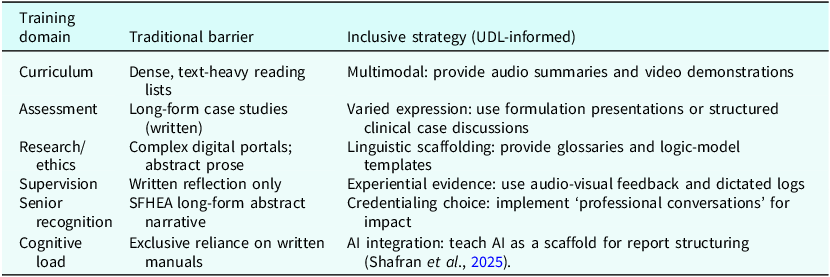
Universal Design for Learning offers a coherent framework for interpreting both the barriers identified and the inclusive practices that developed in response. By treating learner variability as the norm rather than the exception, UDL-informed approaches have been associated with improved accessibility and engagement without lowering standards (Durgungoz, Reference Durgungoz2025; Meyer et al., Reference Meyer, Rose and Gordon2014; Morgan, Reference Morgan2011). Crucially, the strategies described here did not merely accommodate difference; they strengthened constructive alignment, suggesting that UDL is not only an accessibility framework but a pedagogically robust means of improving the authenticity and fairness of competence assessment. The practical implication is to embed UDL across all curriculum components, extending it from the experiential elements where it already operates into academic assessment and research literacy, the areas that generate most exclusion. Embedding scaffolded writing support by design (explicit teaching of conventions, staged feedback, and exemplars with transparent criteria) not only improves accessibility but may widen participation in early-career research, broadening the range of voices contributing to CBT scholarship and training innovation. Table 1 illustrates how such UDL-informed design might be operationalised across key training domains, in ways consistent with the BABCP Minimum Training Standards’ emphasis on experiential learning, supervised competence, and reflective practice.
Inclusive pedagogical strategies for CBT training

Table 1. Long description
A table with four rows and three columns comparing traditional barriers and inclusive strategies in CBT training across various domains. The columns are labeled Training domain, Traditional barrier, and Inclusive strategy (UDL-informed). The rows are labeled Curriculum, Assessment, Research/ethics, Supervision, Senior recognition, and Cognitive load. Each row provides specific examples of traditional barriers and corresponding inclusive strategies. For example, under Curriculum, the traditional barrier is dense, text-heavy reading lists, while the inclusive strategy is to provide audio summaries and video demonstrations. Under Assessment, the traditional barrier is long-form case studies (written), and the inclusive strategy is to use formulation presentations or structured clinical case discussions.
Disclosure, culture, and workforce sustainability
These findings carry implications beyond individual inclusion. The extensive compensatory labour required to navigate academic systems is linked to fatigue, distress, and burnout risk (Mortimore and Crozier, Reference Mortimore and Crozier2006; Tcherdakoff et al., Reference Tcherdakoff, Marshall, Dowthwaite, Bird and Cox2025); within intensive CBT pathways that already combine academic study, supervised practice, and service delivery, such additional load may compound attrition risk. Reluctance to disclose neurodivergence, shaped by stigma and concerns about professional credibility (Griffin and Pollak, Reference Griffin and Pollak2009; Hassard et al., Reference Hassard, Yildrim, Thomson and Blake2024; Hamilton Clark, Reference Hamilton Clark2024), further constrains access to support. Addressing systemic academic barriers is therefore not only an inclusion issue but a strategic workforce priority, particularly within NHS expansion contexts. Developing neurodiversity-affirming, strengths-based training cultures, together with equipping training leaders and supervisors with development in inclusive pedagogy and neurodiversity-affirming supervision, may enhance psychological safety, sustain professional identity, and support diverse practitioners in progressing to senior clinical and academic roles.
These experiences also speak to professional identity formation, a central but often implicit outcome of clinical training. For neurodivergent, disabled and other marginalised trainees, forming a professional identity can mean reconciling that identity with dominant, and often narrow, conceptions of who a professional is and how a professional should communicate and behave (Mayer et al., Reference Mayer, Nimmon, Shalev, Gross, Bulk, Battalova, Krupa and Jarus2024). Recognising that these conceptions are constructed rather than fixed opens space to redefine professionalism more inclusively, and to treat the negotiation of a neurodivergent professional identity as a legitimate part of training rather than a private struggle.
Technology as a complementary tool
Emerging innovations, such as simulation-based learning and AI-supported feedback and supervision, offer further opportunities to support inclusive design, providing experiential rehearsal, timely feedback, and adaptive scaffolding aligned with competence development (Shafran et al., Reference Shafran, Bond and Carlbring2025). When ethically governed and designed inclusively, such tools may complement UDL-informed curricula by reducing reliance on narrow academic gatekeeping mechanisms rather than reproducing them.
Strengths, limitations, and contribution
Although grounded in a single practitioner’s experience, the analytic contribution of this autoethnography lies in illuminating systemic processes that dominant research methodologies often render invisible. By integrating lived experience with neurodiversity theory, experiential learning scholarship, and inclusive pedagogy, the study extends CBT education literature by showing how training structures might be redesigned to enhance accessibility while maintaining rigorous professional standards. As with all autoethnography, transferability rather than statistical generalisability is the appropriate criterion: the account’s value lies in analytic resonance rather than representativeness, and future research should test these propositions empirically, evaluating UDL-informed curricula, diversified assessment models, and neurodivergent trainee outcomes across programmes, with practitioner voices centred throughout.
Conclusion
This critical autoethnographic study explored how dyslexic neurodivergence shaped engagement with CBT training, academic assessment, and pedagogical leadership within accredited professional education environments. The barriers encountered were rooted primarily in systemic misalignment between traditional academic structures and the experiential nature of CBT competence development, rather than in individual cognitive limitation, an interpretation that aligns with contemporary neurodiversity theory locating disability within institutional design rather than individual deficit (Botha, Reference Botha2021; Kapp, Reference Kapp2020).
Academic conventions privileging linear written communication and implicit scholarly norms frequently obscured clinical understanding and amplified hidden labour (Burke, Reference Burke2012; MacCullagh et al., Reference MacCullagh, Bosanquet and Badcock2017). Experiential learning environments, by contrast, revealed cognitive strengths central to effective CBT practice, including integrative formulation, relational attunement, and adaptive therapeutic responding (Bennett-Levy and Thwaites, Reference Bennett-Levy and Thwaites2007; Bennett-Levy et al., Reference Bennett-Levy, McManus, Westling and Fennell2009). UDL offers a coherent and practical framework for addressing these misalignments, aligning assessment more closely with authentic therapeutic competence while proactively supporting diverse learning profiles, and without compromising academic standards (Meyer et al., Reference Meyer, Rose and Gordon2014; Morgan, Reference Morgan2011).
While grounded in a single practitioner’s lived experience, this study illuminates systemic processes shaping learning, competence demonstration, and professional progression within CBT education, and points toward empirical evaluation of UDL-informed curricula, diversified assessment, and neurodivergent trainee outcomes, with practitioner voices centred throughout. In moving from accommodation-based approaches towards proactive pedagogical design, CBT education has the opportunity to enhance competence development, strengthen workforce sustainability, and better reflect the cognitive diversity of both practitioners and the communities they serve.
Key practice points
-
(1) Academic assessment practices within CBT training are multimodal but may unintentionally privilege written fluency, potentially obscuring strong formulation and therapeutic skills among neurodivergent trainees.
-
(2) Experiential learning environments, including supervision, skills rehearsal, and collaborative formulation, often reveal neurodivergent strengths in pattern recognition, integrative thinking, and therapeutic flexibility that are central to effective CBT practice.
-
(3) CBT training already diversifies assessment (for example, formulation presentations, experiential competence demonstrations, and reflective supervision portfolios); further diversification may strengthen alignment between evaluation processes and real-world CBT competence.
-
(4) Embedding UDL principles within CBT curricula supports accessibility by design, reducing reliance on individual accommodations while maintaining rigorous clinical and academic standards.
-
(5) Explicitly teaching academic conventions and assessment expectations helps reduce hidden barriers within training programmes and promotes equitable competence development across diverse learner backgrounds.
-
(6) Developing neurodiversity-affirming training cultures that recognise cognitive diversity as a professional asset may enhance engagement, wellbeing, and workforce retention within CBT education.
Data availability statement
Due to the autobiographical and professionally situated nature of the qualitative materials, the data are not publicly available to protect confidentiality and privacy.
Acknowledgements
None.
Author contributions
Jennifer Darling: Conceptualization (Lead), Data curation (Lead), Formal analysis (Lead), Investigation (Lead), Methodology (Lead), Project administration (Lead), Resources (Lead), Writing - original draft (Lead), Writing - review & editing (Lead).
Financial support
This research received no specific grant from any funding agency, commercial or not-for-profit sectors.
Competing interests
The author declares none.
Ethical standards
The author confirms that this research was conducted in accordance with the Ethical Principles of Psychologists and Code of Conduct of the BABCP. Given the autoethnographic focus on the author’s own professional experiences, formal institutional ethical approval was not required. Care was taken to anonymise institutional contexts and avoid identification of individuals. Reflexive and ethical considerations were embedded throughout the research process.
Generative AI statement
The author used AI-assisted tools for language refinement and proofreading under human oversight. The author takes full responsibility for the content of this manuscript.

 Open access


Comments
No Comments have been published for this article.