The legitimacy of having judicial bodies make what are essentially political decisions in a democracy is always doubtful, and in countries where judicial bodies have been established only recently, their judgment is even less likely to be considered binding. Footnote 1
Although the judicial system plays an important role in the political process, it has received little attention from a comparative perspective. Only a few of the judiciaries in Western countries have been researched empirically. At the same time, systematic analyses of judicial politics in nascent democracies remain scarce. This study aims to address the judiciary and its problems in a newly democratic country, the Republic of China (ROC) on Taiwan. I employ the vote-buying cases from 2000 to 2010 as an indicator to examine whether or not Taiwan's judicial system is politically biased in its decisions.
Vote buying is a common characteristic in the electoral politics of some developing and even democratized countries.Footnote 2 Taiwan is a democratic regime with aspects of institutionalized electoral competition, for it has approximately six decades of experience with elections; nevertheless, vote buying is still rampant on the island and this malpractice has long been an issue of great concern to scholars of Taiwan's democratization.Footnote 3 Some common sayings in the Taiwanese dialect describe the prevalence of vote buying: for one, “elections have no master and can be bought with money” (xuanju wu shifu, yong qian mai jiu you 選舉無師父, 用錢買就有); and another, “if you spend money you are not guaranteed to win the election, but if you do not spend money, you are guaranteed to lose it” (huaqian bu yiding hui dangxuan, dan bu huaqian jiu yiding luoxuan 花錢不一定會當選, 但不花錢就一定落選). In terms of region, it is widely accepted that vote buying is more serious and widespread in traditional agricultural districts than in metropolitan ones.
To make matters worse, the general public does not seem to trust the courts to be independent of political influences. Some folk sayings about the judicial system reveal the negative stereotypes of vote-buying verdicts; for example, “the courts are dominated by the Kuomintang (KMT)” (fayuan shi guomindang kai de 法院是國民黨開的) (this despite the rival Democratic Progressive Party [DPP] winning the 2000 and 2004 presidential elections and thus as ruling party, some may argue, controlling the courts from 2000–2008); “those elected will be let off, but those losing the elections will be imprisoned” (dangxuan guoguan, luoxuan beiguan 當選過關, 落選被關); “those with good social connections won't have any problem, but those without connections will have big trouble;” (you guanxi jiu mei guanxi, mei guanxi jiu you guanxi 有關係就沒關係, 沒關係就有關係); and, “at the first trial a heavy sentence is passed, at the second trial the sentence is halved, and at the third trial ‘they eat pig's trotter noodles’” (yishen zhongpan, ershen jianban, sanshen chi zhujiao mianxian 一審重判, 二審減半, 三審吃豬腳麵線) [a Taiwanese proverb meaning the case has been quashed].
This study examines the decisions of Taiwan's three-tiered court system – district courts, high courts, and the Supreme Court – regarding vote-buying litigation. In particular, it highlights the following question: are the courts' decisions on vote-buying cases affected by political influences? There is one reason for focusing on the case of Taiwan in this respect: Taiwan is a robust, growing country undergoing social, economic, and political transition. In particular, it has been transformed from an authoritarian to a democratic polity since the late 1980s. For those of us who study sociopolitical evolution in newly electoral democracies, the Taiwan case might further our understanding of judicial politics from a comparative perspective.
With this end in mind, this study explores four interrelated issues. It first offers a description of the types of vote buying in Taiwan. Second, it outlines the position that the judiciary might have political considerations in vote-buying trials and the possible factors that could affect case decisions. Third, employing data from verdicts by three court tiers on vote-buying litigation between 2000 and 2010, it describes the time-series distribution of the vote-buying cases and thereupon constructs hierarchical logistic regression models to test whether judgments on vote-buying cases are affected by political factors. In the conclusion, the key findings are reviewed, the limitations of this study are outlined, and suggestions of judicial politics are made for future research.
Vote Buying in Taiwan
It is typically accepted that vote buying refers to the exchange of money or gifts for a vote.Footnote 4 During election campaigns, political parties, local factions, political machines, candidates, or their agents (known as vote brokers) offer money or material gifts to people with the right to vote in exchange for their vote. By contrast, a burgeoning literature provides an alternative explanation for electoral rewards that includes vote buying (targeting supporters and opposing or indifferent voters) and turnout buying (targeting nonvoting supporters and opposing or indifferent nonvoters).Footnote 5
Vote buying in Taiwan takes a variety of forms which can be classified as follows: use of money, use of gifts, election banquets, purchasing voters' identification cards, betting on election results, transferring loans, increasing employees' salaries, and paying voters' tax bills.Footnote 6 In terms of the targets of the vote buying, there are two main categories. The first type is for direct elections of administrative leaders (such as village heads, township chiefs, county magistrates and city mayors, and the president) and for the election of all other public representatives (i.e., village board members, township representatives, county and city councillors, and members of the Legislative Yuan). In these elections, the target of vote buying is a citizen holding the right to vote. The second category of vote buying does not target ordinary people at large but various levels of elected representatives who can vote for speakers and deputy speakers of county and city councils. The nature of vote buying varies by target.
The constituencies for direct elections of county magistrates and city mayors are quite large, and the electorate is considerable. Therefore, the targets and effectiveness of vote buying are hard to control. Unless the candidates plan meticulously and boast a huge campaign fund, the results of vote buying should be poor. The situation for local-level elections (such as village heads, township chiefs, village board members, township representatives, and even county and city councilors) is quite different. The electoral districts are relatively smaller, there are fewer voters, the number of seats tends to be quite large, and the threshold for wining is lower. Accordingly, candidates only need to gain support from a portion of the voters to get elected. In such elections, the targets of vote buying are much easier to control. In addition, in various elections for speakers and deputy speakers of county and city councils, the number of councillors who have the right to vote is lower. The targets of vote buying are easier to monitor and the rewards of vote buying are greater. Overall, vote buying is most effective in these types of election. Regardless of the level of election, the objectives of vote buying are the same: either to offer rewards to loyalists and opposing or indifferent voters in exchange for votes, or, in Simeon Nichter's words,Footnote 7 to mobilize indifferent supporters to show up at the polls, with the ultimate goal of gaining office.
The illegal practice of vote buying has long been a subject of social and media discussion. Academics in Taiwan have offered some explanations for the causes and consequences of vote buying and have contributed to a growing literature on the subject.Footnote 8 From a legal perspective, the widespread phenomenon of vote buying can be partly attributed to the judicial system's handling of vote-buying litigation, which is the topic of this study.
The Political Influence on Vote-buying Litigation
Taiwan's judiciary differs from the system of Anglo-American law (common law); its legal foundations can be traced to Japan, Germany, and even the Roman Empire and are therefore referred to as Romano-Germanic law (civil law). The court system in Taiwan has three levels: district courts that hear civil and criminal cases in the first instance; high courts at the intermediate level that hear appeals against judgments of district courts; and the Supreme Court at the highest appellate level, which reviews judgments by lower courts for compliance with pertinent laws or regulations. Issues of fact are decided in the first and second levels, while only issues of law are considered by the Supreme Court. The civil law heritage is strikingly different from its Anglo-Saxon counterparts. Whereas many cases in the United States have merely one trial to reach a final verdict, most vote-buying cases may need three trials to end with a conclusive decision in Taiwan.
The KMT government retreated to Taiwan in 1949 after losing the civil war in mainland China. From the early 1950s through the mid-1980s, the KMT regime was characterized as an authoritarian one-party state with elements of totalitarianism in view of its comprehensive domination over the ruling mechanism.Footnote 9 Accordingly, the judiciary, including the prosecution and court systems, could not avoid the penetration of party power.Footnote 10 For decades, the KMT, with its political advantage, adopted various methods and channels to intervene in the judicial system; these tactics included personnel management, job transfers, financial expenditure, and internal organizational administration.
Research has shown that because the courts have long been manipulated politically, society has little confidence in the judiciary.Footnote 11 In the era of KMT domination, the vast majority of candidates were members of the ruling party. Therefore, the judiciary was unable to stringently investigate vote buying. While the prosecution system paid lip service to such probes, in reality they were neither expeditious nor effective. Even in instances where vote buying was investigated, the process tended to be highly selective; to that extent, the courts' handling of vote-buying cases was often affected by political considerations. According to a campaign worker (commonly known as a vote broker [zhuang jiao, 樁腳; or in the Taiwanese dialect, thiāu-áa-kha, 柱仔腳]) interviewed by Joseph Bosco for his field study in Wandan Township, Pingdong County (屏東縣萬丹鄉), “[r]eporting vote-buying does no good here because the courts are not independent of the party. The courts will always support the power of the [KMT] party.”Footnote 12 It was generally believed that the leadership of the KMT ostensibly called for a strengthening of the rule of law and judicial independence, but in practice, it frequently interfered with judicial operation, especially in vote-buying cases.Footnote 13
One reason that vote-buying investigations can be seen as highly selective may be that it is hard to define what constitutes “vote-buying behaviour.” This ambiguity has often hampered the courts in obtaining sufficient evidence and, therefore, issuing an appropriate sentence. It is widely accepted that the judiciary's inactive investigation of cases does not stem solely from its inability to overcome technical difficulties. Political considerations (for instance, harming the nation's image and difficulties with local factions) are the crux of the problem. The difficulties in defining this crime have contributed to the relatively flexible verdicts reached in numerous vote-buying cases. This line of argument suggests that political considerations might influence the judiciary's verdicts.
Apart from party influence on the judicial process, two other variables may affect the courts' handling of vote-buying cases. First, whether or not a candidate is elected should be a significant political factor. It is generally held that when a candidate wins an election, the court is likely to find the defendant not guilty or, if there is a conviction, to grant probation due to a lack of evidence. In contrast, when a vote-buying suspect fails to win an election, his or her political influence tends to decline significantly. Therefore, the court is more likely to actively pursue accusations and the probability of a prison sentence is much higher.
The second variable is whether different types of elections affect the decisions in vote-buying cases. As mentioned above, it is widely believed that in such cases, “those with good social connections won't have any problem, but those without connections will have big trouble.” There is no doubt that this popular saying is very damaging for public trust of the judiciary. In some individual cases, it is not hard to find court decisions reflecting this perspective. However, this study aims to examine whether these are deviant cases or generalizations. It is hypothesized that the higher the level of election, the greater the political influence on a judicial decision. There are two reasons for this assumption. First, from the perspective of political authority, national-level elections determine which political party will be in power. In contrast, although local-level elections are extremely competitive, the results cannot affect the authority of the central government. Second, the greater the political resources of a candidate, the higher the level of elections he or she will contest. Viewed in this light, political factors are more likely to come into play in national-level election cases.
In this research, litigants include not only candidates but also their campaign workers and people accused of accepting bribes. In general elections, campaigns are mass activities and are not just limited to the actions of candidates; they rely heavily upon campaign workers to contact the voters. The objective of campaign workers is to help get their candidate elected; hence, campaign workers' actions are viewed as being equivalent to a candidate's behaviour. In Taiwan's elections, the vast majority of vote buying is done not by the candidates, but by the candidates' agents: the campaign workers. Alternatively, campaign workers will assign vote buying to subsidiary campaign workers or supporters. Some vote-buying cases involve elections for speakers or deputy speakers of county and city councils. The majority of defendants in these cases have already been charged with receiving bribes or making an agreement on their voting decision with a vote buyer. Therefore, the defendants in the vote-buying cases analyzed here include the candidates, their campaign workers, and persons charged with giving or receiving bribes.
The judiciary's handling of vote-buying cases can be divided into two stages: the prosecuting attorney's investigation of the case and the court's trial and verdict. There are two possible results from the prosecutor's investigation: charge or discharge. When the case is brought to court, the court reaches either a verdict of guilty or not guilty; a guilty verdict also includes the granting of probation.Footnote 14 Since prosecution system material is not available, this study analyzes the verdicts from the three-tiered court system – district courts, high courts, and the Supreme Court.Footnote 15
Research Hypotheses and Data Collection
From the foregoing discussion, a set of explicit hypotheses can be proposed:
-
Hypothesis 1. If the defendant in a vote-buying case is a KMT candidate, a campaign worker for a KMT candidate, or is accused of accepting a bribe from a KMT candidate, then (s)he is more likely to be found not guilty by the court. If the defendant is found guilty, (s)he is more likely to be placed on probation;
-
Hypothesis 2. If the defendant in a vote-buying case is elected, is the campaign worker of an elected candidate, or is accused of receiving a bribe from an elected candidate, then (s)he is more likely to be found not guilty by the court. If the defendant is found guilty, (s)he is more likely to be placed on probation;
-
Hypothesis 3. In vote-buying cases, the higher the level of election, the greater the probability of a defendant being found not guilty by the court. If the defendant is found guilty, (s)he is more likely to be placed on probation.
This study uses the three-tiered courts' judgments on vote-buying cases as the dependent variable, and the units of analysis are the defendants in vote-buying cases. The dependent variable is divided into two categories: guilty or not guilty verdicts; to that extent, guilty verdicts include receiving a prison sentence or probation. This is one way to examine the veracity of the folk saying “at the first trial a heavy sentence will be passed; at the second, the sentence will be halved; and at the third, the case will be quashed.”
The three independent variables in this study are partisanship, elected or not elected, and level of election. Partisanship is divided into four categories: KMT, DPP, other parties (including the People First Party [PFP], the New Party, the Taiwan Solidarity Union, the Taiwan Independence Party, the Non-Partisan Solidarity Union, and others), and independents. Successful election is set at 1 and defeat in the election is set at 0. The level of election is classified into five categories: national election (president and the Legislative Yuan), county magistrates and city mayors, county and city councils, speakers and deputy speakers of county and city councils, and sub-county/city election (village heads, township chiefs, village board members, and township representatives).
To examine whether political factors affect the court decisions in vote-buying cases, this study collects data for the vote-buying litigation judgments during the period from January 2000 to September 2010 at the three court levels from 21 district courts (located in Taipei 臺北, Shilin 士林, Banqiao 板橋, Taoyuan 桃園, Xinzhu 新竹, Miaoli 苗栗, Taichung 臺中, Nantou 南投, Zhanghua 彰化, Yunlin 雲林, Jiayi 嘉義, Tainan 臺南, Kaohsiung 高雄, Pingdong 屏東, Taidong 臺東, Hualien 花蓮, Ilan 宜蘭, Keelung 基隆, Penghu 澎湖, Jinmen 金門, and Lianjiang 連江), six high courts (Taipei, Taichung, Tainan, Kaohsiung, Hualien, and Jinmen), and the Supreme Court.Footnote 16 During this period, district courts reached judgment on 7,886 defendants, the high courts 4,696 defendants, and the Supreme Court 762 defendants.
Discussion of Findings
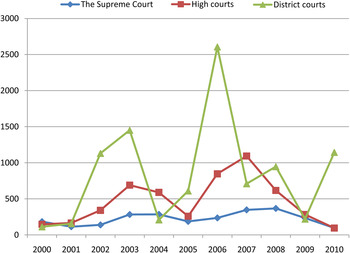
I first present a statistical chart to show trends in trial verdicts from 2000 to 2010, as shown in Figure 1. There are at least two political implications that can be drawn from these outcomes. First, the frequency distributions of vote-buying cases at the three court levels fluctuate over time. The graph of the district courts especially climbed in 2003, 2006, and 2010, because the races for county and city councils and sub-county/city elections were held in 2002, 2005, and 2010. Second, the fluctuation gap from district courts through high courts is approximately one year; hence the verdicts of the high courts increased in 2003 and were at a peak in 2007.
The Frequencies of Vote-buying Cases in Taiwan, 2000–2010

It is worth mentioning that a series of recent events seemingly revealed a reduction in the impact of political factors on vote-buying litigation during the course of Taiwan's democratic transition. Taiwan experienced another turnover of ruling power in 2008 because the KMT won the parliamentary and presidential elections consecutively, and therefore took a step forward in the process of democratic consolidation. In the past two years since the KMT government took office, four victorious KMT candidates (Zhang Shuo-wen 張碩文, Li Yi-ting 李乙廷, Liao Zheng-jing 廖正井, and Jiang Lian-fu 江連福) have been found guilty of vote-buying and lost their positions. In the subsequent by-elections in 2009 and 2010, three of these seats were lost to the DPP and one independent. In a sense, the KMT's defeats were due to public dissatisfaction with the malpractice of vote buying. Therefore, one could argue that the courts are not dominated by the KMT and that political factors have a decreased effect upon verdicts of vote-buying litigation.
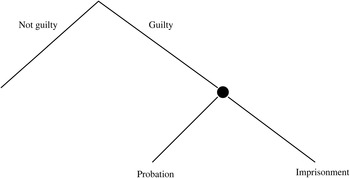
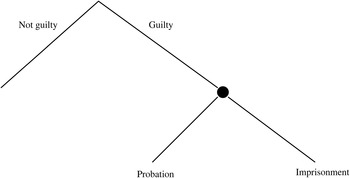
As for the statistical method, this study employs hierarchical logistic models, and the order of analysis is shown in Figure 2.Footnote 17 First, it analyzes whether being a member of the KMT, winning the election, and running in higher level elections have a bearing on the verdict in vote-buying cases with a not guilty decision. Next, it examines whether the above-mentioned political factors affect the awarding of a probationary sentence to guilty defendants.
The Analytical Order of the Hierarchical Logistic Model
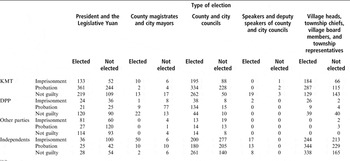
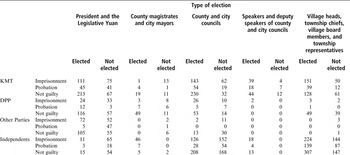
This study first performs a cross-tabulation of the district courts' decisions on vote-buying cases. As shown in Table 1, out of the 7,886 vote-buying cases, 5,309 defendants were found guilty (including probationary and prison sentences), while 2,577 were found not guilty. In sum, the results indicate that KMT and independent candidates were more likely to use vote-buying strategies. In the category of national-election vote-buying case verdicts, there were 1,118 KMT defendants, 713 of whom (63.77%) won elections. Amongst this group, 133 were found guilty and received prison sentences (18.65%), while 361 were found guilty but allowed probation (50.63%). There were 316 DPP defendants, 165 of whom (52.22%) won elections. Among them, 24 were found guilty and received prison sentences (14.55%), while 21 were found guilty but received a reprieve (12.73%), i.e., postponement of punishment, and 120 were found not guilty (72.73%).
The District Courts' Decisions in Vote-buying Cases

Unit:
Defendant
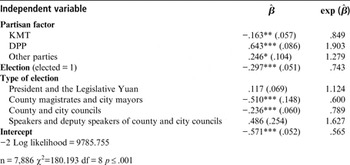
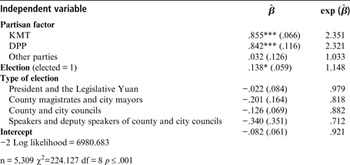
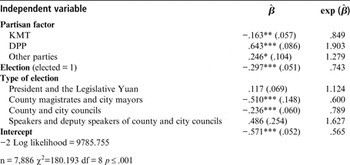
Table 2 illustrates the analyses for district courts' not guilty verdicts, which yield some interesting but unanticipated findings. The data show that in vote-buying trials with KMT defendants, the local courts were less likely to reach not guilty verdicts. Somewhat surprisingly, the evidence reveals that, compared to nonpartisan candidates, DPP and other parties' members tended to receive not guilty decisions more often. More specifically, on average, the odds of a DPP or other candidate receiving a not guilty verdict were about 1.903 and 1.279 times that of an independent defendant, ceteris paribus. Contrary to expectations, the variable of winning the election exerted an important but unpredicted influence on the dependent variable. As for the level of election, only two of the four coefficients (the elections to county magistrates and city mayors, and county and city councils) reach negative and statistical significance, and it runs in a direction opposite the one expected.
Logit Estimates for the District Courts' Not Guilty Decisions in Vote-buying Cases
Note:
Estimated robust standard errors are shown in parentheses.
*p ≤ .05; **p ≤ .01; ***p ≤ .001.
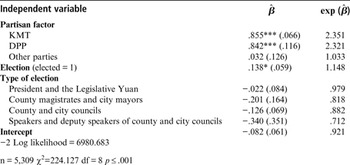
The estimations reported in Table 3 indicate the analyses for district courts' probationary verdicts. The findings demonstrate that both KMT and DPP partisanships are positive and statistically significant determinants of the probation decisions on vote-buying cases; that is, KMT and DPP defendants are more likely to receive probationary sentences than nonpartisan candidates. This is in line with Hypothesis 1. The results also reveal that the factor of winning the election has a significant correlation with the courts' decisions in the anticipated direction. As remarked in Hypothesis 2, other things being equal, if the defendant is elected, he or she is more likely to be placed on probation. As for the type of elections, none of them emerge as statistically significant, which implies that these independent variables have little impact on probationary verdicts of district courts.
Logit Estimates for the District Courts' Probation Decisions in Vote-buying Cases
Note:
Estimated robust standard errors are shown in parentheses.
*p ≤ .05; **p ≤ .01; ***p ≤ .001.
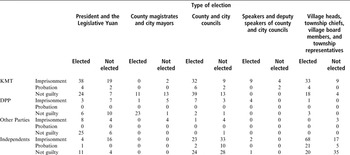
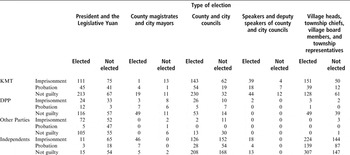
In addition to district courts' verdicts, this study further examines whether there is any difference in the vote-buying case judgments between the high courts and the Supreme Court. Table 4 presents the results of the vote-buying cases for the higher courts. Out of 4,696 cases, 2,362 defendants were found guilty (including probationary and prison sentences), while 2,334 were found not guilty. In the national-election vote-buying case decisions, there were 552 KMT defendants, 369 of whom were elected (66.85%). Amongst this group, 111 were found guilty and received prison sentences (30.08%), while 45 were found guilty but received reprieves (12.20%); 213 were found not guilty (57.72%). There were a total of 245 DPP candidates, 336 members of other parties, and 166 nonpartisan candidates. Among the DPP's candidates, 72 were found guilty and received prison sentences (29.39%), while 12 were found guilty but granted probation (4.9%), and 116 were found not guilty (47.35%).
The High Courts' Decisions in Vote-buying Cases
Unit:
Defendant
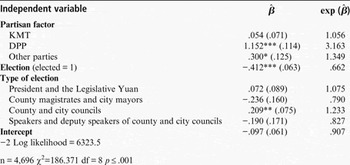
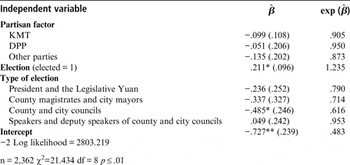
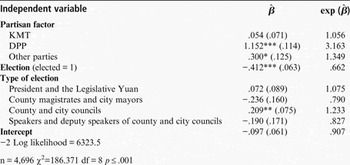
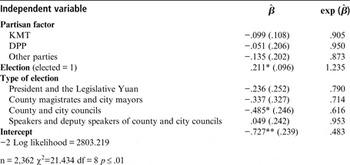
Tables 5 and 6 display the estimates for the hierarchical logistic coefficients for the higher courts' not guilty and probation verdicts. As shown in Table 5, compared to nonpartisan defendants, KMT candidates have no significant differences in not guilty sentences; contrarily, both DPP and other parties' candidates were more likely to receive not guilty decisions. Contrary to expectations, the variable of winning the election has a significant but unexpected influence on the dependent variable. As for the level of elections, only candidates running for county and city councils were more likely to reach not guilty verdicts, while the other independent variables have little influence on not guilty decisions. Table 6 shows analyses of whether the defendants found guilty would receive probationary sentences from the high courts. The data demonstrate that none of the partisan factors have a significant impact on the dependent variable. As hypothesized, winning the election emerges as statistically significant and in the anticipated direction; it means that elected defendants are more likely than losing ones to receive reprieves, all other things being equal.
Logit Estimates for the High Courts' Not Guilty Decisions in Vote-buying Cases
Note:
Estimated robust standard errors are shown in parentheses.
*p ≤ .05; **p ≤ .01; ***p ≤ .001.
Logit Estimates for the High Courts' Probation Decisions in Vote-buying Cases
Note:
Estimated robust standard errors are shown in parentheses.
*p ≤ .05; **p ≤ .01; ***p ≤ .001.
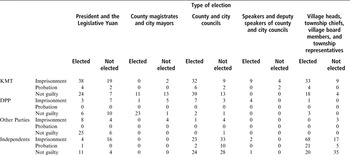
Table 7 shows the cross-tabulation for vote-buying cases in the Supreme Court. Out of 762 defendants, 330 were found not guilty, 373 received prison sentences, and only 59 were found guilty but were placed on probation. In the national-election vote-buying trials, there were 94 KMT defendants and most of them were elected, 26 DPP, 43 from other parties, and 36 independents. Among the KMT, 57 were found guilty and received prison sentences, while six were found guilty but granted reprieves.
The Supreme Court's Decisions in Vote-buying Cases
Unit:
Defendant
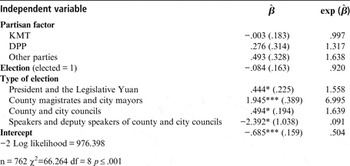
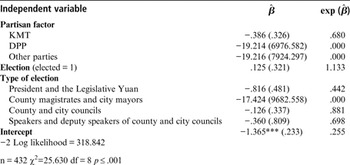
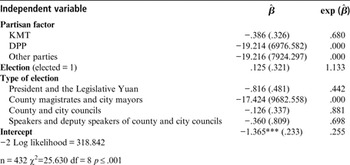
Tables 8 and 9 present the analyses of the Supreme Court's not guilty and probation verdicts. An examination of the results shows that the coefficients for the political factors are consistently weak and not statistically significant. The data indicate that there is no significant relationship between whether candidates are elected or not and whether they receive not guilty verdicts or probationary sentences. In the same vein, there is little difference in the probability of partisan defendants receiving probationary sentences. The findings demonstrate that only the variables of the types of election keep a conditional connection with vote-buying decisions.
Logit Estimates for the Supreme Court's Not Guilty Decisions in Vote-buying Cases

Note:
Estimated robust standard errors are shown in parentheses.
*p ≤ .05; **p ≤ .01; ***p ≤ .001.
Logit Estimates for the Supreme Court's Probation Decisions in Vote-buying Cases
Note:
Estimated robust standard errors are shown in parentheses.
*p ≤ .05; **p ≤ .01; ***p ≤ .001.
This section summarizes the major findings of this study. First, the hypothesis that KMT defendants have a political advantage in judicial verdicts is not absolutely supported. The findings reveal that KMT partisanship has a limited effect on vote-buying trials; that is, KMT defendants are just barely more likely to receive probationary verdicts at the local-level courts. In other words, the common impression that KMT members have an advantage in judicial verdicts needs to be reevaluated. Second, whether or not a litigant wins an election has no consistent influence on the courts' decisions. The popular saying that “those elected will be let off, but those losing elections will be imprisoned” has no basis when viewed in the light of the judicial verdicts. Third, this study also finds no strong support for the belief that the “higher the level of election, the greater the level of political influence on judicial verdicts.” Last but not least, many people have the stereotype that in vote-buying cases, the level of political influence on the court's verdict rises with each trial. However, this assumption does not tally with the data. Taken as a whole, the empirical results demonstrate that the effects of political variables exert considerably less influence than expected on vote-buying case verdicts.
Conclusion
Although the judiciary is an important part of the political process, it has received relatively little attention other than in some Western countries. As Alexis de Tocqueville observed in 1835: “Scarcely any political question arises in the United States which is not resolved, sooner or later, into a judicial question;” and, “[h]e hears the authority of a judge invoked in the political occurrences of every day, and…the judges are important political functionaries.”Footnote 18 Viewed from a comparative perspective, Tocqueville's descriptions are even more applicable today because they highlight the role that the judicial system plays in any given newly democratized regime.Footnote 19 This study is concerned with whether or not Taiwanese courts' decisions on vote-buying litigation are affected by political influences.
The widespread phenomenon of vote buying is a major problem for Taiwan's electoral politics. The damage to Taiwan's democracy caused by vote buying has long been noted. A number of popular sayings about the judiciary reflect this negative public impression of vote-buying cases, for example: “the courts are dominated by the Kuomintang;” “those elected will be let off, but those losing the elections will be imprisoned;” “those with good social connections won't have any problem, but those without connections will have big trouble;” and, “at the first trial a heavy sentence is passed, at the second the sentence is halved, and at the third the case is quashed.” The analysis presented in this paper, on court decisions on three judicial tiers for vote-buying litigation between 2000 and 2010, examined whether the judicial trials on vote-buying cases were influenced by political factors, and the degree of influence. The data illustrate that there is not necessarily a causal relationship between court verdicts and partisan effects, whether the defendant wins the election or not, the type of election (for tapping sociopolitical connections), or the level of the court. In sum, it appears that there is a gap between court verdicts in vote-buying cases and the way they are popularly perceived.
This study merely examines one aspect of the judicial system in Taiwan, that is, the impact of political variables on court decisions for vote-buying litigation. Here the findings are not conclusive and further research is needed. In the past two decades, the judiciary has been much improved in terms of independence and fairness, but it still leaves much to be desired. Other questions and issues closely related to the judiciary should be paid further attention, for instance, the transparency and accountability of the judicial system, the discrepancy between court decisions and social desirability, developing a set of measurement criteria to assess the public evaluation of judicial performance, reforming legal education, and evaluating the young judges who are appointed straight out of law school and take the bench without the maturity or sociopolitical experience to deal with complicated cases.
Methodologically speaking, there are at least four areas that can be strengthened in future research projects. First, the major limitation of this study is that the data set is limited to 2000–2010. Future work should extend the time period; this would allow comparison of judicial verdicts in vote-buying trials in different time frames. To that extent, future analysis could use the number of times (including even before 2000) that the defendant won an election as a measure of the defendant's political influence. This is based on the assumption that the more frequently a defendant is elected, the more influence the defendant possesses, and the more likely it is that the defendant can affect the court decision. Second, it is feasible to employ a similar research framework for other judicial issues that are politically contentious or controversial, for example, trial verdicts in campaigns of calumny. Third, some qualitative approaches, for instance, participation observation and intensive interviews, are needed in order to probe the causes and consequences of vote-buying litigation. Last but not least, although this study uses data on vote-buying cases only from Taiwan, attempts could be made to apply this research to other Asian countries, especially village elections and vote buying in China, even to the extent of making cross-national comparisons. Clearly there is still much potential for future research in this field.